
 Entrepreneurship and resilience: a systematic literature review
ABSTRACT
Purpose Identifying what the recent literature reveals about the characteristics of resilient behavior manifested by self-employed entrepreneurs in contexts of uncertainty.
Design/methodology/approach A Systematic Literature Review (SLR) was conducted based on the PRISMA-ScR protocol, using articles published between 2020 and 2025 from the Scopus and Web of Science databases. After applying filters, removing duplicates, and screening, 49 studies were qualitatively analyzed and organized into thematic clusters using Vosviewer software.
Findings Four dimensions of resilient behavior were identified: (1) intrapersonal resilience, related to emotions, attitudes, and beliefs; (2) strategies and proactiveness, associated with anticipating action and innovation; (3) coping with extreme adversities, such as the COVID-19 pandemic; and (4) connections, involving support networks and the use of technologies. The most recurrent characteristics include self-control, persistence, adaptability, positive attitude, faith, optimism, and seeking support, manifested in a combined and contextual manner.
Research limitations/implications Scarcity of studies dedicated exclusively to self-employed entrepreneurs, suggesting the need for further qualitative research.
Practical implications The findings can guide public policies and training programs that, in addition to technical skills, also foster socio-emotional and adaptive abilities.
Social implications By highlighting the importance of resilience, the study contributes to initiatives that support the sustainability of self-employed businesses, strengthening their economic and social role.
Originality/value Systematizes recent evidence on entrepreneurial resilience, detailing dimensions and strategies, and emphasizing the relevance of emotional and contextual aspects for survival and growth in uncertain environments.
Keywords
Entrepreneurship; Resilience; Resilient behavior; Self-employment
RESUMO
Objetivo Identificar o que a literatura recente revela sobre as características do comportamento resiliente manifestadas por empreendedores que atuam por conta própria em contextos de incerteza.
Desenho/metodologia/abordagem Realizou-se uma Revisão Sistemática da Literatura (RSL) com base no protocolo PRISMA-ScR, a partir de artigos publicados entre 2020 e 2025 nas bases Scopus e Web of Science. Após filtros, remoção de duplicatas e triagem, 49 estudos foram analisados qualitativamente e organizados em clusters temáticos no software Vosviewer.
Resultados Identificaram-se quatro dimensões do comportamento resiliente: (1) resiliência intrapessoal, ligada a emoções, atitudes e crenças; (2) estratégias e pró-atividade, associadas à ação antecipada e inovação; (3) enfrentamento de adversidades extremas, como a pandemia de COVID-19; e (4) conexões, envolvendo redes de apoio e uso de tecnologias. As características mais recorrentes incluem autocontrole, persistência, adaptabilidade, atitude positiva, fé, otimismo e busca por apoio, manifestando-se de forma combinada e contextual.
Limitações/implicações da pesquisa Escassez de estudos dedicados exclusivamente a empreendedores por conta própria, sugerindo necessidade de aprofundamento qualitativo.
Implicações práticas Os achados podem orientar políticas públicas e programas de capacitação que contemplem, além de competências técnicas, habilidades socioemocionais e adaptativas.
Implicações sociais Ao evidenciar a importância da resiliência, o estudo contribui para ações que sustentem negócios autônomos, fortalecendo seu papel econômico e social.
Originalidade/valor Sistematiza evidências recentes sobre resiliência empreendedora, detalhando dimensões e estratégias, e destacando a relevância de aspectos emocionais e contextuais para sobrevivência e crescimento em ambientes incertos.
Palavras-chave
Empreendedorismo; Resiliência; Comportamento resiliente; Trabalho por conta própria
1 INTRODUCTION
Entrepreneurship has been identified as an important element for economic and social development, as it generates jobs, stimulates innovation, and contributes to increased productivity (Gobatti Calça, Alves Maciel & Cerqueira Adão,2022; Maczulskij & Viinikainen, 2023). In recent years, the number of self-employed workers has grown, making this group one of the focal points of public policies aimed at the labor market (Cieślik, Nolan, O’Hagan-Luff & van Stel, 2023). In the global context, self-employment represents about 46.6% of all workers in informal employment, highlighting its relevance and annual growth in several economies (OIT, 2023). Although not all move on to hiring employees, even the decision to employ one person could positively impact unemployment rates (Cieślik et al., 2023). However, this step brings challenges and costs, leading many self-employed workers to continue working alone throughout their careers. Their experiences, goals, and difficulties tend to differ from those of entrepreneurs who already employ others, reinforcing the need to study them as a specific group (Cieślik et al., 2023).
In unstable and unpredictable scenarios, it is common for these professionals to face greater pressures, which demand more than technical skills. Their personal characteristics directly influence their decisions and their ability to move forward with their businesses (Zayadin, Zucchella, Anand, Jones & Ameen, 2023). This occurs because, instead of planning, they often need to adapt, using what they have at hand to create opportunities (Sarasvathy, 2001). Facing uncertain and varied outcomes and overcoming these obstacles, as experienced by self-employed entrepreneurs, is recognized as resilience (Conduah & Essiaw, 2022).
Resilience is present in the trajectory of many entrepreneurs, especially those facing financial difficulties, political instability, or lack of institutional support (Zayadin et al., 2023). It refers to the ability to adapt, reorganize strategies, and continue even after failures or frustrations (Slusarczyk, Moghavvemi & Tehseen, 2023). When combined with other elements such as hope, optimism, and self-efficacy, resilience forms the so-called psychological capital, which contributes to reducing stress and fostering a more proactive stance in the face of challenges (Zayadin et al., 2023). Entrepreneurs who demonstrate this set of characteristics tend to seek alternative paths and continue operating even in adverse situations (Samat et al., 2023).
Despite the relevance of these two traits, entrepreneurship and resilience, little is known about how they relate in the context of self-employment and what the main characteristics of resilient behavior are. This theoretical gap matters not only because of the scarcity of studies, but also due to the need to understand the mechanisms that enable survival and adaptation among those who undertake autonomously in uncertain environments. Investigating this phenomenon helps deepen the debate on entrepreneurial behavior in uncertain contexts, showing how psychological and social factors influence the capacity to keep a business operating. In addition, it offers theoretical and practical inputs for public policies and support programs aimed at strengthening the resilience and sustainability of such ventures.
Accordingly, the research question guiding this study is: what does the recent literature reveal about the characteristics of resilient behavior manifested by self-employed entrepreneurs in contexts of uncertainty? By mapping what has already been investigated, this study seeks to identify those characteristics.
2 THEORETICAL FRAMEWORK
The sections of the theoretical framework were organized as follows: The first corresponds to this section on Entrepreneurship, followed by Self-employment, then Resilience, and concluding with the presentation of the Relationship between resilience and entrepreneurship.
Entrepreneurship
Entrepreneurship is recognized as a force that drives economic growth, job creation, and innovation, involving the mobilization of personal skills and judgment in the face of uncertain scenarios (Relente & Capistrano, 2025). Beyond creating businesses, the entrepreneur acts under conditions of risk, applying practical knowledge and an action-oriented mindset (Caputo, Nguyen & Delladio, 2025). This ability to decide and adapt in contexts of instability is connected to resilience, as it requires individuals to be willing to face external pressures, learn from experience, and sustain their business over time (Moxoto, Soukiazis & Melo, 2025).
Self-Employment
Self-employment can be understood as the practice of starting and running a business independently, usually without formal employment ties. This form of activity is related to entrepreneurial intention, which reflects an individual’s willingness and desire to take responsibility for a productive activity with autonomy and decision-making freedom (Tripopsakul, 2025). Studies analyzing profiles of entrepreneurial intention identify sociocultural differences that affect individuals’ behavior when choosing entrepreneurship. These distinctions help to understand that not all self-employed entrepreneurs share the same motivations or structural conditions to start and sustain a business (Tripopsakul, 2025).
Although self-employment represents independence and flexibility, it is often associated with high risks and the need to develop multiple skills. Characteristics such as the ability to deal with uncertainties, learn from experiences, and adapt strategies are important for facing the challenges of instability and informality (Caputo et al., 2025).
Despite the obstacles faced, self-employed entrepreneurs contribute significantly to the labor market by diversifying forms of occupation, generating income, and promoting innovative solutions in different social contexts. Perceived self-efficacy is one of the factors driving this contribution, as it influences engagement and resilience in the face of difficulties (Relente & Capistrano, 2025).
It is important to note that formal entrepreneurship is different from self-employment, as while the entrepreneur faces challenges related to management and growth, the self-employed deal with instability, low income, and lack of support (Bögenhold & Klinglmair, 2016).
Resilience
Resilience is understood as the individual’s ability to face and adapt to adverse situations while maintaining or recovering emotional and functional balance. In the context of entrepreneurship, this characteristic has been studied as an important factor when dealing with the uncertainties and recurring failures of entrepreneurial activity (Guerrero & Walsh, 2024).
Resilience is part of psychological capital alongside hope, optimism, and self-efficacy, forming a set of factors that strengthen the entrepreneurial stance in the face of difficulties. This set has been associated with increased motivation and the ability to maintain focus even in adverse contexts (Jalil, Ali, & Kamarulzaman, 2023).
Within the concept of entrepreneurship, resilience manifests as an integrated set of emotional, cognitive, and behavioral resources that enable individuals to face, adapt to, and learn from adverse situations (Jalil et al., 2023). These elements include emotional regulation, understood as the capacity to maintain balance and control impulses under pressure; self-efficacy and confidence, understood as the belief in one’s ability to act and overcome challenges; cognitive flexibility, seen as the ability to reinterpret events and reformulate strategies; and proactive action, understood as the willingness to act even under uncertainty (Kasseeah, 2023). In many cases, social and spiritual dimensions are also present, such as interpersonal support, faith, and optimism, which strengthen ongoing coping (Nguyen et al., 2025). Thus, entrepreneurial resilience can be understood as a dynamic process of adjustment and overcoming that combines internal attitudes and external resources in the pursuit of sustainability and purpose in business (Guerrero & Walsh, 2024).
Relationships between Entrepreneurship and Resilience
The relationship between entrepreneurship and resilience is important because resilience, which involves qualities such as determination, optimism, and confidence, helps entrepreneurs face challenges and overcome unexpected obstacles. It serves as the foundation that enables adaptation for both the entrepreneur and the business in difficult times, being significant for success and growth in uncertain environments (Conduah & Essiaw, 2022).
Furthermore, resilience manifests at various levels, from the personal qualities of entrepreneurs to the capabilities of the business, such as innovation and flexibility. It is relevant not only for the creation and strengthening of the business in times of crisis but also for aiding recovery after failures. This process contributes to the economic recovery of a region and to the sustainable development of society, highlighting the importance of support and policies that encourage this quality to deal with market uncertainty (Conduah & Essiaw, 2022).
Some critical approaches warn that the discourse on entrepreneurial resilience tends to overvalue its positive effects, obscuring the structural factors that produce vulnerabilities for self-employed workers. In this view, resilience can be seen as an individual response to the demands of a system that pressures entrepreneurs to absorb risks and accept precarious conditions. This perspective advances the debate by suggesting that, beyond behavioral characteristics, we should also consider the social and economic inequalities of the entrepreneurial context (Ferraz, 2021).
3 METHODOLOGICAL PROCEDURES
This research was conducted through a Systematic Literature Review (SLR), with the aim of identifying what the recent literature reveals about the characteristics of resilient behavior manifested by self-employed entrepreneurs in contexts of uncertainty. It was developed based on the PRISMA-ScR (Preferred Reporting Items for Systematic Reviews and Meta-Analyses – Scoping Review) model, as proposed by Tricco et al. (2018). The choice of this protocol is justified by the exploratory nature of this study, which seeks to map how the concepts of entrepreneurship and resilience have been addressed in the context of self-employment, especially in scenarios of uncertainty.
Unlike a narrative review, the SLR follows rigorous protocols that reduce researcher bias and ensure greater reliability in the selection and analysis of studies (Tricco et al., 2018). The SLR carried out followed a protocol consisting of six main stages: (1) definition of the research objectives; (2) identification of relevant studies; (3) data extraction; (4) quality assessment of the studies; (5) synthesis of evidence; and (6) interpretation of results, as indicated by Tricco et al. (2018). The selected databases were Scopus and Web of Science (WoS), as they are recognized for the quality of their journals and their relevance to studies in the field of entrepreneurship. Filters were applied to limit the results to scientific articles published in peer-reviewed journals, excluding theses, books, conference papers, and technical documents. In addition, articles from the health and education fields were excluded, as they did not align with the scope of this research. The review included studies that were relevant to articles published between 2020 and 2025, research addressing the entrepreneurial context with an emphasis on self-employed workers or other terms with the same meaning, and articles addressing resilience.
The initial results totaled 3,293 articles in Web of Science and 4,098 articles in Scopus. The same search terms and filters were used in both databases. The filter for the years 2020 to 2025 was applied because, as this is a topic that evolves constantly, it was important to include the most recent scientific articles. The filters for administration and business, the field in which entrepreneurship is classified, and for the English and Portuguese languages were also applied. After applying the filters, the search returned a total of 962 relevant articles in Web of Science, and using the same search criteria and filters, 994 articles in Scopus.
Thus, a total of 1,956 articles were selected, combining the two databases. In this context, the online analysis platform Rayyan was used to merge the two databases and subsequently remove duplicate articles or those that could not be retrieved. This made it possible to compile a total of 1,361 articles. Using Rayyan, screening was then carried out based on the analysis of titles and abstracts to eliminate irrelevant articles for this research. Subsequently, eligibility criteria were applied to the set of articles, allowing for exclusion or inclusion according to the main question of the SLR.
After the initial screening, the 49 selected articles were analyzed for adherence to the research question. Studies were excluded that, although addressing the theme of resilience, dealt with corporate, educational, health, or public policy contexts without a direct relationship to self-employment. Articles that presented quantitative models without a behavioral discussion were also disregarded. Thus, a final set of 18 studies was retained, whose contents were aligned with the objective of identifying characteristics of resilient behavior among entrepreneurs who work on their own. The procedure is illustrated in Figure 1.

4 ANALYSIS AND DISCUSSION
The preliminary analysis of the 49 selected articles indicates that the concept of resilience, often associated with overcoming challenges, appears recurrently as a characteristic of resilient behavior among entrepreneurs in different contexts, especially in situations of uncertainty. The term self-employment appears in different forms but always with the same context, reinforcing the relevance of the chosen scope. The articles suggest that contexts of uncertainty, such as economic crises, institutional instability, or technological changes, are frequently mentioned. These patterns in the literature highlight the importance of resilience in facing challenges by self-employed entrepreneurs.
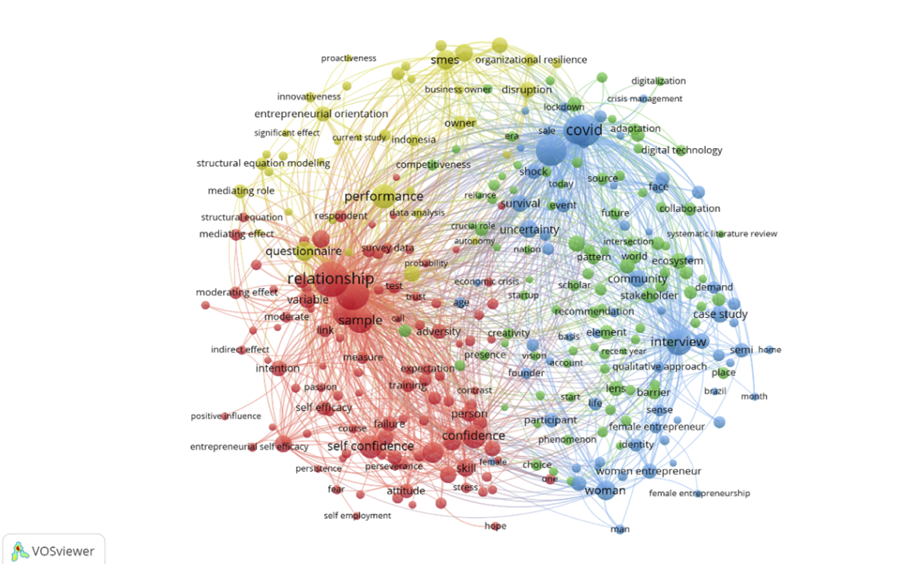
From the visualization in Figure 2, four major thematic clusters were identified, which help to understand the dimensions of resilient behavior among self-employed entrepreneurs in contexts of uncertainty. Each cluster reveals aspects that contribute to building resilience in the entrepreneurial profile.

The first cluster focuses on intrapersonal resilience and shows how resilient behavior begins within the entrepreneur themselves. It highlights the emotions, attitudes, and beliefs that help the self-employed worker to keep going, even when everything seems difficult. This group helps to understand that, for the self-employed, being resilient also means believing in oneself and maintaining emotional balance to avoid giving up in the face of uncertainty.
The second cluster focuses on strategies and proactivity, presenting an action-oriented perspective. It shows that many self-employed entrepreneurs face uncertainty by remaining proactive, seeking innovation, and making confident decisions even without guarantees that everything will work out. Instead of only reacting to problems, they try to anticipate them, find new opportunities, and stay focused on business performance. This attitude demonstrates that resilient behavior also emerges when the entrepreneur chooses to act with courage, even when facing difficulties, believing that movement is better than inaction.
The third cluster focuses on extreme adversity and shows how self-employed entrepreneurs dealt with extreme situations, such as the COVID-19 pandemic. This moment brought a shock and forced many people to adapt overnight in an attempt to keep their businesses alive. It was then that resilience emerged strongly, in the form of rapid adaptation, creativity, and strategic changes. For those who are self-employed, survival depends heavily on agility and the ability to respond, even without knowing exactly what will happen. This group helps to understand how resilience is practical: it appears when the entrepreneur finds a way to keep going, even when everything changes suddenly.
The fourth and final cluster focuses on connections and shows how the surrounding environment influences the resilient behavior of self-employed entrepreneurs. This includes connections with other people, the use of technology, and participation in networks or communities. Being open to collaboration, seeking support in difficult times, and learning to use digital tools are forms of adaptation that strengthen resilience. This group shows that being resilient is not only an individual matter but also involves knowing how to navigate the context, connect with what is around, and take advantage of opportunities to grow in times of uncertainty.
Based on the analysis of the 18 selected articles, Table 1 was prepared to synthesize the main characteristics of resilient behavior identified in self-employed entrepreneurs.
The analysis of the clusters made it possible to visualize different aspects of resilient behavior in entrepreneurs who work on their own. These groupings show that resilience does not manifest in isolation but rather through dimensions connected to the emotional, strategic, adaptive, and social context of the entrepreneur (Yana Mbena & Yeboah, 2024).
It can be observed that certain behaviors are repeated in different contexts, indicating that entrepreneurial resilience goes beyond isolated responses and is built through continuous coping strategies. Emotional self-regulation emerges as an important foundation for dealing with uncertainty, being consistently activated in situations of pressure or instability (Nguyen et al., 2025; Kiptoo et al., 2024). At the same time, aspects such as adaptation, creativity, and seeking support reveal that entrepreneurs working on their own build resilience by combining individual factors with resources available in their environment (Makandwa & de Klerk, 2023).
The characteristics of resilient behavior observed in self-employed entrepreneurs reveal a set of attitudes, perceptions, and responses that combine over time. These characteristics do not form a fixed pattern; they manifest in ways that vary according to individual experience, available resources, and the type of adversity faced (Vale et al., 2021). In this context, business continuity depends not only on an internal disposition but also on the ability to interpret uncertain scenarios, maintain external connections, and adapt to changes through actions consistent with the lived reality (Fouriea et al., 2023).
The identification of different characteristics of resilient behavior broadens the theoretical understanding of how self-employed entrepreneurs face adverse scenarios. Literature often addresses resilience as a generic quality, but the data from this review show that it manifests through specific behaviors, such as emotional regulation, seeking support, reconfiguring the business, and using proactive strategies (Kasseeah, 2023). These elements help build a more detailed view of the adaptation process, especially in contexts of high instability, such as economic crises or pandemics (Baldacchino, 2025).
Evidence reinforces that resilient behavior is not static but is continuously built in response to the environment. This creates room for new theoretical models to consider the challenges of self-employment, which involves greater risks, less protection, and constant decision-making under conditions of uncertainty (Mramba, 2024). This study shows that resilience can be understood as a set of skills that interact with each other and are shaped by entrepreneurial experience (Vale et al., 2021).
The results point to important paths for possible support and training actions aimed at self-employed entrepreneurs. Knowing that behaviors such as planning, initiative, and emotional control make a difference in maintaining the business can guide the creation of programs that strengthen these skills from the start of the entrepreneurial journey (Kiptoo et al., 2024). Recognizing the importance of factors such as faith, optimism, and support networks broadens the perspective on the reality of those who undertake without formal structure (Kasseeah, 2023).
In the context of public policies, the evidence suggests that initiatives aimed at entrepreneurship should not be limited to providing credit or technical training. It is necessary to develop more comprehensive strategies that include emotional support, encouragement of mutual collaboration, and promotion of the use of technologies as a form of adaptation (Baldacchino, 2025). By understanding the various dimensions of resilient behavior, practical actions can be more effective and better adjusted to the reality of self-employed workers (Yana Mbena & Yeboah, 2024).
It was observed that the studies analyzed were published predominantly in English, with a prevalence of journals based in European and African countries. This geographical distribution reflects the expansion of the resilience debate beyond traditional research contexts, incorporating distinct cultural and socioeconomic realities.
5 FINAL REMARKS
The analysis conducted in this review allowed for an understanding that the resilient behavior of self-employed entrepreneurs is composed of several characteristics that go beyond emotional endurance. Elements such as self-control, persistence, positive attitude, faith, motivation, and adaptive strategies are shown to be important for business continuity in contexts of uncertainty (Kiptoo et al., 2024). These behaviors appear in different combinations and are shaped by life experience, culture, and the structural conditions of each entrepreneur (Fourie et al., 2023).
The results of this review indicate that public policies and training programs aimed at self-employed entrepreneurs should integrate, in a balanced way, technical skills and socioemotional abilities. This means that support initiatives should include, in addition to training in management, finance, and innovation, the development of capacities such as self-control, persistence, adaptability, and the strategic use of support networks. By promoting these skills from the early stages of the entrepreneurial journey, it is possible to increase the likelihood of business survival and growth in contexts of high uncertainty.
Strengthening resilience among self-employed entrepreneurs contributes directly to maintaining economic activities in vulnerable communities, especially during periods of economic crisis, political instability, or accelerated technological change. By recognizing and supporting the importance of factors such as faith, optimism, positive attitude, and collaborative bonds, policies and social actions can generate a positive impact not only on the individual performance of the entrepreneur but also on social cohesion and local economic development, expanding the collective capacity to face adversities.
An important limitation of this review lies in the scarcity of studies focused exclusively on self-employed entrepreneurs. Although the selected articles meet this criterion, it was evident that there is difficulty in finding works with this specific scope, since much of the academic production still addresses entrepreneurship broadly, with a predominant focus on small and medium-sized enterprises. Variation in theoretical approaches to resilience was also observed, sometimes described as an individual trait, sometimes as a process or outcome, which makes precise comparisons between studies more difficult.
For future research, it is suggested to qualitatively deepen the resilient behavior characteristics identified in this review, exploring gender perspectives to enrich this understanding, as women entrepreneurs often face different obstacles that directly influence the strategies adopted to deal with adversity.
REFERENCES
-
Aránega, A. Y., Montesinos, C. G., Urueña, R. C., & Sánchez, R. C. (2025). Digitalization intention in entrepreneurs and SMEs: a structural equation model of digital behavior and work-life balance. International Entrepreneurship and Management Journal, 21(1),24. doi.org/10.1007/s11365-024-01049-2
» https://doi.org/10.1007/s11365-024-01049-2 -
Badzaban, F., Rezaei-Moghaddam, K., & Fatemi, M. (2021). Analysing the individual entrepreneurial resilience of rural women. Journal of Global Entrepreneurship Research,11(1), 241-254. doi.org/10.1007/s40497-021-00290-1
» https://doi.org/10.1007/s40497-021-00290-1 - Baldacchino, L., & Sassetti, S. (2025). The effects of coping strategies on entrepreneurs' psychological well-being under uncertainty. Strategic Change, 34(2), 253-265. doi.org/10.1002/jsc.2613
- Battisti, M., Gish, J. J., Hatak, I., & Zhou, H. (2025). Establishing a recovery menu to increase the resilience of entrepreneurs. British Journal of Management, 36(1), 56-72. doi.org/10.1111/1467-8551.12827
- Block, J. H., Diegel, W., & Fisch, C. (2024). How venture capital funding changes an entrepreneur's digital identity: more self-confidence and professionalism but less authenticity! Review of managerial science, 18*(8), 2287-2319. doi.org/10.1007/s11846-023-00686-1
- Bögenhold, D., & Klinglmair, A. (2016). Entrepreneurship and hybrid self-employment. In Contemporary Entrepreneurship: Multidisciplinary Perspectives on Innovation and Growth, 127-140.
- Caliendo, M., Graeber, D., Kritikos, A. S., & Seebauer, J. (2023). Pandemic depression: Covid-19 and the mental health of the self-employed. Entrepreneurship theory and practice, 47(3), 788-830. doi.org/10.1177/10422587221102106
-
Gobatti Calça, K., Alves Maciel, M. D., & Cerqueira Adão, S. A. D. R. (2022). Unemployment and entrepreneurship in the Covid-19 pandemic and its effects on Brazilian society. Brazilian Journal of Management/Revista de Administração da UFSM, 15. doi.org/10.5902/1983465969297
» https://doi.org/10.5902/1983465969297 - Caputo, A., Nguyen, V. H. A., & Delladio, S. (2025). Risk-taking, knowledge, and mindset: unpacking the antecedents of entrepreneurial intention. International Entrepreneurship and Management Journal, 21*(1), 1-29. doi.org/10.1007/s11365-024-01064-3
- Cieslik, J., Nolan, E., O'Hagan-Luff, M., & van Stel, A. (2023). Overconfidence among solo entrepreneurs: the role of national culture. Journal of Small Business and Enterprise Development, 30*(4), 667-691. doi.org/10.1108/JSBED-08-2022-0361
-
Conduah, A. K., & Essiaw, M. N. (2022). Resilience and entrepreneurship: a systematic review. F1000Research, 11, 579. doi.org/10.12688/f1000research.75473.1
» doi.org/10.12688/f1000research.75473.1 - de Araujo Moxoto, A. C., Soukiazis, E., & Melo, P. (2025). Determinants of success in initial coin offerings (ICOs): A systematic literature review. Digital Business, 5(2), 100123. doi.org/10.1016/j.digbus.2025.100123
- de Moura Ferraz, J. (2021). Para além da prática empreendedora no capitalismo brasileiro. Actual.
- do Vale, A. F. N., de Sousa, J. C., De Oliveira, A. M. B., da Costa Regis, S. V., & de Lima, J. S. S. (2021). O impacto da Covid-19 mediado pela resiliência humana em microempreendedores do ramo da Beleza. Revista Gestão Organizacional, 14(1), 212-230. doi.org/10.22277/rgo.v14i1
-
Duong, L. (2025). Start with a bold statement: gendered displays of confidence in entrepreneurial pitching. Entrepreneurship & Regional Development ,18(1). doi.org/10.1080/08985626.2024.2448665
» 10.1080/08985626.2024.2448665 -
Fourie, A., Saayman, A., & Blaauw, D. (2023). Investigating the resilience and challenges of informal street traders in south africa's tourism sector: a focus on migrant entrepreneurship. Current Issues in Tourism, 16(1). doi.org/10.1080/13683500.2024.2428766
» doi.org/10.1080/13683500.2024.2428766 -
Guerrero, M., & Walsh, G. S. (2024). How do entrepreneurs build a resilient and persistent identity? Re-examining the financial crisis impact. *International Entrepreneurship and Management Journal, 20(3), 1963-1997. doi.org/10.1007/s11365-023-00902-0
» https://doi.org/10.1007/s11365-023-00902-0 -
International Labour Organization. (2023). World employment and social outlook: Trends 2023. International Labour Office. https://www.ilo.org/global/research/global-reports/weso/trends2023
» https://www.ilo.org/global/research/global-reports/weso/trends2023 - Jalil, M. F., Ali, A., & Kamarulzaman, R. (2023). The influence of psychological capital and social capital on women entrepreneurs' intentions: the mediating role of attitude. Humanities and Social Sciences Communications, 10(1), 1-14. doi.org/10.1057/s41599-023-01908-3
- Kasseeah, H. (2023). The quest for surviving Covid-19: adoption of online technologies by self-employed women in mauritius. Journal of Business and Socio-economic Development, 4 (3), 241-253. doi.org10.1108/JBSED-10-2022-0114
-
Kiptoo, M., Sambajee, P., & Baum, T. (2024). Resilience through adversity: a case of informal artisan entrepreneurs in kenya. International Journal of Entrepreneurial Behavior & Research, 30 (11), 446-465. doi.org10.1108/IJEBR-07-2023-0762
» https://doi.org/10.1108/IJEBR-07-2023-0762 -
Krishnan, S. N., Ganesh, L. S., & Rajendran, C. (2022). The square inch quilting studio: survival strategies for a lifestyle enterprise. The International Journal of Entrepreneurship and Innovation, 23 (2), 99-110. doi.org/10.1177/14657503211044771
» doi.org/10.1177/14657503211044771 -
Maczulskij, T., & Viinikainen, J. (2023). Self-confidence predicts entrepreneurship and entrepreneurial success. Journal of Business Venturing Insights ,19(1). doi.org/10.1016/j.jbvi.2023.e00382
» doi.org/10.1016/j.jbvi.2023.e00382 -
Makandwa, G., & de Klerk, S. (2023). Impact of family moral support on female entrepreneurs involved in craft tourism. Journal of Tourism and Cultural Change, 22 (1), 61-75. doi.org/10.1080/14766825.2023.2248065
» https://doi.org/10.1080/14766825.2023.2248065 - Mramba, N. R. (2024). Exploring work-life balance among women entrepreneurs of food vending business in africa. Review of Business and Economics Studies, 12 (1), 25-36. doi.org10.26794/2308-944X-2024-12-1-25-36
- Nguyen, N. C., Hasnaoui, J. A., Lodorfos, G., Matta, D., & Laine, I. (2025). Resilience, optimism, and entrepreneurial well-being: a review and research agenda. International Journal of Entrepreneurship and Small Business, 55 (6), 20-40. doi.org10.1504/IJESB.2025.10070928
- Olivas, R. I., Urrutia De la Garza, J. A., Solís, F. T., y Mendoza, U. (2025). Liderazgo resiliente en empresas. Revista Venezolana De Gerencia, 30 (110), 942-960. doi.org/10.52080/rvgluz.30
- Padilla-Meléndez, A., Ciruela-Lorenzo, A. M., Del-Aguila-Obra, A. R., & Plaza-Angulo, J. J. (2022). Understanding the entrepreneurial resilience of indigenous women entrepreneurs as a dynamic process. The case of Quechuas in Bolivia. Entrepreneurship & Regional Development, 34 (9-10), 852-867. doi.org/10.1080/08985626.2022.2103744
-
Relente, A. R. R., & Capistrano, E. P. S. (2025). Innovation self-efficacy, theory of planned behavior, and entrepreneurial intentions: the perspective of young filipinos. Asia Pacific Management Review, 30(3), 100-350. doi.org/10.1016/j.apmrv.2024.100350
» https://doi.org/10.1016/j.apmrv.2024.100350 - Samat, M. F., Anual, N., Hussin, S. N. A., & Rahim, H. L. (2023). Factors Influencing Entrepreneurial Propensity Among Urban Poor Family in Malaysia. Review of Integrative Business and Economics Research, 12 (1), 230-246.
- Sarasvathy, S. D. (2001). Causation and effectuation: toward a theoretical shift from economic inevitability to entrepreneurial contingency. Academy of management Review, 26(2), 243-263.
- Sendawula, K., Najjinda, S., Nanyanzi, M., Kimuli, S. N. L., & Walugembe, A. (2024). Personal traits and formalization of entrepreneurial ventures: insights from a developing country. New England Journal of Entrepreneurship, 27(1), 63-88. doi.org10.1108/NEJE-04-2023-0022
- Shet, S. V., Raut, G., Shet, P., Argade, P., & Piekara, A. (2024). From challenges to competencies: informal female entrepreneurship in emerging economies. Journal of Small Business and Enterprise Development. doi.org10.1108/JSBED-03-2024-0146
- Simarasl, N., Tabesh, P., Munyon, T. P., & Marzban, Z. (2024). Unveiled confidence: exploring how institutional support enhances the entrepreneurial self-efficacy and performance of female entrepreneurs in constrained contexts. European management journal, 42(1), 33-45. doi.org/10.1016/j.emj.2022.07.003
-
Slusarczyk, B., Moghavvemi, S., & Tehseen, S. (2023). Women and business: empirical study on economic constraints, legal conditions, and social support influencing women entrepreneurs in malaysia and poland. Entrepreneurial Business and Economics Review, 11(2), 87-102. doi.org/10.15678/EBER.2023.110204
» https://doi.org/10.15678/EBER.2023.110204 - Tricco, A. C., Lillie, E., Zarin, W., O’Brien, K. K., Colquhoun, H., Levac, D., ... & Straus, S. E. (2018). PRISMA extension for scoping reviews (PRISMA-ScR): checklist and explanation. Annals of internal medicine, 169(7), 467-473. doi.org/10.7326/M18-0850
- Tripopsakul, S. (2025). Entrepreneurial Intentions: Analyzing Sociocultural and Perceptual Influences Using the Theory of Planned Behavior. International Review of Management and Marketing, 15(3), 98. doi.org/10.32479/irmm.17947
- Yana Mbena, J., & Yeboah, K. O. (2024). Striving for a life out of shadows: informal entrepreneurial dynamics in time of crisis. Future Business Journal, 10(1), 28. doi.org/10.1186/s43093-024-00316-6
- Zayadin, R., Zucchella, A., Anand, A., Jones, P., & Ameen, N. (2023). Entrepreneurs' decisions in perceived environmental uncertainty. British Journal of Management, 34(2), 831-848. doi.org10.1111/1467-8551.12612
-
Plagiarism Check:
The ReA/UFSM maintains the practice of submitting all documents approved for publication to the plagiarism check, using specific tools, e.g.: Turnitin.
-
Data availability statement:
Data will be available upon request
Edited by
-
Edited by:
Jordana Marques Kneipp
Data will be available upon request

 Source: Adapted by the authors from Tricco (2018).
 Source: Cluster generated by the author using Vosviewer software.