
 Brazilian Agrarian and Development Laws: The Legal Framework of Brazilian Agribusiness and Its Financialization
Abstract
This article aims to define agribusiness, indicate its legal bases and illustrate the financialization trend it is currently undergoing in Brazil. Agribusiness is understood as the integration between agriculture and industry, which results from government actions, among which, the formulation of a legal framework. Agribusiness is becoming increasingly financialized, largely due to the creation of new legal technologies that have been crucial toward enhancing this trend. The question this paper seeks to explore is: what role does Law play in the consolidation of agribusiness and its current state of financialization? Methodologically, we sought to define agribusiness. Subsequently, we contextualized the development of agribusiness in the broader landscape of the social and legal debates that took place in Brazil in the 1960s and 1970s. We then discussed the new legal instruments that have allowed for greater interaction between financial capital and agriculture. Finally, by analyzing data from sources such as the Ministry of Agriculture, Banco do Brasil and the Securities and Exchange Commission, we conclude that financialization is a strong trend in Brazilian agriculture. The trend is further supported by new agricultural legislation, which has promoted structural changes in the relationship between Brazilian agriculture and the financial market. As a result of these changes, credit for agribusiness tends to increasingly come from the financial market.
Keywords
Agribusiness; economic law; agrarian law; financialization; rural development
Resumen
El objetivo de este artículo es definir el agronegocio, señalar sus bases jurídicas y demostrar su actual tendencia a la financiarización en Brasil. Se entiende por agronegocio la integración de la agricultura y la industria, resultado de las acciones del Estado brasileño, que ha llevado a la formulación de un marco jurídico propio. El agronegocio se está financiarizando, y la creación de nuevas tecnologías jurídicas ha sido fundamental para impulsar esta tendencia. El problema que se planteó fue: ¿qué papel desempeña el Derecho en la consolidación del agronegocio y en su actual financiarización? Metodológicamente, se intentó definir qué es el agronegocio. A continuación, se situó en el debate jurídico y social brasileño de las décadas de 1960 y 1970 y se discutieron los nuevos instrumentos jurídicos que están permitiendo una mayor interacción entre el capital financiero y la agricultura. Por último, a través de un análisis basado en cifras de fuentes como el Ministerio de Agricultura, el Banco de Brasil y la Comisión de Valores Mobiliarios, se trató de presentar la financiarización como una fuerte tendencia en la agricultura brasileña. El resultado es que la nueva legislación agrícola está propiciando cambios estructurales en la relación entre la agricultura brasileña y el mercado financiero. Se concluye que la fuente de crédito de la agroindustria tiende a provenir cada vez más del mercado financiero.
Palabras clave
Agronegocios; derecho económico; derecho agrario; financiarización; desarrollo rural
Resumo
O objetivo deste artigo é definir o agronegócio, apontar suas bases jurídicas e demonstrar sua atual tendência de financeirização no Brasil. O agronegócio é entendido como a integração entre a agricultura e a indústria, fruto das ações do Estado brasileiro, perpassando a formulação de um marco jurídico próprio. Ele está se financeirizando, e a criação de novas tecnologias jurídicas tem sido fundamental para o aprofundamento dessa tendência. Assim, o problema enfrentado foi: qual o papel cumprido pelo Direito na consolidação do agronegócio e na sua atual financeirização? Metodologicamente, procurou-se definir o que é o agronegócio. Depois, situou-o no debate jurídico social brasileiro dos anos 1960 e 1970. Discorreu-se sobre os novos instrumentos jurídicos que estão permitindo maior interação do capital financeiro com a agricultura. Por fim, por meio de uma análise baseada em números de fontes como Ministério da Agricultura, Banco do Brasil e Comissão de Valores Mobiliários, procurou-se apresentar a financeirização como uma forte tendência da agricultura brasileira. O resultado é que as novas legislações do agronegócio estão fomentando mudanças estruturais na relação da agricultura brasileira com o mercado financeiro. Como conclusão, apresenta-se que a fonte de crédito do agronegócio tende a advir cada vez mais do mercado financeiro.
Palavras-chave
Agronegócio; direito econômico; direito agrário; financeirização; desenvolvimento rural
Introduction1
This article is based on the premise that agribusiness, in addition to being an agricultural-economic activity, is also a legal-social construction. According to this perspective, Law has played a central role in creating the mechanisms that ensure the development of agribusiness. The focus of this paper will be to define agribusiness, discuss the role Law has played in its constitution and development and assess its current financialization process.
For the purposes of this article, the following question was formulated: what is Law’s role in the emergence of agribusiness and its current state of financialization? To answer the question, the following methodological steps were taken: 1) initially, we define agribusiness; 2) we discuss how agribusiness was structured in the 1960s and 1970s, as well as the State’s role in this process; 3) agribusiness’s financialization dynamics and the legal instruments that support this process are addressed; and, 4) finally, we illustrate the rapid integration between financial capital and agribusiness that is currently underway.
We chose the above methodological strategy because defining agribusiness provides greater conceptual rigor and demonstrates that a specific form of relationship between the land and the market is under examination. This relationship was fostered by the State through public policies and was not originally financialized, but became so when, in the 2020s, a rapid process of integration with financial capital began. The main theoretical frameworks used are the works of Davis and Goldberg (1957) and those of Ploeg (2016) and Delgado (2018).
Defining agribusiness allows us to conclude that it is not a natural development of agriculture, but rather the result of a domestic developmental project, supported by public policies and a legal framework. The emergence of agribusiness in Brazil, in the 1960s and 1970s, was accompanied by debates regarding the advancement of legal regulations in the field. For this reason, we resort to contextualizing the domestic political-economic discussion that created the backdrop against which the modernization of Brazilian rural areas took place, demonstrating the role that Law played in this process. Santos (2023) and Prado Junior’s (2000) works provide the theoretical framework for this reflection.
We then discuss the financialization process agriculture underwent, indicating how Law offered the means for financial capital to advance in the countryside. We argue that agribusiness was not originally financialized, but rather that this process only began to occur more intensely recently, after the 2020s, with the approval of a new legal framework for Brazilian agribusiness. Therefore, it is a new phenomenon. The works by Perin Junior and Buranello (2011), Coelho (2011) and Saad Filho (2011) provide the main theoretical frameworks used to discuss this process.
Finally, we seek to highlight the integration between agro-industrial capital and financial capital with evidence obtained via a document review of materials sourced from the Ministry of Agriculture, Banco do Brasil and the Securities and Exchange Commission. This document review provides an empirical basis to demonstrate the effects of the legal framework known as “the new agribusiness laws,” which includes the rapid, though still incipient, advancement of financial capital in Brazilian agribusiness.
The financialization of agriculture is a new phenomenon, which gained momentum in the 2020s. It is necessary to first understand the nature of agribusiness to comprehend its present-day moment and the role Law plays in its development and the financialization process that it is currently undergoing. As the financialization of agriculture is recent, it warrants attention for being a major trend in domestic agriculture, which will likely result in structural changes to Brazilian agribusiness.
1. Agribusiness, the State and the Development of Agriculture
Agribusiness as a concept was first coined by Davis and Goldberg (1957). For the authors, what marks agribusiness is the shift from peasant to industrial agriculture, which produces surpluses to be sold in the market. While peasant agriculture is associated with self-sufficiency and, therefore, does not subject itself to an intense division of labor, industrial agriculture is specialized, market-oriented and dependent on commercial exchanges (Delgado, 2012).
The above concept of agribusiness emerges from opposition to different forms of agricultural management. The UN Declaration on the Rights of Peasants and Other People Working in Rural Areas showcases the plurality of forms of agriculture. Among the subjects protected by this document are: indigenous people; local, nomadic, and semi-nomadic agricultural communities; landless people; local agricultural practitioners; fishermen; extractivists (UN, 2018).
While peasant farming tends toward a diversity of crops, agribusiness tends to specialize in a single crop - that which provides the greatest profitability - and counts on the market to acquire the necessary means to carry out production, such as through the provision of seeds, pesticides and fertilizers. Agribusiness is a particular form of production marked by specialization, industrial timing, intense integration with the market and contractual labor relations. It is organized according to business rationale, its central aim being profit, and it is dependent on the injection of capital to meet commercial demands through the production of goods (Davis; Goldberg, 1957; Kautsky, 1980).
It should be noted that the concept of agribusiness is not associated with property size or the manner through which capital is obtained. A small property, including a family run one, can be managed within the agro-industrial model.2 At the same time, the concept is also not restricted to its relationship with the financial market. Capital can be public, private or come from the financial market. What characterizes agribusiness is its integration with industry and not the size of the property or its level of financialization.
Brazilian agribusiness can be understood as a state policy targeted at the countryside (prior to the 1988 Constitution), built and sustained with public capital and highly legally regulated. Agribusiness is not, therefore, a fortuitous circumstance or the result of the natural development of the market. Comprehending and analyzing this reality is important to the process of understanding the nature of agribusiness, the role that Law played in structuring it and how financial capital becomes part of it (Santos, 2023).
Discussions on the need to modernize the Brazilian agrarian model came onto the national political scene in the 1950s. The Getúlio Vargas administration focused on industrialization and on legally regulating it, paying little attention to the countryside. However, in the 1950s, the agrarian debate came into the public sphere, initially driven by grassroots agrarian mobilization, led by the Peasant Leagues, and by emerging development discussions (Santos, 2023).
In the post-war period, the concept of development was incorporated into global forums, dominating international and national agendas. In a post-colonial world,3 developmentalism emerged as a set of discourses, practices, metrics and an objective to be pursued by all countries, but mainly by underdeveloped ones belonging to the global South (Escobar, 2014). Faced with this global context, in the 1950s, Brazil began to search for answers and paths toward domestic development, which bolstered criticism aimed at the archaic and unproductive countryside (Santos, 2023).
The Brazilian agrarian structure - marked by large estates and markedly low productivity - was identified as an obstacle to development, as it was incapable of producing enough to feed both the countryside and the city, and it failed to meet the growing demand, generated by domestic industry, for cheap raw materials. What’s more, the semi-feudal relationships that dominated the countryside did not guarantee income for rural laborers, who comprised the majority of the Brazilian population, making it difficult to create a national consumer market, a pillar of the industrialization process, based on import substitution (Castro, 2004).
In a Brazil that sought development, the industrial policy required the reformulation of the rural structure. In accordance with the developmentalist mindset, agrarian reform and the intensification of agricultural production were incorporated into the public agenda as conditions for industrial advancement and for overcoming underdevelopment (Castro, 2004; Prado Júnior, 2000).
Not only did the urban proletariat suffer the consequences of the archaic agrarian structures, but rural laborers were also subjected to a system of food deprivation. However, unlike the urban proletariat, whose rights were recognized by the Consolidation of Labor Laws (CLT, from the acronym in Portuguese) of 1943, the rural population - despite being the majority of the Brazilian demographic - only saw their labor relations and partnerships with large landowners regulated in the mid-1960s (Brazil, 1943; Castro, 2004; Delgado, 2018).4
In the words of Josué de Castro (2004), the work relations that prevailed in the countryside were semi-feudal in nature. Relationships such as sharecropping or partnership were not legally regulated. Peasants cultivated their land and that of their landlords or shared the gains from production without any mediation of a contract providing minimum safeguards. This posed consequences for the country’s development, as it deprived the largest portion of the Brazilian population of rights, income and the possibility of becoming domestic product consumers (Furtado, 2009; Prado Júnior, 2000).
Among the ways found to address the underdevelopment of the countryside was the demand, going on since the 1940s, for the passing of a code specific to rural areas. This code aimed to promote agrarian reform, regulate agrarian contracts and grant labor rights (Castro, 2004).
The struggle for the modernization of Brazilian agriculture was associated with the construction of a legal framework for rural areas, which had the potential to confront semi-feudal labor relations, stimulate production and combat land concentration, as well as integrate the Brazilian countryside into a capitalist-type economy.
2. Land Statute and Modernization of the Brazilian Countryside
After 1945, the world plunged into the Cold War. Across Latin America and across the globe, there were several conflicts that placed rural agrarian groups as central actors demanding the right to land. The Chinese revolution of 1949 and the Cuban revolution of 1959 are significant examples of this process. The right to land, agrarian reform and rural social conflict became key issues in the polarized world.
Seeking to offer geopolitical responses to Latin American social tensions, specifically in light of the fear generated by the Cuban revolution, the Organization of American States (OAS) organized the Punta del Este Conference in 1961, bringing together foreign ministers from all over the Americas (Avila, 2011; Santos, 2023).
The Punta del Este Conference was the materialization of international pressure from the United States to promote agrarian reform in Latin America and to implement public policies to induce production in the countryside. Among its results was the creation of the Alliance for Progress, which had among its goals the promotion and adoption of agrarian and agricultural policy measures by Latin American States,5 aiming to reduce social tensions on the continent (Avila, 2011; Heinen, 2013; Santos, 2023; Silva, 2008).
Despite the military coup in Brazil, which occurred in April 1964, social, intellectual and international pressure for agrarian reform, from the OAS and the United States, remained. It was in this context that, already under the aegis of the corporate-military regime, the Land Statute, Law No. 4,504/1964, was promulgated in November of 1964 (Brazil, 1964a), establishing a “countryside code” (Santos, 2023).
The Land Statute was a cornerstone within the project to modernize the Brazilian countryside. Up until its creation, there was no systematic legal provision for agrarian and agricultural policies and the regulation of agrarian contracts. Brazilian rural relationships were governed by the Civil Code, through its classic principles - especially with regard to contracts - and there was no legal differentiation between relationships developed in the countryside and those established in the city. What’s more, there was a lack of basic legal definitions for concepts such as the rural module, family property, smallholdings and large estates (Heinen, 2013).
The “countryside code” created a legal basis for the development of public policies that would forward the agrarian economy and promote changes in its social structures. The “code’s” structuring axes were: 1) to establish a land policy;6 2) to establish a set of agricultural policies; and 3) to regulate agrarian contracts (lease and partnership, that is, the work relationship in addition to employment).7
With the establishment of the “code,” Brazil now possessed a legal document that, in principle, sought to foster production and expropriate areas that remained unproductive. At the normative level, agrarian and agricultural policies developed in an articulated manner and had the social function of property as their guiding principle.
The corporate-military regime, however, prioritized conservative modernization of the countryside, in which economic development was not accompanied by social development (Pires; Ramos, 2017).8 Agricultural policies were introduced, initiating the implementation of the Green Revolution in Brazil. On the other hand, agrarian reform and regulation of labor relations policies were not implemented (Santos, 2023).9
The modernization of the Brazilian countryside, however, failed to be followed by changes in social structures. The seigneurial power of the large estates remained, as did the process of marginalization of the agrarian labor force, worsening social conflicts and creating a rural exodus. None of the policies implemented promoted the democratization of access to land. Rural economic development began, leaving the dominant agrarian and social structures intact. The large estate was modernized and made productive. Capital made its way into the countryside, modernizing it without allowing for rural laborer citizenship, the dignity of rural work, democracy and access to land as a right to flourish (Pires; Ramos, 2017).
With the Land Statute and the legislation that resulted from it, the Brazilian State had the necessary legal support to develop modernizing agricultural policies. A legal framework that allowed the structuring of an agrarian economy that led to integration between agriculture and industry was created. In this context, a national credit system was institutionalized, which included new legal-economic securities and bonds for rural areas and which, in turn, favored the circulation of investments and a voluminous and accelerated taking of loans.
Thus, Brazilian agribusiness was not a spontaneous development of the free market or of capital in agriculture, but rather the result of public policies for the countryside that had the Land Statute as their founding legal landmark. It was the result of a State policy that has lasted for 60 years and has experienced little change, despite even a new constitution (the Constitution of 1988), with its bases and foundations remaining practically unaltered since its creation (Santos, 2023).
3. Public Policies for the Countryside and Formation of Brazilian Agribusiness
Brazilian agribusiness was not originally financialized, that is, supported by private capital obtained, above all, from the securities market (Harvey, 2014). Its financialization is the result of national public policies and the injection of public capital. Among the set of structural policies developed by the Brazilian State and targeted at the formation of national agribusiness, the establishment of the Brazilian Agricultural Research Corporation (Embrapa) and the national agricultural credit and insurance system are worth highlighting.
In 1973, Embrapa was created with the goal of professionalizing research in agriculture and livestock and to support the creation of the agro-industrial complex. Its objective was to develop a specific form of knowledge in which agriculture and industry were understood as a unit (Mengel; Aquino, 2016).
Embrapa’s founding represents a highly successful epistemological and political choice for the direction of national agricultural activity, through which that activity itself was transformed.10 In addition to developing technology, Embrapa facilitated the growth of the national agro-industrial complex, driving the modernization of the countryside.
The objective was not merely to improve a cultivar, develop a breed or create machinery, but rather to integrate research in which cultivars, agrochemicals and machines were combined and passed on to farmers as a technological package. The foundations of a new production system were developed, integrating industry and agriculture.
Allowing farmers access to these innovations through the provision of public capital was just as important as developing technology and new epistemic bases. In 1964, the National Credit System was established by Law No. 4,595/1964 (Brazil, 1964b). In 1965, rural credit became the subject of its own legislation via Law No. 4,829/1965 (Brazil, 1965). In 1966, agricultural insurance was created by Decree-Law No. 73/1966 (Brazil, 1966), and more precise legal contours were provided with the creation of the Agricultural Activity Guarantee Program (Proagro, from the acronym in Portuguese), in 1973, by Law No. 5,969/1973 (Marques, 2007).
Rural credit and agricultural insurance11 emerged as instruments to promote agribusiness, facilitating the incorporation of technologies typical of the Green Revolution and the flourishing of the agro-industrial complex. Financing lines were intended to incorporate modernizing technologies (a technological package of seeds, fertilizers, pesticides and machinery) and enable the emergence of the necessary infrastructure for this new form of agriculture (storage, transport, processing, marketing, etc.) (Farias, 2016).
It is worth mentioning that the Brazilian national bank, Banco do Brasil, already offered loans for agriculture, as authorized by Law No. 454/1937 (Brazil, 1937). However, Brazil experienced a nationwide problem of scarcity and access to said credit lines, which the 1964 legislation sought to resolve. Law No. 4,595/1964 created a national, centralized, perennial economic policy, providing revenue sources, focused on the transition from the agricultural to the agribusiness model. A National Rural Credit System (SNCR, from the acronym in Portuguese) with well-defined modalities was created and remains structurally unaltered to this day (Marques, 2007; Santos, 2019).12
Furthermore, for capital to circulate, the structure and security provided by Law are necessary. The emergence of legal technologies that meet social needs and respond to new economic demands is crucial. In this sense, it was necessary to structure bonds and securities, alongside rural credit, that would enable the economic dynamism that changes in the countryside required.
In 1957, prior to the National Rural Credit System and the Land Statute, Law No. 3,253/1957 (Brazil, 1957) was enacted, establishing Rural Credit Certificates.13 The goal was to replace cash transactions, simplify the process of obtaining credit and make credit cheaper. This legal innovation made it possible to boost the agrarian economy by replacing operations in cash with banknotes that represented present and future payment promises.
In 1967, the Federal Government issued Decree-Law No. 167 (Brazil, 1967), which established specific credit instruments for agricultural financing operations. Among the instruments created were the Credit Note and the Rural Duplicate. The former could be issued without real guarantees. The latter made private advance credit possible by allowing the buyer to pay at a later time for the purchased merchandise (Marques, 2007). Through such legislation, the legal bases were built so that capital could move with greater fluidity and security, making its way into the countryside.14
However, it is important to point out that the granting of credit went essentially toward financing large properties, a problem that persists to this day. There is a preference among banks and intermediary financial institutions for borrowers with greater liquidity, a better track record and greater personal and real guarantees, as well as for those who are able to negotiate larger volumes (Santos, 2019).15
The promotion of agribusiness has, however, entered a new stage: stimulus for investment by private capital, especially the injection of private capital from the financial market, which has required a new legal framework. This stage will be analyzed in the section that follows.
4. Agribusiness and Its Financialization
According to Alfredo Saad Filho (2011), in the financialization process, the State’s role of resource allocation is transferred to the financial sector, increasing its influence on investment, employment, exchange, product and state financing policies. Law plays a fundamental role in this process by creating the legal bases that will support this new form of circulation and accumulation of capital.
In Brazil, agrarian financialization intensified in the 1990s, with the advance of neoliberalism, during the Collor and Fernando Henrique administrations. Questions regarding the State’s role and economic deregulation also impacted agribusiness. The reduction of public credit and the rise in interest rates seen in the 1990s, resulting from a financial crisis and liberalizing policies, generated heavy debt in the sector (Dornelas, 2020).
The inducement of private capital in financing agricultural activities was one of the solutions formulated in the face of the financial crisis of the 1990s. The solution was made possible with the development of a new legal framework that favored a greater presence of private resources in the daily financing of productive activities. Law No. 8,929/1994 (Brazil, 1994), which established the Rural Product Certificate (CPR, from the Portuguese acronym), served this very purpose.
The CPR represents an instrument created so that producers could anticipate revenue using future contracts. By issuing a CPR with the promise of delivery of a specific commodity, the producer receives financial compensation that can be used to purchase agricultural inputs, machinery and financing - such transactions are known as Barter operations. As a result, the farmer became less dependent on public loans, whilst turning trading companies, cooperatives, input dealers and private financial institutions into active credit agents16 and thus expanding the presence of private capital (Perin Junior; Buranello, 2011; Coelho, 2011).
It is important to note how Law structures the economy in such cases, as the creation of a legal apparatus allowed the emergence of new economic relationships between farmers and their partners, enabling the expansion of credit. According to data from Banco do Brasil (2004), in 2004, 30% of Brazilian agricultural credit was private, a specific result of the CPR.17
The CPR also facilitated the rise of speculative capital in agriculture, given that it is a bond that represents a commitment to deliver a commodity at a future time. Speculators can acquire CPRs, not seeking to receive the final product but to profit from fluctuations in its price (Coelho, 2011). They can go further, acting to either inflate or deflate the value of a commodity, as occurred in the 2008 food crisis, which can cause significant worry over food security.
The CPR law was, however, a significant milestone for the more intense presence of private capital in rural activities. Since then, a complex legal system has been structured that represents a turn in the direction of the financialization of agriculture, allowing rural producers’ daily lives to connect speedily and safely to national and international capital market operations. What’s more, another significant step was introduced by Law No. 11,076/2004 (Brazil, 2004), also called the Agro Law, which regulates refinancing and securitization in agribusiness.
The Agro Law established means for the recapitalization of agribusiness. To this end, it regulates certificates that enabled debts to be transformed into revenue, which could then be used for reinvestment. The Agribusiness Credit Law (CDCA, from the acronym in Portuguese), the Agribusiness Credit Letter (LCA, in Portuguese) and the Agribusiness Receivables Certificate (CRA, from the Portuguese) were created after the Agro Law.18 These instruments enable a financial agent in debt to the agricultural sector (backed, as a rule, by the CPR)19 to sell the debt to the market to obtain new resources (Perin Junior; Buranello, 2011).
The main difference, in comparison with the refinancing bonds created by Law No. 11,076/2004, is the issuer. The CDCA is issued by cooperatives or agribusiness entrepreneurs; the LCA by financial institutions, both public and private; and the CRA by securitization companies. These bonds are sold on the financial market. The issuer is then able to refinance by selling these bonds, acquiring capital to carry out new operations linked to agribusiness (Perin Junior; Buranello, 2011).
To illustrate, let us consider when a bank purchases CPRs. To capitalize, the bank issues an LCA, with the CPR as collateral, and sells the LCA on the securities market, promising to pay a certain pre-established interest rate. The agribusiness agent’s debt, which takes the form of a CPR or promissory note, allows for the creation of a bond (LCA), which will be negotiated in the financial market, enabling bank recapitalization. With this, the bank is able, via the financial market, to acquire new resources and intensify operations aimed at agribusiness (Coelho, 2011; Perin Junior; Buranello, 2011).
In the 2020s, new legislation was passed with the goal of facilitating the advancement of the financial market in agro-industrial chains. It sought to create new versatile guarantees, reduce bureaucracy and institutionalize Investment Funds for agribusiness. The new agriculture law of 2020 (Law No. 2020 [Brazil, 2020]) focused on improving guarantees for credit-obtaining operations, creating Solidarity Guarantee Funds (FGS, in Portuguese) and regulating rural asset segregation. It also reduced the bureaucracy of issuing CPRs and expanded their reach.
In 2021, Law No. 14,130 (Brazil, 2021) was enacted, which created Investment Funds in Agro-Industrial Production Chains (Fiagros, from the Portuguese). These are funds which specifically focus on agribusiness. They enable investing in industries (refrigeration, machinery, processing); agricultural companies; rural properties; land; agribusiness credit rights, such as CPRs, LCAs, CRAs or CDCAs; infrastructure, etc. One example of Fiagro activity is the possibility of acquiring or leasing a property anywhere across the country, which is managed by the fund, which then distributes the profits. Fiagros also enable the acquisition of land for speculative purposes. They also allow buying shares in agribusiness companies, such as warehouses, food processors or agricultural inputs.
In sum, the expansion of the financial market has the potential to generate profound changes in how the countryside functions, especially due to the expansion of credit provided by the capital market.
5. The Expansion of Financial Capital in Brazilian Agribusiness
The effects of the legal changes promoted as of 1994, with the CPR law, and further enhanced in the early 2020s by the new agribusiness laws, can already be perceived. Despite the changes being recent, a significant increase in credit from the capital market for agriculture indicates a tendency: the intensification of the financialization of national agriculture.
Public credit continues to be significant in agricultural financing. For the 2022/2023 harvest, 287.16 billion reais were made available. As for the 2023/2024 harvest, that number rose to 364.22 billion reais (Brazil, 2023). However, the advance of private capital in agricultural financing is significant. In June 2022, according to the Ministry of Agriculture, the number of CPRs available reached 156 billion reais, an increase of 824% compared to 2020. Other credit titles also displayed significant growth in the same period. CDCAs increased by 141%, reaching 23.36 billion, and the availability of CRAs rose by 74%, yielding 79.5 billion reais (Brazil, 2022).
Furthermore, according to the Ministry of Agriculture (Brazil, 2022), uncontrolled resources, that is, those obtained in the private market with freely set interest rates, grew 134% between the 2018/2019 and the 2022/2023 harvests. Financing using LCAs grew 84.1% in the same period, corresponding to 20% of the credit contracted in the 2021/2022 harvest and reaching a total of 57.8 billion reais.
According to data from the Ministry of Agriculture (Brazil, 2024a), for the 2024/2025 Safra plan, 400.59 billion reais of credit was made available, in addition to 108 billion reais in LCA resources, which are accessed through the issuance of CPRs. There was, therefore, a 73% growth in the total amount of credit via LCAs in relation to the previous year, a number significantly higher than the rise in volume of resources made available through traditional lines of credit, despite the relevant increase provided by the Safra plan.
The legislative changes of the 2020s reshaped the relationship between financial capital and agribusiness. They provided greater credit guarantees; greater flexibility in issuing and registering CPRs; and gave rise to actors focused exclusively on investment in the agro-industrial chain, the Fiagros. A complete system, with all its parts, was established. These legal changes kickstarted a new stage in the financialization of Brazil’s domestic agribusiness.
Through the analysis of documents contained in the CVM Bulletin, published by the Securities and Exchange Commission (CVM, from the Portuguese acronym) from 2022 onwards, the growth of investments funded by financial capital in Brazilian agriculture is recognizable. A comparison between the numbers from September 2022 (CVM, 2022) and those published in the most recent bulletin, in July 2024 (CMV, 2024), demonstrates an increase of the capital market in agriculture and allows us to predict its continued growth.
Since the creation of Fiagros in 2021 and up until September 2022, 37 operational funds were established, accumulating a net worth of 7 billion reais and offering 5 billion reais worth of credit. This represents a 10% growth compared to the previous year (CVM, 2022). In June 2024, there were 115 operational Fiagros, an increase of 67% compared to June 2023, which adds up to a 210.8% increase in a period of less than 24 months. The net worth gathered by the Fiagros went from 7 billion to 37.7 billion reais in the period between 2022 and 2024 (438.5%), and in just the last 12 months (Jun/2023 to Jun/2024), an increase of 153% was observed (CVM, 2024).
Fiagros’ rapid expansion is significant for understanding the advance of financialization in agribusiness, as they represent key economic agents in the integration between financial and agro-industrial capital, which play a structuring role in the transfer of resources from the capital market to agriculture and of profits and dividends from agriculture to the financial market. This expanding liaison has the potential to increasingly direct (or disrupt) national agricultural policy itself, as well as impact land ownership. This is notable, as investment funds concentrate a large part of the resources of the Brazilian capital market, totaling 9.14 trillion, which represents 61% of the total of 14.97 trillion reais held in the market (see Graph 1).

Fiagros represent the constitution of economic agents within the capital market that focus on the entire Agro-Industrial Chain, from land acquisition to investment in productive activities. The CVM bulletin (2024) points out that 44% of these funds are directed at the land market (Fiagro-FII) and represent 48% of the total net equity invested, which is where the majority of capital is concentrated. Within the composition of the Funds’ portfolios, the security with the largest investment contribution is the CRA.
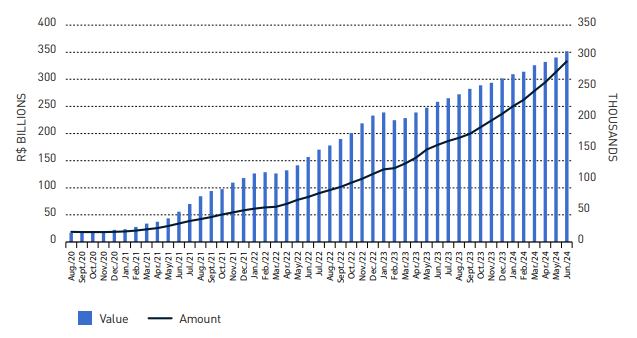
The CRA, created in 2004, has experienced exponential growth since 2021, and it has done so as a result of legal changes. Since its creation, it has had a historical average offer of 12 billion reais, rising in 2021 to 30 billion reais and in September 2022 to 33 billion reais. By June 2024, supply had reached 141.2 billion reais, a 328.8% increase in less than 24 months (CVM, 2022; 2024).
The majority of resources raised through CRAs are intended for production activities, representing 43% of the volume of capital raised. However, as the 2024 bulletin points out, it is still a very concentrated resource offer, given that 94% of CRAs offered are classified as concentrated, which happens when 20% or more of the collateral is linked to a single debtor (CVM, 2024). This is an indication that despite rapid growth, the CRA has possibly not contributed to the widespread financing of Brazilian agriculture.
The numbers, despite being very significant, are still timid when analyzing the size of the capital market in Brazil and the small participation of agribusiness, especially when utilizing the participation of agriculture in the national Gross Domestic Product (GDP) as a parameter.
According to a 2024 report by the Center for Advanced Studies in Applied Economics (Cepea, in Portuguese) from the University of São Paulo (USP), which measures the GDP of Brazilian agribusiness, taking into account the entire agro-industrial chain, the national wealth of this activity for 2024 amounted to 2.45 trillion reais (Cepea, 2024). Of this total, 1.65 trillion refers to the agricultural sector and 801 billion to livestock. In this sense, agribusiness represents 21.5% of Brazilian GDP.
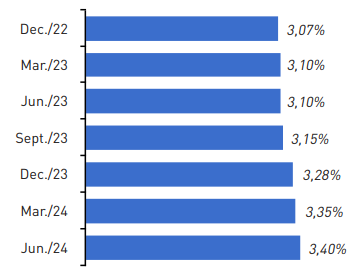
There exists, therefore, a large discrepancy. On the one hand, the agro-industrial complex (CAI, in Portuguese) represents 21.5% of the national GDP, while on the other, it represents only 3.4% of the capital market, accounting for 509.59 billion reais (CVM, 2024), as can be seen in Graphs 2 and 3.
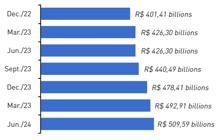

The demand for resources in the financial market through sophisticated credit bond issuance operations tends to be an increasing reality for the Brazilian Agro-Industrial Complex. Following the large upsurge recorded in the last two years, between 2022 and 2024, as well as using agribusiness GDP as a parameter, we predict that the financial market’s participation in agricultural financing will continue to grow dramatically in the coming years.
6. Integration of Financial Capital and Agribusiness
Contraction of public credit in the early 1990s led the federal government to create credit instruments that enabled the expansion of private capital (Dornelas, 2020). The CPR increased capital in agriculture through the establishment of future contracts. In these contracts, the producer committed to delivering part of the harvest at pre-determined values to trading company interested in purchasing their products. These companies, in turn, made payments to large input suppliers to whom they delivered their products.
Barter operations were institutionalized as an alternative to public credit via the banking system and were commonly formalized through CPRs or Rural Promissory Notes. In a context of credit scarcity and rising interest rates, in the early 1990s, this instrument became an important response to the public credit crisis, gaining popularity and spreading across the agriculture sector nationwide.
According to data from Banco do Brasil (2004), future sales accounted for 30% of the credit injected into national agricultural production, 30% came from rural financing and 40% utilized private resources. This demonstrates that the 1994 CPR legislation induced, in a short period of time, rapid growth in private capital arising from future sales. At the same time, it shows the scarcity and potential demand for new sources of financing, as 40% of investment is still accounted for via private resources.
The legal changes in the 2000s, especially in the 2020s, steered the formulation of the legal framework that allowed a greater presence of private capital in agriculture, thus creating greater integration between agribusiness and the financial sector. In 2004, new agribusiness securities (LCA, CRA and CDCA) were created, allowing banking institutions, trading companies and securitization companies (which can directly connect farmers to the capital market) to go to the financial market for credit, thus expanding the supply of credit for agriculture. In 2021, the law creating Fiagros was issued, establishing an important communication channel between private investors operating in the capital market, large and small shareholders and domestic agribusiness.
Despite the creation of agribusiness credit titles in 2004, ten years after the establishment of the CPR, it was only after the legal innovations in the 2020s (which include the creation of the FGS, the CRI, rural asset allocation and greater de-bureaucratization, combined with the establishment of Fiagros) that financial and agricultural capital began to move quickly towards greater integration.
The Agro Bulletin, from the Ministry of Agriculture (Brazil, 2024b), points to a dizzying increase in the issuance of CPRs in the capital market from 2021 onwards. As previously mentioned, the CPR is, as a rule, used to back agribusiness refinancing bonds.

The integration between agricultural and financial capital is a recent process that is still is expanding. It can be said that there is strong evidence that the presence of private capital originating from the financial market will continue to grow. This is evidenced by an increase in the stock of agribusiness bonds, identified in the last two years (2022-2024); the small percentage of CAI composition in the capital market (3.4% in June 2024); and the percentage of participation of the Agro-Industrial Chain in domestic GDP, (21.5%, in 2024) (CVM, 2024).
As observed in data from the Ministry of Agriculture (Brazil, 2023; 2024a), the presence of public capital, via the Safra plan, continues to expand. There is no retraction of public credit. However, the numbers point to a significant expansion of credit via the financial market, illustrating the rising integration between agriculture and the capital market.
In the context of increased financialization in agribusiness, Investment Funds show a propensity for the real estate market, which represents 44% of Fiagro-FII funds in operation and 48% of total net equity. These operations use rural properties and rural property credit rights as associated items (CVM, 2004).
Regarding the preferred real estate property and the credit rights associated with them, CRIs and CRAs stand out in these funds’ portfolios, representing 48% of total investment, 11.6 billion as of June 2024 (CVM, 2004). As the CVM (2024) points out, most of the resources obtained through CRAs are targeted at domestic productive activities. However, the majority of securities offered (94%) are of the concentrated kind (when 20% or more of the collateral is related to a single debtor).
The numbers indicate a predilection for investment in real estate and a concentration of resources raised via the capital market. Access to land continues to be central, which will possibly generate consequences in the face of the increase in financialization. At the same time, fundraising via Funds is not yet widespread as in the case of barter operations.
With the advance of the financialization process, it is likely that farmers will seek resources through securitization companies, just as they do through the issuance of a CPR or banking institutions, especially following the launch of the Safra plan.
Agribusiness is a particular form of agriculture in which there is technical and capital integration between agriculture and industry (Delgado, 2012). What has begun to be observed in the last two years, starting in 2021, after the approval of the new agricultural laws, is a completely new phenomenon: the growing association between financial and agro-industrial capital.
Conclusion
Agribusiness is a specific way of doing agriculture. It is a social, cultural, epistemic and legal phenomenon with its own historicity. The goal of this paper was to demonstrate that agribusiness is the result of economic, social and legal public policies, and that, currently, it experiences increasing financialization. This process is a result of legal changes that occurred in the 2000s and especially those implemented after the 2020s.
Reconceptualizing agribusiness allows us to understand that it is not the only agricultural pinnacle, but rather one way among the many diverse ways of doing agriculture. Alternative ways of relating to the land and the environment and of engaging in agriculture exist.
In addition, this paper sought to present a conceptual distinction that is not always made clear, which is that agribusiness is not originally or naturally financialized. This is a very recent process, which began in the 1990s in Brazil with the CPR law as an important milestone, but which was intensified in the 2020s. We are experiencing the beginning of a profound change in the way agribusiness is financed and, consequently, a change in its own productive dynamics and a redefinition of its various institutions.
The financialization process deserves special attention from Law. Agriculture comprises an essential public function, as it is an activity that guarantees sustenance, which must be accessible, healthy and cheap. Agriculture is also involved in the preservation of the environment and in generating employment and income, as well as in the formation of a national consumer market.
It was this discussion that, in the 1950s and 1960s, led to national political tensions, which created the conditions for the emergence of the Land Statute and a credit policy, rural assistance and the development of new technologies aimed at modernizing Brazilian agriculture.
In sum, the new moment that Brazilian agribusiness is experiencing, i.e., an expansion of credit via financialization, does not eliminate or reduce the need for a debate regarding the public function of agriculture, land management and access to territories. On the contrary, this debate has become even more crucial. The increased presence of financial capital in agriculture should not compromise its status as a public good.
REFERENCES
-
AVILA, Carlos Federico Domínguez. A Conferência de Punta del Este cinquenta anos depois: um estudo da VIII Reunião de Consulta de Ministros das Relações Exteriores das Américas (1962). Carta Internacional, [s.l.], v. 6, n. 1, p. 53-66, 2011. Available at: Available at: https://www.cartainternacional.abri.org.br/Carta/article/view/24 Accessed on: Nov. 1st, 2023.
» https://www.cartainternacional.abri.org.br/Carta/article/view/24 -
BANCO CENTRAL DO BRASIL. Resolução CMN n. 301, de 9 de outubro de 1974 [1974]. Available at: Available at: https://www.bcb.gov.br/estabilidadefinanceira/exibenormativo?tipo=RESOLU%C3%87%C3%83O№=301 Accessed on: Mar. 26th, 2025.
» https://www.bcb.gov.br/estabilidadefinanceira/exibenormativo?tipo=RESOLU%C3%87%C3%83O№=301 -
BANCO DO BRASIL. Evolução histórica do crédito rural. Revista de Política Agrícola, Brasília, v. 13, n. 4, p. 10-17, Oct./Dec. 2004. Available at: Available at: https://seer.sede.embrapa.br/index.php/RPA/article/view/587/pdf Accessed on: Dec. 31th, 2023.
» https://seer.sede.embrapa.br/index.php/RPA/article/view/587/pdf -
BRAZIL. Crédito rural: Governo Federal lança Plano Safra 24/25 com R$ 400,59 bilhões para agricultura empresarial. Gov.br, Jul. 3rd, 2024. [2024a]. Available at: Available at: https://www.gov.br/agricultura/pt-br/assuntos/noticias/governo-federal-lanca-plano-safra-24-25-com-r-400-59-bilhoes-para-agricultura-empresarial Accessed on: Aug. 27th, 2024.
» https://www.gov.br/agricultura/pt-br/assuntos/noticias/governo-federal-lanca-plano-safra-24-25-com-r-400-59-bilhoes-para-agricultura-empresarial -
BRAZIL. Ministry of Agriculture and Livestock. Boletim do Agro: finanças privadas. July 2024. [2024b]. Available at: Available at: https://www.gov.br/agricultura/pt-br/assuntos/politica-agricola/boletim-de-financas-privadas-do-agro/boletim-de-financas-privadas-do-agro-jul.2024/view Accessed on: Sept. 6th, 2024.
» https://www.gov.br/agricultura/pt-br/assuntos/politica-agricola/boletim-de-financas-privadas-do-agro/boletim-de-financas-privadas-do-agro-jul.2024/view -
BRAZIL. Crédito rural: presidente anuncia Plano Safra 2023/2024 com financiamento de R$ 364,22 bilhões. Gov.br, Jun. 27th, 2023. Available at: Available at: https://www.gov.br/agricultura/pt-br/assuntos/noticias/presidente-anuncia-plano-safra-2023-2024 Accessed on: Sept. 1st, 2023.
» https://www.gov.br/agricultura/pt-br/assuntos/noticias/presidente-anuncia-plano-safra-2023-2024 -
BRAZIL. Ministry of Agriculture, Livestock and Supply. Plano Safra 2022/2023 Brasília, 2022. Available at: Available at: https://www.gov.br/agricultura/pt-br/assuntos/politica-agricola/plano-safra/2022-2023/cartilha-plano-safra-2022-2023.pdf/ Accessed on: Sept. 1st, 2023.
» https://www.gov.br/agricultura/pt-br/assuntos/politica-agricola/plano-safra/2022-2023/cartilha-plano-safra-2022-2023.pdf/ -
BRAZIL. Lei n. 14.130, de 29 de março de 2021 Altera a Lei n. 8.668, de 25 de junho de 1993, para instituir os Fundos de Investimento nas Cadeias Produtivas Agroindustriais (Fiagro), e a Lei n. 11.033, de 21 de dezembro de 2004; e dá outras providências. [2021]. Available at: Available at: https://www.planalto.gov.br/ccivil_03/_ato2019-2022/2021/lei/l14130.htm Accessed on: Mar. 18th, 2025.
» https://www.planalto.gov.br/ccivil_03/_ato2019-2022/2021/lei/l14130.htm -
BRAZIL. Lei n. 13.986 de 7 de abril de 2020 Institui o Fundo Garantidor Solidário (FGS); dispõe sobre o patrimônio rural em afetação, a Cédula Imobiliária Rural (CIR), a escrituração de títulos de crédito e a concessão de subvenção econômica para empresas cerealistas; altera as Leis n.os 8.427, de 27 de maio de 1992, 8.929, de 22 de agosto de 1994, 11.076, de 30 de dezembro de 2004, 10.931, de 2 de agosto de 2004, 12.865, de 9 de outubro de 2013, 5.709, de 7 de outubro de 1971, 6.634, de 2 de maio de 1979, 6.015, de 31 de dezembro de 1973, 7.827, de 27 de setembro de 1989, 8.212, de 24 de julho de 1991, 10.169, de 29 de dezembro de 2000, 11.116, de 18 de maio de 2005, 12.810, de 15 de maio de 2013, 13.340, de 28 de setembro de 2016, 13.576, de 26 de dezembro de 2017, e o Decreto-Lei n. 167, de 14 de fevereiro de 1967; revoga dispositivos das Leis n.os 4.728, de 14 de julho de 1965, e 13.476, de 28 de agosto de 2017, e dos Decretos-Leis n.os 13, de 18 de julho de 1966; 14, de 29 de julho de 1966; e 73, de 21 de novembro de 1966; e dá outras providências. [2020]. Available at: Available at: https://www.planalto.gov.br/ccivil_03/_ato2019-2022/2020/lei/l13986.htm Accessed on: Mar. 18th, 2025.
» https://www.planalto.gov.br/ccivil_03/_ato2019-2022/2020/lei/l13986.htm -
BRAZIL. Lei n. 11.326, de 24 de julho de 2006 Estabelece as diretrizes para a formulação da Política Nacional da Agricultura Familiar e Empreendimentos Familiares Rurais. [2006]. Available at: Available at: https://www.planalto.gov.br/ccivil_03/%5C_ato2004-2006/2006/lei/l11326.htm Accessed on: Sept. 6th, 2024.
» https://www.planalto.gov.br/ccivil_03/%5C_ato2004-2006/2006/lei/l11326.htm -
BRAZIL. Lei n. 11.076, de 30 de dezembro de 2004 Dispõe sobre o Certificado de Depósito Agropecuário - CDA, o Warrant Agropecuário - WA, o Certificado de Direitos Creditórios do Agronegócio - CDCA, a Letra de Crédito do Agronegócio - LCA e o Certificado de Recebíveis do Agronegócio - CRA, dá nova redação a dispositivos das Leis n.s 9.973, de 29 de maio de 2000, que dispõe sobre o sistema de armazenagem dos produtos agropecuários, 8.427, de 27 de maio de 1992, que dispõe sobre a concessão de subvenção econômica nas operações de crédito rural, 8.929, de 22 de agosto de 1994, que institui a Cédula de Produto Rural - CPR, 9.514, de 20 de novembro de 1997, que dispõe sobre o Sistema de Financiamento Imobiliário e institui a alienação fiduciária de coisa imóvel, e altera a Taxa de Fiscalização de que trata a Lei n. 7.940, de 20 de dezembro de 1989, e dá outras providências. [2004]. Available at: Available at: https://www.planalto.gov.br/ccivil_03/_ato2004-2006/2004/lei/l11076.htm Accessed on: Mar. 18th, 2025.
» https://www.planalto.gov.br/ccivil_03/_ato2004-2006/2004/lei/l11076.htm -
BRAZIL. Lei n. 8.929, de 22 de agosto de 1994 Institui a Cédula de Produto Rural e dá outras providências. [1994]. Available at: Available at: https://www.planalto.gov.br/ccivil_03/LEIS/L8929.htm Accessed on: Mar. 18th, 2025.
» https://www.planalto.gov.br/ccivil_03/LEIS/L8929.htm -
BRAZIL. Decreto-Lei n. 167, de 14 de fevereiro de 1967 Dispõe sobre títulos de crédito rural e dá outras providências. [1967]. Available at: Available at: https://www.planalto.gov.br/ccivil_03/decreto-lei/del0167.htm Accessed on: Mar. 18th, 2025.
» https://www.planalto.gov.br/ccivil_03/decreto-lei/del0167.htm -
BRAZIL. Decreto-Lei n. 73, de 21 de novembro de 1966 Dispõe sobre o Sistema Nacional de Seguros Privados, disciplina as operações de seguros e resseguros e as operações de proteção patrimonial mutualista e dá outras providências. (Redação dada pela Lei Complementar n. 213, de 2025). [1966]. Available at: Available at: https://www.planalto.gov.br/ccivil_03/decreto-lei/del0073.htm Accessed on: Mar. 18th, 2025.
» https://www.planalto.gov.br/ccivil_03/decreto-lei/del0073.htm -
BRAZIL. Lei n. 4.829, de 5 de novembro de 1965 Institucionaliza o crédito rural. [1965]. Available at: Available at: https://www.planalto.gov.br/ccivil_03/leis/l4829.htm#:~:text=LEI%20No%204.829%2C%20DE%205%20DE%20NOVEMBRO%20DE%201965&text=Institucionaliza%20o%20cr%C3%A9dito%20rural.&text=Art.,o%20bem%2Destar%20do%20povo Accessed on: Mar. 18th, 2025.
» https://www.planalto.gov.br/ccivil_03/leis/l4829.htm#:~:text=LEI%20No%204.829%2C%20DE%205%20DE%20NOVEMBRO%20DE%201965&text=Institucionaliza%20o%20cr%C3%A9dito%20rural.&text=Art.,o%20bem%2Destar%20do%20povo -
BRAZIL. Lei n. 4.504, de 30 de novembro de 1964. Dispõe sobre o Estatuto da Terra, e dá outras providências. [1964a]. Available at: Available at: https://www.planalto.gov.br/ccivil_03/leis/l4504.htm Accessed on: Nov. 7th, 2023.
» https://www.planalto.gov.br/ccivil_03/leis/l4504.htm -
BRAZIL. Lei n. 4.595, de 31 de dezembro de 1964 Dispõe sobre a Política e as Instituições Monetárias, Bancárias e Creditícias, Cria o Conselho Monetário Nacional e dá outras providências. [1964b]. Available at: Available at: https://www.planalto.gov.br/ccivil_03/leis/l4595.htm Accessed on: Mar. 18th, 2025.
» https://www.planalto.gov.br/ccivil_03/leis/l4595.htm -
BRAZIL. Câmara dos Deputados. Projeto n. 1.337/1963 Considera objeto de tratado a matéria da Carta de Punta Del Este, firmada em agôsto de 1961 por representantes de nações americanas. Nov. 21th, 1963. Available at: Available at: https://www.camara.leg.br/proposicoesWeb/prop_mostrarintegra?codteor=1197041 Accessed on: Nov. 6th, 2023.
» https://www.camara.leg.br/proposicoesWeb/prop_mostrarintegra?codteor=1197041 -
BRAZIL. Lei n. 3.253, de 27 de agosto de 1957 Cria cédulas de crédito rural e dá outras providências. [1957]. Available at: Available at: https://www.planalto.gov.br/ccivil_03/leis/1950-1969/l3253.htm#:~:text=LEI%20N%C2%BA%203.253%2C%20DE%2027%20DE%20AGOSTO%20DE%201957.&text=Cria%20c%C3%A9dulas%20de%20cr%C3%A9dito%20rural%2C%20e%20d%C3%A1%20outras%20provid%C3%AAncias.&text=Das%20C%C3%A9dulas%20de%20Cr%C3%A9dito%20Rural Accessed on: Mar. 18th, 2025.
» https://www.planalto.gov.br/ccivil_03/leis/1950-1969/l3253.htm#:~:text=LEI%20N%C2%BA%203.253%2C%20DE%2027%20DE%20AGOSTO%20DE%201957.&text=Cria%20c%C3%A9dulas%20de%20cr%C3%A9dito%20rural%2C%20e%20d%C3%A1%20outras%20provid%C3%AAncias.&text=Das%20C%C3%A9dulas%20de%20Cr%C3%A9dito%20Rural -
BRAZIL. Decreto-Lei n. 5.452, de 1º de maio de 1943 Aprova a Consolidação das Leis do Trabalho. [1943]. Available at: Available at: https://www.planalto.gov.br/ccivil_03/decreto-lei/del5452.htm Accessed on: Mar. 18th, 2025.
» https://www.planalto.gov.br/ccivil_03/decreto-lei/del5452.htm -
BRAZIL. Lei n. 454, de 9 de julho de 1937 Autoriza o Tesouro Nacional a subscrever novas ações do Banco do Brasil, até a importância de 100.000:000$000, e a emitir “bonus” para financiamento da agricultura, creação e outras indústrias. [1937]. Available at: Available at: https://www.planalto.gov.br/ccivil_03/LEIS/1930-1949/L0454.htm#:~:text=LEI%20No%20454%2C%20DE%209%20DE%20JULHO%20DE%201937.&text=Autoriza%20o%20Tesouro%20Nacional%20a,agricultura%2C%20crea%C3%A7%C3%A3o%20e%20outras%20ind%C3%BAstrias Accessed on: Mar. 18th, 2025.
» https://www.planalto.gov.br/ccivil_03/LEIS/1930-1949/L0454.htm#:~:text=LEI%20No%20454%2C%20DE%209%20DE%20JULHO%20DE%201937.&text=Autoriza%20o%20Tesouro%20Nacional%20a,agricultura%2C%20crea%C3%A7%C3%A3o%20e%20outras%20ind%C3%BAstrias - CASTRO, Josué de. Geografia da fome 4. ed. Rio de Janeiro: Civilização Brasileira, 2004.
- CASTRO, Josué de. Documentário do nordeste 4. ed. São Paulo: Brasiliense, 1968.
-
CENTRO DE ESTUDOS AVANÇADOS EM ECONOMIA APLICADA (CEPEA). PIB do agronegócio brasileiro Available at: Available at: https://www.cepea.esalq.usp.br/br/pib-do-agronegocio-brasileiro.aspx#:~:text=Com%20base%20nesse%20desempenho%2C%20o,do%20primeiro%20trimestre%20de%202024 Accessed on: Aug. 31th, 2024.
» https://www.cepea.esalq.usp.br/br/pib-do-agronegocio-brasileiro.aspx#:~:text=Com%20base%20nesse%20desempenho%2C%20o,do%20primeiro%20trimestre%20de%202024 - COELHO, Fábio Ulhoa. Títulos do agronegócio In: BURANELLO, Renato; SOUZA, André Ricardo Passo de; PERIN JUNIOR, Ecio. Direito do agronegócio: mercado, regulação, tributação e meio ambiente São Paulo: Quartier Latin, 2011.
-
COMISSÃO DE VALORES MOBILIÁRIOS (CVM). Boletim CVM Agronegócio: estatísticas. 7. ed. Jun. 2024. Available at: Available at: https://www.gov.br/cvm/pt-br/centrais-de-conteudo/publicacoes/boletins/boletim-cvm-agronegocio Accessed on: Aug. 27th, 2024.
» https://www.gov.br/cvm/pt-br/centrais-de-conteudo/publicacoes/boletins/boletim-cvm-agronegocio -
COMISSÃO DE VALORES MOBILIÁRIOS (CVM). Boletim CVM Agronegócio: estatísticas. 1. ed. Sept. 2022. Available at: Available at: https://www.gov.br/cvm/pt-br/centrais-de-conteudo/publicacoes/boletins/boletim-cvm-agronegocio Accessed on: Aug. 27th, 2024.
» https://www.gov.br/cvm/pt-br/centrais-de-conteudo/publicacoes/boletins/boletim-cvm-agronegocio - DAVIS, John H.; GOLDBERG, Ray A. A Concept of Agribusiness. Division of Research. Graduate School of Business Administration. Harvard University. Boston, Massachusetts: The Alpine Press, 1957.
- DELGADO, Guilherme Costa. Do “capital financeiro na agricultura” à economia do agronegócio: mudanças cíclicas em meio século (1965-2012). Porto Alegre: Editora da UFRGS, 2012.
- DELGADO, Maurício Godinho. Curso de Direito do Trabalho 17. ed. São Paulo: LTr, 2018.
-
DORNELAS, Larissa Naves de Deus. Evolução da política de crédito rural no Brasil: uma análise histórica. Extensão Rural, Santa Maria, v. 27, n. 2, p. 25-39, 2020. Available at: Available at: https://periodicos.ufsm.br/extensaorural/article/view/37583 Accessed on: Dec. 18th, 2023.
» https://periodicos.ufsm.br/extensaorural/article/view/37583 - ESCOBAR, Arturo. La invención del desarrollo 2. ed. Popayán: Universidad del Cauca, 2014.
-
FARIAS, Alexandrina Benjamin Estevão de. Seguro rural, políticas públicas e a modernização conservadora no campo brasileiro 2016. 114 f. Dissertation (Master’s in Agrarian Law) - Universidade Federal de Goiás, Goiânia, 2016. Available at: Available at: https://repositorio.bc.ufg.br/tede/items/bc5a54d0-a4d7-4166-b270-9f6c93199659 Accessed on: Dec. 8th, 2023.
» https://repositorio.bc.ufg.br/tede/items/bc5a54d0-a4d7-4166-b270-9f6c93199659 -
FOOD & WATER WATCH. Cargill: A Threat to Food and Farming. 2009. Available at: Available at: https://www.foodandwaterwatch.org/ Accessed on: Dec. 21th, 2023.
» https://www.foodandwaterwatch.org/ - FURTADO, Celso. Desenvolvimento e subdesenvolvimento Rio de Janeiro: Contraponto: Centro Internacional Celso Furtado, 2009.
- FURTADO, Celso. Raízes do subdesenvolvimento Rio de Janeiro: Civilização Brasileira, 2011.
- HARVEY, David. O neoliberalismo: história e implicações. 5. ed. São Paulo: Edições Loyola, 2014.
-
HEINEN, Milton Inácio. Propriedade familiar: evolução conceitual e o reconhecimento formal de uma categoria rural. Revista da Faculdade de Direito da UFG, Goiânia, v. 37, n. 1, p. 94-116, 2013. Available at: Available at: https://revistas.ufg.br/revfd/article/view/33574 Accessed on: Nov. 6th, 2023.
» https://revistas.ufg.br/revfd/article/view/33574 - KAUTSKY, Karl. A questão agrária São Paulo: Proposta Editorial, 1980.
- MARQUES, Benedito Ferreira. Direito agrário brasileiro 7. ed. São Paulo: Atlas, 2007.
- MARX, Karl. O capital: crítica da economia política. Livro I: o processo de produção do capital. 2. ed. São Paulo: Boitempo, 2017.
-
MENGEL, Alex Alexandre; AQUINO, Silvia Lima de. A modernização da agricultura e a criação da Embrapa: transformações na pesquisa agropecuária brasileira. Revista Campo-Território, Uberlândia, v. 10, n. 21, p. 4-27, Aug. 2016. Available at: Available at: https://seer.ufu.br/index.php/campoterritorio/article/view/30205 Accessed on: Nov. 21th, 2023.
» https://seer.ufu.br/index.php/campoterritorio/article/view/30205 - PERIN JUNIOR, Ecio; BURANELLO, Renato. Constituição econômica, política agrícola e sistema privado de financiamento do agronegócio. In: BURANELLO, Renato; SOUZA, André Ricardo Passo de; PERIN JUNIOR, Ecio. Direito do agronegócio: mercado, regulação, tributação e meio ambiente. São Paulo: Quartier Latin, 2011.
-
PIRES, Murilo José de Souza; RAMOS, Pedro. O termo modernização conservadora: sua origem e utilização no Brasil. Revista Econômica do Nordeste, [s.l.], v. 40, n. 3, p. 411-424, 2017. Available at: Available at: https://www.bnb.gov.br/revista/index.php/ren/article/view/367 Accessed on: Nov. 8th, 2023.
» https://www.bnb.gov.br/revista/index.php/ren/article/view/367 - PLOEG, Jan Douwe Van Der. Camponeses e a arte da agricultura: um manifesto chayanoviano. São Paulo; Porto Alegre: Editora Unesp; Editora UFRGS, 2016.
- POLANYI, Karl. A grande transformação: as origens de nossa época. 2. ed. Rio de Janeiro: Elsevier, 2012.
- PRADO JÚNIOR, Caio. A questão agrária no Brasil 5. ed. São Paulo: Brasiliense, 2000.
-
SAAD FILHO, Alfredo. Crise no neoliberalismo ou crise do neoliberalismo? Crítica e Sociedade: Revista de Cultura Política, Uberlândia, v. 1, n. 3, Edição Especial - Dossiê: A crise atual do capitalismo, dez. 2011. Available at: Available at: https://seer.ufu.br/index.php/criticasociedade/article/view/14547 Accessed on: Dec. 5th, 2023.
» https://seer.ufu.br/index.php/criticasociedade/article/view/14547 -
SALATI, Paula. MST inicia captação de R$ 17,5 milhões no mercado financeiro para produção da agricultura familiar. G1, Jul. 27th, 2021. Available at: Available at: https://g1.globo.com/economia/agronegocios/noticia/2021/07/27/mst-inicia-captacao-de-r-175-milhoes-no-mercado-financeiro-para-producao-da-agricultura-familiar.ghtml Accessed on: Sept. 1st, 2023.
» https://g1.globo.com/economia/agronegocios/noticia/2021/07/27/mst-inicia-captacao-de-r-175-milhoes-no-mercado-financeiro-para-producao-da-agricultura-familiar.ghtml - SANTOS, João Paulo de Faria. A formação do direito agrário: planejamento, soberania e democracia econômica no campo. São Paulo: Quartier Latin, 2023.
-
SANTOS, João Paulo de Faria. O atual estágio da constitucionalização do crédito rural: apontamentos sobre soberania econômica, democracia e redução das desigualdades. Revista Fórum de Direito Financeiro e Econômico, v. 8 n. 14, Sept. 2018/Feb. 2019. Available at: Available at: http://ojs.editoraforum.com.br/rfdfe/index.php/rfdfe/article/view/377 Accessed on: Nov. 22th, 2023.
» http://ojs.editoraforum.com.br/rfdfe/index.php/rfdfe/article/view/377 -
SILVA, Vicenta Gil da. A Aliança para o Progresso no Brasil: de propaganda anticomunista a instrumento de intervenção política (1961-1964). 2008. 248f. Dissertation (Master’s in History), Instituto de Filosofia e Ciências Humanas, Universidade Federal do Rio Grande do Sul, Porto Alegre, 2008. Available at: Available at: http://hdl.handle.net/10183/14692 Accessed on: Nov. 1st, 2023.
» http://hdl.handle.net/10183/14692 -
UNITED NATIONS (UN). United Nations Declaration on the Rights of Peasants and Other People Working in Rural Areas Resolution adopted by the General Assembly on 17 December 2018. [2018]. Available at: Available at: https://www.geneva-academy.ch/joomlatools-files/docman-files/UN%20Declaration%20on%20the%20rights%20of%20peasants.pdf Accessed on: Mar. 18th, 2025.
» https://www.geneva-academy.ch/joomlatools-files/docman-files/UN%20Declaration%20on%20the%20rights%20of%20peasants.pdf
-
1
This article is a product of the research “Agribusiness and Financialization of the Countryside: Risks and Guaranteeing the Right to Adequate Food and the Environment”, funded by CNPQ, call for proposal CNPq No. 14/2023.
-
2
According to Brazilian legislation, Law No. 11,326/2006 (Brazil, 2006), family farming is defined as a family run production unit, whose workforce is comprised of the family and that generates the majority of the family income. Also, the farmland is small (but the size varies across Brazilian municipalities). In other words, family farming can be of a traditional or subsistence farming type, but it can also be part of an industrial model.
-
3
According to Arturo Escobar (2014, p.52), the developmentalist discourse emerged in the vacuum generated by the fall of European colonial empires after the Second World War, serving to remodel the North-South relationship on the same hierarchical and dependent bases: “Initially created in the United States and Western Europe, the development strategy became a powerful force in the Third World itself after a few years”. For Escobar (2014, p. 49), development means: “[...] high levels of industrialization and urbanization, agricultural technology, rapid growth in material production and levels of life, and widespread adoption of education and modern cultural values”.
-
4
As can still be observed in art. 7, b, of the CLT (Brazil, 1943). Labor legislation specific to the countryside came into existence through the Rural Worker Statute, Law No. 4,214/1963, promulgated by João Goulart. According to Delgado (2018, p. 474): “It extended only a few provisions to rural employees, such as the precepts relating to minimum wage, vacations, advance notice and remuneration”. It was the cause of great social unrest, being listed by Delgado (2018) as one of the factors that led to the military coup in the years that followed. It was revoked in 1973.
-
5
Agrarian policies are associated with the issue of land and the reorganization of territorial space, such as that effected through agrarian reform and colonization policies. Agricultural policies are linked to promoting production, including measures such as credit, marketing, electrification, storage, supply, etc.
-
6
Agrarian policy proposed the colonization of new lands and agrarian reform to democratize access to land and eliminate large estates. The large estate is defined as an unproductive property or one that is larger than 600 rural modules in size.
-
7
It sought to differentiate agrarian contracts from civil contracts, regulating leasing and rural partnerships. Labor relations needed to be regulated. Work in the field was not, for the most part, that of the rural employee, regulated by the Rural Worker Statute of 1963. Other work relationships, in which the peasant produced in partnership with the landlord or rented the land, remained in need of regulation.
-
8
Conservative modernization is a category applied to the Brazilian countryside, in which economic development has not been accompanied by changes in the social structure (Pires; Ramos, 2017).
-
9
In relation to land policy, colonization policies were prioritized in the agricultural frontiers of Center-Western and Northern Brazil (Santos, 2023).
-
10
It was necessary to produce technology and disseminated knowledge that would bring the industrial sector closer to the agricultural sector. Embrapa was created with this goal. It replaced the former National Department of Agricultural Research (DNPEA), offering more professional management of research, articulated with market demands and with a focus on modernizing agriculture and developing agribusiness (Mengel; Aquino, 2016).
-
11
Agricultural insurance emerged as credit insurance against the risks inherent to rural activities. Since its creation, its legal structure has been that of an adhesion clause, which conditioned the taking of credit. Since the very start, Circular 241 of the Central Bank of Brazil, from 1974, which regulated Proagro, imposed as a condition for receiving the settlement payment proof that “modern inputs” recommended by technical assistance were used in production (Farias, 2016; Banco Central do Brasil, 1974).
-
12
Financing for funding, investment and commercialization, with controlled and uncontrolled interest rates, was created. With regard to uncontrolled interest, the rate was agreed between the contractors, with the Workers’ Support Fund as its main source. As for controlled interest rates, interest is set by the government, pre-determined, and has as its main funding resources obtained from savings accounts, the national treasury and compulsory bank deposits (Santos, 2019).
-
13
Law No. 3,253/1957 created the Rural Pledge and Mortgage Certificate and the Rural Promissory Note. These were added to the Rural Pledge Certificate, which was already in existence at the time (Marques, 2007).
-
14
Law needs to offer a dynamic and secure legal structure for the circulation of capital. Before the creation of the National Credit System, the formalization of agrarian contracts took place through public or private deeds. The costs were high, especially when there were mortgage guarantees, as they had to be submitted to the notary. “That is to say, the borrower, in addition to the financial charges to which he was subjected to by the bank, also had to pay the fees for drawing up the deeds and registering the mortgage lien. In these deeds, extensive and numerous clauses were inserted, aiming for the greatest possible security” (Marques, 2007, p. 157).
-
15
Agricultural policy acted as an agrarian counter-reform policy, favoring the concentration of land, as credit favored the large rural owner, strengthening the producer who was already part of the market (Santos, 2019).
-
16
Credit does not circulate exclusively through monetary financing. When a supply business or a machinery manufacturer accepts a certain amount of soybeans of a certain quality as payment for a tractor or fertilizer at a future time, it is anticipating credit for the farmer and collaborating in the expansion of private capital (Perin Junior; Buranello, 2011).
-
17
Rural Credit accounts for 30% of the annual credit demand. Another 30% is obtained through advance sales - including CPR - and exchange of products for supplies or advances from suppliers, and the remaining 40% is met through the producers’ own resources” (Banco do Brasil, 2004, p. 13). It should be noted that, in this case, private credit is not necessarily obtained from the financial market.
-
18
The Agribusiness Deposit Certificate (CDA, from the Portuguese) and the Agricultural Warrant (WA, from the Portuguese) were also established, and both were tied to inventory stocked in warehouses as collateral.
-
19
In addition to the CPR, agribusiness credit securities may be backed by different legal instruments that serve as guarantees, such as the Commercial Duplicate, the Rural Promissory Note or the Agricultural Deposit Certificate. However, the most commonly used instrument is the CPR (Coelho, 2011).
-
Como citar este artigo
ROCHA, Eduardo Gonçalves; MOURA, Priscila Kavamura Guimarães de; COSTA, Alexandre Bernardino. Brazilian Agrarian and Development Laws: The Legal Framework of Brazilian Agribusiness and Its Financialization. Revista Direito GV, São Paulo, v. 21, e2511, 2025. https://doi.org/10.1590/2317-6172202511

 Source:
  Source:
  Source:
  Source: