 Deactivation of brazilian stricto sensu postgraduate courses in information science: an initial discussion
ABSTRACT
Introduction: The importance of Postgraduate courses for the development of a society is unquestionable, although many challenges make it difficult for programs that offer this level of education to survive.
Objective: The aim of this study is to characterize the Brazilian Postgraduate programs in the area of Information Science that have been deactivated.
Methodology: In terms of nature, it is characterized as basic research and, in terms of objectives, it is descriptive and quantitative research, applying the procedures of documentary research, through consultation of the Coordination's Catalog of Theses and Dissertations for the Improvement of Higher Education Personnel. The period from 2004 to 2021 was considered, and the procedures adopted identified the programs, characterized those that were deactivated and mapped the themes of their research.
Results: The results revealed the existence of three deactivated programs, one of which was professional and had only been in existence for a short time, although it contributed to increasing the production share of the studies defended in them whose themes addressed information as an object of study, representing, thus, the field of Information Science.
Conclusion: The analysis of deactivated programs highlighted the strengthening of the area, reinforced the role played by professional programs and indicated possible challenges, such as the attempt to meet the evaluation criteria in relation to socioeconomic inequalities in the Brazilian territory.
KEYWORDS:
Brazilian graduate programs; Course evaluation; Educational challenges; Academic development; Evaluation research
RESUMO
Introdução: A importância dos cursos de Pós-Graduação para o desenvolvimento de uma sociedade é inquestionável, embora muitos desafios dificultem a sobrevivência dos programas que oferecem esse nível de ensino.
Objetivo: Pretende-se, com este estudo, caracterizar os programas brasileiros de Pós-Graduação da área da Ciência da Informação que foram desativados.
Metodologia: Quanto à natureza, caracteriza-se como uma pesquisa básica e, quanto aos objetivos, trata-se de pesquisa, descritiva e quantitativa, aplicando-se os procedimentos da pesquisa documental, por meio da consulta ao Catálogo de Teses e Dissertações da Coordenação de Aperfeiçoamento de Pessoal de Nível Superior. Foi considerado o intervalo de 2004 a 2021, e os procedimentos adotados identificaram os programas, caracterizaram os desativados e mapearam as temáticas das suas pesquisas.
Resultados: Os resultados revelaram a existência de três programas desativados, sendo um deles de modalidade profissional e com um tempo curto de existência, embora tenha contribuído para elevar a parcela de produção dos estudos neles defendidos cujas temáticas abordaram a informação como objeto de estudo, representando, assim, o campo da Ciência da Informação.
Conclusão: A análise dos programas desativados evidenciou o fortalecimento da área, reforçou o papel exercido pelos programas profissionais e indicou possíveis desafios, tal como a tentativa de atender aos critérios de avaliação em relação às desigualdades socioeconômicas do território brasileiro.
PALAVRAS-CHAVE:
Pós-graduação brasileira; Avaliação de cursos; Desafios educacionais; Desenvolvimento acadêmico; Pesquisa e desenvolvimento
1 INTRODUCTION
Brazilian postgraduate courses began in the 1930s with the "European origin" model of professorships, in which "a single professor - the full professor - was responsible for teaching and research, assisted by a variable number of assistants appointed by him" (Balbachevsky, 2005, p. 276). According to the author, to support this model, characterized by informal teaching and centered on the thesis, Brazil received foreign professors, either on academic missions or as asylum seekers fleeing the war in their countries.
According to Nazareno and Herbetta (2019), the regulation of postgraduate studies in Brazil began in the 1960s, with the publication of Opinion No. 977/1965, issued by the Federal Education Council (FEC) to meet the requirements of Article 69 of the National Education Guidelines and Bases Law (LDB) of 1961, which provided for the existence of courses at this level. The purpose of the opinion was to "[...] correct the structural deficiencies that existed mainly in the training of teachers and in the qualification of personnel who would focus on scientific production and contribute to national development" (Nazareno; Herbetta, 2019, p. 104). Thus, the goal was to provide specialized training for teachers in Brazilian universities and colleges, which was later expanded to meet the needs of the labor market, offering an education that combined academic and professional training.
The Coordination for the Improvement of Higher Education Personnel (CAPES), which was created in 1951 to maintain qualified training in higher education and is affiliated with the Ministry of Education, created "a sophisticated evaluation system based on peer review" in 1970, which "[...] made it possible to link official support to program performance and eventually established a minimum standard of academic quality for programs [...]" (Balbachevsky, 2005, p. 276). Thus, in 1976, "[...] the first evaluation process for postgraduate programs took place [...]" (Balbachevsky, 2005, p. 282). Subsequently, according to the author, the evaluation models were improved and became increasingly strict, imposing international quality standards, and by 1998, a grade of three was the minimum required for recognition of a postgraduate program.
Nearly 60 years after their regulation, Brazilian postgraduate programs, especially those in the stricto sensu modality, have made progress in Brazil's development indices, although some challenges remain in terms of strengthening these programs. Venturini (2019) mentions that the most visible challenge is the intense regional, ethnic, racial, and economic inequalities that make education unequal across the vast national territory. Similarly, Magalhães (2023) mentions that regional inequalities weaken the results of the CAPES evaluation of courses. This inequality, in most cases, hinders the release of resources to support the activities of the courses and can also lead to the closure or deactivation of the programs offered.
In the field of Information Science, few studies have set out to map the scenario of postgraduate courses in this area of knowledge and the challenges they face. Among the few studies are Pinheiro (2007) and Lança, Amaral and Gracioso (2018). The first identified the existence of 9 programs with master's degrees, and 5 of them also with Ph.D. degrees. The second study showed an increase in the number of programs and courses, with 9 programs created between 2015 and 2017, 6 of which are professional programs. In total, according to Lança, Amaral and Gracioso (2018), Brazil had 8 professional and 15 academic programs in 2017, the oldest being the Universidade Federal do Rio de Janeiro (UFRJ-IBICT), founded in 1970 and the first Master in Information Science in Brazil.
Since more than five years have passed since the period analyzed by Lança, Amaral, and Gracioso (2018), it is appropriate to review the current panorama of graduate programs in information science to highlight the survival or deactivation of the programs implemented. Therefore, this study aims to map and characterize the Brazilian postgraduate programs in Information Science that have been deactivated, to understand the challenges that have become obstacles that have not been overcome. It is considered that the results of this study provide an opportunity to identify the survival and deactivation of programs in information science, which makes it easier to identify the difficulties faced by this area of knowledge, contributing to funding agencies and educational institutions being able to establish strategies to strengthen what already exists as well as encourage the implementation of new programs.
In this context, Souza and Stumpf (2009) state that it is opportune to identify the programs in the field of Information Science, as well as the advances and challenges related to the trajectory of research in this area. This is especially necessary because Information Science is a young field, still in the formative stages of its researchers, but with significant efforts to discuss factors related to the development of its body of knowledge. It is also important to note, in agreement with Souza and Stumpf (2009), that mapping the courses and identifying their trajectories are justifiable initiatives, since it was after the year 2000 that Brazilian postgraduate programs received a major boost, in all areas of knowledge, including, in this process, the area of Information Science.
In terms of textual structure, this article consists of five sections, including this introductory part. Next, some challenges related to the deactivation of Brazilian postgraduate courses are described, followed by the methodological procedures. Then there are the results and discussion of the study, ending with the conclusion section.
2 BRAZILIAN POSTGRADUATES: CHALLENGES AND EVALUATION
Nobre and Freitas (2017) state that Brazilian graduate education is governed by an integrated system composed of universities and other higher education institutions, which have autonomy to create or close courses, although the system depends on funding from CAPES and its ranking, which assigns a classification that allows courses to continue. Thus, the authors state that the purpose of the system is to meet the needs of training teachers and researchers, with activities focused on teaching and research, and also on training highly specialized technicians to work in different segments of the market (both public and private).
Araújo and Valentim (2019) emphasize the importance of postgraduate studies in consolidating a field of knowledge, and value the evaluation tools that make it possible to improve teaching and research in professional qualification courses. In turn, Nóbrega (2018) points out that several factors contribute to the strengthening of Brazilian postgraduate studies, such as the assessment strategies adopted by CAPES and the involvement of funding agencies, actions that improve research practices. In addition, the involvement and performance of teaching and research institutions that have adopted expansion and internationalization policies should also be evaluated, with the aim of increasing the role of these institutions in Brazil's economic development (Trevisou; Balsanello, 2023).
The history of postgraduate studies in Brazil shows its development and strengthening, both quantitatively and qualitatively. The numerical expansion of stricto sensu courses in public and private institutions occurred mainly since the 2000s, in line with the increase in undergraduate courses and the investment in teaching and research in higher education institutions (Nóbrega, 2018). Regarding the expansion of the number of courses, Trevisou and Balsánello (2023) identify an exponential growth, as the number of master's and doctoral courses increased from 2,119 in 1999 to 6,924 in 2019, an annual growth rate of around 14.5%, with a parallel growth in enrollment, which went from 85,276 in 1999 to 292,766 in 2019.
If, on the one hand, the role of CAPES is fundamental for the qualification of research activities, requiring a standard of quality that is essential for the improvement of scientific discoveries, on the other hand, it imposes a requirement that cannot always be met by all institutions, due to various factors. As a consequence, failure to meet the quality criteria established by CAPES leads to a reduction in investments and the release of resources needed to guarantee research activities.
2.1 Factors for the deactivation of Graduate Programs
The deactivation of courses is a complex process, and it is difficult to identify the real factors that interfere with their cancellation. Orth's research (2023), which was carried out on social work courses, showed that a course is deactivated due to a lack of demand, a lack of resources, and also due to the negative result of the evaluation carried out by the accrediting institutions. According to the author, this is not a single factor, but a set of factors involving the responsibilities of different institutions.
Analyzing the contents of the 49 Capes evaluation forms, referring to the different areas of knowledge, it can be seen that the programs are required to articulate the activities and actions of the PPG with the Institutional Development Plan (IDP) of the university. The absence of this element can lead to inconsistencies in the identity of the program (philosophy, mission, and pedagogical guidelines, among others). There may also be a lack of alignment with market demands, with the result that graduates do not find a role in the country's productive sector, which is why the evaluation of courses considers graduates. PPGs must have a certain thematic scope to respond to the real needs of society. Another problem is when the group of professors in the PPG lacks maturity, which hinders collective production in a given field of knowledge. Thus, despite the peculiarities verified in the records of each area of knowledge, basic quantitative metrics, such as the bibliographic production of the faculty and students, are often not met by the programs, which leads to a reduction of the grade and the deactivation of the program.
Côco and Amaral (2021, p. 799-800) report that the evaluation of PPGs is currently carried out on a four-yearly basis and aims to ensure continuous quality improvement, thus "[...] programs with very low scores are deactivated and programs with higher scores are treated differently, especially in terms of funding". As mentioned above, the CAPES criteria for evaluating postgraduate programs require them to meet standards of excellence comparable to levels 6 and 7, under penalty of a reduction in the institution's funding. In the case of budgetary constraints, the programs' functioning is compromised and demand is likely to decrease, reasons that can be considered as possible factors leading to the deactivation of the courses offered.
Even considering the progress made by postgraduate programs in Brazil, such as in information science programs, as stated by Araújo and Valentim (2019), there are assumptions about the difficulties faced by these programs. Probably the greatest challenge is related to the unequal distribution of programs among the Brazilian regions, a fact confirmed by Lança, Amaral, and Gracioso (2018), when the authors state that the challenge is based on the social inequalities that exist in the intense Brazilian territory, a fact that can jeopardize the validity and survival of the courses.
We are a continental country, with its own peculiarities and regionalities. Reproducing or trying to reproduce an evaluation format from other countries, without a little anthropophagy, may continue to generate discussions, dissatisfaction, and inequalities in Brazilian universities. We believe that it is necessary for academics, organizations, and public institutions to come together to find solutions that reflect everyone's needs (Cardoso; Dantas, 2019, p. 7).
This fact was also confirmed by Silva (2008), who criticized the evaluation system for not considering the economic differences between Brazilian regions. The study indicated that the more developed regions, such as the Southeast and South, have the largest number of programs compared to other regions, such as the North and Northeast. "As a result, master's and doctoral programs in the country that do not meet the required minimum level of excellence have often been closed" (Silva, 2008, p. 57). Also discussing this issue, Guimarães, Brito and Santos (2020, p. 68) point out that there has been progress in Brazilian postgraduate studies, especially with the expansion of the number of courses in different regions, but that regional asymmetries continue to be the main challenge, i.e., "[...] without the necessary public funding, regional disparities in Brazilian postgraduate studies will deepen".
In the perspectives discussed in this section, it is necessary to recognize that "[...] these actors [scholars, entities, and institutions] must be valued and understand that the primary purpose of postgraduate studies is to provide qualified training for the production of knowledge" and that "there must be a guaranteed allocation of resources and adequate infrastructure to promote science, technology, and innovation in the country" (Parada; Kantorski; Nichiata, 2020, p. 2).
3 METHODOLOGY
From a methodological perspective, it is basic research because it "[...] aims to generate new knowledge useful for the advancement of science" without, in principle, "expected practical application" (Prodanov, Freitas, 2013, p. 51). In terms of its objectives, it is exploratory and descriptive, since the data collected are characterized, analyzed, and classified because of a priori created categories of analysis (variables), using a primarily quantitative approach.
In terms of technical procedures, documentary research was used, which uses documents of a primary nature (or primary source) because "[...] it is based on materials that have not yet received an analytical treatment or that can be reworked according to the objectives of the research" (Prodanov, Freitas, 2013, p. 55). Capes open data is considered a primary document based on Pinheiro's (2006, p. 2) statement that primary documents "[...] are those that are presented and disseminated in the exact form in which they are produced by their authors". Following this perspective, open government data is guided by the definition: "open data is data that can be freely used, reused, and redistributed by anyone" and "[...] the data must be available in its entirety, (...) preferably by download from the Internet; it must also be in a convenient and modifiable format" (Manual, 2011, p. 13). In addition, open government data retains the nature of "primary" data: it is presented as collected from the source, at the highest level of granularity possible, without aggregation or modification" (Manual, 2011, p. 14).
The platform consulted to collect the primary data was the CAPES Open Data website, specifically the first set of data from the Theses and Dissertations Catalog, which covers the period from 2004 to 2021. This interval was chosen because the data were collected in the first months of 2022, when the data for 2022 had not yet been made available by CAPES.
The data were collected, opened and grouped using the OpenRefine software, version 3.7.5, and then structured in a DataFrame. They were then subjected to a cleaning process to correct various inconsistencies, such as repetitions, and to standardize the structure of the data (format of letters and numbers). Next, the development environment was structured using the Python programming language and the Pandas and Matplotlib libraries, using Google's Colab tool.
Once the programming environment was structured and formatted, we proceeded to data processing, considering the 19 categories of analysis (variables) studied, divided into two stages: 1) a survey of programs in the field of computer science, and 2) characterization of disabled programs, as shown in Chart 1.
Once the data had been processed and the 19 categories of analysis (variables) shown in Chart 1 had been defined, with 6 categories of analysis (variables) in stage 1 and 13 categories of analysis (variables) in stage 2, the next step was to work on the visualization of the data to evaluate the results and make them explicit. For this purpose, the graphical resources of the Plotly library were used, either in the form of graphs or charts, since this tool is very robust in the field of data visualization (Lafuente et al., 2021). In particular, for the treatment of research topics, keywords with more than two occurrences over the years were studied.
4 RESULTS AND DISCUSSION
The results are presented in accordance with two basic stages: 1) a survey of programs in the field of Information Science and 2) a characterization of the deactivated programs, based on their respective categories of analysis (variables).
4.1 Results of the survey of programs
The data used identified a total of 30 programs in the field of Computer Science, as of 2022. It is considered that there is still room for an increase in the number of Brazilian programs in the same area, since other areas of knowledge have more expressive numbers, such as Production Engineering, which, according to Tonon, Matsuura and Lage Júnio (2022), has 75 courses in operation; and also the area of Law, which, according to Rocha, Leal and Ribeiro (2021), had 105 programs in operation, with data from 2020. The information on the official website of Capes in November 2023 shows that there are 80 programs in operation in 53 different institutions.
The analysis in Stage 1 considered six categories of analysis (variables), namely: name of the programs (1), linking institution (2), year of creation (3), state or UF (4), level (5), and Capes concept or grade (6). For a holistic view of all programs, Table 2 presents a summary of 5 of the 6 categories of analysis (variables 1, 2, 4, and 5) related to this stage 1.
The results of the analysis of the four categories (variables) in stage 1, shown in Table 2, show a variation in the names of the programs (variable 1), with the most common name being Information Science, with 20 programs (about 67%). These programs are spread over 25 different institutions (variable 2), with USP, UEL, UFMG, UNIRIO and UFF each having two programs.
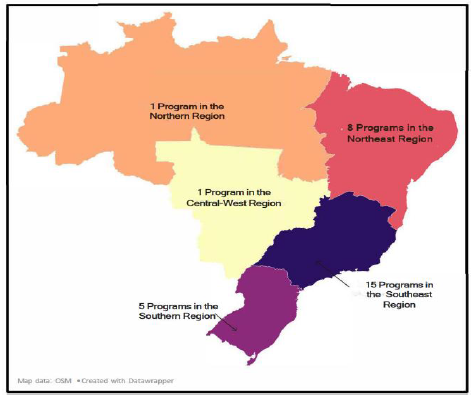
When identifying the state or UF (variable 4), the locations to which the programs belong were checked, and it was found that there are 6 programs in RJ, with 20%, 5 programs in SP, with about 17%, 3 programs in MG, with 10%, 2 programs in SC, PR, and CE, with about 7% each, and 1 program in SE, DF, PA, BA, PB, AL, PE, ES, RN, and RS, with about 3% each. These states are distributed among the five Brazilian regions, as shown in Figure 1.

Figure 1 shows that the Southeast has a total of 15 programs, or 50% of the total. This is followed by the Northeast with 8 programs (26.67%), the South with 5 programs (16.67%), and the Midwest and North with 1 program each (3.33%). The small number of programs in the Midwest and North indicates that there is room for expansion in the field of computer science and that new programs can be created there. Although there is a significant number of programs, with their presence in almost all Brazilian states (there is representation in all Brazilian regions), the concentration is in the Southeast (15 programs), Northeast (8) and South (5). In the Southeast, Rio de Janeiro (6 programs), São Paulo (4) and Minas Gerais (3) stand out. In the second place, in the Northeast, we highlight the state of Ceará (2) and the states of Sergipe, Bahia, Paraíba, Alagoas, Pernambuco, and Rio Grande do Norte (1 each). In third place, in the South, we highlight the states of Santa Catarina and Paraná (2 each).
This result is in line with the picture identified by Pinheiro (2007), Souza and Stumpf (2009), and Lança, Amaral, and Gracioso (2018), who point to an uneven distribution between the regions. The result also shows a slight divergence from the findings of Silva (2008), who reports that the Southeast and South regions have more programs. In this study, it was found that the Northeast has more programs in Information Science than the South. This may not seem like very significant data from a holistic view of Brazilian postgraduate studies, but it shows an effort by the area to boost the creation of programs in regions that were previously underserved, contributing to the decentralization of knowledge and the inclusion of different socio-economic realities in the national academic scene. Furthermore, it may reveal that the guidelines established in the National Postgraduate Plans (PNPG) from 2005 to 2010 and 2011 to 2020, which provided for policies to minimize regional asymmetries, have had some effect, at least in the area of Information Science. However, it should be noted that more effective policies are needed to eliminate the regional asymmetries recognized in the literature. It is hoped that these will be considered in the new PNPG, from 2021 to 2030, which is still being drawn up and only had its first committee meeting after June 2023.
Regarding program levels (variable 5), in the area of information science, there are 19 Academic Masters (ME), around 63%, 13 Academic Doctorates (DO), around 43%, 8 Professional Masters (MP), around 26% and, until December 2022, no Professional Doctorates1. About the eight professional programs, their creation may be associated with the fact that Information Science has an application characteristic, i.e., it relates to other areas of knowledge, fostering interdisciplinary and benefiting society (Lança; Amaral; Gracioso, 2018).
In the columns of program levels are the concepts or grades assigned to the programs by Capes (variable 6), a situation recorded after the result of the 2017-2020 evaluation, published in December 2022. It can be seen that there was only 1 (3%) program with a grade of 7, UNESP, and only 1 (3%) program with a grade of 6, UFRJ, considered to be of a high international standard. Then there were 5 programs with a score of 5 (17%), 15 programs with a score of 4 (50%), 5 programs with a score of 3 (17%) and 3 programs without a score (10%), which have already been deactivated, an issue that will be returned to in the next step 2.
With regard to the years in which the programs were created (variable 3), when analyzing their historical trajectory, it became clear that for the 30 programs, the range of variation in creation was from 1970 to 2019, as shown in Graph 1.

Looking at Graph 1, you can see that there were intervals of intermittent program creation until 2009, when programs were created every year until 2019, with a gradual increase. The exception is 2014, when no new programs were created. A gradual growth was also found in the study by Lança, Amaral, and Gracioso (2018), who identified the oldest program as that of UFRJ, which implemented the first master's in information science in Brazil, created by IBICT in 1970. The authors also reported that three programs stood out as having existed the longest: UFMG's PPGCI program, which began in 1976 with a master's degree and added a Ph.D. in 1997; UNB's, implemented in 1978; and UNESP's, created in 1988.
A highlight was 2013, when 8 new programs were created, followed by 2016, with 6 new programs, and 2012, with another 3. This means that 17 new programs, about 57% of the programs, were created after 2012, probably due to the VI PNPG, from 2011 to 2020, which reinforced the need to train and qualify human resources for Brazil's strategic sectors, which had already been provided for in the V PNPG, from 2005 to 2010, but which had not yet been effectively achieved in 2010.
The lack of creation of new programs in the years 2020 to 2022 can be attributed to the Covid-19 pandemic, which has deeply affected Brazilian postgraduate studies. Universities have had to make significant efforts to adapt to the new reality of remote or virtual teaching. In addition, it is known that there was an evaluation of proposals for new courses (APCN) in 2020, but this activity was not carried out in the following years, which may have directly affected this result.
Returning to Chart 2 and Graph 1, there are three programs highlighted (in red) that refer to programs that were deactivated by 2022, showing that there were 27 active programs at that time. In accordance with the procedures of this study, the three inactive programs will be analyzed in detail in the next step.
4.2 Results of the characterization of deactivated programs
In this stage 2, the characterization of the deactivated programs, we present the details of the description of the specificities of the three inactive programs, which were identified in stage 1, based on 13 categories of analysis (variables), namely: name of the programs (7), institution (8), year of creation (9), year of deactivation (10), Capes concept (over time) (11), state and region (12), major area (13), area of evaluation (14), teaching modality (15), level (16), number of defenses (17), research themes (18) and reason for deactivation (19).
For a holistic view of the deactivated programs, we present a summary of ten of the thirteen categories of analysis (variables), as shown in Table 3.
The data in Chart 3 gives an overview of the deactivated programs. Starting with a detailed analysis of the deactivated programs, we see that there are two programs with the name (variable 7) of Information Science and one called Information Management, and they are linked to three different institutions (variable 8), namely: PUC/Campinas, UFF and UEL, respectively.
Regarding the year of creation (variable 9) and the year of deactivation (variable 10), the situation is shown in Table 4.
Chart 4 shows that the programs were deactivated in 2007, 2008 and 2014; one of them, a professional program, had a very short lifespan (six years), while the others, academic programs, lasted 30 and 40 years.
As for the CAPES concept (over time) (variable 11), Table 1 shows an overview of the grades.
Table 1 shows that the scores for the programs at PUC-Campinas and UEL declined over the evaluation periods, according to the data from 2004 to 2021. This did not happen with the UFF program because, as described in Table 3, the end of the UFF-IBICT agreement was identified as the direct cause of its deactivation and not its score.
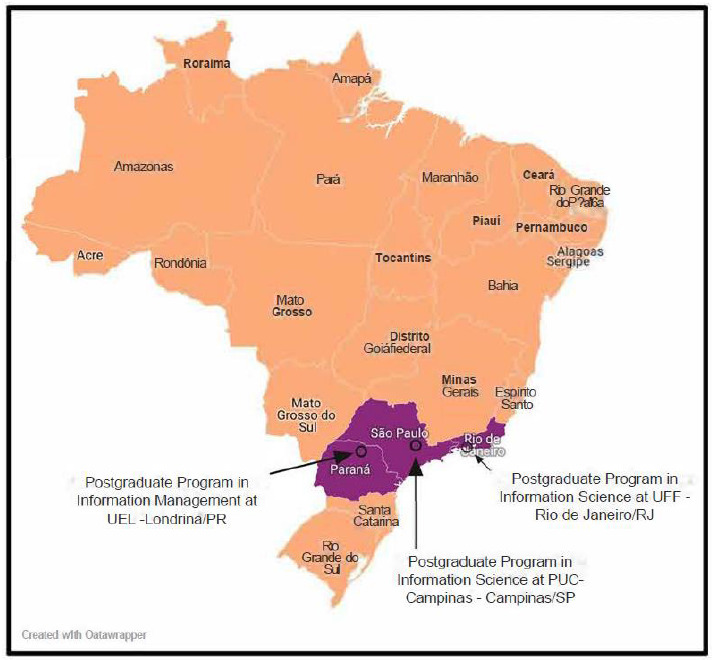
As for the identification of the state and region (variable 12) of the excluded programs, all three programs are located in the South and Southeast regions, as shown in Figure 2.

Distribution by Brazilian states and regions of deactivated Information Science graduate programs - situation in 2022
From Figure 2, we can see that the three deactivated programs are located in the regions that together have the highest concentration of programs in Information Science, with the South region having an inactive program in the state of Paraná, and the Southeast region having two inactive programs, one in the state of São Paulo and one in the state of Rio de Janeiro. It is important to note that the UEL deactivated its Information Management program in 2014, but since 2012 it has created a new master's and doctoral program in Information Science, which is active.
All the deactivated programs have Information Science as their major field (variable 13), which is related to the CAPES assessment area (variable 14) called Communication and Information. As for the type of teaching (variable 15), they are all face-to-face, and according to the level (variable 16), there is one with an Academic Master's Degree (PUC/Campinas), one with a Professional Master's Degree (UEL) and one with an Academic Master's Degree that started in 1970 and an Academic Doctorate that started in 1991 (UFF).
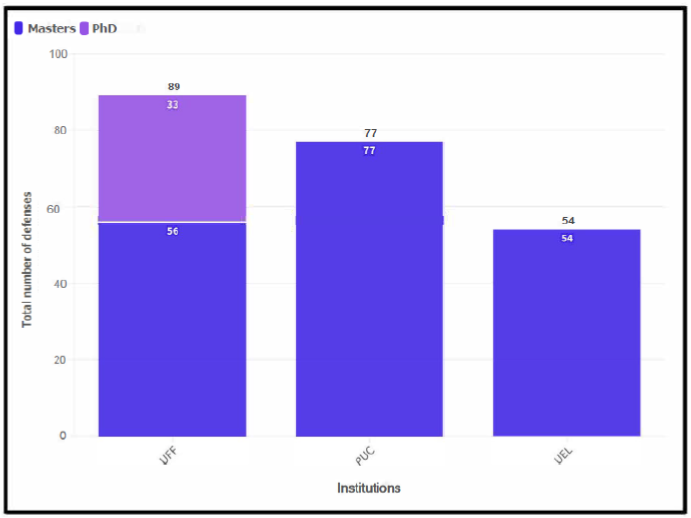
With regard to the number of defenses (variable 17) that took place in the three deactivated programs between 2004 and 2021, it was found that there were 220 Master's defenses, as shown in Graph 2.

Number of defenses of deactivated Information Science programs; values between 2004 and 2021
As can be seen in Graph 2, out of a total of 220 defenses, there were 89 or 40.5% defenses in the UFF program, 77 or 35% defenses in the PUC/Campinas program, and 54 or 24.5% defenses in the UEL program. In summary, there were 133 or 60.5% of academic Master's defenses (PUC/Campinas and UFF), 54 or 24.5% of professional Master's defenses (UEL) and 33 or 15% of academic Doctoral defenses (UFF). The UEL program, which is a professional program, had a high number of defenses, with 54 defenses in only six years, which means an average of nine defenses per year. This result confirms the study of Martins et al. (2015, p. 411) when they report that "[...] the growing demand and need for improvement among graduate professionals has led them to seek new knowledge to qualify their professional performance".
With regard to the research topics (variable 18), the results are presented separately by institution, based on the frequency of appearance of the keywords attributed by the respective authors, considering those that appeared twice or more. First, Graph 3 shows the variety of terms and their respective quantities related to the PUC-Campinas program from 2004 to 2006 (the program was abolished in 2007).
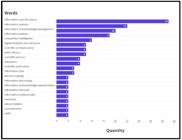
Themes of research defended in the PUC-Campinas program, from 2004 to 2006, and their corresponding quantities, based on the most frequent keywords.
When examining the set of keywords with the most occurrences in PUCCAMP papers between 2004 and 2006, the term "information (specific types)" dominates with 19 occurrences, including studies on scientific, business, government, technical, and decision-making information, with 9 occurrences of the term "information" alone, which does not provide enough semantics to be an element that "[. . .] enhances access to the content of documents, beyond the information represented by the title and abstract", as argued by Miguéis et al. (2013, p. 115). Fujita et al. (2023, p. 3) have already discussed the problem of the "lack of methodological guidance for the indexing process" when authors assign keywords to their publications. In light of this problem, it should be noted that this set of keywords does not necessarily reflect the topics and issues actually addressed in information science research.
There were also 12 occurrences of terms representing the management and representation of information and knowledge, showing the link between information science and the organization of knowledge and its management aspects. Terms related to knowledge domains were also found, such as "information science" with 9 occurrences and "documentation" with 2 occurrences. A primary analysis of the keywords shows the relevance of the technological aspects of information (with the terms "information systems", "information technology", "information retrieval") with 16 occurrences, the theme of scientific communication (with the terms "scientific communication", "scientific journal", "scientific production", "scientometrics") with 14 occurrences, and the focus on people (with the terms "digital inclusion and exclusion", "information professional") with 7 occurrences.
Taking into account the conceptual scope of the field of information science, as defined by Saracevic (1996), as well as subsequent reflections by other authors (Pinheiro, 2006; Araújo and Valentin, 2019 ), it is possible to conclude that the thematic diversity found in Figure 5includes terms representative of studies in the field, namely: "information (specific types)", "information systems", "information and knowledge management", "scientific communication", "scientific production", "information flow", "information technology", "representation of information and knowledge", and "information retrieval". These nine terms are frequently addressed in information science research, reflecting the different fields of study and research.
Graph 4 shows the variety of terms and their quantities in relation to the UEL program between 2010 and 2012 (the program was discontinued in 2014).

Themes of research defended in the UEL program, from 2010 to 2012, and their corresponding quantities, based on the most frequent keywords.
In the analysis of the themes defended in the UEL postgraduate studies, no keywords were found among the terms that represent areas of knowledge, as was the case with the results of PUC-Campinas. Seventeen occurrences were found for terms that represent the link between information science and the organization of knowledge and its management aspects (with the terms "information organization", "information and knowledge management", "information mediation"). A primary analysis of the keywords also shows the relevance of the technological aspects of information (with the terms "information systems", "information technology", "information retrieval"), with 16 occurrences, and issues related to people (with the terms "information behavior", "information competence", "information needs"), with 11 occurrences. These data reflect the diversity of topics in the research conducted at UEL and underscore the importance of an integrated and holistic view of information and related processes.
Graph 5 shows the variety of terms and their quantities in relation to the UFF program between 2004 and 2009 (the program was discontinued in 2008).

Themes of research defended in the UFF program, from 2004 to 2009, and their corresponding quantities, based on the most frequent keywords.
When examining the set of keywords with the most occurrences in the UFF papers between 2004 and 2009, the term "information (specific types)" dominates, as in the PUC-Campinas results, with 23 occurrences, including studies on scientific, archival, cultural, geographical, governmental, journalistic, technical and technological information, with 10 occurrences of the term "information" alone. As mentioned above, this usage does not provide sufficient semantics, as discussed by Miguéis et al. (2013).
There were 16 occurrences of terms representing the management and representation of information and knowledge (with the terms "knowledge organization", "knowledge management", "knowledge representation", "information transfer"), showing the link between information science and the organization of knowledge and its management aspects. Terms related to knowledge fields were also found, such as "information science", "education", "museology", "documentation" and "archivology", with a total of 18 occurrences.
The analysis of the keywords also shows the relevance of the technological aspects of information (with the terms "information technology", "electronic network", "information retrieval", "information systems", "information architecture"), with 16 occurrences, the theme of scientific communication (with the terms "scientific communication", "journals"), with 12 occurrences, and issues related to people (with the terms "information user studies", "information society"), with 11 occurrences. These are very central topics in information science studies when analyzed in the light of Saracevic's (1996) definition of the field.
Furthermore, noteworthy was the theme of "interdisciplinarity", with 7 occurrences that did not appear in the keywords of the papers in the other two programs. It is understood that the set of keywords shown in Figure 5reflects the rich diversity of approaches and the depth of research carried out at UFF, underlining the continuous evolution and importance of Information Science in the academic context of the institution over the years.
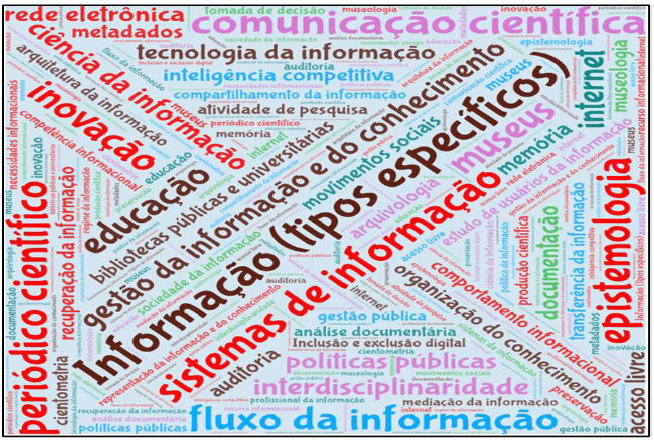
When analyzing the set of the three deactivated postgraduate courses (UEL, UFF and PUCCAMP), the centrality of the term "information (specific types)" is evident, with 42 occurrences, along with the term "information flow", with 9 occurrences", reinforcing the intrinsic importance of information in the field of Information Science, with the flow of information being its object of study, analysis, and use in the various investigations carried out by the postgraduate courses. And it is possible to note that the UFF showed remarkable consistency in terms of mentions of other keywords. These nuances reflect the particularities of each program and the evolution of their lines of research, but in essence, they all converge towards the appreciation and profound understanding of information in their respective academic contexts. An illustrative representation of the scientific fields of the three programs is shown in Figure 3.
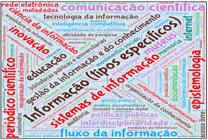
Cloud of the most frequently occurring keywords representing the field of research of the three deactivated postgraduate programs (UEL, UFF and PUCCAMP).
As can be seen in Figure 3, in addition to the two terms already mentioned, attention is drawn to terms that highlight the field's vocation for science communication, technological aspects related to innovation and access to information, as well as the emphasis on the organization and management of knowledge for different audiences. The results listed here are in line with the theoretical-conceptual bases or principles/foundations of information science as presented in the literature of the field, such as the classical concept proposed by Borko (1968, p. 3):
Information science is the discipline that studies the properties and behavior of information, the forces that govern information flows, and the implications of information processing for optimal accessibility and usability. Information science is concerned with the body of knowledge related to the origin, collection, organization, storage, retrieval, interpretation, transmission, transformation, and use of information. It includes research into the representation of information in natural and artificial systems, the use of codes for the efficient transmission of messages, and the study of processing and techniques applied to computers and their programming systems. [...].
From a conceptual and practical perspective, the studies of Information Science are based on the concepts identified, particularly with regard to the transfer of information through flows that guarantee the generation of knowledge and value for organizations.
In turn, the consideration of Information Science as an interdisciplinary field has been discussed since Saracevic (1996), who states that relations between fields are strengthened, generating new knowledge based on new reflections "[...] that take different levels of intellectual cooperation [...]" (Saracevic, 1996, p. 50). It should be noted, however, that this is not yet a settled issue in information science. In the study presented here, the term "interdisciplinary" appeared only in the keywords of the articles from the UFF program, but in the study by Lança, Amaral and Gracioso (2018), the term was used more forcefully. According to the authors, the territory is determined and delimited by interdisciplinary relations, "[...] in a process of constant mutation, like a living organism [...]", whose "[...] transmutations are determined by scientific, technological, economic, historical, social and cultural phenomena [...]" (Lança, Amaral and Gracioso, 2018, p. 159).
In addition to the discussion about the interdisciplinarity of the field, research in the field involves in-depth studies related to theories, concepts, and principles that lead to reflection and imagination to produce theoretical knowledge. Information science is also concerned with empirical information problems. It is therefore possible to observe that Information Science continues to evolve to find theoretical, experimental, and practical solutions, a nature already observed by Saracevic (1996). In this sense, the professional programs are manifested, which aim to train professionals "[...] committed to the ethics and the economic, social, and educational functions of information for citizenship, [...] generating and disseminating technical and scientific knowledge for innovation [...]" (Martins et al., 2015, p. 419).
Regarding the reasons for the deactivation of the programs (variable 19), it was clear that two of them - PUC-Campinas and UEL - did not reach the minimum score required to guarantee their operation, as determined by the CAPES evaluation. As for the UFF program, it was deactivated due to an institutional problem since the interinstitutional partnership contract was not renewed.
It should be noted that this is not unique to computer science, as studies in other fields of knowledge have shown. Tonon, Matsuura and Lage Júnio (2022) show that in the field of production engineering, three programs were deactivated in 2021 (there were 75 in operation) for reasons related to the low score obtained in the CAPES evaluation. A similar trend was observed in the study of Rocha, Leal and Ribeiro (2021), in the field of Law, whose results showed the existence of two deactivated programs in 2020 (there were 103 in operation), with indications that the reasons are related to the CAPES evaluation.
As reflected by Velloso (2014, p. 13), postgraduate education is supported by a single regulatory framework, "[...] which created clear and uniform parameters for the creation and operation of programs, evaluation mechanisms centralized by CAPES [...] and funding mechanisms linked to the evaluation of programs [...]". It is likely that the challenge to be overcome relates to the standard of evaluation, which could not be the same for everyone due to economic differences between regions, which could lead to unfair evaluation. "This is because the country's economic development has tended to favor certain regions, harming others [...]" (Guimarães; Brito; Santos, 2020, p. 50), which is a socially constituted problem and, as such, difficult to solve.
5 FINAL CONSIDERATIONS
When studying the panorama of Brazilian Postgraduate Programs in Information Science, it was possible to see that they have followed the development of Brazilian Postgraduate Programs, considering the increase in the number of programs and the distribution among Brazilian regions. There were indications that the Northeast region has promoted the creation of programs in the area, since in this study it has more PPGs than the South. This strongly suggests that there is an effort to decentralize knowledge and to strengthen regions that were previously underserved by computer science programs. However, in general, the programs in the Northeast have lower scores than the PPGs in the South and Southeast, probably due in part to the impact of the CAPES evaluation, which does not adopt criteria based on the socio-economic reality of each region and/or community.
Postgraduate programs in computer science began in 1970, and at the time of this study's survey (2022), there were a total of 27 current programs and three that had been deactivated. The finding that the number of active programs is much higher than the number of deactivated programs indicates that the programs are trying to meet the evaluation criteria and thus maintain the continuity of the courses offered to maintain a quality standard focused on research practices, an occurrence that has also been observed in other fields of knowledge.
Of the deactivated programs (two academic and one professional), the professional program was implemented in the 21st century, in 2008, and had a relatively short lifespan (six years) compared to the other two (1970 and 1977). The reason for deactivating the newer programs was the lower score obtained in the CAPES evaluation, while the older program was deactivated because the contract between the institutions that offered it was not renewed.
Despite their inactivation, the three programs contributed to the advancement of Brazilian Information Science, in the sense that they produced 220 pieces of research in the period analyzed, with the participation of the professional program standing out, considering its short period of existence. This shows the value of professional courses for society and the interest of professionals in the field in solving empirical information problems, which proves the social and applied nature of Information Science.
As for the topics studied in the defended studies, it was found that the programs maintained the principles and foundations of Information Science. The concentration areas and their respective lines of research have developed studies that comprehensively represent the information universe. This is due to the analytical focus on the different aspects, contexts, and approaches to the object of information.
Based on these results, it is understood that the general objective of the study was achieved, since the study characterized the deactivated postgraduate programs in the field of information science. The analysis made it possible to see the possible challenges that permeate the trajectory of these programs, especially with regard to the attempt of two of them (PUC-Campinas and UEL) to meet the evaluation criteria.
The primarily quantitative nature of this study made it impossible to carry out a more in-depth and contextualized analysis of the challenges faced by postgraduate programs in Information Science. In this sense, the study manifested itself as a first discussion, the results of which show a small quantitative part of this level of education in the field mentioned. Therefore, the conclusions represent a starting point for further research on the progress and challenges of postgraduate programs offered by educational institutions in Brazil.
In an attempt to continue studying this issue, two new research approaches are being developed, both of a qualitative nature. We propose to study the main reasons that led to the deactivation of the programs through interviews with the coordinators of these courses. Another possibility is to analyze the CAPES evaluation criteria and their impact on the standardization of the evaluation process, regardless of the socio-economic conditions of each Brazilian region.
Acknowledgements:
Thanks to the National Council for Scientific and Technological Development - CNPq (process 307765/2023-7) for the promotion of research and to the Coordination Foundation for the Improvement of Higher Education Personnel - CAPES for the sandwich doctoral scholarship awarded to the first author.
References
-
ARAÚJO, C. A. Á; VALENTIM, M. L. P. A Ciência da Informação no Brasil: mapeamento da pesquisa e cenário institucional. Bibliotecas, Anales de Investigación, México, v. 15, n. 2, p. 232-259, jul./dez. 2019. Disponível em: https://l1nq.com/z7n1P Acesso em: 24 set. 2023.
» https://l1nq.com/z7n1P - BALBACHEVSKY, E. A pós-graduação no Brasil: novos desafios para uma política bem sucedida. In: Brock. C.; SCHWARTZMAN, S. Os desafios da educação no Brasil. Rio de Janeiro: Nova Fronteira, 2005.
- BORKO, H. Information Science: what is it? American Documentation, [S.l.], v. 19, n. 1, p. 3-5, jan. 1968.
-
CARDOSO, M. C. de O; DANTAS, R. M. M. C. A Pós-Graduação stricto sensu, a avaliação e suas controvérsias. Revista Scientiarum Historia, Rio de Janeiro, v. 1, n. 1, p. 8, jan./jun. 2019. Disponível em: https://encr.pw/ZiFxf Acesso em: 24 set. 2023.
» https://encr.pw/ZiFxf -
CÔCO, D; AMARAL, L. O PROEX/CAPES como política pública de Pós-Graduação. Interfaces da Educação, Paranaíba, v. 12, n. 35, p. 792-815, dez. 2021. Disponível em: https://l1nq.com/7B841 Acesso em: 24 set. 2023.
» https://l1nq.com/7B841 -
FUJITA, M. S. L. et al. Atribuição de palavras-chave em trabalhos completos de evento: análise de controle de vocabulário. Informação & Informação, Londrina, v. 27, n. 4, p. 1-31, 2023. Disponível em: https://encr.pw/XnxY9 Acesso em: 28 jun. 2024.
» https://encr.pw/XnxY9 -
GUIMARÃES, A. R; BRITO, C. de S; SANTOS, J. A. B. dos. Expansão e financiamento da Pós-Graduação e desigualdade regional no Brasil. Revista Práxis Educacional, Vitória da Conquista, v. 16, n. 41, p. 47-71, dez. 2020. Disponível em: https://acesse.dev/JsSvR Acesso em: 24 set. 2023.
» https://acesse.dev/JsSvR -
LAFUENTE, D. et al. A Gentle introduction to machine learning for chemists: an undergraduate workshop using python notebooks for visualization, data processing, analysis, and modeling. Journal of Chemical Education, [S. l.], v. 98, n. 9, p. 2892-2898, set. 2021. Disponível em: https://acesse.dev/PbmcC Acesso em: 15 jul. 2023.
» https://acesse.dev/PbmcC -
LANÇA, T. A; AMARAL, R. M; GRACIOSO, L. S. Multi e interdisciplinaridade nos programas de Pós-Graduação em Ciência da Informação brasileiros. Perspectivas em Ciência da Informação, Belo Horizonte, v. 23, n. 4, p. 150-183, out./dez. 2018. Disponível em: https://encr.pw/Qz5EY Acesso em: 23 set. 2023.
» https://encr.pw/Qz5EY -
MAGALHÃES, L. S. A Pós-Graduação em Educação na Região Norte e a CAPES: avaliação, indução e autoavaliação-planejamento. 2023. 278f. Tese (Doutorado em Educação) - Faculdade de Educação, Universidade Federal do Amazonas, Manaus, 2023. Disponível em: https://encr.pw/edYYL Acesso em: 23 set. 2023.
» https://encr.pw/edYYL -
MANUAL dos Dados Abertos: Governo. Tradução e adaptação para o contexto brasileiro por Comunidade Transparência Hacker. Brasília: Comitê Gestor da Internet no Brasil (CGI.br), 2011. Disponível em: https://acesse.dev/Bm8EJ Acesso em: 25 out. 2023.
» https://acesse.dev/Bm8EJ -
MARTINS, A. C. de M. et al. Mestrado profissional na área de Ciência da Informação no Brasil: o caso de Santa Catarina. Revista ACB: Biblioteconomia em Santa Catarina, Florianópolis, v. 20, n. 3, p. 411-422, set./dez. 2015. Disponível em: https://encr.pw/mEv9P Acesso em: 25 set. 2023.
» https://encr.pw/mEv9P - MIGUÉIS, A. et al. A importância das palavras-chave dos artigos científicos da área das Ciências Farmacêuticas, depositadas no Estudo Geral: estudo comparativo com os termos atribuídos na MEDLINE. InCID: Revista Ciência da Informação e Documentação, Ribeirão Preto, v. 4, n. 2, p. 112-125, 2013.
-
NAZARENO, E; HERBETTA, A. F. A Pós-Graduação brasileira: sua construção assimétrica e algumas tentativas de superação. Estudos de Psicologia, Campinas, v. 24, n. 2, p. 103-112, abr./jun. 2019. Disponível em: https://acesse.dev/6hXcf Acesso em: 23 set. 2023.
» https://acesse.dev/6hXcf -
NOBRE, L. N; FREITAS, R. R. A evolução da Pós-Graduação no Brasil: histórico, políticas e avaliação. Brazilian Journal of Production Engineering, São Mateus, v. 3, n. 2, p. 18-30, jul./dez. 2017. Disponível em: https://l1nq.com/mr8dG Acesso em: 24 set. 2023.
» https://l1nq.com/mr8dG -
NÓBREGA, M. H. da. Orientandos e orientadores no século XXI: desafios da Pós-Graduação. Educação & Realidade, Porto Alegre, v. 43, n. 3, p. 1055-1076, jul./set. 2018. Disponível em: https://acesse.dev/BoP3B Acesso em: 24 set. 2023.
» https://acesse.dev/BoP3B -
ORTH, T. O processo de fechamento do Programa de Pós-Graduação em Serviço Social da PUCRS: a quem serve a política de educação no Brasil? In: ENCONTRO INTERNACIONAL DE POLÍTICA SOCIAL, 9., 2023, Vitória. Anais [...]. Vitória: UFES, 2023. p. 01-15. Disponível em: https://l1nq.com/pHPKQ Acesso em: 24 set. 2023.
» https://l1nq.com/pHPKQ -
PARADA, C. G. de L; KANTORSKI, L. P; NICHIATA, L. Y. I. Novos rumos da avaliação da Pós-Graduação brasileira e os desafios da área de Enfermagem. Revista Gaúcha de Enfermagem, Porto Alegre, v. 41, n. 1, p. 01-02, jan./jun. 2020. Disponível em: https://l1nq.com/cgWlU Acesso em: 24 set. 2023.
» https://l1nq.com/cgWlU -
PINHEIRO, L. V. R. Cenário da Pós-Graduação em Ciência da Informação no Brasil: influências e tendência. In: ENCONTRO NACIONAL DE PESQUISA EM CIÊNCIA DA INFORMAÇÃO, 8., 2007, Salvador. Anais [...]. Salvador: ANCIB, 2007. p. 01-14. Disponível em: https://acesse.dev/NVoEt Acesso em: 23 set. 2023.
» https://acesse.dev/NVoEt -
PINHEIRO, L. V. R. Fontes ou recursos de informação: categorias e evolução conceitual. Pesquisa Brasileira em Ciência da Informação e Biblioteconomia, João Pessoa, v. 1, n. 11, 2006. Disponível em: https://l1nq.com/qRcFP Acesso em: 25 out. 2023.
» https://l1nq.com/qRcFP - PRODANOV, C. C; FREITAS, E. C. de. Metodologia do trabalho científico:métodos e técnicas da pesquisa e do trabalho acadêmico. 2. ed. Novo Hamburgo: Feevale, 2013.
-
ROCHA, D. V. da; LEAL, F; RIBEIRO, L. M. A expansão da Pós-Graduação em Direito no Brasil (1998-2017): avanço quantitativo e persistências metodológicas. Revista Eletrônica do Curso de Direito da UFS, Aracaju, v. 16, n. 2, p. 01-35, jul./dez. 2021. Disponível em: https://encr.pw/lhCpk Acesso em: 25 set. 2023.
» https://encr.pw/lhCpk -
SARACEVIC, T. Ciência da Informação: origem, evolução e relações. Perspectiva em Ciência da Informação, Belo Horizonte, v. 1, n. 1, p. 41-62, jan./jun. 1996. Disponível em: https://encr.pw/Xa8yy Acesso em: 26 set. 2023.
» https://encr.pw/Xa8yy -
SILVA, M. da C. F. Pós-Graduação stricto sensu e desenvolvimento regional. Publicação UEPG Ciência, Humanidades, Ciência e Sociologia Aplicada, Linguística, Letras e Artes, Ponta Grossa, v. 16, n. 1, p. 55-60, jun. 2008. Disponível em: https://l1nq.com/5sFta Acesso em: 24 set. 2023.
» https://l1nq.com/5sFta -
SOUZA, R. F. de; STUMPF, I. R. C. Ciência da Informação como área do conhecimento: abordagem no contexto da pesquisa e da Pós-Graduação no Brasil. Perspectiva em Ciência da Informação, Belo Horizonte, v. 14, núm. esp., p. 41-58, dez. 2009. Disponível em: https://acesse.dev/5ZX9O Acesso em: 24 set. 2023.
» https://acesse.dev/5ZX9O -
TONON, G. F. de L; MATSUURA, G. T. M; LAGE JÚNIO, M. Análise da Graduação e da Pós-Graduação para o Curso de Engenharia de Produção no Brasil. Revista de Ensino de Engenharia, [S. l.], v. 41, n. 1, p. 350-361, jan. 2022. Disponível em: https://encr.pw/6NzfM Acesso em: 25 set. 2023.
» https://encr.pw/6NzfM -
TREVISOU, J. V; BALSANELLO, G. Uma década de Pós-Graduação: o que a experiência da UFFS evidencia? Fronteiras: Revista Catarinense de História, Chapecó, v. 41, n. 1, p. 213-239, jan./jun. 2023. Disponível em: https://encr.pw/dmF5k Acesso em: 24 set. 2023.
» https://encr.pw/dmF5k -
URBANETZ, S. T; CASSIANO, E. L. O Mestrado Profissional em Educação Profissional e Tecnológica (PROFEPT) e o significado dessa oferta de formação em Pós-Graduação no Brasil. Movimento: Revista de Educação, Niterói, ano 7, n. 14, núm. esp., p. 135-156, dez. 2020. Disponível em: https://acesse.dev/90XZY Acesso em: 23 set. 2023.
» https://acesse.dev/90XZY -
VELLOSO, A. A pós-graduação no Brasil: legados e desafios. Almanaque Multidisciplinar de Pesquisa, Rio de Janeiro, v. 1, n. 1, 2014. Disponível em: https://encr.pw/r8jpE Acesso em: 23 set. 2023.
» https://encr.pw/r8jpE -
VENTURINI, A. C. Ação afirmativa na Pós-Graduação: os desafios da expansão de uma política de inclusão. 2019. 320f. Tese (Doutorado em Ciência Política) - Centro de Ciências Sociais, Universidade do Estado do Rio de Janeiro, Rio de Janeiro, 2019. Disponível em: https://encr.pw/LNF0U Acesso em: 23 set. 2023.
» https://encr.pw/LNF0U

-
1
[1] The Graduate Program in Information Science (PPGCI) of the Federal University of Sergipe (UFS) reports on its website that Capes has approved the operation of the first Professional Doctorate in Information Science in Brazil, scheduled to begin in 2024. However, at the time of publication of this article, the registration of the program was not yet available on the Sucupira platform with information about the program.


 Source: Study data (2023).
 Legend: red bars: deactivated programs; green bars: active programsSource: Research data (2024).
 Source: Study data (2024).
 Source: Study data (2024).
 Source: Study data (2024).
 Source: Study data (2024).
 Source: Study data (2024).
 Source: Study data (2024).