 SOCIAL NETWORK ANALYSIS OF THE THEMES: INFORMATION MANAGEMENT AND INNOVATION
ABSTRACT:
This study aims to identify relations between the terms "information management" and "innovation management" with a view to the formation of a bibliographic portfolio for the interdisciplinary study of the subject in Information Science. This is an exploratory study with application of Social Network Analysis tool in the Science Direct database between 2010-2015 to construct diagrams that represent the interaction between the most frequent concepts of the network. The results evidenced the low quantitative interaction between the terms analyzed and a possible gap to be explored by Information Science in the Information Management sub-area.
KEYWORDS:
Interdisciplinary; Information management; Innovation; Concept theory; Information organization
RESUMO:
O objetivo do estudo é identificar relações entre os termos “gestão da informação” e “gestão da inovação” com vistas à formação de um portfólio bibliográfico para o estudo interdisciplinar do tema em Ciência da Informação. Trata-se de um estudo exploratório com aplicação de ferramenta de Análise de Redes Sociais na base de dados Science Direct entre 2010-2015 para construção de diagramas que representem a interação entre os conceitos mais frequentes da rede. Os resultados evidenciaram a baixa interação quantitativa entre os termos analisados e uma possível lacuna a ser explorada pela Ciência da Informação na sub-área da Gestão da Informação.
PALAVRAS CHAVE:
Interdisciplinaridade; Gestão da informação; Inovação; Teoria do conceito; Organização da informação
RESUMEN:
El objetivo del estudio es identificar correlaciones entre los términos "gestión de la información" y "gestión de la innovación" con miras a la formación de una cartera bibliográfica para el estudio interdisciplinario del tema en Ciencia de la Información. Se trata de un estudio exploratorio con aplicación de herramienta de Análisis de Redes Sociales en la base de datos Science Direct entre 2010-2015 para la construcción de diagramas que representen la interacción entre los conceptos más frecuentes de la red. Los resultados evidenciaron la baja interacción cuantitativa entre los términos analizados y una posible laguna a ser explorada por la Ciencia de la Información en la sub-área de la Gestión de la Información.
PALABRAS CLAVE:
Interdisciplinariedad; Gestión de la información; Innovación; Teoría del concepto; Organizacíon de la informácion
1 INTRODUCTION
Nowadays, the importance of Innovation Management in the context of the competitiveness of companies is consensual, adding to the importance of the knowledge management process on quality information (SORDI, 2008).
However, the term "knowledge" is sometimes used synonymously with "information" and vice versa. In the field of Information Science (IC), the reduction of the conceptual ambiguity between terms is essential for the proper development of research and practices in the area and, in this case, the term of “information". Even more, since it integrates the epistemological status of a scientific area.
Vick, Nagano and Santos (2009) explain that "both information and knowledge are relational insofar as they depend on the transmission of meanings dynamically through human actions".
The relevance of each area is affirmed when one realizes that not just the development of better technologies if there isn´t an information management. Both the knowledge and the information comes from the human creativity, so it is necessary that we have a focus on the need for the 'end user', analyzing the human factor in all aspects (Davenport, 1998).
Rossatto (2003, p.7) describes knowledge management as "a continuous and dynamic strategic process aimed at managing the company's intangible capital and all strategic points related to it and stimulating the conversion of knowledge". (our translation). In turn, information management is described by Choo (2003, p.19) as a "strategic resource of the organization".
Therefore, it is assumed that managing information means constantly seeking new ideas, processes or improvements in products or services. It is in the process of managing information and developing the knowledge that innovative groups can come up, setting goals, goals and working in teams
Defending the idea that Information Management can offer a relevant contribution in the processes of innovation of organizations. The present study aims to explore the relation between the themes: information management and innovation in articles published in the base science direct in recent years.
This study is characterized as exploratory, because it analyzes two themes already consolidated in their respective fields of study. However, although a lot of potential has already been observed for proposals for additional applications, still had no answer to the following research question:
What is the incidence of use of the term 'Information Management' in the publications that address the innovation management in several fields of knowledge?
What is the incidence of use of the term 'Information Management' in the publications adressing innovation management in various fields of knowledge?
The application of Social Network Analysis is a tool used to verify the relation between themes. Adjacency matrices were built with the UCINET and Netdraw software that allow us to analyze and describe some relevant considerations of the research question that we propose to answer.
UCINET is a software package for data analysis of social networks that includes the NetDraw network visualization tool. The software allows an analysis of the connections and differentiates by color the levels of the entities involved in the study, allowing a better visualization and analysis of the mapping.
2 INNOVATION MANAGEMENT
The publications on innovation topic have gained ground, in the various fields of knowledge over the last few years. However, it is possible to observe several contexts which the innovation process is more established. Characteristically in countries where technological capacity is more advanced and which present higher rates of investment in Research and Development (R&D).
This situation evidences the need for maturation of several aspects that allow more efficiency in the innovation process. As in the case of innovation culture, financial incentives for innovative development, human resources, partner networks, absorption capacity, learning processes, access to information, among others (CHOEN & LEVINTHAL, 1989, 1990; DYER & SINGH, 2003).
In this sense, the results of the innovation management can be perceived directly in the business competitiveness and consequently to reflect on the sustainable growth. In addition, innovation has a character of prospecting opportunities, seeking solutions to perceived problems, changes in the conventional business model that can add value.
Entrepreneurial potential and continuous R&D investment are directly linked to innovation processes. Tidd, Bessant and Pavitt (2008) show that innovation is not just about generating new ideas, new markets, but also about new ways of acting in established firms.
Regarding the way innovation occurs, Tidd, Bessant and Pavitt (2008, p.107) indicate that an understanding is possible where "innovation is a process, not an isolated event, and needs to be managed as such. Influences on this process can be manipulated to affect the outcome - that is, innovation can be managed" (our translation).
Internal interaction between employees and external stakeholders is conducive to the development of innovations (CHESBROUGH, 2003). Through the exchange of experiences between the participants of the group, understanding of the organization´s functioning, it becomes possible the learning process, insertion of routines capable for better results in the innovation management aspects.
2.1 Innovation Concept
Innovation is a continuous process that occurs in an orderly and organized way, so it depends on management. The innovation concept is broadly addressed in the Oslo Manual, as can be seen in the following definition:
“An innovation is the implementation of a product (good or service) new or significantly improved, or a process, or a new marketing method, or a new organizational method in business practices, workplace organization or external relations” (MANUAL DE OSLO, 2005, p. 56).
Although the approach of the Oslo Manual (2005, p. 56) innovation concepts is more focused on products and services, in which "an innovation can be more narrowly categorized due to the implementation of one or more types of innovation, i.e., product and process innovations".
A product or process can be recognized as an innovation, it must be implemented and recognized its value by the market. According to the Oslo Manual (2005, p 56), "an innovative enterprise is one that has implemented innovation during the period of analysis".
In this connection, on innovation concept, it´s relevant to mention that innovation is directly related to the organization's strategy, teamwork, openness and willingness to change. In order for this, the organization needs to be prepared to face the challenges and needed changes, so the support of managers is fundamental.
2.2 Types of Innovation according Oslo Manual
This subsection is based on the main standardization document for concepts related to innovation at the global level: the Oslo Manual (2005). Definitions on types of innovation are still under development and are less established than definitions of product and process innovation.
The Oslo Manual (2005) points to four forms of innovation: product, process, organizational and marketing. The innovations of products and processes, focusing on technological concepts promoting significant changes in these products and processes, boosting performance and ratability. The organizational and market innovations focus on a broader set of innovations, from deploying new organizational methods to product design changes and ways of building the value of the product or service.
The primary contribution of the economist Joseph Alois Schumpeter is cited in the Oslo Manual (2005) for having an influence on innovation theories. His position argues that by a dynamic process development is being conducted, so that new technologies are eliminating the old technologies, a phenomenon described by him as a "creative destruction".
Schumpeter (1934, apud MANUAL DE OSLO, 2005, p. 36) the radical innovation is more complex and generates ruptures; while incremental innovation aims to "increase" will give continuity to the processes.
Schumpeter (1934) proposes five types of innovation:
-
introduction of new products
-
introduction of new production methods;
-
opening new markets;
-
development of new sources of raw materials and other inputs;
-
creation of new market structures in an industry.
The Oslo Manual (2005) classifies innovation in four areas: product, process, marketing and organization. It is understood by product, consumer goods and services rendered. Product technological innovation can be presented in two ways: new products technologically (product may even have been based on a prior technology but overall new and differentiated focus); technologically enhanced products (simple use products that improve their performance significantly, may involve cost enhancement as well).
The definitions of marketing and organizational innovations are not yet well defined; they are in the process of being developed, as opposed to the definitions of product and process innovation. Marketing innovations are turned to serve the market and consumers in order to while organizational innovation is related to change, provide better performance for the organization and its business (OSLO, 2005).
The recognition of this identity between new and improved product may generate some recognition difficulty at first, especially in the service sector.
The search for improvements in performance, cost reduction and market competitiveness are some of the factors that drive companies on innovation way.
Accordingly, the Oslo Manual (2006, p. 37) points to the Schumpeterian view that "tends to emphasize innovation as market experiments and to look for large, sweeping changes that fundamentally restructure industries and markets".
Finally, innovation in the current context can also be presented as a business strategy in order to increase the development and performance of a product or service. This helps to demystify the idea that innovation is directly related to technology, just rescue the types mentioned in this section to realize how broad this understanding can be.
2.3 Stages of the Innovation process
In the organizational environment the expected effects occur differently. For this reason, several methodologies provide steps and procedures for establishing the steps of the innovation process. This procedure for innovation should not be considered as a standard, since in different contexts and cultures adaptations of the models and methodologies are necessary according to the reality of the organization.
Stefanovitz e Nagano (2014, p. 463) argue that "to succeed through innovation, a set of activities must happen in a coordinated and synchronized way".
Figure 1 shows a proposal for consolidating the synthesis of innovation management processes and their delimitations (STEFANOVITZ; NAGANO, 2014).

The need to collect and analyze information about a new product in the market is a key factor in the innovation process. This action occurs in the Prospecting phase, which the end customer receives a new product or service offer.
In the Ideation phase presents as an extraordinary factor, new proposals that present ideas of new solutions or improvements to something already existing.
The next step is Strategy Building, a process that is divided into three stages: analysis, choice and planning. The information is fundamental in this process and all the collections, analyzes carried out at this stage are fundamental for the implementation of the idea (TIDD, BESSANT, PAVITT, 2008).
The Resource Mobilization appears between the construction strategy and implementation which is necessary to define what resources will be used in the execution.
Implementation results from all previous phases and the result are in a product or service that is being awaited by a specific market. Time and cost are decisive at this stage; the whole organization is involved at this phase. The process of developing new products and services are the two main processes that guide the implementation of innovations (STEFANOVITZ; NAGANO, 2014).
The process of innovation management (STEFANOVITZ; NAGANO, 2014) also includes the Evaluation phase, which will enable organizations' innovation processes to constantly improve, through analyzes that show advances and setbacks. This evaluation process will encompass two phases: one of review of the project (soon after release) and another of evaluation of the system (allowing monitoring).
In the words of Stefanovitz and Nagano (2014, p. 466) "The challenge of innovating requires the creation of new ideas, the overcoming of technological and marketing paradigms and a new look at reality. It is not, therefore, a mechanistic process with standardized and repetitive inputs and outputs".
Therefore, the idea that innovating action should not be based solely on technological modernization is reinforced, it is necessary to establish a culture of innovation that engages people and provides good insights of creativity.
3 INFORMATION MANAGEMENT
In the scope of Information Management, it is the role of the information professional to ensure that the correct and relevant information reaches the user, to the decision maker at the right moment, assisting in the informational demand of a specific context.
In a competitive environment, the management of information is essential to establish a sense of trust and bond among the organization's employees. Moreover, the maintenance of these attributes is of extreme importance for the image of this organization. The better the information management in the organization, the better the performance of your collaborative network, for example.
According to Choo (2003b, p.19), "information is the resource that allows an effective combination and use of the other factors of production - in fact, it is the meta-resource that coordinates the mobilization of other means in order to enable the organization to perform".
It is important for each organization to find ways to effectively manage its information processes, thereby increasing learning and adaptation, transforming information into knowledge.
Choo (2003b, p. 20) argues that "As rhetoric, information management is often equated with information technology management or the management of information resources or the management of information policies and models". This idea is presented in Figure 2.

3.1 The Informational model of Choo
The informational model of Choo (2003b) aims to analyze the information and its cycle of activities that are interconnected, organizing the knowledge:
The process model describes information management as a continuous cycle of six closely related activities: identification of information needs; Information acquisition; Organization and storage of information; Development of information products and services; Distribution of information; Use of information (CHOO, 2003b, p.58).
Figure 3 shows the information management process model followed by a brief description of this process.

It is noted that in several situations organizations face adversities in their routine, requiring access to information accurately and quickly in most cases. The focus of these needs should appear on points presented by users and also in situations described by them. That is, the real need to understand the user and the informational need. Choo (2003b, p.63) "The information requirements of the organization are determined from the information needs of the members of key constituencies of the organization".
The need to access and hold information as well as the adequacy of this information to organizational demands provides and defines complex planning networks in order to acquire them (CHOO, 2003b). The accumulation of information generated by the company demands norms, procedures that help to manage the informational needs encountered at first. Likewise, the adequacy and evaluation of sources to their needs.
The main objective in organizing and storage is to facilitate access to information. Organizations define within their needs the best practices to store and organize access to their information. "Information services and products need to add value by enhancing the quality of information and improving the adequacy between information and user needs or preferences" (CHOO, 2003b, p.59).
Distribution of information phase aims to efficient distribution of the information, contemplating always the necessities of the user and allowing the access with precision and quality.
The information becomes useful only when it infuses the user with relevant meaning, since the same information may have different meanings for different users (CHOO, 2003a).
The use of information is intended to create and apply knowledge through interpretation and decision-making processes. The use of information in interpretation implies the social construction of reality and the representation of information and its distribution should support the multilevel interaction of social discourse. The use of information in decision making involves the choice of alternatives and the content and provision of information should contain the kinetic and non-linear nature of the decision process (CHOO, 2003b, p.59).
Therefore, amplitude of the information will be directly related to the user and the design to the use you want to do, either in problem solving or decision-making.
4 METHODOLOGICAL PROCEDURES
This section aims to present the methodological procedures of the study, with the purpose of demonstrating and reporting the tools, steps and procedures used to reach the results that will be presented later.
4.1 Social Network Analysis
The relation between the Management Information and Innovation subjects is evaluated in this study by applying the methodology of Social Network Analysis (SNA) in view aim of this study. The SNA uses a set of measures that allows the understanding of different patterns of interaction between individuals, institutions, and as in the case in question the relationship between certain theoretical concepts.
The main justification for the use of SNA is to verify relation between topics of information management and innovation in accordance with the proposed exploratory objective.
In the words to Valk, Chapin e Gijsbers (2011, p. 26) “literature in the area of social network analysis (SNA) gives insight into concepts of network structure that may influence for instance the extent of diffusion of knowledge through a network”.
4.2 Data collection and construction of diagrams
For data collection, searches were done for articles published in the database of science direct that contained in some part of the manuscript the following terms: 'information management' AND 'innovation management', in this way to retrieve articles that contained simultaneously the terms.
From the identification of these articles, the data were organized in the form of matrices in excel according to their keywords. After the article was collected one by one, the collected data were organized, taking care to eliminate repeated words, plural and singular terms, etc.
The temporal horizon of the publications was from 2010 to 2015, divided by two times: 2010 - 2013 and 2014 - 2015. Thus, the construction of the diagrams followed two stages of the period as can be observed in the results.
From the matrices data organized in excel, adjacency matrices were constructed based on the keywords of published articles. In the first time, the total number of articles was 124, but some were not available for consultation and thus a total of 101 articles were consulted.
In the second time were 133 articles, but available for consultation only 110 articles totaled.
The software used to construct the diagrams was UCINET and NetDraw. In the first step in the data collection excel was used.
5 NETWORK OF RELATION BETWEEN CONCEPTS: APPLICATION OF SOCIAL NETWORK ANALYSIS
The concepts of information management and innovation management are assumed in the present study as complementary potential to improve the competitive performance of organizations, considering that both are transversal to several areas of knowledge. In addition, both present structural proposals in aspects considered relevant in the current context of constant technological developments: information and innovation.
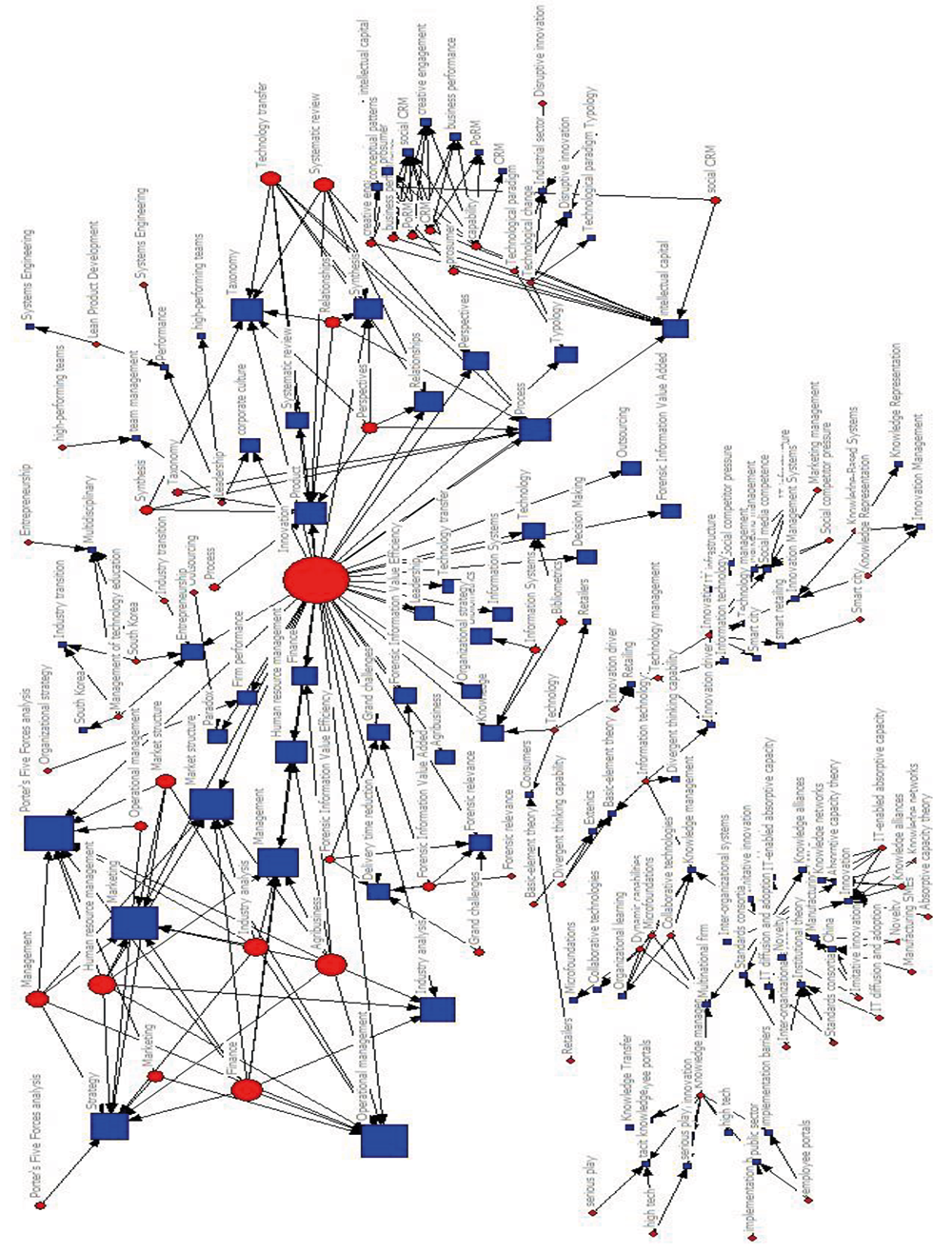
The results of Social Network Analysis application (presented in Figures 4 and 5) show some concepts of different areas, but mostly in the field of management that relate to the studies that approach the themes in question.
Initially, a general diagram on overall relations of the concepts was originated, due to the network density the data were treated and giving rise to the diagrams with the most significant results (most existing relations).
Figures 4 and 5 present the result of the interaction of concepts present in articles published in the science direct base with temporal cut in the periods of 2010-2013 and 2014- 2015, respectively. In each of the diagrams it is possible to verify the incidence of small composite networks between concepts. This fact is explained by the different application areas of the articles analyzed.
The networks represented in the diagrams are composed of the nodes (concepts of origin) and the links (relationships between concepts). Thus, circles represent the concepts that dominate the force of interaction and the squares represent concepts that were used together in the same published article.
Although searches have been made in articles containing both concepts simultaneously in some part of the text (Innovation Management AND Information Management), there was no significant effect of these terms and thus are not shown in the following diagrams.
Graph 1 presents the five journals that presented the largest number of articles based on the search conducted in the Science Direct database published between 2010 - 2013.

The five journals largest number of articles represents almost 50% of the total of the analyzed publications, being this list led by the Journal Procedia - Social and Behavioral Sciences. This is a journal that receives manuscripts of conferences that have an Elsevier agreement (publisher of contents). This can be one of the justifications for the largest number of publications, in addition to the scope related to the topics analyzed here.
It is interesting to mention that the other journals presented in Graph 1 are related to the area of management, decision support and information.

Some evidences are observed from the analysis of the diagrams. The terms: innovation; trust; Interorganizational systems; Knowledge management; management systems were the ones that had the highest incidence in articles published in the period 2010- 2013.
The following (Table 1) show the most frequent relations between terms higher incidence in the network:
The results highlight the existing information management gap in studies on the innovation process. The analysis of terms that frequently appear on the network shows the transition of the collaborative innovation management. As a case of: network management; Innovation networks; Interorganizational agreements; Private public cooperation. However, the informational resource was not observed as a predominant factor in the network composed of terms present in articles published between 2010 and 2013.

The diagram for the period 2014-2015 (Figure 5) presents a more complex network, with a higher incidence of frequent concepts. Among these, the most frequent are: innovation; finance; agribusiness; industry analysis; human resource management; management.
Table 2 presents the most frequent terms and terms with the highest incidence in the network:
Finally, it is noticed that the predominant terms come from the management area. Although the concepts used for data collection have not presented significant frequency and thus are not found in the diagrams, several concepts inherent to the processes of innovation and information management were identified in the network relations of concepts: organizational strategy, information systems, Decision-making, intellectual capital, technology management, knowledge management.
The absence of information management term may reflect the gap in empirical studies approximate the field of innovation, even though the potential of the interaction of these processes have already been observed in the literature.
In contrast to this, the term 'knowledge management' is evidenced by articles in the 2010-2013 respecting to frequency with the terms: design, organizational learning, critical success factors, Gray Relational Analysis (GRA).
It should be noted that the term 'knowledge management' and 'knowledge management systems' were among the most frequent in the analyzed period, as previously described.
The incidence of the term knowledge management presents relations with the following terms: collaborative technologies and organizational learning during 2014-2015.
Knowledge management shows have already filled their role in the studies that address the theme of innovation. But information management, as a complementary process in this area, is not yet adequately assured as a potential participant in this process.
Graph 2 shows the most frequent journals in papers analyzed in the period 2014-2015, in the same way as presented for the previous period.

The journal 'Procedia - Social and Behavioral Sciences' continues to lead the list, a total of 35 articles of which contained in some part of the text the terms 'information management' AND 'innovation management'. As mentioned previously, it can be justified by its scope and for being manuscripts of conferences that have an agreement with Elsevier.
In relation to the previous period, shown previously, new journals appear in the list of 5 most frequent, as is the case of 'Procedia - Computer Science' and 'Technological Forecasting and Social Change'.
Table 1 below presents some information on the diagrams presented previously for the periods 2010-2013 and 2014-2015.
The analysis of the centrality allows understanding the positioning of the different actors in the network, in this case the keywords. Degree centrality, which expresses the number of direct links an actor (keyword) has with the remaining actors (keywords) of the network, being a measure of the degree of activity.
The diagram of the period 2010-2013 is composed of 828 components, presenting 176 relations ties. The degree of centrality of this network was of 3.4%, meaning low number of predominant keywords in the relations with the other keywords.
In the period from 2014 to 2015, the number of components is 994 with 295 relations of relations. Compared with the previous period, the increase in the number of loops was more pronounced than the number of components, although the later was also larger.
The degree of centrality did not present representative alterations, being its value of 3.6% remaining the characteristic of a network formed by few predominant keywords.
6 CONCLUSIONS
This study aimed at exploring the relationship between information management and innovation in articles published in the Science Direct database, the time horizon of publications from 2010 to 2015, divided between two searches in the years 2010-2013 and 2014-2015.
The use of the term 'knowledge management' was highlighted in the networks represented by the diagrams, as mentioned in the results section. In this case, the results corroborate Donate and Pablo's (2014, 360) statement when analyzing the role of knowledge- led leadership in knowledge management and innovation practices “Emerging in the nineties, knowledge management (KM) is a well-established discipline in the academic field and business world alike” which the authors continue to argue that the importance and use of knowledge management are unquestionable.
On the other hand, the results evidenced a low occurrence for the term "information management" in the articles identified in Boolean association with the term "innovation management". Considering the possibility that conceptual ambiguities may involve the use of the terms "information" and "knowledge" as synonyms and that, for the field of information science, the reduction of ambiguity is fundamental for the adequate theoretical and practical use of concepts in practice communities. It is considered necessary a qualitative deepening of the use of the terms in the bibliographical rescued.
Information Management is a "strategic resource of the organization". Fundamental for decision-making in the development of a particular innovation in the stages: prospecting, ideation, strategy construction, resource mobilization and implementation (according to Figure 1).
In the diagrams it was verified that there seems to be a gap in studies dealing with information management in the scope of innovation processes. This situation is evidenced by the lack of relationship between these concepts in the studies published in the Science Direct database, as treated in the application of Social Network Analysis.
The diagrams presented in the study provided insight into which subjects are most often handled jointly in recent publications in quantitative terms of keyword occurrence.
This was an exercise that could be replicated in future studies using other databases (national and international) for the area of Information Science and related areas in order to verify the incidence of publications that integrate these concepts.
More importantly, a deepening of the analysis of the results found in qualitative terms on the declared or implicit concepts, may return results that associate more strongly what has been considered as information management in the field of information science or confirm the shortage of Approaches that correlate the term with "innovation management", which was considered a gap to be explored in future studies in the Information Science.
References
- CHESBROUGH, Henry. Open Innovation: The New Imperative for Creating and Profiting from Technology. Boston: Harvard Business School Press, 2003.
- CHOO, Chun Wei. A organização do conhecimento: como as organizações usam a informação para criar significado, construir conhecimento e tomar decisões. São Paulo: Senac, 2003a. 425 p.
- CHOO, Chun Wei. Gestão de Informação para a Organização Inteligente: A arte de explorar o meio ambiente. Lisboa: Caminho, 2003b. 365 p.
-
DAVENPORT, Thomas H. Ecologia da Informação: Por que só a tecnologia não basta para o sucesso na era da informação. São Paulo: Futura, 1998. Tradução: Bernadette Siqueira Abrão. Disponível em: <http://amormino.com.br/livros/20141114-ecologia-informacao.pdf>. Acesso em: 19 jun. 2017.
» http://amormino.com.br/livros/20141114-ecologia-informacao.pdf - DONATE, Mario J; PABLO, Jesús D.S. The role of knowledge-oriented leadership in knowledge managament practices and innovation. Journal of Business Research, v. 68, pp. 360-370, 2014.
- DYER, Jeffrey H; SINGH, Harbir. Utilizando alianças para construir vantagem competitiva em tecnologias emergentes. In: Day, G.S., Schoemaker, P.J.H., Gunther, R.E. Gestão de Tecnologias Emergentes: a visão de Wharton School. Porto Alegre: Bookman, 2003, pp. 312-327.
-
FINEP. Manual de Oslo. 2005. Disponível em: <http://www.finep.gov.br/images/apoio-e-financiamento/manualoslo.pdf>. Acesso em: 15 maio 2017.
» http://www.finep.gov.br/images/apoio-e-financiamento/manualoslo.pdf - FOGL, J. Relations of the concepts 'information' and 'knowledge'. International Fórum on Information and Documentation, The Hague, v.4, n.1, p. 21-24, 1979.
- KROEFF, Marcia Silveira et al. Análise de citações dos artigos publicados em periódicos da área da Ciência da Informação que versam sobre gestão da informação. RBBD. Revista Brasileira de Biblioteconomia e Documentação, São Paulo, v. 11, n. 1, p. 41-65, jul. 2015.
- MCGEE, J. V.; PRUSAK, L. Gerenciamento estratégico da informação: aumente a competitividade e a eficiência de sua empresa utilizando a informação como uma ferramenta estratégica. Rio de Janeiro: Campus, 1994.
- SORDI, José Osvaldo de. Administração da Informação: FUNDAMENTOS E PRÁTICAS PARA UMA NOVA GESTÃO DO CONHECIMENTO. São Paulo: Saraiva, 2008. 185 p.
-
STEFANOVITZ, Juliano Pavanelli; NAGANO, Marcelo Seido. Gestão da inovação de produto: proposição de um modelo integrado. Production, [s.l.], v. 24, n. 2, p.462-476, jun. 2014. FapUNIFESP (SciELO). http://dx.doi.org/10.1590/s0103-65132013005000062.
» https://doi.org/10.1590/s0103-65132013005000062 - TIDD, Joe; BESSANT, John; PAVITT, Keith. Gestão da Inovação. 3. Ed. Porto Alegre: Bookman, 2008. 600 p.
- VALK, Tessa van der; CHAPPIN, Maryse M.H; GIJSBERS, Govert W. Evaluating innovation networks in emerging technologies. Technological Forecasting & Social Change, v. 78, p. 25-39, 2011.
- VICK, Thais; NAGANO, Marcelo Seido; SANTOS, Fernando César Almada. Aportes da gestão da informação para a criação de conhecimento em equipes de inovação. Perspectivas em Ciência da Informação, Belo Horizonte, v. 14, n. 2, p.204-219, maio 2009.


 Thumbnail
 Source:
  Source:
  Source:
  Source: Primary Data, elaborated by the authors.
 Source: Primary Data, elaborated by the authors.
 Source: Primary Data, elaborated by the authors.
 Source: Primary Data, elaborated by the authors.

