 THE DIGITAL OBJECT IDENTIFIER (DOI) IN ELECTRONIC JOURNALS OF COMMUNICATION AND INFORMATION
ABSTRACT:
The present study seeks to investigate the use of the Digital Object Identifier (DOI) in the scientific journals of Communication and Information and, providing new integration utilities with the Lattes Platform. In this sense, it aims to inform the existing titles in Communication Information in electronic format, demonstrate the importance of DOI in the integration with the Lattes Platform in order to guarantee author credibility and analyze the characteristics of publications that have DOI. The methodology used for the development of this study is bibliographic, research with descriptive-descriptive characteristics. From the development of the research, it is inferred that of all the analyzed journals (33 journals), 10 titles in the evaluation of 2013 and 06 titles of the evaluation of 2014 present DOI in their publications, all have WebQualis classification, Qualis A1 in the area Communication and Information. Most publications are international and only 3 titles are national. It is necessary that journals, principally national ones, accompany new technologies such as DOI for objects and ORCID for the identification of people, bringing more mechanisms that guarantee authors 'credibility and to bring the researchers' connection, and both can already be adopted in the Platform Lattes.
KEYWORDS:
Digital Object Identifier; Librarianship; Information Science; Scientific journals
RESUMO:
O presente estudo busca investigar a utilização do Digital Object Identifier (DOI) nos periódicos científicos de Biblioteconomia e Ciência da Informação e, proporcionando novas utilidades de integração com a Plataforma Lattes. Neste sentido, objetiva-se informar os títulos existentes em Biblioteconomia e Ciência da Informação em formato eletrônico, demonstrar a importância do DOI na integração com a Plataforma Lattes visando à garantia de credibilidade autoral e analisar as características das publicações que possuem DOI. A metodologia utilizada para o desenvolvimento deste estudo é bibliográfico, pesquisa com característica explicativa-descritiva. A partir do desenvolvimento da pesquisa, infere-se que de todos os periódicos analisados (33 periódicos), 10 títulos na avaliação de 2013 e 06 títulos da avaliação de 2014 apresentam o DOI em suas publicações, todas possuem classificação WebQualis, Qualis A1 na área de Comunicação e Informação. Em sua maioria as publicações são internacionais e apenas 3 títulos são nacionais. Torna-se necessário que os periódicos principalmente os nacionais acompanhem as novas tecnologias como o DOI para objetos e o ORCID para a identificação de pessoas, trazendo mais mecanismos que garantem credibilidade dos autores e para trazer conecção dos pesquisadores, e ambos já podem ser adotados na Plataforma Lattes.
PALAVRAS-CHAVE:
Identificador de objeto digital; Biblioteconomia; Ciência da informação; Periódicos científicos
RESUMEN:
O presente estudo busca investigar el uso de Identificador de Objeto Digital (DOI) nos periódicos científicos de Biblioteconomía y Ciencia de la Información y proporcionando nuevas utilidades de integración con una Plataforma Lattes. En este sentido, la información se refiere a los títulos existentes en la Biblioteconomía y la Ciencia de la Información en formato electrónico, la demostración de la DOI en la integración con una Plataforma Lattes visando a la garantía de credibilidad de autor y etiquetar como características de las publicaciones que son DOI. Una metodología utilizada para el desarrollo de este estudio bibliográfico, la investigación con características explicativas-descritivas. (33 periódicos), 10 títulos en la evaluación de 2013 y 06 títulos de la evaluación de 2014, que se publican en el DOI en sus publicaciones, todas las clasificaciones WebQualis, Qualis A1 en el área De Comunicação e Información. En su mayoría como las publicaciones son los únicos 3 títulos están nacionales. Torna-se necesario que los periódicos también los países asociados como nuevas tecnologías como DOI para los objetos y ORCID para una identificación de personas, trazando más mecanismos que garantem credibilidad de los autores y para trazar conección de los buscadores na Plataforma Lattes.
PALABRAS CLAVE:
Identificador de objeto digital; Biblioteconomia; Ciencia de la información; Periódicos científicos
1 INTRODUCTION
The Digital Object Identifier (DOI) is a tool that allows complementary services whose metadata makes possible the referencing of plans of identification. Considering this, the theme of this paper is the study of DOI as a disseminator of information through scientific e-journals, especially those devoted to Communication and Information issues.
Scientific journals are publications that divulge texts from the scientific community and furthers the knowledge it creates, therefore, they fill an important role in science divulgation.
Based on this premise, identifiers are necessary to enable the search for information efficiently and effectively, for we live in such an age in which time is very precious. Thus DOI is developed as an identifier and facilitator of information search in a faster alternative to the user.
It is asked then: Does the DOI, while an identifier of Librarianship and Information Science related publications, make possible new integration utilities with the Lattes Platform? To answer this question it is intended to: a)list the existing titles on Communication and Information available in e-format; B) demonstrate the importance of the DOI in the integration with the Lattes Platform aiming at the guarantee of author credibility and; C) analyze the profile of the publications that use the DOI. The general objective is to investigate the usage of DOI in Communication and Information publications, and to provide new integration utilities with the Lattes Platform as well; the specific objectives are: to inform the existing titles in the area already described in electronic format; to emonstrate the importance of DOI in the Lattes Platform integration to ensure author credibility and Analyze the characteristics of publications that use DOI.
2 LITERATURE REVIEW
The literature review addresses the following subjects: scientific journals, the DOI and Plataforma Lattes:
2.1 Scientific Journals
Scientific communication is the main goal of scientific journals; they are of great importance not only for diffusion of scientific knowledge, but also for the evolution of science itself. According to Dias (2006, p. 51):
[...] journals are an important medium in formal communication: in many fields, such as natural, exact and life sciences, they are undoubtedly the foremost one; In others, as in social and human sciences, they share this position with books, but are often supplanted by them.
The etymology of the term periodical has its origin in the latin word periodus, which means space of time. While the word publicatione comes from the Latin, which means act or effect of publishing. We realized that the journal was idealized for publications of information on a regular frequency (FACHIN; HILLESHEIM, 2006, p.20).
Meadows (1999, p.8) supplements this concept of the term periodical with the following explanation:
[...] [it] became common use in the second half of the 18th century and refers to any publication that appears at certain intervals and contains several articles by different authors. To make matters confusing, the word serial [serial or serialized] appeared in the 19th century to designate any publication edited in successive and connected parts. In general, journals (and magazines) are periodicals, but mainly in humanities there are serial publications that perform many of the functions of a newspaper. These fluctuations of word meanings are not unique to the English language. In German, for example, early journals were often called the word Zeitung. This came later to be more associated with newspapers and, from the 19th Century on, the word Zeitschrift, started to be favoured in the titles of scientific magazines.
There are several authors and scientific institutions that define periodicals, and the nomenclature of serial publications as well. According to the ABNT (6021, 2015) a periodical publication is made available on any medium, with successive units, designated numerically and / or chronologically, in order to be produced continuously. In order to highlight its main characteristics and to differentiate other types of bibliographical materials, the conceptual explanation of Campos (1980) covers this theme, according to this author:
Periodicals are publications that usually appear in fascicles or brochures, with regular frequency, addressing several subjects, from specialized ones to those of general order, covering a specific publication or the population as a whole, being published from time to time, periodically And for an indefinite period.
As Stumpf (1996) explains, in the 19th century journals were recognized as a reliable means of scientific communication, thus consolidating themselves as a form of scientific record. The costs and the delay in the publication of books; Exchange of letters and minutes could not cure the need to disseminate the results of scientific studies emanating from academic communities. Resulting in the union of scientists to resolve this problem and decide to publish their own research in parts, also counting on the collaboration of several authors, coming in the publication of scientific journals.
The first scientific periodicals appeared in Paris under the title Journal des Scavants in 1965, and in London, the Philosophical Transactions of the Royal Society of London, in which the members of the Royal Society published their researches. These two publications provided information about science on a constant basis, with the purpose of summarizing books, cultural facts, reports of experiments and scientific observations in order to keep European society informed, but also each one had its own characteristics (MEADOWS, 1999).
Regarding Brazil, after the foundation of the Imprensa Régia in 1808, publications relevant to the society were published and it is registers in the records as precursors of the publication of the national science, highlighting the periodical the "Gazetta Médica do Rio de Janeiro", which first appeared In 1862 and the "Gazetta Médica da Bahia" published in 1866.
In the 19th and 20th centuries, the publication of scientific journals was expanded due to several factors such as: the growth of the number of scientists, scientific journals, publications linked to universities, the State and commercial publishers; The advancement of Information and Communication Technologies (ICTs). Resulting in the lowest cost of publishing, dissemination and dissemination of information (FREITAS, 2006).
All these elements allowed the evolution of scientific publication form requiring the e-format. The procedures in the editorial process and publication that occurred in the physical environment should also be covered in the electronic medium, although the online resource presents particular aspects linked to the support that count on availability of access, information retrieval, interactivity criteria and navigability. But they should follow parameters marked out in the tradition and legitimacy of the printed journal: editorial policy, a strict quality review (Peer Review), dedicate themselves to a specific area, keep regular editions, have ISSN, DOI, Have departmental character to name a few. (GRUSZYNSKI, 2007).
2.2 Digital Object Identification and Lattes Plataform
According to Brito et al. (2015, p.8) the DOI is "a system that allows the univocal identification, location and description of digital entities - physical or abstract". That is, this system aims at standardization and also a way of preserving the information that is found on the internet. Complementing:
A DOI is assigned to a particular content by a publisher or responsible institution. Even if property rights or location issues change, DOI must remain the same. Once a DOI is assigned, it can not be removed or altered, but it is possible to change the information bound to a DOI by making a new repository of information, maintaining the DOI and changing the metadata (BRITO et al., 2015, P.8).
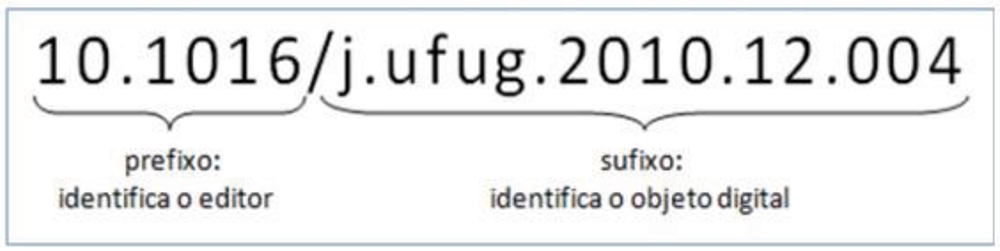
Considering this perspective, Ferreira et al. (2015) points out that DOI is actually a form of standardization of the various documents found in digital networks. Therefore, it is usually composed by numbers and letters (see Figure 1), where it is inserted into a digital object as a way of unique identity in the web environment.
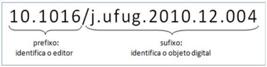
It should be noted that DOI numbers start with "10". Futhermore, its prefix and suffix are separated by a slash (/). With regard to the prefix, it is possible to state that it corresponds to the number of 4 or more digits that are linked to an organization of the publisher, and the suffix will be made possible by the publisher present in the prefix, which is responsible for determining the rules of indeterminacy.
The DOI originated from the idea of three editorial associations, namely International Publishers Association; International Association of Scientific, Technical and Medical Publishers; And, Association of American Publishers). The objective of said institutions was to devise an alternative that would enable the great demand brought about by the TICs.
Document management in cyberspace through DOI was first launched at the International Book Fair in Frankfurt, Germany, in 1997 and is currently managed by The International DOI Foundation, Inc. (IDF). It is a numerical identification system for digital content, which can be attributed to periodicals, encyclopedias, learning objects, images, electronic books or intellectual contents that need to have their property rights protected (SHITSUKA; SHITSUKA; RISEMBERG, 2016 , Pp. 505).
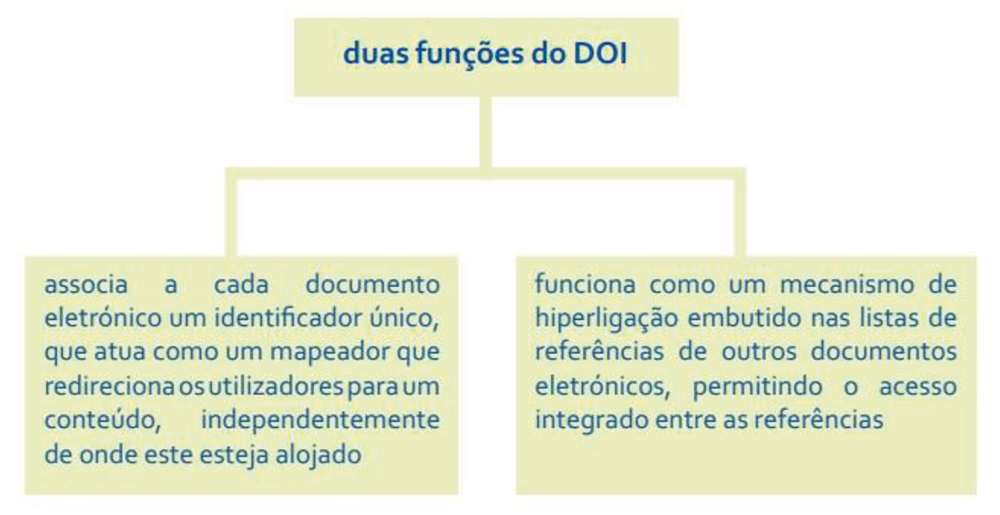
The aforementioned authors state that the DOI is not limited only to journal articles, however, it is noted that its universe encompasses other types of media, such as those described in the mentions above. Thus, it can be argued that DOI has two distinct functions, which are best exposed in Picture 2.

It is also interesting that DOI operates under the ISO 26324 (2012) quality standard. According to Brito et al. (2015, p.9), DOI "[...] enables the assignment of an identifier, called the DOI name, allied to the metadata store, for the later location of the object, by means of this identifier. With this, you can find a resource or your information on the web."
From its users' point of view, the DOI system operates on two distinct moments: metadata storage and DOI name resolution. Firstly, the publisher deposits the metadata associated with the objects identified by the DOI names. At this stage, the metadata is validated and processed by a registration agency - including Crossref - and, when duly certified, is recorded in the DOI system, in which the registration agencies are federated. In the second moment, the readers activate a service of resolution of names having as parameter determined name DOI, which will return
the set of metadata associated with the object identified by it. This type of triggering occurs transparently when clicking on a link named DOI (BRITO et al., 2015, pp. 10-11).
Considering the DOI regarded to the Lattes Platform, Shitsuka, Shitsuka and Risemberg (2016, pp. 505-506) state that "[...] the code is used by the National Research Council (CNPq) in the Lattes Platform for identification of scanned objects with copyright, as is the case of articles whose journals contain this manager. "
According to Ferreira et al. (2015, p.1), the main errors for completing the DOI in the Lattes Curriculum are:
errors and / or lack in the completion of the metadata referring to the author's name (s) in the journal, by the authors at the time of submission and the editorial team in the review;
inconsistencies between the name of the author registered in the Plataforma Lattes and in the publication that received the DOI;
error in the insertion of the DOI in the Lattes Platform, since the authors insert, for example, the complete address http://dx.doi.org/10.1590/S0100-39842002000100015, when the correct one is to insert of this form: 10.1590 / S0100-39842002000100015.
In 2007 the Conselho Nacional de Desenvolvimento Científico e Tecnológico (CNPq) concluded the contract with the International Digital Obejct Identifier Foundation for use in the Plataforma Lattes, DOI this an instrument of publications in social networks. Like all articles in the Scielo library, just as the SEER journals already possessed the DOI. Its insertion in the lattes curriculum was for the purpose of certification, providing the access of the articles by the platform, guaranteeing the copyright, bringing greater credibility in the registered information (CNPq, 2007).
In order to highlight the importance of the Lattes Curriculum in the national scientific bias, Balancieri et al (2005: 70) explains:
[...] is the set of knowledge systems of the Palataforma Lattes, a CT & I information architecture developed for CNPq to manage its development activities and to integrate in the same environment the various actors linked to the National Innovation System of the country. In addition to enabling the interoperability of federal agencies' information systems, the Plataforma Lattes has streamlined the CT & I management process.
Through this explanation we mention how the implementation of DOI in the Lattes Platform represents an advance in the evolution of scientific communication. Because it establishes a link between the lattes curriculum and the published article site. The DOI must be assigned by the publisher of the publication, this informs the DOI number of each article.
3 METHODOLOGY
The methodological and operational procedure is first approached from a bibliographic study, according to Forte (2006), this type of research covers the material that must be collected, subjected to a screening, from which it is possible to establish a delineated and concise reading plan. The research's characteristic is the explicative-descriptive style that, according to Marconi and Lakatos (2010), this type of research aims to broaden generalizations, to structure and define theoretical models, to relate hypotheses in a more unitary view of the universe or the productive scope in general and to generate Hypotheses or ideas by virtue of logical deduction.
A research was carried out in which the data extracted from the Sucupira Platform were used as a reference, extracting the titles of scientific journals of the Communication and Information area that presented A1 classification in the years of 2013 and 2014, in order to demonstrate DOI in their publications.
In this sense, it was necessary to identify the scientific journals in the area of Communication and Information, presenting some characteristics of these journals in front of information found in the National Catalog of Serial Publications (CCN) and in the newspaper's own website. They show the following information: Title, URL, periodicity and other descriptions.
The methodology works with steps to be followed aiming at achieving a purpose in the research. According to Marconi and Lakatos (2002, page 15) the research "is a formal procedure ... that requires a scientific treatment and constitutes the way to know the reality that one intends to study."
The research was set up as a bibliographical one, because they come from bibliographic material to compose the theoretical framework and subsidize the foundation of scientific communication as the work of Meadows (1999) present in this study.
The study is characterized as explanatory-descriptive, in the explanatory sense because it is concerned with identifying in the research determining factors for the occurrence of phenomena (GIL, 2007), that is, explains things through the results offered. Also in a descriptive way because it intends to describe the facts and phenomena of a certain reality portrayed. (TRIVIÑOS, 1987).
Initially, we identified the scientific journals published in the area of Communication and Information that are indicated in the evaluation of WebQualis of periodicals. To do so, we searched the sucupira platform, search sites, through keywords the titles and links of the periodicals of the area previously mentioned, all scientific.
It is worth noting that these serial publications are being published regularly, and after consultation in each periodical and respective sites, a comparative analysis was carried out between the two years of evaluation, indicating titles that appear in the years 2013 and 2014, as well as the titles that Disappeared and others that arose. And finally an analysis of the titles that presented the DOI in their scientific articles that brings out the focus of this study.
4 DATA ANALYSIS
From the consultation on the Sucupira Platform, the information representing the titles of journals that passed the evaluation of Qualis in the years from 2013 to 2014 in the area of Communication and Information with extract A1 was extracted and structured. They represent a scientific recognition at the national level to have a relevant extract for degrees and postgraduate programs.
It has become necessary to dismantle in increasing order the years of published evaluations to demonstrate their specificities and to indicate the year they have adopted DOI in their publications. In Table 1, we see the 17 journals titles of the 2013 evaluation and their specificities and the presentation of the year found DOI in their publications.
From the total of 17 titles of Communication and Information periodicals, with A1 extract in the 2013 evaluation, of this analyzed universe 12 titles are of international origin, mainly of the United States and, being 5 national titles.
We also noticed that, among all the titles analyzed, only 10 presented the DOI in their publications, it was not possible to locate the DOI in the journals Hermés, Information & society, International Journal of Communication, Knowledge organization and perspectives in Information Science, for not presenting and or because you have limited access to the journal. And in the case of the journal Perspectives in Information Science in the printed format indicated also in the evaluation, for this type of format it is not possible to have DOI, so it was not included within the analysis by this characteristic.
In the total of 16 titles of Communication and Information journals, with A1 extract in the evaluation of 2014, of this analyzed universe 7 nationalities were identified and 12 titles are of international origin, mainly of Spain and the United States and, being 4 national titles.
Of the titles analyzed, only 7 titles present DOI in their publications, it was not possible to locate DOI in the periodicals El Professional de la información, Hermés, Information & Society, Information research, International Journal of Communication, Knowledge Organization, Perspectives in Information Science . In the cases indicated in the printed format shown in the evaluation, since this type of format is not possible to obtain the DOI, it was not included within the analysis for this characteristic.
In the table below, it shows the relationship of the securities to these two years of evaluation of Qualis for periodicals of Communication and Information.
In the relation between the titles referring to the evaluations of 2013 and 2014. Note that some titles of the communication and information area with the A1 classification, in the universe of 33 titles, of which 09 titles appear in both evaluations, which are: Hermés, Information & Society, International Journal of Communication, Library Research, Knowledge Organization, Perspectives in Information Science, Spanish Journal of Scientific Documentation, Sociétés and Transformation. Within these journals 5 do not have the DOI in their publications, which are: Prospects in Information Science; Knowledge Organization; Internation Journal of Communication; Information & Society and Hermés.
As of this universe of 33 titles, 05 new titles appear in the 2014 evaluation, which are: Journal of the American Society for Information Science and Technology, Information Sciences, Information Research, The professional of Information, Communicate. Considering the titles repeated only once. Among these 05 only 03 papers present the DOI in their articles, which are: Communicate; Information Sciences; Journal of the American Society for Information Science and Technology.
Continuing the comparisons of the evaluations of 2013 and 2014, 05 titles ceased to appear with the A1 classification in 2014 and were present in 2013, which are: Television & New Media; Social Semiotics; Scientometrics; Media, Culture & Society and Journalism Studies. All five journals have DOI in their publications. Other requirements were taken into account so that they did not appear in the 2014 relation.
In 2013, of the 17 titles, only 10 actually present the DOI in their publications and in which 09 are international journals and only 01 is of Brazilian origin, which is Transformation.
Regarding the DOI, in the evaluations of 2013 and 2014, in this prism 12 titles have the DOI in scientific articles, and taking into account the most current evaluation of 2014 only 6 present the DOI. Note that some titles are repeated and also because they enter the evaluation the printed version cannot have DOI in their publications. The national journals that appear in 2014, which are: Information & Society and Information Science Perspectives do not present the DOI in their publications, possibly putting in the country the adoption of DOI in articles is something very recent in the scientific field and, appearing in the curricula Lattes of the researchers and also comes up against the financial aspects.
The DOI is likely to become increasingly evident in publications at the national and / or international level, it is believed that in the next evaluations the titles present in the relationship should present the DOI. For this has become an important mechanism for the identification of publications and scientific evidence.
5 FINAL CONSIDERATIONS
In n relation to scientific communication, the new ICTs and the creation of other computational mechanisms have stimulated an evolution in the production and dissemination of scientific research. Evidenciating in the theoretical framework, the first basic forms of communication until the maturation and implantation of the periodicals in the scientific scope. This vehicle, in both printed and e-format, ensured the improvement of Science and recognition of the authors.
In this study we pointed to the increase of DOI in serial publications as a form of credibility of scientific information and guarantee of copyright, as this became a crucial identification element in the provision and integration of data, which was adhered to in the Plataforma Lattes, allowing access Of a scientific article and / or in the lattes curriculum has an identification numbering that is present in the journal in which the article was published.
With the purpose of knowing the periodicals of the Communication and Information area that have DOI, we searched and found a universe of 17 serial publications in the evaluation of 2013 and 16 titles of journals for the year 2014, all with Qualis A1 evaluation. However, it became clear from this study that the 2014 evaluation showed that only 06 international titles present DOI in their publications, knowing that the serial publications indicated in the printed format were not considered and the titles that were repeated were considered only once. Only two Brazilian journals are present in the year 2014 and they do not have DOI, they may be demonstrating the obstacles that the national scientific publication faces, but that it is possible to grow exponentially the publications with digital tools like DOI.
This study provides the verification of the area of Communication and information in this interaction of data, and seeks to elucidate the importance of the recognition of its contributions in scientific research as well as its authors. For, it is necessary that mainly national journals follow the new technologies such as DOI for objects and ORCID for the identification of people, bringing more mechanisms that guarantee authors credibility and to bring the researchers' connection, and both can already be adopted In the Lattes Platform. Bringing new paths to the evolution of science and the formation of new knowledge.
References
- ASSOCIAÇÃO BRASILEIRA DE NORMAS TÉCNICAS. NBR 6021: Informação e documentação- publicação periódica técnica e∕ou científica-Apresentação. Rio de Janeiro: ABNT, 2015.
-
BALANCIERI, Renato et al. A análise de redes de colaboração científica sob as novas tecnologias de informação e comunicação: um estudo na Plataforma Lattes. Ciência da Informação, Brasília, DF, v.34, n.1, p. 64-77, jan. ∕abr. 2015. Disponível em: <http://www.scielo.br/scielo.php?pid=s010019652005000100008&script=sci_abstract&tlng=pt>. Acesso em: 10 abr. 2016.
» http://www.scielo.br/scielo.php?pid=s010019652005000100008&script=sci_abstract&tlng=pt - BRITO, Ronnie Fagundes de. Guia do usuário do Digital Object Identifier Brasília, DF: IBICT, 2015.
- CAMPOS, Liene. Publicações periódicas e seriadas. 1980. 173f. Dissertação (Mestrado em Biblioteconomia) - Pontifícia Universidade Católica de Campinas, Campinas, 1980.
-
CONSELHO NACIONAL DE PESQUISA (CNPq). Plataforma Lattes usará certificação DOI para artigos publicados. Brasília: CNPQ, 2007. Disponível em: <http://cvirtual-ccs.bvsalud.org/tikiread_article.php?articleId=162&highlight=automatic>. Acesso em: 10 abr. 2016.
» http://cvirtual-ccs.bvsalud.org/tikiread_article.php?articleId=162&highlight=automatic - DIAS, Carolina Guimarães de Souza. Periódicos na comunicação científica: produção e difusão de periódicos e panorama dos veículos brasileiros da área de comunicação na base Qualis. 2006. 171f. Dissertação (Mestrado em Comunicação e cultura) - Escola de Comunicação da Universidade Federal do Rio de Janeiro, Rio de Janeiro, 2006.
- FACHIN, Gleisy Regina Bóries; HILLESHEIM, Araci Isaltina de Andrade. Periódico científico: padronizado e organizado. Florianópolis: editora UFSC, 2006.
- FORTE, Sérgio Henrique Arruda Cavalcante. Manual de elaboração de tese, dissertação e monografia. Fortaleza: Universidade de Fortaleza, 2006.
-
FREITAS, Maria Helena. Considerações acerca dos primeiros periódicos científicos brasileiros. Ciência da Informação, Brasília, DF, v. 35, n. 3, p. 54-66, set.∕dez. 2006. Disponível em: <http:∕∕www.scielo.br∕pdf∕ci∕v35n3a06.pdf>. Acesso em: 15 mar. 2016.
» http:∕∕www.scielo.br∕pdf∕ci∕v35n3a06.pdf - GIL, Antonio Carlos. Métodos e técnicas de pesquisa social. 6 ed. São Paulo: Atlas, 2007.
-
GRUSZYNSKI, Ana Cláudia; SANSEVERINO, Antônio. O Periódico na área de humanidades: critérios de avaliação. In: CONGRESSO BRASILEIRO DE CIENCIAS DA COMUNICAÇÃO, 28., Rio de Janeiro. 2005. Anais eletrônicos... Rio de Janeiro, 2005. Disponível em: <http://www.portcom.intercom.org.xn--brpdfs47533372324880452232867111468010739789-m292aea.pdf/>. Acesso em: 20 mar. 2016.
» http://www.portcom.intercom.org.xn--brpdfs47533372324880452232867111468010739789-m292aea.pdf/ -
INSTITUTO BRASILEIRO DE INFORMAÇÃO EM CIÊNCIA E TECNOLOGIA. Portal do Sistema Eletrônico de Editoração de Revistas: SEER. Disponível em: <http://seer.ibict.br/>. Acesso em: 20 jan. 2016.
» http://seer.ibict.br/ - MARCONI, Marina de Andrade; LAKATOS, Eva Maria. Fundamentos de metodologia científica.7. ed. São Paulo: Atlas, 2010.
- MARCONI, Marina de Andrade; LAKATOS, Eva Maria. Técnicas de pesquisa. 5 ed. ampl. São Paulo: Atlas, 2002.
- MEADOWS, Arthur Jack. A comunicação científica. Brasília, DF: Briquet de Lemos∕Livros, [c1999].
- SHITSUKA, Ricardo; SHITSUKA, Dorlivete Moreira; RISEMBERG, Rabbin Ive Carolina Shitsuka. Avaliação das noções de Digital Object Identifier em alunos de um Curso de Pós- Graduação. Inf. Inf., Londrina, v. 21, n. 1, p. 496-519, jan./abr. 2016.
-
STUMPF, Ilda Regina Chico. Passado e futuro das revistas científicas. Ciência da Informação, Brasília, DF, v.25, n. 3, p.383-386, set. ∕dez. 1996. Disponível em: <http:∕∕seer.ufrgs.br∕intexto∕article∕view∕3369∕3953>. Acesso em: 15 mar. 2016.
» http:∕∕seer.ufrgs.br∕intexto∕article∕view∕3369∕3953 - TRIVIÑOS, Augusto Nibaldo Silva. Introdução à pesquisa em ciências sociais: a pesquisa qualitativa em Educação. São Paulo: Atlas, 1987.

 Thumbnail
 Source:
  Source: