
 Effects of familiarity, task complexity, and preparer experience on revenue recognition
Abstract
This study examines how familiarity with accounting standards, task complexity, and preparer experience influence accountants' judgment and decision-making (JDM) regarding the accounting for revenues from contracts with customers. Recognizing the impact of familiarity with standards and experience on accounting decisions enables organizations to invest in preparer training and development, ensuring preparedness for new standards and complex tasks. Understanding how familiarity with accounting standards and preparers' experience influence accounting decisions improves the transparency and reliability of financial reports, which benefits investors, regulators, and stakeholders by reinforcing corporate governance and market stability. The experiment employed a 2x2 design that manipulated familiarity with accounting standards (International Accounting Standard [IAS] 18 vs. International Financial Reporting Standards [IFRS] 15) and task complexity. Financial statement preparers completed a revenue accounting task. We compared the participants' decisions using an analysis of variance and variance ratio tests to measure noise in judgments between participants in the four groups. Additionally, we measured the preparer's experience based on their length of experience in the accounting profession. The results indicate that familiarity with the standards and task complexity did not significantly affect decision-making. However, greater familiarity with a standard led to more varied decisions. Interestingly, even in complex tasks, familiarity with a standard increased decision variability. Moreover, less experienced preparers exhibited greater variability in their decisions between complex and non-complex tasks than more experienced preparers did. These findings suggest that financial statement preparers in Brazil are adapting to new standards and highlight the impact of experience on the effect of task complexity on accounting judgment.
Keywords:
accounting; revenue recognition; IFRS 15; judgment heuristics; standard complexity
Resumo
Este estudo examina como a familiaridade com os padrões contábeis, a complexidade das tarefas e a experiência do preparador influenciam o julgamento e a tomada de decisão (JDM) dos contadores em relação à contabilização de receitas de contratos com clientes. Reconhecer o impacto da familiaridade com padrões e experiência nas decisões contábeis permite que as organizações invistam em treinamento e desenvolvimento de preparadores, garantindo a preparação para novos padrões e tarefas complexas. Entender como a familiaridade com os padrões contábeis e a experiência dos preparadores influenciam as decisões contábeis melhora a transparência e a confiabilidade dos relatórios financeiros, o que beneficia investidores, reguladores e partes interessadas ao reforçar a governança corporativa e a estabilidade do mercado. O experimento empregou um delineamento 2x2 que manipulou a familiaridade com as normas contábeis (International Accounting Standard [IAS] 18 vs. International Financial Reporting Standards [IFRS] 15) e a complexidade da tarefa. Os preparadores de demonstrações financeiras concluíram uma tarefa de contabilização de receitas. Comparamos as decisões dos participantes usando uma análise de variância e testes de razão de variância para medir o ruído nos julgamentos entre os participantes dos quatro grupos. Além disso, medimos a experiência do preparador com base em seu tempo de experiência na profissão contábil. Os resultados indicam que a familiaridade com as normas e a complexidade da tarefa não afetaram significativamente a tomada de decisão. No entanto, uma maior familiaridade com uma norma levou a decisões mais variadas. Curiosamente, mesmo em tarefas complexas, a familiaridade com uma norma aumentou a variabilidade da decisão. Além disso, preparadores menos experientes exibiram maior variabilidade em suas decisões entre tarefas complexas e não complexas do que preparadores mais experientes. Essas descobertas sugerem que os preparadores de demonstrações financeiras no Brasil estão se adaptando às novas normas e destacam o impacto da experiência no efeito da complexidade da tarefa sobre o julgamento contábil.
Palavras-chave:
contabilidade comportamental; reconhecimento de receita; IFRS 15; heurística de julgamento; complexidade padrão
1. INTRODUCTION
Revenue recognition is one of the main inconsistencies identified by the Public Company Accounting Oversight Board (PCAOB) (Griffith et al., 2015). Due to the diversity of accounting standards applicable to revenue recognition and conflicting guidelines between International Accounting Standards (IAS) 11 and 18, the International Accounting Standards Board (IASB) issued the International Financial Reporting Standard (IFRS) 15 in 2014, which became effective for periods beginning on or after January 1, 2018.
Accounting for revenue from contracts with customers involves a series of professional judgments. The complexity of the revenue recognition task depends on how the transaction information is made available to the accountant.
Constant changes in accounting standards imply the need for preparers and auditors of financial reports to apply unfamiliar accounting standards (at least during the transition period and the first years of implementation). Almost half (45%) of the audit reports that accompanied the financial statements of the largest Brazilian listed companies for the year ending December 31, 2018, mentioned revenue recognition issues as a key audit matter (KAM) (Vargas et al., 2022).
Familiarity affects a preparer's interpretation of accounting standards. The more prepared the accountant is regarding a standard, the greater their familiarity with it and the better their judgment (Chand et al., 2010). According to Sappor et al. (2023), familiarity with an IFRS standard is a fundamental pathway to its effective adoption and interpretation. Thus, the more familiar a decision-maker is with the introduced standards, the fewer difficulties they will encounter when applying them (Maradona et al., 2022).
Moreover, complexity can increase the effort required to solve a task and the noise in the decisions made by different individuals or by the same individual in different tasks. Thus, the more complex a task is, the greater the difference in professional judgment (Libby & Tan, 1994; Kahneman et al., 2021). Additionally, professional experience can contribute to better decision-making (Bonner, 1990) and is considered a significant factor in reducing individual failures of audit professionals (Li et al., 2017).
Studies have examined the effects of complexity, familiarity, and experience on the decision-making of accounting professionals. According to Asare and McDaniel (1996), task familiarity and complexity influence the effectiveness of error detection in the audit process. In contrast, Arnold et al. (2000) argue that experience does not mitigate bias in decision-making. Chand et al. (2010) found that both familiarity with and the complexity of accounting standards significantly affect the judgments of financial statement preparers. Similarly, Mala and Chand (2014) suggest that more targeted guidance on the application of a standard tends to improve preparers' judgment, even when performing complex tasks.
When discussing the application of IFRS standards, Khamis (2016) notes that even experienced preparers had difficulty adopting the new revenue recognition and measurement standards. Barniv et al. (2022) analyzed the impact of analysts' IFRS experience on the accuracy of their forecasts and found that greater experience leads to increased forecast accuracy, boldness, and timeliness. Nguyen et al. (2023) indicate that preparers with more experience tend to apply IFRS standards more effectively within organizations.
Based on this evidence, there is substantial literature on the complexity, familiarity, and experience of preparers in drafting financial statements. However, there has been no joint application of these approaches, especially concerning the analysis from the perspective of the new accounting standard.
Studies indicate that familiarity and complexity interactively influence the effectiveness of professionals (Asare & McDaniel, 1996; Chand et al., 2010) and that differences in preparers' experience affect the comparability of financial reports (Chand et al., 2009; Almeida & Lemes, 2013). However, the findings of Chand et al. (2024) suggest that these variables do not always exhibit significant relationships, highlighting gaps in the understanding of how they connect. Therefore, this study addresses a specific gap by examining how these attributes collectively contribute to better decision-making by financial statement preparers.
Thus, this study investigates the influence of familiarity with standards, task complexity, and preparer experience in accounting for revenues from contracts with customers. Evidence of cognitive effects when applying accounting standards can help practitioners understand how the standards can be interpreted and how the information reported in financial statements can be distorted.
The originality of this study lies in its joint analysis of familiarity with accounting standards, task complexity, and preparer experience in judgment and decision-making concerning the accounting treatment of specific accounting events, such as revenue recognition. By recognizing the significant impact of familiarity with standards and experience on accounting decisions, organizations can strategically invest in preparer training and development initiatives, thereby ensuring preparedness for implementing new standards and handling complex tasks. Moreover, understanding the relationship between familiarity with accounting standards and preparers' experience improves the transparency and reliability of financial reports. This, in turn, benefits investors, regulators, and stakeholders by reinforcing corporate governance practices and fostering market stability.
2. THEORETICAL FRAMEWORK
2.1. Accounting for Revenue
Revenue recognition is challenging due to the diversity of operations that generate revenue in different sectors (Zhang, 2005). Therefore, despite its importance for the decision-making of various information users, relatively few studies have examined this attribute. However, according to Lu and Wang (2018), the literature has examined the effect of revenue recognition standards on the informativeness of accounting results.
Internationally, IFRS 15 (IASB, 2014) came into force in 2018. This standard deals with revenue from contracts with customers and replaced International Accounting Standards (IAS) 11 and 18. According to IAS 18 (IASB, 2012), which was in force in Brazil between January 2010 and December 2017, the first relevant decision for recognizing revenue was to identify whether it arose from the sale of goods, the provision of services, interest, royalties, or dividends. In many cases, the contract or invoice provides objective evidence to help the accounting professional make this determination.
However, according to IFRS 15, preparers and auditors need to exercise a series of relevant professional judgments to recognize revenue from contracts with customers, irrespective of whether the transaction involves the sale of goods or the provision of services. Training materials on IFRS 15 generally group these judgments into five steps for recognizing revenue: (1) identify the contract with a customer, (2) identify the performance obligations in the contract, (3) determine the transaction price, (4) allocate the transaction price to the performance obligations in the contract, and (5) recognize revenue (KPMG, 2022).
Managers responsible for revenue recognition need to pay closer attention to how financial statements reflect their operational decisions (Huefner, 2016), and they must carefully regulate this recognition process due to companies' discretion over their revenues (Johnson, 2018). Thus, investigating whether financial statement preparers and auditors have biases in their judgments about revenue recognition is an essential best practice. In the words of the Brazilian Securities and Exchange Commission (CVM), preparers and auditors must be aware of the "mental traps" that influence their professional judgments when accounting for revenue (CVM, 2022).
Some research has reported that IFRS 15 does not generate significant changes for most companies, but for companies involved in long-term service contracts and multiple-element arrangements, the changes are greater (Aladwey & Diab, 2023; Belesis et al., 2021; Veysey, 2020, Kabir & Su, 2022). These modifications can cause fluctuations in security valuation, as well as changes in how companies operate and their costs and cash flows (Napier & Stadler, 2020).
2.2. Accounting Decision-Making under Uncertainty
It is essential to understand the judgments and decisions of financial statement preparers as it is these professionals that attribute initial reliability to the information that will be used by capital providers (Clor-Proell & Maines, 2014). However, in addition to being reliable, the information must be able to affect decision-making, that is, it must be relevant (IASB, 2018).
One of the goals of accounting judgment and decision-making research is to develop and test theories about the cognitive processes financial statement preparers face. In addition, this research aims to assess the quality and improve the judgments of these professionals (Trotman et al., 2011).
Principle-based standards are characterized by vagueness and imprecision (Penno, 2008), which can lead to different interpretations based on professional judgment. This affects the comparability and reliability of information (Bradbury & Schröder, 2012). Conversely, rule-based accounting standards provide more detailed guidance on the appropriate accounting treatment for each transaction (Sarquis, 2021).
The IFRS standards contain many probabilistic terms that establish the threshold for disclosing information or recognizing certain accounting elements (Cardoso et al., 2023; Doupnik & Riccio, 2006). Thus, the possibility of multiple interpretations of these terms, even at a conceptual level, can result in noise in professionals' decision-making (Kahneman et al., 2021). The IFRS standards are principle-based, as they give financial statement preparers greater latitude for professional judgment in determining the accounting treatment to apply (Sarquis, 2021).
Due to the importance of probabilistic reasoning for decision-making, researchers have dedicated themselves to studying how individuals perceive, process, and evaluate uncertain future events (Slovic et al., 1977). A more specific understanding of the processes involved in evaluating such events is necessary to avoid cognitive biases (Hogarth, 1975). Considering that the accounting standards issued by the IASB are principle-based and contain many probabilistic terms related to uncertain future events, it is important to discuss uncertainty in the decision-making process in behavioral research and understand the various cognitive effects that distort judgments made by financial statement preparers.
2.3 Cognitive Processes in Judgment and Decision-Making
Behavioral studies have addressed biases that influence the judgments and decisions of practitioners in several professions. These biases reveal the heuristics of thinking under the uncertainty that decision makers often face (Tversky & Kahneman, 1974). According to Hammond et al. (1998), although individuals believe that they make decisions rationally and objectively, they tend to carry biases that influence their choices and affect their best professional judgment.
The Dual Process Theory (DPT) suggests that different cognitive processes, such as reasoning, judgment, and decision-making, can be categorized into two mental processing systems: System 1 and System 2 (Evans & Stanovich, 2013). System 1, or lower-level mental processes, are described as fast, reactive, automatic, intuitive, heuristic, and affective, and are associated with perceptual and affective operations. In contrast, higher-level mental processes (System 2) are slow, controlled, reflective, rule-based, effortful, and conscious. They are associated with cognitive tasks that require substantial energy, such as deductive reasoning and hypothetical thinking (Grayot, 2020).
Due to cognitive limitations, humans build simplified models of the world. These models produce heuristics, which provide shortcuts that can produce efficient decisions (Shanteau, 1989). Thus, when judging probabilities, humans tend to employ heuristics to simplify their judgments. This can result in reasonable decisions, but it can also lead to severe, systematic errors (Kahneman & Tversky, 1973; Tversky & Kahneman, 1973).
Heuristics and biases in judgment and decision-making are related to failures in how individuals think. Heuristics consider sensory errors and biases to be forms of irrational thinking. These failures will likely undermine business decisions (Hammond et al., 1998). In February 2022, the CVM issued a letter emphasizing relevant aspects to be observed when preparing statements related to the fiscal year ending December 31, 2021. The letter emphasized that the preparers and auditors must be aware of mental traps when exercising professional judgment (CVM, 2022).
We can expect an inevitable reaction from preparers regarding the characteristics of the new accounting standard (IFRS 15) when it is inserted into the Brazilian environment. Familiarity with the standard can influence their judgments regarding the revenue recognition process. Another factor related to the revenue recognition process is the complexity of the accounting task. Therefore, it is essential to analyze the literature to outline hypotheses for this research.
The DPT suggests that people use two mental processing systems when making decisions: System 1 is fast and intuitive, while System 2 is slower and analytical (Evans & Stanovich, 2013; Grayot, 2020). In accounting, familiarity with accounting standards, task complexity, and preparer experience can influence which system is used.
2.3.1. Familiarity with the standard
Familiarity is considered an important variable that affects how preparers interpret and apply accounting standards. Preparers who are better trained and more exposed to the standard they need to apply will be more familiar with it (Chand et al., 2010). Therefore, interpretations and applications of old standards tend to be more consistent than those of new standards.
Those who are less familiar or less experienced in a given judgment task tend to behave more cautiously or be more risk averse compared to those who are more familiar with the task. In other words, professionals who are unfamiliar with accounting standards may be reluctant to exercise their judgment. Conversely, as Chand et al. (2010) point out, familiarity with a standard allows preparers to expend less effort (e.g., time, cognitive effort, money, and other resources) referring to its content and instead apply greater concentration to exercising professional judgment. Therefore, we propose that noise in decisions is negatively associated with the professional's familiarity with the standard they need to apply:
H1a: There is more dispersion among the judgments of professionals applying an unfamiliar standard (e.g., the new standard IFRS 15) than among the judgments of professionals applying a familiar standard (e.g., the old standard IAS 18).
2.3.2. Task complexity
As established by Libby and Tan (1994), the level of complexity of an accounting task can be defined in two ways: structured (noncomplex) or unstructured (complex).
Routine or familiar actions, such as driving a car or solving a simple math problem, are considered structured tasks. There is a well-established procedure that can be followed for each, or an objectively correct answer (Chand et al., 2010). Structured tasks have well-defined problems that do not require definition. The solutions and information are well-specified, and the level of reasoning or number of calculations necessary for elaboration is low (Libby & Tan, 1994). Many structured tasks can be appropriately handled by fast System 1 (Kahneman, 2013).
Unstructured tasks, however, may not provide objectively correct answers. They also provide less guidance and are generally more complicated than structured tasks (Chand et al., 2010). Tasks that require defining the problem, generating alternative solutions, seeking information from different sources, and performing complex calculations can be categorized as complex or unstructured (Libby & Tan, 1994). Therefore, unstructured tasks demand the effort of the slow System 2 (Kahneman, 2013). For Chand et al. (2010), when a task is complex, the professional must interpret expressions of uncertainty and evaluate several general principles to determine the level of corporate disclosure.
Therefore, task complexity may affect decisions regarding the timing of revenue recognition and measurement. Depending on how the task is presented to the decision-maker, there will be more noise in decisions for complex tasks and less noise for noncomplex tasks. The professional's familiarity with the standard will not protect their decision from noise. Consequently:
H2a: There is more dispersion among the judgments of professionals who solve complex (i.e., unstructured) tasks than among those who solve noncomplex (i.e., structured) tasks.
H2b: Even among professionals who are familiar with the standard, there is more dispersion in the judgments of those who solve complex (i.e., unstructured) tasks than in the judgments of those who solve noncomplex (i.e., structured) tasks.
2.3.3. Preparers' experience in decision-making
The decision-making process requires an understanding of the nature of organizational performance, which can be influenced by the level of experience-based knowledge of professionals (Bonner, 1990). Therefore, identifying different levels of knowledge based on professional experience can help organizations effectively assign individuals to more suitable tasks (Tubbs, 1992).
According to Obradović et al. (2018), accounting standards are flexible regarding the educational background and work experience of financial statement preparers. This allows companies to employ professionals who may lack relevant experience with accounting standards. Additionally, Mısırlıoğlu et al. (2013) point out that, during the mandatory transition period to IFRS, organizations had difficulty producing financial statements that complied with these standards due to the lack of knowledge and experience of their professionals in IFRS.
A professional's experience with applying IFRS significantly impacts their attitude toward generating quality information (Obradović et al., 2018). Therefore, as suggested by Mısırlıoğlu et al. (2013), limitations in the experience of financial statement preparers can represent a significant barrier to the successful adoption of IFRS standards. Thus, the following hypothesis was outlined:
H3a: There is greater judgment dispersion in the group of less experienced professionals compared to the group of more experienced professionals when it comes to less familiar standards (IFRS 15).
The literature reports evidence indicating a significant effect of experience when task complexity is considered. Abdolmohammadi and Wright (1987) provide evidence of significant differences in decision-making between experienced and inexperienced professionals for both structured and unstructured tasks. Accountants are more likely to choose an appropriate problem representation when the task format is appropriate or when they have more experience (Vera-Muñoz et al., 2001). Additionally, evidence shows that audit experience significantly reduces individual auditor failures (Li et al., 2017).
In line with conventional beliefs, older workers are often perceived as having a diminished capacity for learning (Brooke & Taylor, 2005). This perception might lead us to assume that less experienced professionals would be more open to new standards. However, contrary to common stereotypes, certain research findings indicate that employee age is negatively correlated with the ability to adapt to change. This relationship is contingent upon various moderating variables (Kunze et al., 2013). Furthermore, personal resilience, which encompasses self-esteem, optimism, and perceived control, has been shown to be associated with greater acceptance of organizational change (Wanberg & Banas, 2000).
According to Abdolmohammadi and Wright (1987), less experienced professionals exhibit greater uncertainty in their decisions compared to more experienced professionals, with more experienced individuals showing less uncertainty, even when faced with more complex tasks. Thus, the following research hypothesis was formulated:
H3b: The level of judgment dispersion differs between less experienced professionals when solving complex tasks versus non-complex tasks. However, this difference does not occur when comparing more experienced professionals.
3. MATERIAL AND METHODS
3.1. Experiment
We developed an experiment to investigate how task complexity, standard familiarity, and professional experience affect accountants' judgments about revenue recognition and measurement. We asked participants to make decisions related to measuring revenue.
We manipulated familiarity by requiring participants to either apply IAS 18 or IFRS 15. In the Brazilian context, IAS 18 is more familiar given the period of its validity in Brazil (January 1, 2010-December 31, 2017), whereas IFRS 15 only became effective as of January 1, 2018. We collected data for this survey between August 2017 and August 2018. Therefore, we considered IFRS 15 to be less familiar to participants.
We informed participants that the revenue recognition accounting policy was being reformulated in Brazil and that they should judge revenue recognition using one of the accounting standards, which were distributed randomly among subjects. Based on the assigned standard, participants watched a short video presenting the fundamental criteria for revenue recognition under either IAS 18 or IFRS 15. The videos for both standards were similar in terms of format and length.
The videos were intended solely to guide respondents on which standard to use and summarize it. As mentioned, the videos were short and aimed solely at reinforcing the correct revenue recognition standard to adopt. It is acknowledged that during this period of transition between standards, preparers were likely already adapting to the new standard while still retaining familiarity with the old one.
We manipulated complexity between groups by creating scenarios that contained: (1) structured commands, certainty expressions, and no mathematical calculations (less complex), or (2) unstructured commands, uncertainty expressions, and the need to perform additional mathematical calculations (more complex).
Professional experience was measured, but not manipulated; that is, it was measured by the length of time spent working in the accounting profession. In order to evaluate how experience can mediate the effects of familiarity and task complexity on revenue judgments, the sample was subdivided into two groups: more and less experienced preparers. Those with professional experience less than or equal to the median were categorized as less experienced, while the remaining individuals were classified as more experienced.
3.1.1. Task - determine the transaction price (IFRS 15 step 3)
The task was to determine the transaction price. Respondents received the following excerpt: “Company Y signed 150 new contracts with different customers. Each contract involves the sale of a tablet device for $2,000 in cash (each tablet device cost Company Y $900). Therefore, the value of all contracts signed in January totals $300,000”. In this task, we manipulated complexity, as shown in Table 1.
According to IFRS 15, regardless of the complexity of the task, respondents were to deduct the value of the 10 tablets because the entity did not expect to be entitled to such remuneration. On the other hand, according to IAS 18, respondents were not to deduct anything from the contract value. Considering that IFRS 15 establishes essential procedures for determining the transaction price in a contract that did not exist in IAS 18 or IAS 11, familiarity with the standard might play a significant role. Under IAS 18, a revenue of $300,000 would be recognized in January, whereas according to IFRS 15, $280,000 would be recognized.
3.2. Data Treatment and Research Design
The analysis aimed to identify whether familiarity with the accounting standard and task complexity affected accountants' decisions and how professional experience moderates these effects. Figure 1 shows the research design.

The respondents were separated into four groups in a 2x2 format. Group A performed the set of structured (not complex) tasks according to IAS 18. Group B performed the set of unstructured (complex) tasks according to IAS 18. Group C performed the set of structured (not complex) tasks according to IFRS 15. Finally, group D performed the set of unstructured (complex) tasks according to IFRS 15. Table 2 summarizes the manipulation structure of the experiment:
The randomly formed groups were demographically homogeneous. The χ² test was used to assess the homogeneity of the experimental groups based on the following variables: gender, professional experience, marital status, and ethnicity. For the respondents’ age, the F-test was used. There were no differences in mean or frequency in any of the groups formed.
3.3. Sample
After the Federal Accounting Council (CFC) and the ethics committee of the university with which one of the co-authors is affiliated approved the research project, the CFC sent email inviting professional accountants to access the link to the electronic questionnaire hosted by SurveyMonkey. Data were collected anonymously between August 2017 and July 2018, during the transition period from IAS 18 to IFRS 15, when professionals were not yet familiar with the new accounting standard. We did not offer any incentive to participants.
Based on their responses regarding demographics, we directed only those who identified as financial statement preparers to the questions used for the experiment in this research. We asked them to answer questions related to recognizing and measuring revenue from contracts with customers. We analyzed the results based on the responses of 356 participants who completed the task. Table 3 shows all the criteria adopted to exclude individuals from the final sample.
The questionnaire included check questions designed to verify the respondents' attention. On one screen, each respondent saw an image a die with the numbers 1 to 6 displayed randomly. On the next screen, they were asked to indicate which side of the die they had seen earlier. This question aimed to determine whether the respondent was paying attention while completing the questionnaire.
Additional questions were asked to assess the respondents' familiarity with the Full IFRS and IFRS for SMEs standards. Respondents were asked to select one of the following options: not familiar, slightly familiar, familiar, or very familiar. Only those respondents who indicated that they were familiar or very familiar with the standards were selected to complete the revenue recognition tasks.
To prevent bias in their responses, we avoided asking respondents to indicate their level of familiarity with IAS 18 and IFRS 15 specifically. This ensured that they would not preemptively assign different levels of familiarity to the standards when completing the tasks. At the end of the questionnaire, respondents were asked to select the accounting standard they used for the previous tasks.
After completing the tasks, we asked the participants about the experimental manipulations for which they were selected. We excluded 12 respondents from the sample during this step.
4. RESULTS
4.1. Familiarity with the Standard and Task Complexity
The experiment aimed to analyze the preparers' behavior when measuring revenue, which is known under the IFRS 15 as determining the transaction price (step 3). We asked participants to assign the total revenue amount that the company must recognize in January. As shown in Table 4, when testing H1a, we found that the variability (dispersion) in responses concerning revenue recognition between IAS 18 and IFRS 15 (familiarity) did not reach statistical significance [Panel B: F(1.66); prob. = 0.999].
Furthermore, compelling statistical evidence emerged, revealing a greater degree of dispersion in the judgments of participants who answered according to the most familiar norm (IAS 18) [Panel A: IAS 18 (SD) = 41.982; IFRS 15 (SD) = 32.608], thereby contradicting our initial hypothesis. We can also see that complexity did not generate statistically significant more noise (dispersion) in revenue recognition between the groups that received unstructured tasks versus the groups that received structured tasks [Panel B: F(1.23); prob. = 0.086].
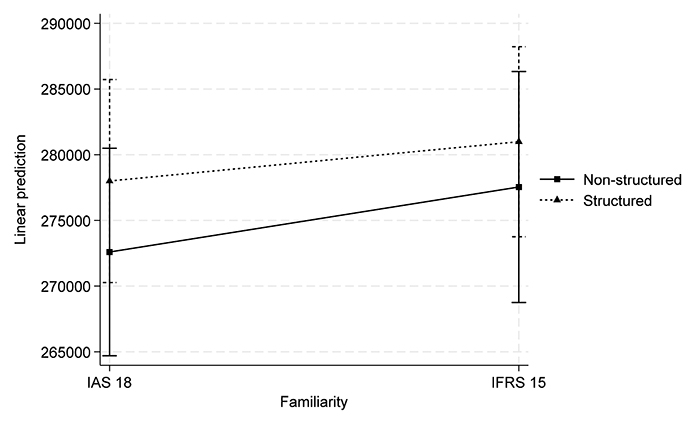
Upon analyzing the dispersion in the judgments of professionals who received the more familiar norm (IAS 18), we observed that there was no significant difference in judgments between complex (unstructured) and non-complex (structured) tasks [Panel C: F(1.34); prob. = 0.085]. When analyzing the group of respondents who received complex (unstructured) tasks, we observed there was no more noise in the judgments of groups that received IFRS 15 than in the judgments of groups that received IAS 18 [Panel C: F(1.97); prob. = 0.998]. Conversely, the group that received the more familiar standard (IAS 18) exhibited greater noise than the group that received the less familiar standard (IFRS 15) [Panel A: IAS 18 (SD) = 45.031; IFRS 15 (SD) = 32.060]. Indeed, the heightened adaptation of Brazilian preparers to the new accounting standard is reaffirmed. Notably, even when confronted with more complex tasks, they consistently exhibit reduced variability in effectively resolving challenges related to IFRS 15. Figure 2 shows the adjusted predictions of familiarity and complexity with a 95% confidence interval.

The research hypotheses (H1a, H2a, and H2b) were not supported due to: greater dispersion in the judgments of professionals who responded to the familiar standard (IAS 18) compared to professionals who responded to the non-familiar standard (IFRS 15); no difference in dispersion between the judgments of professionals who solved complex (unstructured) and those who solved non-complex (structured) tasks; no difference in dispersion in the judgments of professionals who solved complex and non-complex tasks in the familiar norm (IAS 18).
4.2. Moderating Effects of Preparers' Experience
To assess how professional experience can mitigate the effects of complexity and unfamiliarity with the norm, we subdivided the sample into two groups: more experienced and less experienced individuals. Those with professional experience less than or equal to the median were categorized as "less experienced," while the remaining individuals were classified as "more experienced." The average experience was 14.5 years, ranging from 0 to 50 years, with a median of 11 years. Therefore, out of the 356 individuals, 182 were classified as less experienced and 174 were classified as more experienced.
It is important to underscore that professional experience was not manipulated as an independent variable and, therefore, did not modify the experimental protocol. The resulting composition of the four groups was homogeneous. Our overarching objective is to assess the impact of experience on within-group variance.
When analyzing the dispersion of judgments among professionals who received the less familiar standard (IFRS 15), we observed that judgments from less experienced participants were not more dispersed than those from more experienced participants [Panel C: F(0.99) ; Prob. = 0.519]. When analyzing the group of less experienced respondents, who received non-complex (structured) and complex (unstructured) tasks, a significant difference in noise was observed in the judgments of this group depending on the level of complexity of the task [Panel C: F(1.93); Prob. = 0.002]. Conversely, the group of more experienced preparers did not show a significant difference in the dispersion of their judgments when comparing complex and non-complex tasks [Panel C: F(0.82); Prob. = 0.354].
These results demonstrate that, for more experienced professionals, the level of task complexity does not significantly interfere with their judgments. For less experienced professionals, task complexity tends to affect their judgments due to the greater dispersion for complex tasks compared to non-complex tasks [Panel B - Less experienced: Structured (SD) = 31.032; Unstructured (SD) = 43.129]. These findings corroborate those of Abdolmohammadi and Wright (1987) and Vera-Muñoz et al. (2001), who noted that more experienced professionals exhibit less uncertainty in their decisions, even when faced with more complex tasks. Figure 3 summarizes the findings for H1a, H2a, H2b, H3a, and H3b.
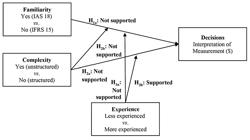
In summary, the findings suggest that professionals who adhere to a more widely recognized standard exhibit greater variability in their judgments. Interestingly, the complexity factor does not seem to have a direct impact on preparers' judgments. This pattern persists even when they tackle more complex tasks, where an increased tendency to display dispersion in judgments is evident among those who follow the familiar standard.
The DPT may help explain these findings by suggesting that practitioners use two distinct cognitive systems when making decisions: System 1, which is fast, intuitive, and automatic; and System 2, which is slower, more analytical, and deliberate (Evans & Stanovich, 2013; Grayot, 2020). In revenue recognition and measurement decisions, familiarity with a standard such as IFRS 15 may cause preparers to rely more on System 1, resulting in faster, less analytical decisions. This could explain the increased variability observed among those familiar with the standard. The theory also posits that task complexity activates System 2, requiring more effortful and deliberate processing. However, complexity does not seem to directly impact judgment variability among those familiar with the standard, possibly because they continue to rely on automatic and intuitive processes despite the complexity. Therefore, despite the rejection of many of the hypotheses, it is observed that judgment processes still corroborate the DPT.
Cova (2015) pointed out that Brazilian accounting professionals should prepare for the implementation of IFRS 15 in advance, recommending that companies establish a plan quickly due to the potential changes in policies, procedures, internal controls, and systems that this rule may cause. According to Cova (2015), preparation in advance is therefore a fundamental measure for a smooth transition. Research conducted by Ben Salem and Damak Ayadi (2023) sheds light on the pivotal role of interpersonal communication in fostering the implementation of international standards. Additionally, their findings underscore the complex influence of coercive and mimetic isomorphism on nations. These influences predominantly stem from the global integration facilitated by the adoption of IFRS in the international economy, compelling countries to carefully deliberate and determine their chosen adoption strategies.
However, these results may reflect the preparation process that companies and financial statement preparers carried out in advance, thus adapting to the new procedures that came into force in the Brazilian environment in 2018. Less dispersion in the judgments of preparers who received the new IFRS 15 standard may reflect a previous preparation process for the standard.
Finally, it was observed that the preparer's experience is a factor that moderates the effect of task complexity on revenue judgment. That is, less experienced professionals exhibit greater dispersion (or uncertainty) in their judgments when faced with more complex tasks. This effect does not occur when professionals have greater experience.
These findings corroborate those of Abdolmohammadi and Wright (1987), Vera-Muñoz et al. (2001), and Li et al. (2017), who pointed out that less experienced professionals exhibit greater uncertainty in their decisions, whereas more experienced professionals exhibit less uncertainty, even in more complex tasks.
5. CONCLUSIONS
This study investigated the joint influence of familiarity with accounting standards and task complexity on the recognition and measurement of revenue in contracts with customers. Participants were randomly assigned to apply either the old, familiar IAS 18 standard or the new, unfamiliar IFRS 15 standard, which came into effect in January 2018 (data were collected between July 2017 and August 2018). Task complexity was also randomly manipulated, presenting participants with structured or unstructured information. The latter required individuals to make a more significant effort to find the solution.
The task was designed to evaluate preparers' behavior when applying the revenue accounting standard and included measuring revenue (i.e., determining the transaction price). Thus, the task aimed to be representative of the revenue measurement procedure.
The task effectively revealed differences in the proportion of noise (dispersion) in the responses between groups that received different accounting standards. Participants who performed the familiar task had a higher standard deviation than those given unfamiliar information. This result contradicts the initial hypotheses that preparers who received the old norm would exhibit less uncertainty in their decisions and that preparers who received the new norm would exhibit greater uncertainty, resulting in greater dispersion in their responses. However, since implementation of the standard in Brazil was recommended in advance (Cova, 2015), this result may represent how statement preparers adapted to the new standard during the transition period. Additionally, Ben Salem and Damak Ayadi (2023) suggest that interpersonal communication may have been a relevant factor in implementing IFRS 15, possibly influencing the deliberation and determination of strategies for adopting new standards in a country.
Additionally, we observed that the preparer's experience is a factor that moderates the effect of task complexity on revenue judgments. Less experienced professionals exhibit greater dispersion across different levels of task complexity. This effect does not occur in the group of professionals with greater market experience. These results corroborate those of Abdolmohammadi and Wright (1987), Vera-Muñoz et al. (2001), and Li et al. (2017), as more experienced professionals exhibit less uncertainty in their decisions, even when faced with greater task complexity.
These findings enhance our understanding of how human perceptions are influenced by aspects arising from their behavior. Their judgments and decisions concerning the same event tend to differ depending on how it is oriented and the experience acquired by the individual. In a broader sense, this discussion is relevant because it provides insights into how individuals make judgments during the transition period between standards, which can generate a lack of comparability in financial reports. By the end of the first year of adopting IFRS 15, 45% of the companies in the Ibovespa mentioned revenue recognition in their KAMs, indicating that this issue had become significant in the statements of the most relevant companies in the Brazilian financial market (Vargas et al., 2022).
Thus, the present work has several implications for the various users of accounting information, who constantly make judgments and decisions based on reports prepared by professionals, such as the respondents in this study. The results serve as a warning to users to carefully analyze these reports and realize that the reported values are only approximations of reality that can be affected by several factors.
The main limitation of this study, and therefore the biggest challenge, is data collection via questionnaire. The questionnaire was sent to all accountants registered with the CFC. In addition to the low response rate, conscientious and adequate responses to the tasks required the implementation of check questions in the questionnaire and the subsequent validation of the data. This control allowed for a more concise analysis despite reducing the final sample. For future research, we suggest evaluating the level of familiarity with the new standard several years after its implementation. We also suggest using experimental approaches that combine between-subjects and within-subjects manipulations to test whether the natural complexity of the task moderates the complexity of the operationalization to which the participant is subjected.
References
-
Abdolmohammadi, M., & Wright, A. (1987). An examination of the effects of experience and task complexity on audit judgments. Accounting Review, 62(1), 1-13. https://www.jstor.org/stable/248042
» https://www.jstor.org/stable/248042 -
Aladwey, L., & Diab, A. (2023). The determinants and effects of the early adoption of IFRS 15:Evidence from a developing country. Cogent Business & Management, 10(1), 2167544. https://doi.org/10.1080/23311975.2023.2167544
» https://doi.org/10.1080/23311975.2023.2167544 -
Almeida, N. S. D., & Lemes, S. (2013). Evidências do entendimento de quatro pronunciamentos contábeis por auditores independentes do Brasil.Revista de Administração Contemporânea,17, 83-105. https://doi.org/10.1590/S1415-65552013000100006
» https://doi.org/10.1590/S1415-65552013000100006 -
Arnold, V., Collier, P. A., Leech, S. A., & Sutton, S. G. (2000). The effect of experience and complexity on order and recency bias in decision making by professional accountants.Accounting & Finance,40(2), 109-134. https://doi.org/10.1111/1467-629X.00039
» https://doi.org/10.1111/1467-629X.00039 -
Asare, S. K., & McDaniel, L. S. (1996). The effects of familiarity with the preparer and task complexity on the effectiveness of the audit review process. The Accounting Review, 71(2), 139-159. http://www.jstor.org/stable/248443
» http://www.jstor.org/stable/248443 -
Barniv, R. R., Myring, M., & Westfall, T. (2022). Does IFRS experience improve analyst performance?.Journal of International Accounting, Auditing and Taxation,46, 100443. https://doi.org/10.1016/j.intaccaudtax.2021.100443
» https://doi.org/10.1016/j.intaccaudtax.2021.100443 -
Belesis, N., Sorros, J., Karagiorgos, A., & Kousounadis, P. (2021). Cumulative effect of IFRS 15 and IFRS 16 on maritime company financial statements: A hypothetical case. SN Business & Economics, 1(3), 51. https://doi.org/10.1007/s43546-021-00043-y
» https://doi.org/10.1007/s43546-021-00043-y -
Ben Salem, R., & Damak Ayadi, S. (2023). The impact of acculturation process and the institutional isomorphism on IFRS adoption.EuroMed Journal of Business,18(2), 184-206. https://doi.org/10.1108/EMJB-04-2021-0058
» https://doi.org/10.1108/EMJB-04-2021-0058 -
Bonner, S. E. (1990). Experience effects in auditing: The role of task-specific knowledge. Accounting Review , 65(1), 72-92. https://www.jstor.org/stable/247877
» https://www.jstor.org/stable/247877 -
Bradbury, M. E., & Schröder, L. B. (2012). The content of accounting standards: Principles versus rules.The BritishAccounting Review ,44(1), 1-10.https://doi.org/10.1016/j.bar.2011.12.003
» https://doi.org/10.1016/j.bar.2011.12.003 -
Brooke, L., & Taylor, P. (2005). Older workers and employment: Managing age relations. Ageing & Society, 25(3), 415-429. https://doi.org/10.1017/S0144686X05003466
» https://doi.org/10.1017/S0144686X05003466 -
Cardoso, R. L., Leite, R. O., & Aquino, A. C. B. (2023). Probable at first glance, but unlikely after closer look: The role of cognitive reflection ability on the assessment of probabilistic expressions. The International Journal of Accounting https://doi.org/10.1142/S109440602350004X
» https://doi.org/10.1142/S109440602350004X -
Cova, C. J. G. (2015). Os impactos da assimilação da norma Internacional de Relatório Financeiro (IFRS 15) e seus efeitos assimétricos nas demonstrações financeiras das empresas brasileiras.Pensar Contábil,17(64), 48-56. http://atena.org.br/revista/ojs-2.2.3-08/index.php/pensarcontabil/article/view/2623/2205
» http://atena.org.br/revista/ojs-2.2.3-08/index.php/pensarcontabil/article/view/2623/2205 -
Chand, P., Leung, P., Martinov-Bennie, N., & Carey, P. (2024). Ambiguity in international financial reporting standards (IFRS) and its impact on judgments of auditors.Managerial Auditing Journal,39(6), 587-602. https://doi.org/10.1108/MAJ-03-2023-3849
» https://doi.org/10.1108/MAJ-03-2023-3849 - Chand, P., Patel, C., & Day, R. (2009). Factors causing differences in the financial reporting practices in selected south pacific countries in the post-convergence period.Asian Academy of Management Journal,13(2), 111-129.
-
Chand, P., Patel, C., & Patel, A. (2010). Interpretation and application of “new” and “complex” international financial reporting standards in Fiji: Implications for convergence of accounting standards.Advances in Accounting,26(2), 280-289. https://doi.org/10.1016/j.adiac.2010.08.004
» https://doi.org/10.1016/j.adiac.2010.08.004 -
Clor‐Proell, S. M., & Maines, L. A. (2014). The impact of recognition versus disclosure on financial information: A preparer’s perspective.Journal of Accounting Research,52(3), 671-701. https://doi.org/10.1111/1475-679X.12053
» https://doi.org/10.1111/1475-679X.12053 -
Comissão de Valores Mobiliários (CVM). (2022). Ofício-Circular/CVM/SNC/SEP/01/2022 CVM. http://conteudo.cvm.gov.br/export/sites/cvm/legislacao/oficios-circulares/snc-sep/anexos/ocsncsep012022.pdf
» http://conteudo.cvm.gov.br/export/sites/cvm/legislacao/oficios-circulares/snc-sep/anexos/ocsncsep012022.pdf -
Doupnik, T. S., & Riccio, E. L. (2006). The influence of conservatism and secrecy on the interpretation of verbal probability expressions in the Anglo and Latin cultural areas.The International Journal of Accounting ,41(3), 237-261. https://doi.org/10.1016/j.intacc.2006.07.005
» https://doi.org/10.1016/j.intacc.2006.07.005 -
Evans, J. S. B., & Stanovich, K. E. (2013). Dual-process theories of higher cognition: Advancing the debate. Perspectives on Psychological Science, 8(3), 223-241. https://doi.org/10.1177/1745691612460685
» https://doi.org/10.1177/1745691612460685 -
Grayot, J. D. (2020). Dual process theories in behavioral economics and neuroeconomics: A critical review. Review of Philosophy and Psychology, 11(1), 105-136. https://doi.org/10.1007/s13164-019-00446-9
» https://doi.org/10.1007/s13164-019-00446-9 -
Griffith, E. E., Hammersley, J. S., & Kadous, K. (2015). Audits of complex estimates as verification of management numbers: How institutional pressures shape practice. Contemporary Accounting Research, 32(3), 833-863. https://doi.org/10.1111/1911-3846.12104
» https://doi.org/10.1111/1911-3846.12104 -
Hammond, J. S., Keeney, R. L., & Raiffa, H. (1998). The hidden traps in decision making.Harvard Business Review,76(5), 47-58. http://prof.usb.ve/lcolmen/The%20Hidden%20Traps%20in%20decision%20making.pdf
» http://prof.usb.ve/lcolmen/The%20Hidden%20Traps%20in%20decision%20making.pdf -
Hogarth, R. M. (1975). Cognitive processes and the assessment of subjective probability distributions.Journal of the American Statistical Association,70(350), 271-289. https://doi.org/10.1080/01621459.1975.10479858
» https://doi.org/10.1080/01621459.1975.10479858 -
Huefner, R. J. (2016). The impact of new financial reporting standards on revenue management. Journal of Revenue and Pricing Management, 15(1), 78-81. https://doi.org/10.1057/rpm.2015.45
» https://doi.org/10.1057/rpm.2015.45 -
International Accounting Standards Board [IASB] (2012). International Accounting Standard[IAS] 18, Revenue https://www.ifrs.org/issued-standards/list-of-standards/ias-18-revenue/#about
» https://www.ifrs.org/issued-standards/list-of-standards/ias-18-revenue/#about -
International Accounting Standards Board [IASB]. (2014). International Financial Reporting Standard [IFRS] 15, Revenue from contracts with customers http://eifrs.ifrs.org/eifrs/bnstandards/en/2016/ifrs15.pdf
» http://eifrs.ifrs.org/eifrs/bnstandards/en/2016/ifrs15.pdf -
International Accounting Standards Board [IASB]. (2018). Conceptual framework for financial reporting https://www.ifrs.org/issued-standards/list-of-standards/conceptual-framework/#standard
» https://www.ifrs.org/issued-standards/list-of-standards/conceptual-framework/#standard -
Johnson, L. (2018). A high-level overview of how the new accounting standard update on revenue recognition impacts the united states healthcare system Undergraduate Honors Theses. East Tennessee State University. Paper 456. https://dc.etsu.edu/honors/456/
» https://dc.etsu.edu/honors/456/ -
Kabir, H., & Su, L. (2022). How did IFRS 15 affect the revenue recognition practices and financial statements of firms? Evidence from Australia and New Zealand.Journal of International Accounting, Auditing and Taxation ,49, 100507. https://doi.org/10.1016/j.intaccaudtax.2022.100507
» https://doi.org/10.1016/j.intaccaudtax.2022.100507 - Kahneman, D. (2013). Thinking, fast and slow Farrar Straus Giroux.
-
Kahneman, D., & Tversky, A. (1973). On the psychology of prediction.Psychological Review,80(4), 237-251. https://doi.org/10.1037/h0034747
» https://doi.org/10.1037/h0034747 - Kahneman, D., Sibony, O., & Sunstein, C. (2021). Noise: a flaw in human judgment Hachette Books.
-
Khamis, A. M. (2016). Perception of preparers and auditors on new revenue recognition standard (IFRS 15): evidence from Egypt. Jurnal Dinamika Akuntansi dan Bisnis, 3(2), 1-18. https://jurnal.usk.ac.id/JDAB/article/view/5383
» https://jurnal.usk.ac.id/JDAB/article/view/5383 -
KPMG (2022). Revenues - IFRS 15 handbook https://assets.kpmg/content/dam/kpmg/xx/pdf/2022/11/handbook-revenue.pdf
» https://assets.kpmg/content/dam/kpmg/xx/pdf/2022/11/handbook-revenue.pdf -
Kunze, F., Boehm, S., & Bruch, H. (2013). Age, resistance to change, and job performance. Journal of Managerial Psychology, 28(7-8), 741-760. https://doi.org/10.1108/JMP-06-2013-0194
» https://doi.org/10.1108/JMP-06-2013-0194 -
Li, L., Qi, B., Tian, G., & Zhang, G. (2017). The Contagion Effect of Low-Quality Audits at the Level of Individual Auditors. The Accounting Review , 92(1), 137-163. https://doi.org/10.2308/accr-51407
» https://doi.org/10.2308/accr-51407 -
Libby, R., & Tan, H. T. (1994). Modeling the determinants of audit expertise.Accounting, Organizations and Society,19(8), 701-716. https://doi.org/10.1016/0361-3682(94)90030-2
» https://doi.org/10.1016/0361-3682(94)90030-2 -
Lu, H. Y., & Wang, S. (2018). Does lifting the objective-price constraint in revenue recognition increase the value relevance of earnings and revenue? Asian Review of Accounting, 26(4), 545-570. https://doi.org/10.1108/ARA-08-2017-0126
» https://doi.org/10.1108/ARA-08-2017-0126 -
Mala, R., & Chand, P. (2014). Impacts of additional guidance provided on international financial reporting standards on the judgments of accountants.The International Journal of Accounting ,49(2), 263-288. https://doi.org/10.1016/j.intacc.2014.04.008
» https://doi.org/10.1016/j.intacc.2014.04.008 -
Maradona, A. F., Chand, P., & Lodhia, S. (2022). Professional skills required by accountants for applying international financial reporting standards: implications from Indonesia. Meditari Accountancy Research, 32(2), 269-293. https://doi.org/10.1108/MEDAR-02-2022-1591
» https://doi.org/10.1108/MEDAR-02-2022-1591 -
Mısırlıoğlu, İ. U., Tucker, J., & Yükseltürk, O. (2013). Does mandatory adoption of IFRS guarantee compliance?. The International Journal of Accounting , 48(3), 327-363. https://doi.org/10.1016/j.intacc.2013.07.002
» https://doi.org/10.1016/j.intacc.2013.07.002 -
Napier, C. J., & Stadler, C. (2020). The real effects of a new accounting standard: The case of IFRS 15 Revenue from Contracts with Customers. Accounting and Business Research, 50(5), 474-503. https://doi.org/10.1080/00014788.2020.1770933
» https://doi.org/10.1080/00014788.2020.1770933 -
Nguyen, H. T. T., Nguyen, H. T. T., & Van Nguyen, C. (2023). Analysis of factors affecting the adoption of IFRS in an emerging economy.Heliyon, 9(6), e17331. https://doi.org/10.1016/j.heliyon.2023.e17331
» https://doi.org/10.1016/j.heliyon.2023.e17331 -
Obradović, V., Čupić, M., & Dimitrijević, D. (2018). Application of International Financial Reporting Standards in the transition economy of Serbia. Australian Accounting Review , 28(1), 48-60. https://doi.org/10.1111/auar.12187
» https://doi.org/10.1111/auar.12187 -
Penno, M. C. (2008). Rules and accounting: Vagueness in conceptual frameworks. Accounting Horizons,22(3), 339-351. https://doi.org/10.2308/acch.2008.22.3.339
» https://doi.org/10.2308/acch.2008.22.3.339 -
Sappor, P., Atta Sarpong, F., & Ahmed Seidu Seini, R. (2023). The adoption of IFRS for SMEs in the northern sector of Ghana: A case of structural equation modeling. Cogent Business & Management , 10(1), 2180840. https://doi.org/10.1080/23311975.2023.2180840
» https://doi.org/10.1080/23311975.2023.2180840 -
Sarquis, R. W. (2021). Afinal, o que se busca é comparabilidade ou uniformidade?.Revista Mineira de Contabilidade,22(2), 4-8. https://doi.org/10.51320/rmc.v22i2.1355
» https://doi.org/10.51320/rmc.v22i2.1355 -
Shanteau, J. (1989). Cognitive heuristics and biases in behavioral auditing: Review, comments and observations.Accounting, Organizations and Society ,14(1-2), 165-177. https://doi.org/10.1016/0361-3682(89)90040-8
» https://doi.org/10.1016/0361-3682(89)90040-8 -
Slovic, P., Fischhoff, B., & Lichtenstein, S. (1977). Behavioral decision theory.Annual Review of Psychology,28(1), 1-39. https://doi.org/10.1146/annurev.ps.28.020177.000245
» https://doi.org/10.1146/annurev.ps.28.020177.000245 -
Tversky, A., & Kahneman, D. (1973). Availability: A heuristic for judging frequency and probability.Cognitive Psychology, 5(2), 207-232. https://doi.org/10.1016/0010-0285(73)90033-9
» https://doi.org/10.1016/0010-0285(73)90033-9 -
Tversky, A., & Kahneman, D. (1974). Judgment under uncertainty: Heuristics and biases.Science,185(4157), 1124-1131. https://doi.org/10.1126/science.185.4157.112
» https://doi.org/10.1126/science.185.4157.112 -
Trotman, K. T., Tan, H. C., & Ang, N. (2011). Fifty‐year overview of judgment and decision‐making research in accounting.Accounting & Finance ,51(1), 278-360. https://doi.org/10.1111/j.1467-629X.2010.00398.x
» https://doi.org/10.1111/j.1467-629X.2010.00398.x -
Tubbs, R. M. (1992). The effect of experience on the auditor's organization and amount of knowledge. Accounting Review , 783-801. https://www.jstor.org/stable/248324
» https://www.jstor.org/stable/248324 -
Vargas, J. M. B., Bianchi, M., & Venturini, L. D. B. (2022). Tendências dos Principais Assuntos de Auditoria Evidenciados nos Setores de Utilidade Pública e Telecomunicações da B3.ConTexto-Contabilidade em Texto,22(50), 63-79. https://www.seer.ufrgs.br/index.php/ConTexto/article/view/121426
» https://www.seer.ufrgs.br/index.php/ConTexto/article/view/121426 -
Vera‐Muñoz, S. C., Kinney, W. R., & Bonner, S. E. (2001). The effects of domain experience and task presentation format on accountants' information relevance assurance. The Accounting Review , 76(3), 405-429. https://doi.org/10.2308/accr.2001.76.3.405
» https://doi.org/10.2308/accr.2001.76.3.405 -
Veysey, R. (2020). ‘The real effects of a new revenue accounting standard’- a practitioner view. Accounting and Business Research , 50(5), 504-506. https://doi.org/10.1080/00014788.2020.1770935
» https://doi.org/10.1080/00014788.2020.1770935 -
Wanberg, C. R., & Banas, J. T. (2000). Predictors and outcomes of openness to changes in a reorganizing workplace. Journal of Applied Psychology, 85(1), 132-142. https://doi.org/10.1037/0021-9010.85.1.132
» https://doi.org/10.1037/0021-9010.85.1.132 -
Zhang, Y. (2005). Revenue recognition timing and attributes of reported revenue: The case of software industry’s adoption of SOP 91-1.Journal of Accounting and Economics,39(3), 535-56. https://doi.org/10.1016/j.jacceco.2005.04.003
» https://doi.org/10.1016/j.jacceco.2005.04.003
-
DATA AVAILABILITY STATEMENT
Datasets related to this article will be available upon request to the corresponding author.
-
FINANCING
This study was financed by the National Council for Scientific and Technological Development (CNPq) under grants 306997/2022-3 and 444560/2020-3, the Coordination for the Improvement of Higher Education Personnel (Capes) under grant 88882.184085/2000-01, and the State of Rio de Janeiro Research Support Foundation (FAPERJ) under grants E-26/202.517/2019 and E-26/211.165/2019.
-
This is a bilingual text. This article has also been translated into Portuguese and published under the DOI https://doi.org/10.1590/1808-057x20252215.pt
-
This article stems from a Master's dissertation submitted by co-author Paulo Vitor Souza de Souza in 2016.
-
Study presented at the Behavioral Science Lab 2022, May 2022.
Datasets related to this article will be available upon request to the corresponding author.

 Source: Prepared by the authors.
 Source: Prepared by the authors.
 Source: Prepared by the authors.