
 Earnings management in Brazil (2000-2025): synthesis, evidence, and research agenda
This article offers a systematic, analytical, and narrative review of earnings management research in Brazil from 2000 to 2025. It integrates methods, findings, and mechanisms with an emphasis on the role of the Accounting & Finance Review (A&FR) and the formulation of a 2026-2030 agenda guided by credible identification, replicability, and regulatory utility. The methodology involved searching SciELO, SPELL, Google Scholar, and the CAPES Portal (PT/EN) for empirical studies focused on Brazil that used quantitative proxies (e.g., accruals, real activities, earnings quality, and earnings distribution). Screening was performed in two stages, with coding by thematic axes [International Financial Reporting Standards (IFRS), governance/auditing, accounting-tax, and sectoral/ownership] and proxy families (Jones/Kothari, Dechow-Dichev/McNichols, Roychowdhury, and hybrid/AI). A narrative summary was supported by a timeline and tables. Research gaps include limited causal evidence specific to norms (IFRS 15/16/17), an incomplete understanding of governance and audit mechanisms [committees, sector specialization, and American depositary receipts (ADRs)], the integration of text and numbers with interpretability, the micro-impacts of digital transformation [enterprise resource planning (ERP), continuous auditing, and smart contracts], and the effects of base erosion and profit shifting (BEPS) on the accounting and tax link. The results indicate that, on average, convergence with IFRS is associated with a moderate reduction in accruals-based management conditioned by governance, auditing (Big Four), and enforcement. There are also signs of substitution for real activities under greater accounting scrutiny. Abnormal book-tax differences (BTDs) and low tax-accounting compliance are related to lower earnings persistence and higher informational risk. The A&FR standardized protocols, aligned designs with Brazilian specifics, and connected results to regulatory issues. The article consolidates best practices, such as sector benchmarks, fixed effects, clustering, and sensitivity tests, and proposes a 2026-2030 agenda with five focus areas: accruals-real trade-offs, specific IFRS, governance and audit mechanisms, text and numbers integration, and digital transformation. The relevance of the topic lies in its useful synthesis for researchers (a map of validity and gaps), regulators and auditors (prioritization of oversight), and information users (warning signs). By integrating 25 years of evidence into a unified explanatory framework, the study reorganizes the field by clarifying the channels, conditions, and limits of management, standardizes protocols for the Brazilian context, and defines high-return priorities for 2026-2030. This reinforces the cumulative nature of the literature and brings the national debate closer to international standards.
Keywords:
earnings management; earnings quality; IFRS; corporate governance; auditing; Brazil
 Thumbnail
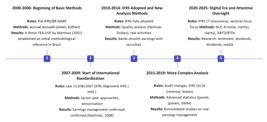
 ABTD = abnormal book-tax differences (BTD); BR GAAP = Brazilian Generally Accepted Accounting Principles; FEA-USP = School of Economics, Business, and Accounting of the University of São Paulo; GMM = generalized method of moments; AI = artificial intelligence; IFRS = International Financial Reporting Standards; NLP = natural language processing.
Source:
Prepared by the author.
ABTD = abnormal book-tax differences (BTD); BR GAAP = Brazilian Generally Accepted Accounting Principles; FEA-USP = School of Economics, Business, and Accounting of the University of São Paulo; GMM = generalized method of moments; AI = artificial intelligence; IFRS = International Financial Reporting Standards; NLP = natural language processing.
Source:
Prepared by the author.