 Beneficial rhizobacteria and cover crops on soybean development
ABSTRACT
Soybean cultivation holds national and international significance, necessitating sustainable production practices. This study evaluated the impact of plant growth-promoting rhizobacteria (PGPR) and cover crops on soybean yield components and grain yield. The experiment followed a randomized block design in a 5 × 2 factorial scheme with four replications. Treatments included the application of a PGPR combination (Bacillus sp. + Serratia marcescens) and five cover crops grown in the off-season: rice, corn, millet, Urochloa ruziziensis, and a cover crops mix. Over five agricultural seasons (2019/20–2023/24), we assessed the number of pods per plant, grains per pod, 100-grain mass, and grain yield. Cover crops did not influence yield components or grain yield. However, applying the PGPR mixture (Bacillus sp. BRM 63573 + Serratia marcescens BRM 32114) significantly improved 100-grain mass and grain yield. Among climatic factors, solar radiation was the primary determinant of grain yield variation. These findings highlight the potential of PGPR to enhance soybean production sustainably, while cover crops may require further investigation to optimize their role in this system.
Keywords
Sustainable agriculture;
Glycine max
; No-tillage system; beneficial microorganisms; multifunctional rhizobacteria
INTRODUCTION
Soybeans (Glycine max L.) are a highly significant agricultural crop both nationally and internationally, especially prevalent in the animal feed industry. According to the USDA (United States Department of Agriculture) (1), the projected soybean harvest in Brazil for the 2024/25 season is 169 million tons, solidifying the country’s position as the largest producer and exporter of this grain. Currently, the soybean planting area in Brazil covers 46.02 million hectares (2). Despite the large volume of grain produced, there are numerous challenges to achieving more sustainable and self-sufficient agricultural production for this and other crops.
Several factors can influence the productivity and components of soybean yield, posing a challenge for producers to address. Understanding issues or unexpected outcomes that may arise is particularly challenging when making decisions. Among the various factors affecting crop productivity are the genetic characteristics of the cultivar, crop management practices, and environmental factors such as water availability, soil type, and climate (3). Climatic conditions, including precipitation, temperature, and solar radiation, play crucial roles in the soybean development cycle. For example, solar radiation is vital for the growth of any agricultural crop, as it directly influences the biological processes of plants. According to Fancelli and Dourado Neto (4), processes like photosynthesis, respiration, transpiration, and evaporation rely directly on the energy available in the environment, commonly referred to as heat. Assis and Mendez (5) note that solar radiation is essentially the sole source of energy for the physiological and biochemical processes in plants. Shibles and Weber (6) observed that greater efficiency in the use of solar radiation is critical for soybean crop yield, especially during the grain-filling phase. All these factors can potentially limit the adequate development of the crop.
In terms of soybean crop management, certain technologies with the potential for enhancing sustainability have been gaining technical and scientific attention. Notably, the use of plant growth-promoting rhizobacteria (PGPR) combined with plant cover crops has shown promise. These practices primarily aim to reduce the use of agricultural inputs and production costs, while also increasing the overall productivity of agricultural crops.
The use of plant growth-promoting rhizobacteria (PGPR) is a technology extensively studied and applied in agriculture to enhance crop growth. This promotion can occur through both direct and indirect mechanisms. Direct mechanisms include biological nitrogen fixation, the solubilization of essential nutrients like phosphate, potassium, and zinc, as well as biofilm and siderophore production (7). Indirect mechanisms involve providing biological control of pests and diseases (8,7). Mondani et al. (9) found that PGPR could increase soybean productivity under water stress conditions by improving photosynthesis and radiation use efficiency. De Paula et al. (10) tested various rhizobacteria isolates and observed that some effectively promoted soybean growth by efficiently mineralizing and making nutrients such as nitrogen available. Chagas Júnior et al. (11) reported that using inoculants based on Bacillus sp. led to significantly higher plant height, root length, shoot dry mass, root dry mass, and total dry mass compared to the control group without rhizobacteria. Rezende et al. (12) tested nine rhizobacteria isolates and found that combinations of Azospirillum brasiliense + Pseudomonas sp., Serratia sp. + Trichoderma koningiopsis, and Bacillus sp. + Serratia sp. were effective, resulting in increased macronutrient content, improved gas exchange, and enhanced agronomic performance in common beans.
The use of cover crops is recognized as a soil conservation practice primarily aimed at maintaining soil coverage. It is considered conservation-friendly due to its many benefits, including protection against raindrop impact and erosion processes, enhanced moisture retention through reduced evapotranspiration, shielding of soil biota from solar radiation, and contribution to nutrient cycling. Additionally, cover crops help prevent nutrient leaching, aid in recovering degraded areas, and can even suppress weed growth (13, 14, 15, 16, 17, 18, 19, 20).
As the search for more sustainable, unconventional, and environmentally friendly technologies intensifies, the combination of plant growth-promoting rhizobacteria (PGPR) with cover crops in soybean production has gained significant attention for its promising and strategic benefits. Frasca et al. (21) investigated the use of eight cover crops species alongside the microorganisms Serratia marcescens and Trichoderma koningiopsis. They found that incorporating microorganisms with cover crops, including mixtures of millet (Pennisetum glaucum), Crotalaria ochroleuca, black oats (Avena strigosa), white oats (Avena sativa), buckwheat (Fagopyrum esculentum), and coracana grass (Eleusine coracana), as well as combinations like black oats, buckwheat, millet, Piatã grass (Brachiaria brizantha), and Crotalaria ochroleuca, led to significant improvements in both the chemical and biological quality of the soil. Additionally, these treatments resulted in increased numbers of pods and grains per common bean pod. Araújo et al. (22) reported that multifunctional microorganisms, such as Bacillus sp. and Azospirillum sp., combined with cover crops grown before rice, such as Crotalaria species, millet, Urochloa ruziziensis, and buckwheat, significantly enhanced rice grain yield and quality.
However, despite the potential benefits, there is still limited research on the combined use of cover crops and beneficial microorganisms. Therefore, this study aims to investigate the effects of integrating plant growth-promoting rhizobacteria and cover crops on the components of yield and soybean grain yield.
MATERIALS AND METHODS
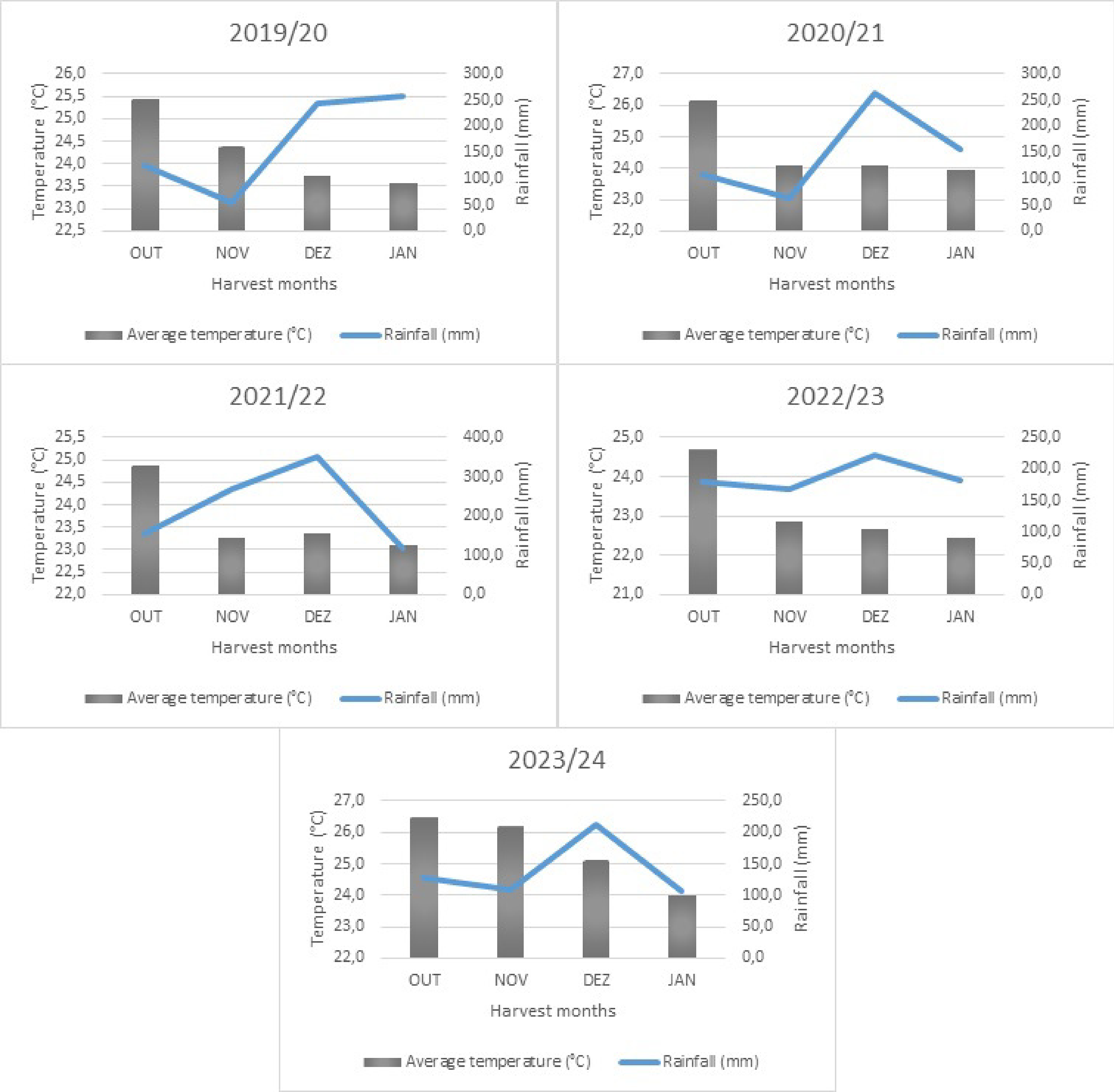
The experiments were conducted at the experimental area of Embrapa Rice and Beans in Santo Antônio de Goiás, GO, during the 2019/20, 2020/21, 2021/22, 2022/23, and 2023/24 growing seasons. The area is located at coordinates 16°29’29.3’’ S latitude, 49°17’44.8’’ W longitude, and at an altitude of 821 meters. The region has a tropical climate with an average temperature of 23°C, ranging from 14.2°C to 34.8°C throughout the year, classified as Aw according to the Köppen classification (23). The average annual rainfall in the region is 1428 mm, and when necessary, central pivot irrigation was used (Figure 1). The soil in the area is classified as a dark red acric latosol, and its fertility was assessed prior to the experiment’s installation. Samples were collected from a depth of 0 to 20 cm, with the following results: pH (water) 5.8; Organic Matter = 33.8 g kg-1; P-Mehlich = 12.9 mg dm-3; K = 2 mmolc dm-3; Ca²⁺ = 14.2 mmolc dm-3; Mg²⁺ = 6.1 mmolc dm-3; Al³⁺ = 1 mmolc dm-3; H + Al = 27 mmolc dm-3; SB = 22.3 mmolc dm-3; Cu²⁺ = 1.4 mg dm-3; Zn²⁺ = 4.3 mg dm-3; Fe³⁺ = 21 mg dm-3; Mn²⁺ = 13.7 mg dm-3; β-glucosidase = 19.6 mg g-1 h-1; Arylsulfatase = 13.9 mg g-1 h-1.

Average temperature (°C) and average rainfall (mm) data during the 2019/20, 2020/21, 2021/22, 2022/23 and 2023/24 harvest periods.
The experimental design used was a randomized block design in a 5 x 2 x 5 factorial scheme, with four replications. The treatments consisted of a combination of five cover crops grown during the off-season, two microorganism managements (with and without), and five agricultural harvests (2019/20, 2020/21, 2021/22, 2022/23, and 2023/24). The plots measured 20 m long by 6.30 m wide, totaling 126 m² per plot, with a useful area of 27 m² (the three central rows of the plot).
The rhizobacteria used were obtained from the microbiological collection of Embrapa Rice and Beans. The strains Bacillus sp. (BRM 63573) and Serratia marcescens (BRM 32114) were used. These bacteria were selected based on previous studies conducted under greenhouse conditions (24). The predetermined isolates were plated on Petri dishes containing PDA (Potato Dextrose Agar) and placed in a BOD incubator for 4 days at 25 °C. After this period, using a Drigalski loop, the bacteria were aseptically inoculated into a nutrient broth solution containing agar (autoclaved at 121 °C for 30 minutes). To allow the bacteria multiplication, this solution was kept in a shaking table chamber for 48 hours at 24 °C. After this period, the solutions were calibrated to a concentration of 1x10⁸ Colony Forming Units ml-1 using a spectrophotometer (Adapted from (11)).
The cover crops used in the experiment were millet (Pennisetum glaucum), Congo grass (Urochloa ruziziensis), rice (Oryza sativa), maize (Zea mays), and Mix Ultra cover crops, which included white lupin (Lupinus albus), buckwheat (Fagopyrum esculentum), white oats (Avena sativa), black oats (Avena strigosa Schreb), crotalaria ochroleuca (Crotalaria ochroleuca), crotalaria juncea (Crotalaria juncea), turnip rape (Raphanus sativus), millet (Pennisetum glaucum), and coracana grass (Eleusine coracana). Before planting the plots with the cover crops, glyphosate herbicide was applied at approximately 4 liters per hectare. The cover crops were sown in February and March using a no-till system, with a mechanized seeder and a Micron® seeding furrow sprayer to apply the microorganisms. A total of 85 kg ha-1 of P₂O₅ was applied at planting, with two top dressings performed at 20 and 40 days after emergence (DAE), respectively. The area with the cover crops was cultivated until it was desiccated with glyphosate, 15 days before sowing the winter-cultivated common beans and then the summer-cultivated soybeans.
When the soybeans were planted, the bacteria were applied using a Micron® sprayer at a dosage of 300 ml per hectare of Bacillus sp. microbial solution and 300 ml ha-1 of Serratia marcescens microbial solution, both diluted in 20 liters of water. For the inoculation of Bradyrhizobium japonicum, 600 ml ha-1 of the commercial inoculant Grap Nodl® was used in all treatments, which is the dose recommended by the manufacturer.
The soybeans were planted in the first half of October each year, also using a no-till system. The cultivar used was BRS 6970 IPRO from Embrapa, with 15 seeds sown per meter. The planting spacing was 0.45 m between rows. The fertilizer applied was 300 kg ha-1 of a 5-30-15 formulated fertilizer. Chemical products were applied according to agronomic recommendations for the crop to keep a disease, pest and weed free area.
The soybeans were harvested after physiological maturity using a mechanical harvester. The grains were weighed (adjusted to a moisture content of 130 g kg-1, wet basis) and converted to kg per hectare. The following variables were analyzed on the harvest day: pods per plant (number), grains per pod (number), and mass of 100 grains (grams), adjusted to a moisture content of 130 g kg-1 (wet basis). For these evaluations, 10 plants were collected at random from the useful area of each plot.
The data obtained were submitted to an analysis of variance to check the significance of the interactions among factors. If there were no significant interactions, we analyzed each single factors. The means were compared using the Fisher’s test (LSD) at a 5% probability level, using the statistical software Sisvar version 5.6 (25). Additionally, we performed the Pearson’s correlation coefficient (PCC) analysis between soybean grain yield and meteorological data, using the test-t (p <0.01 and p < 0.05) with R 4.4.1(26).
RESULTS AND DISCUSSION
According to the statistical analysis, there was no interaction between the factors (Table 1). Therefore, the independent factors were analyzed. Regarding the cover crops grown in the off-season, it was found that they had no effect on the soybean’s productivity components or grain yield. Nascente & Crusciol (27), working with Urochloa brizantha, U. ruziziensis, Panicum maximum, and Pennisetum glaucum, also reported that cover crops did not affect soybean yields. Similarly, Pott et al. (28) found no significant differences in soybean yield or 100-grain mass with the use of cover crops, whether in monoculture, intercropping, or as a mix of cover crops. Silva et al. (29) found similar results for soybean yield components using plant cover mixes.
Grain yield (PROD), number of pods per plant (NPP), number of grains per pod (NGP), and mass of 100 grains (M100) of soybeans affected by cover crops and multifunctional rhizobacteria in the 2019/20, 2020/21, 2021/22, 2022/23, and 2023/24 harvests
Based on these research results, it can be inferred that soybean plants are minimally affected by cover crops. However, cover crops produce biomass, which is important for regions with nutritionally poorer soils, such as the Cerrado in Brazil or the African Savannas. In the process of straw degradation, plants with greater biomass production tend to release more nutrients, contributing to the soil fertility improvement (30). Additionally, a greater amount of straw helps to improve soil cover, protect it from erosion, suppress weeds, and enhance the soil’s biological activity (29).
On the other hand, leaving the area fallow is not sustainable, as it does not produce a large amount of biomass and increases the weed seed bank (22, 24). According to Araújo et al. (22), the use of vegetable cover during the off-season has significantly contributed to the reduction of weeds in areas cultivated with soybeans and rice in the Cerrado region.
Regarding the microorganism’s factor, it was found that their use resulted in a higher 100 grains mass and grain yield compared to the treatment without microorganisms (Table 1). Similarly, Tavanti et al. (31), using Bacillus subtilis strains, observed increases in crop yield, as well as enhanced vigor and seedling emergence. Frasca et al. (21) also noted greater increases in the 100 grains mass and soybean productivity with the use of multifunctional microorganisms. Park et al. (32) reported that the Bacillus aryabhattai strain SRB02 significantly promoted soybean growth. Braga Júnior et al. (33) found that inoculation with Bacillus subtilis (Bs10) led to increased productivity, biomass, and stand maintenance in soybeans. Mondani et al. (34) observed a 22.9% increase in grain yield in soybeans inoculated with growth-promoting rhizobacteria (Bacillus subtilis and Bacillus licheniformis) under water stress.
Based on these research results, it can be inferred that using plant growth-promoting rhizobacteria is a sustainable practice that benefits soybean development, including increased grain yield. The microorganisms used in this study (Bacillus sp. (BRM 63573) and Serratia marcescens (BRM 32114)) enhanced soybean productivity. Silva et al. (35) previously reported that a mixture of these bacteria led to greater root development and higher total biomass production (both root and aerial parts) compared to the control treatment without microorganisms. In a more recent study, Silva et al. (24) found that these two bacteria resulted in a 25% increase in the initial development of the soybean root system compared to the non-application of microorganisms. According to the authors, these bacteria can produce auxins (AIA), cellulase, solubilize phosphate, produce siderophores, and form biofilms. Thus, it can be inferred that these characteristics of the microorganisms contributed to increased grain mass and yield in soybeans.
The data on yield components and grain yield varied between harvests (Table 1). These variations were likely due to climatic changes from one year to the next.
To better understand the relationship between soybean yields across the five harvests and the meteorological variables for the same period (Table 2), Pearson’s correlation coefficient (PCC) was calculated. This coefficient is used to determine the degree of linear relationship between two variables (36). The value of this coefficient ranges from -1 to +1, indicating a negative relationship, no correlation, or a positive relationship between the variables.
Average values of meteorological variables and Pearson correlation coefficients (PCC) between soybean grain yield in the 2019/20, 2020/21, 2021/22, 2022/23, and 2023/24 harvests and meteorological variables
In the correlation analysis between soybean productivity across the five harvests and various meteorological variables, including maximum temperature, minimum temperature, temperature, rainfall, relative humidity, and solar radiation, only the last variable showed correlation (Table 2). The correlation analysis between productivity and solar radiation during these periods revealed a Pearson correlation coefficient of 0.62**, which is significant at the 1% and 5% probability levels according to the t-test. This value indicates a moderate positive correlation, meaning that as solar radiation increases, soybean productivity also increases.
Solar radiation plays a crucial role in plant growth and development, significantly influencing the production capacity and yield of crops. There is a direct relationship between growth, production, and the amount of light in the environment (37, 38). Santos et al. (39) evaluated the capture and use of solar radiation by soybeans, common beans, and weeds. They observed that soybeans were the most efficient among the species assessed in utilizing photosynthetically active radiation, showing superior efficiency in converting intercepted radiation into biomass. Fattori Junior et al. (40), in a study evaluating the effect of cloudiness on soybean yields in southeastern Brazil, observed a correlation between clear sky conditions and higher soybean yields. The authors reported that a reduction in solar radiation by approximately 22% and 29% resulted in a 26% to 37% reduction in soybean yield, respectively. Supporting this finding, our experiment showed that higher solar radiation in the 2023/24 harvest led to increased soybean yields, in contrast to the 2019/20 harvest, which had the lowest radiation (Table 1 and Table 2).
CONCLUSIONS
The rice, corn, Urochloa ruziziensis, millet, cover crops as well as a cover crops mix did not affect the soybean crop yields components or grain yield.
The combination of Bacillus sp. (BRM 63573) and Serratia marcescens (BRM 32114) microorganisms led to significant increases in the 100 grains mass and soybean grain yield.
Solar radiation was the climatic factor that most significantly affected soybean productivity in the studied crops.
ACKNOWLEDGMENTS, FINANCIAL SUPPORT AND FULL DISCLOSURE
We thank the Brazilian Agricultural Research Corporation (EMBRAPA), Ministry of Agriculture and Livestock (MAPA), Federal Agency for Support and Evaluation of Graduate Education (CAPES) and University of Brasília (UnB) for financial and structural support.
REFERENCES
-
1 United States Department of Agriculture – USDA. Country summary – Brazil: soybean [Internet]. 2024 [cited 2024 Aug 1]. Available from: https://ipad.fas.usda.gov/countrysummary/Default.aspx?id=BR&crop=Soybean
» https://ipad.fas.usda.gov/countrysummary/Default.aspx?id=BR&crop=Soybean -
2 Companhia Nacional de Abastecimento – CONAB. Acompanhamento da safra brasileira: grãos, 10º levantamento [Internet]. 2023 [cited 2024 Jul 31]. Available from: https://www.conab.gov.br/info-agro/safras/graos
» https://www.conab.gov.br/info-agro/safras/graos - 3 Souza AG, Smiderle OJ. Cultura da soja: radiação solar, acúmulo de matéria seca e suas interações para alta produtividade. In: Melo JOF, Silva APCM, Garcia EM, Taroco HA, Reina LDCB, editors. Ciências Agrárias: Tecnologia, sustentabilidade e inovação. 6th ed. 2024. p. 84–107.
- 4 Fancelli AL, Dourado Neto D. Produção de milho. Guaíba: Agropecuária; 2000.
- 5 Assis FN, Mendez MEG. Relação entre radiação fotossinteticamente ativa e radiação global. Pesq Agropec Bras. 1989;24:797–800.
- 6 Shibles RM, Weber CR. Interception of solar radiation and dry matter production by various soybean planting patterns. Crop Sci. 1966;6:55–9.
- 7 Verma M, Mishra J, Arora NK. Plant growth-promoting rhizobacteria: diversity and applications. In: Sobti R, Arora N, Kothari R, editors. Environmental biotechnology: for sustainable future. Singapore: Springer; 2019. p. 129–73.
- 8 Romagnoli EM, Andreote FD. Rizosfera. In: Cardoso EJBN, Andreote FD, editors. Microbiologia do solo. Piracicaba: ESALQ; 2016. p. 47–55.
- 9 Mondani F, Khani K, Honarmand SJ, Saeidi M. Evaluating effects of plant growth-promoting rhizobacteria on the radiation use efficiency and yield of soybean (Glycine max) under water deficit stress condition. Agric Water Manag. 2018;213:701–13.
- 10 De Paula GF, Demétrio GB, Matsumoto LS. Biotechnological potential of soybean plant growth-promoting rhizobacteria. Rev Caatinga. 2021;34:328–38.
- 11 Chagas Júnior AF, Borba E, Martins ALL, Souza MC, Gomes FL, Oliveira RS, et al. Bacillus sp. como promotor de crescimento em soja. Rev Cienc Agrar. 2021;44:170–9.
- 12 Rezende CC, Nascente AS, Silva MA, Frasca LLM, Pires RAC, De Filippi MCC, et al. Physiological and agronomic performance of common bean treated with multifunctional microorganisms. Rev Bras Cienc Agrar. 2021;16:838.
- 13 Amado TJC, Bayer C, Eltz FLF, Brum ACR. Potencial de culturas de cobertura em acumular carbono e nitrogênio no solo no plantio direto e a melhoria da qualidade ambiental. Rev Bras Cienc Solo. 2001;25:189–97.
-
14 Lamas FM. Plantas de cobertura: o que é isto? [Internet]. 2017 [cited 2024 May 5]. Available from: https://www.embrapa.br/busca-de-noticias/-/noticia/28512796/artigo—plantas-de-cobertura-o-que-e-isto
» https://www.embrapa.br/busca-de-noticias/-/noticia/28512796/artigo—plantas-de-cobertura-o-que-e-isto - 15 Michelon CJ, Junges E, Casali CA, Pellegrini JBR, Neto LR, Oliveira ZB, et al. Atributos do solo e produtividade do milho cultivado em sucessão a plantas de cobertura de inverno. Rev Cienc Agroveterinarias. 2019;18:230–9.
- 16 Santos FLS, Nascente AS, Lacerda MC, Calil FN, Dias JMM. Consórcio do arroz de terras altas A501CL com Urochloa ruziziensis. In: XI Congresso Brasileiro de Arroz Irrigado; 2019; Balneário Camboriú. p. 1–4.
- 17 Barbieri JD, Dallacort R, Daniel DF, Dalchiavon FC, Freitas PSL. Cobertura do solo, evapotranspiração e produtividade do milho safrinha. Agron Crop J. 2020;29:76–91.
- 18 Reis GP, Borsoi A. Atributos físicos do solo, incidência de plantas daninhas e massa seca de plantas de cobertura na entressafra da soja em Latossolo Vermelho. Rev Cultivando Saber. 2020;1:69–76.
- 19 Lange A, Buchelt AC, Tolfo DA, Dassi D, Silva AFS, Cavalli E. Sistema soja e milho safrinha consorciado com Urochloa ruziziensis: dois anos de cultivo. Rev Cienc Agron. 2021;30:149–65.
- 20 Marasca I, De Jesus ES, Paiva Filho SV, Tavares RLM. Eficiência das plantas de cobertura na densidade de plantas daninhas e como descompactadoras de solo. Agraria. 2021;14:295–303.
- 21 Frasca LLM, Nascente AS, Rezende CC, Silva MA, Lanna AC, Ferreira EPB, et al. Consortium of multifunctional microorganisms in soybean culture. Colloquium Agrariae. 2022;18:61–7.
- 22 Araujo FC, Nascente AS, De Filippi MCC, Silva MA, Sousa VS, Lanna AC. Cover crops and multifunctional microorganisms can affect development of upland rice. Aust J Crop Sci. 2021;15:137–44.
- 23 Alvares CA, Stape JL, Sentelhas PC, Gonçalves JLM, Sparovek G. Köppen’s climate classification map for Brazil. Meteorol Z. 2013;22:711–28.
- 24 Silva MA, Cruz DRC, Frasca LLM, De Filippi MCC, Ferreira AL, Nascente AS. Inoculation and co-inoculation with multifunctional rhizobacteria for the initial development of soybean. Pesq Agropec Trop. 2022;52:73558.
- 25 Ferreira DF. Sisvar: a computer analysis system to fixed effects split plot type designs. Rev Bras Biom. 2019;37:529–35.
-
26 R Core Team. R: A language and environment for statistical computing [Internet]. Version 4.4.1. Vienna: R Foundation for Statistical Computing; 2024 [cited 2024 Apr 10]. Available from: https://www.R-project.org/
» https://www.R-project.org/ - 27 Nascente AS, Crusciol CAC. Cover crops and herbicide timing management on soybean yield under no-tillage system. Pesq Agropec Bras. 2012;47:187–92.
- 28 Pott CA, Conrado PM, Rampim L, Umburanas RC, Conrado AMC, Outeiro VH, et al. Mixture of winter cover crops improves soil physical properties under no-tillage system in a subtropical environment. Soil Tillage Res. 2023;234:105854.
- 29 Silva MA, Nascente AS, De Filippi MCC, Frasca LLM, Rezende CC. Sustainable agricultural practices to improve soil quality and productivity of soybean and upland rice. Aust J Crop Sci. 2023;1:61–8.
- 30 Nascente AS, Stone LF, Crusciol CAC. Soil chemical properties affected by cover crops under no-tillage system. Rev Ceres Online. 2015;62:401–9.
- 31 Tavanti TR, Tavanti RFR, Galindo FS, Simões I, Dameto LS, Sá ME. Yield and quality of soybean seeds inoculated with Bacillus subtilis strains. Rev Bras Eng Agríc Ambient. 2020;24:65–71.
- 32 Park YG, Mun B, Kang S, Hussain A, Shahzad R, Seo C, et al. Bacillus aryabhattai SRB02 tolerates oxidative and nitrosative stress and promotes the growth of soybean by modulating the production of phytohormones. PLoS One. 2017;12(3):e0173203.
- 33 Braga Júnior GM, Chagas Júnior AF, Chagas LFB, Martins ALL, Oliveira RS, Lima CA, et al. Bacillus subtilis as a growth promoter inoculant on soybean plants in field. Braz J Dev. 2021;7:107220–37.
- 34 Mondani F, Khani K, Honarmand SJ, Saeidi M. Evaluating effects of plant growth-promoting rhizobacteria on the radiation use efficiency and yield of soybean (Glycine max) under water deficit stress condition. Agric Water Manag. 2018;213:701–13.
- 35 Silva MA, Nascente AS, De Filippi MCC, Lanna AC, Silva GB, Silva JFAE. Single or mixed growth promoting microorganisms as affecting biomass production, gas exchange and nutrient content of soybean plants. Rev Caatinga. 2020;33:619–32.
- 36 Ferreira PV. Estatística experimental aplicada às ciências agrárias. 1st ed. Viçosa: UFV; 2018.
- 37 Melges E, Lopes NF, Oliva MA. Crescimento, produção de matéria seca e produtividade da soja submetida a quatro níveis de radiação solar. Pesq Agropec Bras. 1989;24:1073–80.
- 38 Hammad HM, Abbas F, Ahmad A, Fahad S, Laghari KQ, Alharby H, et al. The effect of nutrients shortage on plant’s efficiency to capture solar radiations under semi-arid environments. Environ Sci Pollut Res. 2016;23:20497–505.
- 39 Santos JB, Procópio SO, Silva AA, Costa LC. Captação e aproveitamento da radiação solar pelas culturas da soja e do feijão e por plantas daninhas. Bragantia. 2003;62:147–53.
- 40 Fattori Junior IM, Da Silva EHFM, Rosa JM, Marin FR. Assessing cloudiness effect on soybean in the Southeast Brazil. Agrometeoros. 2019;27:73–80.
Edited by
-
Editors:
Fábio PiresTeogenes Senna Oliveira