Clinical application of the International Classification of Functioning, Disability and Health in adults and older adults with dysphagia: An exploratory study
ABSTRACT
Purpose: to describe the categories of the International Classification of Functioning, Disability and Health (ICF) of adults and older adults with dysphagia, according to clinical-care and sociodemographic aspects.
Methods: an observational, descriptive, cross-sectional study with 50 adults and older adults with oropharyngeal dysphagia. The study verified socioeconomic conditions with the Brazilian Economic Classification Criteria, assessed orofacial structures involved in swallowing, and used the Dysphagia Risk Evaluation Protocol, the Functional Oral Intake Scale to determine the feeding route, and the International Classification of Functioning. It also preselected Body Functions (b) and Body Structures (s) components related to swallowing ability, followed by descriptive analysis of the data.
Results: most participants were females, older adults, with mild dysphagia, and fed orally with more than one consistency, but with special preparation. The study identified 38 ICF categories, 28 related to body functions and 10 to body structures, corresponding to speech/communication, oral motor skills, and dysphagia.
Conclusion: the International Classification of Functioning, Disability and Health made it possible to describe the components of body structure and function that a patient presented with oropharyngeal dysphagia may show.
Keywords:
Deglutition Disorders; International Classification of Functioning, Disability and Health; Rehabilitation Services; Adult; Aged
RESUMO
Objetivo: descrever as categorias da Classificação Internacional de Funcionalidade, Incapacidade e Saúde de adultos e idosos com disfagia segundo aspectos clínico-assistenciais e sociodemográficos.
Métodos: estudo observacional, descritivo transversal, amostra composta por 50 adultos e idosos com disfagia orofaríngea. Foram utilizados o Critério de Classificação Econômica Brasil para conhecimento das condições socioeconômicas, avaliação das estruturas orofaciais envolvidas na deglutição, Protocolo de Avaliação do Risco para Disfagia, Escala Funcional de Ingestão por Via Oral para determinar a via de alimentação e a Classificação Internacional de Funcionalidade. Foi realizada pré-seleção dos componentes de Funções do Corpo (b - Body Functions) e Estruturas do Corpo (s - Structure) relacionados à habilidade de deglutição e a análise descritiva dos dados.
Resultados: a maioria dos participantes era do sexo feminino e idosa, apresentava disfagia leve e se alimentava por via oral com mais de uma consistência, mas com preparo especial. Foram identificadas 38 categorias da CIF, 28 de funções do corpo e 10 de estruturas do corpo, correspondentes à fala/comunicação, motricidade orofacial e disfagia.
Conclusão: foi possível descrever, por meio da classificação internacional de funcionalidade incapacidade e saúde, os componentes de estrutura do corpo e funções do corpo que o paciente com disfagia orofaríngea pode apresentar.
Descritores:
Transtornos de Deglutição; Classificação Internacional de Funcionalidade, Incapacidade e Saúde; Serviços de Reabilitação; Adulto; Idoso
INTRODUCTION
Swallowing is a complex neuromuscular process involving diverse structures, such as cranial nerves, different muscle groups, and cortical and subcortical brain areas, which must perform a coordinated sequence of events for the process to occur efficiently and safely1,2.
Swallowing disorder, also known as dysphagia, can result from various health conditions, such as stroke, progressive neurological diseases, head and neck cancer, and so forth1,2. It affects about 27% of older people in the community and can reach 47.5% in hospitalized subjects3. The main complications resulting from dysphagia are malnutrition, dehydration, and aspiration pneumonia1,2.
Eating not only fulfills the body's nutritional needs for survival; it is also a social act and source of pleasure, providing interaction between people3. From this perspective, an individual with dysphagia may have disabilities and impaired functioning of varying degrees or magnitudes.
The World Health Organization (WHO) proposes the International Classification of Functioning, Disability and Health (ICF) as a basis for understanding and studying health and related conditions, in a unified and standardized language, to support statistical parameters related to health and disability and to promote the participation, inclusion, and health of people with disabilities4. It is based on the biopsychosocial approach, considering the vision of the different dimensions of health in its biological, individual, and social perspectives4. Thus, “functioning” is a term that encompasses the positive aspects of all body functions, activities, and participation; conversely, “disability” encompasses the negative aspects of impairments, activity limitations, or participation restrictions4.
The American Speech-Language-Hearing Association (ASHA) suggests that the framework for describing functioning and health through the ICF is useful for showcasing the breadth of the speech-language pathologist's role in preventing, assessing, and habilitating/rehabilitating communication and swallowing disorders, improving these functions, and scientifically investigating them5. In Brazil, the National Health Policy for Older Adults establishes the goal of comprehensive healthcare for these people and considers functioning as an important health indicator for them6.
Using the ICF in clinical practice allows for dynamic classification and coding, with referencing codes that relate to various dimensions of health (biological, individual, and social), interacting components of body structures, body functions, and activities and participation with health conditions that can be modified by clinical intervention or by changes in the physical, social, or political environment4. It is worth noting that people with the same health condition may have different ICF classifications, since they are based on individual and contextual characteristics.
The application of the ICF in dysphagia is feasible in processes of diverse etiologies and can contribute to clinical management in diagnostic/rehabilitation contexts, allowing the development of therapeutic plans centered on the patients’ needs7. Thus, the description of the categories in swallowing disorders allows for a broad understanding of the subject's health status regarding functioning and disability, as well as the monitoring of therapeutic progress.
Although the ICF integrally encompasses the components of Body Functions, Body Structures, Activities and Participation, and Environmental Factors, this study was specifically directed towards Body Functions and Body Structures. This choice is justified by the fact that dysphagia in adults and older people manifests primarily through organic and functional changes that influence the physiological processes of swallowing. Thus, the analysis focused on this component allows for a more detailed understanding of the associated clinical conditions, providing essential elements for assessment and therapeutic planning. Although aspects related to Activities and Participation are fundamental to a comprehensive understanding of functioning, this work addressed them only contextually, since the clinical emphasis was on the structural and functional changes involved in dysphagia.
This study aimed to describe which ICF Body Functions and Body Structures categories can be applied in speech-language pathology clinical practice in dysphagia in adults and older adults with dysphagia, according to clinical-care and sociodemographic aspects.
METHODS
This is a descriptive, cross-sectional, observational study with a non-probabilistic sample of 50 outpatients of the specialized oropharyngeal dysphagia rehabilitation unit of a public hospital. A convenience sample size was chosen, based on the demand met during the data collection period and the exploratory nature of the investigation. All participants signed an informed consent form, and the study was approved by the Research Ethics Committee of the Federal University of Minas Gerais under approval 3.006.459, CAEE 00993018.3.0000.5149, in accordance with the standards defined by Resolution 466/2012, National Health Council, Ministry of Health, Brazil.
The sample included service users over 18 years old, diagnosed with oropharyngeal dysphagia. Participants who did not have the neurological or cognitive conditions to understand the proposed instruments or who did not fully respond to the instruments were excluded. The participants were characterized through the analysis of medical records, from which the study collected information on their age, education level, and place of residence. The Brazilian Economic Classification Criteria8 was applied in interviews to understand their socioeconomic conditions. Individuals over 60 years old were considered older adults9.
Swallowing was assessed with the Dysphagia Risk Evaluation Protocol (PARD)10, and the degree of swallowing ability was classified into seven levels, ranging from normal swallowing (level 1) to severe oropharyngeal dysphagia (level 7). The Functional Oral Intake Scale (FOIS)11 was used to determine the feeding route, ranging from nothing by mouth (FOIS 1) to total oral diet with no restrictions (FOIS 7).
The ICF4 categories related to swallowing ability were listed according to the components of Body Functions (b) and Body Structures (s). This study was developed as a first step in the selection and application of ICF categories related to swallowing ability. The intention is to present the categories related to Activities and Participation and Environmental Factors in future studies. The orofacial structures involved in swallowing ability were assessed with a routine service protocol, applied during clinical swallowing assessment, which analyzes: 1. health conditions: alertness, autonomy, independence, and respiratory conditions; 2. oral communication - voice quality; loudness; resonance; articulation; speech intelligibility; expressive language; receptive language; 3. myofunctional conditions of the stomatognathic and neck system structures - face; lips; tongue; cheeks; hard and soft palates; dentition; salivation; larynx. 4. presence of pathological and protective reflexes related to feeding - sucking, biting, searching, gagging, and coughing. 5. functional assessment of chewing and swallowing.
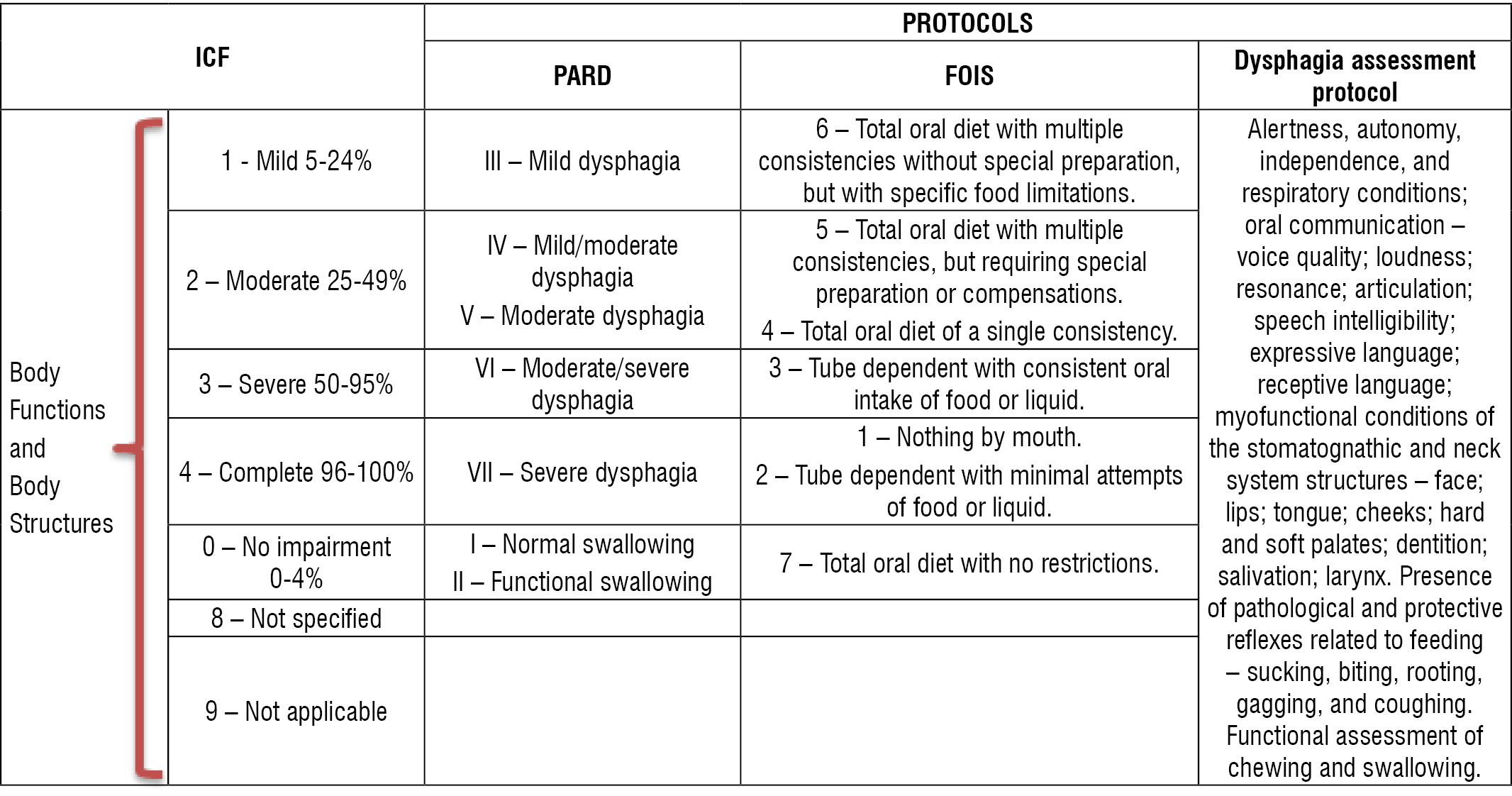
One of the researchers initially conducted a broad open selection of ICF categories related to swallowing ability according to the protocols used in the speech-language pathology clinical practice of the service, as previously mentioned (Figure 1). After matching the ICF categories with the dysphagia assessment protocols, two researchers experienced in working with dysphagia and ICF judged and selected the codes that best corresponded to the items in the clinical assessment instruments. The three researchers held meetings to this end, making decisions by consensus. They took the following steps to select the ICF categories:
-
Careful study of the assessment protocol for identifying, describing, and determining the ICF categories.
-
The set of categories was selected for each ICF component according to the procedures performed in the clinical swallowing assessment.
-
Individual analysis of each participant's assessment protocols to match them with the previously selected categories.
-
Assigning a qualifier to the categories, determined as:
-
Body Functions: .0 (no impairment), .1 (mild impairment), .2 (moderate impairment), .3 (severe impairment), .4 (complete impairment), .8 (not specified), and .9 (not applicable).
-
Body Structures: First qualifier, referring to the extent or magnitude of an impairment: .0 (no impairment), .1 (mild impairment), .2 (moderate impairment), .3 (severe impairment), .4 (complete impairment), .8 (not specified), .9 (not applicable); second qualifier, indicating the nature of the change in structure: .0 (no change in structure), .1 (total absence), .2 (partial absence), .3 (additional part), .4 (aberrant dimensions), .5 (discontinuity), .6 (deviated position), .7 (qualitative changes in structure, including fluid accumulation), .8 (not specified), .9 (not applicable); third qualifier, indicating location: .0 (more than one region), .1 (right), .2 (left), .3 (both sides), .4 (front), .5 (rear), .6 (proximal), .7 (distal), .8 (not specified), .9 (not applicable).
Assessment of Body Structures and Body Functions, according to results obtained in the clinical speech-language pathology assessment of swallowing
The study variables underwent descriptive analysis, using the frequency distribution of categorical variables and analysis of measures of central tendency and dispersion of continuous variables. The SPSS software, version 25.0, was used for data entry, processing, and analysis.
RESULTS
The ages of the 50 participating individuals ranged from 24 to 89 years, with a mean of 60 years (±16.08) and a median of 63 years. The majority were female (76.0%) and older (56.0%), resided in Belo Horizonte (68.0%), and belonged to class C (56%), according to the Brazilian Economic Classification Criteria. Most were illiterate or had incomplete primary education, followed by complete secondary education. The PARD and FOIS revealed that most participants had mild dysphagia (60.0%) and ate orally with more than one consistency, but with special preparation (70.0%) (Table 1).
The study selected 38 ICF categories (28 from Body Functions and 10 from Body Structures). The selected categories are presented in Chart 1.
Categories from the International Classification of Functioning, Disability and Health selected for the research, according to the responses from the dysphagia assessment protocols, the Dysphagia Risk Evaluation Protocol, and the Functional Oral Intake Scale
The classification of ICF Body Structures (by extent, nature, and location) indicated that teeth, gums, tongue, and head and neck muscles presented the greatest deficiency. The qualifier "unspecified extent of deficiency" prevailed in 38.5% of cases, "nature" in 23.1%, and "location" in 30.8% (Table 2).
Analysis of Body Functions showed that most participants had mildly impaired voice functions, voice production, voice quality, speech rhythm, speech rate, ingestion functions, biting, chewing, food manipulation in the mouth, salivation, swallowing, and oral swallowing (Table 3).
DISCUSSION
The first point that stands out is the high number of ICF categories selected in an open search, taking as a reference the protocols used to assess the study participants. The selection of 38 categories demonstrates the feasibility of using the biopsychosocial model and the opportunity provided by the protocols selected for the study to discuss the implementation of the ICF for assessment, rehabilitation, and monitoring in the context of dysphagia.
The researchers selected 10 Body Structure categories present in chapters referring to structures related to voice and speech; structures of the cardiovascular, immune, and respiratory systems; structures related to the digestive, metabolic, and endocrine systems; structures related to movement; and skin and related structures. They indicate that oropharyngeal dysphagia is a symptom present in different conditions, sometimes a multifactorial symptom1,3, as well as the variety of structures necessary for eating. Difficulties in swallowing can occur for various reasons, such as dental alterations and unstable tongue movement patterns, which impact orofacial motor skills and can contribute to deficient bolus retention, manipulation, and propulsion from the oral cavity to the pharynx12.
Moreover, the 28 Body Functions categories were present in the chapters referring to mental functions; sensory and pain functions; voice and speech functions; functions of the cardiovascular, hematological, immune, and respiratory systems; and functions of the digestive, metabolic, and endocrine systems. They indicate the possibility of comprehensive ICF use in dysphagia. These functions, integrated into speech-language pathology clinical practice indysphagia, manifest with different symptoms, such as odynophagia, malnutrition, and dehydration. The integration between the functions and adequate physiology is necessary for food recognition, bolus formation, saliva production, and all the synchronous biomechanics of the swallowing phases13.
The observation of Body Functions components indicated mild deficiencies related to swallowing and oral communication. It is important to note that the structures used in communication and swallowing are mostly the same. Vocal changes may be present in subjects with dysphagia, including symptoms such as a wet voice as an indicative sign of stasis of secretions, liquids, or food in the laryngeal vestibule, as well as the risk of aspiration12. A study aiming to correlate voice conditions with speech characteristics in patients diagnosed with dysphagia identified multiple characteristics of voice and speech changes in these patients, suggesting a multidimensional investigation between communication and swallowing functions14. The ICF allows this multidimensional analysis, covering all correlated functions, thus enabling a more complete classification.
Oropharyngeal dysphagia may be associated with language disorders, such as aphasia. Hence, the patient's preservation of cognitive and communicative abilities is an indicator for classifying them on the scale of independence relative to functional swallowing. Also, fluctuations in the state of consciousness or cognitive functions may prevent learning that favors swallowing15.
The ICF framework for describing dysphagia16 indicated that Body Structures categories and codes relate to the parts of the neurological system and structures necessary to bring food to the mouth, manipulate it properly, and direct it to the stomach16. In turn, Body Functions categories and codes describe the swallowing process, including specific movements involved in the ability to swallow, and reflect the implications for the person’s successful eating and drinking16. A Brazilian consensus in the field suggests that the assessment of people with dysphagia should encompass questions about the main alterations common to this age group, considering active aging, comfort, and functioning as health goals for them17. It also emphasizes the importance of understanding the effects of dysphagia on people's lives, including demographic variables, such as age and race, and personality traits, coping styles, and motivation. The development of an ICF checklist for speech-language pathology hospital intervention indicated a greater predominance of categories related to oral functions18. Voice, speech, language, and orofacial motor skills are interconnected with swallowing and should not be fragmented in speech-language pathology rehabilitation.
The present study observed that most participants with mild oropharyngeal dysphagia had an oral feeding route with multiple consistencies, but with special preparation or compensations (FOIS 5). The feeding route corroborates the findings of a study that characterized the swallowing impairments and the main speech-language pathology interventions and procedures in palliative care patients with oropharyngeal dysphagia, which found that half of the participants also presented FOIS 519. The higher proportion of mild deficiency among the participants in this study may be associated with the profile of patients treated in specialized rehabilitation services, since they are not in a critical phase of frailty, such as when hospitalized. Moreover, participants who did not have the neurological or cognitive conditions to understand and respond to the proposed instruments were excluded, and such cases are likely to have more severe dysphagia. It is also worth noting that some impairments in the biomechanics of swallowing, such as silent aspirations, may not be identified solely through clinical evaluation, and the ICF extent may be insufficiently classified20.
The ICF is still little used in dysphagia, although its classification can be used to identify the functioning and participation of patients with speech-language disorders and to guide therapeutic progress based on the perception of professionals, patients, and their family and caregivers21. A wider use of the ICF is observed in areas such as occupational therapy, whereas studies indicate a lack of use in areas such as physiotherapy22,23.
The frequency of “not specified” deficiency in the extent of the structures involved in swallowing is due to the lack of instrumental investigation to objectively determine the magnitude of the deficiency. Nonetheless, the ICF can be used together with instrumental assessment of swallowing biomechanics, such as videofluoroscopic swallowing study24, the Iowa Oral Performance Instrument (IOPI)25, which measures tongue pressure, and dysphagia screening instruments17.
The characteristics of the present sample regarding sex, age group, and education corroborate the findings of a study that evaluated the sociodemographic, economic, clinical, and behavioral characteristics and the degree of frailty of older people treated in a specialized rehabilitation service26. There is also a greater predominance of tooth loss as age advances, and in women, and lower income and education are also associated with the number of teeth27. Swallowing changes with aging, resulting from various causes, such as the aging of the structures involved in the ability to swallow in senescence, or as a consequence of numerous diseases in senility, which can decrease sensorimotor and functional abilities, leading, for example, to symptoms such as reduced saliva production, slow bolus formation and transport, and food residue in the digestive tract26.
ICF application in rehabilitation services requires the development of appropriate tools for clinical-therapeutic practice. The description of the user's functioning can be accompanied by the qualifiers provided by the classification, also allowing for the monitoring of changes throughout the therapeutic process28. The ICF can be a model for designating guidelines for the health professionals’ procedures regarding the consequences of diseases in aging, guiding individual therapeutic plans6. Furthermore, data can be systematized to identify health indicators and their contribution to improving the quality of care. Models of ICF use in other countries have shown that using the classification in clinical routine has structured interventions with an emphasis on aspects of participation and environment29.
A scoping review aimed at identifying the variety of patient-reported outcome measures used in dysphagia after stroke indicated that the concepts mapped, according to protocols described in the literature, were mostly items related to Body Functions and some concepts related to Activities and Participation30. The ICF reflects the diverse and multifaceted effects of dysphagia and can be a framework to represent its complexity.
Limitations of the present study include the sample characteristics, since it was carried out in a single outpatient service, and the subjectivity in the speech-language pathology clinical assessment, without the support of instrumental investigation, which directly impacted the "not specified" classifications. Thus, data collection based on clinical protocols may imply underdiagnosis and, consequently, ICF’s insufficient classification. Another limitation was the lack of cross-validation of the ICF components with other functional scales.
Nevertheless, the study identified the main ICF Body Functions and Body Structures categories that can be used in outpatient dysphagia services, including those with interventions in various pathologies. This result also points to the possibility of using the ICF in services with a similar structure and allows for discussion about the ICF with patients with dysphagia. It is also intended to explore aspects related to the use of the classification in terms of its application to the Activities and Participation component, considering tasks related to swallowing ability and involvement in real-life situations. It is suggested that future studies validate ICF components with other functional scales.
CONCLUSION
This study identified 38 ICF categories (28 related to Body Functions and 10 to Body Structures) that can be attributed to subjects with dysphagia. Regarding Body Structure components evaluated in individuals presented with dysphagia, deficiencies were found in categories from different chapters. As for Body Functions, the categories teeth, gums, tongue, and head and neck muscles presented the greatest deficiency.
REFERENCES
-
1 Christmas C, Rogus-Pulia N. Swallowing disorders in the older population. J Am Geriatr Soc. 2019;67(12):2643-9. https://doi.org/10.1111/jgs.16137 PMID: 31430395.
» https://doi.org/10.1111/jgs.16137 -
2 Balou M, Herzberg EG, Kamelhar D, Molfenter SM. An intensive swallowing exercise protocol for improving swallowing physiology in older adults with radiographically confirmed dysphagia. Clin Interv Aging. 2019;14:283-288. https://doi.org/10.2147/CIA.S194723 PMID: PMC6375531.
» https://doi.org/10.2147/CIA.S194723 -
3 Ortega O, Martín A, Clavé P. Diagnosis and management of oropharyngeal dysphagia among older persons, state of the art. J Am Med Dir Assoc. 2017;18(7):576-82. https://doi.org/10.1016/j.jamda.2017.02.015 PMID: 28412164.
» https://doi.org/10.1016/j.jamda.2017.02.015 - 4 World Health Organization (WHO). ICF: International Classification of Functioning, Disability and Health. São Paulo: Edusp; 2015.
-
5 ASHA [webpage on the Internet]. Scope of Practice in Speech-Language Pathology Ad Hoc Committee [accessed on July 28, 2025]. Available at: https://www.asha.org/siteassets/publications/sp2016-00343.pdf
» https://www.asha.org/siteassets/publications/sp2016-00343.pdf -
6 Ministério da Saúde [Webpage on the internet]. Gov.br. [accessed on July 31, 2025]. Available at: https://bvsms.saude.gov.br/bvs/saudelegis/gm/2006/prt2528_19_10_2006.html
» https://bvsms.saude.gov.br/bvs/saudelegis/gm/2006/prt2528_19_10_2006.html -
7 Renom-Guiteras M, Najas-Sales V, Ramirez-Mirabal E, Nadal-Castells MJ, Pintor-Ojeda A, Bascuñana-Ambrós H. Holistic semi-presential evaluation of oropharyngeal dysphagia with the framework of International Classification of Functioning, Disability and Health: Optimizing evaluation to improve rehabilitation treatment. Rehabilitacion (Madr). 2023;57(1):100735. https://doi.org/10.1016/j.rh.2022.03.001 PMID: 35570031.
» https://doi.org/10.1016/j.rh.2022.03.001 -
8 ABEP [Webpage on the internet]. Critério Brasil [Accessed on 17 apr 2025]. Available at: http://www.abep.org/criterio-brasil
» http://www.abep.org/criterio-brasil - 9 WHO (2002) Active Ageing - A Police Framework. A Contribution of the World Health Organization to the second United Nations World Assembly on Aging. Madrid, Spain, April, 2002.
-
10 Padovani AR, Moraes DP, Mangili LD, Andrade CRF de. Dysphagia Risk Evaluation Protocol. Revista da Sociedade Brasileira de Fonoaudiologia. 2007;12(3):199-205. https://doi.org/10.1590/S1516-80342007000300007
» https://doi.org/10.1590/S1516-80342007000300007 -
11 Crary MA, Mann GD, Groher ME. Initial psychometric assessment of a functional oral intake scale for dysphagia in stroke patients. Arch Phys Med Rehabil. 2005;86(8):1516-20. https://doi.org/10.1016/j.apmr.2004.11.049 PMID: 16084801.
» https://doi.org/10.1016/j.apmr.2004.11.049 -
12 Campos SM de L, Trindade DRP, Cavalcanti RVA, Taveira KVM, Ferreira LM de BM, Magalhães Junior HV. Signs and symptoms of oropharyngeal dysphagia in institutionalized older adults: An integrative review. Audiol., Commun. Res. 2022;27:e2492. https://doi.org/10.1590/2317-6431-2021-2492
» https://doi.org/10.1590/2317-6431-2021-2492 -
13 Silva LM de L, Lima CR de, Cunha DA da, Orange LG de. Dysphagia and its relation with nutritional status and calorie/protein intake in the elderly. Rev. CEFAC. 2019;21(3):e15618. https://doi.org/10.1590/1982-0216/201921315618
» https://doi.org/10.1590/1982-0216/201921315618 -
14 Flórez-Gómez AF, Orozco-Arroyave JR, Roldán-Vasco S. Correlation between speech-related feature spaces and clinical voice disorders in patients with dysphagia. TecnoLógicas. 2022;25(53):e2220. https://doi.org/10.22430/22565337.2220
» https://doi.org/10.22430/22565337.2220 -
15 Ortiz KZ, Marinelli MR. Investigation on the complaint of dysphagia in aphasic patients. Rev. CEFAC. 2013;15(6):1503-11. https://doi.org/10.1590/S1516-18462013005000043
» https://doi.org/10.1590/S1516-18462013005000043 -
16 Threats TT. Use of the ICF in dysphagia management. Semin Speech Lang. 2007;28(4):323-33. https://doi.org/10.1055/s-2007-986529 PMID: 17935017.
» https://doi.org/10.1055/s-2007-986529 -
17 I Consenso Brasileiro de Nutrição e Disfagia em Idosos Hospitalizados [book on the Internet]. Coordenadora Myrian Najas. Barueri, São Paulo: Minha Editora; 2011. ISBN 978-85-7868-017-6 [accessed on July 31, 2025]. Available at: https://sbgg.org.br/wp-content/uploads/2014/10/Consenso_Brasileiro_de_Nutricao1.pdf
» https://sbgg.org.br/wp-content/uploads/2014/10/Consenso_Brasileiro_de_Nutricao1.pdf -
18 Borges FA, Farias LP, Paulon RMC, Colombari HNS, Brito CMM de, Padovani M. International Classification of Functioning (ICF) check list proposal for phonoaudiology in hospital care. Revista cif brasil. 2021;13(3):1-19. https://doi.org/10.4322/CIFBRASIL.2021.016
» https://doi.org/10.4322/CIFBRASIL.2021.016 -
19 Andrade JM, Duarte YA de O, Alves LC, Andrade FCD, Souza Junior PRB de, Lima-Costa MF et al. Frailty profile in Brazilian older adults: ELSI-Brazil. Revista de Saúde Pública. 2018;52(Supl 2):17s. https://doi.org/10.11606/s1518-8787.2018052000616
» https://doi.org/10.11606/s1518-8787.2018052000616 -
20 Silva-Munhoz L de F, Bühler KE, Limongi SC. Comparison between clinical and videofluoroscopic evaluation of swallowing in children with suspected dysphagia. CoDAS. 2015;27(2):186-92. http://dx.doi.org/10.1590/2317-1782/20152014149 PMID: 26107085.
» http://dx.doi.org/10.1590/2317-1782/20152014149 -
21 Antunes APA, Silva CSR, Ferreira LP, Palladino RRR. Use of the International Classification of Functioning, Disability and Health in Speech-Language-Hearing Therapy: An integrative literature review. Rev. CEFAC. 2019;21(4):e18018. http://dx.doi.org/10.1590/1982-0216/201921418018
» http://dx.doi.org/10.1590/1982-0216/201921418018 -
22 Cabrera N, Karla J, Costa C, Valenciano PJ. The biopsychosocial model in in game therapy rehabilitation in cerebral palsy: Systematic review. Acta Fisiátrica. 2023;30(2):136-42. https://doi.org/10.11606/issn.2317-0190.v30i2a200298
» https://doi.org/10.11606/issn.2317-0190.v30i2a200298 -
23 Marcelino DAS, Barbosa LS, Cardoso AJV, Miranda VCR, Matos MR, Teodoro ECM. Use of the International Classification of Functionality, Disability and Health (ICF) in the assessment and rehabilitation of cardiopathy patients: An integrative review. Rev. Ciên. Saúde. 2023;8(1):16-24. https://doi.org/10.3109/09638288.2014.935875 PMID: 24986707.
» https://doi.org/10.3109/09638288.2014.935875 -
24 Fabricio MZ, Pacheco-Castilho AC, Pontes-Neto OM, Dantas RO. Clinical swallowing assessment in the diagnosis of silent aspiration. Rev. CEFAC. 2020;22(6):e8420. https://doi.org/10.1590/1982-0216/20202268420
» https://doi.org/10.1590/1982-0216/20202268420 -
25 MPB Pontes, JF Godoy, GF Rocha, HC Galvão. Investigation of tongue pressure in individuals with myasthenia gravis. Revista Brasileira de Ciências da Saúde. 2021;25(3). https://doi.org/10.22478/ufpb.2317-6032.2021v25n3.57322
» https://doi.org/10.22478/ufpb.2317-6032.2021v25n3.57322 -
26 Benzecry G, Silva BP, Foliene AC, Sousa KMR, Chaud DMA. Prevalence and factors associated to dysphagia in elderly: A review. Disciplinarum Scientia. Série: Ciências da Saúde. 2020:21(2):e:1-10. https://doi.org/10.37777/dscs.v21n1-024
» https://doi.org/10.37777/dscs.v21n1-024 -
27 Gomes VV, Gondinho BVC, Silva-Junior MF, Cavalcante D de FB, Bulgareli JV, Sousa M da LR de et al. Tooth loss in adults: Factors associated with the position and number of lost teeth. Revista de Saúde Pública. 2019;(12)9;53. https://doi.org/10.11606/S1518-8787.2019053001318
» https://doi.org/10.11606/S1518-8787.2019053001318 -
28 Viktoria Stein K, Barbazza ES, Tello J, Kluge H. Towards people-centred health services delivery: A Framework for Action for the World Health Organisation (WHO) European Region. Int J Integr Care. 2013 Dec 23;13:e058. https://doi.org/10.5334/ijic.1514 PMID: 24409110; PMCID: PMC3886596.
» https://doi.org/10.5334/ijic.1514 -
29 Cieza A, Sabariego C, Bickenbach J, Chatterji S. Rethinking disability. BMC Medicine. 2018;16(14). https://doi.org/10.1186/s12916-017-1002-6
» https://doi.org/10.1186/s12916-017-1002-6 -
30 Moloney J, Regan J, Walshe M. Patient reported outcome measures in dysphagia research following stroke: A scoping review and qualitative analysis. Dysphagia. 2023;38(1):181-90. https://doi.org/10.1007/s00455-022-10448-y Epub 2022 Apr 25. Erratum in: Dysphagia. 2023;38(1):191. https://doi.org/10.1007/s00455-022-10507-4 PMID: 35467246; PMCID: PMC9873730.
» https://doi.org/10.1007/s00455-022-10448-y
-
A study conducted at the Speech-Language-Hearing Department of the Medical School at the Universidade Federal de Minas Gerais, Belo Horizonte, MG, Brazil.
-
Financial support
This study was financed in part by the Coordenação de Aperfeiçoamento de Pessoal de Nível Superior - Brazil (CAPES) - Finance Code 001; and Conselho Nacional de Desenvolvimento Científico e Tecnológico (CNPq) Bolsa de Produtividade em Pesquisa - PQ: 307841/2022-7
-
Data sharing statement
The participant data that underpin the results presented in this article will be available in the text, tables, figures, or appendices published in the manuscript, permanently and for public access. The data will be presented in a way that protects the identity of the participants.
The participant data that underpin the results presented in this article will be available in the text, tables, figures, or appendices published in the manuscript, permanently and for public access. The data will be presented in a way that protects the identity of the participants.