Auditory perception and visual perception in children: A scoping review
ABSTRACT
Purpose: to report on global scientific literature about the relationship between auditory perception and visual perception in children.
Methods: a scoping review conducted using the following national and international databases: PubMed, SciELO, LILACS, Scopus, Cochrane, ScienceDirect, and Web of Science. The eligibility criteria for this review included studies that addressed the relationship between auditory perception and visual perception in children.
Literature Review: six articles that met the eligibility criteria were selected. The assessment methods, objectives, and child samples of the studies were diverse. Three of the six articles demonstrated the relationship between auditory and visual perception in children with or at risk for dyslexia, one demonstrated audiovisual asynchrony in children with developmental language disorders, and two observed the association between auditory and visual perception in children with and without central auditory processing disorders.
Conclusion: the review identified scientific studies demonstrating the relationship between auditory and visual perception in children. However, the literature still has few records reporting this correlation. Hence, further research is necessary to benefit children and fill gaps in the literature.
Keywords:
Auditory Perception; Visual Perception; Child; Audiology; Learning
RESUMO
Objetivos: reportar as produções científicas sobre a relação entre percepção auditiva e percepção visual em crianças na literatura mundial.
Métodos: trata-se de uma revisão de escopo realizada nas bases de dados nacionais e internacionais: Pubmed, Scielo, Lilacs, Scopus, Cochrane, Science direct e Web of Science. Os critérios de elegibilidade adotados para construção desta revisão abrangeram os estudos que abordassem a relação entre Percepção Auditiva e Percepção Visual em crianças.
Revisão de Literatura: oram selecionados seis artigos que cumpriram os critérios de elegibilidade. Observou-se que as formas de avaliação, objetivos e o público infantil dos estudos foram diversificados. Dos seis artigos, três mostraram a relação entre percepção auditiva e visual em crianças com dislexia ou com risco para dislexia, um mostrou a assincronia audiovisual em crianças com Transtorno do Desenvolvimento da Linguagem, e dois observaram a associação entre percepção auditiva e visual em crianças com e sem alteração do Processamento Auditivo Central.
Conclusão: foram identificadas produções científicas que mostram a relação entre a percepção auditiva e percepção visual em crianças. Apesar disso, é válido considerar que, a literatura ainda possui poucos registros referindo a essa correlação, sendo importante que novas pesquisas sejam realizadas, a fim de beneficiar a população infantil e preencher lacunas deixadas na literatura.
Descritores:
Percepção Auditiva; Percepção Visual; Criança; Audiologia
INTRODUCTION
Perception is extremely important to humans and is generally defined as the ability to associate sensory information with the senses, hence, the terms visual, auditory, and somesthetic perception. Perception involves complex processes linked to memory, cognition, and behavior, and is the basis for language development1. Thus, a disorder in perception disrupts all subsequent levels of experience2.
The auditory system consists of sensory structures and central connections responsible for the sensation and perception of sound stimuli. This system can be divided into two distinct, interrelated parts, defined as the peripheral auditory system and the central auditory system. The peripheral part comprises structures of the outer ear, middle ear, inner ear, and peripheral nervous system (vestibular-cochlear nerve)3. The central system refers to the auditory pathways located in the brainstem and cortical areas related to hearing4.
Auditory perception refers to the processing of an audible acoustic signal, initiated by receptor cells sensitive to specific sound stimuli. Given such complexity, these stimuli are processed through a series of neuroanatomical connections originating in the neurons of the cochlea and terminating in the cerebral auditory cortex5. After being detected by the inner ear, sound undergoes several physiological and cognitive processes before being decoded and understood in the brain. These processes consist of a set of auditory abilities on which the person relies to interpret the sound message6.
Thus, assessing auditory functions goes far beyond simply measuring hearing thresholds. The acoustic signal must be analyzed and interpreted to transform it into a meaningful message. Therefore, the organic and functional integrity of the entire auditory system7 is essential to enable efficient auditory comprehension.
Impairment in this process causes central auditory processing disorder (CAPD). This term describes a deficit in the complete perception or analysis of verbal or nonverbal auditory information due to a failure in the central auditory system8, whose mechanisms and processes also interfere with and influence higher functions, including language and learning9. Children with CAPD tend to have difficulties in school and can often be characterized as distractible, forgetful, restless, talkative, and have difficulty with the concept of time10. Thus, they tend to ignore relevant auditory information.
Not only auditory but also visual perception alterations have been described in children with learning disabilities11. Visual perception is the ability to process visual stimuli and is composed of a set of visual perceptive skills essential for reading and learning. These skills analyze and process visual information to provide comprehension of what is seen12 and construct experience and awareness of the visual world based on attention to guide motor actions3,4. Adequate visual perception requires intact visual functions and cortical structures13.
Visual perception develops rapidly during childhood and approaches adult development around 11 to 12 years old14. Visual-motor perceptual function results from a combination of visual-motor skills, motor and cognitive planning, visual perceptual skills (such as eye-hand coordination), position in space, spatial relations, figure-ground, and form constancy15. Therefore, children with learning disorders are prone to visual perceptual alterations due to dysfunctions in brain areas responsible for the visuospatial perception necessary for writing16.
In addition to the common complaints and characteristics reported in children with changes in auditory or visual perception, anatomical-physiological relationships can be found between the two systems by studying the central hearing pathways in more detail17-19.
The inferior colliculus is an auditory structure of the midbrain serving as an auditory transmission station, also related to auditory-visual reflexes17. It is likely the place where information from various sensory pathways is modulated and integrated, altering auditory information18. The medial geniculate body is a structure responsible for the auditory pathway, and the lateral geniculate body is responsible for the visual pathway. Both are located in the thalamus and constitute the first place where the auditory and visual pathways intersect. A dysfunction in this connection can lead to complications in reading19.
It is known that much of a child's learning is related to their ability to integrate sensory information. Incoming information is sent through the sensory systems to the central nervous system, where sensory processing occurs. People learn through this perception and the exchange of information between the environment and the various nerve centers. For instance, children develop and learn reading and arithmetic based on sensory integration20.
Given the importance of sensory integration for learning, it is crucial to understand and investigate whether the literature correlates auditory perception with visual perception. This discovery can contribute to a deeper understanding of this integration and the possible simultaneous impact of changes in these systems. It can also aid in more informed and comprehensive speech-language-hearing diagnoses and interventions, as well as in other fields that address learning issues in children. Therefore, this study aimed to report on global scientific literature about the relationship between auditory and visual perception in children.
METHODS
This scoping review followed the PRISMA recommendations for writing scoping reviews (PRISMA-ScR)21, registered on the Open Science Framework (OSF) with DOI 10.17605/OSF.IO/RBXQD.
The scoping review used the following research question to meet its objective: "Is there a relationship between auditory perception and visual perception in children in global literature?". The research employed the population, concept, and context (PCC) strategy to include studies: a) Population: studies with children aged 2 to 12 years; b) Concept: studies addressing the relationship between auditory and visual perception; c) Context: original research and clinical cases available in full, without language restrictions.
The following databases were consulted to identify relevant studies: PubMed, SciELO, LILACS, Scopus, Cochrane, ScienceDirect, and Web of Science. Search terms were defined using subject descriptors from the Health Sciences Descriptors (DeCS) and Medical Subject Headings (MeSH), which facilitate the search and retrieval of articles in healthcare bibliographic databases. A filter was applied to search for articles published in the last 10 years and available in full.
Searches used AND, OR, and All Fields tags, crossing the English and Portuguese descriptors in DeCS and MeSH. Chart 1 presents the search strategies used in the databases.
Eligibility criteria
The eligibility criteria for this review were original research and clinical case studies addressing the relationship between auditory and visual perception in children. Exclusion criteria were studies with adults and older adults, duplicates, studies without free access, literature reviews, and scientific abstracts.
The study selection process occurred in four stages. The first stage began in November 2023 and was updated in June 2024, searching for studies in all databases with descriptors and filters. After collecting from the databases and excluding duplicates, the next stage selected articles whose titles mentioned the relationship between auditory and visual perception in children. This was followed by a third stage, in which the study abstracts were read. In the final stage, the articles selected independently in the previous one met the research criteria and the research question.
Two reviewers (ACM and NCOL) screened the articles independently and selected them based on their titles and abstracts. After selecting these studies, the same reviewers read the articles in full. Another two reviewers (VNM and DFF) were available to reach a consensus decision along with the first two reviewers in cases of disagreement regarding abstracts and full texts. An additional reviewer participated in the final phase to discuss and resolve any possible conflicts.
LITERATURE REVIEW
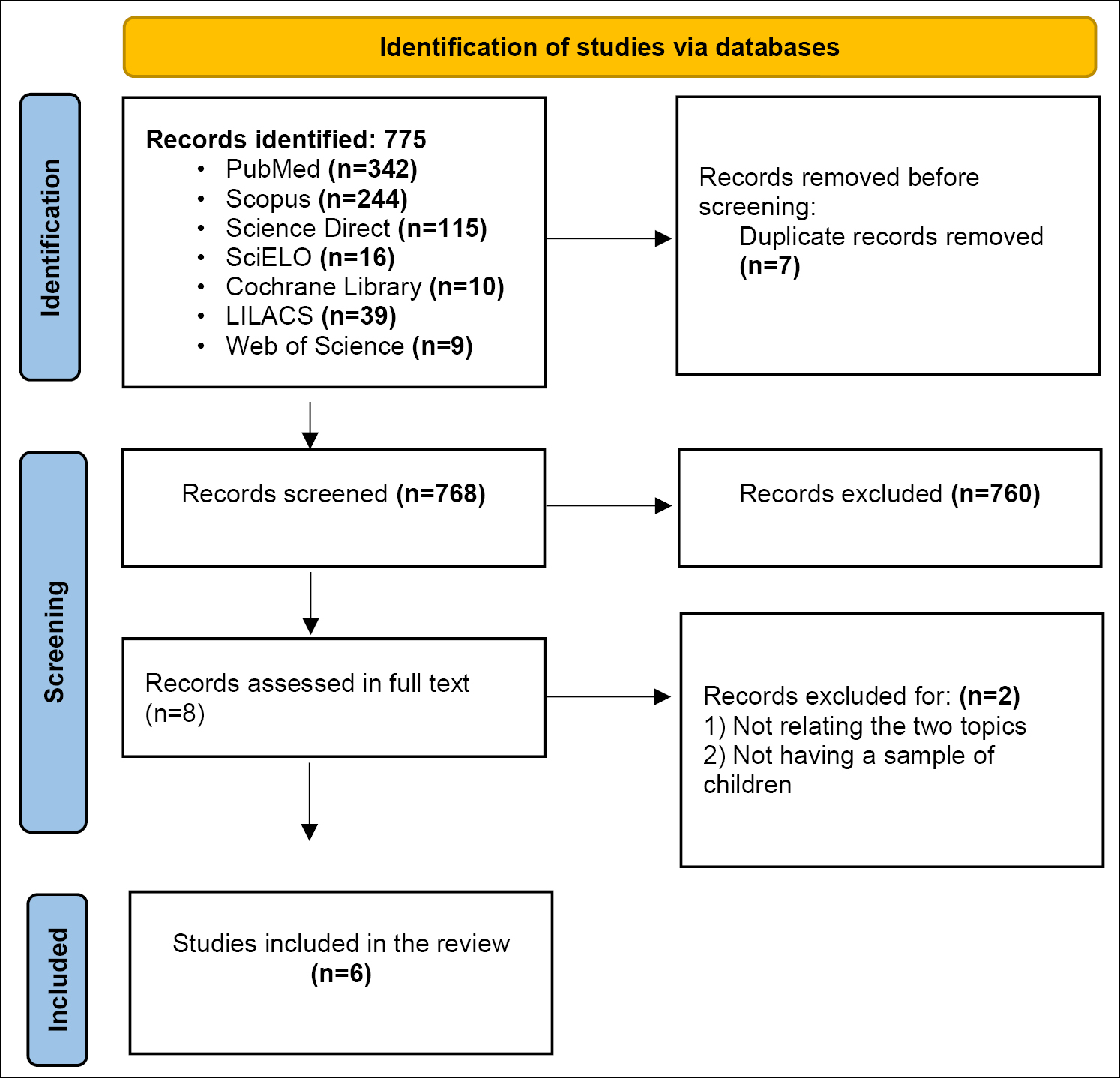
The article search process is presented in Figure 1, through the PRISMA selection flowchart, describing the collection steps and quantity of articles within the research scope.

Flowchart with the different phases of the review based on the PRISMA 2020 guidelines for new systematic reviews that included searches of databases, registries, and other sources
The search initially identified 775 studies with the combined descriptors in their respective databases. Following the predefined steps described above, eight articles were eligible for full-text reading after excluding duplicates and reading the titles and abstracts. Two of the eight articles were excluded for not addressing the relationship between auditory and visual perception in children. Thus, the final sample totaled six articles. A chart was created to summarize them, including the article title, year of publication, author, methods, and main results (Chart 2).
Three22,24,25 of the six articles showed the relationship between auditory and visual perception in children with or at risk for dyslexia, one showed audiovisual asynchrony in children with developmental language disorders (DLD)23, and two observed the association between auditory and visual perception in children with and without CAPD26,27.
Reading is a complex multisensory process that is impaired in people with dyslexia24. Reading involves visual perception/processing, visual memory, visual-auditory association, auditory memory/recognition, phonological processing, oral expression, and verbal processes28.
One of the studies selected in this review evaluated a group of children at risk for dyslexia with auditory and visual temporal order judgment tasks. They performed worse in temporal tasks than children without risk for dyslexia25, corroborating the evidence that children with impaired temporal auditory skills are more susceptible to having language and learning changes29.
Another study evaluated pre-literate children at risk for dyslexia, using functional magnetic resonance imaging (fMRI) and event-related potentials (ERP). The audiovisual tasks involving target matching between trained and untrained grapheme-phoneme pairs revealed changes in the temporal and occipital brain regions for the trained pairs, areas known to be involved in audiovisual integration. This result provides important additional information about the temporal course of audiovisual integration in the early learning phase22 and the correlation between these two systems.
In addition to articles correlating auditory and visual perception in children with or at risk for dyslexia, this correlation was also observed in children with specific language impairment (the former term for the current DLD), assessing audiovisual temporal asynchrony in a simultaneity judgment task. Children with DLD had impairments in detecting audiovisual temporal asynchrony, perceiving asynchrony significantly less often than typically developing children23.
Thus, imprecise audiovisual temporal processing can pose a significant disadvantage for children with DLD. Successful integration of the auditory and visual senses provides significant benefits during a series of tasks, including speech perception in noise, a task commonly encountered in everyday life23. However, a deficient audiovisual temporal function can be improved through audiovisual temporal training to improve language skills in schoolchildren with DLD30.
Two studies26,27 assessed auditory perception using tests specifically for central auditory processing (CAP). The first study found that students with auditory temporal processing impairments are three times more likely to also have visual processing impairments, as they share the magnocellular pathway. Children with central auditory impairments had more symptoms of visual stress, lower reading rates, and greater chances of improving their reading speed with the use of colored overlays than the control group27.
Therefore, this study correlates with an essential aspect of reading proficiency, the temporal sequential processing of auditory and visual information, which enables the formation of precise representations of the order of sounds in a word and the visual sequencing of letters31, demonstrating an important association between auditory and visual processing27.
Another study used CAP assessment tests to evaluate the sensory profile of children with CAPD. It found that these children appear to have more sensory differences than those with normal CAP. In the association between CAP and sensory profile, none of the results indicated statistical significance between study variables, but the differences between them had a moderate effect size for the visual system26.
It can be inferred that the auditory information that reaches children with CAPD is not accurate; they use visual information as a supplementary resource. Thus, individuals automatically resort to other sensory systems to compensate for the inefficiency of auditory function in their daily academic, self-care, and leisure tasks. This may occur because sensory information is interconnected through the neurological structures of the central nervous system and the colliculi, a primarily visual structure that contains an auditory spatial map with neurons from different regions that respond to auditory stimuli32.
Although the included studies relate the two sensory processes, it is important to mention the limitations of the review, as it did not find many studies whose methods described specifically and in detail how auditory and visual abilities are assessed in this population, correlating them and, in case of changes, directing them to some specific type of intervention.
For instance, the CAP test can assess various auditory skills - sound detection, localization and discrimination, recognition, temporal ordering, figure-ground for verbal and nonverbal sounds, auditory synthesis, integration, binaural interaction and separation, auditory closure, and temporal pattern recognition - and thus classify it as normal or abnormal33. In turn, visual skills can be assessed with the Developmental Test of Visual Perception (DTVP-2). It is a battery of eight subtests that measure different visual perception and visual-motor skills, namely eye-hand coordination, position in space, copying, figure-ground, spatial relations, visual closure, visual-motor speed, and form constancy. The DTVP-2 reveals the child's performance in visual perception skills34.
The literature highlights the importance of sensory integration for childhood learning issues20 and auditory and visual skills assessment, especially in children with learning disabilities35,36 - this is a common complaint when these two processes are abnormal, as also observed in the studies in this review. Therefore, studies using standardized assessment procedures are needed to develop intervention programs to minimize the impact of the potential harm these changes can cause.
The literature already presents interventions aimed at children with auditory and visual perceptual alterations with positive results37-40. However, they do so on an individual basis, applying care protocols for one process or another separately - i.e., the studies do not yet address the possibility of interventions that combine auditory and visual perception.
This review makes it possible to infer the relationship between auditory and visual perception in children and their importance for child development, especially for learning aspects. It is also possible to think about new insights for future research aimed at joint evaluations and interventions of these processes.
CONCLUSION
The scoping review identified scientific studies linking auditory and visual perception in children. Even so, few records in the literature refer to this correlation, whether in assessment studies or especially in intervention studies. Therefore, further research in this area is important to benefit children and fill gaps in the literature.
REFERENCES
- 1 Lent R. Às portas da percepção. As bases neurais da percepção e atenção. In: Lent R, editor. Cem bilhões de neurônios? Conceitos Fundamentais de Neurociência. Atheneu. 2nd ed., 2010. Cap. 17: p. 610-42.
- 2 Johnson JD, Mylkelbust HR. Distúrbios de Aprendizagem. São Paulo: Editora da Universidade de São Paulo, 1983.
- 3 Bonaldi LV, Angelis MA, Smith RL. Bases anatômicas da audição e do equilíbrio. São Paulo: Livraria Santos Editora; 2004.
- 4 Haines D. Fundamental neuroscience. New York: Churchill Livings-tone Inc.; 1997.
- 5 Teixeira C, Griz S, Pacífico F, Caldas S. Sistema auditivo central. In: Schochat E, Samelli AG, Couto CM, Teixeira AR, Durante AS, Zanchetta S, editors. Tratado de audiologia. São Paulo: Editora Manole; 2022. p. 13-22.
-
6 American Speech-Language-Hearing Association (ASHA) [Webpage on the Internet]. (Central) Auditory Processing disorders. 2005. [accessed on 23 feb 2024]. Available at: http://www.asha.org/ policy
» http://www.asha.org/ policy - 7 Pinheiro FH. Eficácia do programa de treinamento auditivo em escolares com distúrbio de aprendizagem [dissertation]. Marília (SP): Faculdade de Filosofia e Ciências, Universidade Estadual Paulista; 2009.
-
8 Musiek FE, Baran JA. Neuroanatomy, neurophysiology, and central auditory assessment. Part 1: Brain stem. Ear and Hearing. 1986;7:207-19. https://doi.org/10.1097/00003446-198608000-00001 PMID: 3743912.
» https://doi.org/10.1097/00003446-198608000-00001 -
9 ASHA. American Speech-Language-Hearing Association - Task Force on Central Auditory Processing Consensus Development. Central auditory processing: Current status of research and implications for clinical practice. American Journal of Audiology. 1996;5(2):41-54. https://doi.org/10.1044/1059-0889.0502.41
» https://doi.org/10.1044/1059-0889.0502.41 - 10 AAA: American Academy of Audiology. Practice guidelines for the diagnosis, treatment, and management of children and adults with Central Auditory Processing Disorder (CAPD). Reston: AAA; 2010.
- 11 Souza AV, Capelline SA. Visual perception of students with learning disabilities. Rev. Psicopedagogia. 2011;28(87):256-61.
-
12 Haensch SC, Lima AD. Evaluation of visual perception with the Skills Visual Perceptual Test (TVPS-3) in children aged 6 to 14 years with learning disorders. Saúde e Meio Ambiente: Revista Interdisciplinar. 2019;8:97-113. https://doi.org/10.24302/sma.v8i0.1921
» https://doi.org/10.24302/sma.v8i0.1921 -
13 Shams L, Kim R. Crossmodal influences on visual perception. Phys Life Rev. 2010;7(3):269-84. https://doi.org/10.1016/j.plrev.2010.04.006 PMID: 20447880.
» https://doi.org/10.1016/j.plrev.2010.04.006 -
14 Tsai CL, Wilson PH, Wu SK. Role of visual-perceptual skills (non-motor) in children with developmental coordination disorder. Hum Mov Sci. 2008;27(4):649-64. https://doi.org/10.1016/j.humov.2007.10.002 PMID: 18374437.
» https://doi.org/10.1016/j.humov.2007.10.002 -
15 Brown T, Rodger S. Validity of the developmental test of visual-motor integration supplemental developmental test of visual perception. Percept Mot Skills. 2008;106(3):659-78. https://doi.org/10.2466/pms.106.3.659-678 PMID: 18712186.
» https://doi.org/10.2466/pms.106.3.659-678 - 16 Fusco N, Okuda PMM, Capellini SA. Avaliação e intervenção com a habilidade visomotora em escolares com dislexia e distúrbio de aprendizagem. In: Capellini SA, Silva C, Pinheiro FH, editors. Tópicos em transtornos de aprendizagem. São Paulo: Pulso. 2011. p.79-89.
- 17 Bhatnagar SC. Neurôciência para o estudo dos distúrbios da comunicação. Rio de Janeiro: Guanabara Koogan; 2004.
-
18 Pollak GD, Burguer RM, Klug A. Dissecting the circuitry of auditory system. Trends in Neurosciences. 2003;26(1):33-9. https://doi.org/ 10.1016/S0166-2236(02)00009-7 PMID: 12495861.
» https://doi.org/ 10.1016/S0166-2236(02)00009-7 - 19 Costa-Ferreira MID. A influência da terapia do processamento auditivo na compreensão em leitura: uma abordagem conexionista [thesis]. Porto Alegre (RS): Faculdade de Letras da Pontifícia Universidade Católica do Rio Grande do Sul; 2007.
-
20 Ayres AJ. Sensory integration and the child: Understanding hidden sensory challenges. Los Angeles: Western Psychological Services. 2005. https://doi.org/10.47222/2526-3544.rbto34926
» https://doi.org/10.47222/2526-3544.rbto34926 -
21 Tricco AC, Lillie E, Zarin W, O'Brien KK, Colquhoun H, Levac D et al. PRISMA Extension for Scoping Reviews (PRISMA-ScR): Checklist and explanation. Ann Intern Med. 2018;169(7):467-73. https://doi.org/doi:10.7326/M18-0850 PMID: 30178033.
» https://doi.org/doi:10.7326/M18-0850 -
22 Karipidis II, Pleisch G, Röthlisberger M, Hofstetter C, Dornbierer D, Stämpfli P et al. Neural initialization of audiovisual integration in prereaders at varying risk for developmental dyslexia. Human brain mapping. 2017;38(2):1038-55. https://doi.org/10.1002/hbm.23437 PMID: 27739608.
» https://doi.org/10.1002/hbm.23437 -
23 Kaganovich N. Sensitivity to audiovisual temporal asynchrony in children with a history of specific language impairment and their peers with typical development: A replication and follow-up study. J Speech Lang Hear Res. 2017;60(8):2259-70. https://doi.org/10.1044/2017_JSLHR-L-16-0327 PMID: 28715546.
» https://doi.org/10.1044/2017_JSLHR-L-16-0327 -
24 Gori M, Ober KM, Tinelli F, Coubard OA. Temporal representation impairment in developmental dyslexia for unisensory and multisensory stimuli. Dev Sci. 2020;23(5):e12977. https://doi.org/ 10.1111/desc.12977 PMID: 32333455.
» https://doi.org/ 10.1111/desc.12977 -
25 Ortiz R, Estévez A, Muñetón M, Domínguez C. Visual and auditory perception in preschool children at risk for dyslexia. Res Dev Disabil. 2014;35(11):2673-80. https://doi.org/10.1016/j.ridd.2014.07.007 PMID: 25063906.
» https://doi.org/10.1016/j.ridd.2014.07.007 -
26 Buffone FRRC, Schochat E. Sensory profile of children with Central Auditory Processing Disorder (CAPD). CoDAS. 2022;34(1):e20190282. https://doi.org/10.1590/2317-1782/20212019282 PMID: 35019061.
» https://doi.org/10.1590/2317-1782/20212019282 -
27 Garcia ACO, Vilhena DA, Guimarães MR, Pinheiro ÂMV, Momensohn-Santos TM. Association between auditory temporal and visual processing in reading skill. Rev. CEFAC. 2019;21(5):e6119. https://doi.org/10.1590/1982-0216/20192156119
» https://doi.org/10.1590/1982-0216/20192156119 -
28 Pedrosa BAC, Dourado JS, Lemos SMA. Lexical development, speech language disorders and school performance: Literature review. Rev. CEFAC. 2015;17(5):1633-42. https://doi.org/10.1590/1982-0216201517519913
» https://doi.org/10.1590/1982-0216201517519913 -
29 Olivares-García MR, Peñaloza-López YR, García-Pedroza F, Jesús-Pérez S, Uribe-Escamilla R, Jiménez-de la Sancha S. Identification of auditory laterality by means of a new dichotic digit test in Spanish, and body laterality and spatial orientation in children with dyslexia and in controls. Rev Neurol. 2005;41(4):198-205. https://doi.org/10.33588/rn.4104.2004076 PMID: 16075396.
» https://doi.org/10.33588/rn.4104.2004076 -
30 Powers AR 3rd, Hillock AR, Wallace MT. Perceptual training narrows the temporal window of multisensory binding. J Neurosci. 2009;29(39):12265-74. https://doi.org/10.1523/JNEUROSCI.3501-09.2009 PMID: 19793985.
» https://doi.org/10.1523/JNEUROSCI.3501-09.2009 -
31 Stein J, Walsh V. To see but not to read: The magnocellular theory of dyslexia. Trends Neurosci. 1997;20(4):147-52. https://doi.org/10.1016/s0166-2236(96)01005-3 PMID: 9106353.
» https://doi.org/10.1016/s0166-2236(96)01005-3 -
32 Wu C, Stefanescu RA, Martel DT, Shore SE. Listening to another sense: somatosensory integration in the auditory system. Cell Tissue Res. 2015;361(1):233-50. https://doi.org/10.1007/s00441-014-2074-7 PMID: 25526698. PMC4475675.
» https://doi.org/10.1007/s00441-014-2074-7 - 33 Magalhães MSQ. The central auditory processing disorders in the continuing education of teachers [dissertation]. São Paulo (SP): Programa de Mestrado em Gestão e Práticas Educacionais, Universidade Nove de Julho; 2020.
- 34 Hammil DD, Pearson NA, Voress JK. Teste evolutivo de percepção visual. 2nd ed. Trad. Ferreira MC. Rio de Janeiro: Entreletras. 2001.
-
35 Neves IF, Schochat E. Auditory processing maturation in children with and without learning difficulties. Pró-Fono R. Atual. Científ. 2005;17(3):311-20. https://doi.org/10.1590/S0104-56872005000300005
» https://doi.org/10.1590/S0104-56872005000300005 - 36 Souza AV, Capellini S. Visual perception of students with learning disabilities. Rev. Psicopedagogia. 2011;28(87):256-61.
-
37 Pinheiro FH, Capellini SA. Auditory training in students with learning disabilities. Pró-Fono R. Atual. Científ. 2010;22(1):49-54. https://doi.org/10.1590/S0104-56872010000100010 PMID: 20339808.
» https://doi.org/10.1590/S0104-56872010000100010 -
38 Samelli AG, Mecca FFN. Auditory training for auditory processing disorder: Treinamento auditivo para transtorno do processamento auditivo: uma proposta de intervenção terapêutica. Rev. CEFAC. 2010;12(2):235-41. https://doi.org/10.1590/S1516-18462010005000006
» https://doi.org/10.1590/S1516-18462010005000006 -
39 Vatanabe TY, Navas ALGP, Mariano SPB, Murphy CB, Durante AS. Performance of children with reading difficulties after auditory training. Audiol., Commun. Res. 2014;19(1):7-12. https://doi.org/10.1590/S2317-64312014000100003
» https://doi.org/10.1590/S2317-64312014000100003 -
40 Fusco N, Germano GD, Capellini AS. Efficacy of a perceptual and visual-motor skill intervention program for students with dyslexia. CoDAS. 2015;27(2):128-34. https://doi.org/10.1590/2317-1782/20152014013 PMID: 26107077.
» https://doi.org/10.1590/2317-1782/20152014013
-
A study conducted at the Universidade Federal da Paraíba-UFPB, João Pessoa, PB, Brazil.
-
Financial support: Nothing to declare
-
Data sharing statement:
Individual participant data, including data dictionaries, are not available. Information about which specific data will be shared is also unavailable. Additional related documents, such as the study protocol or statistical analysis plan, are unavailable. Data availability and the period during which they would be accessible are not covered. Similarly, access criteria for data sharing are not applicable, including with whom, for what types of analyses, and by what mechanism.
Individual participant data, including data dictionaries, are not available. Information about which specific data will be shared is also unavailable. Additional related documents, such as the study protocol or statistical analysis plan, are unavailable. Data availability and the period during which they would be accessible are not covered. Similarly, access criteria for data sharing are not applicable, including with whom, for what types of analyses, and by what mechanism.