
 Forensic facial identification in twins: An exploratory study
ABSTRACT
Purpose: to verify the forensic facial aspects that allow the distinction between twins.
Methods: a sample consisting of 30 pairs of twins, mean age of 23.90 (± 6.97), the majority being female and monozygotic. Images were captured in frontal and lateral views, and the faces of the twins were compared through binary analyses consisting of holistic, morphological and photoanthropometric analysis (SAPO® software). The statistical analyses were descriptive and inferential (Student's T, Mann-Whitney and Cohen's d), with a significance level of 5%. A divergence classification that ranged from excellent (between 100 and 85%) to insufficient (below 20%), was used.
Results: in general, it was possible to find differences between the twins, and in a decreasing order, the analyses that obtained divergences were: photoanthropometric, holistic and morphological ones. Dizygotic twins presented greater divergences in the morphological analysis than monozygotic twins.
Conclusion: through facial forensic analysis, it was possible to partially distinguish the twin brothers, with better results when the techniques were used in combination.
Keywords:
Face; Speech-Language Pathology; Twin Study; Facial Recognition; Anthropometry
RESUMO
Objetivo: verificar os aspectos faciais forenses que permitem a distinção entre gêmeos.
Métodos: amostra constituída por 30 pares de gêmeos, idade média de 23,90 (± 6,97), sendo a maioria do gênero feminino e monozigóticos. Imagens foram capturadas nas normas frontal e laterais, sendo comparadas as faces entre os irmãos gêmeos por análises binárias constituídas das análises: holística, morfológica e fotoantropométrica (software SAPO®). As análises estatísticas foram descritivas e inferenciais (T de Student, Mann-Whitney e d de Cohen), com relevância de 5%. Foi utilizada classificação de divergências que variou de ótimo (entre 100 e 85%) a insuficiente (abaixo de 20%).
Resultados: de forma geral, foi possível encontrar diferenças entre os gêmeos. Em ordem decrescente as análises que obtiveram divergências foram: fotoantropométrica (com relevância estatística), holística e morfológica. Os gêmeos dizigóticos apresentaram maiores divergências na análise morfológica do que os monozigóticos.
Conclusão: pela análise forense facial foi possível distinguir parcialmente os irmãos gêmeos, com melhores resultados quando as técnicas foram utilizadas de forma combinada.
Descritores:
Face; Fonoaudiologia; Estudo em Gêmeos; Reconhecimento Facial; Antropometria
INTRODUCTION
According to the literature, forensic human identification can be performed through a set of analyses, among which facial analyses stand out, always in a binary manner1. Recognizing a person's face reveals a sophisticated ability to capture subtle morphological variations between individuals, since no two people are exactly alike, and this recognition is facilitated when there is some specific facial feature, such as a prominent nasal bridge2. However, even algorithms struggle to distinguish faces, especially those of twins3.
Regarding twins, the subject of this study, facial differences can be caused by several factors, including dietary habits and environmental effects. Lifestyle factors, such as stress, sun exposure, smoking, and body weight, among others, affect how the face ages4,5. Thus, several facial aspects can be analyzed, such as wrinkles and expression lines, which are clear when a person is smiling and can provide valuable clues to differentiate them6.
Failing to identify a subject who has an identical twin properly can negatively impact economic and security aspects7, which is a challenge to be overcome in the global context6, since facial distinction between twins has not always been consistent, especially between monozygotic twins8, justifying the present research.
Given the above, this research aimed at verifying the forensic facial features that enable distinction between twins.
METHODS
A cross-sectional, descriptive, observational, and exploratory study, with a convenience sample (recruitment technique: Snowball sampling). The present study was submitted to and approved by the Research Ethics Committee of the Federal University of Sergipe, SE, Brazil (CAAE number 68277623.3.0000.5546 and protocol number 6.071.015). This investigation follows the ethical research recommendations described in Resolutions 466/12 and 510/16 of the National Research Ethics Commission.
Those who wished to participate received an explanatory letter and signed the Informed Consent Form (ICF), both written in clear, understandable language. The ICF was signed in duplicate, one copy for the responsible researcher and the other for the participant, for proper filing. The research ensured participants' anonymity by identifying them using an alphanumeric system in a spreadsheet dedicated to recording the results.
Data collection was conducted via the Zoom platform, on a pre-determined date and time agreed upon with the participants. Participants were asked to sit comfortably in a chair in a well-lit location without interruptions on the data collection date. Upon participating in the research, they were also asked to identify any twins or siblings from their family or community.
Specifically, the free version of the platform used to capture the images (Zoom) offers a maximum resolution of 720p, that is, 1280 × 720 pixels (width × height), corresponding to 921,600 image points.
The sample was configured by convenience sampling, through participants' own indications, by invitation on private social networks, and by the Snowball technique9, as mentioned earlier. It was interrupted when there were no further indications of twins or when, in the indications provided, there was no acceptance to proceed with the research.
Participants underwent oral interviews and visual inspections, documented via video and photographs, as detailed below, to assess eligibility criteria. If they met the research requirements, they were photographed from the front and right side.
For inclusion, participants had to be monozygotic or dizygotic twins of the same sex and have intact hard and soft tissues of the face. Exclusion criteria included previous or current medical and/or speech therapy interventions, facial harmonization or aesthetic procedures, facial surgeries, previous or current medical and/or speech therapy interventions, the presence of scars and/or facial deformities, and dizygotic twins of different sexes, as well as children and older people.
In a quiet and private setting, at a predetermined time and by mutual agreement with the participant, procedures were carried out, including obtaining information on identification data, socioeconomic data, age, and whether surgical and/or aesthetic procedures had been performed, among others.
The photographic documentation followed the standards described in Image Factors to Consider in Facial Image Comparison by the Facial Identification Scientific Working Group10. Facial analyses were binary and, for this purpose, three methods from the FISWG Guidelines for Facial Comparison Methods11 were used: holistic, morphological, and photoanthropometric analysis. In the holistic analysis, the vertical positions that provide a comparison between the right and left hemifaces and the horizontal position containing seven items of symmetry analysis between eyebrows, eyes, nostrils, lips, jaw, and thirds of the face were visually inspected.
The morphological assessment consisted of 28 items of analysis, as shown in Chart 1.
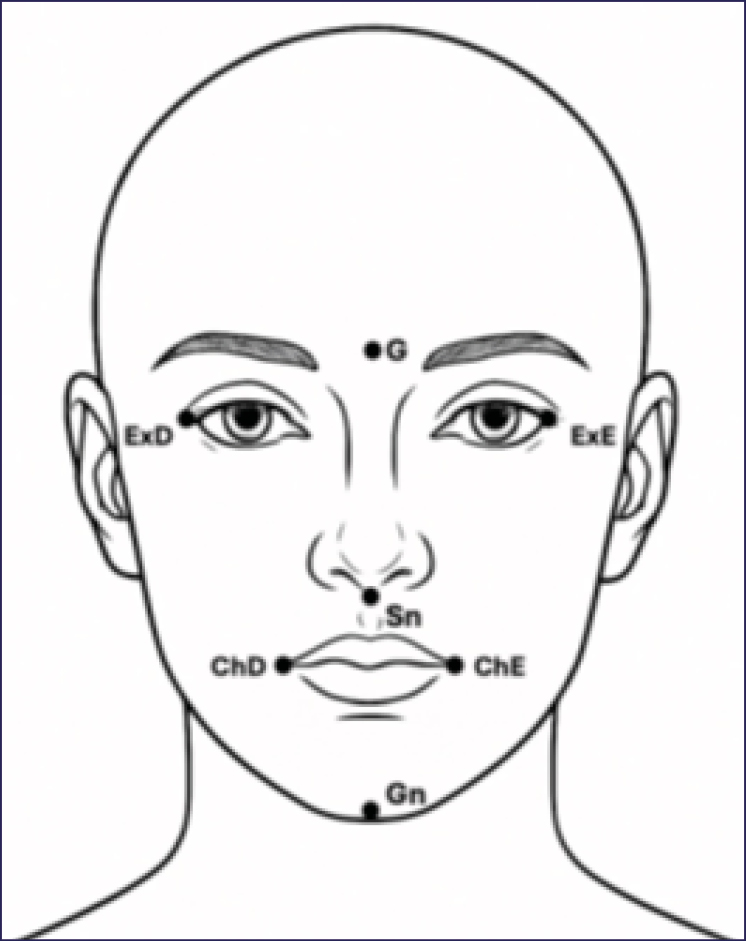
Photoanthropometric assessment was performed using SAPO® software. The images were previously adjusted by superimposing the eyeballs using GIMP® software, by varying the opacity, and after the images were adjusted so that facial proportions could be obtained from the following anthropometric points: glabella (G), subnasal (Sn), gnathion (Gn), cheilion (Ch, both right and left: ChD and ChE), and exocanthus (Ex, also right and left: ExD and ExE), as shown in Figure 1.

Schematic drawing of a female face, created with the aid of artificial intelligence (ChatGPT, OpenAI, 2025)12, with the facial anthropometric points used in the study.
To ensure accurate measurements, a 1-centimeter (10mm) line was drawn horizontally and vertically in PowerPoint (Microsoft® suite) and transferred to the adjusted images, which were saved as JPEGs. Next, the scales of the "x" and "y" axes were calibrated to 10mm in the software itself (SAPO®). The results were transferred to an Excel spreadsheet (Microsoft Office Suite®).
It should be noted that photoanthropometric measurements do not correspond to actual facial measurements and that a difference greater than two millimeters was considered to be a divergence between a subject's measurement and that of a twin brother (or sister).
The results of the analyses performed were transcribed onto a separate sheet, and any similarities or differences between the data obtained were recorded. Given the above, to minimize discrepancies in the analysis, two researchers analyzed the images in a randomized, blinded manner, and the results were subsequently statistically interpreted using the Intraclass Correlation Coefficient (ICC)13.
For these analyses, the researchers underwent prior training, according to the FISWG14 Guide for Facial Comparison Training of Examiners to Competency, by one of the authors (MIBCR), a specialist in Speech-Language Pathology Expertise from the Brazilian Society of Speech-Language Pathology, considered the gold standard for the analyses given her qualifications, publications, teaching experience, and practice in the forensic field. The training included facilitation in applying the methods described here and in defining the limitations of the analyses.
At the end of the data collection, the data were made available in spreadsheets in Microsoft Office Excel® 2013 and analyzed using descriptive statistics through the measurement of frequency, mean, and standard deviation, and by classifying the divergences as: Very High (100-85%), High (84-70%), Moderate (69-50%), Low (49-20%), and Very Low (below 20%). This classification was based on the assumption that, according to the World Health Organization15, values between 85% and 95% can be considered satisfactory in the evaluation of oral conditions. Authors16 added that 70% is sufficient for accurate analysis of facial patterns. Thus, values below this percentage would not indicate a method considered satisfactory. Therefore, the authors of the present study devised this classification to assess the strength of the divergences, since to date nothing has been designed for this purpose.
To verify the reliability of the evaluators' analyses, the holistic, morphological, and photoanthropometric assessments were compared; the evaluator's measurements were repeated in 25% of the sample; and the results were compared using the Intraclass Correlation Coefficient (ICC). The ICC was interpreted as13: poor (<0.50), moderate (0.50 to 0.75), good (0.75 to 0.90), and excellent (>0.90).
The normality of the variables was verified using the Shapiro-Wilk test. The Student's t-test was applied when the assumption of normality was met, and the Mann-Whitney test when it was rejected.
The effect size was calculated using Cohen's d test for normally distributed variables and the biserial rank test. Values up to 0.2 in the tests that verified the effect size were considered weak, from 0.2 to 0.5 medium, and above 0.8 strong. Statistical analysis was performed using Jamovi software version 2.3. For all inferential analyses, the assumptions of the tests used were verified, and a significance level of 5% was considered.
RESULTS
The sample consisted of 60 people (30 twins) whose ages ranged from 16 to 47 years (mean: 23.90 ± 6.97), the majority being females (n=40, 66.67%), single (n=52, 86.66%), with a salary range between one and three minimum wages (n=47, 78.33%), completed high school education (n=31, 51.67%), and monozygotic (n=50, 83.33%). The sample characteristics are shown in Chart 2.
By comparing the analyses between the evaluator considered the gold standard and the evaluator, it was possible to verify that, in the holistic, morphological, and photoanthropometric analyses, the ICC was excellent, as shown in Tables 1 and 2.
Holistic analysis revealed that horizontal analysis enabled greater differentiation among twins (lips, eyebrows, eyes, and nostrils). However, overall, the distinction between twins ranked low, at about 49% of cases.
Morphological analysis revealed little discriminatory power between the participating twin pairs (mean divergence: 7.83 ± 3.01), equivalent to 21.94%, and the classification was considered low. However, it was the analysis that enabled differentiation between monozygotic and dizygotic twins using statistical methods. The structures that allowed the best discrimination, in descending order of occurrence, were the discriminatory features (87.5% - very high classification), the labial commissures (75% - high classification), the width of the nose and mouth (both with 68.75% - moderate), the shape and thickness of the lips (62.5% each - moderate) and, finally, the size of the eyes (56.25% - moderate).
Photoanthropometric analysis revealed the most significant differences in descending order: the lower third of the face, the left hemiface, the right hemiface, and the middle third. Overall, the twins' distinction showed moderate accuracy (57.5%). Overall, the average divergence by twin typology was 4.5 ± 1.9 (42.8%, considered low), and it was possible to conclude that when the analysis techniques were used together, it was possible to distinguish monozygotic from dizygotic twins (Tables 3 and 4).
Thus, difficulties were highlighted in distinguishing between people considered physically identical, as in the case of monozygotic twins. However, it should be noted that there are limitations in interpreting the results due to the exploratory nature of the study and the small number of dizygotic twins.
DISCUSSION
This exploratory research aimed to verify the role of facial features in forensic distinction between twins, given the similarity between monozygotic twins who share the same ovum, and because, in standard genetic tests, the Short Tandem Repeats (STR) profiles are identical, which does not occur with dizygotic twins due to the fertilization of two ova17. Thus, genetic and molecular influences can hinder the differentiation between faces, as the craniofacial region is subject to such influences from the embryonic period, as well as epigenetic factors such as hormones, nutrition, possible traumas, diseases, treatments, lifestyle, habits, and how the person performs their oral functions (such as breathing and chewing, for example)18.
Therefore, facial comparisons for forensic purposes require a technical and scientific basis, and guidelines must be used, such as those recommended by the Facial Identification Scientific Working Group (FISWG), which comprises four subtypes of analysis: holistic, morphological, photoanthropometric, and image overlay19,20.
The human capacity for holistic facial comparison is variable and depends on factors such as the evaluator's competence and familiarity with this practice. The results of this analysis showed differences between twins. However, in the comparison between monozygotic and dizygotic twins, the number of differences was similar, probably because it is subjective, since the images are processed and analyzed as a whole, without considering the parts that make up the face21.
Several methods are employed in forensic human identification, and as noted in the literature, there are difficulties in differentiating twins, especially monozygotic twins. Although morphological analysis showed differences among the analyzed siblings, the differentiation was classified as low. When comparing monozygotic and dizygotic twins, greater morphological divergence was observed in dizygotic twins, as expected, and the statistical analyses confirmed this. Researchers3 reported that among facial morphological aspects, face shape was the one that allowed the most significant differentiation between monozygotic twins, contrary to the results obtained in the present research. The discrepancy may have occurred due to the difference in the method used, since the authors used the Crowdsourcing method (based on the wisdom of crowds), in which images of twins were made available to 120 participants between 18 and 60 years old, who were asked what facilitated their discrimination, with alternatives such as: eyebrows, eyes, nose, mouth, and face shape.
It is worth highlighting that distinguishing characteristics such as blemishes, scars, moles, freckles, and others facilitated differentiation between the twins, ratifying what the literature affirms: that facial markings can be considered biometric signatures that favor the distinction between individuals22.
Furthermore, genetic variations found in monozygotic twins may also explain the subtle differences that differentiate the faces of these siblings, particularly in facial height, ear size, and lip23. In the present study, the lips (both in holistic and morphological analysis) also allowed for such a distinction.
In contrast, photoanthropometric analysis yielded the greatest differences among the analyses performed, demonstrating greater precision in this study. Researchers24 showed that facial measurements obtained via photoanthropometry in frontal and lateral views were concordant at most anthropometric points, highlighting the applicability of this technique. However, in this study, it resulted in moderate differentiation. No evident differences were found between monozygotic and dizygotic twins in this type of analysis, most likely due to the reduced number of anthropometric points studied (thirds of the face and hemifaces) and dizygotic twins.
In light of the above, it is suggested that future research utilize a greater number of variables, such as distances (Superior Nostril, Nasion-Stomion, Upper Lip-Lower Lip, Philtrum Crest-Lower Lip), indices (Chelion-Lower Lip and Medial Iridium-Medial Iridium, Nasion-Stoma, Superior Nostril-Superior Nostril, Chelion-Upper Lip/Lower Lip, Upper Lip-Lower Lip), and angles (Gonion-Pronasal, Lower/Upper Lip-Chelion and Endocanth D/E and Alar), as found in the literature24, in addition to increasing the sample size. It should be noted, however, that the lower third (Sn-Gn) showed the greatest divergences, as cited in a study using three-dimensional comparisons25.
Image overlay, not used in this research, is frequently performed in Forensic Dentistry, such as manual or digital bite comparison, and helps supplement a forensic report, with computerized analysis using software being more precise26, simplifying the chain of evidence27, and its use in speech-language pathology assessments is of interest. Thus, the ideal is a combination of analyses, since each has its benefits and limitations, and can improve forensic facial identification in twins.
Despite the limited number of participants, especially dizygotic twins, it was possible to obtain more discrepancies when the techniques were analyzed together. Nevertheless, it can be inferred that accuracy rates below 50% are not ideal. Thus, the findings of the literature28 are confirmed, highlighting the difficulties in distinguishing identical twins' faces. Studies must deepen knowledge on this aspect so that the similarities between monozygotic twins are not used maliciously to deceive the legal system. Similarly, in criminal proceedings, expert reports from different specialists, including those on human facial identification, assist decision-making but cannot serve as the primary and sole method of identification, according to the literature29.
Future research incorporating additional analytical parameters, such as lip and ear prints, could expand the range of forensic facial identification analysis methods to enable cross-referencing and improve the performance of automated facial recognition techniques. Another finding observed during the research was the difficulty in determining the robustness of forensic analysis in twins, especially monozygotic twins, highlighting the need for greater effort on the part of researchers in this regard, mainly because facial identifications tend to increase due to technological advances, the ease of installing closed-circuit security systems, and the availability of video cameras in intercoms and telephones, as reported in the literature30.
Furthermore, automatic facial recognition systems also have difficulty distinguishing identical twins. Updates to the systems are constantly needed to avoid biometric identification errors in real life31. Algorithms and different facial recognition models (such as FaceNet, VGGFace, VGG16, and VGG19) have been used to reduce discrepancies in analyses. However, they still need improvement32, showing how difficult it is, at the moment, to recognize monozygotic twins' faces.
CONCLUSION
It is concluded that holistic, morphological, and photoanthropometric analyses, when performed together, allowed partial distinction between twins, with greater divergences observed in dizygotic twins, particularly in the morphological analysis. Among the analyses performed, the evaluated items that best allowed for distinctions between twin siblings were: Holistic - lips, eyebrows, eyes, and nostrils, due to their asymmetries; Morphological - discriminative characteristics, labial commissures, width of the nose and mouth, lips (shape and thickness), and eye size; and Photoanthropometric (in a descending order) - height of the lower third of the face, distance from the labial commissure to the outer corner of the eye (left and right), and height of the middle third.
ACKNOWLEDGEMENTS
To the National Council for Scientific and Technological Development (CNPq) for granting a student scientific initiation scholarship.
REFERENCES
- 1 Rehder MI. Identificação forense do falante. In: Rehder MI, Cazumbá LF, Cazumbá M, editors. Identificação de falantes: uma introdução à fonoaudiologia forense. Rio de Janeiro: Revinter; 2015. p. 1-6.
-
2 Faber J. O reconhecimento facial é baseado na comparação das faces com padrões pré- estabelecidos. Rev. Dent. Press Ortod. Ortop. Facial. 2006;11(6):15. https://doi.org/10.1590/S1415-54192006000600002
» https://doi.org/10.1590/S1415-54192006000600002 -
3 Mousavi S, Charmi M, Hassanpoor H. Recognition of identical twins based on the most distinctive region of the face: Human criteria and machine processing approaches. Multimed. tools appl. 2021;80(10):15765-802. https://doi.org/10.1007/s11042-020-10360-3
» https://doi.org/10.1007/s11042-020-10360-3 -
4 Leung WC. Is skin ageing in the elderly caused by sun exposure or smoking? Int. j. dermatol. 2002;147(6):1187-91. https://doi.org/10.1046/j.1365-2133.2002.04991.x
» https://doi.org/10.1046/j.1365-2133.2002.04991.x -
5 Ichibori R, Fujiwara T, Tanigawa T, Kanazawa S, Shingaki K, Torii K et al. Objective assessment of facial skin aging and the associated environmental factors in Japanese monozygotic twins. J. cosmet. dermatol. 2014;13(2):158-63. https://doi.org/10.1111/jocd.12081 PMID: 24910280.
» https://doi.org/10.1111/jocd.12081 -
6 Le THNK, Luu K, Seshadri K, Savvides M. A facial aging approach to identification of identical twins. In: IEEE Fifth International Conference on Biometrics: Theory, Applications and Systems (BTAS), Arlington, VA, USA, p. 91-8, 2012. https://doi.org/10.1109/BTAS.2012.6374562
» https://doi.org/10.1109/BTAS.2012.6374562 -
7 Sun Z, Paulino AA, Feng J, Chai Z, Tan T, Jain AK. A study of multibiometric traits of identical twins. Proceedings of The International Society for Optical Engineering (SPIE). 2010;7667:1-12. https://doi.org/10.1117/12.851369
» https://doi.org/10.1117/12.851369 -
8 Hersberger-Zurfluh MA, Papageorgiou SN, Motro M, Kantarci A, Will LA, Eliades T. Facial soft tissue growth in identical twins. Am. j. orthod. dentofacial orthop. 2018;154(5):683-92. https://doi.org/10.1016/j.ajodo.2018.01.020 PMID: 30384939.
» https://doi.org/10.1016/j.ajodo.2018.01.020 -
9 Goodman LA. Snowball sampling. Ann. math. stat. [journal on the internet] 1961;32:148-70 [accessed on 2025 fev 28]. Available at: https://www.jstor.org/stable/2237615
» https://www.jstor.org/stable/2237615 -
10 Facial Identification Scientific Working Group - FISWG [webpage on the internet]. Image factors to consider in facial image comparison version 1.0, 2021 [accessed on 2024 nov 1]. Available at: https://fiswg.org/fiswg_image_factors_to_consider_in_facial_img_comparison_v1.0_2021.05.28.pdf
» https://fiswg.org/fiswg_image_factors_to_consider_in_facial_img_comparison_v1.0_2021.05.28.pdf -
11 Facial Identification Scientific Working Group - FISWG [webpage on the internet]. Guidelines for image processing techniques in facial image comparison, version 2.0, 2024 [accessed on 2024 nov 1]. Available at: https://fiswg.org/fiswg_imag_procssng_tchnqs_for_fac_img_comparison_v2.0_20240607.pdf
» https://fiswg.org/fiswg_imag_procssng_tchnqs_for_fac_img_comparison_v2.0_20240607.pdf -
12 OpenAI. ChatGPT [artificial inteligence tools]. Versão GPT-5. San Francisco (CA): OpenAI; 2025. Available at: https://chat.openai.com
» https://chat.openai.com -
13 Koo TK, Li MY. A guideline of selecting and reporting intraclass correlation coefficients for reliability research. J Chiropr Med. 2016;15(2):155-63. https://doi.org/10.1016/j.jcm.2016.02.012 PMID: 27330520.
» https://doi.org/10.1016/j.jcm.2016.02.012 -
14 Facial Identification Scientific Working Group - FISWG [webpage on the internet]. Guide for facial comparison training of examiners to competency, version 2.0, 2023 [accessed on 2024 nov 1]. Available at: https://fiswg.org/fiswg_guide_for_facial_comp_trng_of_exmrs_to_competency_v1.1_20231117.pdf
» https://fiswg.org/fiswg_guide_for_facial_comp_trng_of_exmrs_to_competency_v1.1_20231117.pdf - 15 Petersen PE, Baez RJ. Oral health surveys: Basic methods. 5th ed. Geneva: World Health Organization; 2013.
-
16 Queiroz GV, Rino J, Paiva JBD, Capelozza Filho L. Analysis of reliability, accuracy, sensitivity and predictive value of a subjective method to classify facial pattern in adults. Dental Press J Orthod. 2016;21(6):58-66. https://doi.org/10.1590/2177-6709.21.6.058-066.oar PMID: 28125141.
» https://doi.org/10.1590/2177-6709.21.6.058-066.oar -
17 Antonio LU, Pereira MMI, Ferraz JAML. Diferenciação genética de gêmeos monozigóticos: uma importante evidência para área forense. BJFS. 2017;6(4):485-99. https://doi.org/10.17063/bjfs6(4)y2017485
» https://doi.org/10.17063/bjfs6(4)y2017485 -
18 Ozbilen EO, Basal E, Yilmaz HN, Biren S. Facial morphology differences in monozygotic twins: A retrospective stereophotogrammetric study. Angle orthod. 2023;93(6):706-11. https://doi.org/10.2319/120722-840.1 PMID: 37407504.
» https://doi.org/10.2319/120722-840.1 - 19 Azevedo JF. Prosopografia: identificação facial. In: Rehder MI, Cazumbá LF, Cazumbá M, editors. Identificação de falantes: uma introdução à fonoaudiologia forense. Rio de Janeiro: Revinter; 2015. p. 225-40.
-
20 Oliveira MODR, Curi JP, Baldasso RP, Beaini TL. Reconhecimento facial na prática forense: uma análise dos documentos disponibilizados pelo FISWG. RBOL. 2022;9(1):98-113. https://doi.org/10.21117/rbol-v9n12022-419
» https://doi.org/10.21117/rbol-v9n12022-419 -
21 Facial Identification Scientific Working Group - FISWG [webpage on the internet]. Glossary, version 3.0, 2022 [accessed on 2024 nov 1]. Available at:: https://fiswg.org/fiswg_glossary_v3.0_20221022.pdf
» https://fiswg.org/fiswg_glossary_v3.0_20221022.pdf -
22 Srinivas N, Flynn PJ, Vorder Buegge RW. Human identification using automatic and semi-automatically detected facial marks. J. forensic sci. 2016;61:S117-30. https://doi.org/10.1111/1556-4029.12923 PMID: 27405018.
» https://doi.org/10.1111/1556-4029.12923 -
23 Hauspie RC, Susanne C, Defrise-Gussenhoven E. Testing for the presence of genetic variance in factors of face measurements of Belgian twins. Ann. hum. Biol. 1985;12(5):429-40. https://doi.org/10.1080/03014468500007991 PMID: 4062238.
» https://doi.org/10.1080/03014468500007991 -
24 Falcão TN, Alves YB, Nascimento LG, Tinoco RLR, Lima LNC, Machado CEP et al. Photoanthropometry in forensics: Comparison of facial images with frontal and lateral views. Res. soc. dev. 2021;10(5):e27610514795. https://doi.org/10.33448/rsd-v10i5.14795
» https://doi.org/10.33448/rsd-v10i5.14795 -
25 Djordjevic J, Jadallah M, Zhurov AI, Toma AM, Richmond S. Three-dimensional analysis of facial shape and symmetry in twins using laser surface scanning. Orthod. craniofac. Res. 2013;16(3):146-60. https://doi.org/10.1111/ocr.12012 PMID: 23323545.
» https://doi.org/10.1111/ocr.12012 -
26 Veyta F, Yuniastuti M, Suhartono AW, Auerkari EI. Human bite mark analysis: Review of advantage computer-assisted procedure. AIP Conference Proceedings. 2022;2537(1):030001-8. https://doi.org/10.1063/5.0097979
» https://doi.org/10.1063/5.0097979 -
27 Vilborn P, Bernitz H. A systematic review of 3D scanners and computer assisted analyzes of bite marks: Searching for improved analysis methods during the Covid-19 pandemic. Int J Legal Med. 2022;136(1):209-17. https://doi.org/10.1007/s00414-021-02667-z PMID: 34302214.
» https://doi.org/10.1007/s00414-021-02667-z -
28 Rusia MK, Singh DK. A comprehensive survey on techniques to handle face identity threats: Challenges and opportunities. Multimed. tools appl. 2023;82(2):1669-748. https://doi.org/10.1007/s11042-022-13248-6 PMID: 35702682.
» https://doi.org/10.1007/s11042-022-13248-6 -
29 Pícoli FF, Alves AM, Mundim MBV, Mendes SDSC, Silva RF. A fragilidade da análise facial como único método de identificação humana. Braz. j. forensic sci med law bioeth. 2014;3(4):281-302. https://doi.org/10.17063/bjfs3(4)y2014281
» https://doi.org/10.17063/bjfs3(4)y2014281 -
30 Atsuchi M, Tsuji A, Usumoto Y, Yoshino M, Ikeda N. Assessment of some problematic factors in facial image identification using a 2D/3D superimposition technique. Leg Med (Tokyo). 2013;15(5):244-8. https://doi.org/10.1016/j.legalmed.2013.06.002 PMID: 23886899.
» https://doi.org/10.1016/j.legalmed.2013.06.002 -
31 Sundaresan V, Shanthi SA. Monozygotic twin face recognition: An in-depth analysis and plausible improvements. Image vis. comput. 2021;116:104331. https://doi.org/10.1016/j.imavis.2021.104331
» https://doi.org/10.1016/j.imavis.2021.104331 -
32 Goel R, Mehmood I, Ugail H. A study of deep learning-based face recognition models for sibling identification. Sensors. 2021;21(15):5068. https://doi.org/10.3390/s21155068 PMID: 34372306.
» https://doi.org/10.3390/s21155068
-
Financial support
Undergraduate Research Grant from the National Council for Scientific and Technological Development (Project 12218-2023).
-
Data sharing statement
The individual data of de-identified participants (sex and age) may be shared indefinitely, provided that they are accessed directly by the CEFAC Journal, which holds the copyright to the publication, and that the interested parties are researchers in the field. However, those who use the shared data must cite the original authors of this study.
The individual data of de-identified participants (sex and age) may be shared indefinitely, provided that they are accessed directly by the CEFAC Journal, which holds the copyright to the publication, and that the interested parties are researchers in the field. However, those who use the shared data must cite the original authors of this study.

 Captions: Ch=cheilion, D=right, E=left, Ex=exocanthus, G=glabella, Sn=subnasal, Gn=gnathion.