Anthracnose severity in F2 lima bean progenies obtained by hybridization without emasculation
ABSTRACT
The objective of this study was to obtain anthracnose-resistant lima bean progeny by artificial hybridization. The study was conducted at the Agricultural Sciences Center of the Federal University of Piauí (UFPI), Teresina – Piauí. For the F2 phytopathological evaluation experiment, a completely randomized experimental design was used with four replicates per progeny and a plot consisting of one plant. For inoculation, the CT4 isolate of Colletotrichum truncatum was used at 106 spores/mL, and a control plant was inoculated with autoclaved distilled water. Ten trifoliate leaves of each genotype were scanned from the intermediate region of the plant using ASSES 2.0. After assessing the severity, the average ratings for each population were calculated, classifying them into five categories according to the resistance. To conduct the analysis of variance, the severity data were transformed by √x + 1 and grouped by the test proposed by Scott and Knott (P < 0.05). All analyses were performed using the R and GENES programs. Seven days after inoculation, the progênies were divided into three groups. Groups “A” and “B” corresponded to genotypes classified as highly susceptible and group “C” to genotypes classified as moderately resistant and highly resistant. The genotypes BGP-UFPI 220, BGP-UFPI 251, BGP-UFPI 798, BGP-UFPI 832, BGP-UFPI 1000, and BGP-UFPI 1002 can be used as parents in lima bean improvement programs. Progenies that were moderately resistant and highly resistant, totaling sixteen, were selected for use in breeding programs aimed at anthracnose resistance.
Keywords:
Phytopathological assessment; Colletotrichum truncatum; Artificial hybridizations; Phaseolus lunatus; Progeny selection
RESUMO
O objetivo deste trabalho foi obter progênies de feijão-fava com resistência à antracnose a partir de hibridações artificiais. O estudo foi conduzido no Centro de Ciências Agrárias da Universidade Federal do Piauí (UFPI), Teresina – Piauí. Para o experimento de avaliação fitopatológica da F2 foi utilizado o delineamento experimental inteiramente casualizado, quatro repetições por progênie, sendo a parcela constituída por uma planta. Para inoculação, foi utilizado o isolado CT4 de Colletotrichum truncatum 106 esporos/mL e uma planta testemunha, inoculada com água destilada autoclavada. Da região intermediária da planta dez folhas trifoliadas de cada genótipo foram escaneadas utilizando-se o programa ASSES 2.0. Após avaliar a severidade, as médias para cada população foram calculadas, classificando-as em cinco categorias de acordo com a resistência. Para realização da análise de variância, os dados da severidade foram transformados por √x + 1 e agrupados pelo teste proposto por Scott e Knott (P < 0,05). Todas as análises foram realizadas por meio dos programas R e GENES. Aos sete dias da inoculação, as progênies foram agrupadas em três grupos. Os grupos “A” e “B” corresponderam aos genótipos classificados como altamente suscetíveis, e o grupo “C” aos genótipos classificados como moderadamente resistentes e altamente resistentes. Os genótipos BGP-UFPI 220, BGP-UFPI 251, BGP-UFPI 798, BGP-UFPI 832, BGP-UFPI 1000 e BGP-UFPI 1002 podem ser indicados como genitores para o programa de melhoramento do feijão-fava. Foram selecionadas 16 progênies moderadamente resistentes e altamente resistentes, que podem ser usadas em programas de melhoramento visando resistência à antracnose.
Palavras-chave:
Avaliação fitopatológica; Colletotrichum truncatum; Hibridações artificiais; Phaseolus lunatus; Seleção de progênies
INTRODUCTION
The fava bean is one of the five domesticated species of the Phaseolus genus, being the second most economically important (GARCIA et al., 2021; ASSUNÇÃO-FILHO et al., 2022). It is used as a food source in the form of green or mature grains (GRANJA et al., 2019), with a good nutritional profile as an excellent source of proteins, amino acids, minerals, dietary fiber, and B vitamins (folate, B6, and niacin) (ADEBO, 2023).
The fava bean crop has great socioeconomic importance and is used by small farmers, mainly in northeast Brazil, as an alternative for subsistence and income. In 2022, the country will produce 12,061 tons, harvest an area of 35,609 ha, and have a production value of R$ 90,396.00 (IBGE, 2022).
However, the fava bean crop is still underutilized due to the priority consumption of common beans (BONITA; SHANTIBALA DEVI; SINGH, 2020), in addition to the incidence of diseases (ASSUNÇÃO et al., 2011; SILVA; CHAVES FILHO; MELO FERREIRA, 2010). Anthracnose stands out among the diseases that affect it. The main etiological agent of this disease is the fungus Colletotrichum truncatum (Schw.) Andrus, and More, which have a higher prevalence in northeastern Brazil. The symptoms caused by this pathogen in fava beans are more severe than those in other species, generating typical anthracnose rot mainly in the seeds and pods, but also in the stems and leaves (CAVALCANTE et al., 2019), making it one of the main factors limiting productivity (NASCIMENTO et al., 2017).
The identification and use of resistant genotypes is one of the most efficient strategies for managing plant diseases because it is low-cost, easy to use, ecologically desirable, and reduces or even avoids the indiscriminate use of pesticides (BRITO et al., 2022). Previous studies have identified Phaseolus lunatus genotypes as sources of resistance to anthracnose (CAVALCANTE et al., 2012; SANTOS et al., 2015; CARMO et al., 2015; BRITO et al., 2022; GOMES et al., 2022). Resistant fava bean genotypes selected from germplasm banks, even if they do not present desirable agronomic characteristics related to seed color and size, can be used as sources of resistance in pre-breeding programs.
No artificial hybridization studies involving parents that are resistant to C. truncatum have been conducted on fava beans. Based on these premises, the following hypothesis was established: in the Active Germplasm Bank of Phaseolus at the Federal University of Piauí (BAG-UFPI) of the Genetic Resources and Plant Breeding Laboratory, there are genotypes resistant to C. truncatum that can be used in artificial hybridizations, which could result in populations resistant to anthracnose. Therefore, the objective of this study was to obtain progeny with resistance to anthracnose through artificial hybridization.
MATERIAL AND METHODS
The genetic material used in the study was obtained from crosses performed under a Sombrite® protective screen with a shading intensity of 40%, at the Center of Agricultural Sciences of the Federal University of Piauí (UFPI), in the Department of Plant Science in the city of Teresina - Piauí, located at 05º02’45”S and 42º46’57”W.
The parents involved in the hybridizations (Table 1) come from the Active Germplasm Bank of Phaseolus of the Federal University of Piauí (BAG-UFPI), located in the Laboratory of Genetic Resources and Plant Breeding, and had previously been submitted to phytopathological evaluation (CAVALCANTE et al., 2012; CARMO et al., 2015; BRITO, 2017). The genotypes chosen as donor parents were those with resistance to C. truncatum and at least one dominant morphological characteristic: BGP-UFPI 220, BGP-UFPI 251, and BGP-UFPI 832, with an indeterminate growth pattern (D-), late cycle, and shape of the terminal third trifoliate oval-lanceolate leaf (Wl-) (except for BGP-UFPI 832, which had a round leaflet shape). The recipient parents were those with susceptibility to C. truncatum and recessive characteristics: BGP-UFPI 798, with round leaflets (wlwl), and BGP-UFPI 1000 and BGP-UFPI 1002, with round leaflets (wlwl) and determinate growth (dd).
List of fava bean genotypes from the Active Phaseolus Germplasm Bank of the Federal University of Piauí, contrasting in relation to reaction to anthracnose, growth habit and commercial seed standard, regarding color and leaflet shape, used in the crosses carried out.
To perform the crosses, the genotypes were sown in 36 15-L pots, consisting of six pots per genotype, with an interval of 44 days between genotypes with determinate (early maturity) and indeterminate (late cycle) habits, to obtain coincidence in the flowering period. Three seeds were sown per pot on a substrate composed of soil and cattle manure (3:1). A Minipa MT-241 thermohygrometer was installed on the protective screen to record the temperature and humidity throughout the conduction period.
The artificial hybridizations were performed without emasculation, according to Bliss (1980) and included the following steps: (i) Selection of each pollen-receiving shoot (female parent), which was in the adult phase and completely closed, ensuring sufficient maturity to receive pollen and develop seeds, reducing the risk of self-pollination; (ii) Exposure of the stigma of each selected ideal bud (mature and in pre-anthesis), with the aid of tweezers, separating the petals that surround the male and female organs on their concave side and lightly pressing the base of the ovary, without damaging it; (iv) Selection of a newly opened flower of the male parent, from which the perianth was detached and, then, the base of its ovary was pressed to expose the stigma with pollen. This procedure was performed on a flower that had initiated self-pollination, that is, with anthers releasing pollen grains onto the stigma, which were concentrated at its tip; (v) collection of the stigma of the pollen donor and placing it on the stigma of the female parent, performing cross-pollination; (vi) placing adhesive tape around the pollinated flower for protection and a label on the flower stalk, stating the names of the female and male parents, respectively, as well as the date of pollination and the initials of the person who performed the cross-pollination.
From April to July 2019, 237 crosses were performed, from 8 am to 11 am and 4 pm to 6 pm. During this period, the number of attempts between each combination of parents in which hybrid pods were formed was recorded, as was the percentage of successful hybrid pod formation (Table 2). The percentage of hybrid pods was calculated based on the total number of crosses for each combination.
Percentage (%) of crosses performed and hybrid pods formed from crosses between different genotypes of lima beans (Phaseolus lunatus L.).
Seeds of the F1 hybrids were sown in February 2020 and managed under the same experimental conditions as those of the parents. To confirm hybridization, the following morphological traits were used: growth pattern, leaflet shape, and seed color based on the descriptor catalog for Phaseolus lunatus from the International Plant Genetic Resources Institute (IPGRI 2001). Given that these traits are genetically controlled in lima beans (IPGRI, 2001), they also differ between the parents used. Plants that presented the characteristics of donor parents were considered hybrids.
Seeds of each hybrid plant were harvested individually. Genetic material harvested from the same plant was considered to have originated from the same progeny (Table 3). With the cross BGP-UFPI 1000 × BGP-UFPI 251, in which there was segregation with two seed patterns observed (white and striped), the materials were separated. Some of the F2 seeds collected were directed to phytopathological evaluation.
Genealogy of the six fava bean populations, with the respective progenies evaluated for reaction to anthracnose.
For the phytopathological evaluation, F2 generation plants were grown in a screened area of the Plant Health Sector of UFPI in February 2021. The experimental design was completely randomized, with four replicates per progeny, and consisted of one plant grown in a polyethylene pot (5 L), containing 2.0 kg of topsoil and organic compost in a 3:1 ratio. The plants were tutored with bamboo because of their indeterminate growth habits. Phytosanitary treatments for pest control were performed whenever necessary, and irrigation was maintained throughout the crop cycle (Figure 1).
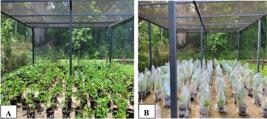
Management of fava bean populations in the F2 generation, in a screened area of the Plant Health Sector, of the Plant Science Department, of the Federal University of Piauí. (A) Plants tutored with bamboo; (B) Plants in a humid chamber.
Each plant was inoculated with C. truncatum at the same stage of development, 40 days after sowing. The CT4 isolate of C. truncatum obtained from the Plant Health Laboratory of the Department of Plant Science/CCA/UFPI was used for inoculation. The inoculum was prepared by adding 20 mL of sterilized distilled water to the plate of the fungus grown in FDA culture medium (beans, dextrose, agar) at 28±1 °C and a 12-hour photoperiod, for 15 days. Plants of each genotype were inoculated with a spore suspension of the CT4 isolate of C. truncatum 106 spores/mL and a control plant was inoculated with autoclaved distilled water. After inoculation, the plants were wrapped in plastic bags (100 × 70 cm) to create a humid chamber (Figure 1B) for 24 h to create satisfactory conditions for fungal colonization.
The evaluation in this study was carried out using two scales: one developed by Carvalho (2009) for detached lima bean leaves. Ten trifoliate leaves from each genotype were selected from the intermediate region of the plants. Leaves were detached and carefully scanned. Once scanned, the percentage of the injured leaf area was measured using the ASSES 2.0 program (LAMARI, 2008), at five and seven days after inoculation (DAI), using a scale of scores from 0 to 5, according to Carvalho (2009), in which 0 = absence of symptoms; 1 = traces at 10% of the injured leaf area; 2 = 11–25% of the injured leaf area; 3 = 26–50% of the injured leaf area, without leaflet loss; 4 = 51–75% of the injured leaf area, with or without one leaflet loss; and 5 = 76–100% of the injured leaf area, with or without loss of two or three leaflets.
After assessing the severity, the overall average of the scores assigned to each population was obtained. Based on these averages, the populations were grouped according to the criteria established by Belmino (2004) into five classes: immune (IM) - 0, highly resistant (HR) - 0.1 to 1.4, moderately resistant (MR) - 1.5 to 2.4, moderately susceptible (MS) - 2.5 to 3.0, and highly susceptible (HS) - above 3.0. Plants that died due to the fungus were classified as highly susceptible to infection.
To perform the analysis of variance, the severity data were transformed by √x + 1 , aiming to obtain normality of errors and homogeneity of variance of the treatments, and were subsequently grouped by the test proposed by Scott and Knott (1974) (P < 0.05%).
All analyses were performed using R (R CORE TEAM, 2023) and GENES (CRUZ, 2014) programs.
RESULTS AND DISCUSSION
Of the 237 crosses performed, the hybrid pod formation rate was 4.8% and 23 seeds were obtained. Although the rate of hybrid pod formation was low, these results were similar to those of Sousa et al. (2022), who hybridized lima beans and obtained 5.8% hybrid pod formation. The authors also observed combinations in which no pod formation was observed, and the lower the temperature fluctuation and the higher the relative humidity, the higher the fruit-set rates. These results are essential for the improvement of P. lunatus aimed at resistance to anthracnose, as there are no hybridizations in lima beans in the literature involving anthracnose-resistant parents.
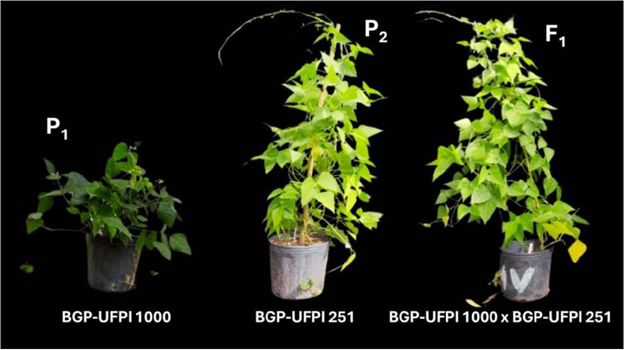
Controlled crosses were confirmed using morphological markers to obtain F1 lima bean hybrids. BGP-UFPI 1000 × BGP-UFPI 832, BGP-UFPI 1002 × BGP-UFPI 251, and BGP-UFPI 1002 × BGP-UFPI 832 were unsuccessful. In contrast, the BGP-UFPI 798 × BGP-UFPI 220 combination stood out, with 13% of hybrid pods formed (Table 2). The controlled crosses (BGP-UFPI 798 × BGP-UFPI 220, BGP-UFPI 798 × BGP-UFPI 832, BGP-UFPI 1000 × BGP-UFPI 220, BGP-UFPI 1000 × BGP-UFPI 251, BGP-UFPI 1000 × BGP-UFPI 832, BGP-UFPI 1002 × BGP-UFPI 220, BGP-UFPI 1002 × BGP-UFPI 251, and BGP-UFPI 1002 × BGP-UFPI 832) were confirmed using morphological Plants with donor genotype characteristics such as an indeterminate growth pattern (D-) (Figure 2) and oval-lanceolate terminal leaflet shape (W1-) (Figure 3) were considered F1 hybrids.

Confirmation of a lima bean plant resulting from artificial hybridization (BGP-UFPI 1000 × BGP-UFPI 251) using the morphological marker indeterminate growth pattern (D-). Recipient parent (P1), donor parent (P2) and F1 generation.

Confirmation of a lima bean plant resulting from artificial hybridization (BGP-UFPI 798 × BGP-UFPI 220) using the morphological marker oval-lanceolate terminal leaflet shape (W1-). Central leaflet of the recipient parent (P1), central leaflet of the donor parent (P2) and central leaflet of the F1 generation.
From the phytopathological evaluation of F2, it was observed that in some genotypes (from the cross BGP-UFPI 1000 × BGP-UFPI 251), it was possible to observe symptoms three days after inoculation (DAI). At 5 DAI, with the exception of the genotypes that had BGP-UFPI 832 as one of the parents, reddish spots were observed on the branches, in addition to visible lesions on the leaf veins, indicating that they were susceptible. At 7 DAI, the highly susceptible genotypes had evident symptoms of branches and petioles with extensive reddish spots and leaf fall. The progeny
obtained from the cross with BGP-UFPI 832 as the male parent showed almost no symptoms.
In general, regarding the leaf area affected by C. truncatum, significant differences were observed between the fava bean genotypes, which indicates the presence of variability, as susceptible genotypes were observed as well as genotypes resistant to the fungus. The experimental coefficients of variation (CV) ranged from 10.25% to 11.86% and were satisfactory, allowing the detection of significant differences between the genotypes (Table 4).
Estimates of the mean squares obtained in the analysis of variance of the evaluation carried out at five and seven days regarding the reaction to anthracnose, in 23 fava bean progenies, from biparental crosses.
Considering the evaluations performed at 5 DAI, three genotypes were classified as highly susceptible, three were classified as moderately susceptible, thirteen were classified as moderately resistant and four were classified as highly resistant. Three groups were formed (Table 5): group “A” corresponded to genotypes classified as highly susceptible (HS) and moderately susceptible (MS), group “B” to moderately resistant genotypes (MR) and group “c” corresponded to moderately resistant genotypes (MR) and those classified as highly resistant (HR).
Average scores assigned to the reactions of lima bean genotypes to Colletotrichum truncatum, evaluated five and seven days after inoculation.
At 7 DAI, a change in the classification of some genotypes was observed. In this case, genotypes previously classified as moderately susceptible were now classified as highly susceptible. One moderately resistant genotype (MR) (P1.07) was now classified as highly susceptible (HS). Two highly resistant genotypes (HR) (P5.01 and P3.04) were now classified as moderately resistant (MR) (Table 5). Three groups were also formed. Groups “A” and “B” corresponded to genotypes classified as highly susceptible (HS) and group “C” to genotypes classified as moderately resistant (MR) and highly resistant (HR) (Table 5). This can be explained by the progression of the disease, changing the score assigned and consequently altering its classification.
The change observed between the evaluations performed five and seven days after inoculation, that is, the increased susceptibility to the fungus after seven days of contagion, was also observed in studies by Brito et al. (2022), Carmo et al. (2015), and Cavalcante et al. (2012), who attributed the change in classification to the hemibiotrophic behavior of the Colletotrichum genus.
After phytopathological evaluation seven days after inoculation, 16 progenies were selected for generation advancement with the aim of obtaining resistant lines, as they showed MR and HR resistance.
Among the 16 selected progenies, 11 MR were from the BGP-UFPI 1000 × BGP-UFPI 251 cross (Figure 4A). These progenies were one of the parents of the genotype BGP-UFPI 251, which had already been classified as HR in studies carried out by Cavalcante et al. (2012) for the evaluation of lima bean genotypes resistant to C. truncatum from detached leaves. Two progenies from crosses BGP-UFPI 798 × BGP-UFPI 220 (Figure 4B), BGP-UFPI 1000 × BGP-UFPI 220 (Figure 4C), and BGP-UFPI 1002 × BGP-UFPI 220 (Figure 4D) were also selected. The four progenies have the male parent BGP-UFPI 220 in common, which was previously classified as MR in whole-plant inoculation studies by Brito et al. (2022) and Cavalcante et al. (2012). Progeny from the cross BGP-UFPI 798 × BGP-UFPI 832 were also selected (Figure 4E). The male parent involved was BGP-UFPI 832, which was classified as having AR in a study by Brito et al. (2022).
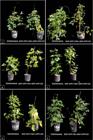
Fava bean progenies resulting from the cross (A) BGP-UFPI 1000 × BGP-UFPI 251, (B) BGP-UFPI 798 × BGP-UFPI 220, (C) BGP-UFPI 1000 × BGP-UFPI 220, (D) BGP-UFPI 1002 × BGP-UFPI 220 and (E) BGP-UFPI 798 × BGP-UFPI 832, with their respective controls.
In general, it was found that the analyzed progenies were classified into three groups regarding resistance to anthracnose at 7 DAI: highly susceptible (HS), and moderately resistant (MR), highly resistant (HR). A total of 16 progenies were selected for their resistance at 7 DAI: fourteen with moderate resistance (MR), and two with high resistance (HR). This selection represents a significant advancement in the genetic improvement of lima beans and will contribute to the future development of disease-resistant lines. Although these results were satisfactory, the experiment was conducted under controlled conditions (screened) and may not fully reflect field conditions, where additional environmental factors can influence resistance to anthracnose. Therefore, it is necessary to conduct experiments in different environments and field conditions to validate the resistance of progenies and confirm the resistance of the selected varieties.
CONCLUSION
Genotypes BGP-UFPI 220, BGP-UFPI 251, BGP-UFPI 832, BGP-UFPI 798, BGP-UFPI 1000, and BGP-UFPI 1002 are indicated as parents for a lima bean breeding program aimed at anthracnose resistance. Morphological markers of leaflet shape and growth habit were efficient in distinguishing lima bean hybrids from crosses.
After phytopathological evaluation seven days after inoculation, 16 progenies with moderately resistant (MR) and highly resistant (HR) strains were selected. Among the 16 selected progenies, 11 were obtained from the cross BGP-UFPI 1000 × BGP-UFPI 251, two from the cross BGP-UFPI 798 × BGP-UFPI 220, one from the cross BGP-UFPI 1000 × BGP-UFPI 220, one from the cross BGP-UFPI 1002 × BGP-UFPI 220, and one from the cross BGP-UFPI 798 × BGP-UFPI 832. These progenies can be used in breeding programs aimed at anthracnose resistance.
REFERENCES
- ADEBO, J. A. A Review on the Potential Food Application of Lima Beans (Phaseolus lunatus L.), an Underutilized Crop. Applied Sciences, 13: 1996, 2023.
- ASSUNÇÃO, I. P. et al. Reaction of faba bean genotypes to Rhizoctonia solani and resistance stability. Horticultura Brasileira, 29: 492-497, 2011.
- ASSUNÇÃO-FILHO, J. R. et al. Selection of superior genotypes of lima bean landraces by multivariate approach. Revista Caatinga, 35: 87-95, 2022.
- BELMINO, C. S. Resistência do feijão-caupi a Colletotrichum truncatum 2004. 64 f. Tese (Doutorado em Fitopatologia) – Universidade Federal de Viçosa, Viçosa, 2004.
- BLISS, F. A. Common bean. In: FEHR, W. R.; HADLEY, H. H. (Eds.). Hybridization Of Crop Plants New York: Wiley, 1980. cap. 17, p. 273-284.
- BONITA, L. C.; SHANTIBALA DEVI, G. A.; SINGH, B. C. H. Lima Bean (Phaseolus lunatus L.) - A Health Perspective. International Journal of Scientific & Technology Research, 9: 5638-5649, 2020.
- BRITO, M. V. Caracterização morfoagronômica e seleção de genótipos de feijão-fava resistentes ao Colletotrichum truncatum 2017. 65 f. Dissertação (Mestrado em Genética e Melhoramento: Área de Concentração em Genética e Melhoramento) – Universidade Federal do Piauí, Teresina, 2017.
- BRITO, M. V. et al. Associação entre resistência de Phaseolus lunatus a Colletotrichum truncatum e caracteres morfoagronômicos. Summa Phytopathologica, 48: 69-77, 2022.
- CARMO, M. D. S. et al. Avaliação de acessos de feijão-fava, para resistência a Colletotrichum truncatum, em condições de folhas destacadas e campo. Summa Phytopathologica, 41: 292-297, 2015.
- CARVALHO, E. M. S. Antracnose em feijão-fava (Phaseolus lunatus L.): Caracterização do agente causal e reação de genótipos a Colletotrichum truncatum 2009. 53 f. Tese (Doutorado em Agronomia. Área de concentração em Produção Vegetal) – Universidade Estadual Paulista, Jaboticabal, 2009.
- CAVALCANTE, G. R. S. et al. Reação de subamostras de feijão-fava à antracnose. Summa Phytopathologica, 38: 329-333, 2012.
- CAVALCANTE, G. R. et al. Diversity, prevalence, and virulence of Colletotrichum species associated with Lima bean in Brazil. Plant Disease, 103: 1961-1966, 2019.
- CRUZ, C. D. GENES - a software package for analysis in experimental statistics and quantitative genetics. Acta Scientiarum, 35: 271-276, 2014.
- GARCIA, T. et al. Comprehensive genomic resources related to domestication and crop improvement traits in Lima bean. Nature Communications, 12: 1-17, 2021.
- GOMES, R. S. S. et al. Reactions of lima bean (Phaseolus lunatus L.) accessions to Colletotrichum truncatum Revista Caatinga, 35: 809-817, 2022.
- GRANJA, M. B. et al. Variedades de feijão-fava submetidas à níveis de salinidade e adubação orgânica. Colloquium Agrariae, 15: 104-114, 2019.
-
IBGE - Instituto Brasileiro de Geografia e Estatística. Banco de dados agregados: pesquisa: produção agrícola municipal, 2021 Available at: https://www.ibge.gov.br/explica/producao-agropecuaria/fava/br. Access on: Jan. 20, 2022.
» https://www.ibge.gov.br/explica/producao-agropecuaria/fava/br. - IPGRI - International Plant Genetic Resources Institute. Descritores para Phaseolus lunatus (Feijão-espadinho) Roma: International Plant Genetic Resources Institute, 2001. 51 p.
- LAMARI, L. ASSESS 2.0: Image Analysis Software for Plant Disease Quantification. St. Paul: American Phytopathological Society, 2008. 125 p.
- NASCIMENTO, A. D. et al. Severidade da antracnose do feijão fava afetada por doses de cálcio e fontes de silício. Revista Ciência Agrícola, 15: 61-68, 2017.
- R CORE TEAM. R: a language and environment for statistical computing Vienna: R Foundation for Statistical Computing, 2023.
- SANTOS, A. R. B. et al. Seleção de subamostras de feijão-fava para resistência à antracnose. Revista Brasileira de Engenharia de Biossistemas, 9: 268-278, 2015.
- SCOTT, A. J.; KNOTT, M. A cluster analysis method for grouping means in the analysis of variance. Biometrics, 30: 507-512, 1974.
- SILVA, J. M.; CHAVES FILHO, J. T.; MELO FERREIRA, A. Concentração de Carboidratos Solúveis em Folhas de Phaseolus lunatus L. em Relação ao Sombreamento. Revista EVS-Revista de Ciências Ambientais e Saúde, 37: 403-417, 2010.
- SOUSA, A. et al. Artificial hybridization without emasculation in lima bean (Phaseolus lunatus L.). Revista Caatinga, 35: 223-230, 2022.