Selectivity of aqueous and alcoholic extracts of Calotropis procera on the predator Euborellia annulipes
ABSTRACT
Extracts from plants, such as giant milkweed (Calotropis procera Aiton, 1811), have been employed in pest management due to their insecticidal potential and safety for humans and animals. However, applying these products in crops may lead to a reduction in natural enemies, such as the earwig (Euborellia annulipes Lucas, 1847), an important ally in biological control. Thus, there is a need to test whether the extract of C. procera affects the survival and biological parameters of E. annulipes. This study aimed to evaluate the effects of aqueous and alcoholic extracts of C. procera at different concentrations on the survival and morphological aspects of the predator E. annulipes. The study was conducted in the Invertebrate Laboratory of the Department of Biosciences at the Center for Agricultural Sciences, Federal University of Paraíba, Campus II, Areia, PB, Brazil, under controlled conditions. Concentrations of 5, 10, 15, and 20% of aqueous and alcoholic extracts from C. procera leaves were tested with topical application on nymphs and adults of E. annulipes. Insect survival, instar duration, body size, and head capsule length were evaluated. Under laboratory conditions, the aqueous extract of C. procera is harmless to E. annulipes; the alcoholic extract is harmless at concentrations of 5, 10, and 15% and moderately toxic at 20%. The alcoholic extract decreases, while the aqueous extract increases, the duration of instars in E. annulipes. Higher concentrations of the alcoholic extract reduce predator size and head capsule length.
Keywords:
Earwig; Integrated Pest Management; Giant Milkweed; Natural enemies
RESUMO
O uso de extratos de plantas como algodão-de-seda (Calotropis procera Aiton, 1811), vem sendo usado no manejo de pragas pelo seu potencial inseticida e por ser mais seguro a humanos e animais. Contudo, a aplicação desses produtos nos cultivos pode implicar na redução dos inimigos naturais, como a tesourinha Euborellia annulipes Lucas, 1847, grande aliada do controle biológico. Assim surge a necessidade de testar se o extrato de C. procera afeta a sobrevivência e parâmetros biológicos de E. annulipes. Objetivou-se com esse estudo avaliar a ação tóxica dos extratos aquosos e alcoólicos de C. procera em diferentes concentrações sobre a sobrevivência e aspectos morfológicos do predador E. annulipes. O estudo foi conduzido no Laboratório de Invertebrados do Departamento de Biociências do Centro de Ciências Agrárias da Universidade Federal da Paraíba, Campus II, Areia – PB, sob condições controladas. Testaram-se as concentrações de 5, 10, 15 e 20% do extrato aquoso e alcoólico de folhas de C. procera, com aplicação tópica sobre ninfas e adultos de E. annulipes. Avaliou-se a sobrevivência dos insetos, duração de ínstares, tamanho corporal e comprimento da cápsula cefálica. Em condições de laboratório, o extrato aquoso de C. procera é inócuo a E. annulipes; o extrato alcoólico demonstra ser inócuo na concentração de 5, 10 e 15%, e moderadamente tóxico a 20%. O extrato alcoólico diminui, enquanto o aquoso aumenta, a duração dos ínstares de E. annulipes. As concentrações mais elevadas do extrato alcoólico, promove a redução no tamanho do predador e no comprimento da cápsula cefálica.
Palavras-chave:
Tesourinha; Manejo Integrado de Pragas; Algodão-de-Seda; Inimigos naturais
INTRODUCTION
Agricultural crops, throughout their phenological development, are susceptible to a range of insects that can attack them, causing low levels of production and, consequently, a low financial return. Thus, Integrated Pest Management (IPM) in agriculture is a necessary approach, which accompanies the entire crop cycle (REZAEI; SAFA; GANJKHANLOO, 2020).
In the context of IPM, it is necessary to use control methods to keep the population of pest insects below the level of economic damage (ZHOU et al., 2024). To this end, producers have a range of measures such as cultural, behavioral, genetic, varietal, biological and chemical control (DARA, 2019). However, chemical control, when used excessively, leads to the selection of resistant insects, decrease in natural enemies, in addition to contamination of soil and surface and subsurface water (OLIVEIRA et al., 2016).
Given this scenario, the use of plant extracts presents itself as an alternative in pest control because it is innocuous to humans and does not leave residues in food (FERREIRA et al., 2024). Thus, some plants such as neem (Azadirachta indica A. Juss) (BENELLI et al., 2017), rue (Ruta graveolens L.) (PERERA; KARUNARATNE; CHINTHAKA, 2022), giant milkweed (Calotropis procera Ait.) (VATS et al., 2023) and others have been studied for having insecticidal potential in the form of both essential oils and aqueous and alcoholic extracts.
C. procera, popularly known as giant milkweed or Sodom apple, is a plant belonging to the Apocynaceae family, a perennial shrub that can reach 1.5 to 3.5 meters in height and has large subcoriaceous leaves (HASSAN et al., 2015). Studies have sought to confirm the efficiency of C. procera in the control of pests of agricultural importance such as Spodoptera frugiperda (J.E. Smith, 1797), Anticarsia gemmatalis (Hübner, 1818), Ceratitis capitata (Wiedemann, 1824) (RAMOS et al., 2007), Spodoptera exigua (Hübner, 1808) (KHAN et al., 2017) and Galleria mellonella (Linnaeus, 1758) (EL-HEFNY, 2019). With these studies and the proof that aqueous and alcoholic extracts of C. procera have an insecticidal action on pest insects, there emerges a need to test whether this extract affects the survival and biological parameters of natural enemies, such as the E. annulipes earwig of the order Dermaptera.
The fauna of predatory insects is extremely important for maintaining the balance of agroecosystems, and in these environments the presence of insects such as Dermaptera significantly helps in carrying out biological control in a natural way, since these predators feed on eggs and larvae of pest insects of agronomic importance (SILVA; BATISTA; BRITO, 2010). The earwig Euborellia annulipes is recognized as an excellent predator of agricultural pests such as S. frugiperda (SILVA; BATISTA; BRITO, 2009), eggs and neonate larvae of Diatraea saccharalis (Fabricius, 1794) (SOUZA et al., 2022), and Plutella xylostella (Linnaeus, 1758) (NUNES et al., 2018).
In this context, with the potential use of C. procera plant extracts in the control of insect pests, investigations are necessary due to the need to understand the action of this extract on the biology of the predator E. annulipes. Thus, the objective of this study was to evaluate the toxic action of aqueous and alcoholic extracts of C. procera at different concentrations on the survival and biological aspects of the predatory earwig E. annulipes.
MATERIAL AND METHODS
Experimental site
The study was conducted at the Invertebrate Laboratory (LABIN) of the Department of Biosciences of the Center for Agrarian Sciences of the Federal University of Paraíba, Campus II, Areia, Paraíba, Brazil, under controlled conditions (temperature: 25 ± 1 ºC; relative humidity: 70 ± 10%; photophase: 12 hours). The earwigs used in this study were obtained from the rearing kept in the laboratory itself.
Rearing of Euborellia annulipes
The predator E. annulipes was reared in transparent rectangular plastic pots (7 cm high x 15 cm wide x 25 cm long) internally lined with layers of moistened toilet paper and hermetically sealed. Couples were placed inside the plastic pots together with the artificial diet suggested by Guimarães et al. (2006) consisting of starter feed for broiler chicken, wheat bran, brewer’s yeast, powdered milk and nipagin. The couples remained together for copulation and were separated after oviposition.
The paper was moistened every two days and changed weekly. When oviposition occurred, the eggs were removed from the plastic pots together with the female and placed in Petri dishes (9.0 cm in diameter x 1.5 cm in height), lined with moistened toilet paper and containing an artificial diet.
Obtaining Calotropis procera extracts
The leaves taken from the middle third of adult C. procera plants were collected in the municipality of Patos, PB (6°59'29.6"S 37°11'18.2"W) in the morning. The material was sent to LABIN for sorting, which consisted of discarding leaves with injuries or attack by microorganisms, and for cleaning with distilled water. After this stage, the leaves were dried with paper towels, packed in kraft paper bags for weighing and subsequent drying in a continuous air circulation oven, where they remained for an interval of 48 h to 168 h, at a temperature of 40 ºC, until reaching constant weight (MENDONÇA et al., 2016).
After drying, the material was crushed in a Wiley mill with stainless steel 10-mesh sieves to obtain a fine powder of uniform granulation, which was stored in glass containers, covered by aluminum foil, properly sealed and maintained at room temperature of 25 ± 1 ºC.
With this product, aqueous and alcoholic extracts were produced at concentrations of 5%, 10%, 15% and 20%. For the aqueous extracts, samples of 5 g, 10 g, 15 g and 20 g, respectively, of crushed leaves were added to 100 mL of distilled water, being kept in contact for 48 h. Alcoholic extracts were produced by mixing these samples with 100 mL of 70% alcohol, a solution maintained for eight days with daily stirring. Both extracts remained in an air-conditioned room with a temperature of 25 ± 1º C in amber glass. After this period, both solutions were filtered in gauze and sterilized filter paper for later use in the bioassays, according to the methodology adapted from Mendonça et al. (2016).
Bioassay - Contact Effect
Nymphs of first, second, third, fourth, fifth instars and adults of E. annulipes were separated in Petri dishes for the application of the aqueous and alcoholic extracts. 1200 insects were used, distributed in 10 treatments, with five replicates each, each of which consisted of four insects, totaling 120 insects/treatment.
1.5 mL of both extracts was applied, at concentrations of 5, 10, 15 and 20%, on the back of the insects with the aid of a graduated pipette, using distilled water in the aqueous extract and 70% alcohol in the alcoholic extract as control treatment. Treated insects were transferred to plastic pots (50mL) containing pieces of folded toilet paper moistened with distilled water and artificial diet.
Parameters evaluated
The survival rate of the insects, after application of the plant extracts, was determined by performing evaluations at intervals of 6, 12, 24, 48 and 72 hours after their exposure to the treatments. Daily evaluations were performed to verify the change in the predator’s instar, whose ecdysis was recorded by observing the presence of exuviae in the plastic pots and/or changes in the color of the nymphs. The duration of each E. annulipes instar was obtained by recording the interval in days between ecdysis events.
Measurements of head capsule and body size were performed at each molting event in insects of I, II, III, IV and V instar. The insects were held between the index and thumb fingers, exposing the lateral portion of their body, which made it possible to measure the total length and head capsule length. The portion from the anterior region of the head to the distal margin of the abdomen and the head capsule size (mm) were measured using a digital caliper of the Stainless Hardened model.
Statistical design and analysis
The experimental design was completely randomized, in a 2 x 5 factorial scheme (extracts x concentrations). The data obtained in the experiments were subjected to analysis of variance (ANOVA) according to the significance of the F Test (1 and 5%) and, when significant, the means of the quantitative factor were subjected to regression analysis. All analyses were performed using the statistical software R version 4.2.1 (R DEVELOPMENT CORE TEAM, 2022).
Based on the survival percentages corrected by Abbott’s formula (ABBOTT, 1925), the extracts tested were classified according to the scale of the International Organization for Biological and Integrated Control of Noxious Animals and Plants (IOBC) (BOLLER et al., 2005), considering the reduction in the population of natural enemies: a) innocuous or mildly toxic, 0 to 50%; b) moderately toxic, 51 to 75%; c) toxic, above 75%.
RESULTS AND DISCUSSION
Concentrations of 0 to 15% of the aqueous extract resulted in a survival rate above 90%, while the concentration of 20% caused the lowest rate, 83%. On the other hand, the concentrations of the alcoholic extract resulted in lower percentages of survival compared to the aqueous extract, differing statistically; at the concentration of 20%, the survival of E. annulipes was reduced to around 34% (Figure 1).

Total survival of E. annulipes earwig after topical application of aqueous and alcoholic extract of C. procera at different concentrations. Means with equal letters at the same concentration do not differ statistically from each other by the F test (p <0.01).
C. procera plants have insecticidal properties due to the presence of chemical groups such as alkaloids, flavonoids, tannins, anthracene derivatives, terpenes, sterols and saponins, as well as more specific groups such as calctin, calotropin, calotoxin (KHATTER; ABULDAHAB, 2012) and, depending on the type of solvent used to produce the extract, there may be a greater amount of secondary metabolites released.
The higher survival rate of the earwig E. annulipes at the concentrations of the aqueous extract demonstrates that this extract is less harmful to the predator under study, either because of the smaller amount of compounds extracted by the solvent or because the insect has a more resistant body structure, considering that this same extract when applied to soft-bodied insects, such as Spodoptera littoralis, resulted in a mortality rate of over 50% (SAYED et al., 2017).
The lower percentage of survival observed at the concentrations of the alcoholic extract may be associated with a higher amount of secondary metabolites present in this extract, as alcohol can extract a greater amount and these chemical compounds present in C. procera are able to complex with soluble extracellular proteins in the membrane of insects (PANDEY; TRIPATHI, 2014). The action of these compounds also affects vital enzymatic pathways, where flavonoids specifically block the enzymes involved in regulating the insect’s molting process, which can cause changes, inhibiting it and resulting in mortality. This fact was also reported by Khatter and Abuldahab (2012), who observed that, due to the action of chemical groups such as calctin, calotropin, calotoxin, there may be a decrease in the performance of physiological processes, especially the synthesis of chitin.
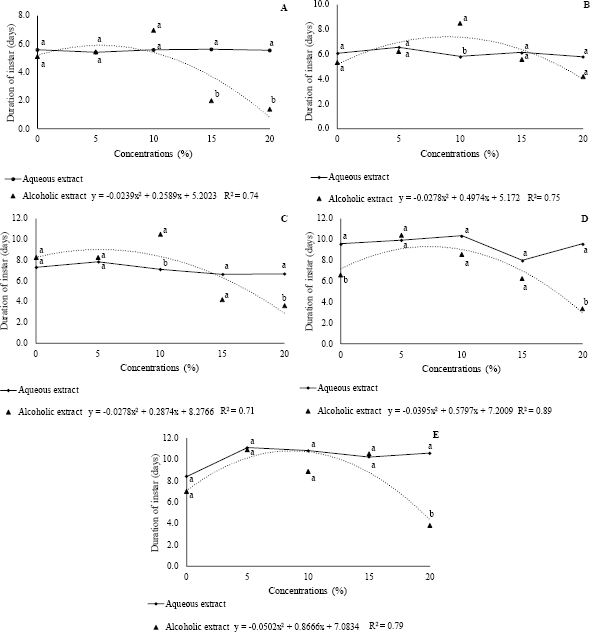
For the parameter of duration of the instars of E. annulipes earwig, the different concentrations of the aqueous extract did not differ statistically in instars I, IV and V, with an average of 6 days for instar I (Figure 2A) and 10 days for instars IV and V (Figures 2D and 2E). In instars II and III, the concentration of 10% of the aqueous extract differed statistically from the others, reducing the duration of the instar to 5.7 and 7 days, respectively (Figures 2B and 2C). With the application of the alcoholic extract, when the concentrations increased, there was a decrease in the duration of the instars, with more evident reductions in instar I, from 5 to 2 days (Figure 2A) and in instar III, from 8 to 3 days, as the concentration increased from 0 to 20% (Figure 2C).

Duration of the instars (I – A; II – B; III – C; IV – D; V – E) of E. annulipes after topical application of aqueous and alcoholic extracts of C. procera at different concentrations. Means with equal letters at the same concentration do not differ statistically from each other by the F test (p <0.05).
The reduction in the duration of instars of E. annulipes when subjected to concentrations of alcoholic extract can be considered beneficial, because according to Silva, Batista and Brito (2010), by promoting a faster biological development, there will also be a greater predation of pest insects, because the greatest predation potential of this earwig is achieved in the adult phase. Such reduction in instar duration with the increase in the concentration of the alcoholic extract may be related to a greater amount of growth inhibitors and toxic substances to the insect, due to the solvent used, causing discomfort in the insect, forcing it to accelerate the ecdysis process (BADER et al., 2021).
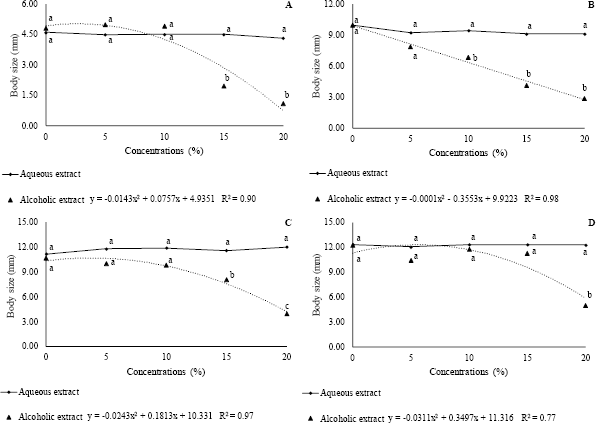
In the analysis of the body size of E. annulipes earwig, the concentrations of the aqueous extract did not differ statistically, leading to averages of 4.5 mm, 10 mm and 12 mm for instars I, III, IV and V, respectively. For the alcoholic extract, with the increase in concentrations there were significant reductions in this parameter, especially at concentrations of 15 and 20%. There were reductions of 2 mm in the body size of the insects of instar I, 7 mm in the insects of instar III, 6 mm in the insects of instar IV and V at a concentration of 20% (Figure 3).

Body size of E. annulipes after topical application of aqueous and alcoholic extracts of C. procera at different concentrations in instars I (A), III (B), IV (C) and V (D). Means with equal letters at the same concentration do not differ statistically from each other by the F test (p <0.05).
The reduction observed in the body size of the insect after topical application of the alcoholic extract may be related to the behavior of Dermoptera species, which are constantly self-grooming their body with the mouthparts. Souza et al. (2019) report that this type of behavior can increase the contamination of the insect with the extract, affecting its physiological processes. The action of the extract on the biology of the insect, whether via contact or ingestion, can impair movement and subsequent feeding, as it can result in the disorientation of the insect, preventing physiological processes, hindering the feeding process, retarding growth, and causing mortality (ZOTTI et al., 2010).
From the point of view of biological control, the reduction in the size of the insect’s body is not something interesting, because the more developed the earwigs, the greater the capacity for predation on the pest, as the adult of E. annulipes consumes 1,481.2, 89.20 and 48.6 eggs and caterpillars of 1st and 2nd instars of S. frugiperda, respectively, with the eggs and caterpillars being preyed upon in greater quantity by earwigs of 4th and 5th instar (SILVA; BATISTA; BRITO, 2009).
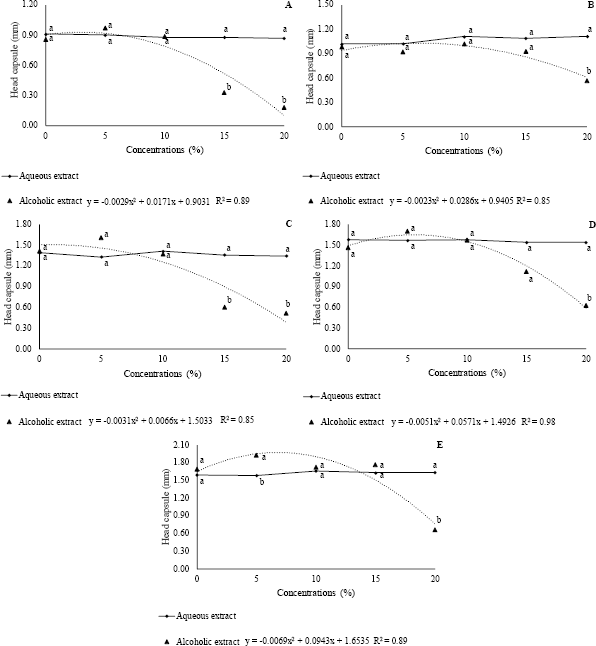
Regarding the values obtained for head capsule length of E. annulipes, the concentrations of the aqueous extract did not differ statistically, leading to averages of 0.90 mm, 1 mm, 1.40 mm, 1.60 mm in instars I, II, III, IV and V, respectively. In the concentrations of the alcoholic extract, at concentrations of 15 and 20%, caused a marked reduction in head capsule length, and the concentration of 20% caused the lowest values in all instars (Figure 4).
Head capsule length of E. annulipes after topical application of aqueous and alcoholic extracts of C. procera at different concentrations in instars I (A), II (B), III (C), IV (D) and V (E). Means with equal letters at the same concentration do not differ statistically from each other by the F test (p <0.05).
Appropriate choice of products for pest control with selectivity to beneficial organisms, such as the earwig E. annulipes, is extremely important for maintaining the level of these organisms in the agroecosystem, because if there is no selectivity, the products can cause changes in the morphology of the insect, such as reductions in the size of the head capsule (MACHADO et al., 2019).
This reduction can lead to problems related to the insect’s body malformation, since it is in this region that the mouthparts, important structures for feeding, are located. Thus, the occurrence of this malformation or reduced size in the head capsule can affect the insect’s feeding process, causing weight loss, delaying its development and causing mortality (LANTERI; DEL RIO, 2011).
In laboratory rearing, the size of the head capsule is also an important aspect, as it is one of the morphological parameters to estimate the insect’s instar (SILVA; BRITO, 2014). Thus, it is worth reiterating the importance of using products that are selective for beneficial organisms, such as the extracts tested in this study, and although the aqueous extract promotes a better development of the head capsule than the alcoholic extract, both at concentrations of 5 to 10% did not significantly reduce this parameter when compared to the control.
CONCLUSION
Under laboratory conditions, the aqueous extract of C. procera is innocuous or slightly toxic to the predator E. annulipes, in topical application. The alcoholic extract of C. procera proved to be innocuous or mildly toxic at concentrations of 5, 10 and 15%, and moderately toxic at concentration of 20% to the predatory insect E. annulipes.
The alcoholic extract of C. procera decreases, while the aqueous extract increases, the duration of E. annulipes instars. Higher concentrations of the alcoholic extract of C. procera cause a reduction in the size of the predatory insect and in the length of its head capsule.
Data Availability:
The data that support the findings of this study can be made available, upon reasonable request, from the corresponding author.
ACKNOWLEDGMENTS
To the National Council for Scientific and Technological Development – CNPq, for granting financial aid.
REFERENCES
- ABBOTT, W. S. A method of computing the effectiveness of an insecticide. Journal of Economic Entomology, 18: 265-267, 1925.
- BADER, A. et al. Systematic Phytochemical Screening of Different Organs of Calotropis procera and the Ovicidal Effect of Their Extracts to the Foodstuff Pest Cadra cautella Molecules, 26: 905-920, 2021.
- BENELLI, G. et al. Neem (Azadirachta indica): towards the ideal insecticide? Natural Product Research, 31: 369-386, 2017.
-
BOLLER, E. F. et al. Working document on selectivity of pesticides. International Organization for Biological and Integrated Control of Noxious Animals and Plants (2005). Available at: <http://www.iobc.ch/2005/Working%Document%20Pesticides_Explanations.pdf>. Access on: Feb. 2, 2024.
» http://www.iobc.ch/2005/Working%Document%20Pesticides_Explanations.pdf - DARA, S. K. The new integrated pest management paradigm for the modern age. Journal of Integrated Pest Management, 10: 1-9, 2019.
- EL-HEFNY, A. A. Sublethal Effects of the Milky Latex of Sodom Apple, Calotropis procera (Alton) on the Growth, development, and some Physiological Aspects of the Greater Wax Moth, Galleria mellonella (L.) (Lepidoptera: Pyralidae). Journal of Plant Protection and Pathology, 10: 491-496, 2019.
- FERREIRA, L. H. G. et al. Potencial de utilização de extratos vegetais como aditivo natural para melhoria da qualidade de ovos–revisão. Brazilian Journal of Animal and Environmental Research, 7: e69287-e69287, 2024.
- GUIMARÃES, M. R. F. et al. Avanços na Metodologia de Criação de Doru luteipes (Scudder, 1876) (Dermaptera: Forficulidae). In: CONGRESSO NACIONAL DE MILHO E SORGO, 26., 2006, Sete Lagoas. Anais… ABMS, Sete Lagoas: 2006. p. 1-7.
- HASSAN, L. M. et al. The biology of Calotropis procera (Aiton) WT. Trees, 29: 311-320, 2015.
- KHAN, S. et al. Insecticidal activity of plant-derived extracts against different economically important pest insects. Phytoparasitica, 45: 113-124, 2017.
- KHATTER, N. A.; ABULDAHAB, F. F. Insecticidal activity of Calotropis procera extracted groups on some biochemical aspects of the house fly, Musca domestica vicina (Diptera: Muscidae). American Journal of Science, 8: 687-693, 2012.
- LANTERI, A. A.; DEL RÍO, M. G. Filogenia de Hexapoda. In: ROIG-JUÑENT, S.; CLAPS, L. E.; MORRONE, J. J. (Eds.) Biodiversidad de Artrópodos Argentinos Buenos Aires: Museo de La Plata, 2011. v. 3, p. 49-66.
- MACHADO, A. V. A. et al. Selective insecticides secure natural enemies action in cotton pest management. Ecotoxicology and Environmental Safety, 184: 109669, 2019.
- MENDONÇA, A. T. et al. A utilização dos extratos hidroalcoólico e alcoólico de Eugenia uniflora L. como agente antibacteriano. Revista da Universidade Vale do Rio Verde, 14: 826-833, 2016.
- NUNES, G. S. et al. Predation of diamondback moth larvae and pupae by Euborellia annulipes Revista Brasileira de Ciências Agrárias, 13: 1-8, 2018.
- OLIVEIRA, A. H. B. et al. The legacy of organochlorine pesticide usage in a tropical semi-arid region (Jaguaribe River, Ceará, Brazil): Implications of the influence of sediment parameters on occurrence, distribution and fate. Science of the Total Environment, 542: 254-263, 2016.
- PANDEY, A.; TRIPATHI, S. Concept of Standardization, Extraction and Pre Phytochemical Screening Strategies for Herbal Drug. Journal of Pharmacognosy and Phytochemistry, 2: 115-119, 2014.
- PERERA, A. G. W. U.; KARUNARATNE, M. M. S. C.; CHINTHAKA, S. D. M. Prolonged repellent activity of Ruta graveolens essential oil adsorbed on different mineral matrices against Sitophilus zeamais (L.) (Coleoptera: Curculionidae). Journal of Stored Products Research, 97: 101976, 2022.
- R DEVELOPMENT CORE TEAM. R: A language and environment for statistical computing. R Foundation for Statistical Computing Vienna: R Foundation for Statistical Computing. 2022.
- RAMOS, M. V. et al. Performance of distinct crop pests reared on diets enriched with latex proteins from Calotropis procera: role of laticifer proteins in plant defense. Plant science, 173: 349-357, 2007.
- REZAEI, R.; SAFA, L.; GANJKHANLOO, M. M. Understanding farmers’ ecological conservation behavior regarding the use of integrated pest management-an application of the technology acceptance model. Global Ecology and Conservation, 22: e00941, 2020.
- SAYED, R. A. et al. Insecticidal properties of some plant extracts against cotton leafworm Spodoptera littoralis (boisd). Sinai Journal of Applied Sciences, 6: 111-120, 2017.
- SILVA, A. B.; BATISTA, J. L.; BRITO, C. H. Aspectos biológicos de Euborellia annulipes (Dermaptera: Anisolabididae) alimentada com o pulgão Hyadaphis foeniculi (Hemiptera: Aphididae). Revista Caatinga, 23: 21-27, 2010.
- SILVA, A. B.; BATISTA, J. L.; BRITO, C. H. Capacidade predatória de Euborellia annulipes (Lucas, 1847) sobre Spodoptera frugiperda (Smith, 1797). Acta Scientiarum Agronomy, 31: 7-11, 2009.
- SILVA, A. B.; BRITO, J. M. Bioecologia de Euborellia annulipes: Dermaptera: Anisolabididae. Revista Verde de Agroecologia e Desenvolvimento Sustentável, 9: 55-61, 2014.
- SOUZA, C. S. F. et al. Controle biológico: qual espécie de tesourinha consome mais lagartas e pode ser menos sensível à exposição a inseticidas? 1. ed. Sete Lagoas, MG: Embrapa, 2019. 25 p. (Boletim de Pesquisa e Desenvolvimento, 188).
- SOUZA, J. M. et al. Predation of Diatraea saccharalis eggs and neonates by the earwig Euborellia annulipes Biological Control, 172: 104953, 2022.
- VATS, T. K. et al. Deterrent effect of Calotropis procera R. Br. on feeding, oviposition and egg hatchability of Plutella xylostella (L.) (Lepidoptera: Plutellidae). Journal of Asia-Pacific Entomology, 26: 102081, 2023.
- ZHOU W. et al. Integrated pest management: an update on the sustainability approach to crop protection. ACS Omega, 9: 41130-41147, 2024.
- ZOTTI, M. J. et al. Seletividade de inseticidas usados na cultura do milho para ovos e ninfas do predador Doru lineare (Eschcholtz, 1822) (Dermaptera: Forficulidae). Arquivos do Instituto Biológico, 77: 111-118, 2010.
Edited by
-
Editor in Chief:
Aurélio Paes Barros Júnior