Water deficit limits growth and yield of cowpea cultivars
ABSTRACT
Irrigation management is essential for applying the required amount of water to crops. This study evaluated the growth and yield of cowpea cultivars as a function of water regime. The experiment was conducted in Teresina, Piauí State, Brazil, from July to September 2022. The experimental design comprised a randomized block in a split-plot scheme with four replicates. The treatments comprised five water regimes (133.80, 191.70, 249.00, 303.00, and 357.00 mm per cycle) and two cowpea cultivars (BRS Inhuma and BRS Olho Negro). Physiological characteristics, growth, and yield were also evaluated. Decreasing water regimes restricted the relative water content of the leaves, relative chlorophyll index, leaf area index, dry matter accumulation, number and size of pods, and cultivar yield. BRS Inhuma showed greater growth, dry matter accumulation, and yield but was more sensitive to decreasing water regimes. Water regimes of 311.00 and 332.08 mm per cycle maximized the yield of BRS Inhuma and BRS Olho Negro, respectively. BRS Olho Negro was more tolerant to growing conditions under water-deficit conditions, indicating that there were genetic variations among the cultivars. Therefore, identifying cowpea cultivars that are more tolerant to water deficit is fundamental to ensuring high yields in irrigated areas.
Keywords:
Irrigation management; Irrigation depths; Evapotranspiration.
RESUMO
O manejo da irrigação é uma ferramenta imprescindível que visa aplicar a quantidade de água necessária as culturas. O objetivo deste estudo foi avaliar o crescimento e a produtividade de cultivares de feijão-caupi em função de regimes hídricos. O experimento foi conduzido em Teresina-PI, Brasil, no período de julho a setembro de 2022. O delineamento experimental foi de blocos casualizados em esquema de parcela subdividida, com quatro repetições. Os tratamentos foram constituídos por cinco regimes hídricos (133,80; 191,70; 249,00; 303,00 e 357,00 mm por ciclo) e duas cultivares de feijão-caupi: BRS Inhuma e BRS Olho Negro. Foram avaliadas as características fisiológicas, crescimento e rendimento. A diminuição do regime hídrico restringiu o teor relativo de água na folha, o índice relativo de clorofila, o índice de área foliar, o acúmulo de massa seca, o número e tamanho das vagens e a produtividade das cultivares. A cultivar BRS Inhuma apresentou maior crescimento, acúmulo de massa seca e produtividade, porém foi mais sensível à diminuição do regime hídrico. Os regimes hídricos 311,00 e 332,08 mm por ciclo maximizaram a produtividade das cultivares BRS Inhuma e BRS Olho Negro, respectivamente. A cultivar BRS Olho Negro foi mais tolerante às condições de cultivo sob déficit hídrico, evidenciando que há variações genéticas entre as cultivares. Portanto, a identificação de cultivares de feijão-caupi mais tolerantes ao déficit hídrico é fundamental para assegurar o alto rendimento das áreas irrigadas.
Palavras-chave:
Manejo da irrigação; Lâminas de irrigação; Evapotranspiração.
INTRODUCTION
Irrigation management (IM) is essential for applying the required amount of water to crops, maximizing the productivity of irrigated areas, and promoting the efficient and economic use of water as a factor in agricultural production (PEREIRA et al., 2019). IM can be performed based on climate, plant, and soil parameters, or their combination (PEREIRA et al., 2019; MIRANDA et al., 2023). The use of these parameters establishes fundamental criteria, such as defining the ideal moment for irrigation and providing the exact amount of water required by agricultural crops throughout production to avoid water deficit (WD) or excess (PEREIRA et al., 2019).
Cowpea (Vigna unguiculata (L.) Walp.) holds substantial socioeconomic importance in Brazil and several countries worldwide, and it is extensively cultivated in tropical and subtropical climatic regions (GNANKAMBARY et al., 2020; SILVA JÚNIOR et al., 2020). However, irregular rainfall in certain regions, inadequate IM, and the use of cultivars that are not adapted to local edaphoclimatic conditions cause decreases in crop yield.
Cowpea requires between 290 to 350 mm of water per cycle. However, local edaphoclimatic conditions and the cultivars grown result in variations (SILVA JÚNIOR et al., 2020; MUNJONJI; AYISI, 2021). Water availability strongly influences growth expression and the productive capacity of the crop, indicating that the occurrence of WD reduces stomatal conductance, leaf transpiration, the quantum efficiency of photosystem II, decreasing photosynthetic rates and limiting cowpea growth and yield (AYALA et al., 2020; MUNJONJI; AYISI, 2021; MIRANDA et al., 2023).
Analysis of plant growth allows for the evaluation of the effects of WD on physiological and biochemical processes. Thus, studies aimed at determining the tolerance and adaptation of new cowpea cultivars to WD are essential. We hypothesized that cowpea cultivars that are more tolerant to WD would undergo less pronounced reductions in growth, biomass accumulation, and yield. Therefore, this study evaluated the growth and yield of cowpea cultivars as a function of water regime (WR).
MATERIAL AND METHODS
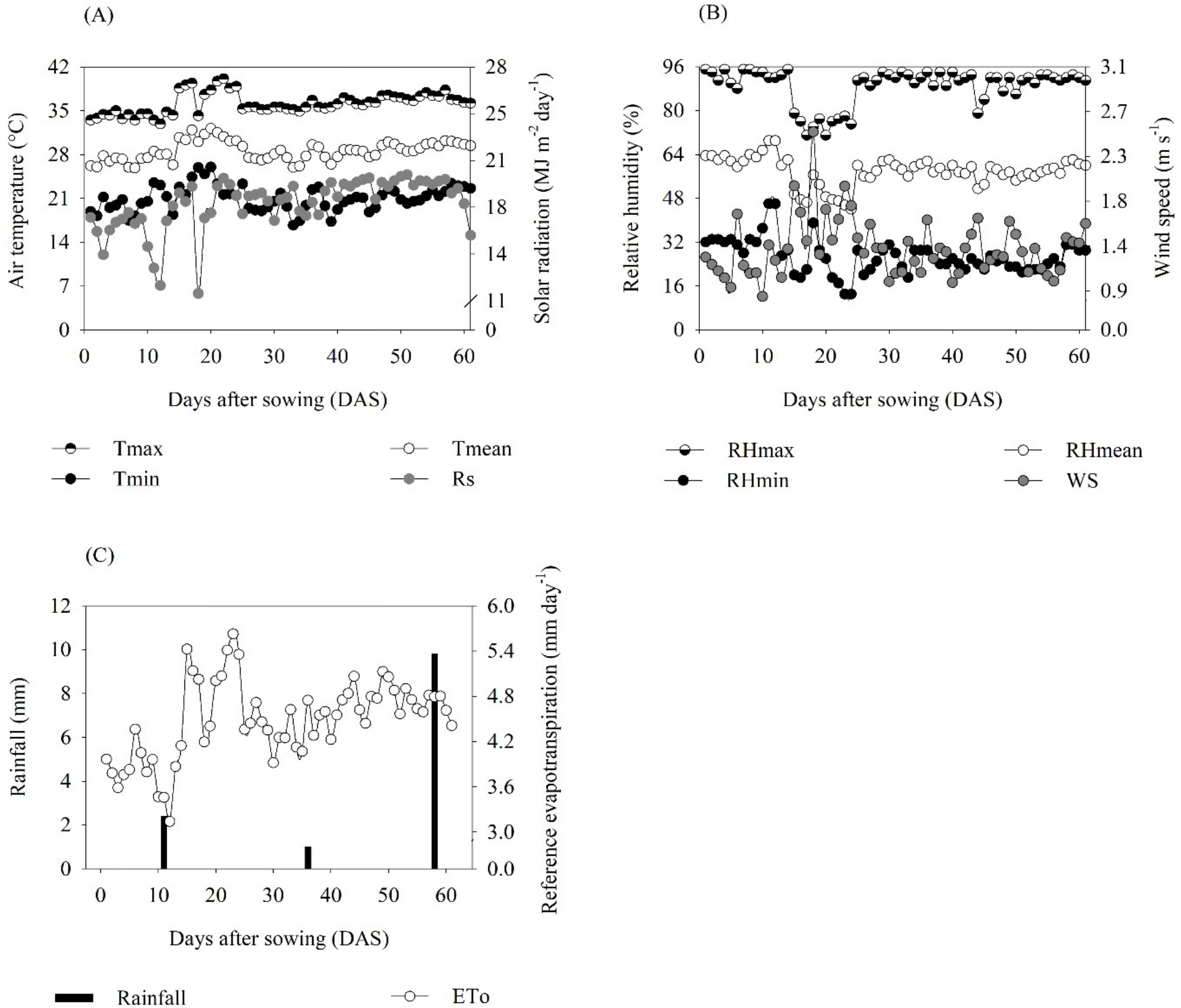
The experiment was conducted at the Brazilian Agricultural Research Corporation - EMBRAPA-Meio-Norte (05°05' S; 42°48' W; and 74.4 m) located in Teresina, Piauí State, Brazil, from July to September 2022. The meteorological conditions observed during the experimental period are shown in Figure 1.

Daily means of meteorological variables: maximum (Tmax), minimum (Tmin), and average air temperature (Tmean), and global solar radiation (Rs) (A); maximum (RHmax), minimum (RHmin), and average relative humidity (RHmean), and wind speed (WS) (B); and rainfall and reference evapotranspiration (ETo) (C) recorded during the experimental period.
The experimental design was a randomized block design in a split-plot scheme with four replicates, with treatments comprising five irrigation depths (WDn), determined daily from fractions of crop evapotranspiration (ETc) (40, 70, 100, 130, and 160% of ETc), distributed in the plots, and two cowpea cultivars (cv) with indeterminate growth habits: BRS Inhuma (cv. Inh) and BRS Olho Negro (cv. Fra) with semi-prostrate and semi-erect growth habits, respectively, were allocated to the subplots. The WDn + Rainfall (13.20 mm) corresponded to WRs of 133.80, 191.70, 249.00, 303.00, and 357.00 mm per cycle.
The experimental plots measured 6 × 12 m and contained 960 plants. The subplots comprised smaller areas (4 × 6 m) containing 480 plants distributed in 8 rows of 60 plants. Only four central rows of each subplot were considered useful.
The experimental area has Yellow Ultisol soil with sandy loam texture (SANTOS et al., 2013). The following characteristics were noted in the 0-0.20 m layers: Chemical: pH (H2O) = 5.7; Ca2+ = 0.78 cmolc dm-3; Mg2+ = 0.35 cmolc dm-3; K+ = 0.09 cmolc dm-3; Na+ = 0.02 cmolc dm-3; Al3+ = 0.04 cmolc dm-3; H+Al = 1.69 cmolc dm-3; P (Mehlich) = 31.12 mg dm-3; organic matter = 12.90 g kg-1; CEC (t) = 1.25 cmolc dm-3. Physical-hydraulic: sand = 876.50 g kg-1; silt = 37.50 g kg-1; clay = 86.00 g kg-1; bulk density = 1.50 g cm-3; moisture at field capacity (θfc) = 0.217 m3 m-3; moisture at permanent wilting point (θpwp) = 0.05 m3 m-3.
The soil was conventionally prepared by harrowing. Foundation fertilization was performed based on the soil chemical analysis and fertilization recommendations proposed by Melo et al. (2018). During sowing, 30, 20, and 60 kg ha-1 of N, P2O5, and K2O, respectively, were applied. Sowing was performed using a SEMEATO experimental planter (SHP 249) with four simultaneous planting rows. The spacing between rows and between plants was 0.5 × 0.10 m, which corresponded to a planting density of 200,000 plants ha-1.
Conventional sprinkler irrigation was also used. The lateral lines comprised PVC pipes with a nominal diameter of 50 mm, 64 m long, with Tigre sprinklers (MIDI 360), full-circle rotating type, flow rate of 1.76 m3 h-1, operating pressure of 25 m H₂O, spacing of 12 × 12 m, and riser height of 1.5 m. The water used for irrigation was obtained from an artesian well, being classified as C1S1, indicating no risks of soil salinization or sodification.
IM was performed using a climatic method based on the estimation of ETo (mm day-1), determined using the Penman Monteith equation (ALLEN et al., 2006). ETc was calculated using the relationship ETc = ETo × Kc × P, where Kc is the crop coefficient (dimensionless) and P is the fraction of the irrigation depth, 0.4, 0.7, 1.0, 1.3, and 1.6, corresponding to 40, 70, 100, 130, and 160% of ETc, respectively. We used the Kc values obtained by Bastos et al. (2008), equal to 0.3, 0.5, 0.8, 1.2, and 0.8 for phases I (0-5 days after sowing [DAS]), II (6-28 DAS), III (29-40 DAS), IV (41-54 DAS), and V (55 DAS until harvest), respectively.
Data on meteorological variables, such as air temperature, relative humidity, global solar radiation, and wind speed (Figures 1A and 1B), were obtained daily from an automatic weather station belonging to the National Institute of Meteorology, located approximately 30 m from the experimental area, and were used to calculate the ETo (Figure 1C).
A fixed irrigation interval of 2 days was used for all treatments, with each WDn application split equally between the morning and afternoon shifts. Sixteen collectors spaced 3.0 × 3.0 m were installed in the central quadrants of the experimental plots. After each irrigation, the applied WDn was measured in the collectors of all treatments to accurately quantifying the applied irrigation depth. Variations in WDn were initiated and finalized at 21 and 55 DAS, respectively.
Phytosanitary management was performed when necessary to prevent weeds, pests, and diseases. Harvest was performed manually at 65 DAS.
The relative water content of the leaves (RWC, %) was determined at 41 and 50 DAS according to the methodology of Smart and Bingham (1974). The relative chlorophyll (Chl) index (RCI) was obtained at 27, 41, and 50 DAS through measurements performed on both sides of the upper part of the leaves using a portable Chl meter (SPAD-502Plus, Konica Minolta, Tokyo, Japan). The morphophysiological variables RWC and RCI were determined for the three plants in each subplot.
The leaf area index (LAI) was determined as the ratio of the leaf area to the spacing occupied by the plant. The leaf dry matter (LDM, g m-2) and total shoot dry matter (TSDM, g m-2) concentrations were obtained by drying plant samples in a forced-air oven (S180AD, Eurobrás, Araraquara, Brazil) at 65 °C for 72 h (ADUSEI et al., 2021). A precision digital scale of 0.01 g (22.31.001.0055, Urano, Canoas, Brazil) was used to determine the dry mass of the plant samples. LAI, LDM, and TSDM were determined at 27, 41, and 55 DAS for the four plants in each subplot.
Yield components were evaluated at the end of the cycle (65 DAS) in 10 plants from each subplot. The number of pods (NP, pods m-2) was determined by counting the total NP harvested and expressed in pods per m2. Pod length (PL, cm) and number of grains per pod (NGP) were determined by selection 10 pods harvested from each subplot. PL was obtained using a measuring tape, and NGP was determined by counting the total grains contained in the selected pods.
Grain yield (GY, kg ha-1) was obtained by weighing the grains harvested from the useful areas of the subplots and expressed in kg ha-1. GY was determined with grain moisture corrected to 13% (SILVA JÚNIOR et al., 2020).
Data were tested for normality of deviations and homogeneity of variances using the Shapiro-Wilk and Bartlett tests, respectively, and then subjected to exploratory analysis of variance at a significance level of 0.05.
Variables that showed significant effects on WR were analyzed using polynomial regression with linear and quadratic models. Regression models were selected based on the significance of regression parameters at a 0.05 significance level and the highest value of the coefficient of determination (R2). For the cv factor, mean comparisons were performed using Tukey’s test at a significance level of 0.05.
Statistical analyses were performed using R software v. 4.2.3 (R Foundation for Statistical Computing, Vienna, Austria), and figures were prepared using SigmaPlot v. 11.0 (Systat Software Inc., San Jose, CA, USA).
RESULTS AND DISCUSSION
RWC was significantly influenced only by WR at 41 and 50 DAS. The data for this variable adequately fitted the second-degree polynomial regression model, with the estimated maximum values of 78.89 and 76.58% obtained with WR of 290.00 and 295.53 mm per cycle, respectively (Figure 2A).

Relative water content in leaves (RWC) (A), relative chlorophyll index (RCI) (B), and leaf area index (LAI) (C) of cowpea as a function of water regimes (WR), and total shoot dry matter (TSDM) (D) as a function of the interaction between WR and cultivars (cv) factors. * and ** indicate significance at 0.05 and 0.01, respectively, by Student's t-test; DAS: days after sowing.
RWC is a physiological variable that reflects the water status of leaves (EZIN et al., 2021). This variable has frequently been employed as an indicator of the effects of WD on plants (EZIN et al., 2021; NUNES et al., 2022). The decrease in RWC under conditions of lower water availability evidences a lower hydration state of the protoplasm of plant cells (PEREIRA et al., 2023), decreasing leaf water potential (ΨL). This decrease in ΨL limits the stomatal opening process and reduces the internal CO2 concentration and photosynthetic rates of cowpea (NUNES et al., 2022).
WDs alter the water status of cowpea, resulting in wilting, yellowing, and leaf drop. Thus, maintaining a high RWC is essential for avoiding membrane damage (NUNES et al., 2022). Ezin et al. (2021) and Nunes et al. (2022) reported a decrease in the RWC in cowpea grown under conditions of lower water availability.
The RCI evaluated at 27, 41, and 55 DAS was significantly influenced by the WR. The maximum values of 53.61, 67.39, and 50.48 were estimated with WR values of 318.75, 337.50, and 386.90 mm per cycle, respectively. There were increments of 25.01, 21.93, and 26.64% in the RCI relative to a WR of 133.80 mm per cycle, respectively (Figure 2B).
The RCI measures the intensity of green leaf coloration as an indirect response to leaf Chl content and N levels in plant tissues (PEREIRA et al., 2023). Chl is the primary photosynthetic pigment responsible for intercepting light energy and is involved in electron transport at the reaction centers (GAO et al., 2020). Under WD conditions, a decrease in Chl content limits photosynthetic rates (ZHUANG et al., 2020), plant growth, and yield (BANGAR et al., 2019).
The decrease in water availability restricts plant transpiration (WASAYA et al., 2021) and reduces contact via mass flow between roots and N ions present in the soil solution that are driven by the transpiration flow (MCMURTRIE; NÄSHOLM, 2018; GLOSER et al., 2020).
This causes lower synthesis or greater degradation of leaf Chl (GNANKAMBARY et al., 2020; MIRANDA et al., 2023) and inhibition of RCI (Figure 2B).
Better maintenance of RWC and photosynthetic pigments, such as Chl, contributes to greater tolerance of cowpea cultivars to abiotic stresses, such as WD (MIRANDA et al., 2023). Despite the lower RCI averages observed at WRs of 133.80 and 191.70 mm per cycle (Figure 2B), cowpea plants grown under these WRs did not show symptoms of N deficiency, such as yellowing and leaf drop, and normally completed the production cycle. Adusei et al. (2021), Ezin et al. (2021), and Silva et al. (2021) reported decreases in the RCI of cowpea under WD conditions.
The cv. Inh showed significant gains of 2.70 and 11.71% in RCI at 27 and 41 DAS, respectively, compared with cv. Fra (48.49; 58.38) (Figure 3B). The RCI values of both cultivars were close to the values reported by Adusei et al. (2021) and Ezin et al. (2021) at 68.0 and 49.70 for the cowpea cultivars Nketewade and Tawa, respectively. Variations related to RCI result from the genetic characteristics of cultivars, N assimilation efficiency, and the evaluation period (PEREIRA et al., 2023).

Relative water content in leaves (RWC) (A), relative chlorophyll index (RCI) (B), leaf area index (LAI) (C), and total shoot dry matter (TSDM) (D) of cowpea cultivars. Means followed by different letters in the periods differ from each other by Tukey test at 0.05 significance level. * and ** indicate significant interaction effect between WR and cultivars (cv) factors at 0.05 and 0.01, respectively; ns: absence of significant difference between cultivars.
WR significantly influenced LAI in all evaluated periods. WRs of 283.75, 300.59, and 317.16 mm per cycle estimated the maximum LAI of 1.60, 3.82, and 3.82 at 27, 41, and 55 DAS, respectively (Figure 2C). LAI is an important morphological variable that depends on the number and size of leaves. Under WD conditions, plants reduce leaf emissions and expansion (WAHAB et al., 2022) to mitigate water loss through transpiration (PEREIRA et al., 2019) and maintain ΨL. However, this strategy inhibits CO2 absorption, increases photorespiration, and restricts the production of photoassimilates, vegetative growth, and biomass accumulation (SELEIMAN et al., 2021; WAHAB et al., 2022).
Leaf area plays a fundamental role in bean tolerance to WD because it is directly related to the plant's ability to control transpiration and water balance. WD causes loss of cell turgor, which inhibits cell division and plant growth (BANGAR et al., 2019). Farooq et al. (2021) reported a decrease in the LAI of cowpea grown under water restriction.
The cv. Inh showed increases in LAI of 17.30, 8.50, and 27.30% compared with cv. Fra (1.15, 2.92, and 2.61) at 27, 41, and 55 DAS, respectively (Figure 3C). The cv. Inh, which has a semi-prostrate growth habit, produced leaves and branches in greater quantity, size, and intensity, which may have contributed to the significant difference observed between the cultivars and the increase in LAI. The leaf is the main organ involved in the photosynthetic process and is responsible for intercepting solar radiation (KIM et al., 2020) and for gas exchange between the plant and the atmosphere. Thus, an increase in the LAI is indicative of canopy development, ensuring greater radiation interception and net photosynthesis, which are reflected in biomass production.
There was a significant interaction between these factors and TSDM at 27 and 55 DAS. During both periods, cv. Inh presented an estimated TSDM of 106.56 and 595.89 g m-2 at WRs of 271.95 and 296.87 mm per cycle, respectively. This cv. suffered reductions of 41.00 and 49.57% in TSDM when grown under a WR of 133.80 mm per cycle on the respective days (Figure 2D). During the same period, the cv. Fra obtained an estimated TSDM of 94.03 and 432.81 g m-2 at WR of 291.51 and 301.61 mm per cycle, respectively, and showed decreases of 38.00 and 48.47% when grown under the lowest WR applied, respectively (Figure 2D).
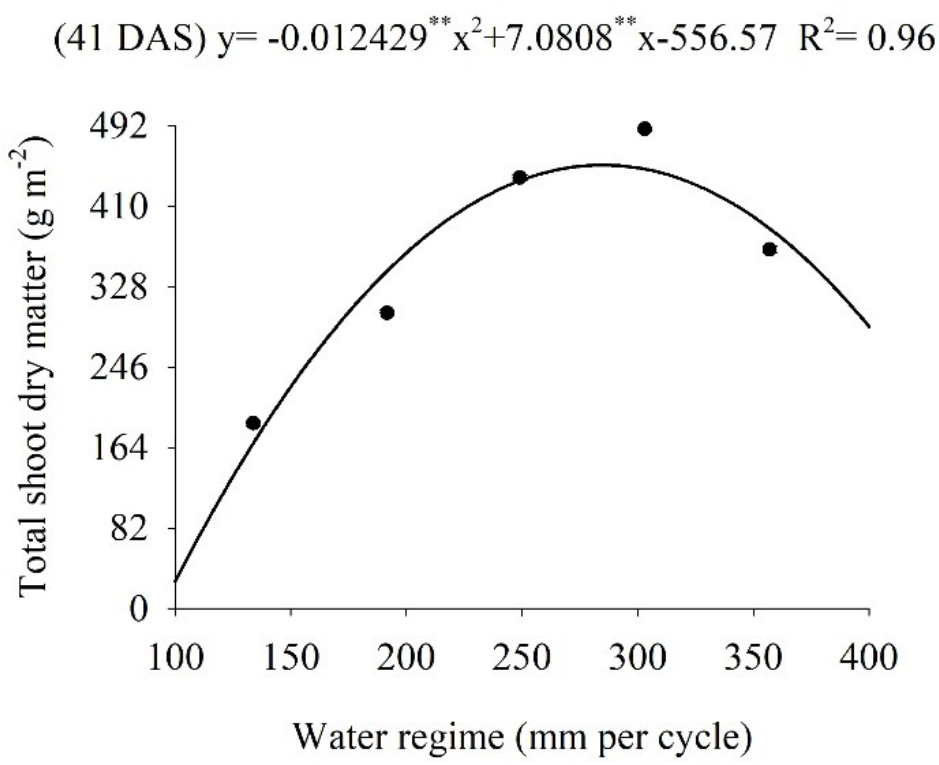
At 41 DAS, the TSDM was significantly influenced by WR. The WR corresponding to 284.84 mm per cycle estimated the maximum TSDM accumulation equal to 451.91 g m-2, with increments of 62.75 and 26.07% relative to WRs of 133.80 and 191.70 mm per cycle, respectively (Figure 4). Ayala et al. (2020), Adusei et al. (2021), Munjonji and Ayisi (2021), and Miranda et al. (2023) investigated the effect of decreased dry matter accumulation in cowpea plants grown under water restriction.

Total shoot dry matter (TSDM) of cowpea as a function of water regimes (WR). ** indicates significance at 0.01 by Student's t-test; DAS: days after sowing.
WD reduces solubility, availability, and nutrient uptake from the soil (WAHAB et al., 2022), and negatively affects physiological characteristics, vegetative growth, biomass, and nutrient accumulation (WASAYA et al., 2021; ELHADY et al., 2021). This explains the decrease in TSDM (Figures 2D and 4) when the cowpea cultivars were grown under WRs lower than 191.70 mm per cycle.
Decreasing WR inhibited TSDM (Figure 2D) in both cultivars; however, cv. Inh, with a semi-prostrate growth habit, was more susceptible to the deleterious effects of WD. Cowpea genotypes less tolerant to WD suffer more pronounced restrictions in growth and biomass production, probably as an acclimation mechanism to WD (SANTOS et al., 2020; ADUSEI et al., 2021; OLORUNWA; SHI; BARICKMAN, 2021; MIRANDA et al., 2023).
At 41 DAS, TSDM was significantly influenced by cultivar. TSDM accumulation was increased by 8.0% in the cv. Inh compared to that in the cv. Fra (341.88 g m-2) (Figure 3D). This was attributed to the higher LAI of this cultivar (Figure 3B).
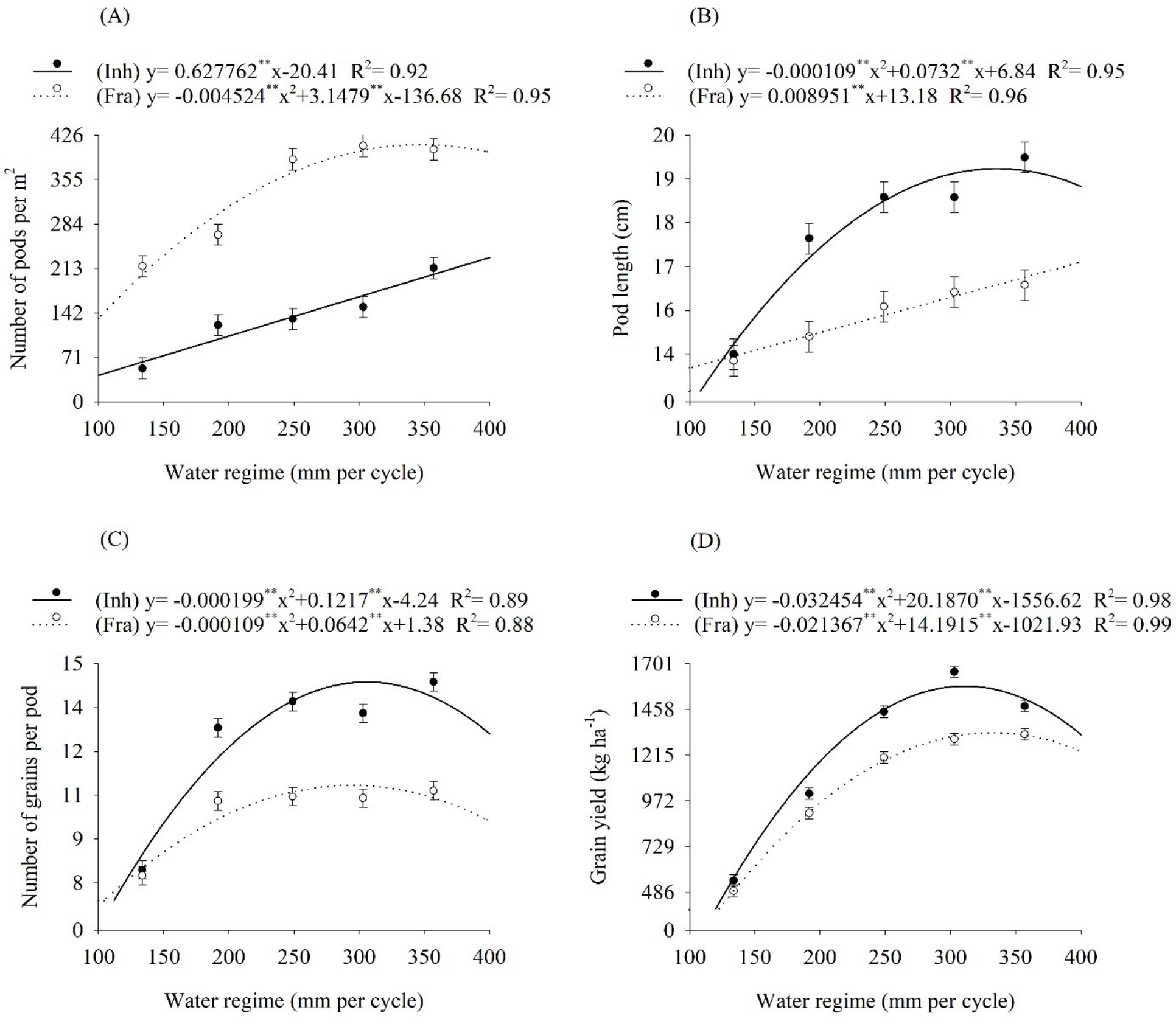
The effect of the interaction between factors was significant for NP. Unfolding of the interaction indicated that cv. Inh obtained an estimated maximum NP of 203.70 pods per m2 at a WR of 357.00 mm per cycle. This cv. suffered decreases in NP of 73.42 and 39.92% when grown under WR of 133.80 and 191.70 mm per cycle, respectively (Figure 5A). However, cv. Fra obtained an NP of 410.91 pods per m2 at a WR of 347.91 mm per cycle. This cv. suffered reductions in NP of 41.50 and 13.62%, respectively, compared with the lowest WR applied (Figure 5A).

Number of pods (NP) (A), pod length (PL) (B), number of grains per pod (NGP) (C), and grain yield (GY) (D) of cowpea as a function of the interaction between water regimes (WR) and cultivars (cv) factors. ** indicates significance at 0.01 by Student's t-test.
PL and NP exhibited significant interaction effects between these factors. The cv. Inh achieved an estimated maximum PL of 19.12 cm with a WR of 335.77 mm per cycle (Figure 5B). The cv. Fra and WR of 357.00 mm per cycle had an estimated PL of 16.37 cm (Figure 5B). WR of 133.80 and 191.70 mm per cycle reduced PL of cv. Inh by 24.52 and 9.21% and of cv. Fra by 12.88 and 9.16%, respectively (Figure 5B).
The interaction between the factors was significant for NGP. The cv. Inh showed an estimated maximum of 14.36 grains per pod, with a WR of 305.77 mm per cycle. Significant reductions of 44.50 and 11.00% in the NGP of this cv. occurred when grown under WRs of 133.80 and 191.70 mm per cycle, respectively (Figure 5C). The cv. Fra obtained an NGP of 10.83 grains per pod at a WR of 294.49 mm per cycle, with decreases of 25.94 and 4.90%, respectively, when grown under the lowest WR applied (Figure 5C).
NP, PL, and NGP depend on the genetic characteristics of cultivars, are directly related to GY in cowpea (SILVA JÚNIOR et al., 2020; ADUSEI et al., 2021; SILVA et al., 2021), and may be influenced by environmental factors such as water availability (ADUSEI et al., 2021; NUNES et al., 2022; SILVA et al., 2021).
The decrease in WR limited the yield components of NP, PL, and NGP in both cultivars, particularly in cv. Inh, which is generally more sensitive to the damaging effects of a WD. In addition to negatively affecting the physiological characteristics (Figures 2A, 2B), leaf emission and expansion (Figure 2C), and biomass production (Figures 2D; Figure 4), WD reduces pollen grain viability and germination, pollen tube development, and grain filling, and causes flower and pod abortion in legumes (FANG et al., 2010).
The interaction between these factors substantially affected the GY. The cv. Inh obtained an estimated maximum GY of 1582.55 kg ha-1 at a WR of 311.00 mm per cycle (Figure 5D). However, cv. Fra showed an estimated maximum GY of 1334.49 kg ha-1 at a WR of 332.08 mm per cycle (Figure 5D). WRs of 133.80 and 191.70 mm per cycle decreased the GY of cv. Inh by 62.45 and 36.10% and of cv. Fra by 62.00 and 31.96%, respectively (Figure 5D).
The decrease in WR negatively affected the RWC (Figure 2A), RCI (Figure 2B), vegetative growth (Figure 2C), biomass accumulation (Figures 2D and 4), and yield components (Figures 5A, B, and C) of both cowpea cultivars, reflecting a decrease in GY.
Crop GY is an essential variable in agricultural production and an important economic indicator of cultivated areas. The adopted IM strategy, physiological conditions, and vegetative growth directly influence this variable (PEREIRA et al., 2023). A decrease in cowpea GY as a function of WD has also been reported by Gnankambary et al. (2020), Adusei et al. (2021), and Munjonji and Ayisi (2021).
CONCLUSION
BRS Olho Negro showed greater tolerance to growing conditions under WD conditions, indicating that there are genetic variations among the cultivars. BRS Inhuma presented a better productive performance than BRS Olho Negro, with a maximum productive potential of 1582.55 kg ha-1 at a WR of 311.00 mm per cycle.
Data Availability:
The data that support the findings of this study can be made available, upon reasonable request, from the corresponding author.
REFERENCES
- ADUSEI, G. et al. The variability of grain yield of some cowpea genotypes in response to phosphorus and water stress under field conditions. Agronomy, 11: 28, 2021.
- ALLEN, R. G. et al. Evapotranspiration del cultivo: guias para la determinación de los requerimientos de agua de los cultivos. Roma: FAO, 2006. 298 p. (Estudio Riego e Drenaje Paper, 56).
- AYALA, C. C. et al. Growth, biomass distribution, gas exchange and chlorophyll fluorescence in cowpea ('Vigna unguiculata'(L.) Walp.) under drought conditions. Australian Journal of Crop Science, 14: 371-381, 2020.
- BANGAR, P. et al. Morphophysiological and biochemical response of mungbean [Vigna radiata (L.) Wilczek] varieties at different developmental stages under drought stress. Turkish Journal of Biology, 43: 58-69, 2019.
- BASTOS, E. A. et al. Evapotranspiração e coeficiente de cultivo do feijão-caupi no Vale do Gurguéia, Piauí. Irriga, 13: 182-190, 2008.
- ELHADY, S. A. A. et al. Hydrogen peroxide supplementation in irrigation water alleviates drought stress and boosts growth and productivity of potato plants. Sustainability, 13: 899, 2021.
- EZIN, V. et al. Adaptation of Cowpea (Vigna unguiculata (L.) Walp.) to water deficit during vegetative and reproductive phases using physiological and agronomic characters. International Journal of Agronomy, 2021: 1-12, 2021.
- FANG, X. et al. Flower numbers, pod production, pollen viability, and pistil function are reduced and flower and pod abortion increased in chickpea (Cicer arietinum L.) under terminal drought. Journal of Experimental Botany, 61: 335-345, 2010.
- FAROOQ, M. et al. Integration of seed priming and biochar application improves drought tolerance in cowpea. Journal of Plant Growth Regulation, 40: 1972-1980, 2021.
- GAO, T. M. et al. Cytological, genetic, and proteomic analysis of a sesame (Sesamum indicum L.) mutant Siyl-1 with yellow-green leaf color. Genes & Genomics, 42: 25-39, 2020.
- GLOSER, V. et al. Early changes in nitrate uptake and assimilation under drought in relation to transpiration. Frontiers in Plant Science, 11: 602065, 2020.
- GNANKAMBARY, K. et al. Assessment of cowpea (Vigna unguiculata (L.) Walp.) mutant lines for drought tolerance. International Journal of Agronomy, 2020: 1-9, 2020.
- KIM, D. et al. Use of structurally-accurate 3D plant models for estimating light interception and photosynthesis of sweet pepper (Capsicum annuum) plants. Computers and Electronics in Agriculture, 177: 105689, 2020.
- MCMURTRIE, R. E.; NÄSHOLM, T. Quantifying the contribution of mass flow to nitrogen acquisition by an individual plant root. New Phytologist, 218: 119-130, 2018.
- MELO, F. B. et al. Recomendação de adubação e calagem para o feijão-caupi na região Meio-Norte do Brasil, Teresina, PI: EMBRAPA MEIO-NORTE, 2018. 8 p. (Comunicado Técnico, 249).
- MIRANDA, R. D. S. et al. Selection of soybean and cowpea cultivars with superior performance under drought using growth and biochemical aspects. Plants, 12: 3134, 2023.
- MUNJONJI, L.; AYISI, K. K. Leaf gas exchange and δ13C in cowpea and triticale under water stress and well-watered conditions. Heliyon, 7: e07060, 2021.
- NUNES, C. et al. Cowpea physiological responses to terminal drought - Comparison between four landraces and a commercial variety. Plants, 11: 593, 2022.
- OLORUNWA, O. J.; SHI, A.; BARICKMAN, T. C. Varying drought stress induces morpho-physiological changes in cowpea (Vigna unguiculata (L.) genotypes inoculated with Bradyrhizobium japonicum Plant Stress, 2: 100033, 2021.
- PEREIRA, L. D. S. et al. Watermelon yield and efficiency of use of water and nitrogen. Revista Caatinga, 32: 769-777, 2019.
- PEREIRA, L. S. et al. Intermittence in irrigation management and nitrogen optimize yield and water use efficiency in baby lettuce. Spanish Journal of Agricultural, 21: 13, 2023.
- SANTOS H. G.et al. Sistema Brasileiro de Classificação de Solos 3. ed, Brasília, DF: Embrapa, 2013. 353 p.
- SANTOS, R. et al. Root and agro-morphological traits performance in cowpea under drought stress. Agronomy, 10: 1604, 2020.
- SELEIMAN, M. F. et al. Drought stress impacts on plants and different approaches to alleviate its adverse effects. Plants, 10: 259, 2021.
- SILVA JÚNIOR, J. S. D. et al. Production performance of BRS Tumucumaque cowpea under different plant densities and water regimes. Revista Caatinga, 33: 205-216, 2020.
- SILVA, J. D. S. et al. Mechanisms of tolerance to water deficit and physiological responses to rehydration in cowpea. Revista Ciência Agronômica, 52: 1-10, 2021.
- SMART, R. E.; BINGHAM, G. E. Rapid estimates of relative water content. Plant Physiology, 53: 258-260, 1974.
- WAHAB, A. et al. Plants’ physio-biochemical and phyto-hormonal responses to alleviate the adverse effects of drought stress: A comprehensive review. Plants, 11: 1620, 2022.
- WASAYA, A. et al. Evaluation of fourteen bread wheat (Triticum aestivum L.) genotypes by observing gas exchange parameters, relative water and chlorophyll content, and yield attributes under drought stress. Sustainability, 13: 4799, 2021.
- ZHUANG, J. et al. Drought stress strengthens the link between chlorophyll fluorescence parameters and photosynthetic traits. PeerJ, 8: e10046, 2020.
Edited by
-
Editor in Chief:
Aurélio Paes Barros Júnior
-
Section Editor:
Francisco Vanies da Silva Sá