Morphophysiological responses of sour passion fruit seedlings to water salinity and hydrogen peroxide
ABSTRACT
Excess dissolved salts in water sources in the semi-arid region of Brazil are one of the stresses that limit the expansion of irrigated areas. In this context, the aim of this study was to evaluate the morphophysiology of sour passion fruit under irrigation with saline water and hydrogen peroxide. The study was conducted under greenhouse conditions at CCTA/UFCG in Pombal, PB, Brazil. A randomized block design was used, in a 5 × 3 factorial scheme, corresponding to five levels of electrical conductivity of irrigation water - ECw (0.3, 1.1, 1.9, 2.7, and 3.5 dS m-1) and three concentrations of hydrogen peroxide - H2O2 (0, 15, and 30 μM), with three replicates and two plants per plot. Plant height, stem diameter, leaf area, absolute and relative growth rates in stem diameter and plant height, gas exchange, electrolyte leakage, and biomass accumulation were evaluated. ECw from 0.3 dS m-1 increased electrolyte leakage in the leaf blade and reduced growth in stem diameter. Foliar application of 15 μM H2O2 reduced salt stress, improving stomatal conductance, plant height and leaf area. H2O2 at concentrations up to 30 μM increased the absolute and relative growth rates in plant height. There was also a significant increase in the accumulation of leaf dry mass with application of H2O2 at concentrations of 15 and 30 μM, as well as in root dry mass with 30 μM.
Keywords:
Acclimatization; Passiflora edulisSims; Salt stress
RESUMO
O excesso de sais dissolvidos nos corpos hídricos do semiárido do Brasil é um dos estresses que limitam a expansão das áreas irrigadas. Neste contexto, objetivou-se avaliar a morfofisiologia do maracujazeiro-azedo em função da irrigação com águas salinas e peróxido de hidrogênio. A pesquisa foi desenvolvida sob condições de casa de vegetação no CCTA/UFCG em Pombal - PB. Foi utilizado o delineamento em blocos casualizados, em esquema fatorial 5 × 3, correspondendo a cinco níveis de condutividade elétrica da água de irrigação - CEa (0,3; 1,1; 1,9; 2,7 e 3,5 dS m-1) e três concentrações de peróxido de hidrogênio – H2O2 (0; 15 e 30 μM), com três repetições e duas plantas por parcelas. Foram avaliadas a altura de plantas, diâmetro de caule, área foliar, taxas de crescimento absoluto e relativo em diâmetro de caule e altura de plantas, as trocas gasosas, o extravasamento de eletrólitos e o acúmulo de fitomassas. CEa a partir de 0,3 dS m-1 aumentou o extravasamento de eletrólitos no limbo foliar e reduziu o crescimento em diâmetro de caule. A aplicação foliar de 15 μM de H2O2 diminuiu o estresse salino, melhorando a condutância estomática, a altura de plantas e a área foliar. H2O2 em concentração de até 30 μM aumentou a taxa de crescimento absoluto e relativo em altura de plantas. Houve também um aumento significativo no acúmulo de fitomassas seca de folhas com aplicação de H2O2 nas concentrações de 15 e 30 μM, assim como da fitomassa seca de raiz com 30 μM.
Palavras-chave:
Aclimatação; Estresse salino; Passiflora edulisSims
INTRODUCTION
Belonging to the Passifloraceae family, sour passion fruit (Passiflora edulis Sims) is a fruit appreciated and cultivated in the most diverse regions of Brazil. Its cultivation gained commercial prominence from the second half of the 1970s, when the country began to expand its cultivated areas in order to meet export demand. This growth has been constant to the present day (FALEIRO et al., 2019).
Currently, passion fruit cultivation stands out in the primary sector, allowing the development of agro-industries and favoring the expansion of fruit growing, especially in small and medium-sized properties, where cultural practices are carried out by family labor, with potential for employment and revenue generation (UCHOA et al., 2021).
In the semi-arid region, the dry climate, low rainfall, high temperatures, and evapotranspiration, in addition to inadequate water management, are factors that compromise agricultural activity (PINHEIRO et al., 2022). When subjected to salt stress conditions, plants in general tend to exhibit restrictions in their growth and/or development (ALHARBY; COLMER; BARRETT-LENNARD, 2018).
The main limitations of using saline water are related to osmotic effects, compromising the absorption of water and nutrients by the roots, and ionic effects through the toxicity of specific ions, as well as indirect effects, such as nutritional imbalance, in addition to causing changes in the physical and chemical characteristics of the soil (CHOURASIA et al., 2021).
The success of agricultural production is directly related to the quantity and quality of available water resources. However, due to the high demand for good quality water, management strategies become essential, including the use of low-quality water, such as saline water, an alternative of great interest, especially in regions with arid and semi-arid climates (LIU et al., 2020; LACERDA et al., 2022). Waters containing dissolved salts in their chemical composition, when incorporated into the soil, cause damage to it, as already observed in several parts of the planet, especially in arid and semi-arid regions, such as the Brazilian Northeast (MEDEIROS et al., 2016). Despite that, saline water represents a potentially valuable source, which could be used to alleviate the scarcity of water resources that affects agricultural production globally (LIMA et al., 2020; PINHEIRO et al., 2022).
Among the strategies used to attenuate the stress caused by salinity on plants, foliar application of hydrogen peroxide (H2O2) stands out. This method involves the prior exposure of plants to specific stressful conditions, causing metabolic changes, responsible for increasing their tolerance to survive adverse conditions (SILVA et al., 2019; VELOSO et al., 2022). Despite being a reactive oxygen species, H2O2 is a signaling molecule that is involved in signal transduction pathways for stress response (MARZO et al., 2018) and can stimulate greater accumulation of proteins and soluble carbohydrates, which will act as organic solutes, performing the osmotic adjustment of plants under salt stress, allowing greater water absorption (CARVALHO et al. 2011).
In view of the above, the objective of this study was to evaluate how the growth and physiological aspects of sour passion fruit are affected by irrigation with saline water and by foliar application of hydrogen peroxide.
MATERIAL AND METHODS
The experiment was carried out from April to June 2019, under greenhouse conditions, at the Center of Sciences and Agri-Food Technology of the Federal University of Campina Grande (UFCG), located in the municipality of Pombal, PB, Brazil (6° 48’ 42” S, 37° 56’ 10” W), and average altitude of 190 m. According to Köppen’s classification, the region has a BSh climate - hot and dry (ALVARES et al., 2013), a common scenario in semi-arid regions. Meteorological data inside the greenhouse were collected during the experiment using a digital thermohygrometer (Figure 1).
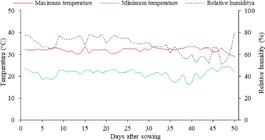
Maximum and minimum air temperature and relative humidity of air during the experimental period (April 30 to June 18, 2019).
The experimental design was in randomized blocks, arranged in a 5 × 3 factorial scheme, where the factors were constituted by five levels of electrical conductivity of irrigation water – ECw (0.3, 1.1, 1.9, 2.7, and 3.5 dS m-1) associated with three concentrations of hydrogen peroxide – H2O2 (0, 15, and 30 μM). The combination of factors resulted in 15 different treatments, with three replicates and two plants per plot, totaling 90 plants in the experiment. The levels of water electrical conductivity were defined based on the study conducted by Andrade et al. (2019). Hydrogen peroxide concentrations were defined based on Silva et al. (2019).
Seeds of sour passion fruit from an accession traditionally cultivated in the municipality of Nova Floresta, PB, were used in this study. This accession is locally known as ‘Guinezinho’ due to the spots on the skin of its fruits, which resemble the feathers of a bird called helmeted guineafowl (MEDEIROS et al., 2016). The seeds were extracted from fruits of a commercial orchard, whose plants were selected based on vigor and phytosanitary conditions, following mass selection criteria in the municipality of Nova Floresta, PB.
Sour passion fruit seedlings were produced in polyethylene bags with dimensions of 15 × 30 cm, filled with a mixture in the proportion of 2:1:1 (on a volume basis) of Neossolo Regolítico (Entisol - Psamment) of sandy loam texture, collected in the rural area of São Domingos, PB, from the 0-20 cm depth, sand and organic matter (well-aged cattle manure). These bags were distributed equidistantly, and arranged on benches at 0.80 m height from the ground. Physical and chemical characteristics of the soil were determined according to the methodology described by Teixeira et al. (2017) and are presented in Table 1.
Chemical and physical characteristics of the soil used in the experiment, before application of the treatments.
Fertilization was carried out through top-dressing, according to the fertilization recommendation for pot experiments described by Novais, Neves and Barros (1991), applying 100 and 300 mg kg-1 of soil of nitrogen and phosphorus (P2O5), respectively, in the form of urea and monoammonium phosphate (MAP), via irrigation water, at 15 and 30 days after sowing (DAS). Potassium fertilization was split into 2 applications (25 and 32 DAS) via fertigation, totaling 150 mg K2O kg-1 of soil, using potassium chloride. To meet the micronutrient requirement, foliar sprays were performed with a solution containing 1.5 g L-1 of Ubyfol® [(N (15%); P2O5 (15%); K2O (15%); Ca (1%); Mg (1.4%); S (2.7%); Zn (0.5%); B (0.05%); Fe (0.5%); Mn (0.05%); Cu (0.5%); Mo (0.02%)] at 10-day intervals, starting at 15 DAS.
The irrigation waters with the different salinity levels were obtained by the addition of sodium (NaCl), calcium (CaCl2.2H2O), and magnesium chloride (MgCl2.6H2O) salts in the equivalent proportion of 7:2:1, according to the pre-established treatments, taking as a basis the water from the municipal supply system, and their quantities were determined considering the relationship between ECw and salt concentration (RICHARDS, 1954), according to Equation 1:
where:
C = Concentration of salts to be added (mmolc L-1); and ECw = Desired electrical conductivity of water (dS m-1).
After dissolving the salts in the water, at each irrigation event, the different levels of electrical conductivity were checked and calibrated with the aid of a benchtop conductivity meter.
Prior to sowing, the volume of water needed for the soil to reach its field capacity was determined. After the soil was brought to field capacity, sowing was carried out by placing two passion fruit seeds per bag, two centimeters deep and distributed equidistantly. At 10 DAS, thinning was performed in order to keep only one plant per bag.
After sowing, irrigation was carried out daily at 5 p.m., applying the volume corresponding to that obtained by the water balance in each bag using Equation 2 (LIMA et al, 2021a):
where:
VI = Volume of water to be used in the irrigation event (mL);
Va = volume applied in the previous irrigation event (mL);
Vd = Volume of water drained (mL); and
LF = Leaching fraction of 0.15.
Solutions with desired concentrations of H2O2 were prepared by dilution in distilled water; soon after preparation, they were stored in a container kept in a dark environment. H2O2 applications were carried out every two weeks manually at 5:00 p.m., spraying the abaxial and adaxial sides of the leaves, so as to fully wet them, using a spray bottle. To prevent H2O2 from dispersing between the different treatments, the plant under application was isolated with a plastic structure during the foliar sprays. During the experimental period, an average volume of 51.63 mL of H2O2 per plant was used in each application.
Plant height (PH), stem diameter (SD), and leaf area (LA) were measured at 30 and 50 DAS. PH was obtained by taking as reference the distance from the plant collar to the insertion of the apical meristem. SD was measured 5 cm above the plant collar, with a digital caliper. LA was obtained by measuring the length and width of all leaves according to the methodology described by Cavalcante et al. (2002), using Equation 3:
where:
LA - Leaf area (cm2); and
x - Product of length by width (cm2).
PH and SD data were then used to calculate the absolute and relative growth rates in stem diameter (AGRSD, RGRSD) and plant height (AGRPH, RGRPH). AGRPH, RGRPH, AGRSD and RGRSD in the period from 30 to 50 DAS were obtained according to Benincasa (2003), using Equations 4 and 5:
where:
AGR = absolute growth rate;
A2 = growth trait at time t2;
A1 = growth trait at time t1; and
t2 – t1 = time difference between evaluations.
where:
RGR = relative growth rate;
A2 = growth trait at time t2;
A1 = growth trait at time t1;
t2 – t1 = time difference between evaluations; and
ln = natural logarithm.
At 50 DAS, gas exchange evaluations were carried out in the plants, measuring the internal CO2 concentration (Ci, in μmol CO2 m-2 s-1), stomatal conductance (gs, in mol H2O m-2 s-1), transpiration (E, in mmol H2O m-2 s-1) and CO2 assimilation rate (A, in μmol CO2 m-2 s-1) using an infrared gas analyzer - IRGA (InfraRed Gas Analyser, model LCpro – SD, from ADC BioScientific, UK), under photosynthetic photon flux density of 1,200 μmol m-2 s-1 and air flow of 200 mL min-1. Readings were carried out between 07:00 and 10:00 a.m., using the third fully expanded leaf counted from the apical bud.
In order to determine electrolyte leakage (%EL), 8 leaf discs of 113 mm² were collected from the third leaf of the stem apex, washed with distilled water to remove additional electrolytes from the leaves and placed in beakers with 50 mL of bidistilled water, which were hermetically sealed with aluminum foil. The beakers were kept at a temperature of 25 ºC for 90 minutes, and the initial electrical conductivity (Ci) was determined; subsequently, the beakers were taken to an oven with forced air ventilation and subjected to a temperature of 80 ºC for 90 minutes, when the final electrical conductivity (Cf) was measured. Thus, the percentage of damage to the cell membrane was obtained according to Scotti-Campos et al. (2013), using Equation 6:
where:
%EL = electrolyte leakage (%);
Ci = initial electrical conductivity (dS m-1); and
Cf = final electrical conductivity (dS m-1).
At 50 DAS, the plants were cut close to the soil surface and separated into leaves, stem, and roots to determine the dry mass accumulation. Subsequently, each part (leaves, stem, and roots) was packed in paper bags and dried in an oven with forced air ventilation, at a temperature of 65 °C, until reaching a constant weight; then, the material was weighed on a digital analytical scale to obtain dry mass of leaves (LDM), stem (SDM), and root (RDM).
The collected data were subjected to analysis of variance by the F test; when significant, linear and quadratic polynomial regression analysis was performed for the ECw levels and Tukey test for the H2O2 concentrations at 0.05 and 0.01 probability levels, using the statistical software SISVAR 5.6 (FERREIRA, 2019).
RESULTS AND DISCUSSION
There was a significant effect of salinity levels on electrolyte leakage in the leaf blade (%EL), transpiration (E), plant height (PH), stem diameter (SD), and leaf area (LA) of sour passion fruit seedlings (Table 2). H2O2 concentrations significantly influenced stomatal conductance (gs) and plant height (PH). On the other hand, the interaction between the factors (SL × H2O2) had a significant effect on the gs, E, A, PH, and LA of sour passion fruit seedlings at 50 DAS.
Summary of the analysis of variance for electrolyte leakage (%EL), stomatal conductance (gs), transpiration (E), CO2 assimilation rate (A), plant height (PH), stem diameter (SD), and leaf area (LA) of ‘Guinezinho’ sour passion fruit seedlings under irrigation with saline waters and foliar applications of hydrogen peroxide, at 50 days after sowing.
The salinity of irrigation water increased electrolyte leakage in the leaf blade of sour passion fruit plants (Figure 2A), by 7.69% per unit increment in ECw. An increase of 24.05% was observed in %EL when comparing plants subjected to ECw of 3.5 dS m-1 to those that received water of 0.3 dS m-1. Such increase in electrolyte leakage in the leaf blade may be related to greater membrane fluidity due to injuries caused by salt stress and may be indicative of K+ efflux, which is abundant in plant cells, inducing lipid peroxidation caused by reactive oxygen species (HNILICKOVÁ et al., 2019). Lima et al. (2021a), in a study on the effects of irrigation with water of different ECw levels (0.3 to 3.5 dS m-1) on sour passion fruit cv. BRS GA1, also observed that the increase in ECw levels from 0.3 dS m-1 caused an increase in the %EL of the seedlings, reaching a maximum value of 26.02% under ECw of 3.5 dS m-1, at 60 DAS.

Electrolyte leakage - %EL (A) of sour passion fruit seedlings as a function of the levels of electrical conductivity of water - ECw and stomatal conductance - gs (B), transpiration - E (C) and CO2 assimilation rate - A (D), as a function of the interaction between ECw levels and concentrations of hydrogen peroxide - H2O2, at 50 days after sowing.
The gs of the sour passion fruit seedlings was significantly affected by the interaction between the factors (SL × H2O2) and, according to the regression equations (Figure 2B), foliar application of H2O2 at concentrations of 0, 15, and 30 μM promoted the maximum values of 0.215, 0.198 and 0.171 mol H2O2 m-2 s-1 under water salinity of 1.5, 0.3, and 3.5 dS m-1, respectively. When comparing the gs of plants grown under ECw of 3.5 dS m-1 to that of plants that received 0.3 dS m-1, reductions of 0.048 and 0.024 mol H2O2 m-2 s-1 were observed under foliar application of 0 and 15 μM of H2O2. On the other hand, under the application of 30 μM of H2O2, there was an increase of 0.052 mol H2O2 m-2 s-1 in gs between plants cultivated under ECw levels of 0.3 and 3.5 dS m-1. Plants grown under salt stress close their stomata as a strategy to increase stomatal resistance to the flow of water vapor from the leaves to the atmosphere, in order to maintain the water potential in the leaves and prevent dehydration (LIMA et al., 2020).
The high levels of salts cause deleterious effects on stomatal opening, due to increased resistance to CO2 diffusion resulting from reduced stomatal opening, or limitations due to inhibition of metabolism in biochemical reactions (RAMOS et al., 2021). Lima et al. (2020), when evaluating the effects of salt stress on sour passion fruit seedlings, found that water salinity above 0.3 dS m-1 negatively interferes with stomatal conductance at 40 DAS.
For leaf transpiration (Figure 2C), the data obtained for plants subjected to H2O2 concentrations of 0 and 30 μM were not satisfactorily described by the regression models tested, showing mean values of 2.26 and 2.35 mmol H2O m-2 s-1, respectively. On the other hand, plants subjected to foliar application of 15 μM of H2O2 reached the maximum estimated value of 2.65 mmol H2O m-2 s-1 under ECw of 1.7 dS m-1. This result may be related to the efficiency of the product in the acclimatization of plants to salt stress. It is also worth pointing out that H2O2 works as a signaling molecule in plants under conditions of biotic and abiotic stresses (MARZO et al., 2018).
For the CO2 assimilation rate (A) of sour passion fruit plants (Figure 2D), foliar application of 0, 15, and 30 μM promoted the maximum estimated values of 12.03, 11.85, and 10.38 μmol CO2 m-2 s-1, under irrigation with ECw of 0.3, 0.3, and 2.7 dS m-1, respectively. On the other hand, the minimum estimated values (8.47, 9.62, and 7.73 μmol CO2 m-2 s-1) were reached in plants irrigated using water with electrical conductivity of 2.6, 3.0 and 0.3 dS m-1, respectively. Partial closure of the stomata is a strategy adopted by plants to reduce water losses through transpiration, resulting in a lower photosynthetic rate, which is one of the causes for the reduced growth of species under conditions of salt stress (PINHEIRO et al., 2022). Gondim et al. (2011) state that the induction of plants by foliar application of H2O2 is the result of the accumulation of soluble proteins, soluble carbohydrates, and NO3-, as well as their role in reducing the levels of Na+ and Cl- in cells.
Plant height (PH) of sour passion fruit decreased linearly with the increase in the levels of electrical conductivity of water and foliar application of 0, 15, and 30 μM (Figure 3A), with decreases of 15.76, 16.40, and 12.79% per unit increase in ECw. When comparing the PH of plants grown under ECw of 3.5 dS m-1 to that of plants that received 0.3 dS m-1, reductions of 52.94, 55.21 and 42.57%, respectively, were observed under foliar application of 0, 15 and 30 μM of H2O2. However, when the H2O2 concentration of 30 μM was applied, there was a reduction in the deleterious effect of salt stress on the growth in plant height, possibly due to the reduction in Na+ and Cl- contents and accumulation of proteins and soluble carbohydrates, in addition to NO3-(GONDIM et al., 2011).

Plant height – PH (A), leaf area – LA (B) of sour passion fruit seedlings, as a function of the interaction between the levels of electrical conductivity of water – ECw and concentrations of hydrogen peroxide – H2O2 and stem diameter – SA (C) as a function of the ECw levels, at 50 days after sowing.
Silva et al. (2019), in a study with ‘Guinezinho’ sour passion fruit under irrigation with saline water (ECw ranging from 0.7 to 2.8 dS m-1), found that the increase in ECw levels from 0.7 dS m-1 reduced the growth in plant height at 45 DAS. On the other hand, in the same study, the authors found that foliar application of H2O2 at a concentration higher than 75 μM markedly reduced the growth in PH of sour passion fruit plants at 60 DAS.
The leaf area (LA) of sour passion fruit plants also decreased linearly with the increase in ECw levels (Figure 3B), whose reductions of 8.14, 8.21, and 9.47% per unit increase in the electrical conductivity of the water at H2O2 concentrations of 0, 15 and 30 μM, respectively. In relative terms, it can be seen that irrigation with water of 3.5 dS m-1 reduced leaf area by 26.70, 26.96, and 31.19% compared to plants cultivated under ECw of 0.3 dS m-1. The inhibition of growth in leaf area of sour passion fruit plants stands out as a tolerance mechanism for reducing water losses to the atmosphere (PINHEIRO et al., 2022). Excess of salts in water and/or soil, regardless of the nature of the cations, hinders the entry of water into plant cells due to the decrease in osmotic potential and causes changes in photosynthetic capacity, consequently leading to inhibition of plant growth (LIMA et al., 2021b).
Lima et al. (2021c), when evaluating the growth of passion fruit cultivars under irrigation with water of different salinity levels (ECw: 0.3, 1.1, 1.9, 2.7, and 3.5 dS m-1), found that ECw from 0.3 dS m-1 markedly reduced growth in leaf area, with decreases of 16.04% per unit increase in ECw, regardless of the cultivar studied, at 75 DAS.
The increase in water salinity linearly reduced the growth in stem diameter of sour passion fruit seedlings (Figure 3C), by 4.03% per unit increment in ECw. When comparing plants subjected to water salinity of 3.5 dS m-1 to those cultivated under ECw of 0.3 dS m-1, a decrease of 13.06% (0.52 mm) was observed in SD. The inhibition of growth in stem diameter is directly related to changes in the water potential of the soil caused by excess salts, which restricts water absorption, reducing the turgor pressure, and cellular activity of plants, by inhibiting cell expansion and elongation (XAVIER et al., 2022).
There was a significant effect of salinity levels (SL) on the absolute (AGRPH) and relative (RGRPH) growth rates in plant height, relative (RGRSD) growth rates in stem diameter and stem dry mass (SDM) of sour passion fruit plants (Table 3). Hydrogen peroxide (H2O2) concentrations also significantly influenced the absolute and relative growth rates in plant height (AGRPH, RGRPH), absolute growth rate in stem diameter (AGRSD), stem dry mass (SDM), and root dry mass (RDM). There was a significant effect of the interaction between the factors (SL × H2O2) on the variables AGRPH, RGRPH, AGRSD, LDM, and SDM of sour passion fruit plants (Table 3).
Summary of the analysis of variance for absolute and relative growth rates in plant height (AGRPH, RGRPH), absolute and relative growth rates in stem diameter (AGRSD, RGRSD), in the period of 30-50 days after sowing and dry mass of leaves (LDM), stem (SDM), and root (RDM) of sour passion fruit seedlings under irrigation with saline water and foliar application of hydrogen peroxide, at 50 days after sowing.
The absolute growth rate in plant height (AGRPH) of sour passion fruit was also reduced by irrigation water salinity (Figure 4A), with maximum estimated values of 3.341, 2.588, and 3.438 cm day-1 obtained under foliar application of 0, 15, and 30 μM of H2O2 and ECw of 0.3 dS m-1. When comparing the AGRPH of plants grown under ECw of 3.5 dS m-1 to that of plants subjected to the lowest water salinity level (0.3 dS m-1), reductions of 2.60, 1.81 and 0.78 cm day-1 were observed, respectively, under foliar application of 0, 15 and 30 μM of H2O2. The relative growth rate in plant height of sour passion fruit (Figure 4B) was inhibited by the increase in ECw levels, with reduction of 8.53% per unit increase in ECw, in plants that received the H2O2 concentration of 0 μM. On the other hand, the data were described by the quadratic model (Figure 4B), with the estimated maximum values of 4.015 and 4.280 cm cm-1 day-1 obtained for foliar application of 15 and 30 μM under ECw of 0.7 and 0.3 dS m-1.

Absolute growth rate in plant height - AGRPH (A) and relative growth rate in plant height - RGRPH (B) of ‘Guinezinho’ sour passion fruit seedlings, as a function of the interaction between the levels of electrical conductivity of water - ECw and concentrations of hydrogen peroxide - H2O2, in the period of 30-50 days after sowing.
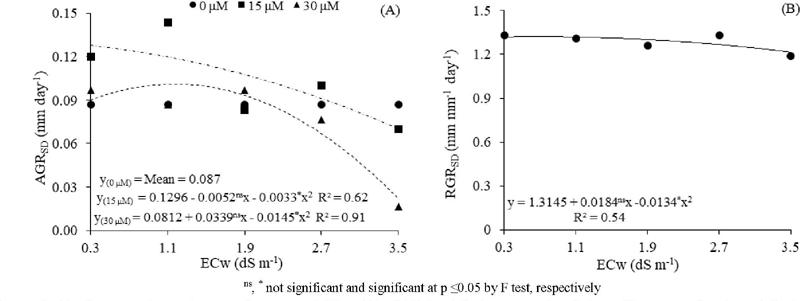
For the absolute growth rate in stem diameter - AGRSD (Figure 5A), the data of plants subjected to 0 μM concentration of H2O2 were not satisfactorily described by the regression models tested, showing a mean value of 0.087 mm day-1. On the other hand, the data were described by the quadratic model for plants grown under 15 and 30 μM of H2O2 (Figure 5A), with maximum estimated values of 0.1277 and 0.100 mm day-1, respectively, in plants irrigated with ECw of 0.3 and 1.2 dS m-1. When comparing the AGRSD of plants grown under ECw of 3.5 dS m-1 to that of plants subjected to water salinity of 0.3 dS m-1, reductions of 0.0567 and 0.067 mm day-1 were observed. The increase in soil and/ or water salinity reduces the availability of water for plants due to osmotic and ionic effects, requiring greater expenditure of metabolic energy in order to maximize water and nutrient absorption; however, there is inhibition of vegetative growth (ANDRADE et al., 2019), a situation that may have occurred with the sour passion fruit seedlings in the present study.

Absolute growth rate in stem diameter – AGRSD (A) of ‘Guinezinho’ sour passion fruit seedlings, as a function of the interaction between the levels of electrical conductivity of water – ECw and concentrations of hydrogen peroxide – H2O2 and relative growth rate in stem diameter – RGRSD (B), as a function of ECw levels, in the period of 30-50 days after sowing.
The relative growth rate in stem diameter (RGRSD) was inhibited by the increase in the levels of electrical conductivity of the water (Figure 5B). The maximum estimated value (1.3208 mm mm-1 day-1) was reached in plants cultivated under ECw of 0.7 dS m-1. From this salinity level of the water, there was a reduction in the RGRSD of the sour passion fruit seedlings, with an estimated minimum value of 1.214 mm mm-1 day-1 obtained under ECw of 3.5 dS m-1. The reduction in plant growth caused by salinity is a consequence of the excess of salts, which interferes in the process of water and nutrient absorption and consequently in cell division and expansion, reducing the cell turgor pressure and plant growth (LIMA et al., 2020). Andrade et al. (2019), in a study with ‘Guinezinho’ sour passion fruit under irrigation with saline water (ECw: 0.7 to 2.8 dS m-1), also observed that the increase in water salinity from 0.7 dS m-1 inhibited the relative growth rate in stem diameter in the period of 8-105 days after transplanting.
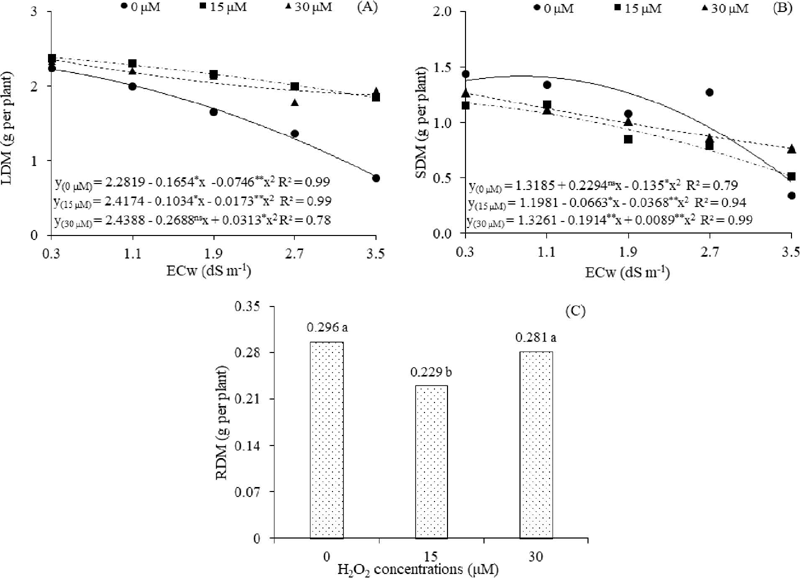
The leaf dry mass (LDM) of the sour passion fruit seedlings was negatively affected by the increase in the levels of electrical conductivity of the water and, according to the regression equations (Figure 6A), the maximum estimated values of (2.22, 2.38, and 2.36 g per plant were obtained in plants irrigated with ECw of 0.3 dS m-1 and under foliar application of 0, 15 and 30 μM of H2O2, respectively. When comparing the LDM accumulation of plants grown under ECw of 3.5 dS m-1 to that of plants irrigated with water of 0.3 dS m-1, reductions of 1.43, 0.54 and 0.48 g per plant were observed, respectively, at H2O2 concentrations of 0, 15 and 30 μM. The reduction in the accumulation of dry mass of leaves in sour passion fruit plants is also related to the osmotic effect caused by the high concentrations of salts in the root zone, leading to changes in ionic and osmotic homeostasis, thus causing a reduction in growth and consequently in biomass accumulation (LIMA et al., 2021b).
Leaf dry mass – LDM (A), and stem dry mass – SDM (B) of sour passion fruit seedlings, as a function of the interaction between the levels of electrical conductivity of water – ECw and concentrations of hydrogen peroxide – H2O2 and root dry mass – RDM (C), as a function of H2O2 concentrations, at 50 days after sowing.
Regarding stem dry mass - SDM (Figure 6B), foliar application of hydrogen peroxide at concentrations of 0, 15 and 30 μM promoted maximum values of 1.41, 1.17 and 1.26 g per plant under irrigation using water with electrical conductivity of 0.9, 0.3 and 0.3 dS m-1, respectively. On the other hand, the lowest SDM values of the sour passion fruit seedlings (0.46, 0.51 and 0.76 g per plant) were obtained under ECw of 3.5 dS m-1, at H2O2 concentrations of 0, 15 and 30 μM. From the accumulation of SDM (Figure 6B) it can be inferred that the mitigating effect of H2O2 during the formation of sour passion fruit seedlings depends on its concentration and on the electrical conductivity level of the irrigation water. Andrade et al. (2022), in a study with the ‘Guinezinho’ accession of sour passion fruit irrigated with waters of different ECw levels (0.7 to 2.8 dS m-1), observed that water salinity from 0.7 dS m-1 inhibited the formation of SDM, with reduction of 32.87% between plants cultivated under ECw levels of 0.7 and 2.8 dS m-1, at 205 days after transplantation.
As for RDM (Figure 6C), there were no significant differences between plants subjected to H2O2 concentrations of 0 and 30 μM. However, when comparing plants that received 0 and 30 μM of H2O2, RDM values were higher than those observed in plants under foliar application of 15 μM of H2O2. This increase in RDM accumulation may be related to th e increase in the synthesis of proteins, soluble carbohydrates, and NO3-, which promotes greater absorption of water and nutrients, and to the reduction of levels of toxic ions (Na+ and Cl-), which occurs due to the preponderant action of H2O2 in stress signaling pathways (LIU et al., 2020).
CONCLUSIONS
Water salinity from 0.3 dS m-1 increases electrolyte leakage in the leaf blade and reduces the growth in stem diameter of sour passion fruit seedlings. Foliar application of 15 μM hydrogen peroxide is able to mitigate the negative effects of salt stress on stomatal conductance, plant height, and leaf area of sour passion fruit. Hydrogen peroxide at concentrations of up to 30 μM increases the absolute and relative growth rates in plant height of sour passion fruit plants. There is an increase in the accumulation of leaf dry mass of sour passion fruit seedlings with the application of 15 and 30 μM of hydrogen peroxide, as well as in root dry mass under application of 30 μM.
REFERENCES
- ALHARBY, H. F.; COLMER, T. D.; BARRETT-LENNARD, E. G. Salinization of the soil solution decreases the further accumulation of salt in the root zone of the halophyte Atriplex nummularia Lindl. growing above shallow saline groundwater. Plant Cell Environ, 41: 99-110, 2018.
- ALVARES, C. A. et al. Koppen’s climate classification map for Brazil. Meteorologische Zeitschrift, 22: 711-728, 2013.
- ANDRADE, E. M. G. et al. Gas exchanges and growth of passion fruit under saline water irrigation and H2O2 application. Revista Brasileira de Engenharia Agrícola e Ambiental, 23: 945-951, 2019.
- ANDRADE, E. M. G. et al. Hydrogen peroxide as attenuator of salt stress effects on the physiology and biomass of yellow passion fruit. Revista Brasileira de Engenharia Agrícola e Ambiental, 28: 571-578, 2022.
- BENINCASA, M. M. P. Análise de crescimento de plantas, noções básicas 2. ed. Jaboticabal, SP: FUNEP, 2003. 41 p.
- CARVALHO, F. E. L. et al. Aclimatação ao estresse salino em plantas de arroz induzida pelo pré-tratamento com H2O2 Revista Brasileira de Engenharia Agrícola e Ambiental, 15: 416-423, 2011.
- CAVALCANTE, L. F. et al. Resposta do maracujazeiro-amarelo (Passiflora edulis f. flavicarpa Deg.) ao manejo e salinidade da água de irrigação. Agropecuária Técnica, 23: 27-33, 2002.
- CHOURASIA, K. N. et al. Salinity stress in potato: understanding physiological, biochemical and molecular responses. Life (Basel), 11: e545, 2021.
- FALEIRO, F. G. et al. Advances in passion fruit (Passiflora spp) propagation. Revista Brasileira de Fruticultura, 41: e-155, 2019.
- FERREIRA, D. F. Sisvar: A computer analysis system to fixed effects split-plot type designs. Revista Brasileira de Biometria, 37: 529-535, 2019.
- GONDIM, F. A. et al. Efeitos do H2O2 no crescimento e acúmulo de solutos em plantas de milho sob estresse salino. Revista Ciência Agronômica, 42: 373-381, 2011.
- HNILICKOVÁ, H. et al. Effect of salt stress on growth, electrolyte leakage, Na+ and K+ content in selected plant species. Plant, Soil and Environment, 65: 90-96, 2019.
- LACERDA, C. N. et al. Morphophysiology and production of guava as a function of water salinity and salicylic acid. Revista Brasileira de Engenharia Agrícola e Ambiental, 26: 451-458, 2022.
- LIMA, G. S. et al. Cationic nature of water and hydrogen peroxide on the formation of passion fruit seedlings. Revista Caatinga, 34: 904-915, 2021b.
- LIMA, G. S. et al. Gas exchange, chloroplast pigments and growth of passion fruit cultivated with saline water and potassium fertilization. Revista Caatinga, 33: 184-194, 2020.
- LIMA, G. S. et al. Gas exchange, growth, and quality of passion fruit seedlings cultivated with saline water. Semina: Ciências Agrárias, 42: 137-154, 2021c.
- LIMA, G. S. et al. Potassium and irrigation water salinity on the formation of sour passion fruit seedlings. Revista Brasileira de Engenharia Agrícola e Ambiental, 25: 393-401, 2021a.
- LIU, L. et al. O. Hydrogen peroxide alleviates salinity-induced damage by increasing proline buildup in wheat seedlings. Plant Cell Reports, 39: 567-575, 2020.
- MARZO, N. D. et al. The role of hydrogen peroxide in redox-dependent signaling: homeostatic and pathological responses in mammalian cells. Cells, 7: e156, 2018.
- MEDEIROS, S. A. S. et al. Água salina e biofertilizante de esterco bovino na formação e qualidade de mudas de maracujazeiro amarelo. Irriga, 21: 779-795, 2016.
- NOVAIS, R. D.; NEVES, J. C. L.; BARROS, N. D. Ensaio em ambiente controlado. In: OLIVEIRA, A. J. et al. (Eds.). Métodos de pesquisa em fertilidade do solo Brasília, DF: EMBRAPA, 1991. v. 1, cap. 2, p. 89-253.
- PINHEIRO, F. W. A. et al. Gas exchange and yellow passion fruit production under irrigation strategies using brackish water and potassium. Revista Ciência Agronômica, 53: e20217816, 2022.
- RAMOS, J. G. et al. Foliar application of H2O2 as salt stress attenuator in ‘BRS Rubi do Cerrado’ sour passion fruit. Semina: Ciências Agrárias, 42: 2253-2270, 2021.
- RICHARDS, L. A. Diagnosis and improvement of saline and alkali soils 1. ed. Washington: U.S. Department of Agriculture, 1954. 160 p. (Agriculture Handbook, 60).
- SCOTTI-CAMPOS, P. et al. Physiological responses and membrane integrity in three Vigna genotypes with contrasting drought tolerance. Emirates Journal of Food and Agriculture, 25: 1002-1013, 2013.
- SILVA, A. A. R. et al. Salt stress and exogenous application of hydrogen peroxide on photosynthetic parameters of soursop. Revista Brasileira de Engenharia Agrícola e Ambiental, 23: 257-263, 2019.
- TEIXEIRA, P. C. et al. Manual de métodos de análise de solo 3. ed. Brasília, DF: Embrapa, 2017. 573 p.
- UCHOA, T. L. et al. Economic profitability of yellow passion fruit in organic cultivation under different input levels and irrigation. Comunicata Scientiae, 12: e3409, 2021.
- VELOSO, L. L. S. A. et al. Growth and gas exchange of soursop under salt stress. Revista Brasileira de Engenharia Agrícola e Ambiental, 26: 119-125, 2022
- XAVIER, A. V. O. et al. Gas exchange, growth and quality of guava seedlings under salt stress and salicylic acid. Revista Ambiente & Agua, 17: e2816, 2022.