 Chemical control of species of genus Commelina
ABSTRACT
The aim of this study was to evaluate control of the species Commelina benghalensis and Commelina diffusa using post-emergent herbicides applied alone and in mixture. Two replicated experiments (EI and EII) were conducted to evaluate two species of Commelina, with four to six leaves (EI) and six to ten leaves (EII). The experiments included 27 treatments with the following post-emergent herbicides that were applied alone or in mixture: glyphosate; 2,4-D; triclopyr; dicamba; carfentrazone; saflufenacil; flumioxazine; chlorimuron; cloransulam and diclosulam+halauxifen. Plant control and the transient fluorescence of chlorophyll-a were visually analysed 21 and 42 days after application (DAA). At 42 DAA, plants were collected to determine the shoot dry weight. The data were submitted to ANOVA (p ≤ 0.05) and compared using the Scott-Knott test. The triple mixtures were effective in controlling both species. The triple mixtures that included carfentrazone afforded faster effective control compared to mixtures containing saflufenacil and flumioxazine. Triclopyr gave faster control of both species compared to the other auxinic herbicides. Both species respond differently to auxinic herbicides, and are more difficult to control when they have between six and ten leaves.
Key words:
C. benghalensis; C. diffusa; Tolerance; Post-emergent
INTRODUCTION
Invasive plants of genus Commelina, such as the species Commelina benghalensis and Commelina diffusa, are known to be difficult to control due to their ease of propagation and tolerance to the herbicide glyphosate (Santos et al., 2004). In agricultural areas where the herbicide is used repeatedly, these plants have become predominant and remain uncontrolled.
Tolerance is the innate ability of a weed species to develop and reproduce following the application of a herbicide at the dose recommended on the label, which might be lethal to other species (Christoffoleti et al., 2016). There is no selection process that makes a given species tolerant to a herbicide; this is a natural characteristic, independent of previous herbicide use (Christoffoleti et al., 2016). In C. benghalensis, tolerance to the herbicide glyphosate occurs due to differential absorption (slower than in other species) and the ability to metabolise part of the herbicide (Monquero et al., 2004). There are, however, few studies that explain how tolerance to the herbicide glyphosate occurs in C. diffusa.
As the species are tolerant to glyphosate, control of these plants is limited to other mechanisms of action that target eudicotyledonous species. However, effective weed control is directly linked to the phenological stage of the plant, where in the early stages, control is easier (Takano et al., 2013). Desiccation is the ideal time to control these species due to the choice of mechanisms of action, and the possibility of mixing two or more herbicides, or even of sequential applications (Gazziero, 2015). Due to the difficulty of controlling C. benghalensis and C. diffusa, double and triple mixtures of herbicides are preferable, particularly because of their broader spectrum, affording effective control with less chance of regrowth.
The aim of this study was to assess control of the weeds C. benghalensis and C. diffusa using post-emergent herbicides employed in pre-planting desiccation in the soya bean, applied both alone and in mixture.
MATERIAL AND METHODS
The experiment was conducted in a greenhouse at the Federal Rural University of Rio de Janeiro. Post-emergent herbicides were used in the trials to evaluate control of the two species, C. benghalensis and C. diffusa. The herbicides were applied at two stages (4-6 leaves and 6-10 leaves) and were considered two separate experiments: EI (four to six leaves) and EII (6 to 10 leaves). The experiments were conducted in a randomised block design (RBD), with four replications, using 1-L plastic pots as the experimental unit, these were filled with a Haplic Eutrophic Planosol (Santos et al., 2018), whose characteristics are described in Table 1.
The plants of C. benghalensis came from seeds purchased from a specialised company, with a germination percentage of 70%. The plants of C. diffusa were obtained by transplanting, collecting stems from plants grown in an area that had not been treated with herbicides. The stems were cut up, and one node was transplanted per pot. Twenty-six post-emergent treatments were evaluated, plus the control with no herbicide, as shown in Table 2.
The herbicides were applied at two distinct phenological stages: the first when the plants had four to six leaves (EI), and the second when the plants had 6 to 10 leaves (EII). A pressurised CO2 backpack sprayer equipped with four XR 110.015 nozzles spaced 0.5 m apart was used to apply the treatments at a pressure of 2.8 bar and a spray volume of 100 L ha-1.
The following response variables were evaluated:
Analysis of the chlorophyll-a fluorescence transient
The chlorophyll-a fluorescence transient was measured using a portable fluorometer (HandyPEA, Hanstech, King’s Lynn, Norkfolk, UK) 42 days after application (DAA) of the treatments in both experiments (EI and EII). The kinetics of the chlorophyll-a fluorescence transient was evaluated, again using a portable fluorometer (HandyPEA, Hanstech, King’s Lynn, Norkfolk, UK). The clips used in these measurements were placed on the middle third of young, fully expanded leaves in the morning, the readings being taken 20 min after the leaves had adapted to the dark. Fluorescence emission was induced in a 4-mm diameter area of the leaf by exposing the sample to a saturating light pulse of 3,000 μmol m-2 s-1. From the transient fluorescence emission curve obtained after the pulse, the intensity determined at 50 μs (initial fluorescence - F0), 100 μs, 300 μs, 2 ms (FJ), 30 ms (FI) and MF (maximum fluorescence) was used to calculate the parameters established by the JIP test (Strasser; Strasser, 1995).
Visual analysis of plant control
A visual evaluation of plant control was carried out 21 and 42 DAA, attributing scores based on the level of plant damage, ranging from 0% to 100%, where 0% represents the lack of any symptoms and 100% represents the death of the plant (Frans; Crowley, 1986).
Shoot dry weight (SDW)
Shoot dry weight was assessed at 42 DAA. The plants were cut close to the ground, packed in paper bags and placed in a forced air circulation oven at 65 ± 5 ºC to constant weight. An analytical balance was used to determine the dry weight of the shoots.
Statistical analysis
The data from the experiments were subjected to ANOVA (p ≤ 0.05), and when statistically significant, the mean values were compared by Scott-Knott test at 5% probability (p ≤ 0.05) using the Sisvar statistical software. The graphs were generated using the SigmaPlot 12.5 statistical software.
RESULTS AND DISCUSSION
Analysis of the chlorophyll-a fluorescence transient for each species
The results of the JIP test showed changes in the photosynthetic metabolism of the plants of both species. In the plants of C. benghalensis with four to six leaves, there was an increase of over 50% in the transient, related to the apparent size of the antenna system (ABS/RC) and caused by the treatments with flumioxazine and glyphosate + chlorimuron; the increase in the treatments with glyphosate and glyphosate + chloransulam was over 80% compared to the control (Figure 1-A).

Chlorophyll-a fluorescence in plants of C. benghalensis at the four to six-leaf stage (A) and the 6 to 10-leaf stage (B - E), subjected to the herbicides glyphosate, 2.4-D, triclopyr, dicamba, diclosulam + halauxifen, carfentrazone, saflufenacil, flumioxazine, chlorimuron and chloransulam, applied alone or in mixture. Figures B-E refer to the herbicide grouping based on the auxinic herbicides under evaluation. Treatments that resulted in plant death are not shown, as they would make any analysis impossible. ABS/RC - Measurement of the apparent size of the antenna system; TR0/RC - Maximum rate of capture of one exciton by the RC, resulting in a reduction in plastoquinone (QA-); DI0/RC - Ratio of the total dissipation of uncaptured excitation energy to the total excitation energy; RE0/RC - Specific energy flux for the transport of electrons from QA- to the electron acceptors of PSI; ET0/RC - Specific energy flux for the transport of electrons per active reaction centre. PIabs - Photosynthetic performance index; PItotal - Total photosynthetic performance index. Seropédica, RJ, 2021
The ABS/RC parameter is related to the apparent increase in the antenna complex; when under the action of herbicides, plants seek to capture more photons in an attempt to normalise the imbalance triggered by the reduction in photosynthesis (Christen et al., 2007). The plants also showed an increase in ET0/RC, this parameter is related to the reoxidation of QA- via electron transport in an active reaction centre. A 40% increase was caused by the glyphosate, flumioxazine and glyphosate + chlorimuron treatments when compared to the control (Figure 1-A). TR0/RC represents the captured energy flux per reaction centre; there was an increase in TR0/RC of more than 40% for the glyphosate, glyphosate + chloransulam, glyphosate + chlorimuron and flumioxazine treatments compared to the control (Figure 1-A).
There was a reduction in PIABS and PITOTAL, with values greater than 80% seen for the glyphosate, flumioxazine, glyphosate + chlorimuron and glyphosate + chloransulam treatments compared to the control (Figure 1-A). The PIABS and PITOTAL performance indices result from the product of terms that express partial potentials for the conservation of energy from an exciton for a reduction in the electron acceptor intersystem, and a reduction in the final electron acceptors of PSI, respectively (Tsimilli-Michael; Strasser, 2008).
As with the plants of C. benghalensis with four to six leaves, plants with six to ten leaves also showed a reduction in PIABS and PITOTAL. There were reductions of more than 70% in PIABS with the glyphosate + Saflufenacil, glyphosate + carfentrazone, dicamba, diclosulam + halauxifen, glyphosate + (diclosulam+halauxifen) + Saflufenacil, glyphosate + (diclosulam+halauxifen) + flumioxazine, flumioxazine, glyphosate + flumioxazine treatments compared to the control (Figure 1 - B, C, D). While for PITOTAL, reductions of more than 90% were caused by the treatments with glyphosate + Saflufenacil, glyphosate + carfentrazone, dicamba, glyphosate + dicamba, glyphosate + (diclosulam+halauxifen) + Saflufenacil, glyphosate + (diclosulam+halauxifen) + flumioxazine and flumioxazine compared to the control (Figure 1 - B, C, D). The treatments that included glyphosate + Saflufenacil, glyphosate + carfentrazone, dicamba, glyphosate + dicamba, glyphosate + dicamba + Saflufenacil, diclosulam + halauxifen, glyphosate + (diclosulam + halauxifen) + Saflufenacil, glyphosate + (diclosulam + halauxifen) + flumioxazine, flumioxazine, glyphosate + chlorimuron and glyphosate + chloransulam resulted in an increase of more than 100% in DI0/RC, again compared to the control (Figure 1 - B, C, D, E). The reduction in the performance indices indicates a loss of photochemical efficiency by the plants (Thach et al., 2007), for which they compensate by losing energy in the form of heat; these two processes compete during the photochemical phase of photosynthesis and result in a loss of photosynthetic efficiency. The increase in DI0/RC may also be an attempt by the plants to avoid accumulating excess unused energy in the reaction centre, so as not to form reactive oxygen species (Szabó; Bergantino; Giacometti, 2005). ET0/RC was reduced by more than 40%, a result of the glyphosate + dicamba and glyphosate + chlorimuron treatments, and by more than 90% by diclosulam + halauxifen and glyphosate + flumioxazine compared to the control (Figure 1 - B, C, D, E). There was an increase in TR0/RC, with values greater than 40% in the treatments with glyphosate + Saflufenacil, glyphosate + carfentrazone, dicamba and glyphosate + chlorimuron, and an increase of 60% for flumioxazine compared to the control (Figure 1 - B, C, D, E). The reduction in PIABS, PITOTAL and ET0/RC, together with the increase in DI0/RC and TR0/RC, can be understood as a reduction in the rate of electron capture and transport at each reaction centre, plus severe damage to the photosynthetic apparatus, indicating a loss of photochemical efficiency in the plants (Thach et al., 2007). The sharp reduction in the performance indices (PIABS and PITOTAL) and the increased energy dissipation may indicate that the absorbed energy was not being used efficiently, as shown by the decrease in photosynthetic activity and the increase in energy dissipated in the form of heat (Lawlor; Tezara, 2009).
Plants of C. diffusa with four to six leaves showed similar behaviour to those of C. benghalensis at the same stage, with an increase in ET0/RC; however, glyphosate caused a more than 90% reduction compared to the control (Figure 2-A). There was an increase of more than 50% in TR0/R caused by the glyphosate + dicamba and glyphosate + dicamba + Saflufenacil mixtures compared to the control (Figure 2-A). At this stage, the plants also showed a reduction in PIABS and PITOTAL, with severe reductions of over 80% in PIABS caused by the glyphosate, glyphosate + dicamba and glyphosate + dicamba + Saflufenacil treatments (Figure 2-A), while PITOTAL showed an increase of over 90% compared to the control, except in the treatments with glyphosate + dicamba + carfentrazone and flumioxazine (Figure 2-A).

Chlorophyll-a fluorescence in plants of C. diffusa at the four to six leaf stage (A) and the 6 to 10 leaf stage (B - E), subjected to the herbicides glyphosate, 2.4-D, triclopyr, dicamba, diclosulam + halauxifen, carfentrazone, saflufenacil, flumioxazine, chlorimuron and cloransulam, applied alone or in mixture. Figures B - E refer to the herbicide groupings based on the auxinic herbicides under evaluation. Treatments that resulted in plant death are not shown, as they would make any analysis impossible. ABS/RC - Measurement of the apparent size of the antenna system; TR0/RC - Maximum rate of capture of one exciton by the RC, resulting in a reduction in plastoquinone (QA-); DI0/RC - Ratio of the total dissipation of uncaptured excitation energy to the total excitation energy; RE0/RC - Specific energy flux for the transport of electrons from QA- to the electron acceptors of PSI; ET0/RC - Specific energy flux for the transport of electrons per active reaction centre. PIabs - Photosynthetic performance index; PItotal - Total photosynthetic performance index. Seropédica, RJ, 2021
Plants of the same species at a more advanced stage (6 to 10 leaves) also showed a reduction in ET0/RC of more than 20% for the glyphosate, dicamba and flumioxazine treatments compared to the control (Figure 2- B, D). There were also reductions in PIABS and PITOTAL. For PIABS, reductions greater than 50% were caused by the glyphosate, glyphosate + saflufenacil, glyphosate + carfentrazone, glyphosate + dicamba and glyphosate + (diclosulam + halauxifen) treatments compared to the control (Figure 2- B, C); while for PITOTAL, there were reductions of more than 50% in the glyphosate + carfentrazone, dicamba, diclosulam + halauxifen treatments, and of more than 80% in the flumioxazine treatment compared to the control (Figure 2- B, C, D). In addition, the glyphosate and glyphosate + dicamba treatments resulted in a 50% increase DI0/RC. Only the flumioxazin and diclosulam + halauxifen treatments showed an increase of more than 90% compared to the control (Figure 2- B, C, D).
The increase in ABS/RC, TR0/RC and ET0/RC can therefore be understood as the effect of the herbicides on the plants of C. diffusa during the two development stages under evaluation, reflecting in the overall performance of photosystem II. These indices indicate a possible disruption of the plant chloroplasts, since the higher absorption (ABS/RC) and capture fluxes (TR0/RC), and the electron transport flow (ET0/RC) show that at the start of the electron transport chain, they are poorly utilised in the water photolysis process, so that by 42 DAA, the plants of C. diffusa showed no metabolic recovery, which was reflected in the reduction in PIABS and PITOTAL. Furthermore, the plants showed an abnormal electron transport flow, with an increase in heat dissipation.
Visual analysis of plant control in each species
For C. benghalensis at 21 DAA, control was less than 100% in the glyphosate, dicamba, flumioxazine, diclosulam+halauxifen, glyphosate+chlorimuron and glyphosate+chloransulam treatments (Figure 3-A).

Percentage control in plants of C. benghalensis and C. diffusa at the four to six-leaf stage, at 21 DAA (A and C) and 42 DAA (B and D). Similar letters do not differ statistically by Scott-Knott test at 5% probability. Seropédica, RJ, 2021
For C. diffusa, the treatments with glyphosate, glyphosate + saflufenacil, dicamba, glyphosate + dicamba, glyphosate + dicamba + saflufenacil, glyphosate + dicamba + carfentrazone, and glyphosate + chlorimuron resulted in unsatisfactory control, which was below 80% at 21 DAA (Figure 3-C).
The herbicide dicamba resulted in the least control of C. diffusa of all the treatments under evaluation; the triple mixtures of dicamba with glyphosate and PPO-inhibiting herbicides also gave poor control, unlike in C. benghalensis, where mixtures containing the herbicide dicamba were effective in controlling the plants (Figure 3-A). It was found that when applied alone, the herbicides 2.4-D, triclopyr and diclosulam+halauxifen show satisfactory control of both species; however, when mixed with glyphosate, the control is increased (Figure 3- A, C). Mixing with glyphosate is therefore better than applying the auxin herbicides alone. This is due to the broader control spectrum of the mixture, which can prevent regrowth. Similar results were seen in a study where glyphosate was mixed with 2.4-D, which was decisive in accelerating and improving the control of difficult-to-control weeds, such as C. benghalensis, Richardia brasiliensis, Euphorbia heterophylla, Spermacoce latifolia, Ipomoea granfiolia and Conyza spp. (Takano et al., 2013). With regard to the PPO herbicides in the mixture, for the two species under evaluation, the double or triple mixtures containing carfentrazone gave effective and faster control when mixed with saflufenacil or flumioxazin. Similar results were noted by Agostineto et al. (2016), who evaluated the control of a mixture of glyphosate + carfentrazone (2L ha-1 + 50 g ha-1) on I. heredifolia, a weed that is also tolerant to glyphosate, and found effective and rapid control in plants with from six to eight leaves. Furthermore, a mixture of glyphosate and PPO-inhibiting herbicides is recommended for controlling glyphosate-tolerant weeds due to the synergistic effect of the mixture (Agostineto et al., 2016).
When evaluated at 42 DAA, the only treatments that did not afford effective control of C. benghalensis were glyphosate, dicamba, flumioxazine, glyphosate + flumioxazine, glyphosate + chlorimuron, glyphosate + chloransulam and diclosulam + halauxifen (Figure 3-A). As was the case with C. benghalensis, flumioxazin did not provide effective control of C. diffusa (Figure 3-C).
The poor control afforded by flumioxazin may be related to the action of the herbicide on the plant. Flumioxazin is a contact herbicide and not translocatable (Rodrigues; Almeida, 2018), which could potentially affect any control and allow the plants to regrow. In the case of C. benghalensis, flumioxazin, dicamba and diclosulam + halauxifen afforded effective control when mixed with glyphosate and the PPO inhibitors (Figure 3-A).
The treatments that included glyphosate, glyphosate + saflufenacil, dicamba and its respective mixtures, flumioxazine, glyphosate + flumioxazine and glyphosate + flumioxazine + saflufenacil (Figure 3-C) showed unsatisfactory control of C. diffusa at 42 DAA, whereas the remaining treatments gave 100% control. Like C. benghalensis, C. diffusa responded differently to the auxinic herbicides, with poorer control for the herbicide dicamba, which failed to provide effective control of the species, while the other auxinic herbicides (2,4-D, triclopyr and diclosulam + halauxifen) caused plant death.
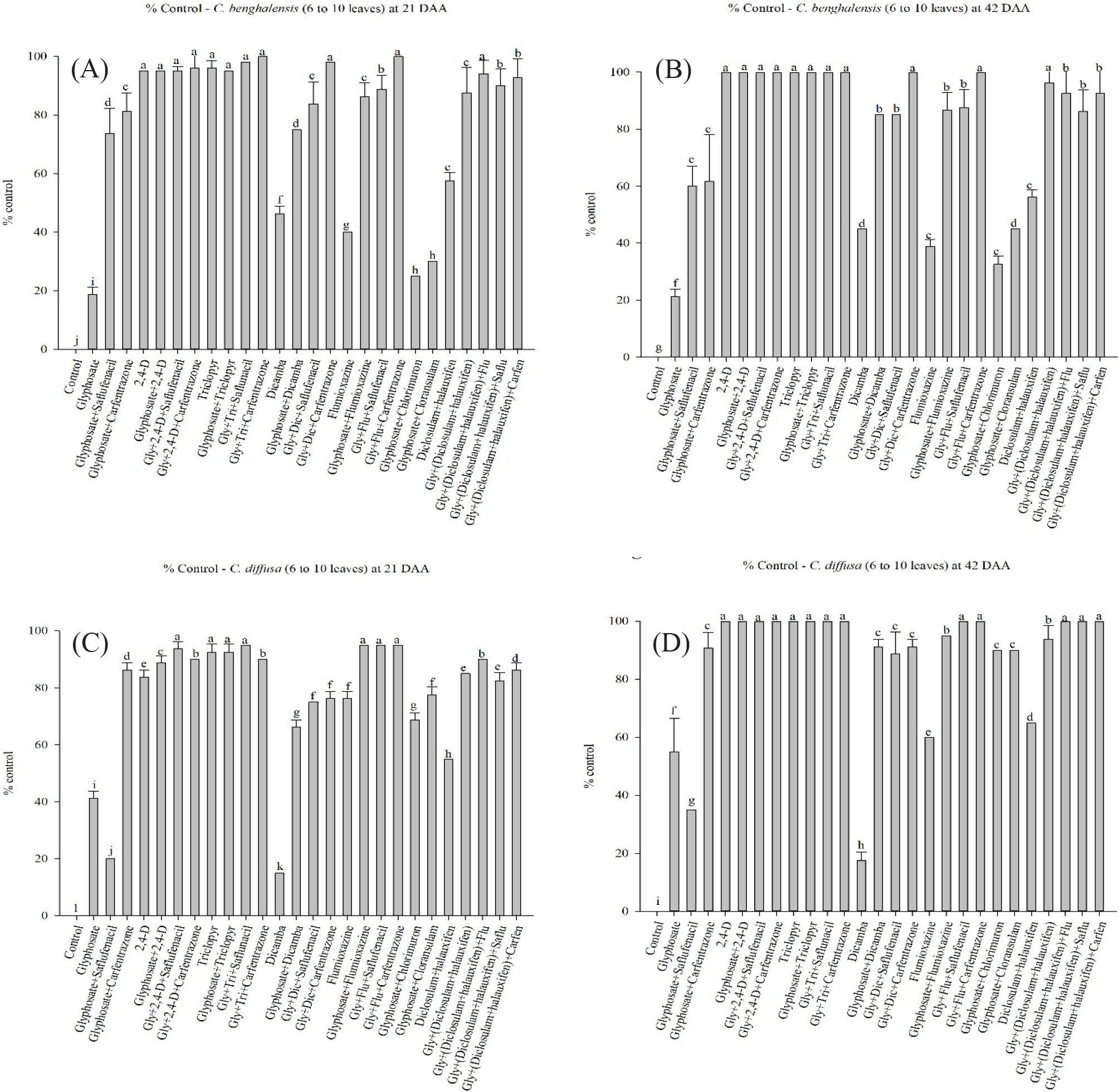
In the trial with C. benghalensis plants with six to ten leaves at 21DAA, the glyphosate, dicamba, flumioxazin, glyphosate + chlorimuron, glyphosate + chloransulam and diclosulam + halauxifen treatments showed the poorest control compared to the other treatments (Figure 4-A).

Percentage control in plants of C. benghalensis and C. diffusa with six to ten leaves, at 21 DAA (A and C) and 42 DAA (B and D). Similar letters do not differ statistically by Scott-Knott test at 5% probability. Seropédica, RJ, 2021
More than 80% control was obtained with 2.4-D, glyphosate + 2.4-D, glyphosate + 2.4-D + carfentrazone, triclopyr and its respective mixtures, glyphosate + dicamba + carfentrazone, glyphosate + flumioxazin, glyphosate + flumioxazin + saflufenacil, glyphosate + (diclosulam +halauxifen), glyphosate + (diclosulam+halauxifen) + saflufenacil, glyphosate + (diclosulam +halauxifen) + flumioxazin and glyphosate + (diclosulam+halauxifen) + carfentrazone (Figure 4-A).
Only the glyphosate + flumioxazin + carfentrazone treatment caused plant death in C. benghalensis at 21 DAA. As seen in the experiment on plants with four to six leaves, the triple mixtures controlled the plants of C. benghalensis faster than the double mixtures. Although the mechanism of action is the same, triclopyr afforded greater control more quickly compared to the 2.4-D, dicamba and diclosulam + halauxifen herbicides. Similar results were found by Walker et al. (2012), who noted that auxinic herbicides were the main choice for post-emergent control of glyphosate-resistant dicotyledonous weeds.
None of the treatments under evaluation caused plant death in C. diffusa at 21 DAA. However, control was greater than 80% in the following treatments: 2.4-D and triclopyr and their respective mixtures, glyphosate + flumioxazine, glyphosate + flumioxazine + saflufenacil, glyphosate + flumioxazine + carfentrazone, glyphosate + (diclosulam + halauxifen), glyphosate + (diclosulam + halauxifen) + flumioxazine, glyphosate + (diclosulam + halauxifen) + saflufenacil and glyphosate + (diclosulam + halauxifen) + carfentrazone (Figure 4-C). The treatment with dicamba showed the poorest control among the auxinic herbicides under evaluation, particularly of plants of C. diffusa with four to six leaves.
For C. benghalensis at 42 DAA, the treatments with 2.4-D and triclopyr and their respective mixtures, glyphosate + dicamba + carfentrazone and glyphosate + flumioxazine + carfentrazone afforded 100% control (Figure 4-B). The following treatments afforded the lowest percentage control: glyphosate, glyphosate + saflufenacil, glyphosate + carfentrazone, dicamba, flumioxazine, glyphosate + chlorimuron, glyphosate + chloransulam and (diclosulam + halauxifen). Of the auxinic herbicides evaluated in this study, dicamba, whether alone or mixed with glyphosate, did not cause any plant death (Figure 4-B).
Similar results were found by Osipe et al. (2017), who evaluated dicamba alone and mixed with glyphosate and found no increase in the control of the mixture compared to glyphosate + 2.4-D; albeit, when applied alone, dicamba afforded limited control. It was found that a mixture of glyphosate + saflufenacil and glyphosate + carfentrazone did not afford effective control of plants of C. benghalensis with six to ten leaves, unlike in the trial with a smaller number of leaves. This means that at a later stage of development, plants are generally more tolerant to treatments with post-emergent herbicides (Martins; Christoffoleti, 2014). However, for the triple mixture of glyphosate, auxinic herbicides and PPO inhibitors, control was effective. As such, for plants of C. benghalensis and C. diffusa with a greater number of leaves, it is necessary to add a third herbicide to ensure effective control.
In the final control assessment for C. diffusa at 42 DAA, glyphosate, glyphosate + saflufenacil, dicamba, flumioxazine and diclosulam + halauxifen afforded the poorest control compared to the other treatments (Figure 4-D).
Plant death occurred with 2.4-D and triclopyr and their respective mixtures, glyphosate + flumioxazine + saflufenacil, glyphosate + flumioxazine + carfentrazone, glyphosate + (diclosulam + halauxifen) + saflufenacil, glyphosate + (diclosulam + halauxifen) + flumioxazine and glyphosate + (diclosulam + halauxifen) + carfentrazone (Figure 4-D). Dicamba showed the poorest control of all the herbicides under evaluation. As seen in the trial with four to six leaves, the triple mixtures were efficient in controlling C. diffusa, and are possible options for post-emergence management. Unlike in C. benghalensis with six to ten leaves, the mixture of glyphosate + carfentrazone was effective in controlling C. diffusa; however, the glyphosate + saflufenacil mixture was ineffective in both species at the later stage (Figure 4- B, D).
Shoot dry weight in both species
For C. benghalensis with four to six leaves, none of the treatments that resulted in no plant control differed significantly for SDW, as shown in Table 3.
SDW in plants of C. benghalensis and C. diffusa with four to six leaves (EI) and six to ten leaves (EII). Seropédica, RJ, 2021
The treatments that did not cause plant death in C. diffusa, namely glyphosate, glyphosate + saflufenacil, dicamba, glyphosate + dicamba + saflufenacil, glyphosate + dicamba + carfentrazone, flumioxazine, glyphosate + flumioxazine and glyphosate + flumioxazine + saflufenacil, differed statistically from the control for SDW (Table 3). The herbicide dicamba had the second highest mean value for SDW, consistent with the poor control seen for these plants. There was no significant difference between the remaining treatments that did not result in plant death.
For the plants of C. benghalensis with six to ten leaves, the treatments that did not result in plant death differed significantly from each other. The highest values for SDW were seen in the treatments with dicamba, flumioxazine, glyphosate + chlorimuron and diclosulam + halauxifen (Table 3). There was no statistical difference between the treatments with glyphosate, glyphosate + saflufenacil, glyphosate + carfentrazone, glyphosate + flumioxazine, glyphosate + flumioxazine + saflufenacil, glyphosate + (diclosulam+halauxifen) + saflufenacil and glyphosate + (diclosulam+halauxifen) + carfentrazone. The same was seen in the treatments with glyphosate + dicamba, glyphosate + dicamba + saflufenacil and glyphosate + cloransulam.
For the plants of C. diffusa with six to ten leaves, there was no statistical difference between the control and the treatments with dicamba and flumioxazine (Table 4). The treatments with glyphosate, glyphosate + saflufenacil, glyphosate + carfentrazone, glyphosate + dicamba, glyphosate + dicamba + saflufenacil, glyphosate + cloransulam and diclosulam + halauxifen were statistically equal, as were the treatments with glyphosate + dicamba + carfentrazone, glyphosate + flumioxazine and glyphosate + chlorimuron.
CONCLUSIONS
-
1. Glyphosate does not provide effective control of species C. benghalensis or C. diffusa, confirming their tolerance to the herbicide;
-
2. Triple mixtures of the herbicide glyphosate, auxin herbicides (2.4-D, triclopyr or (halauxifen+diclosulam)) and carfentrazone proved to be the most effective in controlling the two species under study;
-
3. Flumioxazine, when applied alone, does not effectively control plants of C. benghalensis or C. diffusa, however, depending on the weed community in the area, it can be a good alternative for replacing the auxins in the triple mixture;
-
4. When used alone, the herbicide dicamba does not afford effective control of either species; however when used in a triple mixture with glyphosate and PPO-inhibiting herbicides, it provides control C. diffusa only;
-
5. The mixtures of glyphosate with the ALS inhibitors (chlorimuron and cloransulam) were effective for C. diffusa in both of the phenological stages under evaluation;
-
6. Control of C. benghalensis and C. diffusa in post-emergence should be carried out on four to six leaves, as this is faster and more efficient.
-
1
This research was extracted from the master's dissertation of the lead author presented to the Postgraduate Program in Agricultural and Environmental Engineering (PGEAAmb - UFRRJ). Funded with resources from the Coordenação de Aperfeiçoamento de Pessoal de Nível Superior - Brazil (CAPES) - Funding code 001
REFERENCES
- AGOSTINETO, M. C. et al Sinergismo de misturas de glyphosate e herbicidas inibidores da PPO no controle de corda-de-viola. Revista de Ciências Agroveterinárias, v. 15, n. 1, p. 8-15, 2016.
- CHRISTEN, D. et al Characterization and early detection of grapevine (Vitis vinifera) stress responses to esca disease by in situ chlorophyll fluorescence and comparison with drought stress. Environmental and Experimental Botany, v. 60, p. 504-514, 2007.
- CHRISTOFFOLETI, P. J. et al Resistência das plantas daninhas a herbicida: termos e definições importantes. In: CHRISTOFFOLETI, P. J.; NICOLAI, M. (coord.). Aspectos de resistência de plantas daninhas a herbicidas 4. ed. Piracicaba: HRAC-BR, 2016. p. 11-31.
- FRANS, R.; CROWLEY, H. Experimental design and techniques for measuring and analyzing plant responses to weed control practices. In: SOUTHERN WEED SCIENCE SOCIETY. Research methods in weed science 3. ed. Clemson, 1986. p. 29-45.
- GAZZIERO, D. L. P. Misturas de agrotóxicos em tanque nas propriedades agrícolas do Brasil. Planta Daninha, v. 33, n. 1, p. 83-92, 2015.
- LAWLOR, D. W.; TEZARA, W. Causes of decreased photosynthetic rate and metabolic capacity in water-deficient leaf cells: a critical evaluation of mechanisms and integration of processes. Annals of Botany, v. 103, p. 561-579, 2009.
- MARTINS, B. A. B.; CHRISTOFFOLETI, P. J. Herbicide efficacy on Borreria densiflora control in preand post-emergence conditions. Planta Daninha, v. 32, n. 4, p. 817-825, 2014.
- MONQUERO, P. A. et al Absorção, translocação e metabolismo do glyphosate por plantas tolerantes e suscetíveis a este herbicida. Planta Daninha, v. 22, p. 445-451, 2004.
- OSIPE, J. B. et al Espectro de controle de plantas daninhas com os herbicidas 2,4-D e dicamba associados ou não ao glyphosate. Planta Daninha, v. 35, 2017.
- RODRIGUES, B. N.; ALMEIDA, F. S. Guia de herbicidas 7. ed. Londrina: [s. n.], 2018. 764 p.
- SANTOS, H. G. et al Sistema brasileiro de classificação de solos 5. ed. Brasília, DF: Embrapa, 2018. 356 p.
- SANTOS, L. D. et al Efeito do glyphosate sobre a morfoanatomia das folhas e do caule de Commelina diffusa e C. benghalensis Planta Daninha, v. 22, n. 1, p. 101-107, 2004.
- STRASSER, B. J.; STRASSER, R. J. Measuring fast fluorescence transients to address environmental question: the JIP test. In: MATHIS, P. (ed.). Photosynthesis: from light to biosphere. Dordrecht: Kluwer Academic Publisher, 1995. v. 5, p. 977-980.
- SZABÓ, I.; BERGANTINO, E.; GIACOMETTI, G. M. Light and oxygenic photosynthesis: energy dissipation as a protection mechanism against photo-oxidation. EMBO reports, v. 6, n. 7, p. 629-634, 2005.
- TAKANO, H. K. et al Efeito da adição do 2,4-D ao glyphosate para o controle de espécies de plantas daninhas de difícil controle. Revista Brasileira de Herbicidas, v. 11, p. 1-14, 2013.
- THACH, L. B. et al The OJIP fast fluorescence rise characterizes Graptophyllum species and their stress responses. Photosynthesis Research, v. 94, p. 423-436, 2007.
- TSIMILLI-MICHAEL, M.; STRASSER, R. J. In vivo assessment of plants vitality: applications in detecting and evaluating the impact of Mycorrhization on host plants. In: VARMA, A. (ed.). Mycorrhiza: state of the art, genetics and molecular biology, eco-function, biotechnology, eco-physiology, structure and systematics. Dordrecht: Springer, 2008. v. 3, p. 679-703.
- WALKER, S. et al Weed age affects chemical control of Conyza bonariensis in fallows. Crop Protection, v. 38, p. 15-20, 2012.
-
Editor-in-Chief:
Agricultural Engineer. Manoel Barbosa Filho - manoel.filho@ufc.br