 Water availability, water content and chemical treatment of seeds on the emergence of soybean seedlings
ABSTRACT
During the germination process, seeds are susceptible to abiotic and biotic stresses, such as attacks by pests and pathogens. In this context, chemical treatment of seeds can promote physiological and morphological changes in seeds and seedlings, in addition to protecting seeds. Two experiments were conducted with the following
objectives: (I) assess the effect of soybean seed water content on seedling emergence under different water availability conditions; (II) assess the effect of chemical treatment of soybean seeds on seedling emergence under water stress conditions. In the first experiment, seeds of four cultivars had their water content adjusted to 8, 11, and 14% and were sown in soil under four water potential levels (-0.01; -0.02; -0.10 and -0.40 MPa). In the second experiment, seeds of the same cultivars were treated using metalaxyl, fludioxonil and thiamethoxam, and untreated seeds were used as controls. Sowing was carried out in soil under four water potentials, and seed quality parameters were evaluated in both experiments. The data subjected to analysis of variance, and the means were compared using the Tukey test at 5% probability level. There is no restriction on sowing soybean seeds with water content between 8 and 14% when the soil is under full water availability. Under conditions of soil water restriction, it is recommended to use seeds with water content between 11 and 14%. Under water deficit conditions, treated soybean seeds show better membrane maintenance and superior performance in seedling emergence.
Key words:
Glycine max (L.) Merrill.; Soaking; Vigor; Water deficit.
INTRODUCTION
Recent climate change, especially with regard to rainfall regimes, reinforces concerns about the impacts on crop establishment and consequently on agriculture (De Paola et al., 2014; IPCC, 2023). In the early stages of the establishment of a crop, water deficit causes a delay in the speed of germination and emergence, and under more severe conditions it affects crop development and leads to reduced yield (Salton; Morais; Lohmann, 2021; Soares et al., 2021).
In addition to soil water availability, seed water content also influences germination. Soybean seeds, when placed in substrate with excess moisture, show rapid hydration, and may suffer damage by imbibition, whose intensity depends on the cultivar and on the initial water content. If the entry of water into the seeds is not gradual, the membranes are not able to reorganize themselves after imbibition, causing rupture and disordered release of exudates by the tissues. This process occurs mainly in seeds that have low water content when sown, resulting in a drop in physiological quality, formation of abnormal seedlings and absence of germination (Gordin; Scalon; Masetto, 2015; Silva; Villela, 2011).
During the germination process, the seeds are susceptible to abiotic and biotic stresses, such as pest and pathogen attacks. To mitigate the effects of pest and disease attacks in the soil and protect the seed during germination and seedling establishment, chemical treatment is a widespread strategy, promoting greater uniformity in seedling emergence (Lacerda et al., 2021; Sartori et al., 2020).
Seed treatment is used both for protection from pathogen attack and associated with other molecules in order to promote physiological and morphological changes in seeds and seedlings and enhance the establishment of crops (Frezato et al., 2021).
Studies on the effects of water deficit on germination have identified that water potentials lower than -0.10 MPa caused reduction in germination and seedling emergence. However, most of these studies involved stress artificially caused with osmotic regulators on a paper roll, or did not test seeds with water content below the ideal to start germination or the effect of chemical seed treatment on germination (Rocha et al., 2020; Viçosi et al., 2017).
Thus, the objectives were to: (I) assess the effect of the water content of treated soybean seeds on seedling emergence under different conditions of water availability; (II) assess the effect of chemical treatment of soybean seeds on seedling emergence under water stress conditions.
MATERIAL AND METHODS
Seed samples from four soybean cultivars (Brasmax 8579RSF IPRO, NS 7007 IPRO, Brasmax 8473RSF RR and Brasmax 74I77RSF IPRO) were collected in the 2019/2020 season and sent to the Seed Analysis Laboratory of UNESP/FCAV - Campus of Jaboticabal/SP.
Initially, the lots were characterized according to the following tests and determinations: Water content and germination test, according to methodologies described in the Rules for Seed Analysis (Brasil, 2009). After characterization, the seeds showed germination values between 92 and 98% and water content ranging from 9.7 to 10.3%.
To meet the treatments of the experiments conducted, the seeds were treated using the protocol of 10 g a.i. L-1 of metalaxyl; 25 g a.i. L-1 of fludioxonil at dose of 1 mL.kg-1 of seed and 350 g a.i. L-1 of thiamethoxam at dose of 3 mL.kg-1 of seed. The treatment was carried out manually in transparent plastic bags by shaking the samples for 2 min, considered to be sufficient time for the seeds to be homogeneously covered by the products (Machado et al., 2023). Control treatment was obtained by applying distilled water in the same amount of the chemical treatment mixture, using the same homogenization protocol previously applied.
Based on the initial water content, the calculation was performed to obtain the mass necessary for the seeds to reach water contents of 8, 11, and 14%. The seed lots that required water loss were arranged in a single thin layer and kept on metal trays (20 x 20 x 2 cm) in a forced air circulation oven at a temperature of 33 °C (Vieira et al., 2002).
For the lots that required hydration, the wet atmosphere method was adopted. In this case, the seeds were kept on aluminum screen in transparent acrylic boxes (11.0 x 11.0 x 3.5 cm) containing 40 mL of distilled water inside, at 20 °C (100% RH). In both cases, successive weighings were carried out until the seeds reached the weight equivalent to the desired water content. To confirm the efficiency of the procedure, the water content of the seeds was determined by the oven method at 105 ± 3 °C for 24 hours after adjustment (Brasil, 2009).
In the first experiment, the seeds of the four cultivars, with and without treatment, also had the initial water content adjusted to 8, 11 and 14%, composing a completely randomized experimental design in a 2 x 3 factorial scheme with four replicates.
After that, the electrical conductivity test was carried out using 10 subsamples of 50 seeds, which were weighed on a precision scale (0.0001 g) and immersed in plastic cups containing 75 mL of distilled and deionized water. After the seeds were kept in germination chambers at 25 °C for 24 hours, the electrical conductivity of the imbibition solution was measured with a conductivity meter (Digimed DM-32). The results obtained were divided by the mass of the seeds and expressed in μS cm-1 g-1.
In the second experiment, the seeds of the cultivars were treated according to the treatment protocol described above. Their water content was adjusted to 11%, and sowing was carried out in a substrate composed of soil (soil sample from the arable layer, 0 to 20 cm) under four levels of water potential (-0.01, -0.02, -0.10 and -0.40 MPa), composing the completely randomized experimental design in a 4 x 2 factorial scheme with four replicates, with evaluation of the following variables.
Seedling emergence: conducted with the sowing of four subsamples of 50 seeds of each initial water content on a plastic tray (30.0 x 15.0 x 13.0 cm) filled with Latossolo Vermelho eutroférrico (Oxisol) collected from an area under soybean cultivation in the municipality of Jaboticabal, SP. The soil was collected from the A horizon and passed through a 2.4-mm-mesh sieve. Chemical analysis of the soil was not necessary as the evaluations were carried out during germination and emergence, a phase in which the seedling depends only on the cotyledon reserve material.
The soil water retention curve was established using a Richards pressure plate apparatus and used to adjust the soil water content to the desired water potentials, with daily moisture control through weighing of replicates and additions of water proportional to the daily losses. The emergence test was conducted in a greenhouse (25 ± 2 ºC and RH = 60%) and its evaluations were carried out daily until the 16th day after sowing, when the average percentage of seedling emergence was determined.
To determine the water potentials used, soil samples with preserved structure were collected using metal cylinders of 5 cm in diameter by 5 cm in height (98 cm3), aiming at constructing the characteristic curve of soil water retention. For this, the samples were saturated with water and subjected to 60 and 100 hPa, on a tension table, and at 330, 600, 1000 and 15000 hPa, in Richards chambers (Klute, 1986). After reaching equilibrium, the samples were weighed, dried in an oven with forced circulation, at 105 °C, for 24 hours, and weighed again to determine the dry mass.
The values of soil water tension were transformed into volume-based soil moisture, using the characteristic curve of soil water retention, which was obtained previously and whose data were fitted by the model proposed by Van Genuchten (1980), according to Equation 1.
Where Θ is the volumetric soil water content (cm3 cm-3) and Ψ is the soil water matric potential in centimeters of water column (cwc).
Emergence speed index: conducted in conjunction with the seedling emergence test, up to the 16 th day after sowing, and obtained by computing the number of seedlings emerged per day and applying the formula proposed by Maguire (1962).
Initial, final and mean time of emergence: conducted together with the emergence test, calculated based on the daily count of normal seedlings until the end date of the test. The initial and final times of emergence refer to the first and last day on which there was emergence after sowing, respectively. These times were calculated using the formulas proposed by Santana and Ranal (2004).
In the third experiment, the seeds of the cultivars had the initial water content adjusted to 8, 11 and 14% and were sown in soil under four levels of water potential (-0.01; -0.02; -0.10 and -0.40 MPa), composing the completely randomized experimental design in a 4 x 3 factorial scheme with four replicates. The variables analyzed were seedling emergence, emergence speed index and mean time of emergence as described in the first experiment, in addition to the following evaluations:
Seedling fresh mass: after the 16 th day of sowing, 15 normal seedlings of each experimental plot were removed from the soil, their roots were washed in running water, dried with paper towels and the whole seedlings were weighed on an analytical scale (0.001 g), in the same environment where the experiment was conducted, and the result was expressed in grams of fresh mass/seedling.
Seedling dry mass: after weighing the fresh mass, the seedlings were packed in Kraft paper bags and dried in an oven with forced air circulation at 65 ºC for 48 h. Then, the whole seedlings were weighed on an analytical scale (0.001 g), and the results were expressed in grams of dry mass/seedling.
The results obtained in both experiments were subjected to the Shapiro-Wilk test to check the normality and homogeneity of variances of the data, respectively. The data were subjected to analysis of variance and, when a significant effect was verified, the means were compared by Tukey test at 5% probability level, using R software (Core Team. R). In the second and third experiments, principal component analysis was applied with Past4 software, for general evaluation of the results.
RESULTS AND DISCUSSION
Experiment I
For the four cultivars analyzed, the lowest values of electrical conductivity were found in the most hydrated seeds, with 14% water content (Table 1). This phenomenon can be attributed to the greater organization of the membrane systems of their cells, allowing the reduction of damage by imbibition after immersion in the water used in the test, with less release of solutes. Conversely, drier seeds, with 8% water content, showed higher values of electrical conductivity, indicating damage caused by rapid hydration during the test (Smaniotto et al., 2014).
Electrical conductivity (μs.cm-1. g-1) of seeds of soybean cultivars as a function of different seed water contents
However, the electrical conductivity values were similar in seeds with water content between 8 and 11% of the cultivars 8579RSF IPRO and NS 7007 IPRO and between 11 and 14% of the cultivars 8473RSF RR and 74I77RSF IPRO. Thus, it was possible to verify that the cultivars had seeds with different susceptibilities to the imbibition damage caused by the test. The genetic variability observed in soybean cultivars in terms of damage due to seed imbibition has been reported in research and can be justified by the difference in the lignin content present in the seed coat of different cultivars (Silva; Villela, 2011).
According to Huth et al. (2016), soybean seeds with higher lignin content in the seed coat are less susceptible to moisture damage due to the lower permeability of the seed coat. However, it is not possible to say that this is the only cause, since the seeds of the cultivars used in the study were not characterized as to the lignin content in the seed coat.
Chemical treatment had effect on the electrical conductivity of the seeds of all cultivars, except NS 7007 IPRO. Treated seeds showed higher quality than untreated seeds. We can assume that the active ingredients used in the treatment of soybean seeds favored the integrity of the cell membranes or formed a barrier that reduced the exudation of ions, sugars and metabolites from the seeds in the electrical conductivity test, although there are no reports of this event in the literature.
The loss of cell contents during the germination process is related to the deterioration and reduction of the physiological quality of the seeds (Marcos-Filho, 2015). However, this effect may be dependent on the characteristics of the seeds of the species to be treated, as Vazquez, Cardoso and Peres (2014) did not observe this result in a similar study carried out with corn seeds.
Experiment II
The four cultivars were significantly affected by the interaction between the factors water availability and seed treatment in terms of emergence percentage (Table 2). Seedling emergence was higher among seeds subjected to water availability of -0.01 and -0.02 MPa, and emergence began to decrease from -0.02 MPa in treated seeds of the cultivars NS 7007 IPRO and 8473RSF RR. From the substrate water potential of -0.10 MPa, there was a marked reduction in the emergence percentage up to the potential of -0.40 MPa, when seedling emergence ceased.
Seedling emergence (%) of soybean cultivars as a function of seed treatment and soil water levels
Under water availability of -0.01 MPa, there was no difference between treated and untreated seeds for emergence percentage. Under the potential of -0.02 MPa, there was difference only for the cultivar 8473RSF RR and, under this condition, treated seeds showed superior performance. On the other hand, under the water potential of -0.10 MPa, a condition of lower water availability under which there was emergence, treated seeds showed higher emergence percentage than the untreated seeds of all cultivars, indicating that there are genetic differences in soybean regarding stress tolerance, as verified in the growth of transgenic and non-transgenic plants (Gonçalves et al., 2019).
Treated seeds under conditions of lower water availability indicate that the chemical treatment of soybean seeds could be a mitigating factor for reduction of emergence and yield in situations of stress (Balardin et al., 2011; Conceição et al., 2014).
Emergence speed, evaluated by the emergence speed index and mean time of emergence (Table 3), was influenced only by the substrate water availability. Higher values of speed, by the variables mentioned, were obtained at the highest levels of water availability, -0.01 and -0.02 MPa. For the 8473RSF RR variety, a reduction in emergence speed was observed from -0.02 MPa.
Emergence speed index (ESI) and mean time of emergence (MTE) of seedlings of soybean cultivars as a function of seed treatment and soil water levels
In all cultivars, the worst results of seed performance were obtained under water availability of -0.40MPa, at which there was no seedling emergence, followed by -0.10 MPa. These results were similar to those obtained for emergence percentage (Table 2), but with no effect of seed treatment.
In the multivariate analysis (Table 4), two principal components were necessary to accumulate a variance of 98.35%, with 66.44% and 31.91% of the first and second components, respectively. In order to be considered relevant, the accumulated variance must be at least 70% (Rencher; Christensen, 2012). The one found in the present experiment can be considered high for seeds of major crops. Coelho et al. (2021) and Machado et al. (2023), evaluating safflower, soybean, and corn seeds, obtained variances of 73.98, 60.30 and 64.80%, respectively.
Correlation matrix and eigenvectors of the principal components (PC) for the tests of seedling emergence, emergence speed index and mean, initial and final times of emergence of seedlings from lots of soybean cultivars as a function of seed treatment or not and soil water levels
Regarding the discriminatory power of the variables in each component, i.e., how much and which variables effectively contribute to each component, correlations above 0.60 were considered (Cruz et al., 2020; Machado et al., 2023). Therefore, it can be seen that only the speed index was not correlated with the first component. However, this variable, together with seedling emergence, has greater discriminatory power for the second component.
In the distribution of treatments in the biplot graph (Figure 1), three groups were formed. Group 1 comprise seeds of the four cultivars subjected or not to treatment and water availability levels of -0.01 and -0.02 MPa, presenting higher percentage and speed of emergence, i.e., a greater amount of seedlings in a shorter time in the formation of the initial stand.
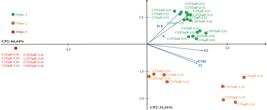
Scattering of eigenvectors along a circular plane and formation of groups obtained by principal component analysis according to seedling emergence (E), emergence speed index (ESI) and mean (MTE), initial (ITE) and final (FTE) times of emergence of seedlings from lots of soybean cultivars (C1: 8579RSF IPRO, C2: NS 7007 IPRO, C3: 8473RSF RR and C4: 74I77RSF IPRO) as a function of the treatment (Treat) or not (Ntreat) of seeds and soil water levels (P-0.01; P-0.02; P-0.10 and P-0.40 MPa)
Seeds with and without treatment of the four cultivars subjected to water availability of -0.10 MPa formed group 2, which was characterized by a lower emergence speed, with higher values of mean, initial and final times of seedling emergence. There was also a differentiation between the cultivars 8473RSF RR and 74I77RSF IPRO, identified as C3 and C4 in the graph. As the distance from these cultivars increases, in the vertical direction, seedling emergence time becomes longer when comparing 8579RSF IPRO and NS 7007 IPRO.
However, at the potential of -0.40 MPa, seedling emergence and formation were not observed for any of the cultivars. This is corroborated by the fact that their points are superimposed on the graph, in red, in the quadrant opposite to emergence and the seedling emergence speed variables.
Experiment III
Seedling emergence was higher between water availability levels of -0.01 and -0.02 MPa for all cultivars evaluated, with maximums of up to 96% and reduction in the percentage of seedlings as water availability decreased (Table 5).
Emergence, emergence speed index and mean time of emergence of seedlings of soybean cultivars as a function of different seed water contents and soil water levels
The cultivar 8473RSF RR showed a drastic reduction in emergence percentage with the decrease in substrate water potential, and values of 44 to 67% were found from -0.02 MPa, with a reduction of up to 45% when compared to the potential of -0.01 MPa, the condition of full water availability.
For the four cultivars, it was observed that, at higher water potential in the substrate (-0.01 MPa), the initial water content of the seeds does not influence emergence (Table 2). Under conditions of high water availability in the substrate, soybean seeds with low water content did not suffer damage due to imbibition, even with a higher degree of cell membrane disorganization (Table 1). Low levels of water availability in the substrate are more harmful to germination and emergence than the initial water content of the seeds (Rosseto et al., 1997).
With the reduction of soil moisture, the water content must be between 11 and 14% for the seed lots to express their maximum physiological potential (Table 5). This care in paying attention to the water content can be incorporated into laboratories that perform quality analyses in the open bed, or even in soybean production field facilities. In the cultivars NS 7007 IPRO and 8579RSF IPRO, there was no significant difference between the seed water contents at -0.02 and -0.10 MPa, respectively.
From the water potential of -0.10 MPa, there was a reduction in the physiological potential of the seeds, with a maximum emergence of 40%, an extremely low value for commercial plantations. Thus, the importance of sowing with adequate soil water availability is clear.
At the water potential of -0.40 MPa, there was no seedling emergence, since the water available in the soil was not sufficient to start the process of seed germination and subsequently seedling emergence.
Emergence speed index (ESI) was reduced by soil water availability from -0.02 MPa, except for the variety 74I77RSF IPRO, which showed a reduction in ESI from water potential of -0.10 MPa, corroborating the results of seedling emergence.
Under the condition of higher water availability in the substrate (-0.01 MPa), it was observed that the seedlings of the cultivars NS 7007 IPRO and 8473RSF RR emerged in a shorter time, around 6 days, with water contents of 11 to 14%.
The other cultivars did not show significant difference under this condition of water availability. A similar behavior was observed at -0.02 and -0.10 MPa, except for seeds of the cultivar 8579RSF IPRO, which showed higher seedling emergence speed in substrate with water availability of -0.10 MPa and seed water content of 8%.
The higher water availability in the substrate (-0.01 MPa) allowed faster emergence for the cultivars evaluated with the different seed water contents, ranging between 6 and 7 days for emergence. No significant difference was observed between the water contents of the seeds of the cultivar 8579RSF IPRO at all levels of water availability tested, with means of 6 days for emergence at the water availability levels of -0.01 and -0.02 MPa and 10 days at the water availability level of -0.10 MPa.
The difference in the behavior between the seeds of the different cultivars under the same water availability in the physiological quality tests may have been caused by differences in their lignin content. Seeds with high lignin content have greater difficulty in water absorption and are more prone to ion leaching (Oliveira et al., 2014), which probably resulted in the distinct behavior between the seeds of the cultivars under different levels of water availability and initial water contents. Botelho et al. (2019) found that cultivars with lower lignin contents have higher seed vigor.
Under the water availability levels of -0.02 and -0.10 MPa, faster emergence was observed for seeds with water content between 11 and 14%, except for 8473RSF RR, whose emergence occurred faster when using seeds with 8% water content under water potential of -0.10 MPa. Seeds with higher initial water content are able to complete the imbibition process to start germination faster than seeds with lower initial water content, since they are closer to the water content necessary for primary root protrusion, which is between 50 and 55% (Marcos Filho et al., 2015).
The highest fresh mass accumulation by seedlings occurred in soil with water availability of -0.01 and -0.02 MPa (Table 6). This data corroborates the other results of physiological quality of the seeds (Table 5), as the decrease in water availability in the substrate caused reduction in seedling development.
Fresh and dry mass of seedlings of soybean cultivars as a function of different seed water contents and soil water levels
The initial water content of the seeds did not always influence the vigor, because the fresh and dry mass accumulation of the seedlings was influenced by cultivar and soil water availability (Table 6). It is worth pointing out that there was no seedling emergence at the tension of -0.4 MPa.
Regarding fresh mass accumulation depending on water availability, similar results were observed for the different water contents of the seeds. In soil with high water availability (-0.01 MPa), all cultivars showed similar values of fresh mass, except 8473 RSFRR.
In soil with water availability of -0.02 MPa, the seeds of half of the cultivars (8473 RSFRR and 8579 RSFIPRO) produced seedlings with a higher fresh mass if sown with higher initial water content. At more negative water tensions (-0.1 MPa), the response of seeds in the production of seedling fresh mass became more variable, not allowing the observation of a behavior related to the cultivar or initial water content.
This phenomenon may be related to genetic differences for tolerance to soil water stress because, in this case, the cotyledon reserve needed to be directed for root expansion, favoring adaptation to water stress conditions. Souza and Castro (2021) studied responses of the soybean cultivar AMS Tibagi to water stress and the link between the physiological and anatomical level during vegetative growth at different moisture levels. The authors observed that thinner roots were formed in response to drought, and severe drought induced larger xylem diameter in the roots.
For the dry mass accumulation of the seedlings, it was not possible to verify a pattern of behavior of the seeds with different initial water contents in response to soil water availability.
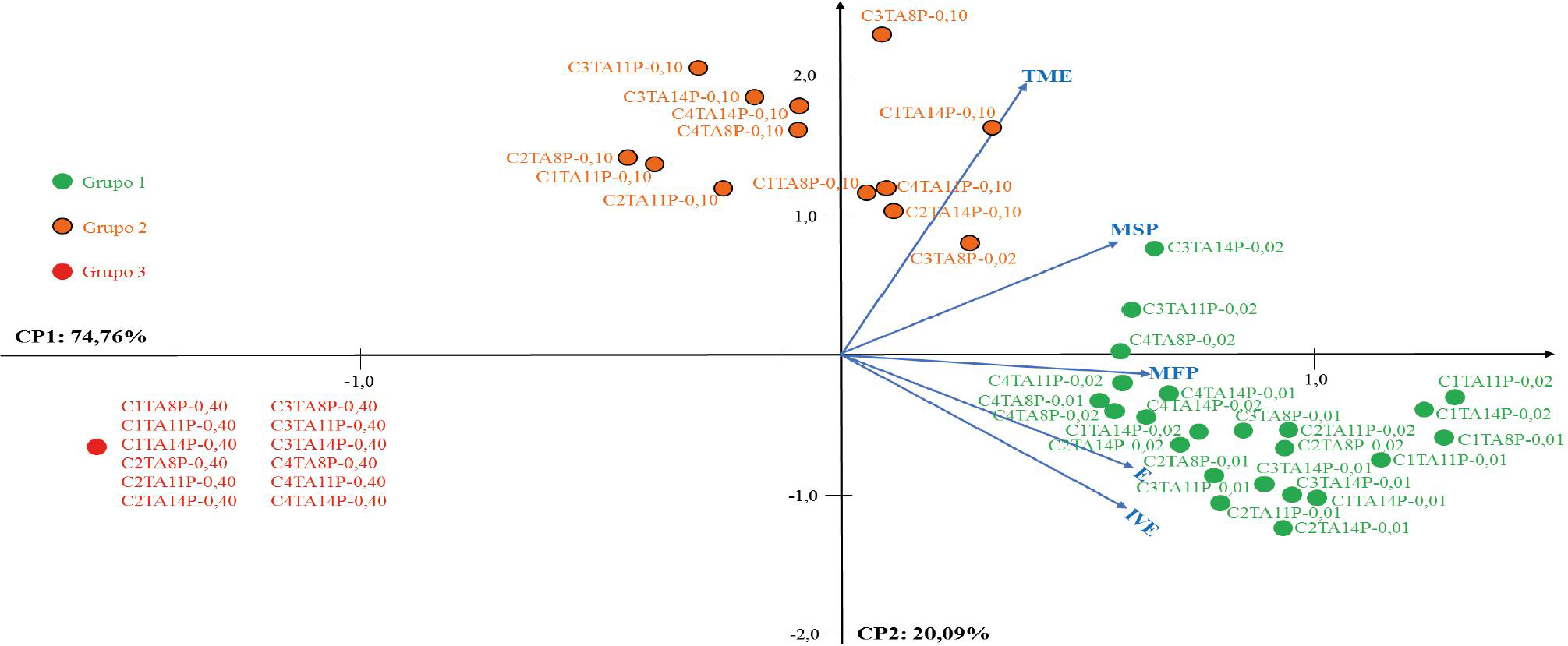
In the evaluation of the univariate variables (Tables 5 and 6) for the principal component analysis of the treatments (Table 7), two principal components were required to accumulate a variance of 94.85%, with 74.76% and 20.09% for the first and second components, respectively.
Correlation matrix and eigenvectors of the principal components for the tests of seedling emergence, emergence speed index, mean time of emergence, shoot fresh mass and total dry mass of seedlings from lots of soybean cultivars as a function of different seed water contents and soil water levels
Accumulated variance greater than 90% is above the minimum required by Rencher and Christensen (2012), which is 70%, and those obtained by Coelho et al. (2021) and Machado et al. (2023), of 73.98, 60.30 and 64.80% for safflower, soybean and corn seeds, respectively. For the correlation and discriminatory power of the variables in each component, values equal to or greater than 0.60 were considered (Cruz et al., 2020). In the first component, only the mean time of seedling emergence did not show correlation; however, for the second component the same variable had discriminatory power.
The biplot graph (Figure 2) showed the formation of three groups. Group 1 comprised seeds with water contents of 8, 11 and 14% of the four cultivars subjected to water availability of -0.01 and -0.02 MPa, except for seeds with 8% water content of the cultivar 8473RSF RR at -0.02 MPa. This group was characterized by the highest values of percentage and speed of seedling emergence, as well as dry mass accumulation. Therefore, water availability in the environment and the amount of water promoted greater emergence and formation of seedlings.

Scattering of eigenvectors along a circular plane and formation of groups obtained by principal component analysis according to seedling emergence, emergence speed index, mean time of emergence, shoot fresh mass and total dry mass of seedlings from lots of soybean cultivars (C1: 8579RSF IPRO, C2: NS 7007 IPRO, C3: 8473RSF RR and C4: 74I77RSF IPRO) as a function of different seed water contents (WC8, WC11 and WC14%) and soil water levels (P-0.01; P-0.02; P-0.10 and P-0.40 MPa)
At -0.10 MPa in the soil, group 2 was formed, containing the four cultivars and the three water contents, as well as seeds with 8% water content of the cultivar 8473RSF RR at -0.02 MPa. As already observed in the previous experiment, the main characteristic of this group was a lower emergence speed, with higher values of mean time of seedling emergence. As in the previous experiment, there was no seedling emergence and formation for seeds of the four cultivars when subjected to soil water potential of -0.40 MPa.
CONCLUSIONS
-
1. Soybean seeds with 14% water content and treated with metalaxyl-m, fludioxonil and thiamethoxam show better membrane maintenance;
-
2. There is no restriction for sowing soybean seeds with water content between 8 and 14% when the soil is under water potential of -0.01 MPa;
-
3. Under conditions of soil water restriction, it is recommended to use seeds with water content between 11 and 14%;
-
4. Under conditions of water deficit, soybean seeds treated with metalaxyl-m, fludioxonil and thiamethoxam show better performance in seedling emergence.
ACKNOWLEDGEMENTS
The authors would like to thank CAPES (Coordination for the Improvement of Higher Education Personnel -Brazil), Financial Code 001, and CNPq (National Council for Scientific and Technological Development) for funding this study.
REFERENCES
- BALARDIN, R. S. et al Tratamento de sementes com fungicidas e inseticidas como redutores dos efeitos do estresse hídrico em plantas de soja. Ciência Rural, v. 41, n. 7, p. 1120-1126, 2011.
- BOTELHO, F. J. E. et al Quality of soybean seeds with different lignin content obtained from desiccated plants. Revista Brasileira de Ciências Agrárias, v. 14, n. 3, p. 1-7, 2019.
- BRASIL. Ministério da Agricultura, Pecuária e Abastecimento. Secretaria de Defesa Agropecuária. Regras para análise de sementes Brasília, DF: MAPA/ACS, 2009. 395 p.
- COELHO, M. V. et al Cold test on the vigor determination of Carthamus tinctorius L. seeds. Revista Brasileira de Ciências Agrárias, v. 16, n. 4, p. 1-8, 2021.
- CONCEIÇÃO, G. M. et al Desempenho de plântulas e produtividade de soja submetida a diferentes tratamentos químicos nas sementes. Bioscience Journal, v. 30, n. 6, p. 1711-1720, 2014.
- CRUZ, J. O. et al Production fields and physiological quality of Panicum maximum Jacq. Cv. Mombasa seeds. Bioscience Journal, v. 36, n. 6, p. 2050-2059, 2020.
- DE PAOLA, F. et al Intensity-duration-frequency (IDF) rainfall curves, for data series and climate projection in African cities. Springer Plus, v. 3, n. 133, p. 1-18, 2014.
- FREZATO, P. et al. Ação de bioestimulantes e nutrientes via tratamento de sementes na germinação e desenvolvimento de plântulas de Glycine max L. Brazilian Journal of Development, v. 7, n. 2, p. 18674-18679, 2021.
- GONÇALVES, C. G. et al Biochemical examination of non-transgenic and transgenic soybean plants under drought stress conditions. Biologia Plantarum, v. 63, p. 314-322, 2019.
- GORDIN, C. R. B.; SCALON, S. P. Q.; MASETTO, T. E. Substrate water availability and seed water content on niger germination. Pesquisa Agropecuária Tropical, v. 45, n. 3, p. 312-318, 2015.
- HUTH, C. et al Susceptibility to weathering damage and oxidative stress on soybean seeds with different lignin contents in the seed coat. Journal of Seed Science, v. 38, n. 4, p. 296-304, 2016.
- IPCC. Climate change 2023: synthesis report: a report of the Intergovernmental Panel on Climate Change. Contribution of Working Groups I, II and III to the Sixth Assessment Report of the Intergovernmental Panel on Climate Change. [CORE WRITING TEAM; LEE, H.; ROMERO, J. (ed.)]. Geneva, Switzerland: IPCC, 2023.
- KLUTE, A. Water retention: laboratory methods. In: KLUTE, A. (ed.). Methods of soil analysis Part 1: Physical and mineralogical methods. Madson: American Society of Agronomy: Soil Science Society of America, 1986. p. 635-660.
- LACERDA, M. P. et al Vigor and oxidation reactions in soybean seedlings submitted to different seed chemical treatments. Journal of Seed Science, v. 43, p. 1-9, 2021.
- MACHADO, C. G. et al Germination and vigor of soybean and corn seeds treated with mixed mineral fertilizers. Plants, v. 12, n. 2, p. 338, 2023.
- MAGUIRE, J. D. Speed of germination-aid selection and evaluation for seedling emergence and vigor. Crop Science, v. 2, p. 176-177, 1962.
- MARCOS FILHO, J. Fisiologia de sementes de plantas cultivadas Londrina: Abrates, 2015. 659 p.
- OLIVEIRA, C. M. G. et al Relationship between pod permeability and seed quality in soybean. Journal of Seed Science, v. 36, n. 3, p. 273-281, 2014.
- RENCHER, A.; CHRISTENSEN, W. Methods of Multivariate Analysis 3rd Ed. Hoboken, New Jersey: Wiley. 2012. 800 p.
- ROCHA, D. K. et al Does the substrate affect the germination of soybean seeds treated with phytosanitary products? Ciência e Agrotecnologia, v. 44, e020119, p. 1-8, 2020.
- ROSSETO, C. A. V. et al Efeito da disponibilidade hídrica do substrato, da qualidade fisiológica e do teor de água inicial das sementes de soja no processo de germinação. Scientia Agrícola, v. 54, n. 1/2, p. 97-105, 1997.
- SALTON, F. G.; MORAIS, H.; LOHMANN, M. Períodos secos no Estado do Paraná. Revista Brasileira de Meteorologia, v. 36, n. 2, p. 295-303, 2021.
- SANTANA, D. G.; RANAL, M. A. Análise da germinação: um enfoque estatístico. Brasília, DF: Editora Universidade de Brasília, 2004. 247 p.
- SMANIOTTO, T. A. S. et al Qualidade fisiológica das sementes de soja armazenadas em diferentes condições. Revista Brasileira de Engenharia Agrícola e Ambiental, v. 18, n. 4, p. 446-453, 2014.
- SARTORI, F. F. et al Soybean seed treatment: how do fungicides translocate in plants? Pest Management Science, v. 76, n. 7, p. 2355-2359, 2020.
- SILVA, K. R. G; VILLELA, F. A. Pré-hidratação e avaliação do potencial fisiológico de sementes de soja. Revista Brasileira de Sementes, v. 33, n. 2, p. 331-345, 2011.
- SOARES, L. A. A. et al Estratégias de irrigação com déficit hídrico nos estádios fenológicos do feijão-caupi sob adubação potássica. Irriga, v. 26, n. 1, p. 111-122, 2021.
- SOUZA, L. T.; CASTRO, S. A. Q. et al Drought stress induces changes in the physiology and root system of soybean plants. Brazilian Journal of Botany v. 44, p. 779-789, 2021.
- VAN GENUCHTEN, M. T. A. Closed-form equation for predicting the hydraulic conductivity of unsaturated soils. Soil Science Society of America Journal, v. 44, p. 892-898, 1980.
- VAZQUEZ, G. H.; CARDOSO, R. D.; PERES, A. R. Tratamento químico de sementes de milho e o teste de condutividade elétrica. Bioscience Journal, v. 30, n. 3, p. 773-781, 2014.
- VIÇOSI, K. A. et al Estresse hídrico simulado em genótipos de feijão, milho e soja. Revista de Agricultura Neotropical, v. 4, n. 5, p. 36-42, 2017.
- VIEIRA, R. D. et al Condutividade elétrica e teor de água inicial das sementes de soja. Pesquisa Agropecuária Brasileira, v. 37, n. 9, p. 1333-1338, 2002.
-
Editor-in-Chief:
Prof. Salvador Barros Torres - sbtorres@ufersa.edu.br