
 The hidden danger of asbestos in disaster situations: reflections for future responses
Abstract
Although the use of asbestos was banned in Brazil in 2017, there remains a significant legacy of this material in the country, including in areas vulnerable to disasters. In May 2024, an unprecedented flood hit 484 municipalities in Rio Grande do Sul, causing damage to buildings and structures that possibly contained asbestos, found in materials such as roofing tiles and water tanks. During disasters, both workers and the general population may be exposed to asbestos, with the risk of developing related diseases such as asbestosis and lung cancer. The potential for environmental and occupational contamination, as well as public health impacts arising from extreme climatic events, combined with the increasing frequency and intensity of disasters, makes it essential to prioritize the development of a national asbestos management plan. This plan should include measures for prevention, safe identification, and removal of materials containing asbestos, as well as training and the provision of protective equipment for workers and residents, with a focus on vulnerable areas such as urban hillside regions and locations with a history of flooding. The establishment of guidelines and awareness-raising initiatives is also necessary to reduce asbestos exposure during disaster situations.
Keywords
Asbestos; Risk Management; Climate Change; Natural Disasters; Occupational Health
Resumo
Embora o uso do amianto tenha sido proibido no Brasil em 2017, ainda existe um grande passivo desse material no país, inclusive em áreas vulneráveis a desastres. Em maio de 2024, uma enchente sem precedentes atingiu 484 municípios no Rio Grande do Sul, causando danos a edificações e instalações que possivelmente continham amianto, presente em materiais como telhas e caixas d’água. Em situações de desastres, tanto os trabalhadores como a população, podem ser expostos ao amianto, com risco de desenvolvimento das doenças relacionadas, como asbestose e câncer de pulmão. O potencial de contaminação ambiental, ocupacional e os impactos à saúde pública decorrentes de eventos climáticos extremos, associados ao aumento da frequência e da intensidade dos desastres, torna imprescindível que se priorize a elaboração de um plano nacional para a gestão do amianto. O plano deve incluir medidas de prevenção, identificação e remoção segura de materiais contendo amianto, além de capacitação e fornecimento de equipamentos de proteção para trabalhadores e moradores, com ênfase em áreas vulneráveis, como regiões urbanas em encostas e locais com histórico de desastres. O estabelecimento de diretrizes e ações de conscientização também é necessário para reduzir a exposição ao amianto em situações de desastre.
Palavras-chave
Amianto; Gestão de Riscos; Mudança Climática; Desastres Naturais; Saúde do Trabalhador
Introduction
In May 2024, a disaster caused by a large volume of rainfall in a short space of time struck the state of Rio Grande do Sul in a devastating and unprecedented way1. Of the state’s 497 municipalities, 484 were affected by the impact of floods, landslides, and mud. In the 418 municipalities that declared a state of calamity or emergency, it was estimated that at least 23,300 private establishments (9.5%) and 334,600 jobs (13.7%) were affected2. In Brazil, floods are the most common climatic event, accounting for around 60% of natural disasters. In Latin America and the Caribbean, this proportion is around 70%3.
The images released highlighted the roofs in the submerged areas, which served as shelters for people and animals awaiting rescue (Figure 1), as well as broken roof tiles thrown in with the rubble, mud and garbage (Figure 2). In Brazil, for decades, buildings have been installed with asbestos-containing materials (ACM), mainly roof tiles and water tanks, but also pipes, floors, ceilings, fire doors, among many others. It is therefore believed that many of the buildings affected had ACM. Moreover, water and sewage pipes may contain asbestos, including the amphibole type (brown asbestos), which is even more harmful than chrysotile (white asbestos)4. In 2017, the use of chrysotile asbestos was banned in Brazil. However, the country is home to a huge ACM liability, estimated at more than 7 million tons5, which could be even greater6.

Houses destroyed on Ilha da Picada after rains and new flooding in Porto Alegre (RS), June 19, 2024

Evidently, in view of the human losses and the various damage, the potential exposure of workers and the population to asbestos ended up being a minor concern in the context of the disaster in Rio Grande do Sul. There was no disclosure of any specific action or planning to deal with ACM, either during or after the flood. However, disaster situations in places with the presence of ACM require adequate planning and structure, with attention to who will remove these materials, under what conditions they will be collected, and what destination will be given to this hazardous waste.
Asbestos is responsible for various diseases such as asbestosis, lung cancer, and mesothelioma, causing 255,000 deaths a year7. In Brazil, from 2000 to 2016, 3,764 deaths from asbestos-related diseases were recorded in the Mortality Information System (SIM), 54.8% from pleural cancer, 36.7% from mesothelioma, 4.7% from pleural plaques, and 3.8% from asbestosis. In 60.0% of cases, there was a failure to record the occupation8. From 2019 to 2021, 115 cases of social security disability benefits granted for mesothelioma were identified, of which only one was characterized as occupational9.
The underreporting of diseases caused by asbestos in Brazil, as well as their relationship with occupation, is recognized10. Laryngeal cancer may also be associated with exposure to asbestos. In Brazil, the burden of disease (disability-adjusted life years) due to malignant laryngeal neoplasms associated with asbestos is high at older ages11.
Furthermore, asbestos is responsible for environmental impacts, such as the degradation of extraction areas and soil contamination due to the improper disposal of its waste. The risk related to asbestos in disaster situations cannot be overlooked, because such situations favor occupational and paraoccupational exposure, exposure of the population, and contamination of the environment in general with asbestos fibers12-16. Extreme weather events such as windstorms, heavy rain, and hailstorms often hit and destroy roofs, which are very vulnerable to these phenomena17. Another aspect is that disasters accelerate the disorderly replacement of ACM where it has been damaged, with the potential to expose workers, since there is no planning or preparation for dismantling processes18.
Due to climate change, there is a tendency for extreme events to occur with greater frequency and intensity. The aim of this essay is to discuss the main risk activities, and the actions needed to reduce the risk of exposure to asbestos in future disasters. Considerations about such risks are not exactly new, but they have started to circulate with unusual frequency in recent years, perhaps stimulated by the discussion of the Intergovernmental Panel on Climate Change19 and by concerns about asbestos, whose ban has been advancing globally, motivating researchers to conceive projects in this direction and public policy makers to propose preventive or mitigating solutions.
Occupational risks related to exposure to asbestos in disaster situations
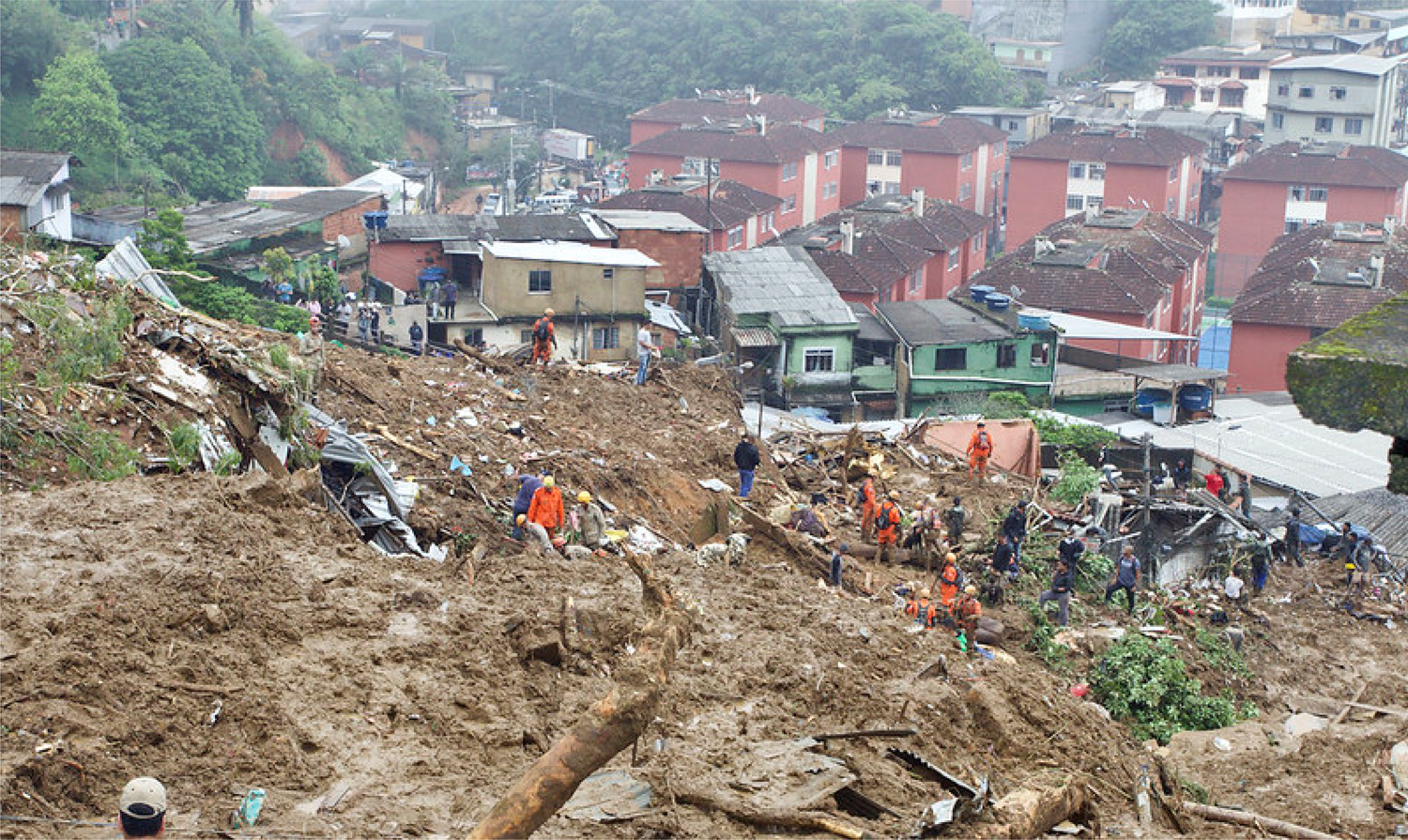
In Brazil, with the ban on the extraction, industrialization, marketing, and distribution of chrysotile asbestos in 2017b, the workers most potentially exposed are those in the remaining activities, basically those in the construction industry, working on renovations and demolitions, and those involved in transporting and disposing of this waste. In disaster situations, such as fires, floods, cyclones, windstorms, and landslides (Figure 3), the risk of contamination also involves workers who work in rescue operations, whether civil defense, health, cleaning, and the general population, when they make efforts to clean up and recover belongings, usually without knowledge of the risks and without adequate protection3,16,20.

A well-known case of asbestos exposure due to disaster was the attack on the World Trade Center on September 11, 2001. In it, the 11,500 New York firefighters were exposed to high concentrations of asbestos, 555 times higher than permitted21. The rescue work and recovery operations lasted around two weeks. The World Trade Center had five tons of asbestos installed in its fire protection systems22. The firefighters who worked in the disaster will have to be monitored for at least 30 years, since asbestos-related diseases have a long latency period.
Natural disasters have also led to asbestos exposure in the United States, such as hurricanes Rita and Katrina23. Gargano et al.24 report that lower respiratory symptoms, especially in communities affected by natural disasters such as Hurricane Sandy, have become more frequent due to environmental exposures. During the reconstruction process, another disaster in which a very high concentration of asbestos was identified resulted from the collapse of buildings containing a large amount of friable asbestos in the Hanshin Awaji Earthquake in Japan in January 1995, leading to exposure of those involved in recovery activities23. In Australia, Khatib et al.16 highlight the concern about asbestos exposure in disasters, considering the increase in its frequency and intensity in that country.
Considerations about asbestos in disaster response strategies
The removal and disposal of asbestos waste are important and complex issues, since these materials are difficult to identify and can easily mix with other waste (Figure 4), especially in disaster situations25. When mixed with other waste, identification becomes even more difficult, and complete separation of ACM is practically impossible. Thus, contaminated waste, often associated with other toxic materials, ends up being sent to ordinary landfills, in non-compliance with Resolution 348 of the National Environment Council (CONAMA), which classifies asbestos waste as hazardous and requires it to be sent to class I landfills26. The lack of adequate infrastructure and the high volumes of waste aggravate this problem, exposing the population to risks of contamination27. In Porto Alegre, Rio Grande do Sul, seven months after the floods, 50,000 tons of waste were still waiting to be disposed of in temporary deposits, called “bota-espera” (throw and wait, in English) by the city council28. Amongst the piles of garbage and debris, there was probably ACM.

Accompanying the work of rescuing flood victims in the city of Petrópolis (RJ), February 16, 2022
When asbestos is dispersed in the environment, it can remain in nearby areas, such as gardens and streets. When it dries, its fibers are resuspended, creating a continuous and diffuse source of contamination that affects workers and people in the community, especially children, who are more vulnerable to the damage caused by asbestos fibers. For this reason, preventive actions are fundamental in public, environmental, and occupational health, reducing exposure to asbestos.
Khatib et al.16 highlight five high-risk scenarios for asbestos exposure: natural disasters (fires, cyclones, storms, floods), contaminated sites, demolitions, renovations, and illegal disposal. Inadequate management in emergency situations, such as disasters, often results in the irregular disposal of contaminated waste. Fires, for example, encourage the dispersal of fibers, damaging asbestos cement but not destroying the mineral29.
A study by Baek et al.23 analyzed asbestos management systems in disasters, based on models from the USA, Japan, and South Korea. Korean experts identified prevention as a priority, including the identification and management of asbestos-containing structures. The following needs were highlighted: improving legislation, safety measures, emergency responses, monitoring, and mapping risks, as well as strategies to prevent the dispersion of fibers. These actions are essential to minimize the damage caused by asbestos in disaster situations.
Even without intervention, installed ACMs can shed fibers, including fiber cement materials30, which require their management. When removal of the ACM is not possible or recommended, there are alternatives such as containment, encapsulation, and insulation31. Gray, Carey, and Reid32 point to degradation of asbestos products due to weathering and increased friability after fires as critical situations. In addition, they highlight the low awareness of the risks associated with ACM, which can expose volunteers, often inadvertently, to dangers during rescue activities in post-disaster scenarios.
In Brazil, asbestos liabilities are found mainly in roof tiles and water tanks, installed in places of greater socio-economic vulnerability. As in other disaster situations, such as the crude oil spill off the coast of the Northeast in 2019, people in vulnerable situations are most affected33. The Brazilian Unified Health System (Sistema Único de Saúde [SUS]) is almost always solely responsible for the health care of these people. A study on the costs of hospitalizations for mesothelioma in the SUS, from 1995 to 2007, showed that the amount spent and the length of stay increased over the period, with high amounts per hospitalization34.
Law No. 12.608/2012 established the National Civil Protection and Defense Policy (PNPDEC), which guides actions to prevent, mitigate, prepare for, respond to, and recover from disasters, integrating with policies such as territorial planning, health, the environment, climate change, and infrastructure to promote sustainable development35. Moreover, the National Civil Protection and Defense Plan (PN-PDC) has been developed with integrated actions between the federal, state, and municipal levels. Of the plan’s 11 documents, the fifth addresses prevention and highlights actions such as building disaster-resilient structures35.
In this context, programmed asbestos removal in areas subject to extreme events, such as floods, fires, and landslides, is an essential preventive strategy. It is crucial to ensure that the structures are not only resistant, but also that they do not represent sources of contamination, as is the case with asbestos cement roofs and water tanks, as well as other ACM (ceilings, insulation, fire doors, etc.).
Identifying the risks is the first step in making asbestos removal feasible. This includes surveying for asbestos as part of risk mapping, updated every three years, and drawing up an inventory of all installed ACM, preferably georeferenced, detailing their state of conservation and use. This process makes it possible to establish priorities for effective decommissioning actions35.
Challenges for Brazil - addressing solutions
Considering the enormous liabilities installed in Brazil and the expectation of natural events that tend to intensify and increase in frequency, it is necessary to draw up a National Asbestos Management Plan integrated with the PN-PDC. Plans developed in other countries, such as the USA and Japan, as well as the study carried out by Baek et al.23, can serve as an initial reference for drawing up a plan adapted to the Brazilian reality. The Australian government also seems to be committed to developing strategies to combat disinformation and designing public policies for managing these risks that are consistent with the new climate reality29. Bolan et al.31 emphasize the need for effective actions to control ACM, including ongoing maintenance and management of the material until it is completely eliminated.
One of the first steps in managing ACMs is to carry out an inventory. This strategy has been adopted by several countries, such as Poland, Italy, Spain, and Australia, which use technologies such as remote sensing, consultation with public and private bodies, the use of mobile devices and applications36-41. The inventory is a fundamental stage, which precedes and guides prevention actions, since it makes it possible to quantify installed liabilities and map which ACM installations are a priority, considering areas at risk due to the incidence of extreme events, for example, and therefore of vulnerability. The PN-PDC already includes mapping of the areas with the highest incidence of extreme natural events in Brazil35.
Another strategic action involves information, awareness-raising, and training, with the aim of preventing exposure to risks during recovery and clean-up activities. One of the challenges is the work of volunteers and property owners who, due to lack of knowledge, do not use adequate protection when potentially exposed to asbestos. Even official teams, such as civil defense, firefighters, and health professionals, are often not prepared or equipped to deal with hazardous waste, such as that containing asbestos.
In this sense, it is essential to implement awareness-raising actions for the general population, warning them of the risks and the necessary precautions. Furthermore, it is essential to train workers who work in rescue and recovery operations, ensuring that they are properly trained and equipped to handle these materials safely.
Final considerations
It is important to reaffirm that exposure to ACM is a persistent problem in Brazil. The potential for environmental and occupational contamination, and the impacts on public health resulting from extreme events, associated with the increased frequency and intensity of disasters, make it essential and urgent to draw up a safe and effective plan for the ACM removal that can be implemented in vulnerable areas, such as urban regions on slopes and places with a history of flooding.
In addition, strict safety measures must be adopted to prevent occupational exposure of professionals involved in rescue and recovery operations, including civil defense teams, firefighters, and workers responsible for cleaning and collecting waste. These measures should be incorporated into post-disaster action strategies, with an emphasis on the continuous training of professionals and the provision of adequate equipment for the safe handling of asbestos. It is also essential to raise awareness and provide protective equipment, both for the volunteer teams and for the people living in the affected areas. All these actions need to be developed in an integrated and participatory manner, with the active collaboration of various social actors, as provided for in the PN-PDC.
The implementation of such actions is challenging, especially in a country with a vast territory and marked by social inequalities. Finally, it is important to emphasize the need to find strategies that make it feasible to draw up and implement public policies, with the involvement of the federal entities, both from a logistical and budgetary point of view.
References
-
1 Guimarães SP. Cronologia de enchente no Rio Grande do Sul revela tragédia anunciada.UOL. 10 maio 2024 [citado14 dez 2024]. Disponível em: https://noticias.uol.com.br/cotidiano/ultimas-noticias/2024/05/10/cronologia-enchente-chuvas-rio-grande-do-sul-2024-tragedia-sem-precedente.htm?cmpid=copiaecola
» https://noticias.uol.com.br/cotidiano/ultimas-noticias/2024/05/10/cronologia-enchente-chuvas-rio-grande-do-sul-2024-tragedia-sem-precedente.htm?cmpid=copiaecola -
2 Ministério do Planejamento e Orçamento (BR). Instituto de Pesquisa Econômica Aplicada. Publicação expressa. Nota técnica, n. 1). Brasília, DF: Instituto de Pesquisa Econômica Aplicada; 2024 [citado 11 dez 2024]. Disponível em: https://repositorio.ipea.gov.br/bitstream/11058/14186/1/NT_CGDTI_01_Publicacao_Expressa.pdf
» https://repositorio.ipea.gov.br/bitstream/11058/14186/1/NT_CGDTI_01_Publicacao_Expressa.pdf -
3 Freitas CM, Ximenes EF. Enchentes e saúde pública: uma questão na literatura científica recente das causas, consequências e respostas para prevenção e mitigação. Cien Saude Colet. 2012 Jun;17(6):1601-15. https://doi.org/10.1590/S1413-81232012000600023
» https://doi.org/10.1590/S1413-81232012000600023 -
4 UK Health Security Agency (UKHSA). Asbestos: general information. 2024. [citado 12 dez 2024]. Disponível em: https://www.gov.uk/government/publications/asbestos-properties-incident-management-and-toxicology/asbestos-general-information
» https://www.gov.uk/government/publications/asbestos-properties-incident-management-and-toxicology/asbestos-general-information -
5 Fundacentro. Nota da Fundacentro sobre os impactos do amianto: instituição realiza estudos sobre a fibra desde a década de 1990. São Paulo: Fundacentro; 2019. [citado 11 dez 2024]. Disponível em: https://www.gov.br/fundacentro/pt-br/comunicacao/noticias/noticias/2019/5/nota-da-fundacentro-sobre-os-impactos-do-amianto
» https://www.gov.br/fundacentro/pt-br/comunicacao/noticias/noticias/2019/5/nota-da-fundacentro-sobre-os-impactos-do-amianto -
6 Lombardi Filho P, Günther WM, Viana E. Asbestos cement materials: impacts on the use and waste generation in Brazil. Rev Bras Cienc Ambient. 2022;57(4):618-29. https://doi.org/10.5327/Z2176-94781392
» https://doi.org/10.5327/Z2176-94781392 -
7 Furuya S, Chimed-Ochir O, Takahashi K, David A, Takala J. Global asbestos disaster. Int J Environ Res Public Health. 2018 May 16;15(5). Disponível em: https://doi.org/10.3390/ijerph15051000
» https://doi.org/10.3390/ijerph15051000 -
8 Cavalcante F, Santana VS. Qualidade dos registros de ocupação das doenças associadas ao asbesto no sistema de informação sobre mortalidade, Brasil. Cad Saude Colet. 2023;31(4):e31040547. https://doi.org/10.1590/1414-462x202331040547
» https://doi.org/10.1590/1414-462x202331040547 -
9 Gomes LEF. Mesotelioma e benefícios previdenciários no Brasil. 2023. [Trabalho de Conclusão de Curso]. Escola Bahiana de Medicina e Saúde Pública; 2023 [citado 25 fev 2025]. Disponível em: https://repositorio.bahiana.edu.br:8443/jspui/handle/bahiana/7817
» https://repositorio.bahiana.edu.br:8443/jspui/handle/bahiana/7817 -
10 Santana VS, Salvi L, Cavalcanti F, Campos F, Algranti E. Underreporting of mesothelioma, asbestosis and pleural plaques in Brazil. Occup Med (Lond). 2021;71(4-5):223-30. https://doi.org/10.1093/occmed/kqab073
» https://doi.org/10.1093/occmed/kqab073 -
11 Viana L P, Bustamante-Teixeira MT, Malta DC, Girardi FA, Nogueira MC. Passos VMA, et al. Mortalidade e carga do câncer de laringe atribuíveis aos riscos ocupacionais no Brasil: estudo da Carga Global de Doença, 2019. Rev Bras Saude Ocup. 2024 Jan;49:edepi9. https://doi.org/10.1590/2317-6369/11522pt2024v49edepi9
» https://doi.org/10.1590/2317-6369/11522pt2024v49edepi9 -
12 Bitencourt DP, Ramos Soares Pinto VR. Segurança do setor de petróleo e gás no Brasil: clima passado e cenários futuros frente às mudanças climáticas. Territorium. 2022;29(2):23-35. https://doi.org/10.14195/1647-7723_29-2_2
» https://doi.org/10.14195/1647-7723_29-2_2 -
13 Aven T. Glette-Iversen I, Karatzoudi K. A risk science perspective on some fundamental issues in climate change research. J Risk Res. 2024 Nov;27(11)1311-23. https://doi.org/10.1080/13669877.2025.2466540
» https://doi.org/10.1080/13669877.2025.2466540 -
14 Giusti L. A review of waste management practices and their impact on human health. Waste Manag. 2009 Aug;29(8):2227-39. https://doi.org/10.1016/j.wasman.2009.03.028
» https://doi.org/10.1016/j.wasman.2009.03.028 -
15 Krausmann E, Renn IE, Campedel M, Cozzan IV. Industrial accidents triggered by earthquakes, floods and lightning: lessons learned from a database analysis. Nat Hazards. 2011;59(1):285-300. https://doi.org/10.1007/s11069-011-9754-3
» https://doi.org/10.1007/s11069-011-9754-3 -
16 Khatib GF, Collins J, Otness P, Goode J, Tomley S, Franklin P, et al. Australia's ongoing challenge of legacy asbestos in the built environment: a review of contemporary asbestos exposure risks. Sustainability (Basel). 2023;15(15):12071. https://doi.org/10.3390/su151512071
» https://doi.org/10.3390/su151512071 -
17 Moyo EN, Nangombe SS. Southern Africa's 2012-13 violent storms: Role of climate change. Procedia IUTAM. 2015;17:69-78. https://doi.org/10.1016/j.piutam.2015.06.011
» https://doi.org/10.1016/j.piutam.2015.06.011 -
18 Moreira AC, Figueiredo ES, Henschel GS, Pottker GS, Schmidt JRA, Lorenzi RL, et al. Guia de boas práticas em desamiantagem. São Paulo: Fundacentro; 2022. Disponível em: http://biblioteca.fundacentro.gov.br/permalink/f/lofgr8/fjd_aleph000054357
» http://biblioteca.fundacentro.gov.br/permalink/f/lofgr8/fjd_aleph000054357 -
19 Field CB, Barros VR, Dokken DJ, Mach KJ, Mastrandrea MD, eds. Impacts, adaptation, and vulnerability. Part A: Global and sectoral aspects: Working Group II to the Fifth Assessment Report of the Intergovernmental Panel on Climate Change. New York: Cambridge University Press; 2014 [citado 10 nov 2024]. Disponível em: https://www.ipcc.ch/site/assets/uploads/2018/02/WGIIAR5-FrontMatterA_FINAL.pdf
» https://www.ipcc.ch/site/assets/uploads/2018/02/WGIIAR5-FrontMatterA_FINAL.pdf -
20 Quezada G, Devaraj D, McLaughlin J, Hanson RI. Asbestos safety futures managing risks and embracing opportunities for Australia's asbestos legacy in the digital age. Canberra: CSIRO; 2018 [citado 10 nov 2024]. Disponível em: https://www.researchgate.net/publication/333507758_ASBESTOS_SAFETY_FUTURES_Managing_risks_and_embracing_opportunities_for_Australia's_asbestos_legacy_in_the_digital_age/references
» https://www.researchgate.net/publication/333507758_ASBESTOS_SAFETY_FUTURES_Managing_risks_and_embracing_opportunities_for_Australia's_asbestos_legacy_in_the_digital_age/references -
21 Kim YC, Hong WH. Optimal management program for asbestos containing building materials to be available in the event of a disaster. Waste Manag. 2017 Jun;64:272-85. https://doi.org/10.1016/j.wasman.2017.03.042
» https://doi.org/10.1016/j.wasman.2017.03.042 -
22 Rom WN, Weiden M, Garcia R, Yie TA, Vathesatogkit P, Tse DB, et al. Acute eosinophilic pneumonia in a New York City firefighter exposed to World Trade Center dust. Am J Respir Crit Care Med. 2002 Sep;166(6):797-800. https://doi.org/10.1164/rccm.200206-576OC
» https://doi.org/10.1164/rccm.200206-576OC -
23 Baek SC, Kim YC, Choi JH, Hong WH. Determination of the essential activity elements of an asbestos management system in the event of a disaster and their prioritization. J Clean Prod. 2016 Nov;137:414-26. https://doi.org/10.1016/j.jclepro.2016.07.117
» https://doi.org/10.1016/j.jclepro.2016.07.117 -
24 Gargano LM, Locke S, Jordan HT, Brackbill RM. Lower respiratory symptoms associated with environmental and reconstruction exposures after Hurricane Sandy. Disaster Med Public Health Prep. 2018;12(6):697-702. https://doi.org/10.1017/dmp.2017.140
» https://doi.org/10.1017/dmp.2017.140 -
25 Brown C, Milke M. Recycling disaster waste: feasibility, method and effectiveness. Resour Conserv Recycling. 2016 Jan;106:21-32. https://doi.org/10.1016/j.resconrec.2015.10.021
» https://doi.org/10.1016/j.resconrec.2015.10.021 -
26 Brasil. Resolução Conama no 348, de 16 de agosto de 2004. Altera a Resolução Conama no 307, de 5 de julho de 2002, incluindo o amianto na classe de resíduos perigosos. Diário Oficial União. 17 ago 2004. [citado em 25 fev 2025]. Disponível em: https://www.normasbrasil.com.br/norma/resolucao-348-2004_100177.html
» https://www.normasbrasil.com.br/norma/resolucao-348-2004_100177.html -
27 Brito M, Paz M. Sete meses após enchentes, 50 mil toneladas de lixo ainda não foram levadas para aterros no RS; veja imagens. 16 dez 2024 [citado 18 mar 2025]. Disponível em: https://g1.globo.com/rs/rio-grande-do-sul/noticia/2024/12/16/sete-meses-apos-enchentes-50-mil-toneladas-de-lixo-ainda-nao-foram-levadas-para-aterros-no-rs-veja-imagens.ghtml
» https://g1.globo.com/rs/rio-grande-do-sul/noticia/2024/12/16/sete-meses-apos-enchentes-50-mil-toneladas-de-lixo-ainda-nao-foram-levadas-para-aterros-no-rs-veja-imagens.ghtml -
28 Porto Alegre. Departamento Municipal de Limpeza Urbana. Prefeitura inicia serviços de limpeza e transporte dos resíduos do último Bota-Espera. 3 jan 2025 [citado 25 fev 2025]. Disponível em: https://www.prefeitura.poa.br/dmlu/noticias/prefeitura-inicia-servicos-de-limpeza-e-transporte-dos-residuos-do-ultimo-bota-espera
» https://www.prefeitura.poa.br/dmlu/noticias/prefeitura-inicia-servicos-de-limpeza-e-transporte-dos-residuos-do-ultimo-bota-espera -
29 Asbestos Safety and Eradication Agency. Fact sheet: bushfires and asbestos. Australia; 2020 [citado 10 dez 2024]. Disponível em: https://www.asbestossafety.gov.au/sites/default/files/documents/2020-02/Bush%20Fire%20Fact%20Sheet%20-%20January%202020.pdf
» https://www.asbestossafety.gov.au/sites/default/files/documents/2020-02/Bush%20Fire%20Fact%20Sheet%20-%20January%202020.pdf -
30 Ervik T, Eriksen Hammer S, Graff P. Mobilization of asbestos fibers by weathering of a corrugated asbestos cement roof. J Occup Environ Hyg. 2021 Mar;18(3):110-7. https://doi.org/10.1080/15459624.2020.1867730
» https://doi.org/10.1080/15459624.2020.1867730 -
31 Bolan S, Kempton L, McCarthy T, Wijesekara H, Piyathilake U, Jasemizad T, et al. Sustainable management of hazardous asbestos-containing materials: containment, stabilization and inertization. Science of The Total Environment. 2023 July;881:163456. https://doi.org/10.1016/j.scitotenv.2023.163456
» https://doi.org/10.1016/j.scitotenv.2023.163456 -
32 Gray C, Carey RN, Reid A. Current and future risks of asbestos exposure in the Australian community. Int J Occup Environ Health. 2016 Oct;22(4):292-9. https://doi.org/10.1080/10773525.2016.1227037
» https://doi.org/10.1080/10773525.2016.1227037 -
33 Pena PG, Northcross AL, de Lima MA, Rêgo RCF. Derramamento de óleo bruto na costa brasileira em 2019: emergência em saúde pública em questão. Cad Saude Publica. 2020;36(2):e00231019. https://doi.org/10.1590/0102-311X00231019
» https://doi.org/10.1590/0102-311X00231019 - 34 Luna CA, Martins FP, Chibante MAS, Castro HA. Estimativa de custo das internações hospitalares por mesotelioma no Brasil Cad Bras Med. 2013;26(1-4):35-44.
-
35 Brasil. Lei nº 12.608, de 10 de abril de 2012. Ministério da Integração e do Desenvolvimento Regional (MIDR). Plano Nacional de Proteção e Defesa C ivil: Fortalecendo a gestão de riscos e desastres no Brasil (PN-PDC 2024-2034). [citado 17 Dez 2024]. Disponível em: https://pndc.com.br/
» https://pndc.com.br/ -
36 Abbasi M, Mostafa S, Vieira AS, Patorniti N, Stewart RA. Mapping roofing with asbestos-containing material by using remote sensing imagery and machine learning-based image classification: a state-of-the-art review. Sustainability (Basel). 2022;14(13):8068. https://doi.org/10.3390/su14138068
» https://doi.org/10.3390/su14138068 -
37 Pini M, Scarpellini S, Rosa R, Neri P, Gualtieri AF, Ferrari AM. Management of asbestos containing materials: a detailed LCA comparison of different scenarios comprising first time asbestos characterization factor proposal. Environ Sci Technol. 2021 Sep;55(18):12672-82. https://doi.org/10.1021/acs.est.1c02410
» https://doi.org/10.1021/acs.est.1c02410 -
38 Tommasini M, Bacciottini A, Gherardelli M. A QGIS tool for automatically identifying asbestos roofing. ISPRS Int J Geoinf. 2019 Mar;8(3):131. https://doi.org/10.3390/ijgi8030131
» https://doi.org/10.3390/ijgi8030131 -
39 Cilia C, Panigada C, Rossini M, Candiani G, Pepe M, Colombo R. Mapping of asbestos cement roofs and their weathering status using hyperspectral aerial images. ISPRS Int J Geoinf. 2015 Jun;4(2):928-41. https://doi.org/10.3390/ijgi4020928
» https://doi.org/10.3390/ijgi4020928 -
40 Govorko MH, Fritschi L, White J, Reid A. Identifying asbestos-containing materials in homes: design and development of the ACM check mobile phone app. JMIR Form Res. 2017 Dec;1(1):e7. https://doi.org/10.2196/formative.8370
» https://doi.org/10.2196/formative.8370 -
41 Govorko M, Fritschi L, Reid A. Using a mobile phone app to identify and assess remaining stocks of in situ asbestos in Australian residential settings. Int J Environ Res Public Health. 2019 Dec;16(24):4922. https://doi.org/10.3390/ijerph16244922
» https://doi.org/10.3390/ijerph16244922
-
Data availability:
The entire data set supporting the results of this study has been published in the article itself.
-
Presentation at a scientific event:
The authors declare that the study was not presented at a scientific event.
-
b
Although the extraction of asbestos in Brazil was banned by the Supreme Federal Court (STF) in 2017, there has been an ongoing legal dispute since then over the authorization to operate the asbestos mine located in Minaçu, Goiás. It should be noted that the workers most exposed to asbestos in Brazil are those who work in the operating mine, and that there is an urgent need for the STF to resume its trial to support a definitive ban on asbestos in Brazil.
-
Funding:
The authors declare that the study was not subsidized.
Edited by
-
Editor-in-chief:
Eduardo Algranti
The entire data set supporting the results of this study has been published in the article itself.

 Source: Bruno Peres/Agência Brasil (https://agenciabrasil.ebc.com.br/foto/2024-06/enchentes-no-rio-grande-do-sul-1718828937).
 Source: Gustavo Mansur/Palácio Piratini (https://www.flickr.com/photos/governo_rs/53730386008/).
 Source: Rogério Santana (https://www.flickr.com/photos/governodorio/51885673464/).
 Source: Rogério Santana (https://www.flickr.com/photos/governodorio/51885674949/).