
 Behavior change intervention related to the lifestyle of primary health care workers: a qualitative study
Abstract
Objective To evaluate the perception of effectiveness and feasibility of a program to support behavioral changes in lifestyle habits for Primary Health Care (PHC) workers.
Methods This qualitative study was carried out in PHC health units in the city of São Carlos, SP. 20 health professionals participating in a health education intervention were interviewed, with four meetings regarding behavioral changes in relation to physical activity and eating habits. At the end of the intervention, a semi-structured interview was conducted about the program, in which participants indicated their level of satisfaction, perceived effectiveness, suggestions for improvement, and knowledge acquired. The recorded reports were analyzed using Bardin and Minayo’s content analysis, with categorization of the main domains identified in the interviews.
Results The reports indicated the perception of the program as feasible, high quality, and effective, which contributes to improving lifestyle and motivates the multiplication of information to PHC users. However, workers indicated a desire for additional long-term programs that offer in-person supervision.
Conclusion Health education in the workplace was effective, and encouraged the implementation of new policies aimed at workers.
Occupational Health; Primary Health Care; Health Behaviors; Physical Activity; Eating Behavior
Resumo
Objetivo Avaliar a percepção de efetividade e viabilidade de um programa de apoio à mudança de comportamento de hábitos de vida para trabalhadores da atenção básica à saúde (ABS).
Métodos Trata-se de um estudo qualitativo realizado nas unidades de saúde da ABS no município de São Carlos, SP. Foram entrevistados 20 profissionais de saúde participantes de uma intervenção de educação em saúde, com quatro encontros referentes a mudança de comportamento em relação à atividade física e hábitos alimentares. Ao final da intervenção, foi realizada uma entrevista semiestruturada sobre o programa, em que os participantes indicaram seu nível de satisfação, efetividade percebida, sugestões de melhoria e conhecimentos adquiridos. Os relatos gravados foram submetidos à análise de conteúdo de Bardin e Minayo, com categorização dos principais domínios identificados nas entrevistas.
Resultados Os relatos indicaram a percepção do programa como viável, de alta qualidade, eficaz, que contribui para a melhora do estilo de vida e motiva a multiplicação de informações a usuários da ABS. No entanto, os trabalhadores indicaram o desejo de programas adicionais de longa duração e que ofereçam supervisão presencial.
Conclusão A educação em saúde no ambiente do trabalho foi efetiva, incentivando a implementação de novas políticas voltadas aos trabalhadores.
Saúde do Trabalhador; Atenção Primária à Saúde; Comportamentos Relacionados com a Saúde; Atividade Física; Comportamento Alimentar
Introduction
Primary health care (PHC) is the gateway to the Brazilian Unified Health System (Sistema Único de Saúde [SUS]), and its structure is aimed at individual and collective actions based on health promotion, prevention, and surveillance, mediated by a multi-professional team1. PHC workers can contribute to the population through health education strategies, offering practices and advice aimed at healthy habits, resulting in improved quality of life for users of the health system2,3.
However, even though they play an important role in the health care of the population, these professionals are not always able to include good lifestyle habits in their own routines4, such as physical activity, healthy eating, and reducing alcohol and tobacco consumption, which can prevent the development of chronic non-communicable diseases, comorbidities, and premature deaths5,6.
Thus, this lack of self-care, combined with the possible negative consequences of work, such as work overload and physical and mental exhaustion7,8, in addition to having an impact on workers’ health, can have a negative influence on the quality of the service and the care provided to the population3,8,9.
As indicated by the World Health Organization (WHO) and the World Economic Forum, workers spend most of their days in the workplace, which, according to these organizations, makes it an opportune place to implement programs and interventions aimed at lifestyle changes, disease prevention and health promotion10.
Despite the various interventions focusing on workers’ health presented in the literature, such as those by Santos et al.11, Sá and Florindo12, and Arrogy et al.13, there is a lack of academic production on the evaluation of these interventions. More in-depth studies on the perceptions of participants in health interventions and programs for workers are important, since, through their perceptions, participants express impressions, emotions, and criticisms, favoring a critical analysis of the proposed interventions but also helping in the process of creating and developing new interventions14.
In the context of this study, these elements help us to understand the complexities and difficulties of practices aimed at changing lifestyles, the meaning of these practices, the reframing of actions in the workplace, and the incorporation of self-care into their routines15, so that the individuality of each participant, expressed through their perceptions, contributes to the overall assessment of the proposed intervention.
In view of this, this study aims to qualitatively evaluate the perceptions of an intervention to promote a healthy lifestyle with primary care workers in a municipality in the interior of the state of São Paulo (SP), Brazil. The qualitative approach can contribute to a better understanding of health interventions and programs, since it allows participants to verbalize and externalize their perceptions freely, considering their experience in a global way, considering objective and subjective aspects16.
Methods
Study design
This is a qualitative study that analyzed the perception of participants in an intervention to improve lifestyle in a randomized clinical trial (RCT) developed in Primary Health Care Units (UBS) and Family Health Units (USF) in the municipality of São Carlos, SP, in 2018 and 2019. The population of this study was made up of PHC workers who met the following inclusion criteria: being 18 years old or older; being a UBS or USF worker; being in the multicomponent intervention group of the RCT, with at least 85% attendance at the meetings.
Multicomponent intervention
The intervention program was registered in the Brazilian Registry of Clinical Trials (ReBEC), with the title Effects of a program of behavior change for primary health care workers, under the registration RBR - 7ph66k. The study was approved by the Human Research Ethics Committee of the Federal University of São Carlos (UFSCar) under process number CEP 57747216.0.0000.5504. All the criteria of Resolution No. 466/2012 of the National Health Council (CNS) were respected and all participants, after understanding the objectives, risks and benefits of the research, signed the Informed Consent Form (ICF).
A partnership was set up with the municipality’s People Management Department to make the intervention possible. The intervention was publicized through lectures, team meetings, distribution of folders, phone calls, and e-mails. After this, interested workers were contacted to take part in the program.
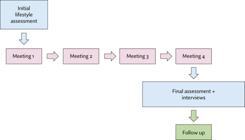
The multicomponent intervention was individual, consisting of an initial lifestyle assessment, followed by four meetings lasting approximately 40 minutes, with the aim of supporting the improvement of lifestyle habits in relation to healthy eating or physical activity, as chosen by the participants. The topics covered in the meetings with the workers were, respectively: tips and benefits of the habit chosen by the participant for change; barriers in the process of changing this habit; and relapses and sabotaging thoughts that arose in the process.
During these four meetings, the participants were given information folders according to the topic and habit chosen. The discussion of the topics was based on the integrated model of behavior change17. The materials given out at each session on healthy eating and physical activity were based on the Dietary Guidelines for the Brazilian Population18and the WHO’s recommendations for physical activity19. This multicomponent intervention was considered feasible based on the analysis of multicomponent interventions tested in other studies and which had effective results9,20,21.
Moreover, the workers received motivational text messages on their cell phones every day until the end of the intervention, also based on the behavior change model17. Also, at each meeting, an action plan was filled in with the workers, in which they set goals to achieve during the intervention and committed to them. At the end of the initial and final assessments, each of the health professionals received feedback on their analyzed lifestyle habits. Figure 1 shows the stages of the multicomponent intervention.
Data collection
Data collection, carried out by means of a semi-structured interview, was guided by nine support questions, with the aim of investigating the opinion of intervention participants about the program carried out, tips for improving the intervention, the conception of some concepts, and their importance.
The questions were based on two qualitative studies carried out previously22,23, one on the inclusion of physical activity programs, health promotion, and education strategies in health services22, and another23aimed at identifying participants’ attendance at physical activity programs. Both studies raised points such as satisfaction, benefits, and strategies for barriers and motivation.
Chart 1 shows the questions asked to the participants to gather their perceptions.
Thus, the nine questions sought to understand the level of satisfaction, suggestions for improving the program, the level of knowledge acquired, the tools and strategies used in the intervention, and the concept of habit change. Prior to having the interview with the participants, a pilot test was carried out, in which the questions were thoroughly analyzed and debated, so that some questions were adjusted because they were confusing or too long.
The interviews were carried out in the participants’ own workplace, in a private room and individually, after the final evaluation of the intervention, by independent interviewers, different from the interventionist, who had been trained beforehand. The interviews were recorded on the interviewer’s smartphone recorder with the worker’s prior authorization and lasted between two and nine minutes. The data was transcribed and classified literally with colloquial speech24, in which pauses and colloquial speech were kept in the transcription.
The qualitative data was analyzed in duplicate, using Bardin’s25and Minayo’s16content analysis technique, which initially consists of a floating reading of the fully transcribed content, then pre-analysis of the data, exploration of the material, and finally interpretation of the results. Based on the content analysis of the answers, they were grouped into categories. To ensure the anonymity of the participants, the letter P was used to identify the participant who answered (P1, P2, P3, etc.).
This study followed the recommendations of the Standards for Reporting Qualitative Research26.
Results and discussion
The 43 workers who participated in the program’s intervention group were invited to take part in this study. Of these, 20 agreed to take part in this stage and therefore made up the sample for this investigation. The 20 workers interviewed were female, had an average age of 42.2 (±7.8) years and worked in different jobs: community health agent, nursing assistant, nurse, dentist, occupational therapist, and doctor.
From the analysis of the interviews, four categories emerged: perceptions of the intervention; participants’ knowledge of behavior change; multiplication of lifestyle information for primary health care users; and suggestions for improvements to the program.
Perceptions of the intervention
The participants were asked about their satisfaction and the effectiveness of the intervention in terms of lifestyle changes and rated the initiative as positive.
Because it encourages you, right? Sometimes, we’re in this monotony, I think it’s more because of that, the incentive, right? (...) I was idle, I needed it, but I needed something to give me... hmm... this trigger to do it (P1).
The program really encouraged me to make exercise a regular part of my life... (P3).
(...) it gave me great encouragement, it helped me to schedule myself, to... sit down to make my meals (P1).
The workers pointed out that the intervention encouraged and supported lifestyle changes, with goals being set and met, and they considered it to be valid and effective. Grande et al.20showed that work consumes a large part of the day and therefore interventions in the workplace are necessary, especially those that include long-term health education21, indicating positive results.
Studies have also shown that interventions aimed at health promotion, using counseling and health education strategies, show a certain degree of adherence by the participants, favoring understanding of healthy habits and helping them to improve their health11,12,27.
Regarding the provision of these actions in the workplace, two participants verbalized the perceived feeling of lack of interest or impracticability on the part of public management in promoting health promotion actions for workers:
It... brings a reality of... of what we’re doing on a daily basis that often goes unnoticed because of the rush, it’s... taking care of the health of... the civil servant is often as important as taking care of the health of the patient, because they’re a person, and they deserve to be taken care of, and you brought this view, of us taking so much care of the other and... and like, what are you doing for your own health? So I think it brought this vision to us (P19).
(...) As employees, we’ve never had... anyone to help us as people, within our work, and I found the proposal interesting, it helped me, my new lifestyle, and I liked it a lot (P16).
The participants’ comments demonstrate the scarcity of interventions aimed at the health of primary health care workers, which is not in line with the National Workers’ Health Policy7,28, which advocates the inclusion of workers’ health care in the Health Care Networks, which has not yet been consolidated, negatively affecting workers who use the health system and the Brazilian Unified Health System (Sistema Único de Saúde [SUS]) workers.
In this context, it is noticeable that the majority of health interventions with primary health care workers are the result of academic interventions9,12,15,20,23,26,27, which, given the lack of actions aimed at the health of the Brazilian Unified Health System (Sistema Único de Saúde [SUS]) workers, denounces the lack of movement on the part of managers regarding the incorporation of programs in the workplace, even though the positive results of this practice are constantly pointed out.
Regarding the adoption of better lifestyle habits, some of the participants admitted their responsibility in the self-care process, but did not feel totally satisfied with the proposal because they wanted long-term practical experience:
I think you even speak well, but if we don’t make an effort, the rest is up to us, isn’t it? It doesn’t depend on you, there’s guidance (P14).
Then the answer is up to me, isn’t it? What affected me. In practice, I couldn’t match it, but I have in mind the whole process that I have to reinforce with the leaflets (laughs), which I can use (...) (P20).
(...) I don’t know... it wasn’t very effective for me, I think (P11).
(...) I think that in addition to theory, there should also be practice (P15).
The dissatisfaction expressed by participant 15 is also indicated in the study by Costa et al.29, who point out that, despite the knowledge acquired through health education, for attitudes to be consolidated, theoretical knowledge must be associated with practice. Resistance to change or difficulty in incorporating new habits can be explained by the initial stage of behavior change30.
What also stands out in the workers’ reports is their desire for change, while at the same time justifying their failure to meet their goals associated with personal reasons:
(...) because people gave me various ideas about what I could do, but I almost always couldn’t put them into practice because of time problems (P6).
It wasn’t that effective, but not because of the program itself, unfortunately I was in a not so good period, right? I was going through a lot of stress, and I couldn’t dedicate myself to it (P10).
I didn’t manage to reach my goal, but it’s... for other reasons (...) it’s personal, my day-to-day life, I can’t share what I have to do with someone else, I must do it myself (...) it’s not laziness, it’s lack of time (P17).
Individual factors show the individual blaming themselves for health care responsibilities30. In this investigation, they can be associated with the female workforce, as indicated by França and Schimanski31, who reports the inclusion of women in the labor market, associated with domestic and family responsibilities, showing an overload that corroborates with their health care taking a back seat.
The study by Lovato et al.23presents the same scenario when investigating attendance at physical activity programs at Primary Health Care Units. The study was not carried out with workers, however, the participants also indicated that adherence is compromised due to family responsibilities and psychological conditions.
Despite some weaknesses pointed out, almost all the participants would recommend the program to friends and family, as they consider it to be a valuable way of encouraging lifestyle changes and passing on knowledge about the subject.
Participants’ knowledge of behavior change
Regarding the participants’ knowledge of the topic covered in the intervention, they reported:
Changing all our habits, changing everything that’s bad, that we used to do to hinder our progress as a person out there, or here at work, I think that’s... what draws our attention to change. The part about sitting down to eat, to talk, to have a coffee, to do some physical activity, I think that’s what I understand as behavioral change (P16).
Getting out of that comfort zone, right? We think it’s just about working, taking care of things, and... I understood that we have to have our leisure time too, for our physical, mental, social, and family well-being, so... I was able to see things a little more clearly. It helped me, you know why? Because I try to live a healthier life, my husband is a vegetarian, he does physical activity, he runs, and he’s always invited me, and I never went, I never went, then after I did this, I said: today I’m going to take advantage of having him, and follow his lead, so it was like that... it came together, it was the leverage. Now the whole family goes (P18).
I think it’s a re-signification of your values, right? sometimes, we get so focused on other things that we can’t see, but when we stop and think about what we’re doing and have the stimulus to really think about it, right? and... and bring to mind what... really weigh up, right? is this doing me good or bad? and be able to give and take... have an attitude, I think that’s it, re-signifying concepts (P10).
The questioning about changing behavior resulted in reflections on life habits, routine, and comfort, as well as a reflection on oneself and the points that could be changed. The statements expressed behavior change as something difficult to achieve, but with beneficial consequences for health and consequently for quality of life32,33.
When asked if the knowledge shared in the intervention meetings has been lasting, the participants gave positive responses, indicating that the knowledge acquired could be applied to everyday life:
Yes, because it’s... it makes a connection with what we really want, right? It’s not something imposed, it’s, you look at yourself and see, look, I’m seeing that I’m in such a way, and there’s a proposal that I’ve given myself for a change, so it’s nothing unattainable, it’s something that can be done (P10).
I think it’s long-lasting, because it’s... you... everything you’ve learned, they’re things you take with you for life, you don’t forget (P13).
Lasting. Lasting because they are things… in practical life, so everything that is put into your practical life and you try to apply and you get results, you take that as a... as a margin of... of objective, so for me, even if, at times, I slip up, it’s... in the face of what I fail to do for myself, but I will never forget what the objective needs to be, so the project brought that to me (P19).
The participants reported that the knowledge shared in the intervention reflects the actions they carry out daily, is related to the goals set, and that even if the change is not immediate, they believe that the knowledge acquired will remain in the long term. Corroborating this, Costa et al.34indicate that programs using health education can be a planned combination of experience-based learning, transmitting information that influences the different aspects of improving their health, and empowering participants32,33.
Communication used in health education programs combines scientific knowledge with popular knowledge. Such interventions make it possible for individuals to adhere to guidelines for changing their behavior, so that when they learn about the benefits and harms of certain habits, they look for strategies to strengthen healthier lifestyle habits, reinforcing the National Policy for Popular Education in Health34,35.
Regarding the strategies and tools used in the intervention, the interviewees highlighted: the guidance offered, the reflections made at the meetings, text messages received between meetings, the feedback on their lifestyle and current anthropometric measurements, as well as the printed materials used, which were the ones that most collaborated with the process of change:
Oh, the whatsapp messages too, the messages that the girl sent me, right? Every day (...) because I was there, right? with the material and every day with the messages and it reminded me every day, so I stuck with it (P7).
I think it was that star, wasn’t it? (...) Some things from there we fixed here within the... unit, not just me but the girls ended up joining and ended up together, we used that star of... lifestyle (P16).
I don’t think I could single out one, but I think all of them, because all the encouragement I was given was... Of course, during this short time, some things were left undone because of my health... not my health, you know, my illness. But I believe that everything... everything I’ve done... (P11).
I think it was the one that made me stop and think that I needed to take my foot off the gas, you know? I won’t remember exactly what it was, but it was to look at myself and say: look, you have the right to stop for a while, look at yourself more, review your routine, right? And organize yourself in such a way that you have time, you have to dedicate yourself to work, to your family, but time for yourself (...) (P10).
The strategies used in the program were seen as powerful by the participants, as indicated by Ribeiro et al.21, who point to the positive results of multicomponent interventions in terms of adherence to change. This research used strategies of individual counseling, goal setting, guidance on overcoming barriers, and the use of printed and educational materials. Research shows that the main methods of motivational interviewing are: reflection, the importance of making an action plan, setting goals, as well as summaries of the change plan that the participant wants to adopt31.
Multiplication of lifestyle information for primary health care users
Some participants reported that when the change starts with themselves, it becomes easier to provide guidance, as people notice the improvement in their lifestyle and this encourages others.
Absolutely, because everything that reflects well on me, if it’s good for me, I can pass on to others, right? There’s no point in me wanting to preach something I don’t do, right? (P1).
Yes. Because you... we experienced it, right? You know the benefit of it, so you can pass it on. There’s no point in you... passing on something you haven’t experienced... then when you do experience it, the information is better, right? (P18).
Yes. Because I work in the health sector, how am I going to talk about changing habits, improving lifestyle with the patient I visit if I don’t do it? What proof am I going to give them that the change in lifestyle is going to be beneficial if I don’t do it? So it has to start with me, I have to prove it so I can, right? Encourage the patient I visit, the patient who comes to the unit, that it’s important (P3).
A study by Figueira et al.36states that the development of health promotion actions in primary care requires professionals who are familiar with the topic of lifestyle changes and who know how to approach them. This is because, when it comes to counseling for health promotion and disease prevention, professionals find it difficult to carry out this action and the format chosen for counseling, which depends not only on technique, but also on personal and professional beliefs.
The multiplication of health information for the population was also addressed by the study by Sá and Florindo12, in which community health agents who took part in the proposed physical activity program indicated that interventions in the work environment offer new knowledge, in order to expand the possibilities of counseling with users of the health service.
Suggestions for improvements to the program
Participants were encouraged to suggest improvements to the program, considering the possibility of future offers:
It’s kind of relative, isn’t it? Because it really depends on the person going, doesn’t it? If they’re very willing... great, go! But if not, I think you need things to motivate them, to really listen to them, to focus on... that they really listened, that they looked for things that could help, guidance, so... that the person who comes to do it is equipped with the same, right? That they have the same willingness to listen, to try to bring the tool according to that person’s needs, I think this can help (P1).
Ah, it would be nice if there were groups, you know? For us to take part in a group, to get together at some point, either for physical activity, or even for a recipe for healthier things, you know? To... see if we don’t get discouraged, because on your own, you end up getting discouraged... We could do some time, something together, you know? It would be really nice (P12).
Maybe an assessment by a professional, to find out what the problem is, to find out what hurts, what prevents it, what stretches it, what... you know? A physiotherapist, something like that... trained... it’s support, like professional support, that can give you more technical information (P20).
The participants made suggestions for strategies to maintain interest and participation. Interventions that use the motivational interviewing technique, which considers autonomy and participation, build alternatives that encourage the interviewee to change, thus causing positive impressions of the strategy32,33. Furthermore, the fact that the meetings were held at the individuals’ workplace, considering the times that suited their availability37, can be considered a driving force.
Another suggestion was related to increasing the duration of the intervention, which can be justified as explained by Reinhardt and Fischer28and Figueira et al.36, who point out that programs carried out with an approach focused on health education have lasting results. In addition, the participants were asked to set goals for changes that they considered feasible, even if they were small. Therefore, the feeling of results from the changes may have been insufficient due to a more immediate expectation, which is common in lifestyle improvements.
Studies such as Hamm et al.38and Arrogy et al.13present interventions that vary between six and three months, but the duration of the program offered is in line with the study by Figlie and Guimarães30and Andretta et al.32, which indicate that interventions carried out with approaches that use strategies such as motivational interviewing are short-lived, with the characteristic of brief interventions, which corroborates the intervention carried out, which is effective in contributing to the worker’s autonomy in relation to habit changes.
The participants signaled their desire to be monitored by nutrition and physical education professionals who can make specific recommendations and assessments. Studies show that this type of intervention using these strategies can be carried out by any previously trained professional12,29,32,33.
Conclusion
The participants considered the program to be effective and feasible. The results point to the lack of actions to promote the health of primary health care workers, who can be multipliers and advisors of a healthy lifestyle for the population, based on the acquisition of knowledge.
The participants’ perceptions, especially regarding the suggestions offered, are of great value to primary health care managers, who can guide the planning and development of theoretical and practical actions for a better lifestyle for workers
In this way, this investigation highlights the importance of implementing actions in favor of occupational health in their work environment, strengthening the need to comply with the objectives of the National Workers’ Health Policy7, which defines guidelines and strategies aimed at safeguarding the health of workers, with health promotion and protection actions, and the implementation of actions that repair health problems resulting from work activity7.
References
- 1 Brasil. Portaria nº 2.436, de 21 de setembro de 2017. Aprova a Política Nacional de Atenção Básica, estabelecendo a revisão de diretrizes para a organização da Atenção Básica, no âmbito do Sistema Único de Saúde (SUS). Ministério da Saúde; 2017. Diário Oficial União. 22 set 2017.
-
2 Aguiar J, Kanan LA, Masiero AV. Práticas integrativas e complementares na atenção básica em saúde: um estudo bibliométrico da produção brasileira. Saude Debate 2020; 43(123):1205-18. https://doi.org/10.1590/0103-1104201912318
» https://doi.org/10.1590/0103-1104201912318 -
3 Florindo AA, Brownson RC, Mielke GI, Gomes GAO, Parra DC, Siqueiro FV et al. Association of knowledge, preventive counseling and personal health behaviors on physical activity and consumption of fruits or vegetables in community health workers. BMC Public Health. 2015;15, (344). https://doi.org/10.1186/s12889-015-1643-3
» https://doi.org/10.1186/s12889-015-1643-3 -
4 Siqueira FV, Reis DS, Souza RAL, Pinho S, Pinho L. Excesso de peso e fatores associados entre profissionais de saúde da Estratégia Saúde da Família. Cad Saude Colet. 2019 abr-jun;27(2):138-45. https://doi.org/10.1590/1414-462X201900020167
» https://doi.org/10.1590/1414-462X201900020167 -
5 Wehrmeister FC, Went AT, Sardinha LMV. Iniquidade e doenças crônicas não transmissíveis no Brasil. Epidemiol Serv Saude. 2022;31(spe1): e20211065. https://doi.org/10.1590/SS2237-9622202200016.especial
» https://doi.org/10.1590/SS2237-9622202200016.especial - 6 Ministério da Saúde (BR). Secretaria de Atnção Primária à Saúde. Departamento de Promoção da Saúde. Guia de atividade física para a população brasileira. Brasília, DF: Ministério da Saúde; 2021.
- 7 Ministério da Saúde (BR). Portaria nº 1.823, de 23 de agosto de 2012. Institui a Política Nacional de Saúde do Trabalhador e da Trabalhadora. Política Nacional de Saúde do Trabalhador e da Trabalhadora. Brasília, DF: Ministério da Saúde; 2012.
-
8 Costa IP, Pimenta CJL, Brito MJM. Adversidades vivenciadas por profissionais na Atenção Primária à Saúde: implicações para os sentidos do trabalho. Escola Anna Nery 2019; 23(3):e20180373. https://doi.org/10.1590/2177-9465-EAN-2018-0373
» https://doi.org/10.1590/2177-9465-EAN-2018-0373 -
9 Soares J, Vargas D. Effectiveness of brief group intervention in the harmful alcohol use in primary health care. Rev Saude Publica 2019 Dec;53:4. https://doi.org/10.11606/S1518-8787.2019053000498
» https://doi.org/10.11606/S1518-8787.2019053000498 - 10 World Health Organization. World Economic Forum. Preventing noncommunicable diseases in the workplace through diet and physical activity: WHO/World Economic Forum report. New York: World Health Organization, World Economic Forum; 2008.
-
11 Santos RP, Horta PM, Souza CS, Santos CA, Oliveira HBS, Almeida LMR, et al. Aconselhamento sobre alimentação e atividade física: prática e adesão de usuários da atenção primária. Rev Gaucha Enferm 2012 dez;33(4):14-21. https://doi.org/10.1590/S1983-14472012000400002
» https://doi.org/10.1590/S1983-14472012000400002 -
12 Sá TH, Florindo AA. Efeitos de um programa educativo sobre práticas e saberes de trabalhadores da Estratégia de Saúde da Família para a promoção de atividade física. Rev Bras Ativ Fis Saude 2012;17(4):293-99. https://rbafs.org.br/RBAFS/article/view/1881
» https://rbafs.org.br/RBAFS/article/view/1881 -
13 Arrogy A, Schotte A, Bogaerts A, Boen F, Seghers J. Short- and long-term effectiveness of a three-month individualized need-supportive physical activity counseling intervention at the workplace. BMC Public Health 2017 Jan;17(1):52. https://doi.org/10.1186/s12889-016-3965-1
» https://doi.org/10.1186/s12889-016-3965-1 - 14 Smith PJ. A percepção como uma relação: uma análise do conceito comum de percepção. Analytica 2014;18(1):109-32.
- 15 Araújo LR, Alves JP, Diniz IVA, Lima GV, Martiniano CS. Modificações no estilo de vida de pessoas com Diabetes mellitus: abordagem nutricional e de atividade física por profissionais da atenção primária à saúde. J Biol Pharm Agricultural Manag. 2021 jan-mar;17(1):78-92.
- 16 Minayo MCS. O desafio do conhecimento: pesquisa qualitativa em saúde. 12a ed. São Paulo: Hucitec; 2010.
-
17 Hagger MS, Chatzisarantis NL. An integrated behavior change model for physical activity. Exerc Sport Sci Ver. 2014 Apr;42(2):62-9. https://doi.org/10.1249/JES.0000000000000008
» https://doi.org/10.1249/JES.0000000000000008 - 18 Ministério da Saúde (BR). Guia alimentar para a população brasileira. Brasília, DF: Ministério da Saúde; 2014.
- 19 Camargo EM. Añes CRR, trad. Diretrizes da OMS para atividade física e comportamento sedentário: num piscar de olhos. Organização Mundial da Saúde; 2020.
-
20 Grande AJ, Silva V, Manzatto L, Rocha GCM, Vilela Junior GB. Comparação de intervenções de promoção à saúde do trabalhador: ensaio clínico controlado randomizado por cluster. Rev Bras Cineantropom Desempenho Hum 2013 fev;15(1):27-37. https://doi.org/10.5007/1980-0037.2013v15n1p27
» https://doi.org/10.5007/1980-0037.2013v15n1p27 -
21 Ribeiro EHC, Garcia LMT, Salvador EP, Costa EF, Andrade DR, Latorre MRDO, et al. Avaliação da efetividade de intervenções de promoção da atividade física no Sistema Único de Saúde. Rev Saude Publica 2017;51:56. https://doi.org/10.1590/S1518-8787.2017051006654
» https://doi.org/10.1590/S1518-8787.2017051006654 -
22 Andrello E, Loch MR, Junior AC, Reichert FF. Atividade física e saúde pública sob o olhar de secretários municipais de saúde. Rev Bras Ativ Fis Saude. 2012;17(3):206-11. https://rbafs.org.br/RBAFS/article/view/1860
» https://rbafs.org.br/RBAFS/article/view/1860 -
23 Lovato N, Loch M, González A, Lopes M. Assiduidade a programas de atividade física oferecidas por Unidades Básicas de Saúde: o discurso de participantes muito e pouco assíduos. Rev Bras Ativ Fis Saude 2015;20(2):184-92. https://doi.org/10.12820/rbafs.v.20n2p184
» https://doi.org/10.12820/rbafs.v.20n2p184 - 24 Gibbs G. Análise de dados qualitativos. Porto Alegre: Artmed; 2009.
- 25 Bardin, L. Análise de conteúdo. São Paulo: Almedina; 2011.
-
26 O'Brien BC, Harris IB, Beckman TJ, Reed DA, Cook DA. Standards for reporting qualitative research: a synthesis of recommendations. Acad Med. 2014;89(9);1245-51. https://doi.org/10.1097/ACM.0000000000000388
» https://doi.org/10.1097/ACM.0000000000000388 -
27 Toledo MTT, Abreu MN, Lopes ACS. Adesão a modos saudáveis de vida mediante aconselhamento por profissionais de saúde. Rev Saude Publica. 2013;47(3):540-8. https://doi.org/10.1590/S0034-8910.2013047003936
» https://doi.org/10.1590/S0034-8910.2013047003936 - 28 Reinhardt EL, Fischer FM. Barreiras às intervenções relacionadas à saúde do trabalhador do setor saúde no Brasil. Rev Panam Salud Publica 2009;25(5):411-7.
-
29 Costa EF, Guerra PH, Santos TI, Florindo AA. Systematic review of physical activity promotion by community health workers. Prev Med 2015 Dec;81:114-21. https://doi.org/10.1016/j.ypmed.2015.08.007
» https://doi.org/10.1016/j.ypmed.2015.08.007 -
30 Figlie NB, Guimarães LP. A entrevista motivacional: conversas sobre mudança. Bol Acad Paul Psicol 2014 dez; 34(87):472-89. https://nelianafiglie.com.br/wp-content/uploads/2015/06/Entrevista-motivacional-conversas-sobre-mudan%C3%A7as.pdf
» https://nelianafiglie.com.br/wp-content/uploads/2015/06/Entrevista-motivacional-conversas-sobre-mudan%C3%A7as.pdf -
31 França AL, Schimanski E. Mulher, trabalho e família: uma análise sobre a dupla jornada feminina e seus reflexos no âmbito familiar. Emancipação 2009;9(1):65-78. https://doi.org/10.5212/Emancipacao.v.9i1.065078
» https://doi.org/10.5212/Emancipacao.v.9i1.065078 - 32 Andretta I, Meyer E, Kuhn RP, Rigni MA. Entrevista motivacional no Brasil: uma revisão sistemática. Mudança - Psicologia da Saúde 2014;22(2):15-21.
- 33 Garcia LM, Andretta I. Revisão sistemática da aplicabilidade da entrevista motivacional no tratamento dos transtornos da alimentação. Mudanças - Psicol Saude 2017; 25(2):59-67.
- 34 Costa AC, Silva RV, Pernambuco AP, Leal JC, Ferreira RV, Cruvinel Júnior RH, et al. Educação a curto prazo e sua influência sobre a saúde de mulheres obesas. Br J Health Rev. 2018;1(2):364-88.
- 35 Ministério da Saúde (BR): Humaniza SUS: documento base para gestores e trabalhadores do SUS. Brasília, DF Ministério da Saúde; 2010.
-
36 Figueira TR, Davis NA, Morais MN, Lopes ACS. Percepções sobre adoção e aconselhamento de modos de vida saudáveis por profissionais de saúde. Trab Educ Saúde 2015;13(1):181-200. https://doi.org/10.1590/1981-7746-sip00021
» https://doi.org/10.1590/1981-7746-sip00021 -
37 Ferreira ML, Artes LMA. Intervenções realizadas no ambiente de trabalho para o uso de drogas: revisão sistemática. Psicol Cienc Prof. 2015 jan-mar;35(1):96-110. https://doi.org/10.1590/1982-3703001802013
» https://doi.org/10.1590/1982-3703001802013 -
38 Hamm NC, Kehler DS, Hay JL, Stammers NA, Strachan SM, Bouchard DR, et al. A quasi-experimental study examining the impact and challenges of implementing a fitness-based health risk assessment and a physical activity counseling intervention in the workplace setting. Health Serv Res Manag Epidemiol. 2019 Oct;6: 2333392819884183. https://doi.org/10.1177/2333392819884183
» https://doi.org/10.1177/2333392819884183
-
Information about academic work:
This article is based on Marília Coelho’s undergraduate thesis entitled “Avaliação de uma intervenção de hábitos de vida para trabalhadores da Atenção Básica: um estudo qualitativo (Evaluation of a lifestyle intervention for primary care workers: a qualitative study)”, presented in 2020 at the Federal University of São Carlos.
-
Data availability:
The entire data set supporting the results of this study is available upon request to the contact author.
-
Presentation at a scientific event:
The authors declare that this study has not been presented at a scientific event.
-
Funding:
The authors declare that the study was not funded.
Edited by
-
Editor-in-Chief:
Ada Ávila Assunção
The entire data set supporting the results of this study is available upon request to the contact author.

 Source: own elaboration.