
 Making work meaningful again: A revolutionary aspiration
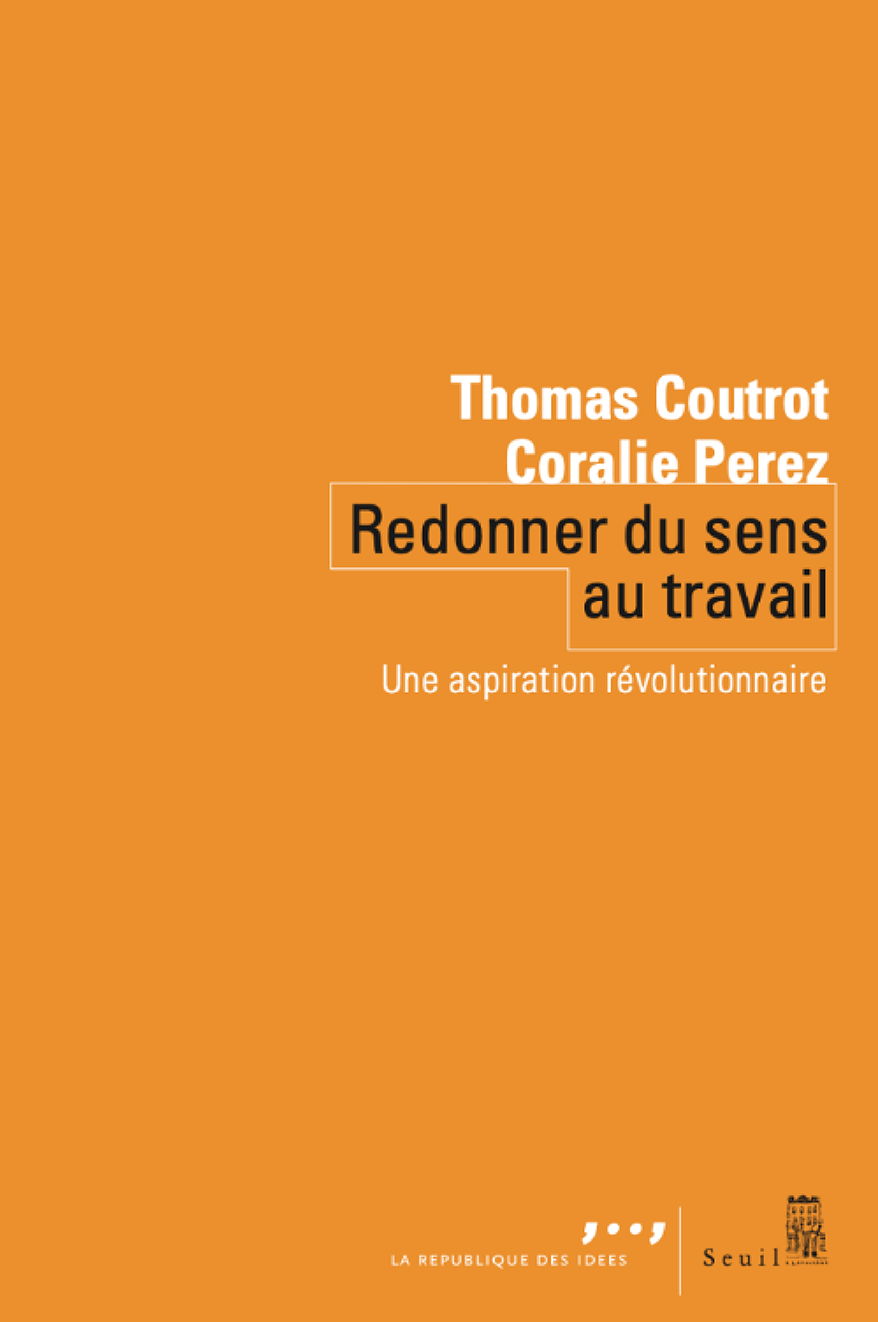
Could reflecting on the meaning of work be revolutionary and subversive in current times? How would such reflection connect with contemporary trade union and environmental movements? Would it encourage an ecosocialist perspective? What are the real origins of worker discouragement in recent years - exacerbated after the COVID-19 health crisis - and what consequences will it have for work, employment, the economy, and ecology in the coming period1? To answer these questions, in Redonner du sens au travail: une aspiration révolutionnaire, Thomas Coutrot and Coralie Perez revisit and interpret data from their previous study Quand le travail perd son sens2- a pioneering econometric investigation into the relationship between the meaning of work and professional mobility in France.
Without academicism, the book shows the authors’ commitment to dialoguing with the working class, against the backdrop of their historical aspirations, some of which are unresolved. It encourages us to reflect on the determinants of the meaning attributed to work by workers and gives new meaning to their critical experiences of the purpose and impact of this work on themselves and the world around them.
Searching for meaning... with an empty tank
In a commentary on the book itself, the authors focus on the current issues surrounding the meaning of work, sometimes inserting them into a larger dimension, that of public health3. The COVID-19 pandemic, which has highlighted the social usefulness of occupations in the public debate, has also reinforced a questioning of the meaning of work. Already in the introduction, the authors give us clues in the wordplay created between sens (sense, meaning) and essence (essence, but colloquially it also means gasoline in France) to express clashing conceptions in the world of real work. The contrast between the worker’s power to act and the power to buy fuel - amid the search for a new order in the post-pandemic chaos: the old ethos and the emerging one, concomitant and conflicting. The prospect is of a new globalized environmental order (eco-nomics) and all sorts of global crises and reverberations that could add (or subtract) meaning and reason to the existence of contemporary work - these are some of the ontogenetic contours of the work. By reviewing specialized multidisciplinary literature, they provide a broad theoretical reference framework for readers interested in the subject of meaning (i.e. the sense of work itself).
On the empirical side, the authors smoothly tackle the difficulties that statistical practice brings to the objectification of perceptions that are sometimes too fluid. Without ignoring Karasek’s epidemiology in the analysis of psychosocial risks at work and its value as a construct for a science aimed at promoting workers’ health, they propose something innovative. They see the emptying of meaning as an emerging psychosocial risk factor amid the health crisis triggered by the pandemic. They postulate that work gains meaning - intrinsically and profoundly political - when it faces the questions of acting for transformation: that of the natural world, that of the social world, and that of oneself, the worker. And they make this political outlook the epistemic foundation of their metrics. They examine the political factors that condition social illness in contemporary times, with biopolitics at the center of determination.
For the authors, the debate on the meaning of work has been the subject of persistent omission in the social sciences and the very idea that work could (or should) have meaning continues to clash with a series of theoretical and political resistances, which they examine at various points.
DARESb evoking Dejours: the worker on the couch?
The first chapter discusses three dimensions of the meaning of work, following the Christophe Dejour concepts and perspective: i) that which relates to a purpose to be achieved in the objective world; ii) that which relates to its social valuation; and iii) that of self-realization, in the subjective world. From this perspective, the authors developed metrics for social utility: (i) ethical coherence (ii) and development capacity (iii), in the search for objective variables to capture the meaning of work, living or dead, on a population scale. These metrics were put to the test in the Working Conditions Surveys conducted from 2013 to 2016c. A comment on the perceived decline in ethical coherence by workers - resulting from the analysis of data from the TraCov telephone survey during the COVID-19 health crisis - concludes the first chapter. The robustness of the French national surveys of working conditions leaves no room for doubt about the relevance of the basic empirical study conducted by the authors.
Chapter 2 begins by problematizing the meaning of work according to various currents of thought. The authors then use empirical data to debunk the idea that the emptying of the meaning of work is exclusively a problem for the “rich”. Closing the chapter, they unveil the prestidigitation of meaning in the doctrine of empowerment, which promotes the intensification of work by cunningly capturing the worker’s subjectivity. In practice, a “pseudo-sense” of work is induced that is intended to be replete of meaning, but which is manipulated as a subterfuge to legitimize the over-exploitation of the workforce, masking it.
The following chapters are filled with vivid testimonies that substantiate the various statistical targets.
Management by figures: from Peter Drucker to today’s disengagement
Recurring expressions in the vocabulary of the loss of the meaning of work: disembodied processes, measurable objectives, continuous benchmarking, permanent reporting, constant organizational changes. At the root of these management techniques is the financialization of the economy, of which the authors are fierce critics.
The “stripped-down management” (or for some just: “lean”) that emerges as a neo-taylorism and the NPM (New Public Management) doctrine inspired by the private sector and applied to public services produce similar and very harmful effects in sectors such as health and education. When management chooses exclusively quantitative evaluation parameters and when the spreadsheet becomes the oracle of productivist optimization (often on an individual basis), it prones to deform work, impoverish its essence, and empty it of human meaning. In the hospital sector, the maniacal rage for evaluations imposed by constant pricing in spreadsheets absorbs time that could be better spent caring for patients or even trying to improve this care. In chapter 7, a nurse describes her traumatic experience with the precariousness of health care at her hospital. In education, the endless evaluations and recurring reforms that lead to the early obsolescence of indicators - a symptom of the performative emphasis on disruptive management - result in equivalent chronophagia. It is no coincidence that these are two sectors facing a serious manpower crisis, with worker disengagement and discouragement, in which burnout has become commonplace, as well as some musculoskeletal disorders and work-related mental disorders.
The paradigmatic case of the professional reconversion of the sociology teacher-researcher who leaves the university to become involved in an ecological bakery project speaks very eloquently about the impeded work of teachers (professional action curtailed by illogicalities) and the current crisis in the activity of education. In the end, the questions “educate for what?” and “for whom?” lead us to a paradoxical circularity: if action in education is impeded, what societal project can be based on good faith?
What’s the point of work that destroys the environment?
Chapter 4 - “Working against nature” - discusses the ethical limits and constraints of a job. It revisits an article by Coutrot on the ethical-environmental conflict at work4. The text ranges from broad issues relating to work that is known to be potentially harmful to the environment (e.g. those involving risks of biosafetyd involved in working with GMOs in agriculture and increased risks in the oil industry) to some specific, more prominent or impactful cases, such as the warnings coming from the world of work.
The authors mention links between trade unionists and environmentalists which, although they still seem uncommon today, deserve more serious study. Such as the case of unionized (CGT) workers from the glass industry in Chalon-sur-Saône, who joined environmental associations to denounce the asbestos pollution caused by their factory. Or, even more emblematic, the case of “labor environmentalism” involving the paper industry in La Chapelle d’Arblay, Normandy - an unprecedented and successful alliance between CGT trade unionists and environmental activists (among others, those from Greenpeace and EELVe).
The carrot and the wand are no panacea...
ESG (Environment, Social & Governance), the carbon credit market, Triple P (People, Planet, Profit), collective interest companies, etc., nothing escapes the critical and ecosystemic eye of the authors in chapter 5 - “In search of lost meaning”. The authors recall the steps taken in the corporate world to overcome the discouragement that workers experience when confronted with Taylorism. This discouragement has largely continued with the advent of “lean” production organizations, whose model has been nicknamed Toyotism or directly “lean production”.
The authors take a panoramic look at corporate governance practices towards social responsibility, a panorama that - “far from being a dream!” - shows how they actually weren’t able to provide employees with a lost sense of meaningfulness in their work. Since the 1970s, little progress has been made in motivating workers to become more involved in their work beyond merely appealing to maximize the shareholder value of their companies. It wasn’t until the 1990s that corporate projects and letters of intent began to circulate which, by promoting the idea of “leadership by values”, sought to encourage a different kind of engagement, one that would emulate the construction of a “shared” meaning between the different productive actors, whether they were technical staff, or blue-collar employees. This is something that, since then, the rhetoric of social responsibility has absorbed and gradually developed, glimmering the values of ethics, compliance, and diversity as a counterpoint to the established management archetype - which Isaac Getz and others labeled “toxic”, as mentioned in the book. Protocols of socio-environmental intent were adopted and publicized in large corporations, even acquiring the status of targets for some of them, which began to receive external audits; in others, however, they were nothing but a marketing gimmick or, at most, wishful thinking.
The authors analyze some explicit cases of ESG’s “good intentions”, but which ended up crossing the Aqueronte River. There are also cases of companies that are recognized as “ethical” in corporate world rankings, such as General Electric, hit by accusations of tax evasion and the target of controversy for its faulty nuclear reactors in Fukushima, and Volkswagen, with its flawed Co2 vehicle emission tests.
Again, empirical data reinforces the arguments. It is astonishing that almost half of French workers report ethical conflicts at work, regardless of whether or not there is an affirmative ESG policy in the company.
Top-down “liberation”
Chapter 6 begins by describing how the history of business management is full of attempts to “humanize work”, which in itself demonstrates the resistance of Taylorism, which would have permeated it.
Then, in view of the hegemonic tendency towards management by numbers, they discuss the proposal for a “liberated company”, a concept coined by Getz, which supposedly relies on employees’ individual and collective self-organization capacities. Something we could call here a “self-management” model, but top-down in its conception and essence. Coutrot and Perez refuse to consider this corporate approach a “cynical” make-believe by the management party - as some have criticized – and judge it to be a form of collective action, concerted between humanist leaders. From there, they go on to analyze various “liberation” experiments underway in France, following this particular political project. They analyze the institutional mechanics of sociocracy and holacracy - models for an ideally self-governing company, where decision-making authority is distributed - and compare these different idealized conceptions with that of the “liberated company”, in order to discuss its limits and possibilities.
Echoes of new ecopraxis
The result of aspirations for personal development and satisfaction with the usefulness of work clashing with real work in the Taylorist organization (which prevents “living work”) is suffering at work. This, if continued, can lead to the search for escape (escape from that organization) or, in the worst case, illness and death. But for Coutrot and Perez, there is a chance of reversal when workers mobilize collectively.
In chapter 7 (bottom-up initiatives), the authors explain that the lack of development capacity and the social usefulness of work proved to be strong determinants of worker mobilization in search of greater meaning for their occupation. The link between the loss of meaning and union mobilization in 2013 and 2016 was analysed in their econometric study. Next, an inferential leap is made to the entire decade, and one can’t help but sense a zeitgeist hovering there. The authors theorize how the mass layoffs that took place after the health crisis - dressed up as a political fact capable of altering social power relations - can translate the weight of a mass action inspired by a collective refusal of indignity. A key point: consent to “bullshit jobs” - rejected in favor of a collective aspiration to live-work, ethically defensible. The worker’s disenchantment with the prestidigitation of meaning, be it media or intracorporate, a disenchantment that has now reached paroxysm and become epidemic. To restore a “healthy human ecology” [our expression] to human action, i.e. that of good living-work, we need to bring another form of work organization to the worker’s perspective, no longer the old formula, overused and endorsed by passive unions in the face of ethical malaise, because they too have already surrendered to scientism and productivism.
Despite the substantial differences in the labor regulatory framework, here and there, south and north - and the reality that distances our economy from the thriving French economy and our culture from theirs - the book brings us reflections that are the order of the day, whether they seem utopian or notf. Let’s hope that some reader of this review takes the time to translate the book, since we certainly lack reflections of this magnitude in Brazil.


References
- 1 Coutrot T, Perez C. Redonner du sens au travail: une aspiration révolutionnaire. Paris: Seuil, 2022. (Seuil. La République des Idées)
-
2 Coutrot T, Perez C. Quand le travail perd son sens. L'influence du sens du travail sur la mobilité professionnelle, la prise de parole et l'absentéisme pour maladie: une analyse longitudinale avec l'enquête Conditions travail 2013-2016. HAL SHS: Sciences humaines et sociales. 2021 [citado 12 ago 2024]. Disponível em: https://shs.hal.science/halshs-03324454
» https://shs.hal.science/halshs-03324454 -
3 Perez C, Coutrot T. Le sens du travail, enjeu majeur de santé publique. Portal Sciences Po: Laboratoire interdisciplinaire d'évaluation des politiques publiques. Paris: Sciences Po; 2021 [citado 12 ago 2024. Disponível em: https://www.sciencespo.fr/liepp/fr/content/coralie-perez-thomas-coutrot-le-sens-du-travail-enjeu-majeur-de-sante-publique.html
» https://www.sciencespo.fr/liepp/fr/content/coralie-perez-thomas-coutrot-le-sens-du-travail-enjeu-majeur-de-sante-publique.html -
4 Coutrot T. Le conflit éthique environnemental au travail: une première analyse empirique à partir de l'enquête Conditions de travail 2019. Revue Travail et Emploi 2021[citado 12 ago 2024]:166-167,183-206. Disponível em: https://dares.travail-emploi.gouv.fr/publication/le-conflit-ethique-environnemental-au-travail-une-premiere-analyse-empirique-partir-de
» https://dares.travail-emploi.gouv.fr/publication/le-conflit-ethique-environnemental-au-travail-une-premiere-analyse-empirique-partir-de
-
b
Acronym for “Direction de l’Animation de la Recherche des Études et des Statistiques”, part of the French Ministry of Labor.
-
c
These Surveys have been carried out by DARES since 1978 in France, in collaboration with INSEE, an acronym for “Institut National de la Statistique et des Études Économiques”, a government body similar to Brazilian IBGE.
-
d
GMO is an acronym for Genetically Modified Organisms.
-
e
EELV is an acronym for “Europe Écologie Les Verts”, a French Eurofederalist and ecologist political grouping (“The Greens”), which became a political party in 2023.
-
f
For those interested in a more in-depth look at the construction of the indicators and their statistical modeling, we recommend reading the authors’ similar article, available for free on the HAL - Open Science platform, as well as the interpretative synopsis of their findings (opus citatum ).
Edited by
-
Editor-in-Chief:
Leila Posenato Garcia


