
 Copenhagen Psychosocial Questionnaire – Brazilian short version (COPSOQ II-Br): application and potential for assessing psychosocial work factors in the context of NR-1
Abstract
Objective To provide a conceptual foundation for and present the Brazilian short version of the Copenhagen Psychosocial Questionnaire (COPSOQ II-Br), explain how scores are calculated and how results are interpreted, and present its applications and potential uses, including as a supportive tool in the context of implementing Labor Regulatory Standard No. 01 (NR-1).
Methods This review is based on the analysis of documentary and scientific sources retrieved from the SciELO, PubMed, and Scopus databases between November 2025 and March 2026.
Results This essay presents the conceptual basis of the instrument and its evolution over the years; it identifies similarities and differences among terminologies addressing psychosocial factors at work, psychosocial risks, and their interfaces with labor regulatory standards. It also provides guidelines for the application, analysis, and interpretation of the data addressed by COPSOQ II-Br and reviews studies that have used the instrument in Brazilian populations, discussing its potential and limitations.
Conclusions This review highlights the potential of COPSOQ II-Br for assessing psychosocial factors in the workplace. The instrument can contribute to organizational diagnosis and support surveillance, planning, and intervention efforts in work environments.
Keywords:
Mental Health; Occupational Stress; Working Conditions; Occupational Health
Resumo
Objetivo Fundamentar conceitualmente e apresentar o Copenhagen Psychosocial Questionnaire em sua versão curta brasileira (COPSOQ II-Br), explicar o cálculo dos escores e a interpretação dos seus resultados e apresentar suas aplicações e potencialidades, inclusive como instrumento de apoio no contexto de aplicação da Norma Regulamentadora do Trabalho n° 01 (NR-1).
Métodos Ensaio fundamentado na análise de fontes documentais e científicas, estas levantadas nas bases SciELO, PubMed e Scopus, de novembro de 2025 a março de 2026.
Resultados O ensaio apresenta a fundamentação conceitual do instrumento e sua evolução ao longo dos anos; identifica similaridades e diferenças entre terminologias que abordam os fatores psicossociais do trabalho, os riscos psicossociais e suas interfaces com as normas regulamentadoras do trabalho. Também apresenta orientações para aplicação, análise e interpretação dos dados que o COPSOQ II-Br aborda e estudos que utilizaram o instrumento em populações brasileiras, discutindo suas potencialidades e limitações.
Conclusões Este ensaio evidencia o potencial do COPSOQ II-Br para a avaliação dos fatores psicossociais do trabalho. O instrumento pode contribuir para o diagnóstico organizacional e subsidiar ações de vigilância, planejamento e intervenção em ambientes de trabalho.
Palavras-chave:
Saúde Mental; Estresse Ocupacional; Condições de Trabalho; Saúde do Trabalhador
Introduction
The growing number of work absences due to mental health problems led to the revision of Labor Regulatory Standard No. 1 (NR-1)1, which requires companies to identify, assess, and propose action plans to mitigate psychosocial risks2. The new version of NR-1 promotes the use of valid and reliable instruments for identifying psychosocial risks in the workplace.
Despite the initiative from the Ministry of Labor and Employment (MTE) to include psychosocial risks as part of Occupational Risk Management (ORM) in NR-1 starting in 20242, assigning this responsibility to employers3, the financial impact of mental illness on public coffers continues to rise. The National Association of Occupational Medicine (ANAMT), based on data from the National Social Security Institute (INSS), noted that absences exceeding 15 days due to mental disorders have shown rapid growth, nearly doubling in volume between January 2023 and November 20254.
These data highlight the complexity of the issue, which requires a genuine commitment from organizations to review their practices and management models, including the active and proactive participation of the people who work there, with the aim of creating safe work environments and processes capable of protecting mental health and, perhaps more importantly, promoting it5. This requires the application of tools capable of analyzing psychosocial factors in the workplace that may act as risk or protective factors, to trigger actions based on a well-defined diagnosis of reality developed in dialogue with different stakeholders.
The short version of the Copenhagen Psychosocial Questionnaire (COPSOQ II-Br) was translated and cross-culturally adapted for use in Brazil in 2019 as part of a doctoral dissertation conducted in the Graduate Program in Physical Therapy at the Federal University of São Carlos6. The article7 resulting from this thesis describes the adaptation and validation process; however, it is not available in Portuguese, does not provide the full version of the validated questionnaire, and does not present operational aspects for the calculation and interpretation of results. Thus, this essay aims to provide a conceptual foundation for and present the Copenhagen Psychosocial Questionnaire in its Brazilian short version (COPSOQ II-Br), explain the calculation of scores and the interpretation of its results, and present its applications and potential, including as a support tool in the context of the application of Labor Regulatory Standard No. 01 (NR-1).
Methods
This is a reflective and interpretive study, grounded in the authors’ experience with the validation and application of the questionnaire and in the analysis of scientific and documentary sources relevant to the topic8. The texts supporting this essay were selected considering the centrality of COPSOQ in the debate on psychosocial factors at work and its contribution as an analytical perspective to be adopted by occupational health and safety (OHS) professionals and employers. The selection of scientific texts was based on a search of the Scientific Electronic Library Online (SciELO), Medical Literature Analysis and Retrieval System Online (MEDLINE)/PubMed, and Scopus databases, covering the period from November 2025 to March 2026, using the keywords: working conditions, work environment, occupational stress, and Copenhagen Psychosocial Questionnaire (COPSOQ).
The analysis of the selected sources was conducted through interpretive reading, focusing on concepts related to the psychosocial aspects of work. The material was organized thematically, guided by the text’s argumentative structure, to ensure greater clarity, transparency, and methodological rigor in the study.
Concepts and Terminology
According to the definition of the International Labour Organization (ILO)9 (Table 1), the work environment and workers are in dynamic interaction, with the work environment, job tasks, and organizational factors representing the aspects that characterize occupational activity. Workers’ reactions depend on their abilities, needs, expectations, culture, and personal lives and may change over time, reflecting adaptations.
The Ministry of Labor and Employment (MTE)10 adopts a definition aligned with that of the ILO (Table 1). Although the relationship between work and workers’ reactions does not necessarily imply a causal relationship11, the ILO definition suggests that a negative interaction between working conditions and workers can lead to emotional disturbances, behavioral problems, and biochemical and neurohormonal changes, with additional risks of physical and mental illnesses, as well as adverse effects on job satisfaction and work performance. Conversely, a balance between occupational conditions and workers can have a positive influence, particularly on health9.
Although there is clarity regarding the impact of psychosocial factors on occupational health, there is still disagreement in the literature regarding the terminology used to refer to psychosocial factors in the workplace. It should be noted that the references included in Table 1 do not exhaust the relevant literature but are considered the main scientific and normative references on the subject.
Multiple meanings and definitions of mental health in the workplace lead to generalizations that do not always reflect similar meanings15. While NR-17 uses the term “psychosocial aspects of work,” NR-1 employs the terminology “work-related psychosocial risk factors”2. Although it does not explicitly define the term, NR-17 states that organizations must assess: “work situations that, due to the nature and content of the required activities, demand adaptation to the psychophysiological characteristics of workers”13. The Information Guide on work-related psychosocial risk factors, on the other hand, defines the term mentioned in NR-1 as:
hazards arising from problems in the design, organization, and management of work, which may have psychological, physical, and social effects on occupational health, such as triggering or exacerbating work-related stress, burnout, depression, WMSDs, among others10 (p. 6).
Although these terms are connected, the psychosocial aspects of work refer to characteristics observed in the workplace, while work-related risk factors are aspects of work that pose a risk to workers’ mental health.
Given the diversity of terms, in this essay we adopt the term psychosocial factors of work. This term seems to us to be more aligned with the theories underpinning COPSOQ, since it refers to positive and negative aspects of the work environment, which can act as protective or risk factors for occupational health.
Copenhagen Psychosocial Questionnaire (COPSOQ)
The COPSOQ was developed in Copenhagen, Denmark, in the early 2000s by Tage Kristensen and colleagues at the National Institute of Occupational Health. The initiative aimed to provide a comprehensive instrument covering both negative and positive elements of the work environment. The instrument was designed to be theoretically grounded, without being tied to a single explanatory model, to integrate dimensions recognized in different conceptual frameworks regarding work, health, and well-being12.
The goal of developing COPSOQ was to enable comparisons at the national and international levels, enhance the analysis of interventions, facilitate the monitoring and comparison of results, improve communication among companies, professionals, and researchers, and make the concepts and theories in this field more accessible12.
According to the original study, COPSOQ was developed based on the following principles12:
-
To be theory-based, but not tied to a specific theory;
-
Consist of dimensions related to different levels of analysis (such as organization, department, job, person-work interface, and individual);
-
Include dimensions related to work tasks, the organization of work, interpersonal relationships at work, cooperation, and leadership;
-
Cover potential work stressors, as well as resources such as support, feedback, commitment, and good health;
-
Be comprehensive and generic, that is, it should be applicable to all sectors of work;
-
Have practical and easy-to-administer versions for both occupational health and safety professionals and workers.
The method of administering the instrument is a critical factor for data quality, especially among workers with varying levels of education. Items with a higher degree of abstraction can lead to diverse interpretations, which underscores the importance of strategies such as assisted administration, pre-testing with cognitive interviews, and standardization of clarifications, to ensure adequate understanding and the validity of responses.
Development of COPSOQ in short, medium, and long versions
COPSOQ has evolved over time into three versions: COPSOQ I, COPSOQ II, and COPSOQ III, each structured into short, medium, and long versions12,16,17. Currently, COPSOQ is available in more than 25 languagesdand is used by the World Health Organization (WHO), the ILO, and the European Agency for Safety and Health at Work (EU-OSHA) as a benchmark for best practices18.
To ensure reliable and comparable results, it is essential that the instrument be used in a version validated for the national context, considering cultural, linguistic, and organizational differences19. Here, we present an overview of the three versions of COPSOQ, developed based on a comparative analysis of the original instruments, emphasizing their characteristics, purposes, and differences.
COPSOQ I, developed in 2005, was structured to comprehensively cover the main psychosocial factors of work, organizing the items into dimensions related to work demands, organization, and content; relationships and leadership; the work-individual interface; health and well-being; as well as individual factors12. The questionnaire is based on the understanding that work is permeated by multiple spheres that affect health, including autonomy, social support, emotional demands, and role clarity, and sought to integrate elements present in various classical theories on psychosocial factors at work, including: (i) the job characteristics model, (ii) the Michigan organizational stress model, (iii) the demand-control-(support) model, (iv) the sociotechnical approach, (v) the action-theoretical approach, (vi) the effort-reward-imbalance model, and (vii) the vitamin model12. As a comprehensive instrument, COPSOQ includes, in addition to environmental and work organization factors, health outcomes, well-being, and job satisfaction.
COPSOQ I is available in three formats: the long version, designed for scientific research, includes multiple dimensions of work and detailed health indicators; the medium version, intended for occupational health professionals, maintains broad coverage but with a reduced number of scales to facilitate use in institutional assessments; and the short version, designed for use in work settings, which emphasizes visual communication of results and understandable feedback. Among the advantages of this first version are its broad conceptual scope and pioneering approach to differentiating types of demands, although some scales showed low practical applicability in organizational contexts12.
In 2010, COPSOQ II was developed based on critical analyses of the instrument’s use in different countries, psychometric evaluations, and the need for conceptual updating16. This version introduces adjustments, such as the exclusion of scales that are not operational for organizational assessment, the reformulation of health scales to more accurately capture psychosocial effects, and the inclusion of new dimensions focused on organizational values, recognition, and work-family conflict. At the same time, 57% of the items were retained, ensuring historical comparability. The three versions (short, medium, and long) retained functions similar to those of the previous version, although the medium version was reorganized to facilitate institutional diagnoses. Among its advantages are greater practical relevance, reorganization of dimensions for institutional use, and reduction of redundancies, while its limitations include variation in scales depending on the occupational context, which requires attention to cultural interpretation16.
The most recent version, COPSOQ III, released in 2019, was the result of an international collaborative process involving researchers and professionals from various countries, with the aim of updating the instrument in light of new changes in the workplace, such as job insecurity, work-life conflicts, and violence, including cyberbullying17. The central element of this version is the concept of core items, which are mandatory and ensure international and longitudinal comparability. These items can be supplemented by additional middle and long items depending on the local context. In the short version, in addition to the core items, a limited number of additional items were included, sufficient to provide complementary information without making the application too lengthy. The medium version combines all core items with the greatest possible number of relevant additional items, balancing content coverage and practicality for institutional assessment. The long version incorporates all core items and all additional items considered important for the national context, offering maximum coverage for detailed research on psychosocial factors at work17. An example of the composition of the versions for the quantitative demands dimension would be: core version (two items), middle version (three items), and long version (four items). Thus, the core version has two questions for assessing quantitative demands (“How often do you not have time to complete all your work tasks?” and “Do you get behind with your work?”), the middle version adds one question (“Is your workload unevenly distributed so it piles up?”), and the long version adds one more question (“Do you have enough time for your work tasks?”)17.
COPSOQ III also incorporated dimensions guided by the perspective of positive resources at work, such as engagement and job quality, aligning the instrument with contemporary debates in positive psychology, social capital, and the Stress-as-Offense-to-Self (SOS) theory17, which were not part of versions I and II.
It is possible to choose which version of COPSOQ to use, but it is important to keep in mind that they are not equivalent. The COPSOQ versions represent three historical moments in the instrument’s development, with changes that respond to theoretical evolution, psychometric evidence, and transformations in the workplace. Table 2 identifies some key elements of each version to guide the most appropriate choice.
Understanding the different versions of COPSOQ and their characteristics, from the structure of the scales, the number of items, and the focus of application to the specific advantages and limitations of each version, provides a basis for choosing the most appropriate instrument for each context. The choice between the long, medium, or short version depends on the purpose of the assessment: the long version is recommended for detailed analyses and in-depth research, allowing for the examination of all psychosocial dimensions; the medium version balances detail and practicality, making it suitable for institutional assessments and periodic monitoring; whereas the short version is useful for rapid screenings, large-scale studies, or survey-type research (electronic or online surveys), when administration time is limited. Although the comparative table offers a useful visual summary to guide decisions, it is important to remember that the choice of version should always consider the objectives of the assessment, as well as practical applicability in the workplace.
Next, we will discuss the COPSOQ II-Br short version, the Brazilian adaptation of one of the instrument’s versions, highlighting its applicability in the national context and its importance for the assessment of psychosocial factors in the workplace. This short version is particularly relevant in light of the update to NR-1, as it allows for a quick, practical, and reliable assessment of working conditions, contributing to the identification of risks and the implementation of strategies for prevention and promotion of occupational health.
It is important to emphasize that the purpose of using the instrument is to identify psychosocial factors requiring the most urgent preventive and corrective actions. The use of COPSOQ, or any other instrument for assessing psychosocial factors in the workplace, solely for the purpose of complying with the standard, without real changes in work organization and without the implementation of effective actions to mitigate risks, will result in the maintenance or even worsening of the current situation of work-related mental illness.
Brazilian version of the COPSOQ II-Br short version
The translation and cultural adaptation process and the psychometric properties of the COPSOQ II-Br short version were carefully evaluated to ensure conceptual fidelity to the original instrument and its applicability in the Brazilian context. The adaptation followed five main stages: translation into Brazilian Portuguese by bilingual translators, synthesis of the translations with experts, back-translation by native speakers, evaluation by a committee of experts, and pre-testing with workers from different levels of e s of education, and productive sectors, resulting in the final version consisting of 23 dimensions and 40 questions6,7.
The psychometric evaluation demonstrated adequate structural validity, with seven domains explaining approximately 50% of the total variance. Internal consistency was satisfactory for most dimensions (Cronbach’s alpha between 0.70 and 0.87), and test-retest reliability showed ICCs between 0.71 and 0.81. Ceiling and floor effects and measurement errors (SEM and MDC) were acceptable. Construct validity was confirmed through significant correlations with demands, control, social support, and musculoskeletal symptoms6,7.
A detailed description of the validation process for the short version of COPSOQ II-Br, as well as the complete questionnaire (pp. 78–81), are available in the doctoral dissertation titled “Psychosocial Aspects at Work”6. Recently, the Brazilian version of COPSOQ II-Br was recognized by the COPSOQ International Research Network and is available at https://www.copsoq-network.org/validation-studies.
The cross-cultural adaptation of the Scandinavian instrument to the Brazilian context strictly followed the steps recommended in the specialized literature. Although there are striking differences between Scandinavian culture, characterized by high levels of trust and low power distance, and Brazilian culture, associated with greater power distance, lower interpersonal trust, and more hierarchical structures, the main psychosocial dimensions of work remained comparable between the two countries during the validation process.
However, it is worth noting that the relevance of the dimensions varies according to the sociocultural and organizational context, and this should be considered when prioritizing actions, especially those considered high-risk. This evidence indicates that the instrument is robust for use in different settings and also reinforces the need for contextualized analyses when interpreting the results. Additionally, the COPSOQ International Network stands out; this network was created to promote the use and dissemination of the instrument across different countries, which facilitates comparative analyses in distinct cultural contexts.
In practice, COPSOQ II-Br operationalizes the concept of psychosocial factors by translating theoretical dimensions of the organization and work content into standardized, measurable, and scientifically validated indicators. In this sense, COPSOQ II-Br supports the systematic assessment of psychosocial factors related to work organization, aligning with the stages of risk identification, assessment, and monitoring outlined in the ORM established by NR-1. Thus, its results provide a technical basis for prioritizing preventive and organizational measures, contributing to the continuous management of psychosocial risks.
Regarding the instrument’s applicability, it is necessary to deepen the critical analysis of the limitations of COPSOQ II-Br, especially in its short version, when used in different organizational contexts. Despite its psychometric validity and operational feasibility, the reduction in the number of items may compromise the instrument’s sensitivity to capture the complexity, variability, and specificity of psychosocial work factors, particularly in heterogeneous work settings. Furthermore, the application of the short version of COPSOQ II-Br is limited when evaluating small groups, in which sample size constraints may preclude statistically robust analyses and increase the risk of simplistic or inaccurate interpretations. Furthermore, in small or medium-sized companies, there is a risk of indirect identification of respondents. In this regard, it is necessary to adopt methodological strategies to mitigate this risk, such as data pooling and the disclosure of results only for groups of a minimum size, to preserve the anonymity and confidentiality of the information.
The interpretation and scoring of the instrument present a certain technical complexity, which requires attention to avoid errors. Furthermore, as a quantitative instrument, it is also recommended to complement the methodology with qualitative approaches, such as focus groups, which allow for a deeper understanding of organizational processes, labor relations, and workers’ experiences, placing the worker at the center of the evaluation process.
Thus, the short version of COPSOQ II-Br serves as a quantitative self-report assessment tool for workers in the context of psychosocial risk management in the workplace; it must be contextualized and integrated with methodological strategies to ensure critical analysis for the effective compliance with NR-1.
Guidelines for data analysis and interpretation
The COPSOQ II-Br consists of 40 questions, structured into 23 dimensions, assessed using a 5-point Likert-type response scale6. The possible responses to the COPSOQ II-Br questions follow the options and interpretations presented in Table 3. At the end of the questions, it is possible to provide additional information on working conditions, stress, health, and other factors.
The interpretation of the score is determined by the sum of the individual items in each dimension21, as presented in Table 4e.
The results for psychosocial factors at work, with the exception of offensive behaviors, can be classified as: safe (when the result indicates a health-promoting situation in the assessed dimension); attention (this intermediate category means that the psychosocial dimension in question is neither good—adequate—nor bad—risky, but requires attention); or risk (unfavorable situation posing a health risk). Offensive behaviors are not classified, as they constitute unacceptable situations in the workplace. In such cases, the organization must offer support to the victim and access to secure reporting channels22,23, in addition to implementing measures to prevent, stop, and punish such behaviors.
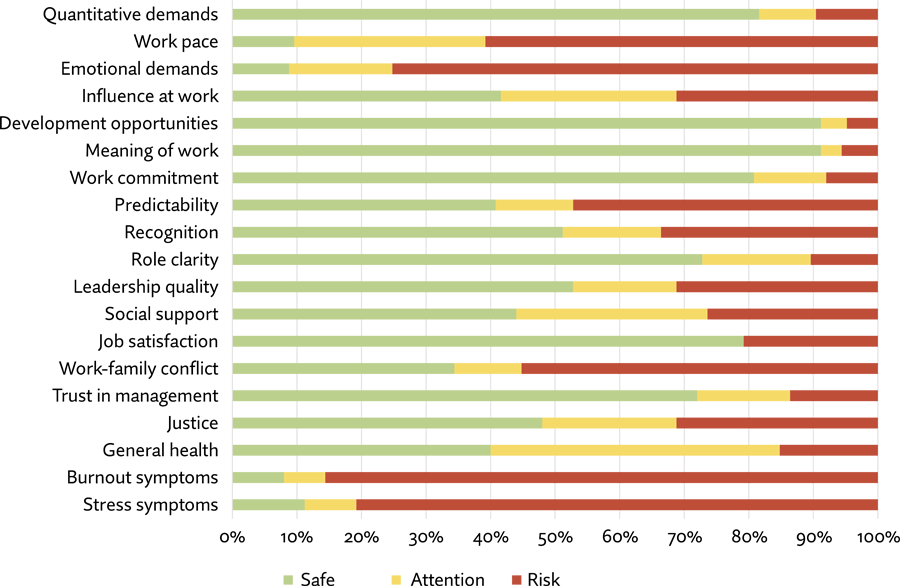
The color-coded classification uses a traffic light system, such that a “safe” result is shown in green, “attention” in yellow, and “risk” in red, except for the job satisfaction dimension, whose result can be classified only as safe or risk. The results for each dimension can be presented using a stacked bar chart, facilitating the visualization of critical dimensions based on a percentage distribution of employees in the evaluated department or sector across each classification category (green, yellow, and red), as adapted from Sato et al.24 and shown in Figure 1.

Example of a stacked bar chart for the traffic light interpretation of COPSOQ II-Br results
Another method for interpreting COPSOQ II-Br results involves calculating the mean of the items in each dimension. The mean of the assessed population can be compared with normative values for the country’s population25. However, it should be noted that, as of the date of approval of this study, no normative mean data were available for the Brazilian population for comparison purposes.
The administration of the COPSOQ II-Br must strictly adhere to ethical principles: participation is anonymous, and results are analyzed collectively. Worker participation in the discussion of results is essential for the adoption of measures to eliminate or mitigate identified psychosocial risks, as is the commitment of management, leaders, and supervisors to managing these risks21. It is worth noting, however, that worker participation in degraded organizational contexts is limited. In environments marked by harassment and other forms of violence, workers tend not to feel safe to participate and truthfully express the reality of their working conditions. In such situations, the quality and validity of the information collected depend on the existence of minimum conditions of trust, protection of anonymity, and the absence of retaliation.
Use of COPSOQ II-Br in Brazilian Populations
The COPSOQ II-Br has been used in different contexts and populations, notably in the IMPACC (Implications of the Covid-19 pandemic on the psychosocial aspects and work capacity of Brazilian workers)fand HEROES (HEalth conditions of healthcaRe wOrkErS) projectsg.
Andrade et al.26 assessed 1,211 workers from various sectors, including education, healthcare, industry, information technology, commerce, and non-essential services, among others. The most affected aspects were stress symptoms, burnout symptoms, work-family conflict, emotional demands, and work pace, indicating that workers were negatively impacted by the pandemic in these areas.
Another study of the same cohort sought to compare remote and in-person workers, revealing unfavorable outcomes in both groups27. During the first wave of the pandemic (2020), remote workers reported higher quantitative demands and work-family conflicts, while on-site workers reported higher emotional demands, low development of new skills, low commitment, low predictability, low recognition, low satisfaction, and a higher incidence of unwanted sexual attention, threats of violence, and physical violence. In the second wave (2021), the remote group continued to report high levels of work-family conflict, while the in-person group reported, in addition to the findings from the first wave, low influence at work, low leadership quality, and symptoms of burnout27.
Sato et al.24 analyzed the HEROES cohort, comprising 125 SUS healthcare professionals, comparing psychosocial factors, psychological and musculoskeletal symptoms, and sleep quality. Most professionals experienced unfavorable psychosocial factors, being exposed to conditions of high emotional demands at work, low predictability, excessive work pace, stress symptoms, burnout symptoms, and work-family conflict. The prevalence of offensive behaviors also deserve attention, as participants reported quite alarming frequencies of unwanted sexual attention (15%), threats of violence (26%), physical violence (9%), and bullying (17%).
Rohwedder et al.28 found that burnout symptoms and job predictability showed a moderate correlation with sleep quality, highlighting the need to minimize stress and promote strategies to mitigate adverse factors, with the aim of reducing the mental distress of healthcare professionals.
A study conducted prior to the pandemic found an association between psychosocial factors and multiregional pain in a sample of 195 workers from various fields, including teachers, administrative staff, healthcare professionals, cleaning personnel, and animal caretakers. There was a direct association between work demands, work-family conflict, burnout symptoms, and stress with multiregional pain, as well as an inverse association with meaning and commitment, predictability, job satisfaction, fairness, and overall health perception29.
It is worth noting that, although studies have not advanced interventions to address psychosocial risk factors at work, since these depend on institutional interest and availability, they point the way for managers and decision-makers to do so. In this sense, COPSOQ II-Br supports situational diagnosis by allowing the identification of the most critical aspects, that is, those posing the greatest risk to workers, which require immediate attention and intervention, thereby assisting occupational health and safety professionals and managers in prioritizing actions.
Final Considerations
This paper presented the conceptual framework and the main operational aspects for the use and interpretation of COPSOQ II-Br, highlighting its potential. COPSOQ II-Br is recommended for organizational diagnosis, supporting surveillance, planning, and intervention actions in work environments.
However, its use requires attention to certain limitations. It is a self-reporting instrument, meaning it depends directly on the respondent’s perception, disposition, and circumstances. In this process, multiple factors can influence and even distort responses, especially in organizational contexts marked by tense relations between management and workers, low levels of trust, or a history of authoritarian practices and rights violations. In addition, issues such as comprehension difficulties, lack of time, or low engagement can also compromise the quality of responses. Furthermore, the findings must be analyzed in accordance with the specific organizational context, and their use in isolation or out of context with other qualitative and institutional information is not recommended.
Thus, COPSOQ II-Br can be used as a tool to support decision-making, which must necessarily be shared with other workers, with a focus on building a safe work environment and contributing to continuous assessment and intervention processes aimed at promoting healthier and more sustainable work environments.
References
-
1 Ministério do Trabalho e Emprego (BR). Governo Federal atualiza NR-01 para incluir riscos psicossociais e reconstitui Comissão do Benzeno. Brasília: Ministério do Trabalho e Emprego; 2024 [citado 26 mar 2026]. Disponível em: https://www.gov.br/trabalho-e-emprego/pt-br/noticias-e-conteudo/2024/Setembro/governo-federal-atualiza-nr-01-para-incluir-riscos-psicossociais-e-reconstitui-comissao-do-benzeno
» https://www.gov.br/trabalho-e-emprego/pt-br/noticias-e-conteudo/2024/Setembro/governo-federal-atualiza-nr-01-para-incluir-riscos-psicossociais-e-reconstitui-comissao-do-benzeno -
2 Ministério do Trabalho e Emprego (BR). Norma Regulamentadora No. 1 (NR-1). Brasília: Ministério do Trabalho e Emprego; 2024 [citado 18 dez 2025]. Disponível em: https://www.gov.br/trabalho-e-emprego/pt-br/acesso-a-informacao/participacao-social/conselhos-e-orgaos-colegiados/comissao-tripartite-partitaria-permanente/normas-regulamentadora/normas-regulamentadoras-vigentes/nr-1
» https://www.gov.br/trabalho-e-emprego/pt-br/acesso-a-informacao/participacao-social/conselhos-e-orgaos-colegiados/comissao-tripartite-partitaria-permanente/normas-regulamentadora/normas-regulamentadoras-vigentes/nr-1 -
3 Ministério do Trabalho e Emprego (BR). Inclusão de fatores de risco psicossociais no GRO começa em caráter educativo a partir de maio [Internet]. Brasília (DF): Ministério do Trabalho e Emprego; 2025 abr [citado 18 dez 2025]. Disponível em: https://www.gov.br/trabalho-e-emprego/pt-br/noticias-e-conteudo/2025/abril/inclusao-de-fatores-de-risco-psicossociais-no-gro-comeca-em-carater-educativo-a-partir-de-maio
» https://www.gov.br/trabalho-e-emprego/pt-br/noticias-e-conteudo/2025/abril/inclusao-de-fatores-de-risco-psicossociais-no-gro-comeca-em-carater-educativo-a-partir-de-maio -
4 Associação Nacional de Medicina do Trabalho. Levantamento da ANAMT revela crescimento de afastamentos por problemas de saúde mental. São Paulo: ANAMT; 2026 [citado 27 mar 2026]. Disponível em: https://www.anamt.org.br/portal/2026/01/27/levantamento-anamt-com-dados-oficiais-do-inss-revela-crescimento-dos-afastamentos-decorrentes-de-problemas-de-saude-mental-entre-2023-e-2025/
» https://www.anamt.org.br/portal/2026/01/27/levantamento-anamt-com-dados-oficiais-do-inss-revela-crescimento-dos-afastamentos-decorrentes-de-problemas-de-saude-mental-entre-2023-e-2025/ -
5 Lucca SR, Silva-Junior JS, Bandini M. Critical analysis of psychosocial factors at work within the Risk Management Program of Regulatory Standard-1. Rev Bras Med Trab. 2025;23(1):e20251425. https://doi.org/10.47626/1679-4435-2025-1425
» https://doi.org/10.47626/1679-4435-2025-1425 -
6 Gonçalves JS. Os aspectos psicossociais no trabalho [tese]. São Carlos: Universidade Federal de São Carlos; 2019 [citado 18 nov 2025]. Disponível em: https://repositorio.ufscar.br/items/ed9cde3b-9d06-4c2f-8d74-c419c265a479
» https://repositorio.ufscar.br/items/ed9cde3b-9d06-4c2f-8d74-c419c265a479 -
7 Gonçalves JS, Moriguchi CS, Chaves TC, Sato TO. Cross-cultural adaptation and psychometric properties of the short version of COPSOQ II-Brazil. Rev. Saúde Pública. 2021;55:69. https://doi.org/10.11606/s1518-8787.2021055003123
» https://doi.org/10.11606/s1518-8787.2021055003123 -
8 Soares SV, Picolli IRA, Casagrande JL. Pesquisa bibliográfica, pesquisa bibliométrica, artigo de revisão e ensaio teórico em administração e contabilidade. Adm Ensino Pesqui. 2018;19(2):308-39. https://doi.org/10.13058/raep.2018.v19n2.970
» https://doi.org/10.13058/raep.2018.v19n2.970 -
9 International Labour Office. Psychosocial factors at work: Recognition and control. Geneva: ILO; 1986 [citado 8 nov 2025]. (Occupational Safety and Health Series, 56). Disponível em: https://webapps.ilo.org/public/libdoc/ilo/1986/86B09_301_engl.pdf
» https://webapps.ilo.org/public/libdoc/ilo/1986/86B09_301_engl.pdf -
10 Ministério do Trabalho e Emprego (BR). Guia de Informações sobre os Fatores de Riscos Psicossociais Relacionados ao Trabalho (Guia NR-01 revisado). Brasília: Ministério do Trabalho e Emprego; 2025 [citado 5 nov 2025]. Disponível em: https://www.gov.br/trabalho-e-emprego/pt-br/acesso-a-informacao/participacao-social/conselhos-e-orgaos-colegiados/comissao-tripartite-partitaria-permanente/normas-regulamentadora/normas-regulamentadoras-vigentes/guia-nr-01-revisado.pdf
» https://www.gov.br/trabalho-e-emprego/pt-br/acesso-a-informacao/participacao-social/conselhos-e-orgaos-colegiados/comissao-tripartite-partitaria-permanente/normas-regulamentadora/normas-regulamentadoras-vigentes/guia-nr-01-revisado.pdf - 11 Vieira CEC, Vieira RCC. Transtornos mentais e trabalho: o caso de um agente de visitação. Cad Psicol Soc Trab. 2011;14(1):145-54.
-
12 Kristensen TS, Hannerz H, Høgh A, Borg V. The Copenhagen psychosocial questionnaire: a tool for the assessment and improvement of the psychosocial work environment. Scand J Work Environ Health. 2005;31(6):438-49. https://doi.org/10.5271/sjweh.948
» https://doi.org/10.5271/sjweh.948 -
13 Ministério do Trabalho e Emprego (BR). Norma Regulamentadora nº 17 - Ergonomia (NR-17) [Internet]. Brasília: Ministério do Trabalho e Emprego; 2022 [citado 2 nov 2025]. Disponível em: https://www.gov.br/trabalho-e-emprego/pt-br/acesso-a-informacao/participacao-social/conselhos-e-orgaos-colegiados/comissao-tripartite-partitaria-permanente/normas-regulamentadora/normas-regulamentadoras-vigentes/nr-17-atualizada-2023.pdf
» https://www.gov.br/trabalho-e-emprego/pt-br/acesso-a-informacao/participacao-social/conselhos-e-orgaos-colegiados/comissao-tripartite-partitaria-permanente/normas-regulamentadora/normas-regulamentadoras-vigentes/nr-17-atualizada-2023.pdf -
14 World Health Organization. Mental health at work: policy brief. Geneva: WHO; 2022 [citado 18 dez 2025]. Disponível em: https://iris.who.int/bitstream/handle/10665/362983/9789240057944-eng.pdf
» https://iris.who.int/bitstream/handle/10665/362983/9789240057944-eng.pdf -
15 Lancman S, Bicudo SPBC, Rodrigues DS, Nogueira LFZ, Barros JO, Barroso BIL. Mental health and work: a systematic review of the concept. Healthcare (Basel). 2024;12(23):2377. https://doi.org/10.3390/healthcare12232377
» https://doi.org/10.3390/healthcare12232377 -
16 Pejtersen JH, Kristensen TS, Borg V, Bjorner JB. The second version of the Copenhagen psychosocial questionnaire. Scand J Public Health. 2010;38(3 Suppl):8-24. https://doi.org/10.1177/1403494809349858
» https://doi.org/10.1177/1403494809349858 -
17 Burr H, Berthelsen H, Moncada S, Nübling M, Dupret E, Demiral Y et al. The third version of the Copenhagen psychosocial questionnaire. Saf Health Work. 2019;10(4):482-503. https://doi.org/10.1016/j.shaw.2019.10.002
» https://doi.org/10.1016/j.shaw.2019.10.002 -
18 International COPSOQ Network. COPSOQ III: guidelines and questionnaire. Freiburg: International COPSOQ Network; 2019 [citado 3 nov 2025]. Disponível em: https://www.copsoq-network.org/assets/Uploads/COPSOQ-network-guidelines-an-questionnaire-COPSOQ-III-131119-signed.pdf
» https://www.copsoq-network.org/assets/Uploads/COPSOQ-network-guidelines-an-questionnaire-COPSOQ-III-131119-signed.pdf -
19 Borsa JC, Damásio BF, Bandeira DR. Adaptação e validação de instrumentos psicológicos entre culturas: algumas considerações. Paideia. 2012;22(53):423-32. https://doi.org/10.1590/S0103-863X2012000300014
» https://doi.org/10.1590/S0103-863X2012000300014 -
20 Lima IAX, Parma GOC, Cotrim TMCP, Moro ARP. Psychometric properties of a medium version of the Copenhagen Psychosocial Questionnaire (COPSOQ II) for southern Brazil. Work. 2019;62(2):175-84. https://doi.org/10.3233/WOR-192853
» https://doi.org/10.3233/WOR-192853 -
21 National Centre for the Working Environment. Psychosocial factors at work: Instructions for users (Translation of Belgian French Version). Copenhagen: Arbejdsmiljø Instituttet; 2011 [citado 18 dez 2025]. Disponível em: https://nfa.elsevierpure.com/da/publications/vejledning-til-brugere-af-amis-korte-sp%C3%B8rgeskema-om-psykisk-arbej/
» https://nfa.elsevierpure.com/da/publications/vejledning-til-brugere-af-amis-korte-sp%C3%B8rgeskema-om-psykisk-arbej/ -
22 Ministério do Trabalho e Emprego (BR). Guia de prevenção ao assédio moral e sexual. Brasília: Ministério do Trabalho e Emprego; 2023 [citado 3 nov 2025]. Disponível em: https://www.gov.br/trabalho-e-emprego/pt-br/assuntos/guia-de-prevencao-ao-assedio-moral-e-sexual/cartilha-discriminacao-e-assedio-mte.pdf
» https://www.gov.br/trabalho-e-emprego/pt-br/assuntos/guia-de-prevencao-ao-assedio-moral-e-sexual/cartilha-discriminacao-e-assedio-mte.pdf -
23 Fundação Jorge Duprat Figueiredo de Segurança e Medicina do Trabalho. Organização e gestão: a influência dos fatores psicossociais na saúde no trabalho. São Paulo: Fundacentro; 2021 [citado 3 nov 2025]. Disponível em: https://www.gov.br/fundacentro/pt-br/centrais-de-conteudo/cursos-e-eventos/Organizaoegestoainflunciadosfatorespsicossociaisnasadenotrabalho.pdf
» https://www.gov.br/fundacentro/pt-br/centrais-de-conteudo/cursos-e-eventos/Organizaoegestoainflunciadosfatorespsicossociaisnasadenotrabalho.pdf -
24 Sato TO, Faria BSF, Albuquerque BB, Silva FLD, Rohwedder LS, Azevedo RT et al. Poor health conditions among Brazilian healthcare workers: the study design and baseline characteristics of the HEROES cohort. Healthcare (Basel). 2022;10(10):2096. https://doi.org/10.3390/healthcare10102096
» https://doi.org/10.3390/healthcare10102096 -
25 Silva CF. Copenhagen Psychosocial Questionnaire - COPSOQ: Portugal e países africanos de língua oficial portuguesa. Aveiro: Fundação para Ciência e Tecnologia; 2011 [citado 2025 dez 18]. Disponível em: https://www.copsoq-network.org/assets/Uploads/COPSOQ-Manual-Portugal2013.pdf
» https://www.copsoq-network.org/assets/Uploads/COPSOQ-Manual-Portugal2013.pdf -
26 Andrade MA, Castro CSM, Batistão MV, Mininel VA, Sato TO. Occupational profile, psychosocial aspects, and work ability of brazilian workers during COVID-19 pandemic: IMPPAC cohort. Saf Health Work. 2022;13(1):104-11. https://doi.org/10.1016/j.shaw.2021.11.004
» https://doi.org/10.1016/j.shaw.2021.11.004 -
27 Andrade MA, Andrews DM, Sato TO. Psychosocial work aspects, work ability, mental health and SARS-CoV-2 infection rates of on-site and remote Brazilian workers during the COVID-19 pandemic - a longitudinal study. BMC Public Health. 2024;24(1):2767. https://doi.org/10.1186/s12889-024-20233-1
» https://doi.org/10.1186/s12889-024-20233-1 -
28 Rohwedder LS, Triches MI, Sousa RA, Sato TO, Mininel VA. Psychosocial risk factors at work and sleep quality in healthcare workers: a cross-sectional study. Sleep Sci. 2024;17(4):e370-80. https://doi.org/10.1055/s-0044-1782172
» https://doi.org/10.1055/s-0044-1782172 -
29 Faria BSF, Gonçalves JS, Sato TO. Association between psychosocial factors in workers and multisite pain: cross-sectional study. Braz J Pain. 2022;5(1):2-7. https://doi.org/10.5935/2595-0118.20220002
» https://doi.org/10.5935/2595-0118.20220002

 Source: adapted from Sato et al.