
 Gender and health in the world of work: reflections on contributions and invisibilities in the publications of the Brazilian Journal of Occupational Health
Abstract
Introduction This essay discusses gender as an analytical category for understanding dynamics and inequalities in work and health, based on an assessment of publications from the Brazilian Journal of Occupational Health (RBSO) over its 52-year history.
Objectives The study aimed to identify the presence and characteristics of the approach to this theme, as well as the challenges to its incorporation into discussions on work and health.
Methods A qualitative, exploratory, and documentary study involving a critical analysis of the articles identified through searches in the RBSO collection.
Discussion The eighteen selected publications highlight gender inequalities in the workplace, with women facing work overload, greater socioeconomic vulnerability, and increased job insecurity — conditions associated with both physical and mental illness. Despite these contributions, gender is rarely explored as a central analytical category, which limits the understanding of the power relations that structure the sexual division of labor and its impacts on health. This gap hinders a more nuanced understanding of the complexity of the experiences of women and those of other marginalized groups, thereby contributing to the reproduction and exacerbation of inequalities. Addressing these asymmetries remains both a historical and current challenge, requiring ethical, political, and scientific commitment to transform practices and policies aimed at workers’ health.
Keywords:
Gender-Based Division of Labor; Gender Equality; Gender and Health; Occupational Health; Document Analysis
Resumo
Introdução Este ensaio discute o gênero como categoria analítica para compreender as dinâmicas e desigualdades no trabalho e na saúde, a partir da avaliação das publicações da Revista Brasileira de Saúde Ocupacional (RBSO) ao longo de seus 52 anos.
Objetivos Identificar a presença e as características da abordagem do tema, bem como os desafios para sua incorporação nas discussões sobre trabalho e saúde.
Métodos Estudo qualitativo, exploratório e documental com análise crítica de 18 publicações, identificadas por buscas no acervo da RBSO.
Discussão As publicações revisadas dão visibilidade às desigualdades de gênero no trabalho, evidenciando que as mulheres enfrentam sobrecarga laboral, maior vulnerabilidade socioeconômica e acentuada precarização do trabalho – condições associadas ao adoecimento físico e mental. Apesar dessas contribuições, gênero é pouco explorado como categoria analítica central, o que restringe a compreensão das relações de poder que estruturam a divisão sexual do trabalho e seus impactos na saúde. Essa lacuna dificulta a apreensão da complexidade das experiências das mulheres e outros sujeitos subalternizados, contribuindo para a reprodução e agudização das desigualdades. Enfrentar essas assimetrias constitui um desafio histórico e atual, que exige compromisso ético, político e científico para transformar práticas e políticas voltadas à saúde do trabalhador e da trabalhadora.
Palavras-chave:
Divisão do Trabalho Baseada no Gênero; Equidade de Gênero; Saúde de Gênero; Saúde do Trabalhador; Análise Documental
Initial Considerations
Historically, the experiences of men and women in the world of work have been shaped by inequalities across different contexts and environments, generating inequities that, as the literature indicates, affect women’s lives and health more intensely1.
Over time, work has been shaped by forms of social organization, reflecting the economic, political, and cultural relations that structure each society. In general, professions result from these forms of organization, reflecting and reproducing their hierarchies and inequalities3,4. Thus, the way work is organized affects the lives and health of workers, reflecting the effects of social inequalities.
Uncovering inequalities by shedding light on the structures that produce and perpetuate them is a fundamental task. In this regard, scientific research plays a central role in revealing the concrete manifestations of these inequalities and their impacts. Since 1973, the Brazilian Journal of Occupational Health (RBSO) has been an important forum for the publication of studies on occupational health, making a significant contribution to the field. The RBSO is a multidisciplinary scientific journal, edited and published by the Fundação Jorge Duprat Figueiredo Foundation for Occupational Safety and Medicine (Fundacentro), from the Brazilian Ministry of Labor and Employment. As an open-access, peer-reviewed journal, it aims to disseminate original research articles on Occupational Safety and Health (OSH). Thus, an analysis of its publications provides a comprehensive view of the field as a whole, highlighting the presence or absence of certain themes in scientific research.
To begin the discussion, it is important to clarify the perspective adopted regarding the concepts of work and gender, considering the breadth and diversity of their meanings in literature. In this essay, the concept of work was analyzed from a broad perspective, encompassing not only paid activities but also those rendered invisible by society, such as domestic and caregiving tasks performed for one’s own family or for the benefit of others, without remuneration. The concept of gender emphasizes the socially constructed relationships that have established—and still maintain—differences in the entry and retention of men and women in specific positions in the world of work5. These positions structure systems of social valuation and devaluation that constitute advantages or vulnerabilities. Such historically entrenched inequalities contribute to the illness of the female body. This concept is also reaffirmed in the journal’s submission guidelines, which highlight the distinction between the terms sex and gender. The former refers to the biological and physiological characteristics that distinguish male and female organisms, while the latter aligns with the conception presented by Scott5.
The authors’ instructions also emphasize that “both sex and gender must be adequately considered in the design and conduct of studies, as well as in the publication of their results.” An editorial note was published by RBSO in 2022, reinforcing the need for this differentiation and suggesting the adoption of the Sex and Gender Equity in Research (SAGER) guidelines. Adopting such measures seeks to overcome barriers to incorporating sex and gender dimensions into research and scientific publications6.
This study sought to identify the presence and characteristics of the gender approach in RBSO publications over more than five decades, critically analyzing its implications and the challenges involved in incorporating this discussion into analyses of work and health.
This essay is structured into three sections. The first discusses the historical and theoretical foundations of gender in the workplace. The second outlines the methodological approach, the results, and critical reflections on how gender has been addressed in the context of work and its relationship to health. The third section analyzes the challenges of addressing gender inequities in the world of work.
From the past to the present: gender relations in the world of work
Throughout the evolution of society, work has taken on different conceptions and practices and can be broadly understood as “a means of survival and the use of humanity’s creative potential and capacities,” which regulates the relationships among people and between people and nature7 (p.19).
Although it has an individual dimension, shaped by the subjectivity of those who perform it, work primarily reflects aspects of collective organization, highlighting its social character in the distinctions observed in the participation and retention of men and women in the labor market, thereby constituting the so-called sexual division of labor.
This concept, widely studied and debated by feminist sociologists such as Daniele Kergoat and Helena Hirata, contrasts with the idea that the distinction between male and female work stems from supposed biological determinants, frequently used to legitimize this differentiation. For these authors, the naturalization of inequalities results from social constructions that not only defined specific spaces for the roles of men and women but also perpetuated an unequal hierarchical relationship between them3,5,8.
While men were integrated into productive social activities in public spaces, women were confined to social roles restricted to the private sphere, engaged in caring for the family and the home. Based on this division, the female role in the family came to be idealized with a focus on preparing women to be exemplary mothers and wives, with their social duties gradually understood as skills inherent to female nature, especially regarding dedication to domestic tasks9.
The boundaries of these spaces have shifted over time, particularly with women’s increased participation in the workforce. However, the consequences of these divisions remain evident in many professions and occupations, where the “masculinization” and “feminization” of tasks remain pronounced. For example, domestic and caregiving activities (whether paid or unpaid) are taken for granted as feminine activities, while roles in the construction sector are generally associated with men.
It can be argued that these differences are not limited solely to the definition of male and female professions but also impact the social valuation or devaluation of women’s work. A study assessing the division of paid and domestic work across 18 European countries identified variations in gender inequality ranging from moderate to high levels10. In Brazil, as in European countries, women’s participation in the labor market is marked by wage inequalities, occupational segregation, and more limited availability of formal employment. However, this reality is even more pronounced in the Brazilian context.
Data from the Continuous National Household Sample Survey11 indicate that in 2018, before the COVID-19 pandemic, employment rates and wages were higher among male workers than females, with male earning, on average, 27.1% more. In 2020, the COVID-19 pandemic intensified inequalities, particularly regarding unpaid domestic work, as the situation required people to remain at home, reducing support networks (schools, daycare centers, and paid domestic workers). The pandemic scenario intensified demands for cleaning, food preparation, and care12,13, in addition to causing the abrupt shift of paid work into the domestic sphere. This form of work, which was already invisible before the pandemic, reinforced traditional roles and, consequently, deepened inequalities14.
The post-pandemic landscape has not altered this reality, as the female workforce still faces higher unemployment rates compared to male (the female unemployment rate in the first quarter of 2025 was 8.7 percent, compared to 5.7 percent among male)15. Remote work is still prevalent, albeit to a lesser extent, and domestic work remains a responsibility of women.
Understanding the forms of social organization of work and assessing the impacts of inequalities arising from the gender division of labor (paid or unpaid) is an important step not only toward recognizing the differences highlighted but also toward the necessary confrontation of this issue.
Studies published since the 1970s have investigated the association between environmental conditions, work organization, and the health–illness process. As a biopsychosocial phenomenon, this process is directly related to the organization and process of work7, which may either promote health or pose risks to individuals’ physical and mental health6. Efforts have been made in the development of studies seeking to clarify this relationship between work characteristics and their effects on occupational health.
RBSO stands out as one of the few Brazilian journals focused on occupational health, with over 50 years of history and an extensive collection of works on the subject. Analyzing its publications to understand how gender and health have been studied and discussed in the context of work over the years can significantly contribute to raising awareness of women’s labor and its impacts on women’s health.
Work, Gender, and Health: contributions and reflections from RBSO publications
In an effort to assess the RBSO’s contribution to the topic over more than 50 years of publications (1973 to 2024), an exploratory search was conducted of published articles addressing issues of gender, work, and health. This is a qualitative study of an exploratory and documentary nature, based on the review and critical analysis of the selected publications.
The searches were initially conducted in the Scientific Electronic Library Online (SciELO), a journal indexing platform that includes issues published between 2003 and 2024. This search was supplemented by a review of digitized archives provided by the RBSO secretariat, containing issues published from 1973 to 2002. Therefore, the study period encompassed the entire duration of the journal’s existence.
Various subject headings (“gender-based division of labor” or “gender studies” or “gender differences” and “health”) and keywords (“sexual division of labor” or “division of labor”) were used in the search for publications. This search strategy proved to be insensitive, yielding few or no articles; thus, new strategies were employed. The combination of the term “gender” with the descriptor “health” generated the highest number of articles: 19 found in SciELO and four in the digitized archives. Following this initial survey, two researchers read the abstracts, followed by a full reading of the articles to confirm the study’s relevance to the theme. In this process, two articles were excluded for not being related to the theme; 21 were retained. Among these, three did not discuss gender as the primary category of analysis but presented results that indicated its relevance to the outcomes investigated. The remaining 18 theoretically addressed gender and health issues and/or analyzed gender as a direct exposure variable, assessing its relationship with the outcome studied.
Among the three articles that did not discuss gender as a primary analytical category but contained results emphasizing its relevance are: a) a mental health assessment, with estimates of mental disorders (MD) among workers at a public university17 which identified a higher prevalence among women; b) an analysis of the association between lumbar spondyloarthrosis and heavy physical labor — which found no statistically significant association with gender but identified a higher prevalence of the outcome among women18; c) validation of a mental health measurement instrument in a sample of IT workers, considering its performance among men and women19.
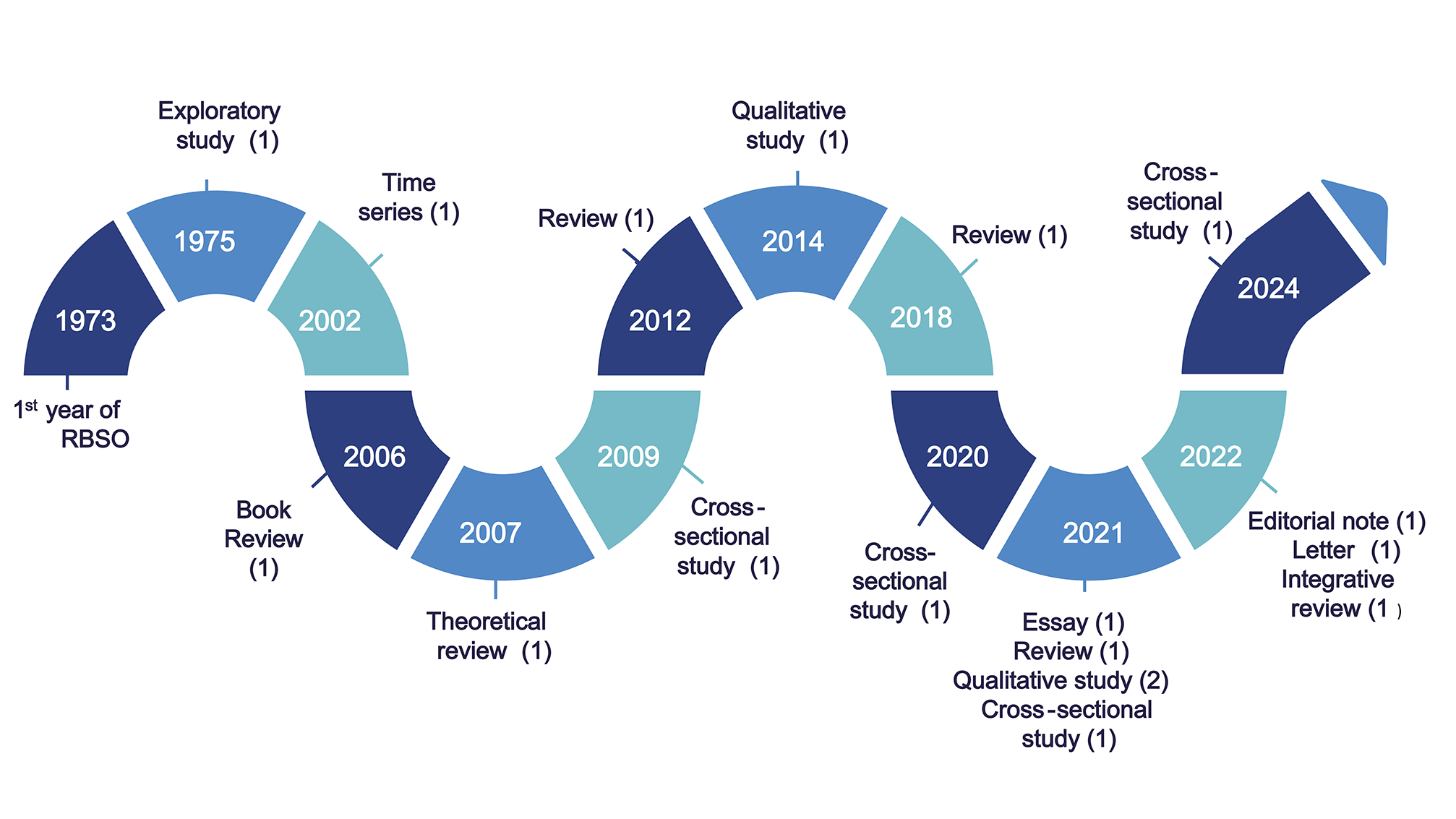
The 18 articles that directly addressed issues of gender, health, and work are presented in Figure 1—a timeline summarizes the publications over time, with information on the methodology used in each study.

A recent increase in the number of publications on gender, work, and health in the RBSO has been observed. Over time, the journal began to include review articles20-23 and analyses of the topic from a theoretical perspective6,12,13,24,25.
It is worth noting the journal’s innovative nature in publishing, in 1975, the exploratory study “Effects of work on the female body”26. Set against the backdrop of the emerging feminist movement and recognizing its social relevance, the study sought to analyze the potential harmful effects of work on the female body. Mental illness was identified as the main reason women took leave from work to seek social security benefits. Furthermore, the study highlights characteristics of the work, such as low pay and the repetitiveness of tasks in the professions analyzed. Unlike feminist scholars, the authors justify the definition of male and female roles based on physical differences between the sexes, emphasizing women’s limitations for work due to physical characteristics and also highlighting women’s emotional subjectivities26. However, this approach, by emphasizing biological aspects, overlooks the fact that factors such as pay and the repetitiveness of tasks are not directly related to biological differences, but rather to the social constructs that shape the division of labor and its value system. In this sense,, Pizzatto, Garbin, and Amadei27 reinforce this critical perspective by highlighting that the differentiation of occupied spaces results from social relations between the genders.
In 2002, a study was published28 using aggregated data, aiming to assess the evolution and social and demographic characteristics of repetitive strain injuries in the Belo Horizonte metropolitan area during the 1990s. The study, grounded in the category of gender, sought to identify specific work situations faced by men and women and the differing health consequences. The results pointed to a predominance of repetitive strain injury (RSI) cases among women and greater exposure and exploitation of the female workforce—a situation resulting from the historical process of occupational segregation that assigns women the most repetitive and monotonous tasks28.
Seven other publications sought to investigate, through qualitative and cross-sectional studies, different aspects of work associated with illness, taking gender issues into account. Table 1 presents a summary of the main results of the association analysis conducted in these studies.
An analysis of cross-sectional studies focusing on work, health, and gender published in RBSO (1981–2022) reveals that gender inequalities continue to shape working conditions and their impacts on women’s health. The data highlight both the persistence of the gendered division of labor and the multiple forms of precariousness that disproportionately affect female workers, especially those with low incomes and engaged in informal or socially undervalued activities.
This scenario perpetuates the historical normalization of social processes by linking women’s work to manual skills (shellfish gatherers) and care work for others (school cooks and healthcare workers). In contrast, Arreal and López29 assessed women’s work in the metalworking sector, highlighting their presence in a predominantly male occupation. Despite this, the findings point to the persistence of gender inequality, as the role performed by the women studied in the company was restricted to the parts distribution sector.
Poor working conditions among women have also been described30, as well as gender inequalities evidenced by the undervaluation of women’s work, manifested in the absence of career paths, low wages, difficulties in balancing work and family life, lack of support networks, and an overload of responsibilities29.
In quantitative studies, gender contrasts regarding pay, working hours, and self-reported health status stand out markedly. Three studies directly assessed gender differences in health between men and women. The first observed a higher prevalence of chronic diseases with reports of poorer health status among female workers; the second identified an inverse relationship, with gender differences, level of education and job dissatisfaction, that is, only among women was higher level of education associated with job dissatisfaction; and the third identified an interaction between gender, race, and occupational stressors on mental health, with women being more affected.
This suggests that, even though women and men are both part of the labor market, women are exposed to conditions that are more harmful to their health or face a greater workload (such as the double shift: work + household chores). Additionally, even when they are more qualified, they may face barriers such as wage inequality, lack of opportunities for advancement, discrimination, or devaluation in the workplace. These disparities negatively impact both their health and job satisfaction.
The study of shellfish gatherers revealed a concerning picture of social vulnerability and ill health, marked by low educational attainment, multiple family responsibilities, and very precarious economic conditions. All women reported musculoskeletal pain, particularly in the lower back, directly related to physical strain, lack of breaks, and repetitive tasks. These findings confirm the physical strain imposed on women in manual occupations that are undervalued and characterized by informality, with strong gender and racial dimensions.
Overall, the results reveal that:
-
Gender inequalities continue to shape working conditions and their impact on women’s health.
-
Forms of precariousness affect women more intensely and systematically, especially those in situations of greater socioeconomic vulnerability.
-
Processes of naturalization that associate women’s work with skills considered “natural,” such as caregiving and repetitive labor, persist.
-
Women continue to face systemic barriers. The burden of family responsibilities, coupled with the lack of support networks, contributes to professional stagnation.
-
Precarious working conditions directly affect women’s health, with frequent reports of chronic illnesses, musculoskeletal pain, and mental distress.
-
Data indicate that higher levels of education do not necessarily translate into satisfaction or recognition in the workplace for women.
-
Even when they enter the labor market, women face cumulative disadvantages that manifest in poorer well-being indicators and a heavier total workload (both paid and unpaid).
-
The effects of these inequalities are exacerbated when considering the intersection of gender, race, and social class.
-
There are few or no occupational health promotion policies specifically targeting women across various sectors.
These data indicate that gender inequalities remain entrenched in both the workplace and the healthcare sector, reinforced by intersectional factors such as class, race, and geography. The invisibility of women in certain occupations and the lack of adequate institutional responses contribute to perpetuating cycles of illness and exclusion, as well documented in RBSO publications.
Reducing gender inequities in the workplace: an old but still relevant challenge
Despite the growing trend of publications on gender and occupational health in recent years, the persistent invisibility of gender as a central analytical category remains evident. Even with the criteria established in the journal’s guidelines for distinguishing between the terms “sex” and “gender,” many studies that label themselves as gender research fail to conduct a critical analysis of power structures, social dynamics, and the intersections between gender, race, class, sexuality, and work5,36. Thus, by addressing the topic in a superficial or decontextualized manner, these studies end up reproducing silences and perpetuating the invisibility of historically marginalized groups.
This limited approach contributes to the reproduction of gender inequalities in the field of occupational health by failing to recognize the diversity and complexity of the experiences lived by women and other subalternized subjects in different work contexts. Instead of challenging the structural hierarchies of a patriarchal and capitalist system, many studies reinforce such inequalities by ignoring the concrete effects of the sexual division of labor, the burden of the double shift, and the symbolic and material violence that permeates working bodies3.
In this context, the development of new analytical and practical approaches is an urgent and necessary challenge. The adoption of an intersectional approach shows promise, as it allows us to recognize how social markers of difference interact to produce specific health inequalities among workers. By highlighting the multiple and simultaneous systems of oppression, intersectionality broadens our understanding of the social determinants of health, especially regarding the experiences of workers exposed to precarious working conditions, workplace bullying, gender-based violence, and work overload37,38.
In the face of this persistent and contemporary challenge, it is necessary to explore new approaches. Adopting an intersectional perspective, which recognizes the distinct ways in which gender inequalities affect health, must be a priority. Among the necessary initiatives are continuing education programs for managers and workers focused on the specific impacts of gender inequalities on health. Such programs should address topics such as occupational stress, mental illness, symbolic and physical violence, as well as the exhaustion resulting from the balancing of productive and reproductive work39.
Implementing structural changes therefore requires not only political and institutional will but also an ethical and epistemological commitment to social justice. Reducing gender inequalities in the workplace is a long-standing challenge that remains relevant today — and one that calls on scientific research, health management, and the labor movement to break with androcentric paradigms, making room for inclusive, critical, and transformative approaches.
References
- 1 Araújo TMD, Carneiro CMM, Pinho PS. Novos observatórios no mundo do trabalho: avanços e desafios na avaliação da relação entre trabalho doméstico e saúde mental. In: Schmidt MLG, Rumin CR, organizadores. Psicologia e saúde no trabalho: da teoria à prática. São Paulo: FiloCzar; 2023. p. 42-56.
-
2 Carneiro CMM, Pinho PS, Teixeira JRB, Araújo TM. Trabalho doméstico não remunerado: persistência da divisão sexual e transtornos mentais. Rev Saude Publica. 2023;57:e31. https://doi.org/10.11606/s1518-8787.2023057004502
» https://doi.org/10.11606/s1518-8787.2023057004502 -
3 Hirata H, Kergoat D. Novas configurações da divisão sexual do trabalho. Cad Pesqui. 2007;37(132):595-609. https://doi.org/10.1590/S0100-15742007000300005
» https://doi.org/10.1590/S0100-15742007000300005 - 4 Saffioti HIB. A mulher na sociedade de classes: mitos e verdades. 3a ed. São Paulo: Expressão Popular; 2013.
- 5 Scott J. Gênero: uma categoria útil de análise histórica. Educ Real. 1995;20(2):71-103.
-
6 Garcia LP. Equidade de sexo e gênero na pesquisa e na publicação científica: as diretrizes SAGER e suas listas de verificação. Rev Bras Saude Ocup. 2022;47:e21. https://doi.org/10.1590/2317-6369nt122pt2022v47e21
» https://doi.org/10.1590/2317-6369nt122pt2022v47e21 - 7 Neves MYR, Seligmann-Silva E, Athayde M. Saúde mental e trabalho: um campo de estudo em construção. In: Figueiredo M, organizador. Cenários do trabalho: subjetividade, movimento e enigma. Rio de Janeiro: DP&A; 2004. p. 19-49.
-
8 Hirata H. Mudanças e permanências nas desigualdades de gênero: divisão sexual do trabalho numa perspectiva comparativa. São Paulo: Friedrich Ebert Stiftung; 2015 [citado 17 mar 2026]. Disponível em: https://collections.fes.de/publikationen/ident/fes/12133
» https://collections.fes.de/publikationen/ident/fes/12133 -
9 Santos LS, Diniz GRS. Donas de casa: classes diferentes, experiências desiguais. Psicol Clin. 2011;23(2):137-49. https://doi.org/10.1590/S0103-56652011000200009
» https://doi.org/10.1590/S0103-56652011000200009 -
10 Cunha V, Atalaia S. The gender(ed) division of labour in Europe: patterns of practices in 18 EU countries. Sociol Probl Prat. 2019;(90):113-37. https://doi.org/10.7458/SPP20199015526
» https://doi.org/10.7458/SPP20199015526 -
11 Instituto Brasileiro de Geografia e Estatística - IBGE. Síntese de indicadores sociais: uma análise das condições de vida da população brasileira: 2019. Rio de Janeiro: Instituto Brasileiro de Geografia e Estatística; 2019 [citado 17 mar 2026]. Disponível em: https://biblioteca.ibge.gov.br/visualizacao/livros/liv101678.pdf
» https://biblioteca.ibge.gov.br/visualizacao/livros/liv101678.pdf -
12 Araújo TM, Lua I. O trabalho mudou-se para casa: trabalho remoto no contexto da pandemia de COVID-19. Rev Bras Saude Ocup. 2021;46:e27. https://doi.org/10.1590/2317-6369000030720
» https://doi.org/10.1590/2317-6369000030720 -
13 Mata JAL, Samimi SAB. Mães acadêmicas durante e após a pandemia de COVID-19. Rev Bras Saude Ocup. 2022;47:ecov1. https://doi.org/10.1590/2317-6369000018121
» https://doi.org/10.1590/2317-6369000018121 -
14 Sullivan C, Lewis S. Home-based telework, gender, and the synchronization of work and family: perspectives of teleworkers and their co-residents. Gend Work Organ. 2001;8(2):123-45. https://doi.org/10.1111/1468-0432.00125
» https://doi.org/10.1111/1468-0432.00125 -
15 Instituto Brasileiro de Geografia e Estatística - IBGE. PNAD contínua: pesquisa nacional por amostra de domicílios contínua. Rio de Janeiro: Instituto Brasileiro de Geografia e Estatística; 2025 [citado 17 mar 2026]. Disponível em: https://www.ibge.gov.br/estatisticas/sociais/trabalho/9173-pesquisa-nacional-por-amostra-de-domicilios-continua-trimestral.html
» https://www.ibge.gov.br/estatisticas/sociais/trabalho/9173-pesquisa-nacional-por-amostra-de-domicilios-continua-trimestral.html -
16 Minayo C, Machado JMH, Pena PGL, organizadores. Saúde do trabalhador na sociedade brasileira contemporânea. Rio de Janeiro: Fundação Oswaldo Cruz; 2011 [citado 17 mar 2026]. Disponível em: http://books.scielo.org/id/qq8zp
» http://books.scielo.org/id/qq8zp -
17 Guimarães LAM, Martins DA, Grubits S, Caetano D. Prevalência de transtornos mentais em trabalhadores de uma universidade pública do estado de São Paulo. Rev Bras Saude Ocup. 2006;31(113):7-18. https://doi.org/10.1590/S0303-76572006000100002
» https://doi.org/10.1590/S0303-76572006000100002 -
18 Silva RA, Ribeiro AC. Associação entre espondiloartrose lombar e trabalho pesado. Rev Bras Saude Ocup. 2009;34(119):51-7. https://doi.org/10.1590/S0303-76572009000100006
» https://doi.org/10.1590/S0303-76572009000100006 - 19 Fernandes SRP, Almeida Filho N. Validação do SRQ-20 em amostra de trabalhadores de informática. Rev Bras Saude Ocup. 1997;24(89):105-12
-
20 Andrade CB, Santos DL, Bitercourt SM, Vedovato TG. Migrações, trabalho de cuidado e saúde de cuidadoras: revisão integrativa. Rev Bras Saude Ocup. 2022;47:e10. https://doi.org/10.1590/2317-6369/07020pt2022v47e10
» https://doi.org/10.1590/2317-6369/07020pt2022v47e10 -
21 Andrade CB, Assis SG. Assédio moral no trabalho, gênero, raça e poder: revisão de literatura. Rev Bras Saude Ocup. 2018;43:e11. https://doi.org/10.1590/2317-6369000012917
» https://doi.org/10.1590/2317-6369000012917 -
22 Brito JC, Neves MY, Oliveira SS, Rotenberg L. Saúde, subjetividade e trabalho: o enfoque clínico e de gênero. Rev Bras Saude Ocup. 2012;37(126):316-29. https://doi.org/10.1590/S0303-76572012000200013
» https://doi.org/10.1590/S0303-76572012000200013 -
23 Pizzinga VH. Vulnerabilidade e atividades essenciais no contexto da COVID-19: reflexões sobre a categoria de trabalhadoras domésticas. Rev Bras Saude Ocup. 2021;46:e25. https://doi.org/10.1590/2317-6369000025020
» https://doi.org/10.1590/2317-6369000025020 -
24 Lima MEA. Contribuições da Clínica da Atividade para o campo da segurança no trabalho. Rev Bras Saude Ocup. 2007;32(115):99-107. https://doi.org/10.1590/S0303-76572007000100009
» https://doi.org/10.1590/S0303-76572007000100009 -
25 Venco S. O trabalho duplicado: a divisão sexual no trabalho e na reprodução - um estudo das trabalhadoras do telemarketing. Rev Bras Saude Ocup. 2006;31(114):173-5. https://doi.org/10.1590/S0303-76572006000200015
» https://doi.org/10.1590/S0303-76572006000200015 - 26 Souza MA, Sá A, Machado PM, Vieira AE. Efeitos do trabalho sobre o organismo feminino. Rev Bras Saude Ocup. 1975;3(10):31-6.
-
27 Pizzatto E, Garbin CAS, Amadei M. Perfil dos acidentes de trabalho ocorridos no município de Araçatuba-SP nos anos de 2000 e 2001. Rev Bras Saude Ocup. 2004;29(90):57-62. https://doi.org/10.1590/S0303-76572004000200007
» https://doi.org/10.1590/S0303-76572004000200007 - 28 Salim CA. Trabalho, saúde e gênero: um estudo sobre as lesões por esforços repetitivos. Rev Bras Saude Ocup. 2002;27(103):49-64.
-
29 Arreal JF, López LC. Trabalhadoras de turno noturno: relações de gênero, produção de vulnerabilidades e promoção da saúde. Rev Bras Saude Ocup. 2014;39(139):184-97. https://doi.org/10.1590/0303-7657000080113
» https://doi.org/10.1590/0303-7657000080113 -
30 Lopes IBS, Bezerra MGV, Silva LRC, Andrade NSM, Carneiro FF, Pessoa VM. Saúde das trabalhadoras da pesca artesanal: cenários desconhecidos do Sistema Único de Saúde (SUS). Rev Bras Saude Ocup. 2021;46:e5. https://doi.org/10.1590/2317-6369000028719
» https://doi.org/10.1590/2317-6369000028719 -
31 Cardillo VH, Gemma SFB, Fuentes-Rojas M. Um olhar interdisciplinar sobre o trabalho das merendeiras terceirizadas de escolas estaduais do município de Campinas, SP. Rev Bras Saude Ocup. 2021;46:e3. https://doi.org/10.1590/2317-6369000004819
» https://doi.org/10.1590/2317-6369000004819 -
32 Vidal RQS, Silvany Neto AM. Trabalhadoras brasileiras: características socioeconômicas e ocupacionais e perfil de saúde, Brasil, 2003. Rev Bras Saude Ocup. 2009;34(120):115-27. https://doi.org/10.1590/S0303-76572009000200003
» https://doi.org/10.1590/S0303-76572009000200003 -
33 Sousa CC, Araújo TM, Pinho PS, Freitas AMC. Insatisfação com o trabalho em saúde: fatores associados e diferenciais de gênero. Rev Bras Saude Ocup. 2020;45:e11. https://doi.org/10.1590/2317-6369000027118
» https://doi.org/10.1590/2317-6369000027118 -
34 Silva RA, Nery AA, Pena PGL, Rios MA, Paula RP. Sintomas musculoesqueléticos em catadoras de marisco. Rev Bras Saude Ocup. 2021;46:e4. https://doi.org/10.1590/2317-6369000020819
» https://doi.org/10.1590/2317-6369000020819 -
35 Sousa CC, Araújo TM. Efeitos combinados de gênero, raça e estressores ocupacionais na saúde mental. Rev Bras Saude Ocup. 2024;49:edepi12. https://doi.org/10.1590/2317-6369/15222pt2024v49edepi12
» https://doi.org/10.1590/2317-6369/15222pt2024v49edepi12 - 36 Crenshaw K. Demarginalizing the intersection of race and sex: a Black feminist critique of antidiscrimination doctrine, feminist theory and antiracist politics. Univ Chic Leg Forum. 1989;1989:139-67.
- 37 Collins PH. Black feminist thought: knowledge, consciousness, and the politics of empowerment. 2a ed. New York: Routledge; 2000.
-
38 Crenshaw K. Mapping the margins: intersectionality, identity politics, and violence against women of color. Stanford Law Rev. 1991;43(6):1241-99. https://doi.org/10.2307/1229039
» https://doi.org/10.2307/1229039 - 39 Schraiber LB. Gênero e saúde: contribuições para o debate teórico-metodológico. Cienc Saúde Colet. 2003;8(1):185-93.

 Source: own elaboration, based on RBSO.