
 Digital Stressors Scale: translation and cross-cultural adaptation for the Brazilian context
Abstract
Introduction Digital stress at work represents a growing risk to occupational health. Up-to-date measurement instruments are essential for proper assessment.
Objective To translate and cross-culturally adapt the Digital Stressors Scale (DSS) to the Brazilian context.
Methods Methodological study of translation, evaluation by a committee of seven experts, pre-testing with five participants from the target population, back-translation, and pilot study with 150 workers. Content validity was assessed by the Content Validity Index (CVI) and the Agreement Rate (AR), and preliminary internal consistency by Cronbach’s alpha (α) and McDonald’s omega (ω).
Results Idiomatic, semantic, experiential, and conceptual equivalences were obtained between the translated version and the original (CVI = 0.96). More than 95% of participants agreed with the clarity and applicability of the instrument. The long and short versions had coefficients α ≥ 0.68 and ω ≥ 0.70.
Discussion The combination of α and ω reinforces the robustness of internal consistency, as omega is less influenced by the limitations of alpha.
Conclusion The Brazilian version of the DSS showed promising initial evidence in a pilot study, however, it does not yet provide sufficient evidence for widespread use in Brazil. Robust psychometric analyses in larger samples are recommended.
Keywords:
Occupational Health; Surveys and Questionnaires; Health Impact Assessment; Occupational Stress; Information Technology; Digital Technology
Resumo
Introdução O estresse digital no trabalho representa um risco crescente à saúde dos(as) trabalhadores(as). Instrumentos de mensuração atualizados são essenciais para avaliação adequada.
Objetivo Traduzir e adaptar transculturalmente o Digital Stressors Scale (DSS) ao contexto brasileiro.
Métodos Estudo metodológico de tradução, avaliação por comitê com sete especialistas, pré-teste com cinco participantes da população-alvo, retrotradução e estudo-piloto com 150 trabalhadores(as). A validade de conteúdo foi avaliada pelo Índice de Validade de Conteúdo (IVC) e pela Taxa de Concordância (TC), e a consistência interna preliminar pelo alfa de Cronbach (α) e pelo ômega de McDonald (ω).
Resultados Foram obtidas as equivalências idiomática, semântica, experimental e conceitual entre a versão traduzida e a original (IVC = 0,96). Mais de 95% dos participantes concordaram com a clareza e aplicabilidade do instrumento. As versões longa e curta apresentaram coeficientes α ≥ 0,68 e ω ≥ 0,70.
Discussão A combinação de α e ω reforça a robustez da consistência interna, pois o ômega é menos influenciado pelas limitações do alfa.
Conclusão A versão brasileira do DSS apresentou evidências iniciais promissoras em estudo-piloto, contudo, ainda não fornece evidências suficientes para uso amplo no Brasil. Recomenda-se a realização de análises psicométricas robustas em amostras maiores.
Palavras-chave:
Saúde do Trabalhador; Inquéritos e Questionários; Avaliação do Impacto na Saúde; Estresse Ocupacional; Tecnologia da Informação; Tecnologia Digital
Introduction
The intensive use of Information and Communication Technologies (ICT) at work has intensified during and after the COVID-19 pandemic. Although essential to the continuity of productive activities, this forced digitization has increased technostress (stress resulting from individual efforts to cope with the demands of using ICT for work)1 among workers, mainly due to remote working, constant connectivity, excessive demands, lack of technical support, blurred boundaries between personal, and professional life and difficulty in mentally disconnecting from work2.
Once the pandemic is over, the effects of this flexibilization and intensification remain. One example is the adoption of hybrid work by 86% of companies in Brazil3. Although the flexibility obtained with ICT has been associated with quality of life, recent studies point to technostress as a critical mediator of this relationship4. According to The Future of Jobs Report5, published by the World Economic Forum in 2025, digital transformation will continue to be the main driver of change in the global labor market and estimates that, by 2030, tasks shared between humans and technologies will increase by 30%, while exclusively human tasks will decrease substantially.
Even before the pandemic, the contemporary subject was already living under self-imposed productivity, in a society of fatigue6. After the pandemic, this logic has intensified: hyperconnectivity has transformed autonomy into surveillance and flexible work into exhaustion. One reflection of the impacts of this new morphology of work is the 134% increase in benefits granted by the Brazilian Social Security System for temporary incapacity due to mental disorders in the two-year period from 2022 to 20247.
Technologies have intensified work with new impacts on workers’ health and well-being, related to stress, anxiety and fatigue resulting from work-related psychosocial risks3. Although the instruments for assessing work-related psychosocial risks, developed between the 1990s and 2000s, are still widely used, they do not cover work characterized by intense dependence on the use of ICTs and exposure to technostress8-10currently known as digital stress11, with a more comprehensive approach.
Digital stress can be understood as the negative psychological response resulting from the use of ICT at work12. Ragu-Nathan et al.12 define it as a stress phenomenon experienced by users as a result of using ICT. Fischer et al.11added the perceptions, emotions, and expectations related to the presence and evolution of these technologies, and their effects on automation and job security.
Empirical evidence points to the negative impact of digital stress on workers’ psychological well-being, such as feelings of fatigue, anxiety and burnout, as well as hypertension, diabetes, dyslipidemia, obesity, depression and insomnia as consequences of technostress12-15. Moreover, increased absenteeism and turnover, reduced individual performance at work and success in digitalization processes and reduce productivity in organizations15,16.
In Brazil, specific instruments for assessing this type of stress are scarce and outdated: 1) RED-TIC17 has good internal consistency but does not include contemporary digital stressors8. 2) Techno-Stress Creators and Inhibitors-TSCI18does not include emerging categories such as safety and invasion of privacy13 and has been partially adapted to Brazil. This methodological gap can also compromise scientific progress, making it difficult to produce evidence on organizational and individual factors that contribute to the development of digital stress and its consequences in Brazil8.
The Digital Stressors Scale (DSS)11, published in 2021, is one of the most up-to-date and complete instruments for assessing digital stress. The aim of this study is to translate, culturally adapt to the Brazilian context and analyze the psychometric properties of this instrument in a preliminary way.
The instrument
The DSS consists of 50 items distributed over 10 dimensions/scales related to the use of ICT for work (Table 1), assessed using a 7-point Likert scale (1= totally disagree to 7= totally agree), plus the option “don’t know” (-1). The application must be online and individual, and the results can be analyzed individually or collectively11,19.
Sociodemographic characteristics of the participants in the pilot study carried out in Brazil between January and August 2023
The instrument can be applied in its complete form (multidimensional), assessing digital stress as a single construct, or segmented by dimension/scale (unidimensional). The result is given by calculating the arithmetic mean of the items, so that higher scores indicate a higher level of perceived digital stress. Answers left blank or scored “-1” should be replaced by the median of the other values corresponding to that item, respecting the proportion of 10%11,19.
Its original version has adequate psychometric properties for both multidimensional and unidimensional application. Internal consistency showed satisfactory coefficients (Cronbach’s alpha, McDonald’s omega, and total omega > 0.70), convergent and discriminant validity of average variance extracted (AVE) >0.50; Fornell-Larcker criterion and heterotrait-monotrait ratio (HTMT) < 0.90. Furthermore, concurrent validity was successfully tested, with a strong Spearman correlation (rs= 0.923; p < 0.001) with the TSCI instrument11.
In 2023, a short version was published, keeping the 10 dimensions/assessment scales, but with 30 items, three in each dimension, also with good psychometric properties evidenced by confirmatory factor analysis [Comparative Fit Index (CFI = 0.99), Root Mean Square Error of Approximation (RMSEA = 0.045) and Standardized Root Mean Square of Residuals (SRMR = 0.034)], and Cronbach’s alpha above 0.70 in all dimensions. The short version should only be applied in its complete (multidimensional) form19.
Methods
Translation and Cross-Cultural Adaptation Procedure
This is an original, methodological study, of an instrumental nature, aimed at the cross-cultural adaptation of an instrument to the Brazilian context. Authorization to carry out the procedure was obtained from the authors in September 2021. The authorization obtained establishes that the original article11 of the publication of the instrument must always be explicitly mentioned and referenced in publications that use the DSS in Portuguese. It also states that the instrument must not be used for commercial purposes or converted into software without the explicit consent of the University of Applied Sciences Upper Austriab.
The process of adaptation into Brazilian Portuguese took place between September 2022 and August 2023, maintaining the original format and digital use of the instrument.
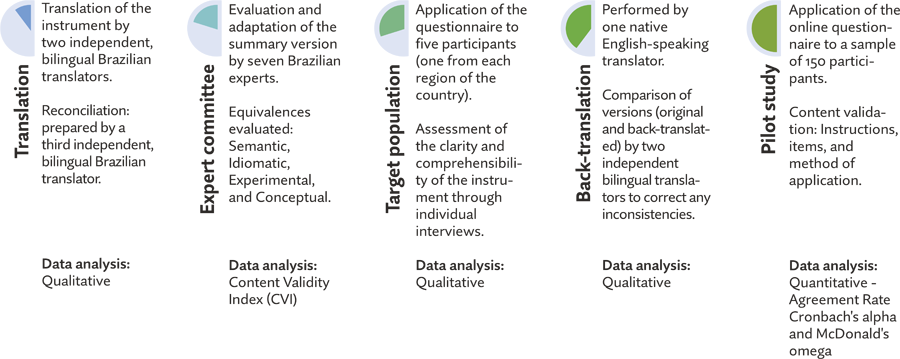
To ensure linguistic, semantic, cultural and conceptual equivalence between the original and adapted versions, the five stages of the cross-cultural adaptation procedure (Figure 1) were carried out, based on references from the national20,21and international literature, in accordance with the guidelines in Appendix A of the International Test Commission (ITC) guide22and Box G of the Consensus-based Standards for The Selection of Health Measurement Instruments (COSMIN) checklist23.

Summary of the five steps taken to translate and cross-culturally adapt the DSS into Brazilian Portuguese
-
Translation: The original questionnaire was sent to two independent bilingual Brazilian translators who were familiar with the purpose of the study, one of whom was a specialist in psychosocial assessment. A third independent, bilingual, Brazilian translator with experience in the field synthesized the versions and reconciled them into a single version, respecting the original meaning and the Brazilian linguistic context.
-
Committee of experts: Seven Brazilian, bilingual, post-graduate judges from the fields of psychology, occupational medicine, sociology, ergonomics and Information Technology (IT), selected for convenience and expertise - five with experience in psychometric tests and four in the construct studied. A 5-point Likert scale (1=not equivalent to 5=very equivalent) was used to assess the semantic, idiomatic, experiential, and conceptual equivalence between the versions. Items scored below 4 were revised and re-evaluated.
-
Evaluation of the target population: Five workers from the five regions of the country, with different professional profiles (coordinator, research analyst, quality technician, operation leader, and administrative assistant) were chosen for convenience. Participants were invited to answer the questionnaire via Google Forms and to take part in open interviews via video call to assess the clarity of the questionnaire’s instructions, their understanding of the items, the suitability of the Likert scale and the online format for application, as well as the response time. Inclusion criteria: active workers aged between 18 and 75 who use ICT in their work activities.
-
Back-translation: The final Brazilian Portuguese version was sent to a bilingual, native English translator for back-translation20. The resulting version was compared to the original by two independent bilingual translators, one a native English speaker, both working in IT but with no experience in the construct being assessed.
-
Pilot study: For this stage, the ITC guide22recommends a minimum sample of n = 30. A total of 150 workers (Table 2) took part, invited for convenience via social networks, by sharing an invitation letter with an open Google Forms link. Multiple responses were blocked, and responses were not mandatory. The inclusion criteria followed those of stage 3. After completing the questionnaire, they answered three objective questions with the options “agree” or “disagree” to validate the content: 1) Can the test instructions be fully understood? 2) Is the online test suitable? 3) Can the items be understood without difficulty? A field was left open for comments and suggestions. The answers to the questionnaire were used for a preliminary reliability analysis, as suggested by the ITC - TD-5 guideline22, to check the preliminary internal consistency of the adapted instrument before carrying out more complex and extensive validation studies21,22.
Data analysis
The semantic, idiomatic, experiential and conceptual equivalences of the items were analyzed using the Content Validity Index (CVI), to reduce the probability of random agreement, a Likert scale of five points was used24, the CVI was calculated by the proportion of 4 or 5 responses from the judges, considering these categories as indicative of the item’s suitability. The CVI-Item was obtained for each item (average of the four equivalences evaluated). To evaluate each scale, the S-CVI/AVE was used (average of the CVI-I for all the items in the scale) and the complete instrument was evaluated by the S-CVI (average of the CVI-I for all the items). The S- CVI/AVE and S- CVI were also calculated considering the items referring to the short version of the instrument. With a panel of seven judges, values ≥ 0.80 were considered indicative of satisfactory content validity25.
Content validation was also carried out using the agreement rate of the answers to the three questions applied to the 150 participants, calculated as (“agree” ÷ total answers × 100), with ≥ 90% being the minimum acceptable value21.
The preliminary analyses of reliability and internal consistency used the responses of the 150 participants, considering the respective items of the original version and the short version. McDonald’s Omega (ω) and Cronbach’s Alpha (α) coefficients were used, with the respective 95% Confidence Interval (CI). Values above 0.70 indicated adequate internal consistency26,27. Missing data and items scored “-1” were replaced by the median19.
The responses of all survey participants were anonymized and processed in Excel. All statistical analyses were carried out using R software. The Brazilian version of the DSS is expected to have adequate content validity and satisfactory preliminary internal consistency in the pilot study for both the original and short versions.
Ethical considerations
The ethical guidelines established by CNS Resolution No. 466/2012 were followed. The study was approved by the Research Ethics Committee of the State University of Campinas, opinion No. 5.667.487 of September 5, 2022. All participants consented and signed the Informed Consent Form; participation was voluntary. The anonymity and confidentiality of the participants was guaranteed, and data analysis was not individualized. The research was recorded and the data made available on the OSF repository (https://osf.io/prz6d/overview)28. The recommendations of the CHERRIES guide for reporting electronic research29were followed.
Results
The idiomatic, semantic, conceptual, and experiential equivalence evaluations resulted in CVI-I = 1.00 for the instructions and CVI-I = 0.96 for the Likert scale. Of the 50 items evaluated, four required adjustments and underwent two rounds of evaluation by the expert committee. In the end, all had a CVI of over 0.80. The complete instrument had an S-CVI of 0.96 for both versions.
As an example of the adjustments made, item 4 of the Social Environment dimension was initially translated as: “Sinto que as TIC criam normas sociais indesejadas [...]”, resulting in CVI-I: 0.4. After reformulation it became: “Eu sinto que as TIC criam regras sociais indesejadas [...]”, CVI-I: 1.0.
Table 3 shows the original English and Brazilian Portuguese versions, with the 30 items of the short version highlighted, and their respective CVIs.
In the stage with the target population, participants didn’t report any difficulty. The average response time was 15 minutes (SD = 5).
In the comparison between the original and back-translated versions, two inconsistencies were corrected, the most relevant of which refers to the item in the “social environment” category, which in English is: “Too much time gets lost at work because of irrelevant communication with other people on social media”, initially translated as “Perde-se muito no trabalho [...]”, which would omit the idea of wasted time. It has been adjusted to “Perde-se muito tempo no trabalho [...]”, remaining faithful to the original.
In the pilot study, the agreement rate was 96% - understanding of the instructions, 99% - online application; and 97% - understanding of the items, values above those recommended, showing adequate validity for cross-cultural adaptation. Of the 150 participants, 19 commented; five considered the questionnaire long, two suggested presenting the items randomly to reduce the feeling of repetition. There were no suggestions for changes to the translation.
Table 4 shows the Cronbach’s alpha values, with the respective CIs, and McDonald’s omega values for the 10 scales of the long and short versions. The results obtained indicate an excellent level of internal consistency for the long version, with the conflict, insecurity, support, and reliability scales having values above 0.90 and the others above 0.70.
As for the short version, only the Complexity scale had an alpha of 0.68, but this was offset by a higher CI of 0.73 and an omega of 0.71, as recommended in the literature. The percentage of missing items was 2.10% for the long version and 1.14% for the short version.
Discussion
The hypothesis that the translated instrument would have satisfactory content validity and preliminary internal consistency in a pilot study for both the original (50 items) and short (30 items) versions was confirmed.
The expert evaluation stage revealed high agreement, with CVI-Is ≥0.80 for all items after adjustments, and S-CVI 0.96 for the complete instrument, suggesting that the items, as well as being understandable, were consistent with the original version.
The participants in the target population understood the instrument well, representing different regions and realities of ICT use in Brazil. The back-translated version was analyzed by two independent translators, who identified the need for adjustments to two items. This stage was essential to consolidate the quality of the final version.
The pilot study confirmed the clarity of the instrument, with over 95% agreement on the instructions, understanding of the items and online application. Some participants criticized the length of the instrument (50 items), mentioning a feeling that the questions were repetitive. This points to the possibility of randomizing items in future applications to reduce response bias and fatigue. These indicators support the validity of cross-cultural adaptation.
The results of the preliminary reliability analysis indicated satisfactory internal consistency in both the full and short versions. The alpha and omega were higher than 0.70 for all the scales in the full version. In the short version, only the complexity scale had an alpha of 0.68, offset by an omega of 0.71 and a CI of over 0.73. These data meet the criteria widely accepted in psychometric literature, which considers values above 0.70 to indicate adequate reliability26,30,27.
The alpha coefficient is sensitive to the total number of items, so longer scales tend to artificially inflate alpha values. On the other hand, in shorter versions, as observed in this study, the alpha can show lower results, even when the internal consistency is adequate30. Sample size also influences these estimates: small samples, common in preliminary analyses, tend to generate less stable results. However, a study published in 2024 showed that a sample of more than 30 participants is suitable for reliability analysis in a pilot study31.
To mitigate these limitations and strengthen the robustness of the analyses, the study also used McDonald’s omega coefficient, which offers a more realistic estimate of reliability by considering the individual factor loadings and associated errors. The omega values were adequate (≥0.70 and ≤0.96). Applying these coefficients together contributes to a more accurate assessment of internal consistency and strengthens the preliminary validity of the Brazilian version of the DSS, both in its complete form and in the short version27.
It is important to mention that the authors suggest a specific interpretation of the results, according to which a value equal to “1” could already be indicative of perceived stress18. However, in agreement with the expert committee, we decided to keep the continuous reading of the scores, compatible with the usual psychometric functioning of seven-point Likert scales, for the Brazilian version32.
Compared to COSMIN checklist G23, only two items were not fully met: the similarity between the original validation samples and this study (convenience sample) and the absence of confirmatory factor analysis or Item Response Theory (IRT), which were not in the current scope. The psychometric qualities established in the original instrument may be affected in the adapted version due to differences between the characteristics of the samples, which, in the original version, were predominantly male (56.2%), graduates (37.4%) and a mean age of 39 years (standard deviation = 14.99)11.
In a recent study carried out in Norway by Sevic et al., the validation of the DSS did not show a good fit with the original format. The authors carried out an exploratory factor analysis, resulting in a version with 37 items distributed in eight factors with high internal consistency (alpha and omega > 0.80). This result reinforces the importance of re-evaluating the factor structure in different cultural contexts and corroborates the need for further studies to confirm the structure of the DSS in Brazil33.
The use of a convenience sample and online collection represents a methodological limitation, with a risk of selection bias. In this study, the sample was made up predominantly of workers from the Southeast and with a high level of education. Despite this, it allowed access to participants from all regions, saving resources. Low familiarity with the electronic form may have had an impact on response time or completion rate, and potential bias due to respondent fatigue.
Conclusion
The Brazilian version of the Digital Stressors Scale, in its original and short versions, showed preliminary evidence of adequate content validity and internal consistency, demonstrating good linguistic, conceptual, experimental and semantic adaptation to the national context. Although promising, the pilot study does not yet provide sufficient evidence for widespread use in Brazil. It is recommended to continue evaluating the psychometric properties with larger and more diverse samples and use factorial or IRT-based analyses to confirm their internal structure and improve their accuracy and applicability.
References
-
1 Tarafdar M, Tu Q, Ragu-Nathan BS, Ragu-Nathan TS. The impact of technostress on role stress and productivity. J Manage Inf Syst. 2007 Jul;24(1):301-28. https://doi.org/10.2753/MIS0742-1222240109
» https://doi.org/10.2753/MIS0742-1222240109 -
2 Bahamondes-Rosado ME, Cerdá-Suárez LM, Ortiz de Zevallos GFD, Espinosa-Cristia JF. Technostress at work during the COVID-19 lockdown phase (2020-2021): a systematic review of the literature. Front Psychol. 2023 Apr;14(April):1173425. https://doi.org/10.3389/fpsyg.2023.1173425
» https://doi.org/10.3389/fpsyg.2023.1173425 -
3 Agência Tecere. Trabalho híbrido predomina na América Latina, mas empresas tendem a aumentar a frequência no escritório JLL. 12 abr 2024 [citado 2 nov 2025]. Disponível em: https://www.jll.com/en-us/insights/hibrido-predomina-na-america-latina
» https://www.jll.com/en-us/insights/hibrido-predomina-na-america-latina -
4 Andrulli R, Gerards R. How new ways of working during COVID-19 affect employee well-being via technostress, need for recovery, and work engagement. Comput Human Behav. 2023:139:107560. https://doi.org/10.1016/j.chb.2022.107560
» https://doi.org/10.1016/j.chb.2022.107560 -
5 World Economic Forum. The future of jobs report 2025: insight report. Cologny: World Economic Forum; 2025 [citado 20 jan 2025]. Disponível em: https://www.weforum.org/publications/the-future-of-jobs-report-2025/
» https://www.weforum.org/publications/the-future-of-jobs-report-2025/ - 6 Byung-Chul Han. Sociedade do cansaço. Petrópolis: Vozes; 2015.
-
7 Nações Unidas Brasil. Brasil: afastamentos por problemas de saúde mental aumentam 134%. Brasília, DF: Nações Unidas Brasil; 2025 [citado 7 nov 2025]. Disponível em: https://brasil.un.org/pt-br/292926-brasil-afastamentos-por-problemas-de-sa%C3%BAde-mental-aumentam-134
» https://brasil.un.org/pt-br/292926-brasil-afastamentos-por-problemas-de-sa%C3%BAde-mental-aumentam-134 -
8 Setta AV, Lucca SR. Tecnologias de informação e comunicação: revisão de escopo dos instrumentos de avaliação dos fatores de risco psicossociais no trabalho contemporâneo. Rev Bras Saude Ocup. 2024;49:e6. https://doi.org/10.1590/2317-6369/02722pt2024v49e6
» https://doi.org/10.1590/2317-6369/02722pt2024v49e6 - 9 Karasek R, Formanzin M, Agbenyikey W, Dolland M, Li J, Si C, et al. The multilevel 'associationalist' demand- control theory and the job content questionnaire 2.0. Eur J Prev Cardiol 2017;24(2_suppl):7-53.
-
10 Burr H, Berthelsen H, Moncada S, Nübling M, Dupret E, Demiral Y, et al. The Third Version of the Copenhagen Psychosocial Questionnaire. Saf Health Work. 2019 Dec;10(4):482-503. https://doi.org/10.1016/j.shaw.2019.10.002
» https://doi.org/10.1016/j.shaw.2019.10.002 -
11 Fischer T, Reuter M, Riedl R. The digital stressors scale: development and validation of a new survey instrument to measure digital stress perceptions in the workplace context. Front. Psychol. 2021 Mar;12(March):607598. https://doi.org/10.3389/fpsyg.2021.607598
» https://doi.org/10.3389/fpsyg.2021.607598 -
12 Ragu-Nathan TS, Tarafdar M, Ragu-Nathan BS, Tu Q. The consequences of technostress for end users in organizations: conceptual development and empirical validation Inf Syst Res. 2008 Dec;19(4):417-33. https://doi.org/10.1287/isre.1070.0165
» https://doi.org/10.1287/isre.1070.0165 -
13 Fischer T, Pehböck A, Riedl R. Is the technostress creators inventory still an up-to-date measurement instrument? Results of a large-scale interview study. 14th International Conference on Wirtschaftsinformatik 2019 Feb [citado 22 jan 2025];1:1834-45. Disponível em: https://www.researchgate.net/publication/331198725_Is_the_Technostress_Creators_Inventory_Still_an_Up-To-Date_Measurement_Instrument_Results_of_a_Large-Scale_Interview_Study
» https://www.researchgate.net/publication/331198725_Is_the_Technostress_Creators_Inventory_Still_an_Up-To-Date_Measurement_Instrument_Results_of_a_Large-Scale_Interview_Study -
14 Nastjuk I, Trang S, Grummeck-Braamt JV, Adam MT, Tarafdar M. Integrating and synthesising technostress research: a meta-analysis on technostress creators, outcomes, and IS usage contexts Eur J Inf Syst. 2024;33(3):361-82. https://doi.org/10.1080/0960085X.2022.2154712
» https://doi.org/10.1080/0960085X.2022.2154712 -
15 Tarafdar M, Tu Q, Ragu-Nathan TS, Ragu-Nathan BS. Crossing to the dark side: examining creators, outcomes, and inhibitors of technostress. Commun ACM. 2011;54(9):113-20. https://doi.org/10.1145/1995376.1995403
» https://doi.org/10.1145/1995376.1995403 -
16 Fuglseth AM, Sørebø Ø. The effects of technostress within the context of employee use of ICT. Comput Human Behav. 2014;40:161-70. https://doi.org/10.1016/j.chb.2014.07.040
» https://doi.org/10.1016/j.chb.2014.07.040 -
17 Carlotto MS, Câmara SG. Tradução, adaptação e exploração de propriedades psicométricas da escala de tecnoestresse (RED/TIC) Psicol Estud. 2010;15(1):171-8. https://doi.org/10.1590/S1413-73722010000100018
» https://doi.org/10.1590/S1413-73722010000100018 -
18 Veiga MG, Felizi RT, Trevisan GD, Cubero DI, Fernandes CE, Oliveira E. Translation and validation of the techno-stress questionnaire in Brazil Rev Assoc Med Bras. 2022 Nov;68(12):1709-14. https://doi.org/10.1590/1806-9282.20220793
» https://doi.org/10.1590/1806-9282.20220793 -
19 Riedl R, Fischer T, Reuter M. Measuring digital stress in the workplace context. Inform Spektrum 2023 Dec 21;46(5-6):235-9. https://doi.org/10.1007/s00287-023-01553-9
» https://doi.org/10.1007/s00287-023-01553-9 -
20 Borsa JC, Damasio BF, Bandeira DR. Adaptação e validação de instrumentos psicológicos entre culturas: algumas considerações. Paidéia (Ribeirão Preto). 2012;22(53):423-32. https://doi.org/10.1590/S0103-863X2012000300014
» https://doi.org/10.1590/S0103-863X2012000300014 -
21 Alexandre NM, Coluci MZ. Validade de conteúdo nos processos de construção e adaptação de instrumentos de medidas. Cien Saude Colet. 2011 Jul;16(7):3061-8. https://doi.org/10.1590/S1413-81232011000800006
» https://doi.org/10.1590/S1413-81232011000800006 - 22 International Test Commission. Diretrizes do ITC para tradução e adaptação de testes. 2a ed. 2017.
-
23 Mokkink LB, Terwee CB, Patrick DL, Alonso J, Stratford PW, Knol DL, et al. The COSMIN checklist for assessing the methodological quality of studies on measurement properties of health status measurement instruments: an international Delphi study Qual Life Res. 2010 May;19(4):539-49. https://doi.org/10.1007/s11136-010-9606-8
» https://doi.org/10.1007/s11136-010-9606-8 -
24 Wynd CA, Schmidt B, Schaefer MA. Two quantitative approaches for estimating content validity. West J Nurs Res. 2003 Aug;25(5):508-18. https://doi.org/10.1177/0193945903252998
» https://doi.org/10.1177/0193945903252998 -
25 Polit DF, Beck CT. The content validity index: are you sure you know what's being reported? Critique and recommendations Res Nurs Health. 2006 Oct;29(5):489-97. https://doi.org/10.1002/nur.20147
» https://doi.org/10.1002/nur.20147 -
26 Izah SC, Sylva L, Hait M. Cronbach's alpha: a cornerstone in ensuring reliability and validity in environmental health assessment. ES Energy Environ 2023;23:1-14. https://doi.org/10.30919/esee1057
» https://doi.org/10.30919/esee1057 -
27 Kalkbrenner MT. Alpha, Omega, and H internal consistency reliability estimates: reviewing these options and when to use them couns outcome Res Eval. 2023 Jan;14(1):77-88. https://doi.org/10.1080/21501378.2021.1940118
» https://doi.org/10.1080/21501378.2021.1940118 -
28 Setta AV, Lucca SR. Brazilian version of Digital Stressors Scale: cross-cultural adaptation OSF. 2025 [citado 08 jul 2025]. Disponível em: https://osf.io/prz6d/overview
» https://osf.io/prz6d/overview -
29 Eysenbach G. Improving the quality of Web surveys: the Checklist for Reporting Results of Internet E-Surveys (CHERRIES) J Med Internet Res. 2004 Sep;6(3):e34. https://doi.org/10.2196/jmir.6.3.e34
» https://doi.org/10.2196/jmir.6.3.e34 -
30 Tavakol M, Dennick R. Making sense of Cronbach's alpha. Int J Med Educ. 2011;2:53-5. Disponível em: https://doi.org/10.5116/ijme.4dfb.8dfd
» https://doi.org/10.5116/ijme.4dfb.8dfd -
31 Bujang MA, Omar ED, Foo DH, Hon YK. Sample size determination for conducting a pilot study to assess reliability of a questionnaire Restor Dent Endod. 2024 Jan;49(1):e3. https://doi.org/10.5395/rde.2024.49.e3
» https://doi.org/10.5395/rde.2024.49.e3 - 32 DeVellis RF. Scale development: theory and applications. 4th ed. Los Angeles: Sage; 2017. Chapter 3; Reliability. (Applied social research methods series, v. 26).
-
33 Sevic A, Foldnes N, Brønnick KK. Measuring digital stress in Norway: translation and validation of the Digital Stressors Scale Front Psychol. 2024 Feb;15:1297194. https://doi.org/10.3389/fpsyg.2024.1297194
» https://doi.org/10.3389/fpsyg.2024.1297194
-
b
Contact person: Dr. René Riedl.
-
Information on academic work:
Work based on the doctoral thesis by Alexandra Vasconcelos Antunes Setta, entitled “Escala de Estressores Digitais: adaptação transcultural e validação psicométrica do instrumento para o português brasileiro (Digital Stressors Scale: cross-cultural adaptation and psychometric validation of the instrument for Brazilian Portuguese)”, presented on January 16, 2026, at the Faculty of Medical Sciences of the State University of Campinas.
-
Data availability:
The entire set of anonymized data supporting the results of this study is available at: OSF (Open Science Framework). URL or DOI: https://doi.org/10.17605/OSF.IO/PRZ6D. July 8, 2025.
-
Statement on the use of Artificial Intelligence:
During the preparation of the article, the artificial intelligence tool Chat GPT version 5.2 was used to carry out the grammar and language review. The authors declare that they have reviewed and validated all the content generated with the help of the artificial intelligence tool.
-
Presentation at a scientific event:
The authors declare that the study has not been presented at a scientific event.
-
Funding:
The authors declare that the study was not subsidized.
Edited by
-
Responsible editors:
Raoni Rocha Simões https://orcid.org/0000-0003-1181-0132 Universidade Federal de Ouro Preto - UFOP Tânia Maria de Araújo https://orcid.org/0000-0003-2766-7799 Universidade Estadual de Feira de Santana - UEFS
The entire set of anonymized data supporting the results of this study is available at: OSF (Open Science Framework). URL or DOI: https://doi.org/10.17605/OSF.IO/PRZ6D. July 8, 2025.

 Source: Authors’ own elaboration.