
 Invisibles at work and in health: occupational exposure of women to asbestos in the region of Pedro Leopoldo-MG, Brazil
Abstract
Objective The study investigated the occupational exposure of women to asbestos and how gender relations interfere with work and illness.
Methods Based on the framework of Worker Health and Bardin’s content analysis, twelve open interviews were conducted between October 2021 and June 2022 with female workers exposed to asbestos in a factory environment in the Pedro Leopoldo region, MG. These workers belong to the Brazilian Association of Asbestos Exposed Workers-MG (Abrea-MG). The MAXQDA software (Analytics Pro 2022 6.0) was used to assist in categorization through algorithmic analysis based on term frequency and the creation of word clouds.
Results Two main axes were identified (Health and Work), encompassing subcategories that highlighted women’s occupational activities with asbestos, family work, inequality, precarization, exploitation, undervaluation of women’s labor, multiple exposure, illnesses related to asbestos-related diseases, recurrent miscarriages, and the limited diagnostic investigation.
Conclusion The invisibility of female labor exposed to asbestos in a factory environment became clear, compounded by the task of washing family clothing (including those exposed to asbestos), taken as a female duty. It is necessary to specifically recognize and address the female workers exposed to and affected by asbestos.
Keywords
Occupational Health; Women’s Work; Asbestos; Occupational Diseases; Gender
Resumo
Objetivo Investigar a exposição ocupacional de mulheres ao amianto e como as relações de gênero interferem no trabalho e no adoecimento.
Métodos Estudo qualitativo, tomando por base o referencial da Saúde do Trabalhador e a análise de conteúdo de Bardin. Foram realizadas 12 entrevistas abertas, no período de outubro de 2021 a junho de 2022, com trabalhadoras expostas ao amianto em ambiente fabril na região de Pedro Leopoldo-MG, afiliadas à Associação Brasileira de Expostos ao Amianto-MG (Abrea-MG). Utilizou-se o software MAXQDA (Analytics Pro 2022 6.0) para auxiliar na categorização e análise algoritmica por meio de frequência de termos e construção de nuvens de palavras.
Resultados Dois eixos principais foram revelados (Saúde e Trabalho), permeados de subcategorias que mostraram as atividades ocupacionais das mulheres com amianto, trabalho familiar, desigualdade, precarização, exploração e desvalorização do trabalho feminino, exposição múltipla, adoecimentos por doenças asbesto relacionadas, recorrência de abortos e incipiente investigação diagnóstica.
Conclusão Restou clara a invisibilidade do trabalho feminino exposto ao amianto em ambiente fabril, acrescido do trabalho de lavagem de vestuário da família (inclusive expostos ao amianto), tomado como tarefa feminina. É preciso reconhecer e lidar de forma específica com as trabalhadoras expostas e adoecidas pelo amianto.
Palavras-chave:
Saúde do Trabalhador; Trabalho Feminino; Amianto; Doenças Profissionais; Gênero
Introduction
Asbestos (Greek) is the commercial and generic name that represent a group of naturally occurring fibrous silicate minerals from serpentine and amphibole series. They include chrysotile (“white asbestos”), from the serpentine family, and the five minerals from the amphibole family: actinolite and amosite (“brown asbestos”), anthophyllite and crocidolite (“blue asbestos”), and tremolite1.
The mineral has several uses, low production costs, and excellent thermal and mechanical resistance, and has been used for millennia. Its uses range from making clothing and other flame-retardant artifacts to tarpaulins and pads, gaskets, clutch disc linings, roof tiles, water tanks, flat panels, lining, flooring, cladding, partitions, thermal and acoustic insulation, paints, and other similar applications.2.
Exposure to asbestos is linked to diseases such as lung cancer, mesothelioma, pleural plaques, and asbestosis3,4. The International Agency for Research on Cancer (IARC), in a comprehensive assessment of the carcinogenicity of asbestos, has accumulated sufficient evidence that “all forms of asbestos”, specifically including chrysotile, crocidolite, amosite, tremolite, actinolite, and anthophyllite, are carcinogenic. Evidence of a causal relationship was considered sufficient for mesothelioma and cancers of the lung, larynx, and ovary, and limited for cancers of the pharynx, stomach, and colorectal1.
For decades, Brazil has been the world’s third largest producer of asbestos, contributing with 15.1% of global production in 20155. However, despite this significant production, the number of deaths related to asbestos exposure between 1980 and 2010 was remarkably low, with only 3,718 cases reported to the Mortality Information System. In contrast, in the United States, where asbestos mining has been banned since 2002, 2,497 deaths from asbestos exposure were reported in 2013 alone6.
In Brazil, Ordinance No. 1339, published on November 18, 1999, established a list of work-related diseases and occupational risk agents/factors coded according to the International Code of Diseases - ICD-10, which includes asbestos-related diseases: malignant neoplasm of the stomach (C16.-), malignant neoplasm of larynx (C32.-), malignant neoplasm of bronchus and lung (C34.-), mesothelioma of pleura (C45.0), mesothelioma of peritoneum (C45.1), pericardial mesothelioma (C45.2), epicardial or pericardial plaques (I34.8), asbestosis (J60), pleural effusion (J90), and pleural plaques (J92)7.
In a recent update of this list, some diseases were included, such as malignant neoplasm of the colon (C18), malignant neoplasm of the rectum (C20), and pneumoconiosis due to asbestos and other mineral fibers (J61). Of particular note is malignant neoplasm of ovary (C56), which represents an important advance for women in recognizing the causal relationship.
Some of the characteristics are the irreversibility and progression of some pathophysiological processes, even after exposure. This means that even when the number of people exposed can be reduced, the effects can progress.
There is a latency period between exposure and the onset of effects (which can be long-lasting), with an average time of 10 years8, which can reach 10 to 15 years for the development of asbestosis, 20 to 30 years for lung cancer, and 40 to 50 years for mesothelioma9. It has been estimated that the peak in deaths from these last two conditions in Brazil will occur between 2021 and 202610.
There are still gaps that require further study. The Brazil Health Report (2019)11points out that asbestos-related deaths among “housewives” accounted for 10.8% of the total, generally considered to be the result of washing clothes and handling objects belonging to family members who worked in contact with the fiber, or even because the workers’ families lived close to the mines and industries12-14.
According to the document11, another hypothesis that could explain this finding is the fact that the death certificate was filled in with job held during the phase of life in which death occurred, without describing previous occupations. In 40.37% of the records of deaths from exposure to asbestos, the occupation was not classified, informed or ignored, which makes it difficult to determine whether the exposure occurred in the workplace11.
Along the same lines, a qualitative study of women exposed to asbestos in the workplace in the state of São Paulo found 22 cases of mesothelioma between 1980 and 1997, of which eight were women and 14 men. However, there is more to be analyzed. It has been shown that between 1980 and 1997, out of 22 cases of mesothelioma, eight were women. The authors warned about the incidence of cases in women, because until the 1988 Constitution15, women were formally prohibited from working in unhealthy activities, including those in contact with asbestos16. Of the eight women, two housewives and under the age of 40, which suggests exposure in childhood (due to the long latency period of the disease), and acquired probably not occupationally and indirectly, i.e. through family members in contact with the carcinogen or even environmental exposure17. But what about the other women? Was there undisclosed occupational exposure?
Costa18, in a study also carried out in São Paulo, identified the same danger situation related to the exposure to asbestos faced by families of workers, due to the contamination of work clothes taken home17, 18.
As well as giving visibility to this serious public health problem, it is essential to unveil the gender relations that permeate the lives of women exposed to asbestos, as well as their struggle, including difficulties and possibilities and that affected groups achieve protection for the health of those exposed, particularly in the place studied.
It is assumed that there are unequal dynamics in the management, care, and assistance to women’s health, which seem to be more latent due to the naturalization of social impositions and family care exercised by women. Furthermore, it is important to note that the situation faced by women exposed to asbestos has been ignored and kept silent for decades, without being addressed in research.
The aim of this study is to investigate the occupational exposure of women to asbestos and how gender relations affect their work and illness. The article presents the work and health paths of women occupationally exposed to asbestos who are members of the Brazilian Association of Asbestos Exposed Workers-MG (Abrea-MG), based in the municipality of Pedro Leopoldo, Minas Gerais, Brazil.
Theoretical background
From an epistemological point of view, the theoretical precept of Workers’ Health (WH) is adopted, in which workers are considered subjects of the knowledge process, since their experience and knowledge about concrete work situations is an essential part of scientific knowledge19. Consequently, this study argues that the health-disease process is strongly determined by workers’ organizational capacity20. In order to understand the relationship between gender and work, we used the concept of the sexual division of labor, which is fundamental for a critical understanding of women’s productive and reproductive work, highlighting it also in the sphere of private relationships, stereotypes of female instinct or maternal love, explaining the “double burden”, re-signifying it as work (exploited and unpaid)21,22.
The work entitled “A Classe Operária tem Dois Sexos” (The Working Class Has Two Sexes) by Elizabeth Souza-Lobo23is also an inspiring source for reflecting on the studies and respective analyses that used to be located in the economy and production, and which are now identified in the differences power relations between actors capable of fighting and experiencing their belonging to one sex. This author encourages us to debate what is at stake in the discourse of asymmetrical relations between men and women.
In this context, the problem studied, which derives from the health and work itineraries from a gender perspective, permeates the current moment and frames a dialogical retrospective between the past, present and future. To understand the production, exposure, use, and consumption of asbestos in the Minas Gerais region, it is essential to concretely establish the relationships between the classes in this arena of struggle: the social movement, those exposed, asbestos-capital and governments. In the words of Hirata and Kergoat21:
The sexual division of labor is the form of social division of labor resulting from social relations between the sexes; more than that, it is a priority factor for the survival of the social relationship between the sexes. This form is modulated historically and socially. Its characteristics are the priority assignment of men to the productive sphere and women to the reproductive sphere and, at the same time, the appropriation by men of functions with greater added social value (political, religious, military, etc.) (p. 599).
This ideology creates a tradition of inferiority, subordination and devaluation of women, which consequently continues to this day with the devaluation of their work. Thus, the sexual division of labor is legitimized through the low salaries paid to women and justified as payments intended only to supplement family income; domestic work, destined “naturally” to women as an attribute, which would be totally disregarded as effectively work, because it is not in the direct field of production; the idea that women are less productive than men because they “don’t work as hard” as men, and therefore all the work done by women is of less value24.
Methods
This is a qualitative, retrospective, and descriptive study of women occupationally exposed to asbestos in the Pedro Leopoldo region of Minas Gerais. The technique used was open and individual interviews, with an approach to oral history for the population studied. As a methodological procedure that seeks, in the construction of sources and documents, to record narratives, testimonies, versions, and interpretations of history in various factual, temporal, spatial, and conflictual dimensions, it allowed the construction of narratives and itineraries25.
Twelve interviews were held with the workers between October 2021 and June 2022, scheduled in advance and interspersed at intervals of approximately one hour. The scheduling was supported by Abrea-MG, a social movement legitimized by the collective in the fight and defense of the health and rights of those exposed to asbestos. The criteria for selecting the participants were that they were close to the movement and had made a recent demand to the association. The appointment was made according to availability, time and the necessary health protection measures, during the covid-19 pandemic, all of which were strictly respected.
The first step in organizing the data was to typify the socioeconomic and demographic profile of the women studied. The interviews were then systematized and categorized according to the content analysis technique26, in which verbal and non-verbal sources of content were subjected to interpretation, key variables were constructed after appropriate analysis and classified according to criteria of similarity, frequency, and relevance in relation to the objective of the study, making it possible to identify the key variables.
The organization and systematization of the data and analysis of the categories were carried out using the qualitative analysis software MAXQDA Analytics Pro 2022 6.027. This program is used to process and analyze non-numerical and unstructured data from various sources of qualitative information28.
The interviews were sorted randomly and numbered chronologically followed by the letter: W (women). The purpose of these records was to preserve the anonymity of the interviewees respondents. The interviews were then uploaded to the program and sent for categorization.
Clouds of the most mentioned words were created by the software and helped with categorical construction. The main axes of analysis were confirmed, among which “Work” and “Health” stood out.
These main axes/categories were broken down into subcategories according to their relevance, pertinence and the interviewees’ speeches (presented in the text) in the presentation and discussion of the itineraries traced and intertwined in the health and work of those exposed to asbestos.
This article is part of the research entitled Itinerários (im)possíveis da saúde e trabalho de homens e mulheres expostos ao amianto na região de Pedro Leopoldo-MG, doctoral thesis, and received approval under number 5.004.836 from the Research Ethics Committee of the Escola Nacional de Saúde Pública Sérgio Arouca, on September 28, 2021. All respondents signed an Informed Consent Form.
Results and Discussion
About the space and the population
Pedro Leopoldo is a city close to Belo Horizonte (40 km) and since the 1960s has had an industry producing fiber cement, with a product portfolio that included asbestos. The company is a major local employer29.
With a population of around 66,000 inhabitants30, it has a small hospital and maternity hospital (45 beds to cover regional needs, including beds provided by the Unified Health System (SUS) and private healthcare plans31, with medium-complexity outpatient and emergency care). There are 13 basic family health units (UBSF), an Integrated Health Care Center (for medical specialties), a Women’s and Children’s Health Clinic, a Mental Health Service, and a Central Pharmacy32. The region has no medium or high-complexity diagnostic and treatment services and is permeated by problems and illnesses with wide-ranging needs.
Socio-economic and demographic profile of the study population
The survey revealed that most of the study participants were married. The predominant age group was between 60 and 70. In terms of education, most of the participants completed elementary school and a minority had higher education. Catholicism was the most common religion, followed by evangelicalism. Most of the women interviewed were retired. Retirement (service time) was the main source of income. The predominant skin color was black, and they lived in the cities of: Pedro Leopoldo, Matozinhos, Confins, and São José da Lapa. These women play a fundamental role in the defense of health, even though they have a discreet political role and occupy management positions in Abrea-MG.
Categories and subcategories identified
Among the categories identified, the following subcategories stand out, shown by the number of times they were mentioned during the interviews (there may be more than one mention per interview): a) Work and life with asbestos: domestic and care work (67), information and use of asbestos (72), exposure at work and at home (78), perceived differences at work from a gender perspective (38), what working with asbestos represented (26), asbestos-related events (65), protective equipment (64), other products used (19), how they joined the company (22), family members who died working with asbestos (18); b) Health: denial of illnesses (14), accident at work (12), other illnesses (42), typical women’s illnesses (16), asbestos-related illnesses (65), and abortion(s) (10).
It can be seen that work was the most addressed area, followed by health, the environment, and finally future projects. Exposure at work and at home, information, and the use of asbestos stand out, followed by domestic and care work. Health, in particular, was portrayed by Asbestos-Related Diseases (ARD), followed by other diseases and diseases typical of women. The recurrent mention of abortion in the interviews is noteworthy from the perspective of women’s health. Although a relationship between exposure to asbestos and adverse reproductive outcomes in humans has not been established, Hricko33 has already warned of problems related to the sexual and/or reproductive health of those exposed to asbestos. According to this author, the potential adverse effects on reproduction, or the ability to give birth to normal, healthy children, caused by exposure to risks such as asbestos in the workplace, are a cause for concern. The study also reported menstrual changes in women, interactions with sexual functions in men, and genetic lesions in germ cells of both males and females. The recurrence of miscarriages among women exposed to asbestos, either directly or indirectly, in the studied region calls for further research, as there is no evidence of this causal relationship.
I had three miscarriages... (W2).
I had two miscarriages... I didn’t even go to the hospital. The first one I did go, because I was 6 months along, but the second one I didn’t even go (W8).
I had to have my uterus removed. It must have been 8 years ago. My husband was still working there, and I had already left (W26).
It should be noted that the illness so emphasized by the respondents reflects expectations about knowledge and treatment of ARD and/or other diseases. There was a discreet number of diagnoses raised by the study: one for pleural plaques and one for asbestosis. There were two cases of oncological investigation. There were a high number of women with no diagnosis or investigation, totaling seven. Of the population studied, only one had no complaints or symptoms of disease. However, health was the main category highlighted by recurring concerns and mentions throughout the survey.
The related word clouds show the terms most used by occupationally exposed women. The size of each word relates to the number of times it was mentioned. The highlights are clear and their relationship to women’s suffering is duly discussed.
Health axis
The analysis of the interviews made it possible to evaluate and align the terms highlighted. The interviewees are sick women.
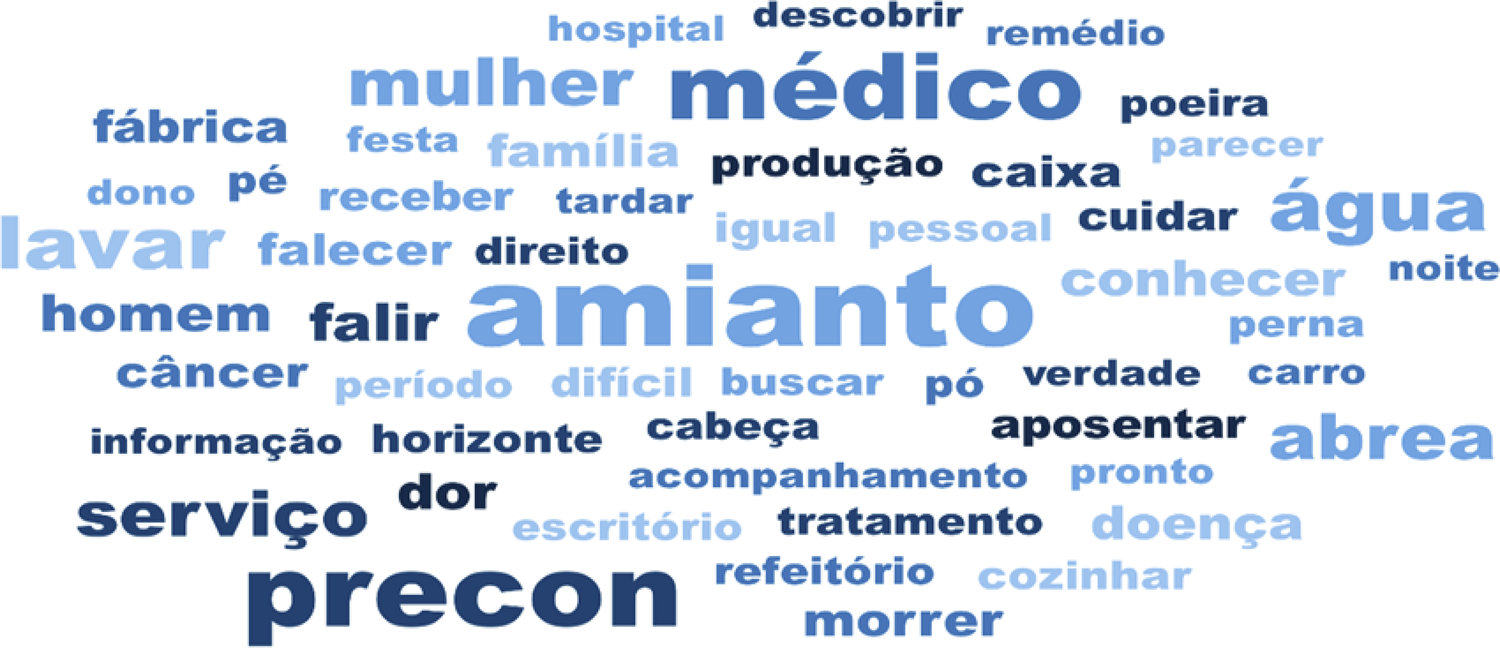
We can see the predominance and centrality of asbestos and possibly the implication and responsibility of the company’s female workers and doctors in the problem addressed. However, this visual approach mainly emphasizes women’s identity, the pain associated with cancer and disease, as well as treatment (and the difficulty of obtaining it) and monitoring these conditions.
Notably, the mention of health is described in the speeches with a focus on illness, death, and dying represented by the respective verbs that appear in the spotlight, as well as retiring, which refer us to the cycles of working life in asbestos.
The doctor and the truth are also presented in the doctor’s alleged belief in the truth. Water, also featured, is a term used to talk about the removal of water from the lungs. Both words have a welfare connotation, highlighting concern, the importance of treatment, and the disease itself.
Although the health categories are less prominent than the work categories, Figure 2 includes subcategories such as diseases typical of women, as well as those related to asbestos and others mentioned, bringing perceptions of illness that are more general and less specific to women.

Cloud of categories formed by the group of women exposed to asbestos from which the Work axis was composed. Words (most to least cited): Occupational and domestic exposure; Domestic and caregiving work; Information and use of asbestos; Protective equipment; Asbestos-related diseases; Family and friends in asbestos; Perceived differences in work from a gender perspective; Deceased family members due to asbestos; What it meant to work with asbestos; Future projects; Other diseases; Diseases typical of women; Dust and powder in the factory; Miscarriage(s); Waste/residues; Denial of the disease; Work accident; Water consumed at work; Other products used; How they joined the company.
Verbs such as caring and cooking also appear as important female functions in domestic and care work. The words family, equal, and right seem to represent a cycle of attention and care and of demands, of inequality in dealing with illnesses and cancerous fiber.
In addition to the word “family”, other terms draw attention to a domestic activity which, as well as being a source of daily work overload, is also a source of further contamination, configuring a multiplicity of contamination which is the action of washing contaminated clothes from working with asbestos. These women washed their own clothes and those of their husbands, who were also asbestos workers. Other verbs aligned with domestic work are cooking and caring. “Contaminating company” was also strongly mentioned. Thus, the number of cases of ARD in women is small compared to the serious overall situation reported by Abrea-MG in Chart 1.
Records of illnesses of members of the Brazilian Association of Asbestos Exposed Workers-MG - Abrea-MG (2017-2022)
However, these data show gaps in access and health care for asbestos workers in that region, while also alerting us to possible new pathologies related to exposure to the carcinogenic fiber, such as thyroid cancer. Although a direct causal relationship with asbestos cannot be established, the high frequency of this neoplasm in members and those exposed to asbestos from Abrea-MG highlights the urgent need for further studies to deepen the understanding of the issue. They also highlight the urgent need for further studies on the subject.
In this context and in line with the study by Gregório et al.35, an average interval of 6.5 months was observed between the onset of symptoms of malignant pleural mesothelioma (MPM) and the first specialist consultation. This delay highlights the shortcomings still present in health systems in the care of ARD, a lack of knowledge on the part of patients about exposure to asbestos and of health professionals, which compromises referral for appropriate treatment. The population studied corroborates the findings on the lack of knowledge of ARD among both exposed women and health professionals. Furthermore, this situation may be aggravated and unprecedented, given the time needed to diagnose ARD in the contingent of exposed female workers not yet located by Abrea-MG in that region.
In addition, the National Cancer Institute (INCA)36reports high mortality from MPM in men in the region studied, especially in Confins (4.0%), compared to the national and global context (0.6%). Also worrying is the lack of information on the mortality of women from MPM in the region, suggesting underreporting and pointing to the need for further studies and the inclusion of the gender dimension.
Work axis
Subcategories such as domestic work and care work were highlighted in the work axis, since women took care of the family with other family members also exposed. “Perceived differences from a gender perspective” is another category highlighted together with protective equipment, exposure at home and at work, representing the multiple forms of contamination. The lack of or little information about the risks of asbestos in the factory was highlighted.
I was the one who looked after the house and the children. I was young then. I was too smart, I could handle it. And he helped a lot, my husband. And there was a neighbor who helped me, with the girl I had, Michele, the oldest. She would help me at dawn, when I was out. When he wasn’t there. Sometimes he was about to arrive, and I was about to leave. His schedule was also difficult. When I arrived, he was leaving (W28).
In addition to the terms highlighted, the interviews and their categorization made it possible to highlight relevant aspects of invisibility and perceptions of equality in a context that is recognizably unequal for the women in this study, represented by the word equal (Figure 1).

Cloud of the words mentioned by the group of women exposed to asbestos at work and which made up the health axis Words (most to least cited): asbestos; doctor; proper name; servisse; wash; water; woman; man; disease; cancer; pain; die; pass; factory; dust; work; right; medicine; take care; head; discover; treatment; retire; leg; foot; hospital; party; family; horizon; meet/know; follow-up; production; box; truth; nigth; office; cook; car; owner.
The study found that occupationally exposed women were, in fact, triply exposed, since they washed their own contaminated clothes and those of their spouses, who were also workers in the same industry. These women were also triply overburdened, having to deal with exploitation at work, domestic chores, and caring for the health of their families.
And these sick women have been exposed for more than two decades, even during the period in which women’s work in unhealthy activities in the industry was banned. But they were invisible. So invisible that they remained unseen even when they were hired to replace men on strike37in the asbestos industry. The “concealment” and pioneering of this history brought by women workers in the asbestos industry in the region exemplify how gender inequalities and restrictive policies have impacted women disproportionately.
The strike was over conditions together with the union. The strike was for better pay. Financial. It was wages. Not even working conditions. I think it was about six months of strike action. But most of the men didn’t come back either. I was the first of the women to join... I also helped sand the water tanks... (W12).
I heard the announcement in the car, and got a group of women together. Come on, I said, guys, we’re not going to miss this... Don’t women like working? Washing other people’s clothes? Ironing, scrubbing floors, doing anything? There we would work on the books, or we’d go to the fields. Ah, we ran there... (W28).
There are conditions revealed by the workers that reinforce the neglect of women’s work. Examples include the lack of proper protective equipment for women, women’s toilets in the production environment, unequal pay, and exposure.
Then they gave me the glove, it didn’t fit my hand. It wasn’t the right size. So it was too big. Then you have to run your hand over it to see if it’s ready to be removed. Then the calender swallowed my hand. It pulled the glove. It swallowed my hand and everything. Then I even broke it, you see, it’s even crooked... (W21).
There were only men’s toilets. Those who worked in the profession didn’t have any. Only in occupational medicine and the office... (W12).
... salary, women always get paid less... (W22).
The marginalization of female workers in the asbestos industry is an example of how gender inequalities and restrictive policies affect women disproportionately in the face of the historical sexual division of labor, characterized by men being given priority in the productive sphere and women in the reproductive sphere, and in this sense by men’s appropriation of functions with greater added social value20.
It is therefore possible to see that there is a tendency to direct women towards occupations related to domestic care, raising children, and family support. When they join companies, these women are often hired under precarious conditions. This job insecurity is based on the sexual division of labor, which keeps the tasks assigned to women in inferior positions in both the productive and reproductive spheres20,38,39.
... I was a maid. I earned so little... I got paid there, right? And I worked from seven to four. Then I worked various hours, heavy hours, very bad hours, but I stuck it out (W22).
In the context of this study, the women analyzed resisted in their own way the barriers imposed by the sexual division in the industrial sector, as well as the burdens of both productive and reproductive work. However, they remained invisible, either because of the work they did or because of the impact on their health, both of which were aggravated by exposure to carcinogenic fibers.
Final considerations
In the context of exposure to asbestos for more than half a century, the lack of political will and commitment to implement solutions to the problems left by this mineral is evident. Solutions already exist and are widely discussed and applied in other countriesb, such as the disposal of asbestos, instituted in Italy since 1992. In this regard, in Brazil, the capital of the state of Santa Catarina, Florianópolis, passed a pioneering Municipal Law No. 10.607/2019⁴⁰ which provides for the removal of asbestosc. However, care for the health of those exposed and labor, civil, and environmental rights are intentionally and constantly distorted.
The central issue when it comes to the historical relationship between gender and health is to find a health policy that does not discard this history, while at the same time seeking to include men. It is undeniable that the knowledge, care, and power related to this dynamic can be harnessed to implement social policies in the area of health. However, there is a need to introduce more incisive gender policies in health programs for women’s comprehensive health care in general and in highly masculinized categories, as in the case of this research.
This research reaffirms the extent to which the sexual division of labor imposes itself both within families and in society in general, which, as Kergoat39points out, plays a fundamental role in social gender relations. This division is not only shaped by social gender relations but also reinforces them. Since health maintenance is intrinsically associated with the domestic and private sphere, it extends into the public space through care activities, which are predominantly carried out by women41. This care permeates all social spheres - both private and public - and is often undertaken by women. However, who will look after these women’s health?
References
-
1 International Agency for Research on Cancer. Arsenic, metals, fibres, and dusts. Lyon: IARC; 2012 [citado 14 jan 2024]. Disponível em: https://publications.iarc.who.int/Book-And-Report-Series/Iarc-Monographs-On-The-Identification-Of-Carcinogenic-Hazards-To-Humans/Arsenic-Metals-Fibres-And-Dusts-2012
» https://publications.iarc.who.int/Book-And-Report-Series/Iarc-Monographs-On-The-Identification-Of-Carcinogenic-Hazards-To-Humans/Arsenic-Metals-Fibres-And-Dusts-2012 - 2 BRASIL. Câmara. Dossiê Amianto Brasil: relatório do Grupo de Trabalho da Comissão de Desenvolvimento Sustentável da Câmara dos Deputados destinado à análise das Implicações do uso do amianto no Brasil. Brasília, DF; 2010.
- 3 World Health Organization. Environmental health WHO - criteria 53: asbestos and other natural mineral fibers. Geneva: World Health Organization; 1986.
-
4 Pezerat H. Chrysotile biopersistence: the misuse biased studies. Int J Occup Environ Health. 2009;15(1):102-6. https://doi.org/10.1179/107735209799449770
» https://doi.org/10.1179/107735209799449770 - 5 Pedra F. Mortalidade por mesotelioma no Brasil de 1980 a 2010 [tese]. Rio de Janeiro: Escola Nacional de Saúde Pública Sérgio Arouca, Fundação Oswaldo Cruz; 2015.
-
6 The United States Geological Survey, National Minerals Information Center Reston: USGS; 2015 [citado 2 jan 2024]. Disponível em: https://d9-wret.s3-uswest-amazonaws.com/assets/palladium/production/mineral-pubs/asbestos/myb1-2015-asbes.pdf
» https://d9-wret.s3-uswest-amazonaws.com/assets/palladium/production/mineral-pubs/asbestos/myb1-2015-asbes.pdf - 7 Ministério da Saúde (BR). Portaria nº 1.339, de 18 de novembro de 1999. Dispõe sobre lista de doenças relacionadas ao trabalho. Diário Oficial União. 19 nov. 1999.
-
8 Mendes R. Asbesto (amianto) e doença: revisão do conhecimento científico e fundamentação para uma urgente mudança da atual política brasileira sobre a questão. Cad Saude Publica. 2000;17(1):7-29. https://doi.org/10.1590/S0102-311X2001000100002
» https://doi.org/10.1590/S0102-311X2001000100002 - 9 Castro HA. Busca de marcadores inflamatórios IL - 1 B, 1L - 6 e TNFa em trabalhadores expostos a poeiras minerais [tese]. Rio de Janeiro: Escola Nacional de Saúde Pública Sérgio Arouca, Fundação Oswaldo Cruz; 2000.
-
10 Algranti E, Saito CA, Carneiro APS, Moreira B, Mendonça EMC, Bussacos MA. The next mesothelioma wave: mortality trends and forecast to 2030 in Brazil. Cancer Epidemiol. 2015;39(5):687-92. https://doi.org/10.1016/j.canep.2015.08.007
» https://doi.org/10.1016/j.canep.2015.08.007 -
11 Ministério da Saúde (BR). Secretaria de Vigilância em Saúde. Departamento de Análise em Saúde e Vigilância de Doenças não Transmissíveis. Saúde Brasil 2019: uma análise da situação de saúde com enfoque nas doenças imunopreveníveis e na imunização. Brasília, DF: Ministério da Saúde; 2019 [citado 22 mar 2024]. Disponível em: https://bvsms.saude.gov.br/bvs/publicacoes/saude_brasil_2019_analise_situacao.pdf
» https://bvsms.saude.gov.br/bvs/publicacoes/saude_brasil_2019_analise_situacao.pdf -
12 Mendes R. Asbesto (amianto) e doença: revisão do conhecimento científico e fundamentação para uma urgente mudança da atual política brasileira sobre a questão. Cad Saude Publica. 2001;17(1):7-29. https://doi.org/10.1590/S0102-311X2001000100002
» https://doi.org/10.1590/S0102-311X2001000100002 -
13 Döngel I, Bayram M, Bakan ND, Yalçin H, Gültürk S. Is living close to ophiolites related to asbestos related diseases? Cross-sectional study. Respir Med. 2013;107(6):870-4. https://doi.org/10.1016/j.rmed.2013.03.006
» https://doi.org/10.1016/j.rmed.2013.03.006 - 14 Benjamin BS, Barros RB, Dias MFP, Lourenço DB. De mágico a assassino: o caminho percorrido para o banimento do amianto crisotila no Brasil. RJLB. 2018;4(6):1461-85.
- 15 Brasil. Senado Federal. Constituição da República Federativa do Brasil. 4a ed. São Paulo: Saraiva; 1990.
-
16 Ferrante D, Bertolotti M, Todesco A, Mirabelli D, Terracini B, Magnani C. Cancer mortality and incidence of mesothelioma in a cohort of wives of asbestos workers in Casale Monferrato, Italy. Environ Health Perspect. 2007;115(10):1401-5. https://doi.org/10.1289/ehp.10195
» https://doi.org/10.1289/ehp.10195 - 17 Scavone L, Giannasi F, Thébaud-Mony A. Cidadania e doenças profissionais: o caso do amianto. Perspectivas. 1999;22:115-128.
- 18 Costa JRL. Estudo da Asbestose no município de Leme [dissertação]. Campinas: Universidade Estadual de Campinas; 1983.
- 19 Oddone I, organizador. Ambiente de trabalho: a luta dos trabalhadores pela saúde. 2a ed. São Paulo: Hucitec; 2020.
- 20 Laurell AC, Noriega M. Processo de produção e saúde: trabalho e desgaste operário. São Paulo: Hucitec; 1989.
-
21 Hirata H, Kergoat D. Novas configurações da divisão sexual do trabalho. Cad Pesqui. 2007;37(132):595-609. https://doi.org/10.1590/S0100-15742007000300005
» https://doi.org/10.1590/S0100-15742007000300005 - 22 Arruzza C, Bhattacharya T, Fraser N. Feminismo para os 99%. São Paulo: Boitempo; 2019.
- 23 Souza-Lobo E. A classe operária tem dois sexos: trabalho, dominação e resistência. 3a ed. São Paulo: Expressão Popular; 2021.
-
24 Alves AES. Divisão sexual do trabalho: a separação da produção do espaço reprodutivo da família. Trab Educ Saude. 2013;11(2):271-89. https://doi.org/10.1590/S1981-77462013000200002
» https://doi.org/10.1590/S1981-77462013000200002 - 25 Delgado LAN. História oral: memória, tempo, identidades. Belo Horizonte: Autêntica; 2006.
- 26 Bardin L. Análise de conteúdo. Lisboa: Edições 70; 1977.
-
27 Maxqda: software de análise qualitativa. Versão Analytics [software] 2022 (release 226.0) [citado 20 abr 2024]. Disponível em: https://maxqda.com.br
» https://maxqda.com.br - 28 Francislê NS, Costa AP, Moreira A. Análise de dados qualitativos suportada pelo software webQDA. In: Anais da VII Conferência Internacional de TIC na Educação: Perspectivas de Inovação; 12-13 maio 2011, Braga, Portugal. Braga: Universidade do Minho; 2011. p. 49-56.
- 29 Deus FC. A Terceirização de transportes na distribuição dos produtos em uma indústria da construção civil: um estudo de caso na Precon Industrial S.A (Matriz, MG) [monograph]. Belo Horizonte: Universidade Federal de Minas Gerais; 2011.
-
30 Instituto Brasileiro de Geografia e Estatística. Cidades e Estados. Pedro Leopoldo - MG. Rio de Janeiro: Instituto Brasileiro de Geografia e Estatística; [citado 30 mar 2024]. Disponível em: https://www.ibge.gov.br/cidades-e-estados/mg/pedro-leopoldo.html
» https://www.ibge.gov.br/cidades-e-estados/mg/pedro-leopoldo.html -
31 Pedro Leopoldo. Conselho Municipal de Saúde. Plano Municipal de Saúde de Pedro Leopoldo 2017-2021 (PMS 2018-2021) [citado 30 jan 2024]. Disponível em: https://pedroleopoldo.mg.gov.br/wp-content/uploads/2019/06/Plano-Municipal-de-Sa%C3%BAde-2018-2021.mg.gov.br
» https://pedroleopoldo.mg.gov.br/wp-content/uploads/2019/06/Plano-Municipal-de-Sa%C3%BAde-2018-2021.mg.gov.br -
32 Pedro Leopoldo. Conselho Municipal de Saúde. [citado 30 jan 2024]. Disponível em: https://pedroleopoldo.mg.gov.br/?page_id=180
» https://pedroleopoldo.mg.gov.br/?page_id=180 - 33 Hricko M, Brunt M. Working for your life: a woman's guide to job health hazards. A joint publication of Labor Occupational Health Program and Public Citizen's Health Research Group. Berkeley: University of California; 1976.
- 34 Felix EG. Itinerários (im)possíveis da saúde e trabalho de homens e mulheres expostos ao amianto na região de Pedro Leopoldo-MG [tese]. Rio de Janeiro: Escola Nacional de Saúde Pública Sergio Arouca, Fundação Oswaldo Cruz; 2023.
-
35 Gregório PHP, Terra RM, Lima LP, Pêgo-Fernandes PM. Mesotelioma em um país em desenvolvimento: análise retrospectiva do processo diagnóstico. J Bras Pneumol. 2022;48(5):e20220064. https://doi.org/10.36416/1806-3756/e20220064
» https://doi.org/10.36416/1806-3756/e20220064 -
36 Instituto Nacional do Câncer. Estatísticas de câncer. 23 jun. 2022 [citado 27 abr 2024]. Disponível em: https://www.inca.gov.br/numeros-de-cancer
» https://www.inca.gov.br/numeros-de-cancer -
37 Sindicato dos Trabalhadores nas Indústrias da Construção do Mobiliário e da Extração de Mármore, Calcário e Pedreiras de Pedro Leopoldo, Matozinhos, Prudente de Morais, Capim Branco e Confins: história. Pedro Leopoldo: Sinticomex [citado 30 jan 2024]. Disponível em: http://www.sinticomex.org.br/paginas/historia
» http://www.sinticomex.org.br/paginas/historia - 38 Guimarães NA, Hirata HS. O gênero do cuidado: desigualdades, significações e identidades. Cotia: Ateliê Editorial; 2020.
- 39 Kergoat D. Divisão sexual do trabalho e relações sociais de sexo. In: Hirata H, Laborie F, Doaré H, Senotier D, organizadores. Dicionário crítico do feminismo. São Paulo: Editora UNESP; 2009. p. 67-75.
- 40 Brasil. Lei nº 10.607, de 11 de setembro de 2019. Dispõe sobre a proibição do uso de produtos, materiais ou artefatos que contenham quaisquer tipos de amianto ou asbesto ou outros minerais que tenham fibras de amianto na sua composição, no município de Florianópolis. Diário Oficial União; 16 set. 2019.
- 41 Scavone L. O trabalho das mulheres pela saúde: cuidar, curar, agir. In: Vilella W, Monteiro S, organizadores. Gênero e saúde: programa saúde da família em questão. São Paulo: Associação Brasileira de Saúde Coletiva; 2005. p. 101-12.
-
b
Germany and France have set up structures funded by public social security, responsible for covering medical expenses and financial compensation for victims of asbestos exposure and their dependents. See Federação Nacional das Caixas de Segurança contra os Acidentes de Trabalho na Indústria (HVBG). Departamento de publicações Amianto: Rumo ao banimento global. Genebra: 2006. ISBN: 92-843-8175-4.
-
c
See Pinto, VRS; Garcia, LP; Lorenzi, RL; Giannasi, F. O banimento do amianto no Brasil e os desafios para as políticas públicas em desamiantagem. Instituto de Pesquisa Econômica Aplicada (Ipea) 2023. Available at https://repositorio.ipea.gov.br/handle/11058/12744.
-
Academic work information:
Study based on the doctoral thesis of Eliana Guimarães Felix, titled “(Im)possible Itineraries of Health and Work of Men and Women Exposed to Asbestos in the Pedro Leopoldo-MG Region” presented in 2023 to the Graduate Program in Public Health at the Sergio Arouca National School of Public Health, Oswaldo Cruz Foundation.
-
Data availability:
The entire data set supporting the results of this study has been published in the article itself.
-
Presentation at a scientific event:
The authors declare that this study has not been presented at a scientific event.
-
Funding:
The authors declare that the work was not subsidized.
Edited by
-
Editor-in-Chief:
Leila Posenato Garcia
The entire data set supporting the results of this study has been published in the article itself.

 Source: Felix, 2023
 Source: Felix, 2023