 Temporal dynamics in the parasite communities of corocoro grunt Orthopristis rubra (Actinopterygii: Haemulidae) from Sepetiba Bay, southeastern Brazil: a comparative study from 1991 to 2024
Abstract
This study investigated the temporal dynamics of metazoan parasite communities of the corocoro grunt Orthopristis rubra (Haemulidae) from State of Rio de Janeiro, Sepetiba Bay, southeastern Brazil, comparing samples collected in 1991–1992, 2011–2012, and 2022–2024. A total of 180 fish were examined, revealing 26 parasite taxa belonging to seven higher groups. The helminth community showed aggregated distributions and a clear temporal pattern in abundance and diversity. Multivariate analyses (nMDS and PERMANOVA) indicated significant but moderate differences among periods, with increased species richness, evenness, and diversity in recent years. Hill diversity profiles revealed higher Shannon and Simpson indices in 2022–2024, suggesting greater balance and reduced dominance. These trends indicate gradual reorganization of parasite assemblages, likely associated with ecological recovery of Sepetiba Bay. The persistence of core digeneans and the appearance of new taxa reflect shifts in food-web structure and host–parasite interactions. The results reinforce the value of long-term parasitological data as bioindicators of ecosystem change in coastal environments under anthropogenic pressure.
Keywords:
Ecological indicators; environmental recovery; Orthopristis rubra; parasite communities; Sepetiba Bay; temporal variation
Resumo
Este estudo investigou a dinâmica temporal das comunidades de metazoários parasitos da corcoroca Orthopristis rubra (Haemulidae) na Baía de Sepetiba, Estado do Rio de Janeiro, sudeste do Brasil, com base em coletas realizadas em 1991–1992, 2011–2012 e 2022–2024. Foram examinados 180 peixes, registrando-se 26 táxons parasitários distribuídos em sete grupos. As comunidades parasitárias apresentaram padrão de distribuição agregada e variações significativas na abundância e na diversidade ao longo do tempo. As análises multivariadas (nMDS e PERMANOVA) indicaram diferenças moderadas entre os períodos, com aumento da riqueza, da equitabilidade e dos índices de diversidade nos anos mais recentes. Os índices de diversidade de Hill evidenciaram maiores valores de Shannon e Simpson em 2022–2024, sugerindo comunidades mais homogêneas e com menor dominância. Esses resultados apontam reorganização gradual dos conjuntos de parasitos, possivelmente associada à recuperação ecológica da Baía de Sepetiba. A persistência de espécies centrais e o surgimento de novos táxons refletem alterações na estrutura trófica e nas interações hospedeiro-parasito. Os achados reforçam a importância de séries parasitológicas de longo prazo como bioindicadores das mudanças em ecossistemas costeiros sob pressão antrópica.
Palavras-chave:
Indicadores ecológicos; recuperação ambiental; Orthopristis rubra; comunidades parasitárias; Baía de Sepetiba; variação temporal
Introduction
The family Haemulidae, popularly known as grunts, represents one of the most diverse groups of fish encompassing about 138 species distributed across 23 genera, with broad global distribution, mainly inhabiting tropical and subtropical marine waters, while occasionally occurring in brackish water but rarely in freshwater (Nelson et al., 2016; Froese & Pauly, 2025). In Brazil, haemulids represents an essential ichthyofaunistic component in marine and coastal ecosystems, playing an important ecological role transporting organic matter from reefs to adjacent areas, and form a key link in the coastal food web (Santos et al., 2007; Nelson et al., 2016; Froese & Pauly, 2025). Commonly known as Corocoro grunt, Orthopristis rubra (Cuvier, 1830) occurs from Honduras to Brazil in western coast of the Atlantic (Froese & Pauly, 2025). They feed on invertebrates as crustaceans and mollusks, among others (Cervigón, 1991). The Corocoro grunt is a commercial fish, appreciated for its taste and can be found fresh or cured with salt, and off Rio de Janeiro it stands out as the most abundant haemulid representative, gaining recognition for its significant contributions to community composition studies and its utility as a bioindicator species (Cervigón et al., 1992; Santos et al., 2007; Seixas et al., 2021).
Sepetiba Bay is considered one of the most important aquatic ecosystems in the state of Rio de Janeiro, due to its role as a breeding ground for fish and crustaceans of economic importance (Costa, 1998). The bay is bordered to the north by the Serra do Mar Mountain range, to the northeast by the Baixada Fluminense region, to the southeast by the Pedra Branca massif, and to the south by the Marambaia restinga (Costa, 1998). Since 1950, this bay has been impacted by anthropogenic actions such as urbanization and industrialization. Nowadays, Sepetiba bay harbors ports, industrial park, and has been observed an intensive population growth nearby (Pfeiffer et al., 1985; Araújo et al., 2002).
Biotic and abiotic factors shape the composition and diversity of parasite communities within fish hosts. Host trophic level, size and density can influence parasite species richness and transmission success (Poulin, 2004; Mouritsen & Poulin, 2005) as well as water temperature, salinity, pollutant load and habitat degradation can play critical roles by altering host susceptibility or the survival of free-living parasite stages (Marcogliese, 2008). Therefore, long-term comparative studies tracking parasite communities in fish across decades are essential to understanding the dynamic processes of parasitism over time, including patterns of community assembly, species turnover, and resilience in the face of environmental change (Espínola-Novelo et al., 2020; Virgilio et al., 2023).
Over the last decades, ecological studies conducted in Sepetiba Bay have focused on fish and their parasites (Luque et al., 1996a; Araújo et al., 1998; Araújo et al., 2002; Benicio et al., 2022). Long-term comparative studies of parasite communities in fish are essential to understanding temporal shifts in host–parasite dynamics, as they reveal subtle yet significant patterns of species turnover and community restructuring that static diversity measures may overlook (Soares et al., 2014; Negreiros et al., 2019). The main purpose of this study is to compare the parasite community structure from O. rubra collected in Sepetiba Bay in 1991/1992, 2011/2012 and 2022/2024, evaluating alterations in ecological parameters during the last thirty years.
Material and Methods
Host collection, processing and analysis
Host samples of this study were obtained directly from licensed fishermen in Sepetiba Bay (22°57′18″S, 43°54′44″W), off the State of Rio de Janeiro, southeastern Brazil. Fish were purchased at a local market and analyzed mostly fresh, but some were kept frozen at -20 °C until examination. A total of 180 specimens of O. rubra were examined, 60 collected between April 1991 and December 1992 (data previously published by Luque et al., 1996a, b), 60 collected between December 2011 and July 2012 (data previously published by Paschoal et al., 2023), and 60 collected between October 2022 and June 2024. The specimens were identified according to Menezes & Figueiredo (1980); the nomenclature and classification were updated according to FishBase (Froese & Pauly, 2025). Each fish was measured for total length. The difference in body length between the fish samples were compared using analysis of variance (ANOVA), followed by the post hoc test of Tukey, since parasite burdens can be correlated with host length (Zar, 2010).
Parasitological procedures
Nematodes, trematodes, cestodes and acanthocephalans were collected from the stomach, body cavity, and intestine washed in saline solution (NaCl 0.85%), fixed in AFA (acetic acid 2%, formaldehyde 3% and ethanol 95%) and preserved in 70% ethanol. The nematodes were cleared in lactophenol, the cestodes, trematodes and acanthocephalans were stained with chlorhydric carmine (Eiras et al., 2006). The monogeneans were collected from the gills and pharynx washed in saline solution (NaCl 0.85%), fixed in hot 4% formalin, stained with Gomori’s trichrome and mounted in Canada balsam. Hirudineans and Crustaceans were collected using the procedures described by Madinabeitia & Nagasawa (2012), preserved in 70% ethanol, cleared in 85% lactic acid for morphological observation, and examined using the wooden slide procedure of Humes & Gooding (1964). General identification of helminth parasites was according to Khalil et al. (1994), Bray et al. (2008), Gibbons (2009) and Amin (2013). The identification of crustacean parasites was according to Cressey (1991), Luque & Takemoto (1996) and Boxshall & Halsey (2004).
Data analysis
To analyze the parasite community structure, prevalence, mean intensity and mean abundance were used as parasite population descriptors (at component population level), according to Bush et al. (1997). The index of dispersion (ID; variance/mean ratio of parasite abundance; where values close to 1 indicate a random distribution, values less than 1 suggest a uniform distribution, and values greater than 1 indicate an aggregated distribution) and the discrepancy index (D; which ranges from 0 = fully random or uniform to 1 = fully aggregated) (Poulin, 1993) were used to evaluate the distribution of parasite species within the host population. The frequency of dominance (percentage of infracommunities in which a parasite species was numerically dominant) was calculated according to Rohde et al. (1995).
The analysis of the helminth community was conducted considering both species abundance and incidence across different collection years. Initially, distances among samples were calculated using the Gower index, chosen because it handles mixed abundance and categorical data (Oksanen et al., 2025). Based on this distance matrix, a Non-metric Multidimensional Scaling (nMDS) analysis with two dimensions was performed to graphically represent the similarity among helminth communities across different collection years. To statistically test differences in community composition among collection years, a PERMANOVA was applied. For each temporal group, convex hull polygons were generated to facilitate the visualization of differences between years.
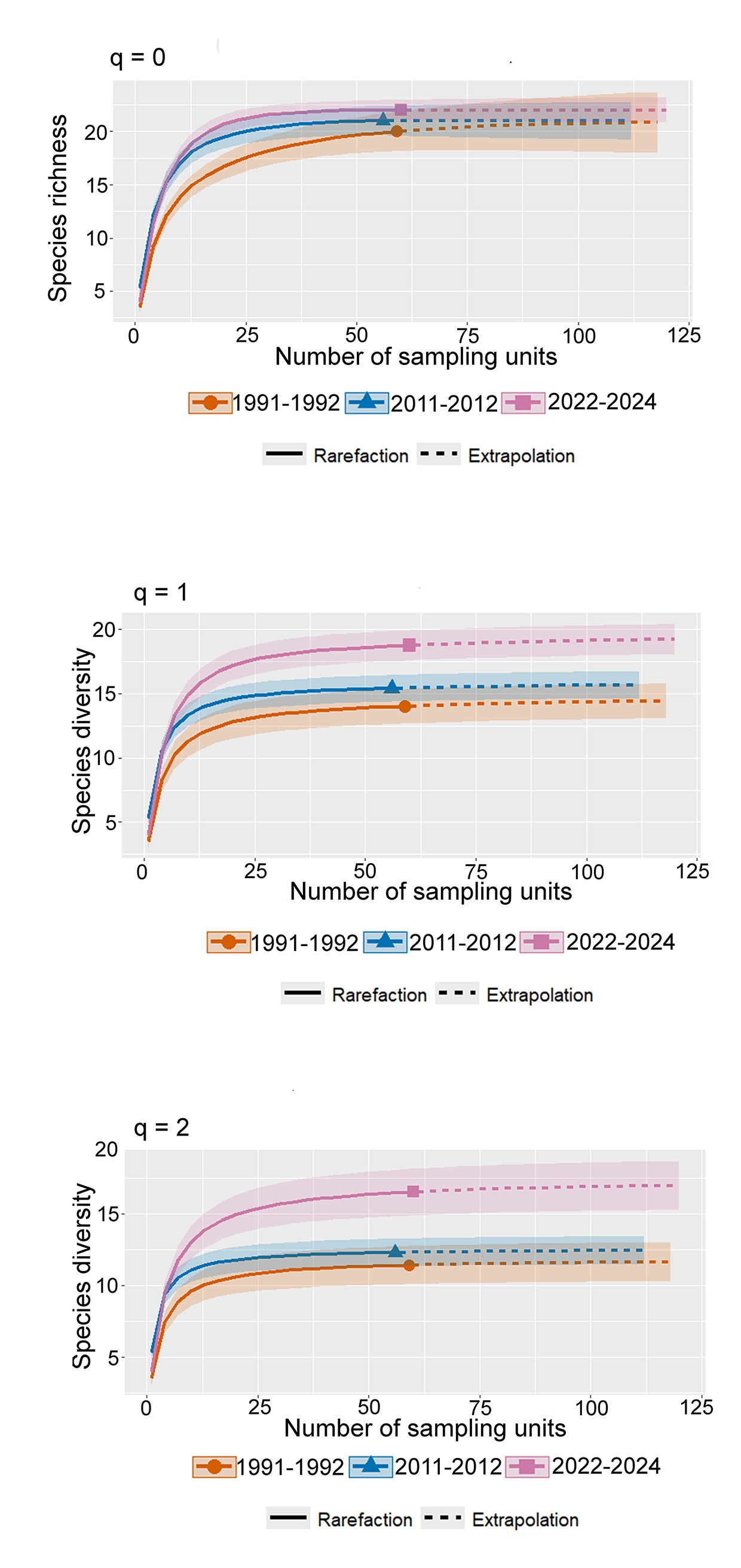
To explore community diversity, helminth abundances were transformed into presence/absence data, allowing the construction of incidence-based rarefaction and extrapolation curves using the iNEXT package. Diversity curves were calculated for species richness (q = 0), Shannon diversity (q = 1), and Simpson diversity (q = 2), considering the number of hosts sampled as the basis for extrapolation.
In addition to these indices, other diversity metrics were calculated based on abundances, including the Berger-Parker index, the Brillouin index, and evenness. All ecological diversity variables (richness, total abundance, Berger-Parker, Brillouin, and evenness) were subsequently log-transformed to meet normality assumptions. To assess differences in diversity among years, ANOVA was performed for each diversity variable, followed by the Tukey HSD test for multiple comparisons. Linear model results were also summarized in forest plots, highlighting estimated coefficients, confidence intervals, and the statistical significance of differences among years. This approach allowed the evaluation of temporal changes in helminth community composition and diversity, considering both quantitative aspects (abundance and diversity) and qualitative aspects (species presence/absence), as well as specific indices reflecting dominance and evenness.
Softwares and packages
All analyses were conducted in R software version 4.5.1 (R Core Team, 2025). The Gower distances, nMDS, PERMANOVA, ANOVA and Tukey test were performed using vegan package (Oksanen et al., 2025), the incidence-based rarefaction and extrapolation curves and calculation of Hill diversity indices were performed using iNEXT package (Chao et al., 2014), plots, including nMDS and forest plot, were performed using ggplot2 package (Wickham, 2016). The level of significance adopted was 5% in all analyses.
Results
Characteristics of host samplings
Fish mean total body length was 24.8 ± 5.4 (13.1-35.5) cm. A comparison of total body length revealed that fish samples were statistically significant (F = 104.7, p < 0.001). The samples from 1991–1992 were smaller (19.2 ± 2.5) than those from 2011–2012 (28.1 ± 3.7) and 2022–2024 (27.1 ± 4.5) (Q = 18.7, p < 0.01; Q = 16.4, p < 0.01, respectively). The samples of 2011–2012 and 2022–2024 did not differentiate statistically (Q = 2.3, p > 0.09).
Characteristics of parasite communities
The total parasite community was composed by 26 different taxa, 15 of which endoparasites belonging to Acanthocephala, Cestoda, Digenea and Nematoda, including larval and adult stages, and 21 ectoparasites belonging to Copepoda, Hirudinea and Monogenea, all adult forms (Table 1). A total of 4052 parasite individuals were collected, with a mean abundance of 22.5 ± 29.2. One hundred and seventy-five specimens of O. rubra were parasitized by at least one taxon of metazoan (59 in 1991–1992; 56 in 2011–2012; 60 in 2022-2024), and five were negative for parasites (one in 1991–1992; four in 2011–2012). Adult endoparasites were the most abundant group in all samples, corresponding to 69.47% (73.6% in 1991–1992; 65.5% in 2011–2012; 70.3% in 2022–2024) of all parasite specimens collected; followed by ectoparasites with 24.31% (18.4% in 1991–1992; 29.7% in 2011–2012; 23.2% in 2022–2024) and larval endoparasites with 6.21% (7.8% in 1991–1992; 4.7% in 2011–2012; 6.4% in 2022–2024). All parasite species had an aggregated distribution pattern (ID > 1), and overall, they showed discrepancy index (D) values higher than 0.56 (Table 2). When comparing the mean abundance, mean species richness, mean diversity indexes (Brillouin and evenness) and Berger-Parker dominance among samples, significant differences were observed (Table 3). In all communities studied, the digenean Infundiburictus longovatus (Hopkins, 1941) was the species with the highest frequency of dominance (Table 3).
Metazoan parasites of Orthopristis rubra according to collection samples, associated with their prevalence (P), mean intensity ± standard deviation (MI±SD), mean abundance ± standard deviation (MA±SD), and site of infection or infestation (Site), from the coastal zone of Rio de Janeiro, Brazil.
Values of variance-to-mean abundance ratio (ID) and index of Discrepancy (D) of metazoan parasites of Orthopristis rubra according to samples, from the coastal zone of Rio de Janeiro, Brazil.
Descriptors of parasite communities of Orthopristis rubra among samples from the coastal zone of Rio de Janeiro, Brazil, represented as mean followed ± 1 standard deviation (range), with the values of ANOVA (F) and the evaluation by a posteriori Tukey test (Q).
The nMDS analysis showed greater dissimilarity of helminth abundance for hosts collected between 2011–2012 and 2022–2024 (Figure 1). Furthermore, an overlap of specimens collected in the first collection period (1991–1992) with the other periods was observed, indicating that this period presented similarities in terms of helminth abundance with later collection periods (Figure 1). In fact, although significant, the PERMANOVA result indicates a weak influence of the collection period on the similarity in helminth species abundance among the analyzed hosts, since the low R2 value (0.083) suggests that temporal variation accounts for only a minor ecological effect on community structure (p = 0.001).

nMDS plot based on Gower distance illustrating the variation in helminth species abundance across different collection periods. Each point represents a sample, and the distance between points reflects dissimilarity in community composition. PERMANOVA results indicate a significant difference in helminth diversity among collection periods (Stress = 0.22).
The analysis of Hill diversity across collection periods revealed a consistent increase in helminth community diversity over time (Figure 2). Species richness (q = 0) was highest in 2022–2024, followed by 2011–2012 and 1991–1992, with rarefaction curves indicating that the more recent period maintained higher diversity even with fewer sampled units (Figure 2). Shannon diversity (q = 1) followed the same pattern, suggesting that the abundance distribution of species is more even in the latest period (Figure 2). Simpson diversity (q = 2) also peaked in 2022–2024, indicating a reduction in dominance by previously common species, although differences among periods were less pronounced for q = 2, reflecting the influence of abundant species (Figure 2). Overall, these results indicate that helminth communities have become more diverse and balanced in species abundance over time.

Hill diversity of helminth communities across collection periods. Diversity indices are shown for q = 0 (species richness), q = 1 (Shannon diversity), and q = 2 (Simpson diversity). The 2022–2024 period consistently shows higher diversity compared to 2011–2012 and 1991–1992. Rarefaction and extrapolation curves indicate that these differences persist even when accounting for sampling effort, suggesting that more recent communities are both richer in species and more evenly distributed in abundance.
Across all metrics, including species abundance, Berger Parker dominance, Brillouin diversity, evenness, and species richness, temporal changes relative to the 1991–1992 baseline varied among periods (Figure 3). The 2022–2024 period consistently showed higher species abundance and richness, together with lower dominance, suggesting more balanced communities. In contrast, the 2011–2012 period presented greater diversity and evenness. Statistically significant differences are indicated by asterisks (Figure 3).

Estimated effects of collection year on helminth community diversity indices. Blue points represent estimated coefficients for each period, with horizontal lines indicating 95% confidence intervals. Asterisks denote statistically significant differences compared to the baseline period (1991–1992). Metrics include species abundance, Berger-Parker Index, Brillouin’s diversity index, evenness, and species richness.
Tukey’s multiple comparisons revealed significant differences in several helminth diversity metrics across collection periods (Table 4). Total abundance was significantly lower in 2022–2024 compared to 1991–1992 and 2011–2012, with no difference between 1991–1992 and 2011–2012 (Table 4). Species dominance (Berger-Parker index) decreased significantly from 1991–1992 to both 2011–2012 and 2022–2024 but did not differ between 2011–2012 and 2022–2024 (Table 4). Brillouin diversity was higher in 2011–2012 than in 1991–1992, with no other significant differences (Table 4). Evenness increased significantly from 1991–1992 to 2011–2012, while richness increased from 1991–1992 to 2011–2012 and decreased in 2022–2024 relative to 2011–2012, showing no difference between 1991–1992 and 2022_2024 (Table 4). These results indicate temporal changes in helminth community structure, reflecting shifts in species composition and dominance over time.
Results of pairwise comparisons of parasite communities of Orthopristis rubra among samples from the coastal zone of Rio de Janeiro, Brazil, across sampling periods (1991–1992, 2011–2012, and 2022–2024). The table presents metrics for each comparison, including estimated differences (diff) in model coefficients, 95% confidence intervals (CI), and corresponding p-values for total species abundance, Berger–Parker dominance index, Brillouin’s diversity index, evenness, and species richness. Significant results (p < 0.05) indicate temporal changes in parasite community structure.
Discussion
This long-term comparative study revealed clear temporal changes in the structure of the metazoan parasite community of O. rubra from Sepetiba Bay, southeastern Brazil. Although the composition of the core parasite fauna remained relatively stable, the relative dominance, diversity indices, and evenness values exhibited significant variation among the three collection periods (1991–1992, 2011–2012, and 2022–2024). These patterns reflect gradual ecological adjustments in host–parasite interactions likely linked to environmental transformations and the progressive recovery of the estuarine ecosystem over the last three decades.
The overall increase in parasite species richness (in 2023–2024) and evenness (in 2011–2012) suggests a partial reorganization of community structure, possibly associated with improved environmental conditions and higher complexity of food webs. Similar patterns have been observed in long-term studies where eutrophication decreased or benthic biodiversity recovered (Virgilio et al., 2023). The persistence of the dominant digenean I. longovatus across all sampling years indicates a relatively stable trophic pathway involving molluscan and fish intermediate hosts, consistent with previous findings in other Haemulidae from tropical estuaries (Luque & Alves, 2001; Paschoal et al., 2023, 2024). However, its declining relative abundance and the emergence of less common taxa (e.g., Diphterostomum brusinae) in recent years may signal changes in transmission efficiency and host diet composition.
Environmental stress, driven by factors such as pollution, habitat alteration, eutrophication, and fluctuations in water quality, is known to reduce parasite diversity and favor generalist or direct-life-cycle taxa (Marcogliese, 2005; Sures et al., 2023). The transient increase in parasite diversity observed here, notably in 2011–2012, might indicate a moderate ecological recovery following earlier degradation events in Sepetiba Bay. Historical records indicate that Sepetiba Bay was subjected to intense industrial discharges and domestic effluents until the early 2000s. From that period onward, the implementation of environmental monitoring programs, increased regulatory enforcement, and mitigation initiatives led to a gradual improvement in water quality and fish community reorganization (Araújo et al., 2002). Parasites with complex life cycles, particularly digeneans, tend to respond positively to ecosystem restoration because their transmission depends on multiple trophic links (Poulin 2004, Palm, 2011; Blasco-Costa & Poulin, 2017). Thus, the observed diversification of the parasite community in O. rubra is consistent with the recovery of intermediate host populations and the re-establishment of food-web connectivity.
The weak but significant temporal signal detected in the multivariate analyses (nMDS and PERMANOVA) also supports the interpretation that changes in parasite assemblages are subtle and cumulative rather than abrupt. This pattern is typical of estuarine systems undergoing slow environmental improvement (Marcogliese, 2023). Moreover, the significant differences in host size among periods could have influenced infection parameters, since larger or older fish generally harbor more diverse parasite infracommunities due to prolonged exposure and broader diet (Lo et al., 1998; Poulin, 2020). Future analyses integrating fish ontogeny with ecological and environmental indicators could help disentangle the respective roles of environmental versus host-related factors.
From an ecological standpoint, the present findings reinforce the usefulness of fish parasites as bioindicators of ecosystem change. The temporal shift from low-diversity, dominance-heavy communities to more balanced assemblages mirrors trends described for benthic and planktonic communities under moderate recovery conditions (Sures et al., 2023). In this sense, O. rubra and its parasite fauna may act as a sentinel system, as changes in parasite community composition and infection patterns can reflect alterations in environmental conditions, thereby providing ecological indicators of long-term health in Sepetiba Bay and other coastal environments exposed to anthropogenic pressures.
Finally, this study highlights the value of maintaining historical parasitological records and continuous monitoring. Long-term data allows distinguishing natural variability from directional trends, improving our understanding of parasite ecology under changing environmental scenarios (Luque & Poulin, 2008; Wood et al., 2023). Integrating such datasets with molecular tools and environmental indicators will be crucial to strengthening the role of parasitology within the broader One Health framework, as host–parasite dynamics can reflect interactions between environmental quality, wildlife health, and potential risks to human populations, thereby supporting more comprehensive aquatic ecosystem management.
Conclusions
This long-term comparative analysis of metazoan parasite communities in O. rubra from Sepetiba Bay demonstrates that parasite assemblages can serve as sensitive indicators of gradual ecological change. Although the core parasite fauna remained relatively stable over more than three decades, shifts in abundance, diversity, and dominance patterns reflect a slow but measurable reorganization of community structure, likely linked to environmental recovery and increased habitat complexity in the bay. The results emphasize the importance of continuous parasitological monitoring to detect subtle ecological responses to anthropogenic and climatic pressures. Integrating these long-term datasets with environmental and molecular indicators will enhance our understanding of ecosystem health and resilience in tropical coastal environments.
-
How to cite:
Mainenti AR, Paschoal F, Cardoso TS, Simões RO, Luque JL. Temporal dynamics in the parasite communities of corocoro grunt Orthopristis rubra (Actinopterygii: Haemulidae) from Sepetiba Bay, southeastern Brazil: a comparative study from 1991 to 2024. Rev Bras Parasitol Vet 2026; 35(2): e016925. https://doi.org/10.1590/S1984-29612026012.
-
Financial support
Adriana R. Mainenti was supported by student fellowships from Coordenação de Aperfeiçoamento de Pessoal do Ensino Superior, Brazil (CAPES) (Finance Code 001). José L. Luque was supported by a research grant from Conselho Nacional de Desenvolvimento Científico e Tecnológico, Brazil (CNPq). Raquel de Oliveira Simões and Thiago dos Santos Cardoso were supported by a research grant from Fundação Carlos Chagas Filho de Amparo à Pesquisa do Estado do Rio de Janeiro (FAPERJ) (ROS: Project number E-26/204.599/2024; TSC: Project number E-26/204.420/2021).
-
Ethics declaration
All applicable institutional, national, and international guidelines for the care and use of animals were followed. As no live animals were used and the fish specimens were obtained from a local market, approval from an ethics committee was not required, in accordance with Brazilian Law No. 11.794, Article 3, Item III.
Data availability
The data are available from the corresponding author on reasonable request.
References
-
Amin OM. Classification of the Acanthocephala. Folia Parasitol (Praha) 2013; 60(4): 273-305. https://doi.org/10.14411/fp.2013.031 PMid:24261131.
» https://doi.org/10.14411/fp.2013.031 -
Araújo FG, Azevedo MCC, Araújo Silva M, Pessanha ALM, Gomes ID, Cruz-Filho AG. Environmental influences on the demersal fish assemblages in the Sepetiba Bay, Brazil. Estuaries 2002; 25(3): 441-450. https://doi.org/10.1007/BF02695986
» https://doi.org/10.1007/BF02695986 -
Araújo FG, Cruz-Filho AG, Azevêdo MCC, Santos ACA. Estrutura da comunidade de peixes demersais da Baía de Sepetiba, RJ. Rev Bras Biol 1998; 58(3): 417-430. https://doi.org/10.1590/S0034-71081998000300007
» https://doi.org/10.1590/S0034-71081998000300007 -
Benicio L, Moreira J, Paschoal F. Community ecology of the metazoan parasites of the Atlantic anchoveta, Cetengraulis edentulus (Actinopterygii: Engraulidae) from the Sepetiba Bay, Rio de Janeiro, Brazil. Zoologia 2022; 39: e21034. https://doi.org/10.1590/s1984-4689.v39.e21034
» https://doi.org/10.1590/s1984-4689.v39.e21034 -
Blasco-Costa I, Poulin R. Parasite life-cycle studies: a plea to resurrect an old parasitological tradition. J Helminthol 2017; 91(6): 647-656. https://doi.org/10.1017/S0022149X16000924 PMid:28166844.
» https://doi.org/10.1017/S0022149X16000924 - Boxshall GA, Halsey SH. An introduction to copepod diversity London: The Ray Society; 2004.
- Bray RA, Gibson DI, Jones A. Keys to the Trematoda Vol. 3. London: CABI International; 2008.
-
Bush AO, Lafferty KD, Lotz JM, Shostak AW. Parasitology Meets Ecology on Its Own Terms: Margolis et al. revisited. J Parasitol 1997; 83(4): 575-583. https://doi.org/10.2307/3284227 PMid:9267395.
» https://doi.org/10.2307/3284227 - Cervigón F, Cipriani R, Fischer W, Garibaldi L, Hendrickx M, Lemus AJ, et al. Fichas FAO de identificación de especies para los fines de la pesca. Guía de campo de las especies comerciales marinas y de aguas salobres de la costa septentrional de Sur América Rome: FAO; 1992.
- Cervigón F. Los peces marinos de Venezuela Vol. 2. Caracas: Fundación Científica Los Roques; 1991.
-
Chao A, Gotelli NJ, Hsieh TC, Sander EL, Ma KH, Colwell RK, et al. Rarefaction and extrapolation with Hill numbers: a framework for sampling and estimation in species diversity studies. Ecol Monogr 2014; 84(1): 45-467. https://doi.org/10.1890/13-0133.1
» https://doi.org/10.1890/13-0133.1 - Costa H. Uma avaliação da qualidade das águas costeiras do Rio de Janeiro. In: Fundação de Estudos do Mar, editor. Qualidade das águas costeiras do RJ Rio de Janeiro: Fundação de Estudos do Mar; 1998. p. 169-196.
-
Cressey RF. Parasitic copepods from the Gulf of Mexico and Caribbean Sea. III: Caligus. Smithson Contrib Zool 1991; 497(497): i-iii, 1-53. https://doi.org/10.5479/si.00810282.497
» https://doi.org/10.5479/si.00810282.497 - Eiras JC, Takemoto RM, Pavanelli GC. Métodos de estudo e técnicas laboratoriais em parasitologia de peixes 2. ed. Maringá: Editora Eduem; 2006.
-
Espínola-Novelo JF, González MT, Pacheco AS, Luque JL, Oliva ME. Testing for deterministic succession in metazoan parasite communities of marine fish. Ecol Lett 2020; 23(4): 631-641. https://doi.org/10.1111/ele.13463 PMid:31994321.
» https://doi.org/10.1111/ele.13463 -
Froese R, Pauly D. FishBase [online]. 2025 [cited 2025 Oct 15]. Available from: www.fishbase.org
» www.fishbase.org - Gibbons LM. Keys to nematode parasites of vertebrates Supplementary volume. Wallingford: CABI International; 2009.
-
Humes AG, Gooding RU. A method for studying the external anatomy of copepods. Crustaceana 1964; 6(3): 238-240. https://doi.org/10.1163/156854064X00650
» https://doi.org/10.1163/156854064X00650 -
Khalil LF, Jones A, Bray RA. Key to the cestodes of vertebrates Wallingford: CABI International; 1994. https://doi.org/10.1079/9780851988795.0000
» https://doi.org/10.1079/9780851988795.0000 -
Lo CM, Morand S, Galzin R. Parasite diversity/host age and size relationship in three coral-reef fishes from French Polynesia. Int J Parasitol 1998; 28(11): 1695-1708. https://doi.org/10.1016/S0020-7519(98)00140-4 PMid:9846606.
» https://doi.org/10.1016/S0020-7519(98)00140-4 - Luque JL, Amato JFR, Takemoto RM. Comparative analysis of the communities of metazoan parasites of Orthopristis ruber and Haemulon steindachneri (Osteichthyes: Haemulidae) from the southeastern Brazilian littoral: I. Structure and influence of the size and sex of hosts. Rev Bras Biol 1996a; 56(2): 279-292.
- Luque JL, Amato JFR, Takemoto RM. Comparative analysis of the communities of metazoan parasites of Orthopristis ruber and Haemulon steindachneri (Osteichthyes: Haemulidae) from the southeastern Brazilian littoral: II. Diversity, interspecific associations, and distribution of the gastrointestinal parasites. Rev Bras Biol 1996b; 56(2): 293-302.
-
Luque JL, Alves DR. Ecologia das comunidades de metazoários parasitos, do xaréu, Caranx hippos (Linnaeus) e do xerelete, Caranx latus Agassiz (Osteichthyes, Carangidae) do litoral do estado do Rio de Janeiro, Brasil. Rev Bras Zool 2001; 18(2): 399-410. https://doi.org/10.1590/S0101-81752001000200011
» https://doi.org/10.1590/S0101-81752001000200011 - Luque JL, Takemoto RM. Parasitic copepods on Orthopristis ruber and Haemulon steindachneri (Osteichthyes: Haemulidae) from the Brazilian littoral, with the description of a new species of Caligus (Siphonostomatoida: Caligidae). Rev Bras Biol 1996; 56(3): 529-546.
-
Luque JL, Poulin R. Linking ecology with parasite diversity in Neotropical fishes. J Fish Biol 2008; 72(1): 189-204. https://doi.org/10.1111/j.1095-8649.2007.01695.x
» https://doi.org/10.1111/j.1095-8649.2007.01695.x -
Madinabeitia I, Nagasawa K. Double-netting: an alternative approach for the recovery of parasitic copepods from finfishes. J Nat Hist 2012; 47(5-12):529-541. https://doi.org/10.1080/00222933.2012.737482
» https://doi.org/10.1080/00222933.2012.737482 -
Marcogliese DJ. Major drivers of biodiversity loss and their impacts on helminth parasite populations and communities. J Helminthol 2023; 97: e34. https://doi.org/10.1017/S0022149X2300010X PMid:37057863.
» https://doi.org/10.1017/S0022149X2300010X -
Marcogliese DJ. Parasites of the superorganism: are they indicators of ecosystem health? Int J Parasitol 2005; 35(7): 705-716. https://doi.org/10.1016/j.ijpara.2005.01.015 PMid:15925594.
» https://doi.org/10.1016/j.ijpara.2005.01.015 -
Marcogliese DJ. The impact of climate change on the parasites and infectious diseases of aquatic animals. Rev Sci Tech 2008; 27(2): 467-484. https://doi.org/10.20506/rst.27.2.1820 PMid:18819673.
» https://doi.org/10.20506/rst.27.2.1820 - Menezes NA, Figueiredo JL. Manual de peixes marinhos do sudeste do Brasil. IV. Teleostei (3) São Paulo: Museu de Zoologia, Universidade de São Paulo; 1980.
-
Mouritsen KN, Poulin R. Parasites boosts biodiversity and changes animal community structure by trait‐mediated indirect effects. Oikos 2005; 108(2): 344-350. https://doi.org/10.1111/j.0030-1299.2005.13507.x
» https://doi.org/10.1111/j.0030-1299.2005.13507.x -
Negreiros LP, Florentino AC, Pereira FB, Tavares-Dias M. Long-term temporal variation in the parasite community structure of metazoans of Pimelodus blochii (Pimelodidae), a catfish from the Brazilian Amazon. Parasitol Res 2019; 118(12): 3337-3347. https://doi.org/10.1007/s00436-019-06480-x PMid:31664517.
» https://doi.org/10.1007/s00436-019-06480-x -
Nelson JS, Grande TC, Wilson M. Fishes of the world Hoboken: John Wiley & Sons; 2016. https://doi.org/10.1002/9781119174844 .
» https://doi.org/10.1002/9781119174844 -
Oksanen J, Simpson G, Blanchet F, Kindt R, Legendre P, Minchin P, et al. vegan: Community Ecology Package. R package version 2.6-10 [online]. 2025 [cited 2025 Oct 20]. Available from: https://CRAN.R-project.org/package=vegan
» https://CRAN.R-project.org/package=vegan -
Palm HW. Fish parasites as biological indicators in a changing world: can we monitor environmental impact and climate change? In: Mehlhorn H, editor. Progress in Parasitology. Parasitology Research Monographs Vol. 2. Berlin: Springer-Verlag; 2011. p. 233-250. https://doi.org/10.1007/978-3-642-21396-0_12
» https://doi.org/10.1007/978-3-642-21396-0_12 -
Paschoal F, Cezar AD, Pereira FB, Luque JL. Structure of the metazoan parasite communities of haemulid fish (Actinopterygii: Perciformes) in the South Atlantic Ocean: a comparative approach. An Acad Bras Cienc 2023; 95(1): e20220205. https://doi.org/10.1590/0001-3765202320220205
» https://doi.org/10.1590/0001-3765202320220205 -
Paschoal F, Nunes JLS, Cezar AD, Pereira FB, Luque JL. The metazoan parasite community of the barred grunt Conodon nobilis (Actinopterygii: Haemulidae) from the coast off Rio de Janeiro, southeastern Brazil. Rev Bras Parasitol Vet 2024; 33(4): e010724. https://doi.org/10.1590/s1984-29612024068 PMid:39607272.
» https://doi.org/10.1590/s1984-29612024068 - Pfeiffer WC, Lacerda LD, Lima NRW. Metais pesados no pescado da Baía de Sepetiba. Cienc Cult 1985; 37(2): 297-302.
-
Poulin R. Meta-analysis of seasonal dynamics of parasite infections in aquatic ecosystems. Int J Parasitol 2020; 50(6-7): 501-510. https://doi.org/10.1016/j.ijpara.2020.03.006 PMid:32380095.
» https://doi.org/10.1016/j.ijpara.2020.03.006 -
Poulin R. Parasites and the neutral theory of biodiversity. Ecography 2004; 27(1): 119-123. https://doi.org/10.1111/j.0906-7590.2004.03695.x
» https://doi.org/10.1111/j.0906-7590.2004.03695.x -
Poulin R. The disparity between observed and uniform distributions: a new look at parasite aggregation. Int J Parasitol 1993; 23(7): 937-944. https://doi.org/10.1016/0020-7519(93)90060-C PMid:8106186.
» https://doi.org/10.1016/0020-7519(93)90060-C -
R Core Team. R: a language and environment for statistical computing [online]. Vienna: R Foundation for Statistical Computing; 2025 [cited 2025 Oct 21]. Available from: https://www.R-project.org
» https://www.R-project.org -
Rohde K, Hayward C, Heap M. Aspects of the ecology of metazoan ectoparasites of marine fishes. Int J Parasitol 1995; 25(8): 945-970. https://doi.org/10.1016/0020-7519(95)00015-T PMid:8550295.
» https://doi.org/10.1016/0020-7519(95)00015-T -
Santos ALB, Pessanha ALM, Araújo FG, Costa MR. Condicionantes ambientais na distribuição e no período reprodutivo do Orthopristis ruber (Cuvier) (Teleostei: Haemulidae) na Baía de Sepetiba, Rio de Janeiro, Brasil. Rev Bras Zool 2007; 24(4): 1017-1024. https://doi.org/10.1590/S0101-81752007000400019
» https://doi.org/10.1590/S0101-81752007000400019 -
Seixas LB, Santos LN, Santos AFGN. Fluctuating asymmetry and organosomatic indexes in fish: the Corocoro grunt as a case study (Haemulidae). An Acad Bras Cienc 2021; 93(suppl 4): e20210520. https://doi.org/10.1590/0001-3765202120210520
» https://doi.org/10.1590/0001-3765202120210520 -
Soares IA, Vieira FM, Luque JL. Parasite community of Pagrus pagrus (Sparidae) from Rio de Janeiro, Brazil: evidence of temporal stability. Rev Bras Parasitol Vet 2014; 23(2): 216-223. https://doi.org/10.1590/S1984-29612014047 PMid:25054501.
» https://doi.org/10.1590/S1984-29612014047 -
Sures B, Nachev M, Pahl S, Schwelm J, Grabner D, Marcogliese DJ, et al. Environmental parasitology: stressor effects on aquatic parasites. Trends Parasitol 2023; 39(6): 461-474. https://doi.org/10.1016/j.pt.2023.03.005 PMid:37061443.
» https://doi.org/10.1016/j.pt.2023.03.005 -
Virgilio LR, Melo HPS, Silva Lima F, Takemoto RM, Camargo LMA, Oliveira Meneguetti DU. Fish endoparasite metacommunity in environments with different degrees of conservation in the western Brazilian Amazon. Parasitol Res 2023; 122(12): 2773-2793. https://doi.org/10.1007/s00436-023-08013-z PMid:37953321.
» https://doi.org/10.1007/s00436-023-08013-z -
Wickham H. ggplot2: elegant graphics for data analysis [online]. New York: Springer-Verlag; 2016 [cited 2025 Oct 21]. Available from: https://ggplot2.tidyverse.org
» https://ggplot2.tidyverse.org -
Wood CL, Welicky RL, Preisser WC, Leslie KL, Mastick N, Greene C, et al. A reconstruction of parasite burden reveals one century of climate-associated parasite decline. Proc Natl Acad Sci USA 2023; 120(3): e2211903120. https://doi.org/10.1073/pnas.2211903120 PMid:36623180.
» https://doi.org/10.1073/pnas.2211903120 - Zar JH. Biostatistical analysis 5th ed. New Jersey: Prentice Hall; 2010.
Edited by
-
Assistant Editor:
Marcos Tavares Dias.