 Adding a new piece to the puzzle of Cosmocercidae evolutionary relationships: genetic characterization of Aplectana pella parasitic in Osteocephalus cabrerai from Amazon Region
Abstract
Aplectana comprises species of gastrointestinal helminths commonly found parasitizing amphibians and reptiles worldwide. However, most species of the genus are described based only on morphological traits. During helminthological surveys, we found nematodes identified as Aplectana pella parasitizing the hylid frog Osteocephalus cabrerai from the same locality as the original description. We provided the first nucleotide sequence of ribosomal gene 18S rDNA for Aplectana pella and established the species' phylogenetic position between representatives of Cosmocercidae. A pairwise genetic comparison between A. pella and its congeners revealed a low genetic divergence. We found that our sequences clustered with species of Cosmocerca, reinforcing the hypothesis that representatives of the genus Aplectana do not form a monophyletic group.
Keywords:
helminths; nematodes; molecular; phylogenetic
Resumo
O gênero Aplectana inclui espécies de helmintos gastrointestinais comumente encontrados parasitando anfíbios e répteis, mundialmente. No entanto, a maioria das espécies do gênero foi descrita com base apenas em caracteres morfológicos. Durante expedições helmintológicas, foram encontrados nematódeos identificados como A. pella parasitando o anuro hilídeo Osteocephalus cabrerai na mesma localidade da descrição original. Foi fornecida a primeira sequência de nucleotídeos do gene ribossomal 18S rDNA de Aplectana pella e se estabeleceu a posição filogenética da espécie em relação aos representantes de Cosmocercidae. Comparações genéticas entre A. pella e seus congêneres revelaram uma baixa divergência genética. Foi encontrado que as sequências estudadas agrupam com espécies de Cosmocerca, reforçando a hipótese que representantes do gênero Aplectana não formam um grupo monofilético.
Palavras-chave:
helmintos; nematódeos; molecular; filogenia
Introduction
Nematodes of the genus Aplectana Railliet & Henry, 1916 (Nematoda: Cosmocercidae) are common parasites of the gastrointestinal tracts of amphibians and reptiles globally. To date, 58 species have been described, with most occurring in anurans from the families Bufonidae and Leptodactylidae (Campião et al., 2014; Vieira et al., 2020; Santos et al., 2023).
In recent years, molecular approaches, including DNA sequencing of specific genes, have been shown to be useful in estimating phylogenetic relationships among species in the family Cosmocercidae (Alcantara et al., 2022; Rebêlo et al., 2023). However, the identification of species of Aplectana from the Neotropical region continues to be based on morphological traits (Chen et al., 2021a). Currently, available genetic data of Aplectana spp. include only Aplectana hylambatis (Baylis, 1927) from South America, Aplectana chamaeleonis (Baylis, 1929) from Africa, Aplectana dayaoshanensis Chen, Ni, Gu, Sinsch & Li, 2021; Aplectana macintoshii (Stewart, 1914) and Aplectana xishuangbannaensis Chen, Gu, Ni & Li, 2021 from Asia (Chen et al., 2021a, b).
During a long-term study of the parasites of vertebrates of the Neotropics, we collected specimens of Aplectana from the large intestine of the frog Osteocephalus cabrerai (Cochran & Goin, 1970) from the Brazilian Amazon. An initial morphological analysis of the nematodes from these frogs suggested that it represented a new species, from which we successfully obtained molecular data. However, further morphological analysis using scanning electron microscopy allowed us to identify it as a previously described species Aplectana pella Santos, Borges & Melo, 2023.
Aplectana pella was described by Santos et al. (2023) from the intestines of the rusty tree frog, Boana boans (Linnaeus, 1758). However, at that time, this species was characterized using light and scanning electron microscopy. Thus, this study aims to provide a genetic characterization of A. pella and assess its phylogenetic relationship with other representatives of the familiy Cosmocercidae.
Material and Methods
During a helminthological survey in the Amazon basin, 84 specimens of O. cabrerai were collected between May 2019 and March 2022 in the Beija-Flor Brilho de Fogo Extractive Reserve (0°47 '30.6' N; 51°58 '42.1' W), located in the municipality of Pedra Branca do Amapari, Amapá state, Brazil. The amphibian hosts were identified following the methodology of Pedroso-Santos et al. (2019).
After capture, frogs were euthanized and standard field morphological measurements were taken, and all specimens were necropsied for helminthological examination. All internal organs were removed and placed in Petri dishes with saline solution (NaCl 0.9%), dissected separately, and the contents of the organs and the organs themselves were examined under a stereomicroscope (LEICA EZ4). All helminths found were rinsed in saline solution, killed with heated 70% alcohol, and preserved in the same solution at room temperature; a collection tag with the host collecting number was placed in each vials. Methods generally followed Gardner et al. (2012).
The prevalence, mean intensity, and mean abundance of parasite infections are reported according to Bush et al. (1997). For morphological analysis, nematodes were hydrated in distilled water, cleared in Amann's lactophenol 20%, mounted on temporary slides, and examined with a microscope (Olympus BX41, Olympus Corp., Tokyo, Japan) coupled with a drawing tube (without zoom adjustment). Two male specimens were post-fixed in 1% Osmium tetroxide (OsO4), dehydrated in an increasing ethanol series and critical-point dried in Carbon dioxide (CO2). Specimens were mounted on metallic stubs, coated with gold-palladium and examined with a scanning electron microscope Vega3 (TESCAN, Brno, Czech Republic) in the Laboratory of Structural Biology, Biological Sciences Institute, Federal University of Pará (UFPA), state of Pará, Brazil.
For molecular analysis, a male was transferred to microtubes containing 100% ethanol and stored in a freezer at −20 °C. We extracted genomic DNA using NucleoSpin Tissue (Macherey-Nagel, Düren, Germany) according to the manufacturer’s instructions. The SSU rDNA gene (18S) was amplified using the protocol and primers described in Gomes et al. (2015).
The resulting amplicons were visualized on 1.5% agarose gel electrophoresis with GelRed Nucleic Acid Stain (Biotium, Hayward, California, USA) on an ultraviolet light transilluminator. PCR products were purified through Illustra GFX PCR DNA and Gel Band kit (GE Healthcare, Chicago, Illinois, USA) according to the manufacturer’s instructions and sequenced using the BigDye Terminator v3.1 Cycle Sequencing kit (Applied Biosystems, USA). Amplicons were sequenced on an Applied Biosystems™ 3730 DNA Analyzer at the DNA Sequencing Platform of the Oswaldo Cruz Foundation (RPT01A/PDTIS/FIOCRUZ).
Contiguous sequences were assembled in Geneious 7.1.3 software and deposited in Genbank (NCBI, 2024). We used the BLAST search to confirm the genetic proximity with other sequences of Cosmocercidae available in the Genbank database. The 18S rDNA datasets were aligned and trimmed using Muscle in Geneious 7.1.3 software. We obtained the saturation-substitutions index of each aligned matrix using the software DAMBE 5. Levels of genetic divergence were estimated using the MEGA 11.0 software package. The Akaike Information Criterion (AIC) via the jModelTest software determined the most appropriate evolutionary nucleotide substitution model. Sequence alignments were then subjected to Maximum Likelihood (ML) and Bayesian Inference (BI) analysis in RAxML 8.2.12 and MrBayes 3.2.7a softwares, respectively. Both analyses were carried out in CIPRES Science Gateway. Only nodes with posterior probabilities greater than 90% were considered well-supported. Maximum Likelihood inference (ML) was implemented, and estimates of the level of robustness of the tree estimations were done using bootstrap analysis through 1,000 repetitions, and only nodes with bootstrap values greater than 70% were considered well-supported.
The trees were visualized and edited in FigTree v1.4.4 software. We used Ichtyobronema hamulatum (Moulton, 1931) (access number: KY476351) and Dichelyne grandistomis (Ferraz & Thatcher, 1988) (access number: KX752094) as two separate outgroups. The sequences were selected based on Chen et al. (2021a, b), Svitin et al. (2023) and Santos et al. (2024), and poorly aligned sequences were excluded from the analysis. Detailed information on the nematode species included in the molecular analysis is provided in Supplementary Table S1.
Results and Discussion
Prevalence, mean intensity, and mean abundance of parasite infections in the frogs studied here were 27.4%, 4.3 ± 3.9 (range 1–15) and 1.18 ± 2.8, respectively. All parasites were adults and were found in the large intestine. The morphology of the specimens analyzed here are identical to the original description and all measurements overlap the range of variation reported for A. pella (see Santos et al., 2023) (Table 1). We observed that the number and distribution of caudal papillae (two ventral precloacal papillae pairs near anterior cloacal lip; one adcloacal pair; five postcloacal pairs; one single unpaired papilla situated on anterior cloacal lip), gubernaculum absent, vulva equatorial and spicule lengths (see Figure 1C-D) are the same as indicated by Santos et al. (2023).
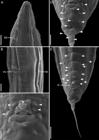
Scanning electron micrographs of Aplectana pella from Osteocephalus cabrerai. (A) Male, anterior end, lateral view; (B) Female vulva, ventral view; (C) Male, details of caudal papillae; (D) Male, distribution of postcloacal papillae; (E) Posterior end of male showing somatic papillae. Arrows: somatic papillae; arrowheads: cloacal papillae; asterisk: unpaired papillae. Abbreviations: cl, cloaca; ep, excretory pore; vu, vulva; la, lateral alae. Scale bars: A= 100 μm; B, E= 50 μm; C= 10 μm; D= 25 μm.
Aplectana pella was originally described in the hylid frog Boana boans from Amapá state, Brazil (Santos et al., 2023). Our specimens were discovered as parasites of another arboreal hylid, O. cabrerai from the same locality, with similar parasitological descriptors (prevalence: 27.38% in O. cabrerai vs. 25% in B. boans; mean intensity: 4.3 in O. cabrerai vs. 6.5 in B. boans; mean abundance: 1.18 in O. cabrerai vs. 1.63 in B. boans), indicating that both hosts occupy similar ecological niches (Neves et al., 2024).
We obtained a fragment of 789pb long for the 18S rDNA gene from A. pella. The BLAST search revealed a sequence closely related to those of Cosmocercidae species available in the NCBI database. The alignment of the gene upon trimming to the shortest sequence length resulted in 747bp and included 16 species distributed across four genera: Aplectana (five sequences), Cosmocerca Diesing, 1861 (four sequences), Cosmocercoides Wilkie, 1930 (four sequences), Nemhelix Morand & Petter, 1986 (one sequence) and the outgroups. The best-fitting nucleotide substitution model identified was TIM3 + G (gamma shape parameter a = 0.0340; lnL = -1761.1172). Xia’s test provided no evidence for substitution saturation in the data matrix.
Pairwise genetic comparison between congeners of A. pella revealed the lowest genetic distance from A. chamaeleonis (1.09%), followed by Aplectana hylambatis (1.63%), A. xishuangbannaensis (3.59%), and A. dayaoshanensis (3.74%) (see Supplementary Table S2). This molecular marker is a well-conserved gene that evolves slowly (Koubková et al., 2008). Thus, our study reinforces the idea that the 18S rDNA region is a good marker for discriminating among genera and a good candidate for phylogenetic studies.
Our phylogenetic trees obtained using Maximum Likelihood (ML) and Bayesian Inference (BI) revealed similar topologies. The sequences of Cosmocercidae (100 bootstrap and 100 posterior probability) formed two large groups (Figure 2). The first was composed of Cosmocercoides spp., Cosmocerca longicauda (Linstow, 1885) and Nemhelix bakeri Morand & Petter, 1986 (78 bootstrap and 99 posterior probability).
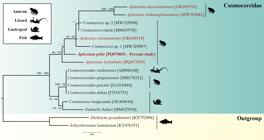
Maximum likelihood topology based on 18S rDNA using Ichtyobronema hamulatum and Dichelyne grandistomis as outgroup. GenBank accession numbers are indicated next to species names. Numbers beside the nodes represent support value by bootstrap for maximum likelihood analysis and posterior probabilities for Bayesian analysis, respectively (bootstrap scores >70 and posterior probabilities >90). Branch-length scale bar indicates number of substitutions per site.
The second group included separate branches of A. hylambatis and A. pella (96 bootstrap and 99 posterior probability). Also, A. pella represents a sister group to a paraphyletic group that includes species of Aplectana and Cosmocerca (35 bootstrap and 64 posterior probability). Our results reinforce that Aplectana is a non-monophyletic genus, consistent with findings from previous studies (Chen et al., 2021a, b; Svitin et al., 2023; Santos et al., 2024). In a recent study, Santos et al. (2024) suggested that the geographic distribution of the species influenced the evolution of Aplectana. However, in the present work, the two sequences from Brazilian specimens did not cluster together, rejecting this hypothesis.
Traditional systematic studies have historically supported the evolutionary hypothesis that Cosmocerca is closely related to Cosmocercoides, mainly because those two genera share the presence of ornamented papillae in male caudal region (Wilkie, 1930; Chabaud, 1978). However, our results support recent phylogenetic studies that found Cosmocerca to be a non-monophyletic genus, closely related to Aplectana (Figure 2) (Chen et al., 2021a, b; Harnoster et al., 2022; Ni et al., 2022; Svitin et al., 2023; Tsuchida et al., 2023; Santos et al., 2024).
Cosmocercoides spp. did appear in our tree as monophyletic and clustered as a sister group to N. bakeri + Cosmocerca longicauda (Figure 2). This result has also been observed in previous studies (Saito et al., 2021; Harnoster et al., 2022; Ni et al., 2022; Svitin et al., 2023; Tsuchida et al., 2023; Santos et al., 2024). However, some studies suggest that the authors who deposited the sequence of C. longicauda misidentified the species (Svitin et al., 2023; Félix et al., 2024). Thus, until now, only Cosmocercoides have been found parasitizing snails, and due to the high genetic divergence observed among C. longicauda and other Cosmocerca spp. we also reinforce that this sequence should be considered a representative of the genus Cosmocercoides.
This study represents the first phylogenetic analysis including A. pella, that showed this genus as non-monophyletic. Therefore, further molecular-phylogenetic studies are necessary to understand better the evolutionary relationships of Aplectana species, particularly in the Neotropical region where significant gaps in the genetic database and taxonomic status exist among the species. We also emphasize the importance of combining detailed morphological and molecular studies with more representatives of the genus to improve our knowledge about the diversity and phylogenetic relationships of Cosmocercidae.
Supplementary Material
Supplementary material accompanies this paper.
Table S1.
Table S2.
This material is available as part of the online article from https://doi.org/10.1590/S1984-29612025007
Acknowledgements
We are grateful to PhD. Ana Nunes Santos for her support. We are grateful to students from the Laboratory of Cellular Biology and Helminthology “Profa. Dra. Reinalda Marisa Lanfredi” (Federal University of Pará, Belém, Brazil) and students from the Laboratory of Herpetology of the Federal University of Amapá. We appreciate the help of Ph.D. Edilene Oliveira da Silva from the Laboratory of Structural and Functional Biology (LABEF – ICB), at the UFPA, Brazil and MSc. Ronald Ferreira Jesus from UFPA for their technical support in scanning electron microscopy analysis. This study is a part of the master’s thesis of Jorge Kevin da Silva Neves in the Postgraduate Program in Zoology (MPEG–UFPA). This work was supported by Coordination for the Improvement of High Higher Education Personnel, Brazil (CAPES); PROPESP/UFPA; Amazon Foundation for Research and Studies Support (FAPESPA)/CNPq–PRONEM (01/2021 process number 794027/2013); the National Council for Scientific and Technological Development (CNPq); Productivity Scholarship Grant (CNPq) to F.T.V. Melo. CNPq (process: 314116/2021-4); Carlos Eduardo Costa-Campos (process: 307697/2022-3). Part of this work was supported by United States National Science Foundation grant numbers: DBI-1901911 and DBI1756397 to S.L. Gardner.
-
How to cite:
Neves JKS, Rebêlo GL, Félix AJS, Gardner SL, Maldonado Júnior A, Costa-Campos CE, et al. Adding a new piece to the puzzle of Cosmocercidae evolutionary relationships: genetic characterization of Aplectana pella parasitic in Osteocephalus cabrerai from Amazon Region. Braz J Vet Parasitol 2025; 34(1): e018124. https://doi.org/10.1590/S1984-29612025007
-
Ethics declaration
All procedures contributing to this work comply with all applicable institutional, national, and international guidelines for animal care and use Animal Research Ethics Committee, Federal University of Pará, under license N8341260821CEUA/UFPa. The present study was approved by Instituto Chico Mendes de Conservação da Biodiversidade (ICMBio), Brazil, and host specimens were collected under license number SISBIO: 53527–4.
References
-
Alcantara EP, Ebert MB, Müller MI, Úngari LP, Ferreira-Silva C, Emmerich E, et al. First molecular assessment on Cosmocerca spp. from Brazilian anurans and description of a new species of Cosmocerca (Ascaridomorpha: Cosmocercoidea) from the white-spotted humming frog Chiasmocleis albopunctata (Boettger, 1885) (Anura: Microhylidae). J Helminthol 2022; 96: e64. http://doi.org/10.1017/S0022149X22000517 PMid:36017718.
» http://doi.org/10.1017/S0022149X22000517 -
Bush AO, Lafferty KD, Lotz JM, Shostak AW. Parasitology Meets Ecology on Its Own Terms: Margolis et al. Revisited. J Parasitol 1997; 83(4): 575-583. http://doi.org/10.2307/3284227 PMid:9267395.
» http://doi.org/10.2307/3284227 -
Campião KM, Morais DH, Dias OT, Aguiar A, Toledo G, Tavares LER, et al. Checklist of helminth parasites of amphibians from South America. Zootaxa 2014; 3843(1): 1-93. http://doi.org/10.11646/zootaxa.3843.1.1 PMid:25082165.
» http://doi.org/10.11646/zootaxa.3843.1.1 - Chabaud AG. Keys to genera of the superfamilies Cosmocercoidea, Seuratoidea, Heterakoidea and Subuluroidea. In: Anderson RC, Chabaud AG, Willmott S, Hartwich G, Bain O, Petter AJ, et al. CIH keys to the nematode parasites of vertebrates Farnham Royal: CABI; 1978. p. 71.
-
Chen H-X, Ni X-F, Gu X-H, Sinsch U, Li L. Morphology, genetic characterization and phylogeny of Aplectana dayaoshanensis n. sp. (Nematoda: Ascaridida) from frogs. Infect Genet Evol 2021a; 96: 105123. http://doi.org/10.1016/j.meegid.2021.105123 PMid:34688888.
» http://doi.org/10.1016/j.meegid.2021.105123 -
Chen H-X, Gu X-H, Ni X-F, Li L. Description of a new species of Aplectana (Nematoda: Ascaridomorpha: Cosmocercidae) using an integrative approach and preliminary phylogenetic study of Cosmocercidae and related taxa. Parasit Vectors 2021b; 14(1): 165. http://doi.org/10.1186/s13071-021-04667-9 PMid:33736693.
» http://doi.org/10.1186/s13071-021-04667-9 -
Félix AJS, Trindade LFF, Rebêlo GL, Neves JKS, Santos AN, Maldonado Júnior A, et al. Two names, one species: redescription and phylogenetic position of Schrankiana formosula Freitas, 1959 provides new insights into the evolutionary history of the Cosmocercidae. Parasitology 2024; 151(8): 832-847. http://doi.org/10.1017/S003118202400091X PMid:39355947.
» http://doi.org/10.1017/S003118202400091X - Gardner SL, Fisher RN, Barry SJ. Field parasitology techniques for use during reptile surveys. In: McDiarmid RW, Foster MS, Guyer C, Gibbons JW, Chernoff N, editors. Reptile biodiversity: standard methods for inventory and monitoring USA: Smithsonian Publications, University of California Press; 2012. p. 114-121.
-
Gomes APN, Olifiers N, Santos MM, Simões RO, Maldonado Júnior A. New records of three species of nematodes in Cerdocyon thous from the Brazilian Pantanal wetlands. Rev Bras Parasitol Vet 2015; 24(3): 324-330. http://doi.org/10.1590/S1984-29612015061 PMid:26444063.
» http://doi.org/10.1590/S1984-29612015061 -
Harnoster F, du Preez LH, Svitin R. Three new species of Cosmocerca Diesing, 1861 (Nematoda: Cosmocercidae) parasitising frogs Cacosternum boettgeri Boulenger, 1882, Kassina senegalensis Dumeril and Bibron, 1841 and Phrynomantis bifasciatus Smith, 1847 from South Africa. Parasitol Res 2022; 121(2): 563-571. http://doi.org/10.1007/s00436-021-07390-7 PMid:35043259.
» http://doi.org/10.1007/s00436-021-07390-7 -
Koubková B, Baruš V, Hodová I, Šimková A. Morphometric and molecular characteristics of Labeonema synodontisi n. comb. (Nematoda: Atractidae) from the West African fishes. Parasitol Res 2008; 102(5): 1013-1020. http://doi.org/10.1007/s00436-007-0869-0 PMid:18214540.
» http://doi.org/10.1007/s00436-007-0869-0 -
National Center for Biotechnology Information - NCBI. Genbank [online]. 2024 [cited 2024 Nov 6]. Available from: htttp://www.ncbi.nml.nih.gov/
» htttp://www.ncbi.nml.nih.gov/ -
Neves JKS, Cardoso EL, Rebêlo GL, Félix AJS, Machado SA, Costa-Campos CE, et al. Filling the gaps on parasites of Osteocephalus: Helminth community structure of Osteocephalus cabrerai (Anura: Hylidae) from the Brazilian Amazon. Int J Parasitol Parasites Wildl 2024; 25: 100996. http://doi.org/10.1016/j.ijppaw.2024.100996 PMid:39380748.
» http://doi.org/10.1016/j.ijppaw.2024.100996 -
Ni X-F, Chen H-X, Zhen X, Gu X-H, Li L. Morphology, genetic characterization and molecular phylogeny of the poorly known nematode parasite Cissophyllus leytensis Tubangui & Villaamil, 1933 (Nematoda: Ascaridida) from the Philippine sailfin lizard Hydrosaurus pustulatus (Eschscholtz, 1829) (Reptilia: Squamata). Parasit Vectors 2022; 15(1): 116. http://doi.org/10.1186/s13071-022-05224-8 PMid:35365181.
» http://doi.org/10.1186/s13071-022-05224-8 - Pedroso-Santos S, Sanches PR, Costa-Campos CE. Anurans and reptiles of the Reserva Extrativista Beija-Flor Brilho de Fogo, Amapá state, eastern Amazon. Herpetol Notes 2019; 12: 799-807.
-
Rebêlo GL, Santos AN, Tavares-Costa LS, Dias-Souza MR, Müller MI, Jesus RF, et al. Morphological and molecular characterization of Cosmocercoides amapari n. sp. (Nematoda: Cosmocercidae), parasitic in hylid frogs from the Brazilian Amazon. Parasitology 2023; 150(3): 286-296. http://doi.org/10.1017/S0031182022001767 PMid:36647762.
» http://doi.org/10.1017/S0031182022001767 -
Saito T, Hayashi K, Hayashi K, Akita Y, Une Y, Kuroki T, et al. Morphological observation and first molecular characterization of Grassenema procaviae Petter, 1959 (Cosmocercoidea: Atractidae) in the stomach of Cape hyrax (Procavia capensis) raised in a zoo in Japan. Parasitol Int 2021; 84: 102385. http://doi.org/10.1016/j.parint.2021.102385 PMid:34015519.
» http://doi.org/10.1016/j.parint.2021.102385 -
Santos AN, Borges ES, Willkens Y, Santos JN, Costa-Campos CE, Melo FTV. A new species of Aplectana Railliet & Henry, 1916 (Nematoda: Cosmocercidae) in the Brazilian Amazon and the taxonomic status of Aplectana longa. Rev Bras Parasitol Vet 2023; 32(4): e014023. http://doi.org/10.1590/s1984-29612023074 PMid:38055440.
» http://doi.org/10.1590/s1984-29612023074 -
Santos PS, Silva ICO, Ferreira VL, Tavares LER, Paiva F, Pereira FB. First genetic characterisation and phylogenetic position of Aplectana hylambatis (Nematoda: Cosmocercidae), infecting Pithecopus azureus (Anura: Hylidae) in the Brazilian Pantanal. J Helminthol 2024; 98: e62. http://doi.org/10.1017/S0022149X24000609 PMid:39480065.
» http://doi.org/10.1017/S0022149X24000609 -
Svitin R, Kuzmin Y, Harnoster F, Nel T, du Preez L. Cosmocerca goroensis n. sp. (Nematoda: Cosmocercidae) from South Africa and its phylogenetic relationships with other cosmocercids based on partial 28S sequences. Syst Parasitol 2023; 100(6): 601-610. http://doi.org/10.1007/s11230-023-10109-0 PMid:37656267.
» http://doi.org/10.1007/s11230-023-10109-0 -
Tsuchida K, Urabe M, Nishikawa K. Two new kathlaniid species (Nematoda: Cosmocercoidea) parasitic in salamanders of the genus Andrias (Amphibia: Caudata: Cryptobranchidae). Parasitol Int 2023; 92: 102693. http://doi.org/10.1016/j.parint.2022.102693 PMid:36272657.
» http://doi.org/10.1016/j.parint.2022.102693 -
Vieira FM, Gonçalves PA, Lima SS, Sousa BM, Muniz-Pereira LC. A new species of Aplectana Railliet & Henry (Nematoda: Cosmocercidae) in Amphisbaena alba Linnaeus (Squamata: Amphisbaenidae) from Minas Gerais State, Brazil. Zootaxa 2020; 4890(2): 234-244. http://doi.org/10.11646/zootaxa.4890.2.4 PMid:33311234.
» http://doi.org/10.11646/zootaxa.4890.2.4 -
Wilkie JS. LXVI.: Some Parasitic Nematodes from Japanese Amphibia. Ann Mag Nat Hist 1930; 6(35): 606-614. http://doi.org/10.1080/00222933008673260
» http://doi.org/10.1080/00222933008673260