
 Evaluation of the intrinsic and extrinsic ecological effects on the helminth communities of Didelphis albiventris (Didelphimorphia, Didelphidae) in Atlantic Forest areas
Abstract
The white-eared opossum Didelphis albiventris is widely distributed throughout Brazil and hosts several parasite species. This study aimed to analyze the influence of intrinsic (sex and age of hosts) and extrinsic (locality and type of land use) factors on the helminth communities of the white-eared opossum in areas of the Atlantic Forest. Helminth samples from 93 D. albiventris specimens from six different localities were used: Belo Horizonte, MG; Curitiba and Guaíra, PR; Porto Alegre, RS; and Mamanguape and Santa Rita, PB. Fourteen species of helminths were identified: Aspidodera raillieti, Cruzia tentaculata, Turgida turgida, Viannaia hamata, Rhopalias coronatus, Rhopalias horridus, Duboisiella proloba, Travassostrongylus orloffi, Travassostrongylus sextus, Brachylaima advena, Plagiorchis didelphidis, Trichuris minuta, Trichuris didelphis, and Oligacanthorhynchus microcephalus. Female hosts and adult hosts had greater helminth species richness and abundance. The helminth species richness and abundance in D. albiventris were influenced by intrinsic (sex and age of the host) and extrinsic (locality and land use) factors with the locality being the main determinant. The structure of the helminth infracommunities varied spatially, with greater differences with increasing geographic distance, highlighting the complexity of host‒parasite interactions in wildlife.
Keywords:
Ecology; metacommunities; opossum; parasitism
Resumo
O gambá-de-orelha-branca – Didelphis albiventris – possui ampla distribuição no Brasil e hospeda diversas espécies de parasitos. Este estudo teve como objetivo analisar a influência de fatores intrínsecos (sexo e idade dos hospedeiros) e extrínsecos (localidade e tipo de uso da terra) sobre as comunidades de helmintos do gambá-de-orelha-branca em áreas da Mata Atlântica. Foram utilizadas amostras de helmintos de 93 espécimes de D. albiventris provenientes de seis localidades diferentes: Belo Horizonte, MG; Curitiba e Guaíra, PR; Porto Alegre, RS; e Mamanguape e Santa Rita, PB. Foram identificadas quatorze espécies de helmintos, sendo elas: Aspidodera raillieti, Cruzia tentaculata, Turgida turgida, Viannaia hamata, Rhopalias coronatus, Rhopalias horridus, Duboisiella proloba, Travassostrongylus orloffi, Travassostrongylus sextus, Brachylaima advena, Plagiorchis didelphidis, Trichuris minuta, Trichuris didelphis e Oligacanthorhynchus microcephalus. Hospedeiros fêmeas e hospedeiros adultos apresentaram maior riqueza e abundância de espécies de helmintos. A riqueza e a abundância de espécies de helmintos em D. albiventris foram influenciadas por fatores intrínsecos (sexo e idade do hospedeiro) e extrínsecos (localidade e uso da terra), sendo a localidade o principal determinante. A estrutura das infracomunidades de helmintos variou espacialmente, apresentando maiores diferenças com o aumento da distância geográfica, evidenciando a complexidade das interações parasito-hospedeiro na natureza.
Palavras-chave:
Ecologia; metacommunidades; gambá; parasitismo
Introduction
Parasitism plays an important role in the structuring of host communities and is fundamental to the dynamics of natural ecosystems. Studies of parasite diversity and their transmission cycles are essential for understanding the ecology of interactions and the ecology of communities. Additionally, parasites play a prominent role as indicators of ecosystem health (Marcogliese, 2005; Brandão et al., 2009; Tompkins et al., 2011). Despite its importance and due to this recognition only in recent decades (Poulin, 2007), there is still a large gap in the knowledge of parasite diversity and the ecological factors that influence parasite occurrence and distribution (Dallas & Presley, 2014; Preisser, 2019; Cirino et al., 2022).
Spatial variation in the composition and structure of wildlife parasite communities can be assessed along an environmental gradient (Dallas & Presley, 2014), in which intrinsic host conditions such as sex, age, body size, phylogeny, and the immune response to infection influence this gradient. Thus, the dynamics of the transmission of parasites in the environment become better understood when larger spatial scales are considered than those usually employed in local studies (Fernandes et al., 2014; Suzán et al., 2015).
Small, non-flying mammals, such as marsupials from the Neotropical region, constitute groups of special interest for studies of parasitism, since many species are known to act as natural reservoirs of parasites with zoonotic potential (Bitencourt & Bezerra, 2022). Helminths are particularly relevant in this context because of their high species diversity, broad host range, and importance to public health (Han et al., 2015, 2016). In addition, helminths are good models for the study of host‒parasite ecological interactions, mainly because of their dispersal potential and the relative ease with which their abundance can be estimated (Poulin, 2007).
Species of opossums have been reported to host several helminth species, including species of medical and veterinary interest (Bezerra-Santos et al., 2021). The white-eared opossum Didelphis albiventris is a species that occurs in different environments, including degraded and conserved areas of the Atlantic Forest, Caatinga, Cerrado, Pantanal, Pampa, and their ecotones (Faria et al., 2019; Cáceres et al., 2023). Didelphis albiventris occurs in open and deciduous forest types from northeastern Brazil to mid-Argentina. In the Atlantic Forest, its occurrence is largely restricted to ecotonal zones or areas with a more open vegetation structure. It is replaced in wetter Atlantic and Araucaria forests by Didelphis aurita, in Amazonian forests by Didelphis marsupialis, and on slopes of the Andes by Didelphis pernigra (Gardner, 2008). Sympatry with D. aurita or D. marsupialis occurs only in areas disturbed by humans (Varejão & Valle 1982, Gardner, 2008). This marsupial has been used as a model for different studies aimed at understanding the ecology of its parasite fauna (Quintão e Silva & Costa, 1999; Müller, 2005; Pinto et al., 2014; Ramos et al., 2016; Zabott et al., 2017; Cirino et al., 2022, 2025; Illia et al., 2024; Hartmann et al., 2025). However, except for the studies by Cirino et al. (2022, 2025), most of the studies mentioned above focused on understanding local factors and did not evaluate spatial effects on the helminth community.
This study aimed to describe helminth communities and investigate intrinsic and extrinsic host-related factors influencing helminth species richness and abundance in D. albiventris in preserved and disturbed localities of the Brazilian Atlantic Forest. The central hypothesis of this study was that the processes responsible for the structure of helminth communities in the opossum D. albiventris are determined by host attributes, such as sex and age, as well as by extrinsic factors, including geographic distance and local environmental effects.
Material and Methods
Study areas
The hosts were collected from six Brazilian localities in the municipalities of Porto Alegre (RS), Curitiba and Guaíra (PR) in the South Region, Belo Horizonte (MG) in the Southeast Region, and Santa Rita and Mamanguape (PB) in the Northeast Region (Figure 1A). The sampling in Porto Alegre, the capital of the state of Rio Grande do Sul (RS), was performed in peri-domicile areas, with transects installed in the backyards of the residents near forest fragments. The areas included the Vale Campus of the Federal University of Rio Grande do Sul (30°4'14.73''S, 51°7'16.35''W), the Vila Laranjeira community (30°2'57.82''S, 51°7'51.65''W), Santana Hill (30°01'59.1"S, 51°07'39.4"W), and Police Hill (30°03'12.0"S, 51°08'55.0" W).
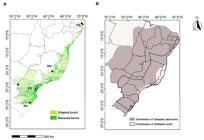
Localities and municipalities where Didelphis albiventris was collected along the Brazilian Atlantic Forest (A), and distribution map of D. albiventris and D. aurita in Brazil (B).
The samplings in Curitiba, the capital of the state of Paraná (PR), were performed at urban parks within the Metropolitan Region of Curitiba: Parque Náutico Municipal de Curitiba (25°31'02.3"S, 49°12'40.4"W), Zoológico Municipal de Curitiba (25°33'09"S, 49°14'07"W), and Jardim Botânico Municipal de Curitiba (25°26'30.1"S, 49°14'14.1"W).
In Guaíra, PR, sampling occurred at Debus Farm, a peri-urban locality, which is part of an area of great environmental relevance near Ilha Grande National Park (24°03'00"S, 54°16'00"W). Additional samples were obtained from Vila Maldiva (24°05'21"S, 54°15'10"W), a peri-urban community located on the banks of the Paraná River adjacent to Ilha Grande National Park.
In Belo Horizonte, the capital of the state of Minas Gerais (MG), four different sites were sampled within the Metropolitan Region: Cidade Administrativa Presidente Tancredo de Almeida Neves (19°47'13"S, 47°57'02"W), Parque Ecológico Francisco Lins do Rêgo – known as Parque Ecológico da Pampulha (19°51'23"S, 43°59'47"W), Comunidade Quilombola de Mangueiras (19°49'28"S, 43°54'16"W), and Parque Olinto Marinho Couto – formerly Parque Bosque São Bento II (19°57'10"S, 43°57'27"W).
The samples from Santa Rita and Mamanguape, state of Paraíba (PB), were concentrated in preserved areas of the Atlantic Forest. In Santa Rita, the collections occurred in the Gargaú Natural Heritage Private Reserve (RPPN), also known as Mata de Santana (7°00'44” S, 34°57'25” W), which has forest fragments in various stages of ecological succession. In Mamanguape, collections were made in the Guaribas Biological Reserve (6°45'32"S, 35'12'51"W), one of the last remnants of the Atlantic Forest in Northeast Brazil.
Methods of helminth collection and fixation
The collections in Curitiba, PR, were performed in April 2019 for four consecutive nights. In Porto Alegre, RS, samples were collected in April 2018; in Guaíra, PR, samples were collected in April 2024; and in Belo Horizonte, MG, samples were collected in September 2019, all for five consecutive nights. In Santa Rita, PB, the collections took place between the end of August and the beginning of September 2017 for six consecutive nights; in Mamanguape, PB, the collections were performed in June 2014 and April 2015 for ten consecutive nights. Captures were made using Tomahawk Live Traps, Model 201 (dimensions: 40.64 × 12.7 × 12.7 cm; USA), on transects of 15 points spaced 20 m apart.
The captured animals were anesthetized and euthanized for the collection of helminths and other samples. The procedures followed the protocols of the Laboratório de Biologia e Parasitologia de Mamíferos Silvestres Reservatórios (LABPMR), Instituto Oswaldo Cruz, FIOCRUZ (IOC/FIOCRUZ) (D’Andrea et al., 2021). The captures were performed under collection licenses from the Brazilian Government’s Chico Mendes Institute for Biodiversity and Conservation (ICMBIO, license 13373). All procedures followed the guidelines for the capture, handling, and care of animals of the Ethical Committee on Animal Use of the Oswaldo Cruz Foundation (CEUA, licenses LW-39/14, L-36/18, and L-036/2018-A1) and followed biosafety protocols for the capture and handling of wild animals (Lemos & D'Andrea, 2014). The collected animals were preserved by taxidermy, and their skeletons were prepared and deposited as voucher material in the Integrated Collection of Wild and Reservoir Mammals (COLMASTO) of the Oswaldo Cruz Institute. The identification of the animals was performed based on external morphology by the National Reference Laboratory for Taxonomy and Diagnosis of Wild Reservoirs of Leishmaniasis of the Oswaldo Cruz Institute.
The animals were dissected, and their organs were individually separated, placed in Petri dishes and immersed in a saline solution (0.85% NaCl). The trachea, lungs, esophagus, heart, kidneys, liver, pancreas, spleen, small intestine, large intestine, cecum, mesenteric veins, reproductive system and body cavities were examined for the presence of helminths. The helminths found were placed in Petri dishes with saline solution (0.85% NaCl). Specimens larger than 0.5 mm were transferred to a Petri dish using fine forceps and a soft brush. Specimens smaller than 0.5 mm were visualized and collected with the aid of a stereoscopic microscope, and a fine brush was used to remove debris from the collected specimens. Some nematode specimens were fixed in AFA (93 parts of 70% ethanol, 5 parts of 0.4% formaldehyde, and 2 parts of 100% acetic acid) and heated to 65°C, whereas others were kept in 70% ethanol for molecular genetic studies.
Helminth identification methods
Helminth species identification was performed using an Axio Scope microscope. A1 – Zeiss coupled to an Axio Cam MRc digital camera for photomicrography. The nematodes were diaphanized with lactophenol or 50% glycerol and adjusted between the slide and coverslip for identification at the species level. The trematodes, cestodes and acanthocephalans were stained with Langeron Carmine, differentiated by 0.5% hydrochloric alcohol, dehydrated in an increasing alcoholic series, diaphanized in methyl salicylate, and mounted in Canada Balsam, with permanent preparation (Amato et al., 1991). The helminths were identified to the species level whenever possible and then counted and separated by sex (except in the case of hermaphrodite species). The specific morphological diagnosis features used to identify the specimens followed Vicente et al. (1997) and Anderson et al. (2009) for Nematoda, Travassos et al. (1969) for Trematoda, Gomes (1977) for Cestoda and Acanthocephala, in addition to the species description publications.
Data analyses
The mean abundance and mean intensity with their standard deviations and the prevalence, with confidence intervals, of each helminth species were calculated for each investigated variable, according to Bush et al. (1997). The mean abundances were calculated by dividing the total number of parasites by the total number of hosts. To calculate the mean intensity, the total number of parasites was divided by the number of infected hosts. For prevalence, the number of infected hosts was divided by the total number of hosts collected and then multiplied by 100. The helminth species richness, represented by the total number of species, and total abundance, represented by the total sum of helminth specimens, were calculated for each infracommunity.
To investigate the factors that influence helminth species richness and helminth abundance, generalized linear models (GLMs) with Gaussian distributions were fitted. All the host specimens analyzed were infected by helminths with high parasite loads, which differs from the common aggregated pattern of most parasites. The distribution of the data was verified by analyzing the distribution of scaled residuals from the global model, according to Hartig (2024), and fitted a Gaussian distribution. The explanatory variables were land use (preserved or peri-urban areas), host sex (male or female), host age (young or adult) and the locality where the hosts were captured (Porto Alegre, Curitiba, Guaíra, Belo Horizonte, Mamanguape and Santa Rita). After the global models were fit, the models were selected based on the corrected Akaike Information Criterion (AICc) to identify which variables best explained the variation in helminth species richness and abundance. The plausible models considered were those with a delta AICc ≤ 2 and greater weight (AICcWt).
The influence of spatial scale on the abundance of each helminth species in the infracommunities was also investigated as follows. First, an abundance matrix of helminth species per infracommunity was constructed, which was transformed by the Hellinger method (Legendre & Gallagher, 2001) to reduce the influence of rare species and make the data suitable for linear methods such as redundancy analysis (RDA). To represent the spatial gradient between the infracommunities, an approach based on distance-derived Moran Eigenvector Maps (dbMEM; Dray et al., 2006) was used to represent spatial patterns at different scales. The geographic coordinates (latitude and longitude) of each location where the infracommunities were sampled were used to calculate a matrix of geodesic distances between the points. This method considers the curvature of the Earth and is more appropriate for spatial data in geographic coordinates (Dray et al., 2012). The dbMEMs represent spatial patterns at multiple scales, ranging from large (first axes) to small (last axes), allowing the identification of broad spatial gradients and local variations. To identify which spatial axes (dbMEM) influenced the species abundance matrix of the infracommunities, forward selection based on the adjusted R2 criterion was applied (Blanchet et al., 2008).
All analyses were performed in the R software environment (R Core Team, 2026). For the spatial analyses, the geosphere (Hijmans et al., 2017) and adespatial (Dray et al., 2022) packages were used. Hellinger transformation and forward selection of spatial descriptors (dbMEM) were performed with the vegan package (Oksanen et al., 2025). The GLM was performed with the stats package (R Core Team, 2026), and the adequacy of the models was verified with the DHARMa package (Hartig, 2024).
Results
Helminths of the phyla Nematoda, Platyhelminthes (classes Cestoda and Trematoda), and Acanthocephala were collected from 93 specimens of D. albiventris as follows: 15 from Porto Alegre, 12 from Curitiba, 14 from Guaíra, 11 from Belo Horizonte, 17 from Santa Rita, and 24 from Mamanguape (Table 1). The species found were Aspidodera raillieti Travassos, 1913; Cruzia tentaculata (Rudolphi 1819) Travassos, 1917; Turgida turgida (Rudolphi, 1819) Travassos, 1920; Viannaia hamata Travassos, 1914; Travassostrongylus orloffi Travassos, 1935; Travassostrongylus sextus Freitas, 1937; Trichuris didelphis Babero, 1960; Trichuris minuta (Rudolphi, 1819); Brachylaima advena Dujardin, 1843; Plagiorchis didelphidis (Parona, 1896) Stossich, 1904; Rhopalias coronatus (Rudolphi, 1819) Stiles & Hassall, 1898; Rhopalias horridus (Diesing, 1850) Stiles & Hassall, 1898; Duboisiella proloba Baer, 1938; and Oligacanthorhynchus microcephalus (Rudolphi, 1819) Schmidt, 1972.
Total number of Didelphis albiventris hosts (n=93) and number of helminths recovered for each species, by locality, in Porto Alegre, Curitiba, Guaíra, Belo Horizonte, Mamanguape and Santa Rita, Brazil.
Specimens of Viannaiasp. were found in the localities of Mamanguape and Santa Rita. These specimens are distinct from Viannaia hamata and from the others 18 species of this genus, thus, probably representing a new species, which will be described elsewhere. Trichurissp. were found in the locality of Belo Horizonte and they could not be identified at the species level because there were only female individuals. Thus, this morphotype was the only one not included in the GLM and dbMEM analyses. Cestode individuals were found in the locality of Mamanguape and could not be identified because of its poor state of conservation (Table 1).
The mean abundances (Tables 2, 3 and 4), mean intensities (Tables 5, 6 and 7) and prevalence rates (Tables 8, 9 and 10) were calculated for the helminth species recovered from each location, as well as for host attributes such as sex (male/female) and age (young/adult). The species with the greatest abundance among all the infracommunities were C. tentaculata (16,106 specimens), V. hamata (5,796 specimens), A. raillieti (2,567 specimens), and Tu. turgida (1,071 specimens) (Tables 2, 3 and 4). These four species were also the most prevalent, with prevalence rates and confidence intervals of 81.72 [72.35 – 88.98], 66.67 [56.13 – 76.11], 56.99 [46.31 – 67.22], and 83.87 [74.80 – 90.68], respectively. C. tentaculata and V. hamata also presented the highest mean intensities with high standard deviations (211.92 ± 233.63 and 109.36 ± 128.65, respectively).
Mean abundance of helminths ± standard deviations and range size in parenthesis in relation to host sex and age recovered from Didelphis albiventris by locality in Porto Alegre, Curitiba, Guaíra, Belo Horizonte, Mamanguape and Santa Rita, Brazil.
Mean abundance of helminths ± standard deviations and range size in parenthesis in relation to host sex and age recovered from Didelphis albiventris by locality in Porto Alegre, Curitiba, Guaíra, Belo Horizonte, Mamanguape and Santa Rita, Brazil.
Mean abundance of helminths ± standard deviations and range size in parenthesis in relation to host sex and age recovered from Didelphis albiventris by locality in Porto Alegre, Curitiba, Guaíra, Belo Horizonte, Mamanguape and Santa Rita, Brazil.
Mean intensity of helminths ± standard deviations and range size in parenthesis in relation to host sex and age recovered from Didelphis albiventris by locality in Porto Alegre, Curitiba, Guaíra, Belo Horizonte, Mamanguape and Santa Rita, Brazil.
Mean intensity of helminths ± standard deviations and range size in parenthesis in relation to host sex and age recovered from Didelphis albiventris by locality in Porto Alegre, Curitiba, Guaíra, Belo Horizonte, Mamanguape and Santa Rita, Brazil.
Mean intensity of helminths ± standard deviations and range size in parenthesis in relation to host sex and age recovered from Didelphis albiventris by locality in Porto Alegre, Curitiba, Guaíra, Belo Horizonte, Mamanguape and Santa Rita, Brazil.
Prevalence (95% confidence interval) of helminths in relation to host sex and age recovered from Didelphis albiventris by locality in Porto Alegre, Curitiba, Guaíra, Belo Horizonte, Mamanguape and Santa Rita, Brazil.
Prevalence (95% confidence interval) of helminths in relation to host sex and age recovered from Didelphis albiventris by locality in Porto Alegre, Curitiba, Guaíra, Belo Horizonte, Mamanguape and Santa Rita, Brazil.
Prevalence (95% confidence interval) of helminths in relation to host sex and age recovered from Didelphis albiventris by locality in Porto Alegre, Curitiba, Guaíra, Belo Horizonte, Mamanguape and Santa Rita, Brazil.
In Porto Alegre, C. tentaculata and V. hamata had the highest mean abundances (231.31 ± 162.95 and 68.33 ± 143.40, respectively) (Tables 2, 3 and 4) and mean intensities (246. 73 ± 156.11 and 85.42 ± 156.78, respectively) (Tables 5, 6 and 7). In Curitiba, C. tentaculata, A. raillieti, and Tu. turgida were the most prevalent species (91.67 [61.52 – 99.79], 83.33 [51.59 – 97.91], and 66.67 [34.89 – 51.78], respectively) (Tables 8, 9 and 10). In Guaíra, C. tentaculata and A. raillieti had the highest mean intensities (118.25 ± 80.93 and 76.00, respectively) (Tables 5, 6 and 7), and Tu. turgida had the highest prevalence (78.57 [49.20 – 95.34]) (Tables 8, 9 and 10). In Belo Horizonte, C. tentaculata had the highest mean abundance (174.82 ± 240.29) (Tables 2, 3 and 4) and mean intensity (213.67 ± 250.67) (Tables 5, 6 and 7). Tu. turgida had the highest prevalence (100.00 [71.51 – 100.00]) (Tables 8, 9 and 10). In Mamanguape, C. tentaculata and V. hamata had the highest abundances (96.25 ± 121.22 and 65.04 ± 91.36, respectively) (Tables 2, 3 and 4). C. tentaculata, A. raillieti, Tu. turgida and V. hamata had the highest prevalence rates (91.67 [73.00 – 98.97], 75.00 [53.29 – 90.23], 79.17 [57.85 – 92.87] and 87.50 [67.64 – 97.34], respectively) (Tables 8, 9 and 10). In Santa Rita, C. tentaculata, V. hamata and A. raillieti had the highest abundances (419.18 ± 320.69, 181.59 ± 121.09 and 70.53 ± 100.44, respectively) (Tables 2, 3 and 4), and C. tentaculata and V. hamata had the highest mean intensities (445.38 ± 311.84 and 192.94 ± 106.84, respectively) (Tables 5, 6 and 7).
In relation to the host sex for the set of locations, A. raillieti and R. horridus mostly occurred in male hosts, and Viannaia sp. Trichuris sp., T. sextus, D. proloba and Cestoda occurred only in male hosts. C. tentaculata. Tu. turgida, Tr. didelphis, Tr. minuta, V. hamata, T. orloffi, B. advena, P. didelphidis, R. coronatus and O. microcephalus mostly occurred in female hosts. The sex of three hosts was not recorded, one in Curitiba, one in Porto Alegre and one in Santa Rita. With respect to host age, the species C. tentaculata, A. raillieti, Tu. turgida, Tr. minuta and Viannaia sp. mostly occurred in adult hosts. Trichuris sp., R. horridus, R. coronatus, O. microcephalus and D. proloba occurred only in adult hosts. The species Tr. didelphis, V. hamata, T. orloffi, and B. advena mostly occurred in young hosts. Travassostrongylus sextus and Cestoda occurred only in young hosts.
The GLM results indicated that all the tested predictors influenced helminth species richness, with a greater effect of locality, which was present in all the models considered plausible, and the type of land use, host sex and age, which were present in four plausible models each (Table 11). Land use had a positive effect on species richness, indicating higher helminth richness in preserved areas than in peri-urban areas (Table 1). Host sex and age were also present in the selected models. Greater species richness was associated with female host and adult host specimens (Tables 2, 3 and 4).
Results of the Generalized Linear Models (GLM) for the helminth species richness recovered from Didelphis albiventris in Porto Alegre, Curitiba, Guaíra, Belo Horizonte, Mamanguape and Santa Rita, Brazil, in relation to host age (young or adult) and sex (male or female), locality, and type of land use.
Similarly to species richness, all the tested predictors were indicated to have influenced helminth abundance, and a greater importance was observed for locality and host age, which were present in all the plausible models (Table 12). Helminth abundance was significantly greater among adult hosts, female hosts, and those from preserved environments (Tables 2, 3 and 4).
Results of the Generalized Linear Models (GLM) for the helminth abundance recovered from Didelphis albiventris in Porto Alegre, Curitiba, Guaíra, Belo Horizonte, Mamanguape, and Santa Rita, Brazil, in relation to host age (young or adult) and sex (male or female), locality, and type of land use.
Regarding the effect of spatial scale on helminth abundance, we found a significant association with the first dbMEM axis (dbMEM1; F = 12.67; df = 1; p = 0.001). This result indicates that the abundance patterns of helminth infracommunities from geographically distant hosts differ along the spatial gradient.
Discussion
Among the 14 helminth species identified, 13 had previously been reported to parasitize Didelphis albiventris. This opossum was recently reported as a new host for Travassostrongylus sextus (Cirino et al., 2025). Curitiba is a new locality of occurrence for the nematodes A. raillieti, C. tentaculata, T. turgida, T. orloffi, T. sextus, and V. hamata and for the trematodes B. advena, P. didelphidis, R. coronatus, and R. horridus. Guaíra has its first record for the nematodes A. raillieti, C. tentaculata, T. turgida, T. didelphis, and for the acanthocephalan O. microcephalus. Belo Horizonte represents a new distribution area for the trematodes R. horridus and D. proloba. Santa Rita represents a new area of occurrence for the nematodes A. raillieti, C. tentaculata, T. turgida, T. didelphis, Tr. minuta, V. hamata, and T. orloffi.
Compared with the other species, C. tentaculata, A. raillieti, and T. turgida had the highest abundance and prevalence, and C. tentaculata had the highest mean intensity. Quintão e Silva & Costa (1999) reported a relatively high prevalence of these three species and a high intensity of C. tentaculata in D. albiventris helminth communities in the region of Pampulha (Belo Horizonte, MG). Higher intensities were recorded for C. tentaculata and V. hamata, corroborating the results reported by Müller (2005) for the same host in the municipality of Pelotas, RS. Zabott et al. (2017) reported a relatively high prevalence of C. tentaculata and T. turgida in D. albiventris compared with other helminths collected in the municipality of Palotina, PR. Cirino et al. (2022) reported a high prevalence of these three nematode species in D. albiventris. In the study by Hartmann et al. (2025), C. tentaculata was the most abundant and prevalent species in D. abiventris in Argentina.
Cruzia tentaculata, A. raillieti, and T. turgida are frequently reported in didelphids in different environments, whose abundance, prevalence and/or intensity are usually high. Acosta-Virgen et al. (2015) recorded these three species parasitizing Didelphis virginiana and Didelphis marsupialis in Mexico; Chero et al. (2017) reported on D. marsupialis in Peru; Costa-Neto et al. (2019) and Boullosa et al. (2021) reported on D. aurita in the state of Rio de Janeiro, Brazil; Freitas et al. (2022) reported on D. marsupialis in the state of Mato Grosso, Brazil; and Hartmann et al. (2025) reported on D. albiventris and D. aurita in Argentina. The relatively high occurrence and wide geographic distribution of C. tentaculata, A. raillieti, and T. turgida indicate that these species act as central components in the structure of the helminth communities of marsupials of the genus Didelphis. (Costa-Neto et al., 2019; Cirino et al., 2022). Thus, C. tentaculata, A. raillieti, and T. turgida can be considered core species of the helminth fauna of D. albiventris. In addition, D. albiventris can occur in sympatry with D. aurita in areas of the Atlantic Forest (see Figure 1B), where they share the same habitat and resources. In these regions, both species exhibit very similar helminth communities, suggesting that parasite sharing is facilitated by niche overlap and exposure to common sources of infection (Hartmann et al., 2025).
With respect to intrinsic factors, female hosts recorded greater helminth species richness and abundance than males did, a result that contradicts expectations, since male specimens of mammals tend to have a larger home range than females do and, consequently, greater exposure to sources of infection in the environment (Zuk & McKean, 1996; Klein, 2004). However, we must mention that the analysis included all the localities and that we captured more male hosts.
The age of the hosts influenced helminth species richness and abundance, indicating higher levels of infection in adult hosts than in young individuals, as expected. Compared with young individuals, adult mammalian hosts can accumulate more parasites throughout life, increasing their infection rates (Behnke et al., 1999; Poulin, 2013). Similar results were reported by Illia et al. (2024), who reported that young specimens of D. albiventris were less parasitized than adult individuals were. In general, these animals do not clear helminth infections over time because the immunity acquired against helminths is, in most cases, partial and not very effective due to the helminth ability to modulate the host's immune system and, therefore, enable long-term persistence within a host and reinfection (Combes, 2001).
With respect to extrinsic factors, the GLM results revealed that helminth species richness and abundance may be influenced by locality, suggesting that differences between localities were determinants of parasite diversity in D. albiventris. Local conditions, such as sunlight incidence and humidity, may influence the community structure of helminths (Bordes et al., 2009; Cardoso et al., 2016). The type of land use also seemed to be an important predictor of helminth species richness and abundance, with higher values observed in preserved areas than in peri-urban areas, indicating that more preserved environments may favor a greater diversity of parasites, a finding that has been reported in other studies (Cardoso et al., 2016; Costa-Neto et al., 2019; Cirino et al., 2022). These results support the hypothesis that fragmentation and anthropogenic disturbance reduce the diversity and transmission of parasites, possibly because of the loss of intermediate hosts and the alteration of the microhabitats necessary for the life cycles of helminths (Cardoso et al., 2016; Kiene et al., 2021). Indeed, intermediate hosts can be considered sources of parasites for definitive hosts (Poulin, 2007). In addition, approximately half of the helminth species recorded in this study have an indirect life cycle. The negative effects of fragmentation on the life cycle of parasites have been reported in several studies (Lafferty & Kuris 1999; Patz et al., 2000; Pakdeenarong et al., 2014).
The influence of spatial scale (dbMEM 1 axis) on helminth abundances among infracommunities suggests that the movement of hosts and their spatial dynamics allowed homogenization in terms of helminth species composition and abundance at the local scale, with greater sharing of parasite species among geographically close infracommunities. This pattern may be explained by the ecological traits of opossums that occupy several environments, have generalist habits, and have a strong ability to adapt to disturbed environments (Gentile et al., 2018). In addition, by maintaining large home ranges to secure essential resources, these hosts are more frequently exposed to parasite transmission (Cáceres, 2012). In general, parasite communities that are geographically distant from each other tend to have different species and/or parasite loads because of changes in landscape structure, environmental conditions and the availability of definitive and intermediate hosts (Poulin, 2003; Krasnov et al., 2005). However, local conditions and the level of disturbance in the environment may also influence parasite fauna across areas (Lafferty & Kuris, 1999; Cardoso et al., 2016).
Given the observational design of this study, we highlight that the reported relationships found should be interpreted with caution. The data were collected during different periods and seasons of the year for each locality, without temporal replication, which may represent a limitation in the interpretation of the results because of the likely unmeasured effect of seasonality on the parasitism of this host. In addition, other factors such as climate, habitat structure or intrinsic factors of the parasites, which were not analyzed in this study, might also have influenced the helminth structure observed.
Conclusions
The helminth species richness and abundance of D. albiventris were influenced by both factors intrinsic to the host (sex and age) and factors extrinsic to the host (locality and land use), suggesting that several factors can act in an integrated way in host‒parasite interactions in wildlife. The spatial scale seemed to influence the structure of the helminth infracommunities of D. albiventris, with greater differences with increasing geographical distance, suggesting that the helminth communities of the infracommunities of this host are structured as a function of local characteristics of the environment, although there are cross sectional patterns in structuring the communities, such as host characteristics.
Acknowledgements
We would like to thank the staff and students of the Laboratory of Biology and Parasitology of Wild Mammals Reservoirs at Oswaldo Cruz Foundation - LABPMR, especially BR Teixeira, BE Andrade-Silva and FO Santos, and the Laboratory of Mammals at Federal University of Paraíba, especially PC Estrela, for help with the fieldwork. CC Ito assisted with fieldwork in Belo Horizonte and Curitiba. We also thank the State Health Secretaries of Minas Gerais and Paraná, the Instituto René Rachou, Dr. Paulo D'Andrea for the ICMBIO license, the National Reference Laboratory for Taxonomy and Diagnosis of Wild Reservoirs of Leishmaniasis of the Oswaldo Cruz Institute, and R Cerqueira and PC Estrela for the coordination of the general project PPBio Rede BioM. A (Mamanguape sampling). We are also grateful to GS Gazêta and SV de Oliveira for coordinating the broader project “Investigação Ecoepidemiológica de Borreliose de Interesse Médico no Brasil”, which provided funding for part of the fieldwork.
Data availability
Data related to the study are included in the article.
How to cite:
Financial support
Ethics declaration
References
-
Acosta-Virgen K, López-Caballero J, García-Prieto L, Mata-López R. Helminths of three species of opossums (Mammalia, Didelphidae) from Mexico. ZooKeys 2015; 511(511): 131-152. https://doi.org/10.3897/zookeys.511.9571 PMid:26257556.
» https://doi.org/10.3897/zookeys.511.9571 - Amato JFR, Walter AB, Amato SB. Protocolo para laboratório: coleta e processamento de parasitas do pescado Rio de Janeiro: Imprensa Universitária, UFRRJ; 1991.
-
Anderson RC, Chaubaud AG, Willmott S. Keys to the nematode parasites of vertebrates: archival volume Wallingford: CABI Publishing; 2009. https://doi.org/10.1079/9781845935726.0000
» https://doi.org/10.1079/9781845935726.0000 -
Behnke JM, Lewis JW, Zain SN, Gilbert FS. Helminth infections in Apodemus sylvaticus in southern England: interactive effects of host age, sex and year on the prevalence and abundance of infections. J Helminthol 1999; 73(1): 31-44. https://doi.org/10.1017/S0022149X00700162 PMid:10431369.
» https://doi.org/10.1017/S0022149X00700162 -
Bezerra-Santos MA, Ramos RAN, Campos AK, Dantas-Torres F, Otranto D. Didelphis spp. opossums and their parasites in the Americas: a One Health perspective. Parasitol Res 2021; 120(12): 4091-4111. https://doi.org/10.1007/s00436-021-07072-4 PMid:33788021.
» https://doi.org/10.1007/s00436-021-07072-4 -
Bitencourt MM, Bezerra AMR. Infection agents of Didelphidae (Didelphimorphia) of Brazil: an underestimated matter in zoonoses research. Mammalia 2022; 86(2): 105-122. https://doi.org/10.1515/mammalia-2021-0134
» https://doi.org/10.1515/mammalia-2021-0134 -
Blanchet FG, Legendre P, Borcard D. Forward selection of explanatory variables. Ecology 2008; 89(9): 2623-2632. https://doi.org/10.1890/07-0986.1 PMid:18831183.
» https://doi.org/10.1890/07-0986.1 -
Bordes F, Morand S, Kelt DA, Van Vuren DH. Home range and parasite diversity in mammals. Am Nat 2009; 173(4): 467-474. https://doi.org/10.1086/597227 PMid:19232003.
» https://doi.org/10.1086/597227 -
Boullosa RG, Costa-Neto SF, Morgado L, Maldonado A Jr, Gentile R. A longitudinal survey of gastrointestinal parasites of the black-eared opossum Didelphis aurita at an urban-sylvatic interface area in Southeast Brazil: a morphological and ecological characterization based on helminth eggs. Parasitol Res 2021; 120(11): 3815-3825. https://doi.org/10.1007/s00436-021-07314-5 PMid:34568959.
» https://doi.org/10.1007/s00436-021-07314-5 -
Brandão ML, Chame M, Cordeiro JLP, Chaves SAM. Diversidade de helmintos intestinais em mamíferos silvestres e domésticos na Caatinga do Parque Nacional Serra da Capivara, sudeste do Piauí, Brasil. Rev Bras Parasitol Vet 2009;18(Suppl 1): 19-28. https://doi.org/10.4322/rbpv.018e1004 PMid:20040186.
» https://doi.org/10.4322/rbpv.018e1004 -
Bush AO, Lafferty KD, Lotz JM, Shostak AW. Parasitology meets ecology on its own terms: Margolis et al. revisited. J Parasitol 1997; 8(4): 575-583. https://doi.org/10.2307/3284227 PMid:9267395.
» https://doi.org/10.2307/3284227 -
Cáceres NC, Delciellos AC, Prevedello JA, Brum MN, Albanese MS. Movement, habitat selection, and home range of American marsupials. In: Cáceres NC, Dickman CR, editors. American and Australasian Marsupials: an evolutionary, biogeographical, and ecological approach Cham: Springer International Publishing; 2023. p. 3-20. https://doi.org/10.1007/978-3-031-08419-5_2
» https://doi.org/10.1007/978-3-031-08419-5_2 - Cáceres NC. Os marsupiais do Brasil: biologia, ecologia e conservação 2nd ed. Campo Grande, MS: Editora UFMS; 2012.
-
Cardoso TDS, Simões RO, Luque JLF, Maldonado A Jr, Gentile R. The influence of habitat fragmentation on helminth communities in rodent populations from a Brazilian Mountain Atlantic Forest. J Helminthol 2016; 90(4): 460-468. https://doi.org/10.1017/S0022149X15000589 PMid:26206199.
» https://doi.org/10.1017/S0022149X15000589 -
Chero JD, Sáez G, Mendoza-Vidaurre C, Iannacone J, Cruces CL. Helminths of the common opossum Didelphis marsupialis (Didelphimorphia: Didelphidae), with a checklist of helminths parasitizing marsupials from Peru. Rev Mex Biodivers 2017; 88(3): 560-571. https://doi.org/10.1016/j.rmb.2017.07.004
» https://doi.org/10.1016/j.rmb.2017.07.004 -
Cirino BS, Costa Neto SF, Cardoso TS, Maldonado Júnior A, Gentile R. Influence of latitude, host body size and host body weight on helminth species richness and abundance in two Neotropical marsupials. Int J Parasitol Parasites Wildl 2025; 27: 101077. https://doi.org/10.1016/j.ijppaw.2025.101077 PMid:40503084.
» https://doi.org/10.1016/j.ijppaw.2025.101077 -
Cirino BS, Costa-Neto SF, Cardoso TS, Estrela PC, Maldonado A Jr, Gentile R. Gleasonian structure in the helminth metacommunity of the opossum Didelphis albiventris in two extremes of the Atlantic Forest. J Helminthol 2022; 96: e7. https://doi.org/10.1017/S0022149X21000791 PMid:35086598.
» https://doi.org/10.1017/S0022149X21000791 - Combes C. Parasitism: The ecology and evolution of intimate interactions Chicago: University of Chicago, Press; 2001.
-
Costa-Neto SF, Cardoso TS, Boullosa RG, Maldonado A Jr, Gentile R. Metacommunity structure of the helminths of the black-eared opossum Didelphis aurita in peri-urban, sylvatic and rural environments in south-eastern Brazil. J Helminthol 2019; 93(6): 720-731. https://doi.org/10.1017/S0022149X18000780 PMid:30220264.
» https://doi.org/10.1017/S0022149X18000780 -
D’Andrea PS, Teixeira BR, Gonçalves-Oliveira J, Dias D, Vilela RV, Lucio CS, et al. The mammal collection of the laboratory of biology and parasitology of reservoir wild mammals – Oswaldo Cruz Foundation. Braz J Mammal 2021; e90: e90202119. https://doi.org/10.32673/bjm.vie90.19
» https://doi.org/10.32673/bjm.vie90.19 -
Dallas T, Presley SJ. Relative importance of host environment, transmission potential and host phylogeny to the structure of parasite metacommunities. Oikos 2014; 123(7): 866-874. https://doi.org/10.1111/oik.00707
» https://doi.org/10.1111/oik.00707 -
Dray S, Bauman D, Blanchet G, Borcard D, Clappe S, Guénard G, et al. Adespatial: multivariate multiscale spatial analysis. R package version 0.3-21 Viena: CRAN; 2022. https://doi.org/10.32614/CRAN.package.adespatial
» https://doi.org/10.32614/CRAN.package.adespatial -
Dray S, Legendre P, Peres-Neto PR. Spatial modelling: a comprehensive framework for principal coordinate analysis of neighbour matrices (PCNM). Ecol Modell 2006; 196(3-4): 483-493. https://doi.org/10.1016/j.ecolmodel.2006.02.015
» https://doi.org/10.1016/j.ecolmodel.2006.02.015 -
Dray S, Pélissier R, Couteron P, Fortin MJ, Legendre P, Peres-Neto PR, et al. Community ecology in the age of multivariate multiscale spatial analysis. Ecol Monogr 2012; 82(3): 257-275. https://doi.org/10.1890/11-1183.1
» https://doi.org/10.1890/11-1183.1 - Faria MB, Lanes RO, Bonvicino CR. Guia dos marsupiais do Brasil: guia de identificação com base em caracteres morfológicos externos e cranianos São Caetano do Sul: Amélie Editorial; 2019.
-
Fernandes IM, Henriques-Silva R, Penha J, Zuanon J, Peres-Neto PR. Spatiotemporal dynamics in a seasonal metacommunity structure is predictable: the case of floodplain-fish communities. Ecography 2014; 37(5): 464-475. https://doi.org/10.1111/j.1600-0587.2013.00527.x
» https://doi.org/10.1111/j.1600-0587.2013.00527.x -
Freitas LC, Maldonado Júnior A, Mendonça RFB, Ramos DGS, Rossi RV, Pacheco RC, et al. Helminth community structure of Didelphis marsupialis (Didelphimorphia, Didelphidae) in a transition area between the Brazilian Amazon and the Cerrado. Rev Bras Parasitol Vet 2022; 31(2): e002922. https://doi.org/10.1590/s1984-29612022031 PMid:35674531.
» https://doi.org/10.1590/s1984-29612022031 -
Gardner AL. Mammals of South America: marsupials, xenarthrans, shrews, and bats Vol. 1. Chicago: University of Chicago, Press; 2008. https://doi.org/10.7208/chicago/9780226282428.001.0001
» https://doi.org/10.7208/chicago/9780226282428.001.0001 -
Gentile R, Cardoso TS, Costa-Neto SF, Teixeira BR, D’Andrea PS. Community structure and population dynamics of small mammals in an urban-sylvatic interface area in Rio de Janeiro, Brazil. Zoologia 2018; 35: e13465. https://doi.org/10.3897/zoologia.35.e13465
» https://doi.org/10.3897/zoologia.35.e13465 - Gomes DC. Contribuição ao conhecimento dos helmintos parasitos de marsupiais no Brasil, da Coleção Helmintológica do Instituto Oswaldo Cruz [thesis]. Seropédica: Universidade Federal Rural do Rio de Janeiro; 1977.
-
Han BA, Kramer AM, Drake JM. Global patterns of zoonotic disease in mammals. Trends Parasitol 2016; 32(7): 565-577. https://doi.org/10.1016/j.pt.2016.04.007 PMid:27316904.
» https://doi.org/10.1016/j.pt.2016.04.007 -
Han BA, Park AW, Jolles AE, Altizer S. Infectious disease transmission and behavioural allometry in wild mammals. J Anim Ecol 2015; 84(3): 637-646. https://doi.org/10.1111/1365-2656.12336 PMid:25631200.
» https://doi.org/10.1111/1365-2656.12336 -
Hartig F. DHARMa: Residual Diagnostics for Hierarchical (Multi-Level/Mixed) Regression Models. R package version 0.4.7 [Internet]. Viena: CRAN; 2024 [cited 2025 Dec 18]. Available from: https://CRAN.R-project.org/package=DHARMa
» https://CRAN.R-project.org/package=DHARMa -
Hartmann BB, Vanderhoeven EA, Di Nucci DL, Solari A, Notarnicola J. Helminths assemblage in two opossum’s species, Didelphis albiventris and Didelphis aurita (Mammalia: Didelphimorphia), from the Atlantic Forest of Argentina. Parasitology 2025; 152(5): 551-562. https://doi.org/10.1017/S0031182025000563 PMid:40269638.
» https://doi.org/10.1017/S0031182025000563 - Hijmans RJ, Williams E, Vennes C, Hijmans MRJ. Package ‘geosphere’.Spherical trigonometry2017;1(7): 1-45.
-
Illia G, Gomez Villafañe IE, Ezquiaga MC, Cassini G, Gozzi AC. Cassini Gh, Gozzi AC. Intestinal helminth community structure of white-eared opossum (Didelphis albiventris) that inhabit rural areas of Buenos Aires, Argentina. Mastozool Neotrop 2024; 31(1): e0989. https://doi.org/10.31687/saremMN.24.31.01.09.e0989
» https://doi.org/10.31687/saremMN.24.31.01.09.e0989 -
Kiene F, Andriatsitohaina B, Ramsay MS, Rakotondravony R, Strube C, Radespiel U. Habitat fragmentation and vegetation structure impact gastrointestinal parasites of small mammalian hosts in Madagascar. Ecol Evol 2021; 11(11): 6766-6788. https://doi.org/10.1002/ece3.7526 PMid:34141255.
» https://doi.org/10.1002/ece3.7526 -
Klein SL. Hormonal and immunological mechanisms mediating sex differences in parasite infection. Parasite Immunol 2004; 26(6-7): 247-264. https://doi.org/10.1111/j.0141-9838.2004.00710.x PMid:15541029.
» https://doi.org/10.1111/j.0141-9838.2004.00710.x -
Krasnov BR, Shenbrot GI, Mouillot D, Khokhlova IS, Poulin R. Spatial variation in species diversity and composition of flea assemblages in small mammalian hosts: geographical distance or faunal similarity? J Biogeogr 2005; 32(4): 633-644. https://doi.org/10.1111/j.1365-2699.2004.01206.x
» https://doi.org/10.1111/j.1365-2699.2004.01206.x -
Lafferty KD, Kuris AM. How environmental stress affects the impacts of parasites. Limnol Oceanogr 1999; 44(3): 925-931. https://doi.org/10.4319/lo.1999.44.3_part_2.0925
» https://doi.org/10.4319/lo.1999.44.3_part_2.0925 -
Legendre P, Gallagher ED. Ecologically meaningful transformations for ordination of species data. Oecologia 2001; 129(2): 271-280. https://doi.org/10.1007/s004420100716 PMid:28547606.
» https://doi.org/10.1007/s004420100716 -
Lemos ER, D’Andrea PS. Trabalho de campo com animais: procedimentos, riscos e biossegurança Rio de Janeiro: Editora Fiocruz; 2014. https://doi.org/10.7476/9786557080658
» https://doi.org/10.7476/9786557080658 -
Marcogliese DJ. Parasites of the superorganism: are they indicators of ecosystem health? Int J Parasitol 2005; 35(7): 705-716. https://doi.org/10.1016/j.ijpara.2005.01.015 PMid:15925594.
» https://doi.org/10.1016/j.ijpara.2005.01.015 - Müller GA. Diversidade e potencial zoonótico de parasitos de Didelphis albiventris Lund, 1841 (Marsupialia: Didelphidae) [thesis]. Porto Alegre: Universidade Federal do Rio Grande do Sul; 2005.
- Oksanen J, Blanchet FG, Friendly M, Kindt R, Legendre P, McGlinn D, et al. vegan: community ecology package. R package version 2.6-6 Viena: CRAN; 2025.
-
Pakdeenarong N, Siribat P, Chaisiri K, Douangboupha B, Ribas A, Chaval Y, et al. Helminth communities in murid rodents from southern and northern localities in Lao PDR: the role of habitat and season. J Helminthol 2014; 88(3): 302-309. https://doi.org/10.1017/S0022149X13000187 PMid:23552185.
» https://doi.org/10.1017/S0022149X13000187 -
Patz JA, Graczyk TK, Geller N, Vittor AY. Effects of environmental change on emerging parasitic diseases. Int J Parasitol 2000; 30(12-13): 1395-1405. https://doi.org/10.1016/S0020-7519(00)00141-7 PMid:11113264.
» https://doi.org/10.1016/S0020-7519(00)00141-7 -
Pinto HA, Mati VLT, Melo AL. Toxocara cati (Nematoda: Ascarididae) in Didelphis albiventris (Marsupialia: Didelphidae) from Brazil: a case of pseudoparasitism. Rev Bras Parasitol Vet 2014; 23(4): 522-525. https://doi.org/10.1590/s1984-29612014074 PMid:25517533.
» https://doi.org/10.1590/s1984-29612014074 -
Poulin R. Evolutionary ecology of parasites 2nd ed. Princeton: Princeton University Press; 2007. https://doi.org/10.1515/9781400840809
» https://doi.org/10.1515/9781400840809 -
Poulin R. Explaining variability in parasite aggregation levels among host samples. Parasitology 2013; 140(4): 541-546. https://doi.org/10.1017/S0031182012002053 PMid:23343821.
» https://doi.org/10.1017/S0031182012002053 -
Poulin R. The decay of similarity with geographical distance in parasite communities of vertebrate hosts. J Biogeogr 2003; 30(10): 1609-1615. https://doi.org/10.1046/j.1365-2699.2003.00949.x
» https://doi.org/10.1046/j.1365-2699.2003.00949.x -
Preisser W. Latitudinal gradients of parasite richness: a review and new insights from helminths of cricetid rodents. Ecography 2019; 42(7): 1315-1330. https://doi.org/10.1111/ecog.04254
» https://doi.org/10.1111/ecog.04254 -
Quintão e Silva MG, Costa HM. Helminths of white-bellied opossum from Brazil. J Wildl Dis 1999; 35(2): 371-374. https://doi.org/10.7589/0090-3558-35.2.371 PMid:10231765.
» https://doi.org/10.7589/0090-3558-35.2.371 -
R Core Team. R: a language and environment for statistical computing [software]. Vienna: R Foundation for Statistical Computing; 2026 [cited 2025 Dec 18]. Available from: https://www.R-project.org/
» https://www.R-project.org/ -
Ramos DGS, Santos ARGLO, Freitas LC, Correa SHR, Kempe GV, Morgado TO, et al. Endoparasites of wild animals from three biomes in the State of Mato Grosso, Brazil. Arq Bras Med Vet Zootec 2016; 68(3): 571-578. https://doi.org/10.1590/1678-4162-8157
» https://doi.org/10.1590/1678-4162-8157 -
Suzán G, García-Peña GE, Castro-Arellano I, Rico O, Rubio AV, Tolsá MJ, et al. Metacommunity and phylogenetic structure determine wildlife and zoonotic infectious disease patterns in time and space. Ecol Evol 2015; 5(4): 865-873. https://doi.org/10.1002/ece3.1404 PMid:25750713.
» https://doi.org/10.1002/ece3.1404 -
Tompkins DM, Dunn AM, Smith MJ, Telfer S. Wildlife diseases: from individuals to ecosystems. J Anim Ecol 2011; 80(1): 19-38. https://doi.org/10.1111/j.1365-2656.2010.01742.x PMid:20735792.
» https://doi.org/10.1111/j.1365-2656.2010.01742.x - Travassos L, Teixeira de Freitas JF, Kohn A. Trematódeos do Brasil. Mem Inst Oswaldo Cruz 1969; 67(1): 1-886. PMid:5397756.
-
Varejão BM, Valle CMC. Contribuição ao estudo da distribuição geográfica das espécies do gênero Didelphis (Mammalia, Marsupialia) no estado de Minas Gerais, Brasil. Lundiana 1982; 2(1): 5-56. https://doi.org/10.35699/2675-5327.1982.21674
» https://doi.org/10.35699/2675-5327.1982.21674 -
Vicente JJ, Rodrigues HO, Gomes DC, Pinto RM. Nematóides do Brasil. Parte V: nematóides de mamíferos. Rev Bras Zool 1997; 14(Suppl 1): 1-452. https://doi.org/10.1590/S0101-81751997000500001
» https://doi.org/10.1590/S0101-81751997000500001 -
Zabott MV, Pinto SB, Viott AM, Gruchouskei L, Bittencourt LHFB. Helmintofauna de Didelphis albiventris (Lund, 1841) no município de Palotina, Paraná, Brasil. Arq Ciênc Vet Zool UNIPAR 2017; 20(1): 19-22. https://doi.org/10.25110/arqvet.v20i1.2017.6315
» https://doi.org/10.25110/arqvet.v20i1.2017.6315 -
Zuk M, McKean KA. Sex differences in parasite infections: patterns and processes. Int J Parasitol 1996; 26(10): 1009-1024. https://doi.org/10.1016/S0020-7519(96)80001-4 PMid:8982783.
» https://doi.org/10.1016/S0020-7519(96)80001-4

