 Pseudoproleptus sp. Larvae (Nematoda: Cystidicolidae) parasitizing Macrobrachium amazonicum (Decapoda: Crustacea) in the state of Pará, Northern Brazil
Abstract
Third-stage larvae of a nematode species were found encapsulated in the cephalothorax of Macrobrachium amazonicum from the Guamá River, municipality of Belém, in the state of Pará, northern Brazil. Of a total of 120 specimens of M. amazonicum that were caught, 15.8% were parasitized with Cystidicolidae larvae that had morphological characteristics compatible with the genus Pseudoproleptus, such as rounded cephalic end, two pseudolips, slit-shaped buccal opening with four large submedian lips, vestibule with prostom and conical tail with a small mucron. The low presence of Pseudoproleptus larvae did not affect the growth of the shrimp, but these results cannot be generalized since the sampling was relatively low. Therefore, so the occurrence of this nematode could still negatively affect the growth and reproduction of these shrimp, leading to their death, which could directly affect their population dynamics and consumption by the Amazonian riverside population. Finally, we recommend more analyses with a greater sampling effort.
Keywords:
Helminth; nematode; parasite; shrimp; Guamá river
Resumo
Larvas de terceiro estágio de uma espécie de nematódeo foram encontradas encapsuladas no cefalotórax de Macrobrachium amazonicum do Rio Guamá, município de Belém, no estado do Pará, norte do Brasil. Em um total de 120 espécimes de M. amazonicum capturados, 15,8% estavam parasitados por larvas de Cystidicolidae que apresentavam características morfológicas compatíveis com o gênero Pseudoproleptus, como extremidade cefálica arredondada, dois pseudolábios, abertura bucal em forma de fenda com quatro grandes lábios submedianos, vestíbulo com prostom e cauda cônica com um pequeno mucro. A baixa presença de larvas de Pseudoproleptus não afetou o crescimento dos camarões, porém estes resultados não podem ser generalizados uma vez que a amostragem foi relativamente baixa. Portanto, a ocorrência desse nematódeo poderia afetar negativamente o crescimento e a reprodução dessa espécie de camarão, levando-o à morte, o que poderia afetar diretamente sua dinâmica populacional e o consumo pela população ribeirinha da Amazônia. Desta forma, recomendamos mais análises com um esforço amostral maior.
Palavras-chave:
Helminto; nematoide; parasito; camarão; Rio Guamá
Introduction
The Amazon biome, encompassing a vast geographical area and a diverse mosaic of habitats including one of the planet’s most biodiverse environments (Pimentel, 2003). The freshwater shrimp family Palaemonidae stands out as one of the most diverse taxa, with approximately 981 species described. Notably the genus Macrobrachium Spence Bate 1868 exhibits significant versatility among the biological communities in aquatic ecosystems. These shrimps play a major in ecological processes, functioning at various levels of the trophic chain (Rodd & Reznick, 1991; Lima et al., 2014).
The genus Macrobrachium comprises 233 species worldwide, of which only 45 are found on the American continent (De Grave & Fransen, 2011) and seven species have been recorded in the state of Pará, Brazil (Pimentel & Magalhães, 2014; Quaresma & Martinelli-Lemos, 2020). Macrobrachium amazonicum (Heller, 1862) popularly known as “Camarão do Rio Amazonas - Amazon River shrimp” or “Camarão Canela - Cinnamon Shrimp” is originally endemic to the Amazonian rivers of South America that flow into the Atlantic Ocean (Holthuis, 1952; Maciel & Valenti, 2009). This species is considered one of the most economically important freshwater crustaceans in Brazil due to its exploitation through small-scale fishing, particularly in the northern region. This activity provides a vital source of protein and income for both riverside and urban populations (Lucena-Frédou et al., 2010; Bentes et al., 2011).
While crustacean fishing holds significant social and commercial importance for the northern region of Brazil, limited data exists regarding parasitism in Amazonian shrimp. The few studies available conducted by Moravec & Santos (2009) and Melo et al. (2011), reported infections by larvae of Cystidicolidae nematodes in M. amazonicum.
This knowledge of the parasitic fauna of M. amazonicum is important as a preventive measure for management and quality of this shrimp species, which is intensively used by the regional population as a high protein food source. Thus, the aim of this study was to describe the occurrence, ecological attributes of parasitism and morphology of larvae of Cystidicolidae nematodes parasitizing M. amazonicum, and to evaluate whether these larvae affect the shrimp's body condition and growth in the state of Pará, northern Brazil.
Material and Methods
Fish and collection location
One hundred and twenty M. amazonicum (50 females and 70 males) specimens were obtained by fishers in the Guamá River, in the municipality of Belém (01º 27' 21” S, 48º 30' 16” W), state of Pará, Brazil. The shrimps were transported in an isothermal box to the Laboratório de Histologia e Embriologia Animal, Instituto de Saúde e Produção Animal, Universidade Federal Rural da Amazônia, City of Belém for necropsy. After biometric parameter analyses for total length, cephalothorax length and abdominal length (see Table 1), the shrimps were necropsied for analyses of parasite helminths.
Descriptive statistics of biometric parameters of Macrobrachium amazonicum collected in Guamá River, Pará state, northern Brazil.
Collection, fixation and identification procedures of parasites
The cephalothorax and abdomen of each specimen was isolated in a Petri dish containing a sodium chloride solution (0.9%) and analyzed using a stereomicroscope (LEICA-ES2). The nematode larvae found dead were fixed in AFA solution (93 parts 70% ethyl alcohol, 5 parts formaldehyde, and 2 parts glacial acetic acid) and stored at room temperature. For morphological and morphometric analysis ten larvae were dehydrated in an ethanol series, clarified with lactophenol, placed on a microscope slide under a coverslip as a temporary mount, observed using a light microscope, and photographed using a microscope (LEICA DM2500) with an imaging capture system. Measurements are given in micrometers unless otherwise noted and are presented as the mean followed by the range (minimum and maximum values) in parentheses.
For scanning electron microscopy, six larvae were washed in phosphate-buffered saline (pH 7.0), post-fixed in 1% osmium tetroxide, dehydrated to the critical point of CO2, metalized with gold-palladium, and analyzed with scanning electron microscope (VEGA 3 LMU/TESCAN) at the Laboratório de Microscópia Eletrônica de Varredura, Instituto da Saúde e Produção Animal - Universidade Federal Rural da Amazônia - UFRA, state of Pará, Brazil.
The ecological terms of parasitism used (i.e., prevalence, mean intensity and mean abundance) were according to Bush et al. (1997) and Bautista-Hernández et al. (2015). Taxonomic classification of M. amazonicum was in accordance with Cervigón et al. (1992), and sexual differentiation was determined by morphological characteristics according to Valenti (1996) and taxonomic classification of nematodes was in accordance with Moravec & Santos (2009), Melo et al. (2011).
Specimen deposit: Four specimens (MPEG-NEM 000418) were deposited in the Coleção de Invertebrados of the Museu Paraense Emílio Goeldi (MPEG), Belém, Pará, Brazil.
Statistical analysis

The relationship between total length and parasitic intensity (number of helminths) was analyzed using a generalized linear model (GLM) with a Negative Binomial distribution, implemented via the MASS package (Ripley et al., 2014) in R. This approach was chosen due to the presence of overdispersion in the count data, as identified in the Poisson model (dispersion > 1). Model fit quality was assessed using McFadden’s pseudo-R2 (McFadden, 1973). The size frequency (Total length, TL, in mm) was grouped into 0.5 cm classes and plotted as histograms. To assess the body condition of parasitized and non-parasitized shrimp, we used the residuals from a log-log linear regression model between body weight and total length (TL), an approach suitable for cases of allometric growth. As noted by Sánchez et al. (2018), condition indices are useful for analyzing infection-fitness relationships.
A t-test was used to compare the size and body condition of parasitized and non-parasitized shrimp, considering males and females separately, while the Mann-Whitney test was used to assess differences in the abundance and intensity, as this dataset did not meet the assumptions of normality and homoscedasticity. To determine the influence of parasitism on shrimp growth, a linear regression was performed on the log-transformed weight (g) against the log-transformed total length. An analysis of covariance (ANCOVA) was then used to evaluate differences in growth between parasitized and non-parasitized shrimp.
Before conducting the statistical analysis, all data were assessed for normality using the Shapiro-Wilk test and for homoscedasticity using Levene's test. All hypotheses were evaluated with an adopted significance level of α = 0.05 (Zar, 2010). The analyses were performed using R software version 4.4.1 (R Core Team, 2024).
Results
Morphological and morphometric data
A total of 74 larvae of nematodes were recovered from M. amazonicum. All specimens collected showed characteristics compatible with third-stage larvae of Pseudoproleptus sp. (Nematoda: Cystidicolidae). The parasites were found encapsulated in the cephalothorax of M. amazonicum. The morphological and morphometric characteristics of the larvae of Pseudoproleptus sp. are presented below.
Nematoda (Rudolphi, 1808)
Family Cystidicolidae Skrjabin, 1946
Pseudoproleptus Khera, 1955
Pseudoproleptus sp. (Description based on ten third-stage larvae) (Figures 1 and 2)
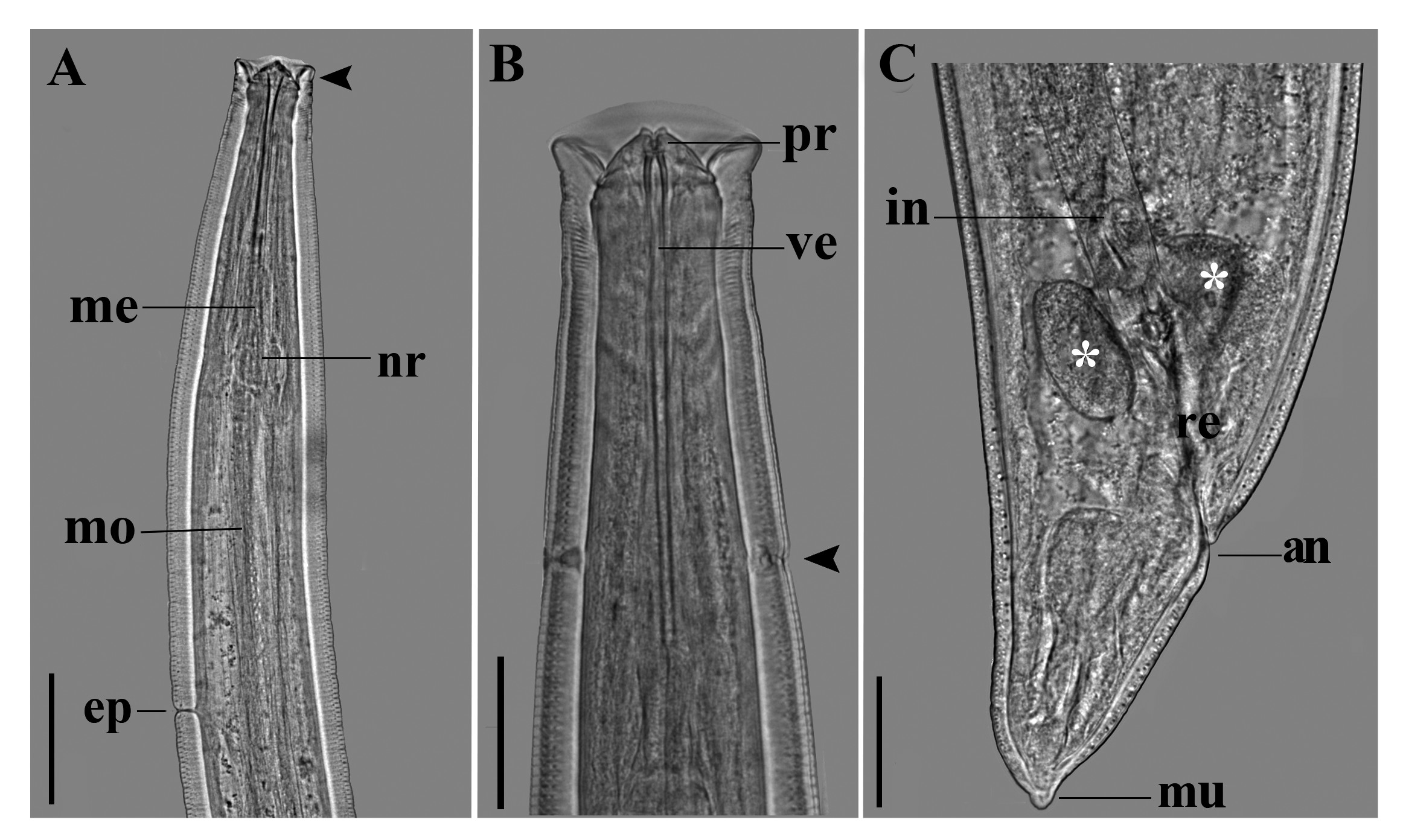
Third-stage larva of Pseudoproleptus sp. from Macrobrachium amazonicum, commercialized in Pará state, northern coast of Brazil: (A) Anterior lateral view, cephalic helmet-like cuticular structure (arrowhead), nerve ring (nr), muscular esophagus (mo) and excretory pore (ep). Bar = 100 μm; (B) Detail of prostom (pr), vestibule (ve) and deirids (arrowheads). Bar = 50 μm; (C) Posterior portion, portion of the intestine (in), rectum (r), unicellular rectal glands (*), anus (an), the tail with mucron (mu). Bar = 50 μm.

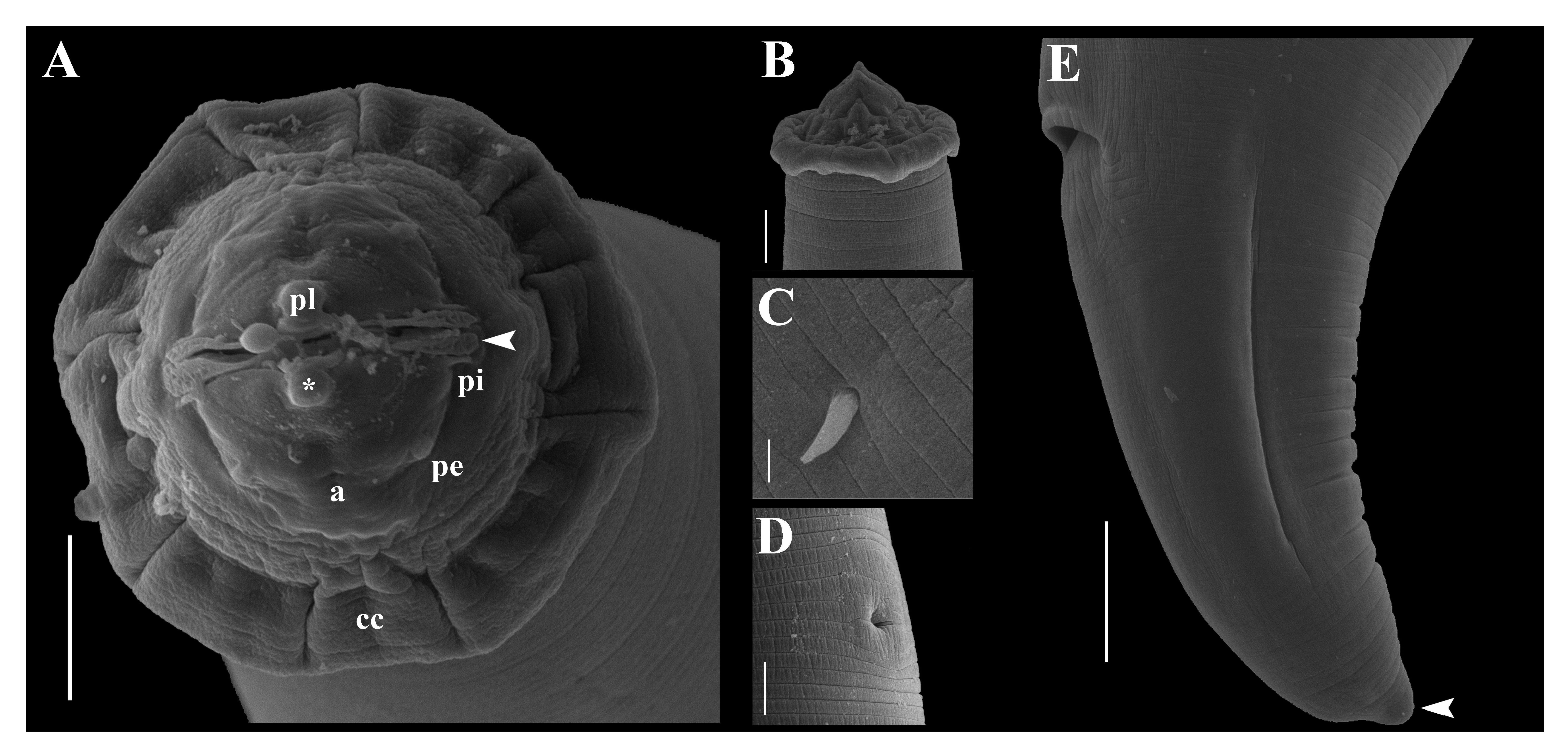
Third-stage larva of Pseudoproleptus sp. from Macrobrachium amazonicum, SEM micrographs: (A) Cephalic apical view: amphid (a), cephalic papilla of internal circle (pi); cephalic papilla of external circle (pe), cephalic helmet-like cuticular structure (cc), pseudolabium (pl), pseudolabial terminal protrusion (*), outer, elongate part of sublabium (arrowhead). Bar = 10 μm; (B) Anterior end of body, lateral view cephalic helmet-like cuticular structure. Bar = 10 μm; (C) Deirid views. Bar = 2 μm; (D) Excretory pore. Bar = 10 μm; (E) Tail, lateral view, with small knob-like terminal projection (arrowhead). Bar = 20 μm.
Medium-sized nematodes, body filiform, measuring 22 mm (17‒28 mm), maximum width at esophageal/intestinal junction 184 (143‒229). Cuticle with thick transverse striations (Figures 1A, 2B, C). Anterior end of body with cephalic helmet-like cuticular structure 25 (20‒32) long; 69 (45‒93) wide (Figures 1A, 2A). Slit-like oral aperture with four large submedian labia (2 dorsolateral and 2 ventrolateral) (Figure 2A). Sublabia plate-like, narrowed proximally, widening to distal ends. Lateral pseudolabia small, with terminal protrusion (Figure 2B). Eight submedian cephalic papillae arranged in two circles and a pair of lateral amphids present: four papillae of external circle larger than those of internal circle. Vestibule with prostom 157 (120‒193) long (Figure 2B). Length of muscular esophagus 0.95 mm (0.83‒1.2 mm) long; 25 (12‒35) wide; length of glandular esophagus 4 mm (3‒4 mm) long; 67 (47‒83) wide. Length ratio of muscular and glandular parts of esophagus 1:5 (1:4‒6). Length of entire esophagus and vestibule with prostom represents 26% (19−38%) of whole-body length. Deirids, nerve-ring and excretory pore at 137 (110‒167) (Figures 1B, 2C), 211 (165‒257) (Figure 1A) and 448 (340‒557) (Figures 1A, 2D), respectively, from anterior extremity. Genital primordium indistinct. Rectum is a short hyaline tube; three small, unicellular rectal glands are present (Figure 1C). Tail conical, 118 (102–163) long, with small knob-like terminal projection 7 (5–8) long (Figures 1C, 2E).
Parasitological data
No significant differences were found in the residuals from the log-log linear regression model, cephalothorax size, or weight, between parasitized and non-parasitized shrimp, considering both males and females. Additionally, there was no significant difference in total length between parasitized and non-parasitized females (Table 2). However, a significant difference in total length was observed when both sexes were analyzed together (t = -2.53, p = 0.02) and when only males were considered (t = -3.10, p < 0.01) (see Table 2). The ecological attributes of parasitism can be seen in Table 3. The result of the negative binomial model of the relationship between the intensity of larvae recovered from M. amazonicum and the total length of the hosts, indicated no significant association (Pseudo-R2 = 0.4938; β = 0.0046; 95% CI: [−0.578, 0.595]; p = 0.987). Therefore, parasitism was present in individuals from 5.34 cm (Figure 3A). One female ovigerum had a longer length of 6.76 cm (Figure 3B) and higher intensity of infection with 21 third-stage larvae of Pseudoproleptus sp. No significant difference between intensity and abundance of parasites was found between males and females. The analysis of covariance (ANCOVA) showed no significant difference in relative growth between non-parasitized and parasitized shrimp (F = 0.0202, p = 0.88).
Parasitological indices of larvae of Pseudoproleptus sp. harvested from Macrobrachium amazonicum from Guamá River, in Pará state northern Brazil.
Results of the t-test and Mann-Whitney of biometric parameters between, males, females, parasitized and parasite-free shrimps.

Histograms showing the total length classes of male (A) and female (B) Macrobrachium amazonicum.
Discussion
The nematodes found encapsulated in the cephalothorax of M. amazonicum captured in the Guamá River, presented morphological characteristics compatible with nematodes of the family Cystidicolidae (Skrjabin, 1946) of genus Pseudoproleptus Khera, 1953, including the presence of a helmet-like cuticular structure in the anterior extremity, slit-like oral aperture with 4 large submedian labia, vestibule with prostom, muscular and glandular esophagus and conical tail with small knob-like terminal projection. Morphologically and morphometrically the third-stage larvae Pseudoproleptus sp. parasite of M. amazonicum, Ageneiosus ucayalensis Castelnau, 1855 (Siluriformes: Auchenipteridae) and Satanoperca jurupari (Heckel, 1840) (Cichliformes: Cichlidae) present similarities between each other.
One morphologically important detail is that the specimens of Pseudoproleptus sp. observed in the present study bears tapered deirids, which differs from that observed by Melo et al. (2011) who described bifurcated deirids in Pseudoproleptus sp. recovered from S. jurupari in the same locality as this study. Melo et al. (2011) claims that the Pseudoproleptus sp. collected from S. jurupari shows forked deirids, but his SEM observation of the deirids of one specimen shows a broken end with only evidence of a double root in this structure.
For Moravec et al. (2003), identifying Cystidicolidae larvae is generally problematic, because the development and larval morphogenesis of the species described remain unknown. Moravec (2007) further states that the adult taxonomy for the Spirurine families is unsatisfactory. Morphological and morphometric comparison of third-stage larvae of Pseudoproleptus sp. parasites of M. amazonicum in the state of Pará, are compared to the work of Moravec & Santos (2009) and Melo et al. (2011) and are presented in the Table 4.
Morphological and morphometric comparison of third-stage larvae of Pseudoproleptus sp. in Macrobrachium amazonicum from Guamá River, in the state of Pará, Brazil.
The lack of significant differences in body condition, cephalothorax size, and weight between parasitized and non-parasitized M. amazonicum shrimp suggests that infection by Pseudoproleptus sp. larvae does not directly impact the physical condition or growth of the shrimp. This may indicate that, at the observed intensity and prevalence, helminth parasites are not sufficiently pathogenic to affect shrimp growth or overall condition.
Parasitism was observed only in males larger than 5.89 cm and females between 5.34 cm and 7.2 cm, aligning with reproductive maturity for the species, which is reached at 4.5-6 cm (Maciel & Valenti, 2009; Pantaleão et al., 2011). This restriction suggests that Pseudoproleptus sp. larvae target only reproductively mature shrimps. The absence of significant growth differences between parasitized and parasite-free females (Table 3) supports this conclusion, indicating that parasitism does not severely impact female growth but rather occurs within a specific size range, likely due to ecological or physiological factors. The focus on reproductively sized individuals may reflect the greater exposure, greater energy availability, and changes in immune function during reproductive phases.
Spatial-temporal variation in M. amazonicum populations, as reported by Bentes et al. (2011), showed a higher abundance of males near creek mouths in March (rainy season) and a concentration of females in headwater sites in September (dry season). This variation could influence differing exposure to parasites for males and females. Ibrahim et al. (2021) also observed that larger, dominant morphotype “Green Claw” males exhibit aggressive behavior toward smaller morphotypes, potentially increasing their exposure to parasites. Another hypothesis is that the aggressive nature of larger males reduces the survival rates of smaller shrimp, making larger hosts more susceptible to helminth parasites due to their higher survival and extended lifespan.
In Brazil there are few records of parasitism in crustaceans. In this study, 15.8% of M. amazonicum were parasitized by Pseudoproleptus sp. larvae. In the same biogeographic region of this study, different authors also reported parasitism by Pseudoproleptus sp. in shrimps and fishes. Moravec & Santos (2009) described the occurrence and prevalence of 32% by Pseudoproleptus sp. larvae in M. amazonicum on Mexiana Island, in state of Pará (Brazil). Melo et al. (2011) demonstrated a low prevalence (0.9%) of parasitism by Pseudoproleptus sp. in A. ucayalensis. Melo et al. (2011) reported the highest prevalence of 37% of parasitism by Pseudoproleptus sp. larvae in S. jurupari caught in the Guamá River, state of Pará. Previously, Takemoto & Lizama (2010) noted the low specificity of nematodes for hosts, especially in the larval stage. Therefore, there seems to be a wide distribution of Pseudoproleptus sp. larvae in the state of Pará.
Parasitism by Pseudoproleptus sp. larvae in commercially important shrimp and fishes in the state of Pará demonstrates that the diversity of parasites in this region is still poorly known. According to Moravec & Santos (2009), no adult species of Pseudoproleptus has been described in the Americas so far. These same authors, when describing the morphology of Pseudoproleptus sp. larvae recovered from M. amazonicum in the state of Pará, related these larvae to Pseudoproleptus izecksohni (Fabio, 1982). However, P. izecksohni was inappropriately proposed to the Heliconema genus as Heliconema izecksohni Fabio, 1982, a parasite of Hoplias malabaricus (Bloch, 1794) (Characiforme: Erythrinidae) caught in the municipality of Campos, Rio de Janeiro state, based on morphological and freshwater host data (see Moravec et al., 2003). In addition, the same authors highlight that Heliconema species are parasites of marine fish, especially of the anguilliform order. Therefore, Moravec et al. (2008) transfers H. izecksohni to the genus Cystidicoloides. Luque et al. (2011) when listing the nematodes associated with fishes in Brazil accepted this species as Cystidicoloides izecksohni (Fábio, 1982).
The occurrence of Pseudoproleptus sp. larvae in different hosts in the Guamá river demonstrates the presence of a complex life cycle of this parasite in the Pará estuary. There are few data on the life cycle of nematodes of the family Cystidicolidae (Anderson, 2000; Moravec, 2007; Melo et al., 2011). Freshwater crustaceans such as M. amazonicum and aquatic insects, function as primary intermediate hosts, with fish being the secondary intermediate hosts (Moravec, 2007). Melo et al. (2011) reported that some species of fish may participate in the life cycle as paratenic hosts, as has been reported for A. ucayalensis and S. jurupari, which were parasitized by third-stage larvae of Pseudoproleptus sp.
Pinheiro et al. (2019), records the presence of Pseudoproleptus sp. larvae in Astronotus ocellatus (Agassiz, 1831) (Cichliformes: Cichlidae) captured in the Tapajós River (Brazil) and used as food in the municipality of Santarém, the same biogeographical region of this study. Therefore, this cichlid is also an important intermediate host for Pseudoproleptus sp. larvae in eastern Amazon.
Conclusions
The occurrence of larvae of Pseudoproleptus in M. amazonicum indicates that this crustacean acts as an intermediate host for third-stage larvae of this genus in the Guamá River. Although the prevalence of parasitism was low, and the differences in growth between parasitized and non-parasitized individuals were not significant, these results cannot be generalized since the sampling was relatively low, therefore the occurrence of this nematode in M. amazonicum can still negatively affect the growth and reproduction of this shrimp, leading it to death, directly affecting its population dynamics, for this we recommend more analysis with a larger sample n .
The occurrence of larvae reinforces the presence of a complex life cycle for Pseudoproleptus in the estuarine region of Pará, with the definitive host still unknown. In addition, because this Amazon shrimp is important to the region's population as a source of foreign exchange, due to its trade and high potential for cultivation, sanitation in aquaculture systems is a critical factor in its production.
Acknowledgements
The authors are grateful to the Laboratório de Histologia e Embriologia Animal and Laboratório de Microscopia Eletrônica de Varredura – Instituto da Saúde e Produção Animal – Universidade Federal Rural da Amazônia – UFRA, campus Belém, state of Pará, Brazil for the use of the scanning electron microscope.
Data availability
Data will be made available on request.
-
How to cite:
Cardoso PJC, Galvão de Cristo LR, Santa Brigida YRG, Giese EG, Pinheiro RHS. Pseudoproleptus sp. Larvae (Nematoda: Cystidicolidae) parasitizing Macrobrachium amazonicum (Decapoda: Crustacea) in the state of Pará, Northern Brazil. Rev Bras Parasitol Vet 2025; 34(3): e002025. https://doi.org/10.1590/S1984-29612025042
-
Financial Support
Dra. Elane Giese was supported by a research fellowship from the Conselho Nacional de Pesquisa e Desenvolvimento Tecnológico (CNPq-Brazil) (#313763/2020-8). Dr. Raul Henrique da Silva Pinheiro was supported by a research fellowship from the Conselho Nacional de Pesquisa e Desenvolvimento Tecnológico (CNPq-Brazil) (Chamada CNPq Nº 32/2023 - Pós-Doutorado Júnior #171021/2023-1).
-
Ethics declaration
All applicable institutional, national, and international guidelines for animal care and use were followed.
References
-
Anderson RC. Nematode parasites of vertebrates: their development and transmission 2nd ed. Wallingford: CABI Publishing; 2000. http://doi.org/10.1079/9780851994215.0000
» http://doi.org/10.1079/9780851994215.0000 - Bautista-Hernández CE, Monks S, Pulido-Flores G, Rodríguez-Ibarra AE. Revisión bibliográfica de algunos términos ecológicos usados en parasitología, y su aplicación en estudios de caso. In: Pulido-Flores G, Monks S, López-Herrera M, editors. Estudios en biodiversidad Lincoln, Nebraska: Zea Books; 2015. p. 11-19. vol. 1.
-
Bentes BS, Martinelli JM, Souza LS, Cavalcante DV, Almeida MC, Isaac VJ. Spatial distribution of the Amazon River prawn Macrobrachium amazonicum (Heller, 1862) (Decapoda, Caridea, Palaemonidae) in two perennial creeks of an estuary on the northern coast of Brazil (Guajará Bay, Belém, Pará). Braz J Biol 2011; 71(4): 925-935. http://doi.org/10.1590/S1519-69842011000500013
» http://doi.org/10.1590/S1519-69842011000500013 -
Bush AO, Lafferty KD, Lotz JM, Shostak AW. Parasitology meets ecology on its own terms: Margolis et al. revisited. J Parasitol 1997; 83(4): 575-583. http://doi.org/10.2307/3284227 PMid:9267395.
» http://doi.org/10.2307/3284227 - Cervigón F, Cipriani R, Fischer W, Garibaldi L, Hendrickx M, Lemus AJ, et al. Guía de campo de las especies comerciales marinas y de aguas salobres de la costa septentrional de Sur America Roma: Food and Agriculture Organization of the United Nations; 1992.
- De Grave S, Fransen CHJM. Carideorum catalogus: the recent species of the dendrobranchiate, stenopodidean, procarididean and caridean shrimps (Crustacea: Decapoda). Zool Meded Leiden 2011; 85: 195-589.
- Holthuis LB. A general revision of the Palaemonidae (Crustacea Decapoda Natantia) of the Americas. II. The subfamily Palaemoninae Los Angeles: Allan Hancock Foundation Publications of the University of Southern California; 1952. (Occasional Paper; 12).
-
Ibrahim ANAF, Karplus I, Valenti WC. Social interaction in males of the Amazon river prawn Macrobrachium amazonicum (Heller, 1862) (Decapoda, Palaemonidae). Crustaceana 2021; 94(3): 325-341. http://doi.org/10.1163/15685403-bja10081
» http://doi.org/10.1163/15685403-bja10081 -
Lima JF, Garcia JS, Silva TC. Natural diet and feeding habits of a freshwater prawn (Macrobrachium carcinus: Crustacea, Decapoda) in the estuary of the Amazon River. Acta Amazon 2014; 44(2): 235-244. http://doi.org/10.1590/S0044-59672014000200009
» http://doi.org/10.1590/S0044-59672014000200009 -
Lucena-Frédou F, Rosa JS Fo, Silva MCM, Azevedo EF. Population dynamics of the river prawn, Macrobrachium amazonicum (Heller, 1862) (Decapoda, Palaemonidae) on Combú island (Amazon estuary). Crustaceana 2010; 83(3): 277-290. http://doi.org/10.1163/001121609X12596543952298
» http://doi.org/10.1163/001121609X12596543952298 -
Luque JL, Aguiar JC, Vieira FM, Gibson DI, Santos CP. Checklist of Nematoda associated with the fishes of Brazil. Zootaxa 2011; 3082(1): 1-88. http://doi.org/10.11646/zootaxa.3082.1.1
» http://doi.org/10.11646/zootaxa.3082.1.1 - Maciel CR, Valenti WC. Biology, fisheries, and aquaculture of the Amazon River prawn Macrobrachium amazonicum: a review. Nauplius 2009; 17(2): 61-79.
- McFadden D. Conditional logit analysis of qualitative choice behavior. In: Zarembka P, editor. Frontiers in econometrics New York, NY: Academic Press; 1973. p. 105-142.
-
Melo MFC, Giese EG, Santos JN, Santos CP. First record of larval Pseudoproleptus sp. (Nematoda: Cystidicolidae) in fish host. Acta Trop 2011; 117(3): 212-215. http://doi.org/10.1016/j.actatropica.2010.12.011 PMid:21187054.
» http://doi.org/10.1016/j.actatropica.2010.12.011 -
Moravec F, Fredensborg BL, Latham ADM, Poulin R. Larval Spirurida (Nematoda) from the crab Macrophthalmus hirtipes in New Zealand. Folia Parasitol 2003; 50(2): 109-114. http://doi.org/10.14411/fp.2003.019 PMid:14560971.
» http://doi.org/10.14411/fp.2003.019 -
Moravec F, Santos CP. Larval Pseudoproleptus sp. (Nematoda: Cystidicolidae) found in the Amazon river prawn Macrobrachium amazonicum (Decapoda: Palaemonidae) in Brazil. J Parasitol 2009; 95(3): 634-638. http://doi.org/10.1645/GE-1887.1 PMid:19014207.
» http://doi.org/10.1645/GE-1887.1 -
Moravec F, Santos MD, Brasil-Sato MC. Redescription of Cystidicoloides fischeri based on specimens from piranhas in Brazil, and erection of a new genus (Nematoda: cystidicolidae). J Parasitol 2008; 94(4): 889-897. http://doi.org/10.1645/GE-1419.1 PMid:18576775.
» http://doi.org/10.1645/GE-1419.1 -
Moravec F. Some aspects of the taxonomy and biology of adult spirurine nematodes parasitic in fishes: a review. Folia Parasitol 2007; 54(4): 239-257. http://doi.org/10.14411/fp.2007.033 PMid:18303766.
» http://doi.org/10.14411/fp.2007.033 -
Pantaleão JAF, Hirose GL, Costa RC. Relative growth, morphological sexual maturity, and size of Macrobrachium amazonicum (Heller 1862) (Crustacea, Decapoda, Palaemonidae) in a population with an entirely freshwater life cycle. Invertebr Reprod Dev 2011; 56(3): 180-190. http://doi.org/10.1080/07924259.2011.587276
» http://doi.org/10.1080/07924259.2011.587276 -
Pimentel FR, Magalhães C. Palaemonidae, Euryrhynchidae, and Sergestidae (Crustacea: Decapoda): records of native species from the states of Amapá and Pará, Brazil, with maps of geographic distribution. Check List 2014; 10(6): 1300-1315. http://doi.org/10.15560/10.6.1300
» http://doi.org/10.15560/10.6.1300 - Pimentel FR. Taxonomia dos Camarões de água doce (Crustacea: Decapoda: Palaemonidae, Euryrhynchidae, Sergestidae) da Amazônia Oriental: Estados do Amapá e Pará [dissertation]. Manaus: Universidade Federal do Amazonas; 2003.
-
Pinheiro RHS, Tavares-Dias M, Giese EG. Helminth parasites in two populations of Astronotus ocellatus (Cichliformes: Cichlidae) from the eastern Amazon, Northern Brazil. Rev Bras Parasitol Vet 2019; 28(3): 425-431. http://doi.org/10.1590/s1984-29612019052 PMid:31365720.
» http://doi.org/10.1590/s1984-29612019052 - Quaresma MC, Martinelli-Lemos JM. Fauna de camarões do Estado do Pará, Amazônia Oriental: lista de espécies. Biota Amazôn 2020; 10(3): 1-6.
-
R Core Team. R: A Language and Environment for Statistical Computing [software]. Vienna: R Foundation for Statistical Computing; 2024 [cited 2024 July 20]. Available from: https://www.R-project.org/
» https://www.R-project.org/ -
Ripley B, Venables B, Bates DM, Hornik K, Gebhardt A, Firth D. MASS: Support functions and datasets for Venables and Ripley's MASS. R package version 7.3-35 [software]. Puducherry: Mass Packagings; 2014 [cited 2025 June 2]. Available from: https://cran.r-project.org/web/packages/MASS/index.html
» https://cran.r-project.org/web/packages/MASS/index.html -
Rodd FH, Reznick DN. Life history evolution in Guppies: III. The impact of prawn predation on Guppy life histories. Oikos 1991; 62(1): 13-19. http://doi.org/10.2307/3545440
» http://doi.org/10.2307/3545440 -
Sánchez CA, Becker DJ, Teitelbaum CS, Barriga P, Brown LM, Majewska AA, et al. On the relationship between body condition and parasite infection in wildlife: a review and meta-analysis. Ecol Lett 2018; 21(12): 1869-1884. http://doi.org/10.1111/ele.13160 PMid:30369000.
» http://doi.org/10.1111/ele.13160 - Takemoto RM, Lizama MLAP. Helminth fauna of fishes from the upper Paraná river floodplain, Brazil. Neotrop Helminthol 2010; 4(1): 5-8.
- Valenti WC. Criação de camarões em águas interiores Jaboticabal: FUNEP; 1996. (Boletim Técnico; 2).
- Zar JH. Biostatistical analysis 5th ed. New Jersey: Prentice Hall; 2010.
Edited by
-
Assistant Editor:
Marcos Tavares Dias