Does academic degree influence theoretical knowledge in eye fundus examination?
ABSTRACT
Objective: To evaluate theoretical knowledge of medical students, medical residents and general medicine specialists in fundus examination.
Methods: This cross-sectional study included three groups: third year medical students, interne medicine residents and general medicine specialists. The selection was based on the expected proficiency for each of the groups. Participants were invited by email. Two questionnaires previously translated and validated to Portuguese were applied: one to evaluate self-confidence with fundus examination with a 5-item Likert scale and a second to evaluate the theoretical knowledge composed of 60-itens. Only fulfilled questionnaires were included in the analysis.
Results: Fifty third year medical students, 9 interne medicine residents and 19 general medicine specialists were included. The mean score of third year medical students, interne medicine residents and general medicine specialists was 36.7 ± 7.07, 43.56 ± 5.03 and 38.68 ± 5.83 (p = 0.02). Pairwise comparison between the groups showed statistical difference when compared the scores of third year medical students and interne medicine residents (p = 0.01), but there was no statistical significance when compared third year medical students to general medicine specialists (p = 0.5) and interne medicine residents to general medicine specialists (p = 0.17). The number of participants that score above the pass-fail cutoff of 46 was 6 (12%), 4 (44.4%) and 2 (10.5%) among third year medical student, interne medicine residents and general medicine specialists, respectively.
Conclusion: Academic degree does not influence the theoretical knowledge in fundus examination.
Keywords:
Educational status; Fundus oculi; Models; theoretical; Students, medical; Surveys and questionnaires
RESUMO
Objetivo: Avaliar o conhecimento teórico de estudantes de medicina, médicos residentes e especialistas em clínica médica no exame de fundo de olho.
Métodos: Este estudo transversal incluiu três grupos: estudantes de medicina do terceiro ano, médicos residentes em clínica médica e especialistas em clínica médica. A seleção dos grupos foi baseada na proficiência esperada para cada grupo. Os participantes foram convidados por e-mail. Dois questionários previamente traduzidos e validados para o português foram aplicados: o primeiro de cinco itens (escala de Likert) para avaliar a autoconfiança no exame de fundo de olho, e o segundo, com 60 itens, para avaliar o conhecimento teórico em fundo de olho. Apenas questionários completos foram incluídos na análise.
Resultados: Cinquenta estudantes de medicina do terceiro ano, nove médicos residentes em clínica médica e 19 especialistas em clínica médica foram incluídos. O número médio de acertos ± desvio-padrão dos grupos estudantes de medicina do terceiro ano, médicos residentes em clínica médica e especialistas em clínica médica foi 36,7 ± 7,07, 43,56 ± 5,03 e 38,68 ± 5,83 (p = 0,02), respectivamente. Comparação pareada entre os grupos mostrou diferença estatisticamente significativa quando comparados estudantes de medicina do terceiro ano e médicos residentes em clínica médica (p = 0,01), mas o mesmo não foi observado na comparação entre estudantes de medicina do terceiro ano e especialistas em clínica médica (p=0,5) e entre médicos residentes em clínica médica e especialistas em clínica médica (p=0,17). O número de participantes com acertos acima do ponto de corte (46 acertos) foi 6 (12%), 4 (44,4%) e 2 (10,5%) entre estudantes de medicina do terceiro ano, médicos residentes em clínica médica e especialistas em clínica médica, respectivamente.
Conclusão: O grau acadêmico não influencia o conhecimento teórico no exame de fundo de olho.
Descritores:
Escolaridade; Fundo de olho; Modelos teóricos; Estudantes de Medicina; Inquéritos e questionários
Introduction
In 2020, it was estimated that 237 million people had a moderate to severe visual impairment, while other 37 million were blind.(1) The usage of a screening method for sight threatening conditions would result in an early diagnosis and treatment, reducing those number. Eye fundus examination, a fast and effective method to screen eye conditions, emerges as an alternative.(2) There are several commercially available devices for fundoscopy, like conventional ophthalmoscope, wide field ophthalmoscope and more recently, smartphone-based ophthalmoscope. However, general practitioners have a lack of self-confidence and knowledge in the exam technique and its interpretation.
Some factors have been raised to explain the lack of knowledge and self-confidence: a crowded curriculum, which reduced the time dedicated to ophthalmology rounds, reduced ophthalmoscope device possession and no consensus among specialists on the minimum proficiency on the exam.(3-6) The International Council of Ophthalmology (ICO)(2,7) and the Association of University Professors of Ophthalmology(8) defined the minimum required proficiency for fundus examination as the capacity of handling the ophthalmoscope and identify normal and abnormal structures. As proposed by authors, this could be achieved by theoretical lectures and basic practice in small groups.
Previously, self-confidence level in fundus examination was evaluated among medical students, medical residents and general practitioners.(9) The highest confidence was observed among the last group, and the lowest, on the first group. Also, among 14-itens of the physical exam, fundus examination had the lowest confidence, while measure the blood pressure, the highest. However, self-confidence not always correlate with proficiency.(10) In literature, there are no studies that evaluated the theoretical knowledge on fundus examination. An instrument that evaluates knowledge on normal and abnormal findings of the exam could comprehensively measure theoretical proficiency on fundus examination. The aim of this study was to to evaluate theoretical knowledge of medical students, medical residents and general medicine specialists in fundus examination.
Methods
This study was approved by the Ethics Committee of the Universidade de Campinas (CAAE: 46531321.5.0000.5404) and conducted in compliance with the Declaration of Helsinki. All procedures were fully explained and an informed consent was obtained from all participants.
Participants selection
The study included three groups: third-year medical students (MS), interne medicine residents (MR) and general medicine specialists (SS). The selection was based on the expected proficiency for each of the groups. In our school, the first formal contact with practical ophthalmology is on the third-year during the clinical rounds. It consists of a theoretical lecture and practice with the ophthalmoscope in a small group (six to seven students), in a total of 8 hours. The choice for MR was made based on the fact that this group was recently graduated in medicine, and is still in formation, which consists of a mid-term between and undergraduate student and a specialist. General medicine specialists were chosen to evaluate the knowledge of a group that has already completed their formation and are in clinical practice.
Questionnaires and procedures
Two questionnaires were applied: one to evaluate self-confidence with fundus examination and a second to evaluate the theoretical knowledge.
The first questionnaire consists of a five-item Likert scale that assess confidence in examine the macula, optic disc, cup-to-disc ratio and the overall technique.(11) The second questionnaire, developed originally by Jørgensen et at.(12) and previously translated to Portuguese.,(13) consists of a 60-item multiple choice instrument with three alternatives each, which only one is correct. The instrument evaluates aspects of the technique, anatomical and pathological findings. The cut-off value of this questionnaire was determined as 46.
Participants were invited by an email that contained a link attached for the questionnaire. The informed consensus was obtained at first place. For the self-confidence questionnaire, the mean score was considered in the analysis, while for the knowledge questionnaire, the total score was considered. Only fulfilled questionnaires were included in the analysis.
Statistical analysis
Normality was calculated with Shapiro-Wilk test. Comparison between the groups was done with analysis of variance (Anova), followed by a post-hoc Tukey test. Pearson correlation was used to calculate the relation between theoretical knowledge and self-confidence in perform fundus examination.
The statistical analysis was performed with the Statistical Package for Social Sciences (SPSS, IBM Corporation, Armon NY, USA, version 22.0). A p-value inferior to 0.05 was considered significant.
Results
Among 253 invitations (120 MS, 48 MR and 85 SS), 78 fulfilled the questionnaire (50 MS, 9 MR and 19 SS), a response rate of 41.7, 18.8 and 22.4%, respectively. Baseline characteristics of each group are shown at table 1.
Baseline characteristics of the groups. Age is shown as mean ± standard-deviation, and gender is shown as number of male/female
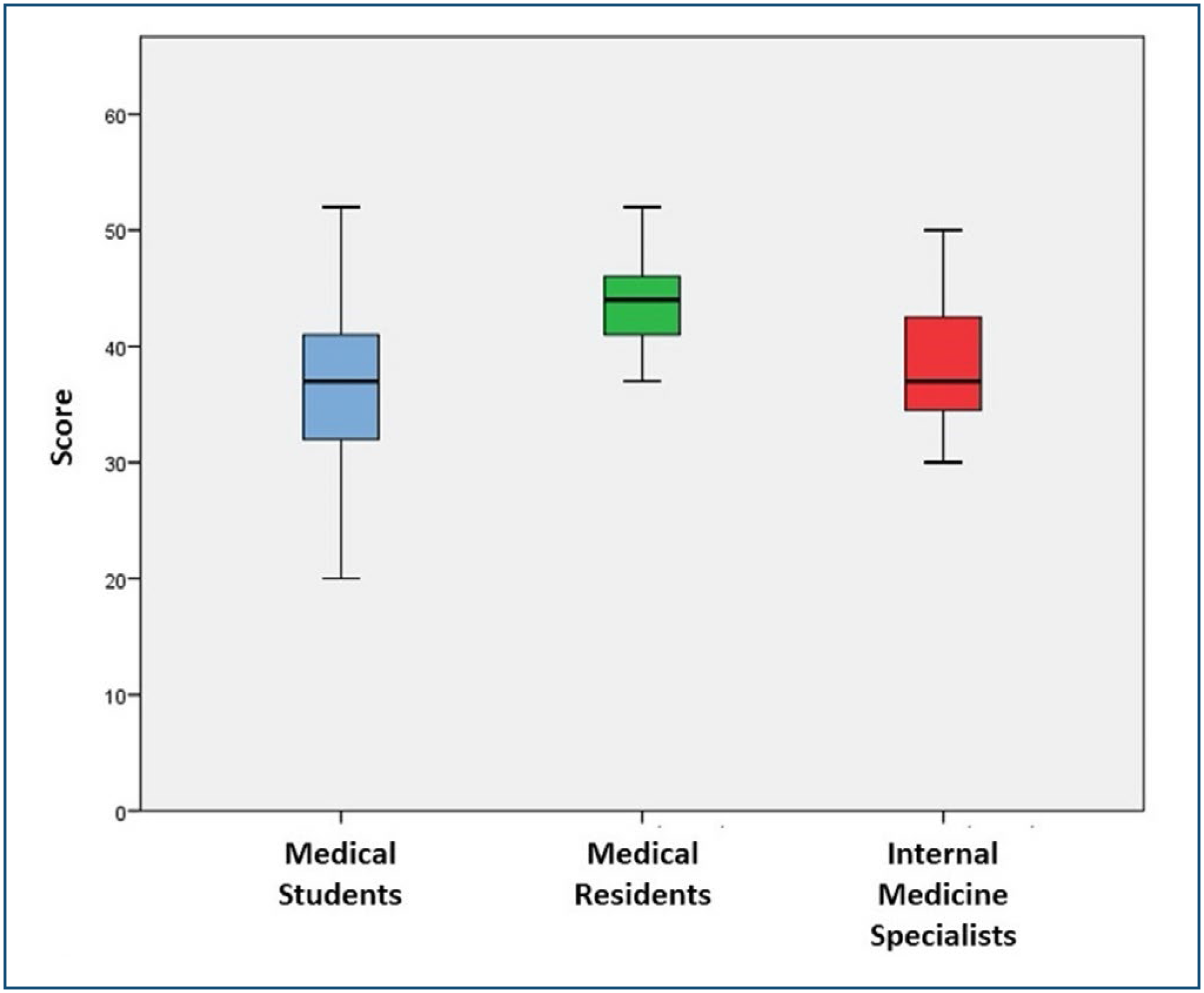
In the 60-item questionnaire, the mean score of the MR group was the highest among the 3 groups, while the MS score, the lowest (43.56 ± 5.03 versus 38.68 ± 5.83 versus 36.7 ± 7.07, p = 0.02). Pairwise comparison between the groups showed statistical difference when compared the scores of MS and MR (p = 0.01), but there was no statistical significance when compared MS to SS (p = 0.5) and MR to SS (p = 0.17). The number of participants that score above the pass-fail cutoff of 46 was 6 (12%), 4 (44.4%) and 2 (10.5%) among MS, MR and SS, respectively (Figure 1).
Mean score in the 60-item theoretical knowledge questionnaire. Mean score of medical students, medical residents and general medicine specialist was 36.7 ± 7.07, 43.56 ± 5.03 versus 38.68 ± 5.83 (p = 0.02), respectively.
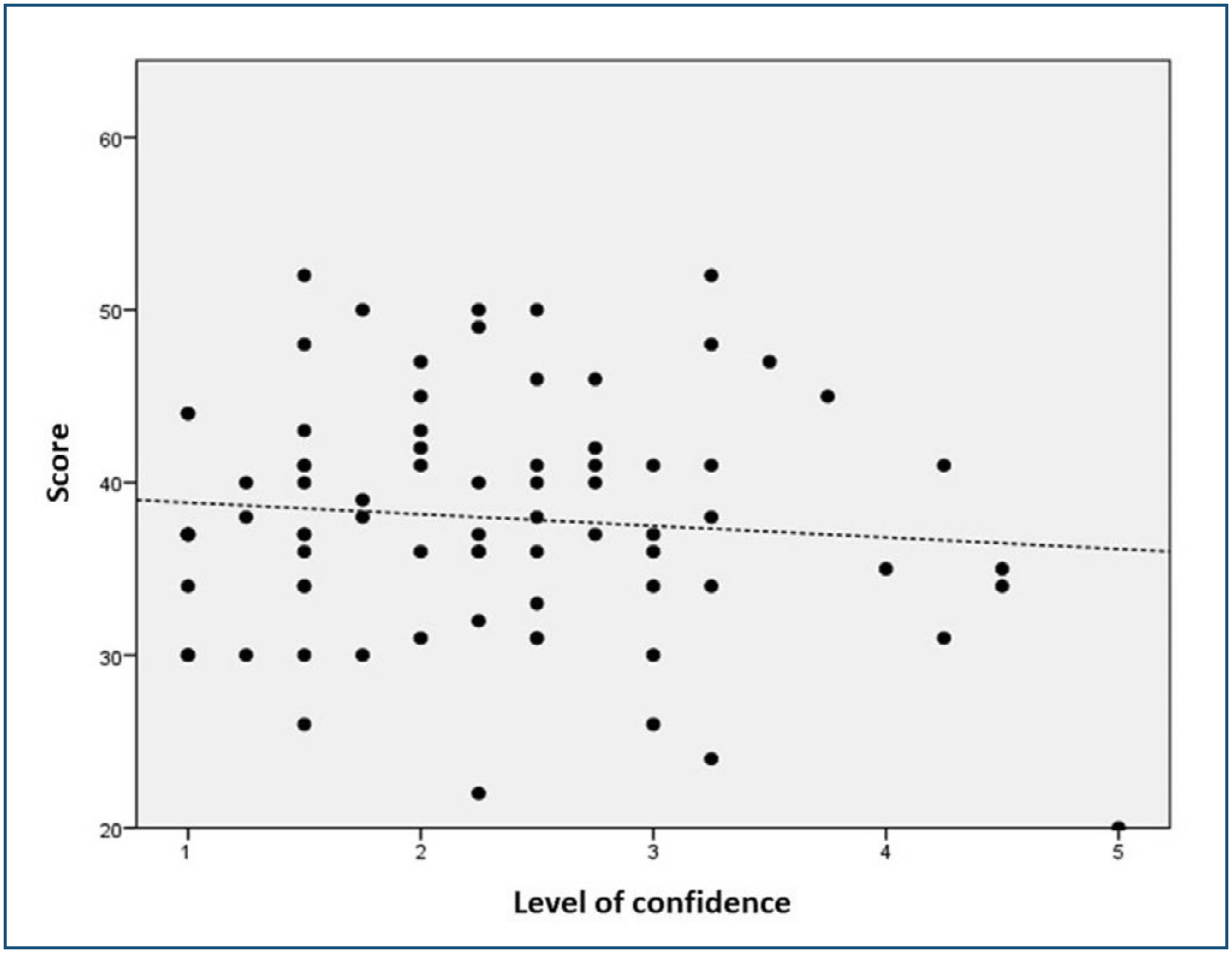
The evaluation of self-confidence in fundus examination showed a moderate confidence of MS (2.43 ± 0.94), a moderate to low confidence of SS (2.19 ± 0.98) and a low confidence od MR (1.72 ± 0.74) (p = 0.1). There was no correlation between the score in the theoretical knowledge questionnaire and reported self-confidence (R = −0.09, p = 0.2) (Figure 2).

Correlation between theoretical knowledge and self-confidence in fundus examination (R = −0.09; p = 0.2).
Discussion
Our study is the first to evaluate theoretical knowledge of eye fundus examination in groups of different academic degrees to the best of our knowledge. The results suggest that direct ophthalmoscopy knowledge does not increases over time with clinical practice. A previous study of Wu et al.(9) evaluated medical students, medical residents and faculty internists self-confidence in several items of the basic physical exam. While "measuring blood pressure" had the highest score (4.7 ± 0.6), "non-dilated fundoscopic examination" had the lowest score (2.5 ± 1.1) in a Likert-scale of one (low confidence) to five (very high confidence). This study found that internists were more confident (3.2 ± 1.1), while medical residents of second, third and fourth-year were less confident among the groups (2.2 ± 1.0). Our study found slightly different results, with the highest self-confidence relying among medical students, and the lowest among medical residents. This study, however, did not measure theoretical knowledge on the exam.
Barriers in fundus examination
Dunn et al.(14) investigated the barriers on the practice of fundoscopy among second- and final-year MS, emergency medicine residents and internal medicine physicians in focal groups. Seven major topics were evaluated: technical barriers, motivation to perform the exam, influence on clinical management, clinical culture and expectations, use of limited resources, training requirements and novel technologies. The authors reported that, because of limited knowledge on the exam, a culture of incompetence by medical students, added by a discouragement by clinical staff, has made fundus examination to be omitted of the physical exam. Also, most doctors are not confident in interpret their findings on the exam, and referral to ophthalmologist became mandatory. Both factors summed made perception of fundoscopy among medical students and general practitioners as futile. The authors concluded that these factors created a cycle among practitioners and medical students, reducing the utility of ophthalmoscopy. This may be broken by focusing in education and use of new techniques and devices, like smartphone-based ophthalmoscopy, as they suggested.
Ophthalmology curricula worldwide
The ICO task force(2) recommends that 13 basic items in ophthalmology have to be taught to medical students. Fundus examination is inserted in many of them, like evaluation of red reflex, intraocular tumors, retina diseases and ocular manifestations of systemic diseases. A total of 40 to 60 hours of ophthalmology, in 5 to 8 days of exposure, is recommend in the medical schools’ curricula by this guideline.
Fan et al.(15) evaluated the curricula of 19 medical schools in Asia and Australia. The range of undergraduate curricula in ophthalmology was from 2 to 18 days, with a mean 8.9 days and median of 8 days, which could be divided in one (26%), two (32%), three (26%) or four (11%) periods during graduation. Formal lectures, offered by 95% of medical schools, corresponded to a minority of the time (1 day of less) for 68% of them. All programs offered small groups tutorials and clinical ophthalmology settings. Ophthalmology rounds were independent in 63% of medical schools, while the other were combined with a variety of medical specialties, like otolaryngology, neurology and neurosurgery. Related to theoretical topics, only 37% of the institutions have been teaching all the 13 items recommended by the ICO task force.(2) Ophthalmic examination, lens and cataract, ocular manifestations of systemic diseases and acute red eyes were the most taught topics is theoretical knowledge, while refractive and corrective methods and intraocular tumors, the least. Moreover, among the ten clinical skills recommended by ICO,(2) only 26% of the schools have been applied all of them to the students: visual acuity testing, direct ophthalmoscopy and confrontations field assessment were the most taught, while anterior chamber depth and intraocular pressure assessment, the least. Clinical and academical ophthalmologists, and ophthalmology residents were the majority of professional involved in teaching medical students (84%, 73% and 73%, respectively). Finally, evaluation of clinical skills and theoretical knowledge occurred in 68.4% and 84.2% of the schools, respectively, which 58.8% required the assessment to be passed to pass year.
In our school, curricula in ophthalmology is divided in three different periods: in the second-year, eye anatomy and physiology is presented through theoretical lectures; in the third-year, as exposed above; and in the fourth-year, which 40-hours of ophthalmology are divided in theoretical lectures (12 hours) and general practice (28 hours) during 7 days. Ophthalmology specialists and residents in ophthalmology are the professionals involved in teaching MS. A theoretical evaluation is done at the end of the rotation, which required a minimum 70% proficiency to be approved and pass year. There is no specific training, continuous education programs or evaluation in ophthalmology for internal medicine residents or their preceptors.
Medical residency in Brazil
The Brazilian regulations for medical residency established a maximum of 60-hours of duty per week, with a maximum of 24-hours on call, and 36 consecutive hours on duty. Also, the resident must have a free day on all clinical and educational responsibilities every week, and a 30-day vacation every year.(16) Factors related to learning satisfaction among Brazilian residents were evaluated as quantity and quality of preceptorship, institution structure, formal evaluations and briefer workload.(17) Thus, an inverted U-shaped correlation between learning and duty hours was found, which means that briefer and longer work journeys were associated with not satisfactory learning.(17) Although this is related to internal medicine residents in their overall practice, it is not possible to affirm that it has some relation to theoretical knowledge in eye fundus.
We can hypothesize that the highest level of theoretical knowledge among MRs can be explained by some factors. First, that residents have an adequate work journey for their learning in fundus examination in our institution. Second, as most of medical residents are young doctors, many of them may be more familiarized with novel ophthalmoscopy techniques, like smartphone-based. Finally, all residents were selected through an exam, which required a comprehensive theoretical knowledge in many aspects of medicine, including ophthalmology.
Level of confidence and knowledge
Despite the high level of confidence among the MS groups, it also presented the lowest level of knowledge. This discrepancy between perceived ability and real proficiency was described by Kruger et al.,(10) which people tend to inflated their own abilities. This may lead to a non-consciousness of their own mistakes and decisions. Moreover, self-confidence and theoretical knowledge in fundus examination did not show a relation in our casuistic.
Limitations
Our study has some limitations. Despite of the adequate number of medical students included, the other two groups presented a lower rate of answers. Also, as the questionnaire was self-assessed, individuals with a higher proficiency were more inclined to fulfill the questionnaire. Moreover, our study was designed to evaluate theoretical knowledge and not practical skills in fundus examination. Finally, as a single center evaluation, these results may not be generalized.
Conclusion
Academic degree does not influence the theoretical knowledge in fundus examination. Moreover, none of the groups presented a satisfactory theoretical knowledge in fundus examination. We suggest more studies to investigate factors that influence theoretical knowledge in fundus examination, as well as interventions that may increase proficiency in this item of the physical exam.
References
- 1 Flaxman SR, Bourne RR, Resnikoff S, Ackland P, Braithwaite T, Cicinelli MV, et al. Global causes of blindness and distance vision impairment 1990–2020: a systematic review and meta-analysis. Lancet Glob Heal. 2017;5(12):e1221-e1234.
- 2 Parrish RK, Tso MO. Principles and guidelines of a curriculum for ophthalmic education of medical students: Presented by International Task Force on Ophthalmic Education of Medical Students - On behalf of the International Council of Ophthalmology (ICO). Klin Monbl Augenheilkd. 2006;223(SUPPL. 5).
- 3 Yusuf IH, Salmon JF, Patel CK. Direct ophthalmoscopy should be taught to undergraduate medical students - Yes. Eye. 2015;29(8):987-9.
- 4 McNaught Al, Pearson RV. Ownership of direct ophthalmoscopes by medical students. Med Educ. 1992;26(1):48-50.
- 5 Benbassat J, Polak BC, Javitt JC. Objectives of teaching direct ophthalmoscopy to medical students. Acta Ophthalmol. 2012;90(6):503-7.
- 6 Mottow-Lippa L. Ophthalmology in the medical school curriculum: reestablishing our value and effecting change. Ophthalmology. 2009;116(7):1235-6.e1.
- 7 Straatsma BR, Coscas GJ, Naumann GO, Spivey BE, Taylor HR, Tso MOM. International ophthalmology strategic plan to preserve and restore vision-vision for the future. Am J Ophthalmol. 2001;132(3):403-4.
- 8 Stern GA. Teaching ophthalmology to primary care physicians. Arch Ophthalmol. 1995;113:722-4.
- 9 Wu EH, Fagan MJ, Reinert SE, Diaz JA. Self-confidence in and perceived utility of the physical examination: A comparison of medical students, residents, and faculty internists. J Gen Intern Med. 2007;22(12):1725-30.
- 10 Kruger J, Dunning D. Unskilled and unaware of it: How difficulties in recognizing one's own incompetence lead to inflated self-assessments. J Pers Soc Psychol. 1999;77(6):1121-34.
- 11 Ayub G, Souza RB, de Albuquerque AM, de Vasconcellos JP. Comparison of conventional and wide field direct ophthalmoscopy on medical students’ self-confidence for fundus examination: a 1-year follow-up. BMC Med Educ. 2021;21:1-9.
- 12 Jørgensen M, Savran MM, Christakopoulos C, Bek T, Grauslund J, Toft PB, et al. Development and validation of a multiple-choice questionnaire-based theoretical test in direct ophthalmoscopy. Acta Ophthalmol. 2019;97(7):700-6.
- 13 Ayub G, Gregorio B Di, Wolf N, Yonamine M, Vasconcelos JP. Translation and validation to Portuguese of a 60-item questionnaire to evaluate theoretical knowledge in fundus examination. Arq Bras Oftalmol. 2022;87(2):1-12.
- 14 Dunn HP, Kang CJ, Marks S, Dunn SM, Healey PR, White AJ. Optimising fundoscopy practices across the medical spectrum: A focus group study. PLoS One. 2023;18(1):e0280937.
- 15 Fan JC, Sherwin T, McGhee CN. Teaching of ophthalmology in undergraduate curricula: A survey of Australasian and Asian medical schools. Clin Exp Ophthalmol. 2007;35(4):310-7.
-
16 Brasil. Presidência da República. Casa Civil. Subchefia para Assuntos Jurídicos. Lei No 6.932, de 7 de Julho de 1981. Dispõe sobre as atividades do médico residente e dá outras providências. Brasília, DF: Diário Oficial da União; 1981 [citado 2024 Out 10]. Disponível em: https://www.planalto.gov.br/ccivil_03/leis/l6932.htm
» https://www.planalto.gov.br/ccivil_03/leis/l6932.htm -
17 de Mélo Silva Júnior ML, Valença MM, Sampaio Rocha-Filho PA. Characteristics of residency programs and residents’ learning experience in Brazil: a multispecialty, nation-wide study. Psychology, Health & Medicine. 2022 [cited 2024 Oct 10]. Availalble from: https://psycnet.apa.org/record/2022-79355-001
» https://psycnet.apa.org/record/2022-79355-001