
 Art and vision: the impact of ocular diseases and the importance of the doctor-patient relationship
ABSTRACT
This study aimed to explore the relationship between doctors and renowned artists with chronic ocular diseases, emphasizing how these conditions have affected their visual perception and artistic expression. The study conducted a narrative review of 24 articles and books, with 15 selected as particularly relevant, analyzing the adaptations made by artists like Claude Monet, Vincent van Gogh, Edgar Degas, and Leonardo da Vinci in response to their visual impairments. The study found that Monet's cataracts led him to use more vivid colors and contrasts, while van Gogh's vision problems influenced his dynamic use of color and brushstrokes. Degas, suffering from macular degeneration, turned to pastels and sculpture, and da Vinci, impaired by presbyopia, developed new shading techniques and shifted his focus towards engineering and architecture. The study highlights the importance of empathetic doctor-patient interactions in managing chronic conditions, particularly for visually dependent professionals. Further research is recommended to integrate these insights into clinical practice and art conservation.
Keywords:
Orbital diseases; Physician-patient relations; Art; Visual perception; Chronic illness
RESUMO
Este estudo teve como objetivo explorar a relação entre médicos e artistas renomados com doenças oculares crônicas, enfatizando em como essas condições afetaram sua percepção visual e expressão artística. Foi realizada uma revisão narrativa de 24 artigos e livros, dos quais 15 foram selecionados como particularmente relevantes, analisando as adaptações feitas por artistas como Claude Monet, Vincent van Gogh, Edgar Degas e Leonardo da Vinci em resposta às suas deficiências visuais. O estudo constatou que a catarata de Monet o levou a usar cores e contrastes mais vivos, enquanto os problemas de visão de van Gogh influenciaram seu uso dinâmico de cores e pinceladas. Degas, acometido por degeneração macular, recorreu aos pastéis e à escultura, e da Vinci, afetado pela presbiopia, desenvolveu novas técnicas de sombreamento e direcionou seu foco para a engenharia e a arquitetura. O estudo destaca a importância das interações empáticas entre médico e paciente no manejo de condições crônicas, especialmente para profissionais dependentes da visão. Recomenda-se a realização de mais pesquisas para integrar esses insights na prática clínica e na conservação de arte.
Descritores:
Doenças orbitárias; Relações médico-paciente; Arte; Percepção visual; Doença crônica
INTRODUCTION
The purpose of this article is to emphasize the fundamental role of the doctor-patient relationship in managing chronic diseases, especially for artists whose vision is crucial for their creative expression. This study explores how renowned artists such as Claude Monet, Vincent van Gogh, Edgar Degas, and Leonardo da Vinci coped with ocular diseases and adapted their techniques in response to these conditions. Diseases such as cataracts, xanthopsia, macular degeneration, and presbyopia profoundly impacted their visual perception and artistic practice.(1-4) The review aims to highlight the importance of a doctor-patient relationship based on trust and effective communication, which can improve treatment adherence and the quality of life for these patients.(5)
Artists often face unique challenges when dealing with ocular diseases, as their vision is a fundamental tool in their creative process.(1) Claude Monet, for example, suffered from cataracts in the later years of his life, which affected his perception of colors and details in his paintings.(2) Vincent van Gogh, known for his mental health crises, also faced visual problems that influenced his use of vibrant colors and intense brushstrokes. Edgar Degas, with macular degeneration, had to adapt his techniques to continue creating art, shifting from oil painting to pastels and sculptures(3). Leonardo da Vinci, in the later years of his life, dealt with presbyopia, which impacted his detailed work.(4)
Understanding how these artists coped with their conditions and how their relationship with their doctors influenced their artistic adaptations is crucial for improving therapeutic approaches for patients with chronic diseases.(5,6) This study aims to provide a comprehensive and integrated view of the intersection between art and medicine, highlighting the importance of a holistic approach to the treatment of chronic conditions.(6)
DEVELOPMENT
This narrative review was conducted through a comprehensive search in the Virtual Health Library (BVS), the Latin American and Caribbean Health Sciences Literature (Lilacs), the Coordination for the Improvement of Higher Education Personnel (Capes) portal, Google Scholar, and books on the works of Claude Monet, Vincent van Gogh, Edgar Degas, and Leonardo da Vinci. The search was carried out in the second half of 2024 using descriptors such as "ocular diseases", "artists", "cataracts", "macular degeneration", "presbyopia", "Claude Monet", "Vincent van Gogh", "Edgar Degas", and "Leonardo da Vinci".(6)
Full articles published in national and international journals, as well as books in English and Portuguese, were included. Of the 24 articles and books identified, 15 were considered relevant to the study. The inclusion criteria were based on the relevance of the content to the study's theme, the methodological quality of the articles, and the availability of detailed information on the artists’ ocular conditions and their artistic adaptations.
The literature review, traditionally known as a narrative review, is characterized by its descriptive-discursive nature, providing a broad presentation and discussion of scientific topics of interest.(7) The search was carried out in the second half of 2024. Most of the selected articles are indexed in the PubMed®, ScienceDirect, and SciELO databases, Lilacs, and Capes, using the descriptors "ocular diseases", "artists", "cataracts", "macular degeneration", "presbyopia", "Claude Monet", "Vincent van Gogh", "Edgar Degas", and "Leonardo da Vinci", without temporal delimitation.
The inclusion criteria considered full articles published in national and international journals, with part of the references being books. Based on a preliminary reading of titles and abstracts, articles addressing the study's theme were selected, including articles and books published in English and Portuguese on Monet, van Gogh, Degas, and da Vinci. The 24 identified publications were included according to the criteria adopted in this study. After reading the results, we found that only 15 articles were relevant to the proposed study object.
Impact of ocular diseases on art
The results indicate that ocular diseases had a significant impact on the visual perception and artistic practice of the studied artists (Table 1).
Claude Monet and cataracts
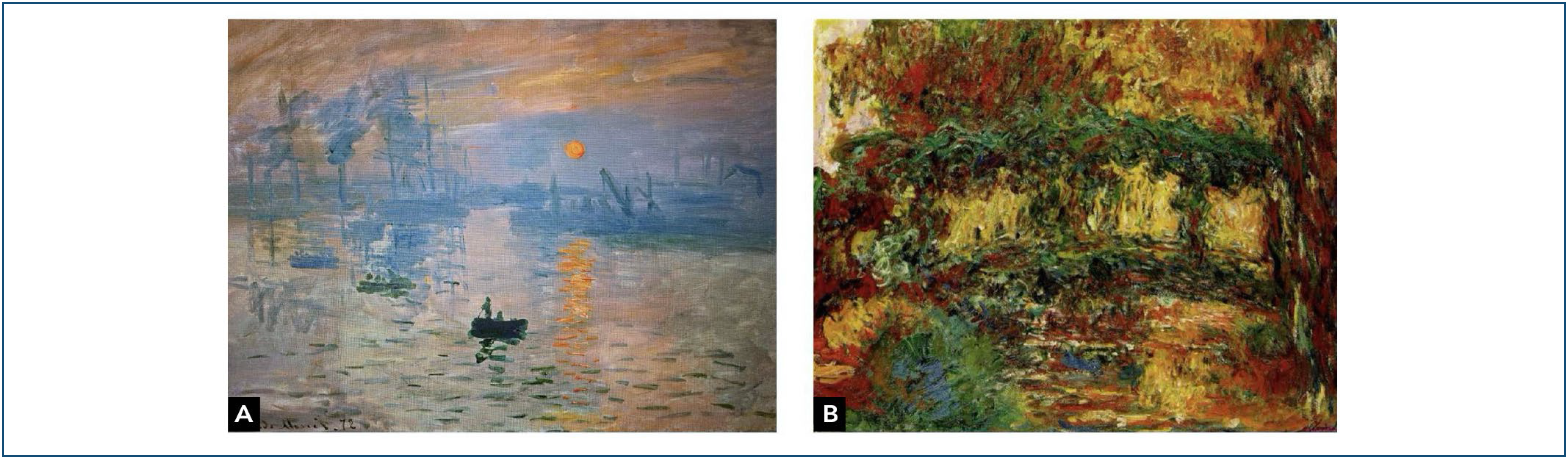
Claude Monet, one of the leading representatives of Impressionism, suffered from cataracts in the later years of his life. Cataracts are characterized by the opacity of the lens, resulting in blurred and distorted vision. Studies indicate that Monet began to experience difficulties with color and detail perception, which led him to adapt his painting techniques. He started using stronger colors and more pronounced contrasts, reflecting the changes in his vision. His relationship with his doctors was crucial for understanding and managing his condition, allowing him to continue painting until shortly before his cataract surgery (Figure 1).(1)

Works by Claude Monet before and after developing cataracts. (A) Impression, Sunrise (1872). (B) The Japanese Bridge (1923). Stronger colors and contrasts during cataract period. The artists studied in this work demonstrated significant adaptations in their artistic techniques due to their ocular conditions. Claude Monet, for example, suffered from cataracts, which affected his perception of colors and details, leading him to use stronger colors and more pronounced contrasts.
Vincent van Gogh and visual crises
Vincent van Gogh faced several visual crises throughout his life, possibly associated with conditions such as epilepsy and glaucoma. These crises affected his perception of colors and shapes, influencing his characteristic artistic style with intense use of vibrant colors and expressive brushstrokes. Van Gogh mentioned in letters to his brother Theo that his visual crises led him to see halos around objects and visual distortions, which were reflected in his works. Communication between Van Gogh and his doctors was limited, and he often struggled alone to understand and manage his condition (Figure 2).(2)

Comparison of Vincent van Gogh's works. (A) The Starry Night (1889). (B) Wheatfield with Crows (1890). Halos and visual distortions during visual crisis. Vincent van Gogh faced visual crises that influenced his intense use of vibrant colors and expressive brushstrokes.
Edgar Degas and macular degeneration
Edgar Degas, known for his depictions of ballerinas and theater scenes, suffered from macular degeneration, a condition that results in the loss of central vision. This condition forced Degas to abandon oil painting and focus on pastels and sculpture, techniques that did not require as much visual precision. Degas adapted his style to cope with the loss of detail, focusing more on general forms and movements. The doctor-patient relationship for Degas was complex, as he often refused to accept his visual limitations and was reluctant to seek medical help (Figure 3).(3)
Edgar Degas’ adaptation to macular degeneration. (A) "The Dance Class" (1874). (B) "The Blue Dancers" (1899). Focus on shapes and movements due to central vision loss. Edgar Degas, with macular degeneration, had to abandon oil painting and focus on pastels and sculpture, adapting his style to cope with the loss of visual details.
Leonardo da Vinci and presbyopia
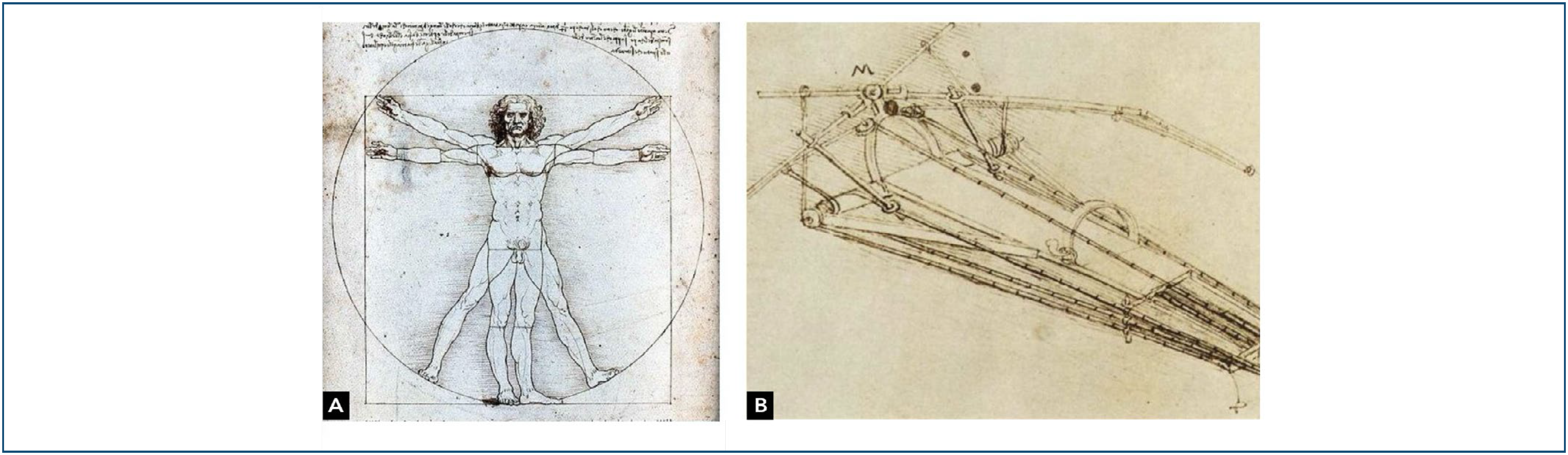
Leonardo da Vinci, the Renaissance polymath, is known for his contributions to various disciplines, including art, science, and engineering. In the later years of his life, Da Vinci suffered from presbyopia, a condition that makes it difficult to focus on close objects. This condition influenced his transition from detailed painting work to engineering projects and architectural drawing, where near vision was less critical. Da Vinci developed shading techniques to compensate for his visual limitations, demonstrating his ability to adapt and innovate. His relationship with doctors is not well-documented, but his adaptations suggest a self-taught approach to managing his condition (Figure 4).(4)

Works of Leonardo da Vinci before and after developing presbyopia. (A) "Vitruvian Man" (c. 1490). (B) "Design for a Flying Machine" (1488). Use of shading techniques. Leonardo da Vinci, affected by presbyopia, developed shading techniques and shifted his focus to engineering and architectural projects.
COMMENTS
The literature review highlights the importance of a doctor-patient relationship based on trust and effective communication for managing chronic diseases in artists. Understanding the specific needs of these patients can lead to the development of more personalized and effective therapeutic strategies. The intersection of art and medicine offers new perspectives for both clinical practice and art history, contributing to the advancement of scientific and technical knowledge.(1-4)
The doctor-patient relationship plays a vital role in the effective management of chronic diseases, especially for patients whose profession heavily depends on vision. Artists like Claude Monet, Vincent van Gogh, Edgar Degas, and Leonardo da Vinci exemplify how chronic ocular conditions can impact artistic production. Monet, affected by cataracts, adapted his techniques by using stronger colors and contrasts; van Gogh, with visual crises, intensified his use of vibrant colors and expressive brushstrokes; Degas, with macular degeneration, shifted his focus to pastels and sculpture; and da Vinci, facing presbyopia, developed shading techniques and redirected his attention to engineering and architectural projects.(1-4)
Mutual trust and effective communication between doctors and patients are fundamental for improving treatment adherence and quality of life. Studies show that an empathetic and personalized approach can help artists better understand and manage their conditions, allowing them to continue creating and expressing themselves through art.(5) Empathy in medical practice facilitates a deeper understanding of the emotional and practical implications of chronic diseases, promoting a more holistic and patient-centered approach.
Future research should explore other ocular conditions and their implications for artistic practice in more detail. Integrating insights from these artists’ experiences can lead to significant advances in both clinical practice and the preservation and appreciation of art. It is essential for healthcare professionals to recognize and consider the unique aspects of artists’ needs, developing interventions that not only address medical conditions but also preserve the artists’ ability to express themselves and contribute to culture and artistic heritage.(6)
The articulation between medical practice and art has the potential to enrich scientific knowledge, promote therapeutic innovation, and provide a better quality of life for artists. This review underscores the need for an interdisciplinary approach that values both physical health and artistic expression, reaffirming the importance of a doctor-patient relationship that goes beyond conventional medical treatment to include understanding and supporting patients’ artistic aspirations.(5)
Understanding the difficulties faced by artists with ocular diseases and the importance of a doctor-patient relationship based on mutual trust can significantly improve therapeutic approaches. This study highlights the need for a holistic view in the treatment of chronic conditions, considering the emotional and professional implications for patients. An empathetic and effective doctor-patient relationship is essential for developing personalized therapeutic strategies that meet the specific needs of artists, allowing them to continue their creative practices despite visual limitations.(1-4)
Future research should explore other ocular conditions and their implications for artistic practice in more detail. Integrating the experiences of these artists can lead to significant advances in both clinical practice and the preservation and appreciation of art. Interdisciplinary collaboration between healthcare professionals and art historians can provide a deeper understanding of the challenges faced by artists with ocular diseases, resulting in more innovative and effective therapeutic approaches, ensuring that these individuals can continue to express themselves and influence the world through their art.(6)
REFERENCES
- 1 De Jesus Souza C, Oliveira ML, Gomes LO. Catarata e a expressão cromática na obra de Monet. Rev Bras Oftalmol. 2019; 78 (5): 304-9.
- 2 Jacob MC. Patología ocular en la obra de Vincent van Gogh. Arch Soc Esp Oftalmol. 2019;91(12):e102-3.
- 3 Arnold WN. A doença de Vincent van Gogh. J Hist Neurosci. 2004;13(1):22-43.
- 4 Santos-Bueso E, Vico-Ruiz E, García-Sánchez J. Patologia ocular na obra de Leonardo da Vinci (I). La Mona Lisa [Patologia ocular nas pinturas de Leonardo da Vinci (I). A Mona Lisa]. Arch Soc Esp Oftalmol. 2014;89(2):e12-3. Spanish.
- 5 Cernea P. [The simultaneous contrast of the colors in Van Gogh's paintings]. Oftalmologia. 2002;55(4):96-100. Romanian.
- 6 Goh E, Teo W. Art and the eye: the impact of ocular pathology on their artistic legacy. Ann Acad Med Singap. 2007;36(10 Suppl 1):S61-S64.
- 7 Palmatier RW, Houston MB, Hulland, J. Review articles: Purpose, process, and structure. J Acad Mark Sci. 2018;46(1):1-5.

 Source: Sousa.(
 Source: Jacob.(
 Source: Arnold.(
 Source: Santos-Bueso et al.(