
 Historiographical practices supported by digital objects contributions from Digital History
Abstract
This article aims to highlight and analyze new practices in historical research, which prioritize the transformation of written physical documents into digital objects. This discussion is based on Digital History, reflecting on the incorporation of digital technologies, which emerges as a theoretical framework for analyzing and understanding digital files and sources as historical records. There are storage spaces for digital objects, characterized as digital repositories, which constitute environments suitable for storing documents. An example is the Book by Ramon Roca Dordal, available in the Digital Content Repository of the Federal University of Santa Catarina. It is possible to infer that the digital object is available in a reliable location that favors the long-term availability of sources, given traces of the digital curation stages and that working with digital sources also becomes possible through software such as Zotero and Tropy.
Keywords:
digital content repository; digitalization; digital curation; history of mathematics education
Resumo
O presente artigo tem como objetivo evidenciar e analisar novas práticas nas pesquisas históricas, as quais privilegiam a transformação de documentos físicos escritos em objetos digitais. Esta discussão toma como base a História digital, que reflete sobre a incorporação das tecnologias digitais e que emerge como referencial teórico para investigar e compreender arquivos e fontes digitais como registros históricos. Evidenciam-se os espaços de armazenamento de objetos digitais, caracterizados como repositórios digitais, os quais se constituem ambientes próprios para a guarda dos documentos. Apresenta-se, como exemplo, o Livro de Ramon Roca Dordal, disponível no Repositório de Conteúdo Digital da Universidade Federal de Santa Catarina. É possível inferir que o objeto digital está disponível em um local confiável que privilegia a disponibilização de fontes a longo prazo, visto que traços das etapas da curadoria digital e do trabalho com as fontes digitais se tornam possíveis também por meio de softwares como Zotero e Tropy.
Palavras-chave:
repositório de conteúdo digital; digitalização; curadoria digital; história da educação matemática
Resumen
Este artículo tiene como objetivo resaltar y analizar nuevas prácticas en la investigación histórica, que priorizan la transformación de documentos físicos escritos en objetos digitales. Esta discusión se fundamenta en la Historia Digital, reflexionando sobre la incorporación de las tecnologías digitales, que surge como un marco teórico para analizar y comprender los archivos y fuentes digitales como registros históricos. Existen espacios de almacenamiento de objetos digitales, caracterizados como repositorios digitales, que constituyen entornos aptos para el almacenamiento de documentos. Un ejemplo es el Libro de Ramon Roca Dordal, disponible en el Repositorio de Contenidos Digitales de la Universidad Federal de Santa Catarina. Es posible inferir que el objeto digital está disponible en una ubicación confiable que favorece la disponibilidad a largo plazo de las fuentes, dados los rastros de las etapas de curación digital y que trabajar con fuentes digitales también es posible a través de software como Zotero y Tropy.
Palabras clave:
repositorio de contenidos digitales; digitalización; curación digital; historia de la educación matemática
Introduction
The advent of the internet and the consequent development of communication and information technologies have led to profound changes in historical research, especially in research related to the history of mathematics education. From images captured on microfilm to high-resolution digital files, this technological revolution has affected everything from the places where they are kept (digital collections) to the actions of researchers who mobilize these documents that become a source of research.
With the development of software and specific search tools, there is a scenario full of new possibilities and major challenges. Historical research, traditionally dependent on visits to physical archives and the handling of original documents, mostly in written form, now also benefits from easier access to digitized sources in virtual collections, such as the Digital Content Repository at the Federal University of Santa Catarina (UFSC). These new storage spaces not only expand the possibilities for research and raise new issues, but also require an adaptation of methodologies and practices for critical analysis of the available sources, as well as attention to the limitations of use based on copyright, organization, serialization, capacity, compatibility and storage.
This article problematizes the historiographical practices carried out when working with digitized sources. This discussion is supported by digital history studies, which reflect on the incorporation of digital technologies into historical research in recent decades, moving from a search for a social history of the media to a theoretical primacy that questions the impact of digital on historiographical practice (Nicodemo et al., 2022).
According to Rocha (2020, p. 182), digital history is a theoretical approach that seeks to examine and interpret digital archives and sources, considering them as records of the past. This approach has been "[...] promoting a revolution in the field of science, changing the way history is done at all levels of research and teaching". It is also worth noting that its growth intensified from the 1990s onwards, driven by the mass use of the internet and the new possibilities it offered for publishing and accessing historical documentation and research (Silveira, 2018).
Historians don't need to be programmers, but knowledge of technologies helps to develop research protocols in the digital environment. Studying digital history means recognizing that historians have made an effort to integrate digital into their research. This can be approached in two ways: through theoretical and methodological discussions involving historical knowledge; and by experimenting with the use of digital resources for scientific dissemination. The importance of this historical approach is highlighted in order to analyze the impact of technologies on sources, archives, writing and the constitution of historiography itself. "At the end of the day, we all use digital sources, but we tend to mistakenly assume that they are faithful copies of the supposed originals" (Nicodemo et al., 2022, p. 11).
Researcher training must take into account the importance of knowing how to use the tools for digital work. This is because "Many current research projects in the field of history have used digital resources without the researcher undertaking an in-depth debate on the theoretical and methodological specificities of their use" (Brasil & Nascimento, 2020, p. 199). In order to create a digital history, the researcher needs to have the necessary infrastructure at their disposal to carry out the research. When a historical record is converted, "[...] through some computational process, into a digital document, a change occurs that could hardly be considered trivial" (Brasil & Nascimento, 2020, p. 201). Historical research using digital objects, given the ease of access to these sources, has significant potential for expanding knowledge, thanks to the support of technological devices and the use of digital research tools.
The widening use of digital sources, due to the abundance of data, brings with it unprecedented challenges, such as the need to develop criteria for analyzing and verifying the authenticity and relevance of information. One way of tackling these challenges lies in the stages of Digital Curation. This is the possibility that this article deals with, as Digital Curation blurs the boundaries of fields of knowledge and new theoretical contributions from the field of Data and Information Science can be borrowed for historical research.
Digital curation can be understood as a set of actions aimed at managing and preserving digital objects throughout their entire life cycle. These actions are fundamental to the creation of long-term storage spaces for documents. This new historiographical practice, which relies on search and consultation tools in the collections available virtually, results in a new organization/structure for the safekeeping of these 'documents'. For this reason, it is possible that historians' work will undergo changes that transform their research practices and the way in which the knowledge they produce is disseminated.
The aim of this text is to highlight and analyze new practices in historical research that favor the transformation of physical written documents into digital objects, based on the stages of Digital Curation. In addition to this introduction, discussions on digital objects and storage sites (digital collections) are presented, against the backdrop of research into the history of mathematics education. At the end, considerations are presented that could support procedures for a historiographical practice that takes into account the characteristics of digital sources. It should be noted that this text incorporates the studies promoted by the development of Project 408797/2021-5 (CNPq/MCTI/FNDCT Call No. 18/2021 - Track A - Emerging Groups SIGLA: Universal 2021 - Coordinated by Prof. Dr. David Antonio da Costa).
Digital objects
According to Barros (2022, p. 15), "[...] digital technology - by being made collectively available - has ended up introducing both new ways of thinking and social practices [...]", modifying the process of human development in the face of technologies, dealing with digital relationships, producing reflections and the application of new research and scientific dissemination techniques. Lacerda (2022) argues that the introduction of digital technologies is innovative and disruptive, as it shapes the way in which individuals live together in society. In exploring the 'digital turn', the author deals with two strands, that of historians concerned with problematizing and reflecting on the epistemological and methodological implications; and the group interested in "[...] applying tools that facilitate and speed up the processes of capturing, recording and analysing sources, that organize academic writing and that can give rise to historical knowledge [...]" (Lacerda, 2022, p. 254). This second aspect can be seen in the approach to new historiographical practices, since many historians have resorted to online platforms in the search for sources to interpret the past (Lacerda, 2022).
So we need to clarify: what are the digital objects mentioned in this text? They are a set of virtual sources (available on the web) that have been rematerialized and transformed through digitization. These digital objects are created with the aim of guaranteeing the quality, integrity and auditability of the information, prioritizing preservation in an interdisciplinary way. In technical terms, these objects "[...] are composed of a set of bit strings" (Associação Brasileira De Normas Técnicas [ABNT], 2007).
For Kallinikos et al. (2010), digital objects differ from physical objects in that they have attributes such as editability, interactivity, openness/access and distribution. These attributes make digital objects variable, unlike physical objects, whose attributes are stable and invariable. Editability makes it possible to modify, delete or add elements to digital objects, enabling regular or continuous updates without them losing authenticity. Interactivity makes it possible to activate functions incorporated into the object, such as the presence of hyperlinks, for new accesses or by other means. Openness allows digital objects to be reprogrammable, so that they can be modified and accessed by other digital objects.
Finally, digital objects are distributed, and are rarely limited to a single source, with boundaries created and maintained technologically (Kallinikos et al., 2010). In this text, we will deal with digital objects related to a set of virtual sources which, when transformed from the physical to the digital universe, acquire the attributes described above.
A physical document that may be available, for example, in a personal collection, when it takes on a digital format, cannot yet be called a digital object. The result of the work carried out to transform the physical document, which begins with digitization, will be its conversion into a 'digital object', provided that metadata (data about the data) is incorporated. Furthermore, its conversion into a format suitable for sharing enables long-term use and reuse.
The documentary contextualization of virtual archives has particularities in the configuration and operation of these archives that highlight the importance of a critical analysis. "Binary coding, bit processing in making documents available, the presence of private software and providers in storage, and the network platforms involved in the interface for accessing digital archives are unprecedented factors that need urgent consideration" (Nicodemo et al., 2022, p. 26).
According to Almeida (2011), digital objects characterized as sources for historical research can be of two types: born-digital or primary digitized. The born-digital are those documents created in the virtual environment such as online journals, emails, blogs, websites, etc., which are accessible from any electronic device and binary codes and are only and exclusively available virtually. Digital objects can also be categorized as digitized primary and are the result of a particular transformation made to physical documents, which are altered in their materiality through the action of digitization. This second type is what interests the discussions in this article.
Certeau (2013, p. 47) points out that the role of the researcher/historian is to create texts that represent the past, converting this material into history. This process begins with the "[...] gesture of separating, gathering and transforming certain objects into documents". Based on Certeau's (2013) comments, the aim is to address new practices in historical research, especially those that focus on digital objects, based on the stages of Digital Curation. Although this author does not directly address digital objects, his reflections offer important contributions to historiographical practices.
Historical research is the result of the researcher's choices and is determined by their 'social place', because "[...] it is according to this place that methods are established, that a topography of interests is outlined, that the documents and questions that will be proposed are organized" (Certeau, 2013, p. 47). This implies the particularity of the place from which one speaks, suggesting that historical research is not a neutral activity, but one influenced by the social and cultural position of the researcher.
As noted by Certeau (2013), research is subject to a set of rules that must be followed, even though these impositions may remain implicitly rooted. These rules, in turn, reflect the influence of a broader context on the practice of research. It is necessary to view history as actions of the institution and social order in which the discipline of history is inserted; an operation through which one must try to understand history as the relationship between place, analysis procedures and the construction of a text.
Certeau (2013) argues that history is understood as an operation in which it is essential to understand the relationship between context, methods of analysis and the construction of the historical text. This approach recognizes that history is an integral part of the reality studied, and not a separate entity. As far as the historian's work is concerned, there are elements that provide the transformation of information that is used to create historical narratives. The author also points out that a valuable historical work is one that is recognized as such by the academic community, is situated within an operative set that represents an advance in relation to the current state of historical objects and methods, so that it paves the way for new research.
In short, Certeau's (2013) approach highlights the importance of the social and intellectual context for the practice of historical research, emphasizing the need to understand the historical process as a complex operation involving the interaction between the researcher, the context and the historical sources. Although not necessarily linked to digital documents, historiographical practice involves a constant analytical movement between theory and empirics. So, for example, one could ask: What are the stages that the historian should take into account when dealing with digital documents? Where and how should these documents be archived and made available to the community?
Storage spaces for digital objects
In order to preserve digital objects in the long term and taking into account the historiographical practices described above, it is necessary to address the place where these objects will be made available. Digital repositories are specific environments for storing virtual documents that have unique characteristics, as they make it possible to apply preservation policies, as well as methods, processes and strategies for maintaining these spaces, in order to make them reliable. Strategies for preserving digital documents are still needed, although there are limitations related to the obsolescence of media, the ease of alteration and the difficulty of identifying originality (Souza & Aganette, 2020).
In this sense, "[...] digital document preservation strategies have been studied with the aim of developing technologies that guarantee the authenticity and reliability of information" (Souza & Aganette, 2020, p. 2). Thus, in addition to repositories being organized as reliable platforms that have characteristics that favour digital preservation, the reliability and authenticity of information, guaranteeing the security of the resources offered, they are also spaces that protect the stored content, ensuring its access, use and reuse.
Reliable repositories have support and security attributes, with administrative responsibility, organizational viability, financial sustainability and certification (Thomaz, 2007).
A digital repository is a place to store digital objects with the capacity to keep and manage material for long periods and provide appropriate access, "[...] it is a digital library designed to store, preserve and guarantee free access, via the Internet, to scientific production within a given institution" (Marcondes & Sayão, 2009, p. 9), favoring scientific communication and guaranteeing long-term storage and preservation.
Rodrigues (2005) points out that repositories can be classified into two types: disciplinary or institutional. Disciplinary repositories, also known as thematic repositories, are open systems that store the research results of one or more specific disciplines. The institutional repository, on the other hand, brings together all the thematic repositories of an organization, aggregating various areas of research, making it multidisciplinary.
The work carried out by GHEMAT-Brasil1 with the UFSC Digital Content Repository (RCD)2 stands out. This is a large database, structured for research into the history of mathematics education, which is organized into communities, sub-communities and collections, and aims to maintain and manage digital objects for long periods of time, promoting greater availability and access to information and maintaining a collection for future research.
Repositories aim to intervene and respond to two strategic issues facing universities: contributing to increasing the visibility, status, image and public "value" of the institution, serving as a tangible indicator of the university's quality and demonstrating scientific relevance; and contributing to the reform of the scientific communication system, expanding access to research results, reassuming academic control over scientific publication, increasing competition and reducing the monopoly of scientific journals - which would also translate into savings for universities and the libraries that serve them (Crow, 2002 apud Camargo & Vidotti, 2009, p. 60, emphasis added).
When dealing with digital scientific environments, such as repositories, based on Information Architecture, some elements appear to be essential: Search Tools; Metadata; Policies; Interoperability; Preservation; Accessibility; Usability. These elements dialog with the characteristics advocated by Kallinikos et al. (2010), such as editability, interactivity, openness/access and distribution, and it can be inferred that repositories are privileged spaces for storing documents, digital objects, with unique characteristics.
Because they are spaces for scientific dissemination, researchers carry out electronic searches in repositories using keywords and indexing devices. It is therefore up to the historian to understand these mechanisms in order to properly characterize the digital sources located in the repository collections that will be picked up a posteriori by these electronic search mechanisms. These characterizations will be specified through the metadata of the digital objects. Each researcher may have a different way of relating concepts to a given source, according to their own experiences: concepts can be related under different entries than the reader supposed and concepts can also change over time (Meadows, 1999). Understanding this complexity is what will best guide the choices and completion of the metadata.
Adding a new digital document to a collection essentially involves two stages: selecting the storage method followed by defining the format and storage location, with the aim of guaranteeing the long-term preservation of this material. In addition, the automatic indexing process must facilitate the classification of the collected material and provide relevant information for data retrieval and distribution.
Indexing can be classified as pre-coordinated and post-coordinated. In pre-coordinated indexing, concepts are combined at the time of indexing (entry), with results organized in order of importance. Post-coordinated indexing, on the other hand, is carried out by each of the terms without ordering (output), with the concepts being combined at the time of retrieval. In post-coordinated indexing, the terms are combined or coordinated at the time of the search and this indexing is mainly used in automated systems (Vanti et al., 2011).
For these authors, each topic is written on a card and the documents to which the topic refers are indicated by a sequential number assigned to each document. In a post-coordinated search, for example, the order of the elements loses its value. Taking the UFSC Institutional Repository as an example, it doesn't matter whether you search for 'notebook' and 'arithmetic', or 'arithmetic' and 'notebook', the results will be the same. In pre-coordinated indexing, complex subjects already enter the vocabulary in a combined form and must take into account all the possibilities of combining terms to form complex subjects. The words, terms or phrases chosen to express a concept, or a combination of indexing concepts, are classificatory and alphabetical and the number of entries grows enormously.
DIGITAL CONTENT REPOSITORY: History Of Mathematics Education (RCD-Hem)
Repositories differ from other databases in that they allow appropriate access to material and store documents made available by other researchers, who share digitized sources used in their research, preserving them properly and respecting the stages of Digital Curation. They can be accessed from any mobile device, allowing the use and reuse of the digital objects available in the space where they were created, gathered and organized in a privileged way. The set of items fed into the repositories depends on the activities of researchers to make their digital sources available. This modus operandi has been developed by GHEMAT-Brasil members for a long time. The work of supporting, building and maintaining the Digital Content Repository - History of Mathematics Education (RCD-Hem) with digital objects began in 2012, as part of a community within UFSC's Institutional Repository.
Institutional repositories are examples of virtual spaces that allow large amounts of information to be stored in digital format. But this still needs to be further problematized in historical research, as long as we consider the researcher's construction of digitized research sources, which become 'digital objects' and are inserted and made available in this particular space, in which, in addition to the limitations imposed by the choices of sources that will be digitized by the researcher who uses them, we seek to verify reliability and authenticity, which can restrict the use of a given 'digital object'.
According to Crow (2002 apud Serra & Eliel, 2024, p. 599), "[...] an Institutional Repository provides two aspects to educational institutions: it expands access to research by disseminating scientific production openly and it provides tangible indicators of the quality of the institution, highlighting the scientific, societal and economic relevance of its research activities [...]", which contributes to the visibility, positioning and public valuation of the institution. When studying the information available about digital objects in databases, Clobridge (2010) points out that metadata is any information about other information. In repositories, metadata consists of various types of details relating to digital objects. This includes aspects such as use and rights, detailed descriptions, structural data, keywords, among other relevant elements. This metadata is essential for the organization and effective retrieval of stored content.
In order to assess the quality of information systems, some characteristics can be addressed, such as accessibility, updating, clarity, comprehension, reliability, ease of use, flexibility, security, usefulness, completeness, response time, integration, readability, timeliness, relevance, credibility, accuracy and, finally, communication (Lameira, 2016). These characteristics - such as reducing the time it takes to access information, updating the items deposited in repositories, publicizing operating policies, preserving digital documents, improving the usefulness of information, the credibility of content, as well as the value of using information - are seeking to be consolidated as criteria and methods for the evaluation and applicability of information systems. Evaluating repositories is a crucial stage in creating a reliable system, as it makes it possible to measure their efficiency and ensure that they keep up with users' needs.
The job of the historian of mathematics education is to try to make a connection with the "[...] construction of overcoming naive, mythical, romantic and memorialistic relationships about mathematics teaching practices carried out in other times" (Valente, 2013, p. 28). By maintaining an ahistorical relationship with their professional predecessors, the production of mathematics teachers can, through the appropriation of this history, establish a less fanciful and more scientific connection with the past.
Historiographical practice in research into the history of mathematics education is related to the safekeeping of documents produced by a school culture, such as normative documents (laws, decrees, regulations of educational institutions, etc.), teaching documents (pedagogical manuals, textbooks, teaching materials, among others) and other documentation (tests, school notebooks, class diaries, etc.). This safeguarding of documents allows not only for the preservation of these objects, but also for the possibility of carrying out new research based on the documents available. However, it is crucial to consider, from the method used to capture the images of these objects, the objective of preserving them, as well as their selection and organization.
These objects, initially selected, collected and deposited, are organized in a systematic way, respecting the transformations of the documents, which were originally found in a dispersed way and, through the RCD, are structured and organized digitally. Although these documents have already served as sources for other research, making them available on the RCD aims to turn them into historical records and reference documents for new investigations. This process facilitates the use and reuse of digital objects, enriching the corpus available to the academic community (Gregorio & Costa, 2022).
Digital tools influence not only data collection, but also the construction and dissemination of historical knowledge. At the same time, a critical and careful approach to the use of these sources is required, especially what is available in the Repository environment, in order to guarantee the integrity and validity of the research carried out in the digital environment, enabling the use and reuse of digital objects, even if limited, supported by the Digital Curation stages, detailed in the next topic.
Digital curation
Digital Curation is associated with the management and care of digital objects throughout their life cycle. According to Santos (2016), Digital Curation refers to a set of actions that ensure the quality, integrity and audit of information over the long term, with the aim of preserving and protecting digital objects in an interdisciplinary way. These actions aim to guarantee access, reuse and dissemination of collections on the internet.
"Digital curation involves maintaining, preserving and adding value to research data throughout its life cycle, preserving its integrity and authenticity, with priority given to planning, evaluation and reassessment" (Digital Curation Center [DCC], 2023). Digitization adds value to digital objects by "[...] intervening in the object, inserting various types of metadata (administrative, descriptive, structural and preservation), taking into account the context and community in which the object is inserted" (Souza, 2016, p. 36). These curatorial actions guarantee long-term preservation and prioritize, in addition to the images obtained through digitization, the transformation of archives into digital objects.
Curatorial actions encompass data management, from planning the creation, including the adoption of good digitization practices and the appropriate selection of formats, to documenting and ensuring that the data is accessible and able to be located and reused now and in the future. These curatorial actions encompass "[...] all the actions necessary to maintain digitized and born-digital objects and data throughout their life cycle, and over time for current and future generations" (Machado, 2017, p. 41).
The stages of digital curation are detailed below:
-
Conceptualize - conceive and plan the creation of digital objects, including data capture methods and storage options;
-
Create and receive - produce digital objects and assign administrative, descriptive, structural and technical archival metadata;
-
Access and use - ensuring that designated users can easily access digital objects on a day-to-day basis. Some digital objects may be publicly available, while others may be password-protected;
-
Evaluate and select - evaluate digital objects and select those that require long-term curation and preservation. Comply with documented guidelines, policies and legal requirements;
-
Discard - free systems of digital objects not selected for curation and long-term preservation. Documented guidelines, policies and legal requirements may require the secure destruction of these objects;
-
Ingest (admit and insert) - transferring digital objects to an archive, trusted digital repository, data center or similar, again adhering to documented guidance, policies and legal requirements;
-
Preservation action - taking action to ensure the long-term preservation and retention of the authoritative nature of digital objects;
-
Re-evaluate - return digital objects that have failed validation procedures for evaluation and re-selection;
-
Storage - keeping data securely as described by the relevant standards;
-
Access and reuse - ensuring that data is accessible to designated users for first-time use and reuse. Some materials may be publicly available, while other data may be password protected;
-
Transform - create digital objects from the original, for example by migrating to a different form (Digital Curation Center, 2023).
These steps favor the preservation of digital objects. By transposing these stages to History of Education and History of Mathematics Education research, the work of transforming the materiality of physical documents into digital objects follows a path that seeks to align with these guidelines. It is necessary to create indicators that can guide good practice in the work and support its use, making it possible to use and reuse the objects in the long term. The reuse of a digital object is usually done by a different researcher to the one who first collected the data. There are authors, such as Curty (2019), who argue that any subsequent use of the data, even by the person who obtained it, should be considered reuse. The author proposes a classification that describes five approaches to the reuse of research data.
For the author, reuse by repurposing is one of the most mentioned approaches in the literature, as it is based on using pre-existing data for purposes other than the original. Reuse by aggregation brings together data from different studies/sources within the same domain to create a more complete collection of data. Reuse by integration involves combining data from different domains and study types. Reuse by meta-analysis "[...] is characterized as combining analyses of data from multiple independent studies with identical or very similar research questions and hypotheses, in order to address questions beyond the scope" (Curty, 2019, p. 183). And finally, reuse by re-analysis, which is aimed at "[...] verifying the results obtained by the study that generated the data, by re-analyzing the data, using the same methods and techniques employed in the original study" (Curty, 2019, p. 184). Consequently, the reuse approach is linked to the issue of reproducibility, in which data is checked with the aim of confirming or refuting previous conclusions.
This approach allows us to infer that the reuse of digital research sources is an increasingly common and relevant practice in research and in areas involving research and knowledge development. This is because it is considered a powerful tool that can lead to significant savings in time and resources, as well as innovative discoveries. In Hem, reuse can be understood as related to integration and meta-analysis, with studies available in virtual environments that can be analyzed and combined with new hypotheses and research questions. This reuse, therefore, must be done carefully and judiciously to guarantee the quality and integrity of the research.
As described, digital objects must have metadata for their storage, which allows information on title, format, file type and standards to be reused and shared. This makes it possible to adopt the FAIR3 principles, according to which data should be "[...] locatable, accessible, interoperable and reusable" (Campos et al., 2023, p. 2). This paper advocates the adoption of the FAIR principles for historical research sources. This is because adopting these principles is fundamental, as it favors and promotes scientific dissemination. When digital objects are aligned with these principles and are open/available, they can be reused on a large scale, boosting new research and historical issues. Thus, Caregnato et al. (2021) point out that metadata, according to the FAIR principles, must follow certain conditions:
-
1 The (meta)data is described in detail with a plurality of precise and relevant attributes;
-
1.1 The (meta)data are published with clear and accessible data use licenses;
-
1.2 (Meta)data are associated with detailed information on their provenance;
-
1.3 The (meta)data meets standards that are relevant to the community in the field. In other words, in order to be reusable, both the data and the metadata must be accompanied by information that effectively enables them to be used in contexts other than those in which they were created (Caregnato et al., 2021).
This information details aspects that go beyond the digitization of the physical document transformed into images. The digital object is built from the set of its metadata for wide dissemination, enabling its use and reuse. The transformations related to digital objects can be associated with a dual function: "[...] to streamline research in a world connected by the internet and to consider how this streamlining changes the way knowledge is produced and the way of life" (Nicodemo et al., 2022, p. 21).
Working with digital objects
Based on what has been said about working with digital objects, their rematerialization, the transformation of sources and the stages of Digital Curation, this section seeks to deal with the use of the objects available in the RCD-UFSC. The digital collection available in the RCD environment is the result of joint work by a team of researchers: those responsible for capturing the images create metadata; others, who share them and make them available virtually in the RCD after submissions to the system; and another team, which moderates and evaluates these insertions and their elements, releasing access to the community.
From the stages of Digital Curation, it is possible to infer that the work begins with extensive planning, with the aim of conceptualizing and characterizing the documents that will be rematerialized, i.e. the creation of the digitized files. According to the Digital Curation Centre [DCC] (2023), 'conceptualizing' refers to "[...] conceiving and planning the creation of digital objects, including capture methods [...]", as is done with digital objects in Hem research.
Next, the technical, descriptive and structural metadata is assigned, in the stage listed as 'create and receive', with the aim of guaranteeing access and use, which, according to the DCC (2023), ensures that users can easily access the objects, which may be publicly available. The steps outlined by the Digital Curatorship actions aim to "[...] evaluate and select digital objects, including those that require long-term curation and preservation".
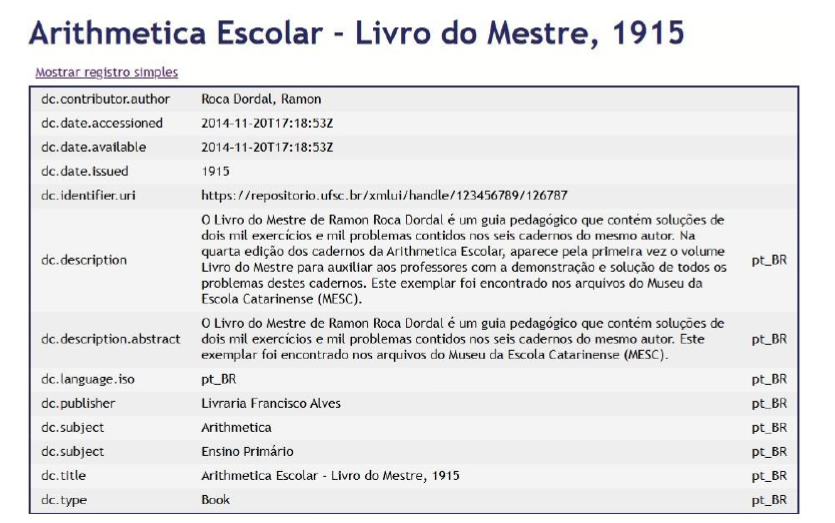
A record in the RCD-Hem/UFSC is shown below. As an example, we present the book entitled Arithmetica escolar - livro do mestre, written by Ramon Roca Dordal, published in 1915, which served as a source for the research (Costa, 2016; Salvador, 2017).

The types of records shown in the figure above, linked to digital objects such as the book mentioned, illustrate some of the metadata available in the RCD-Hem/UFSC. It can be seen that the filling in of the metadata is based on the stages of the Digital Curatorship categories. The information was classified and entered, adhering, according to DCC (2023), to the guidelines, policies and legal requirements, according to which some metadata may be discarded, or re-evaluated, if they do not follow sharing licenses. Preservation actions aim to ensure the long-term conservation and retention of the authoritative nature of digital objects, keeping data stored securely, enabling it to be publicly accessible to users in the long term.
After storage, as in the example above, in the RCD-UFSC, the aim is to keep the data secure, related to the store stage, indicated by the DCC (2023). This is the time to deal with access and reuse, which guarantee the publication of objects, rematerialized from the original document, highlighting the stage of transforming and creating objects.
For all these stages to be completed, as described above, a team of researchers engaged in the conservation and preservation of documents is needed. Based on these preservation actions, information can be located and retrieved through electronic searches using keywords. Keywords, built on the characteristics of digital objects, serve as elements of representation and information retrieval for scientific research. The right choices allow for better indexing by electronic search engines at the time of the search.
In the example cited of Ramon Roca Dordal's work, the keywords are Arithmetica and Ensino Primário. In this environment, search engines also access the titles of digital objects, i.e. a search using the keyword Livro do mestre would also reach this item. Therefore, the idea that the RCD's digital sources can contribute to the development of historical knowledge that touches on other areas of knowledge is reinforced.
Although this article has chosen the copy Livro do mestre, by Ramon Roca Dordal, it is important to note that the author has other works available digitally on the RCD, such as Arithmetica escolar - exercícios e problemas para escolas primárias, famílias e collegios, organized in notebooks and with six accessible editions. Although there are serialized and organized materials with various editions and copies, one of the limitations of a space like the Repository is the difficulty of ensuring that all the materials in a specific collection are available in their entirety.
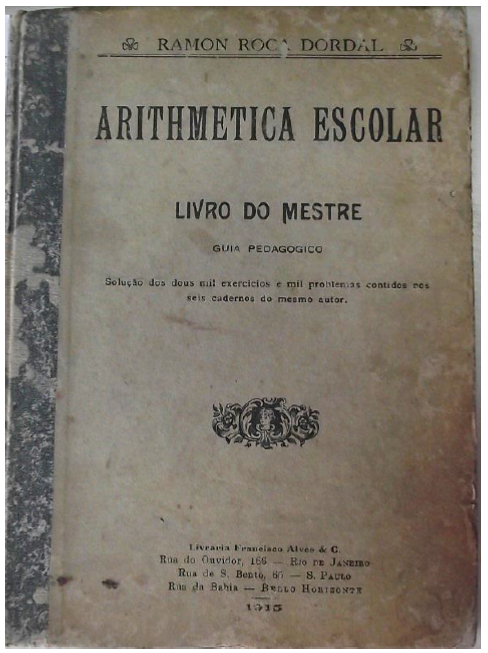
Another important piece of information deals with the generation, production or creation of a digital image representative (Santos & Miranda, 2020). Document digitization includes the stages of reception, checking, preparation, capture, indexing, quality control/inspection/audit. It also guarantees the reliability, authenticity, longevity and security of the documents. The archival literature recommends that the quality of scanned images should be 300dpi (optical resolution/dots per inch). If the text on the target document page has very small characters, the quality should be between 400dpi and 600dpi. In this way, you get a clear and sharp view of the files, which are readable and properly converted into the desired format, be it PDF, JPG or TIFF4. The following image illustrates the cover of Ramon Roca Dordal's book.
All these elements highlight the importance of a suitable place to store the documents, preserving them for the long term, enabling researchers to use and reuse them, as well as the need to follow steps that optimize the researcher's work.
Digital research tools
Working with digital sources is only possible through software. The selection and use of programs for this work should prioritize those that take into account the aforementioned stages of Digital Curation. In addition to the Repositories, two tools in particular help the researcher mobilize and organize sources: Zotero (2024) and Tropy (2024), both free and open source software.
Zotero is a bibliographic reference manager that helps in the preparation of papers and which "[...] constitute[s] today a reality in the generation of scientific production and in the management of research at various academic levels. Thus, in the current scenario, the use of bibliographic reference managers has been incorporating dynamism into its process" (Ferreira, 2017, p. 15). In this way, the tool makes it possible to collect references with one click. The manager automatically detects searches while the browser is in use and so it is possible to save information related to citations of books, articles and web pages. The researcher can organize it in a way that suits their choices and the organization of the research, classifying items into collections and sub-collections and marking them with keywords, notes and tags (Zotero, 2024).
Tropy was developed with the aim of being used in today's archival research, which is marked by greater ease of "[...] access to and copying of documentation, either through the possibility for researchers to directly photograph the documents they are interested in or through major institutional digitization projects that have substantially expanded access to archival documentation worldwide" (Lucchesi, 2023). Tropy helps researchers organize and manage their collections of research photographs, minimizing the chaos that usually plagues computers after a visit to the archive with images of large-volume sources.
Tropy allows the researcher to take control of the research images, which shortens the path from finding archive sources to writing about them. The software allows users to import and organize images in a structured way in projects with lists and collections. This allows researchers to spend more time on their research sources and less time looking for them. Tropy's annotation settings allow you to transcribe documents, select details from images and manipulate photographs to get a clearer view of your sources.
Digital tools help facilitate access to information, saving time and effort, as well as organizing and managing data efficiently, which makes it possible to collaborate and share scientific communication.
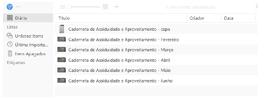
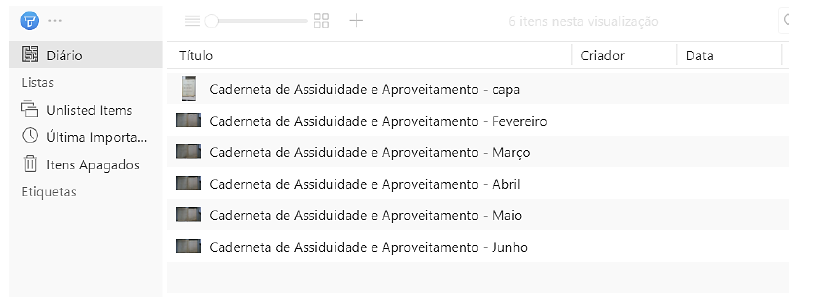
Tropy can, for example, merge images in the case of digitized diaries for historical research. The physical document has already been rematerialized and, based on the Digital Curatorship steps, the scans were created and stored in a virtual space. From there, using Tropy, the metadata for each object was created, so that the files could then be inserted into reliable repositories.
Final Remarks
From the above, it can be inferred that historical practices have been changing over time and with technological innovations. Especially with the use of digital objects and the referral of these objects to storage spaces.
The aim of this text, in terms of historical research, was to highlight and analyze new practices that favor the transformation of physical written documents into digital objects, based on the stages of Digital Curatorship, as shown in the last section, in the conservation of objects in the RCD-Hem/UFSC. The text highlights the need for a reliable space for the long-term storage of digital objects based on digital history studies, which have been gaining ground over time. These new practices in document storage allow not only for the preservation of such objects, but also for the possibility of carrying out new research through the reuse of available documents.
Studying digital history means recognizing that historians have made an effort to integrate the digital into society and that technology makes it possible to introduce new practices into the research process, producing reflections and the application of new techniques for research and scientific dissemination.
The stages of Digital Curation prioritize the preservation of digital objects, guaranteeing editability, interactivity, openness/access and distribution. The rematerialization process, which transforms physical documents into digital objects, must follow the phases of conceptualization, creation, access, evaluation, disposal, ingestion, preservation, reassessment and storage. These stages, together with the production of metadata, digitization and storage in reliable databases, make secure preservation possible, allowing the objects to be used and reused in the long term.
Based on the studies of Certeau (2013), the work of the historian is related to the production of texts that represent the past, based on the separation, gathering and transformation of certain objects. With these actions, it becomes possible to carry out historiographical research anchored in the present time and in the use of digital tools. Although the author does not directly address the digital materiality of these objects, his reflections offer relevant contributions to the current work of researchers.
The example presented, based on Ramon Roca Dordal's Book of the Master, was intended to provide a brief overview of the objects available in the Repository's digital environment. However, it is important to point out the limitations in using these spaces, since the availability of the collection is the result of documents that have been used in other research.
The preparation of the metadata for the items in the RCD involves the appropriate use of powerful digital tools that act in a purposeful way to organize the documents. These tools favor the production of a historiography that takes into account a new set of documentary sources, broadening the problems in historical research.
References
-
Adobe Creative Cloud. (2024). https://www.adobe.com/br/
» https://www.adobe.com/br/ -
Almeida, F. C. (2011). O historiador e as fontes digitais: uma visão acerca da Internet como fonte primária para pesquisas históricas. Revista Aedos, 3(8). https://seer.ufrgs.br/index.php/aedos/article/view/16776
» https://seer.ufrgs.br/index.php/aedos/article/view/16776 - Associação Brasileira de Normas Técnicas [ABNT]. (2007). NBR 15472: sistemas espaciais de dados e informações - Modelo de referência para um sistema aberto de arquivamento de informações.
- Barros, J. D. (2022). História digital: a historiografia diante dos recursos e demandas de um novo tempo. Vozes.
-
Brasil, E., & Nascimento, L. F. (2020). História digital: reflexões a partir da hemeroteca digital brasileira e do uso de caqdas na reelaboração da pesquisa histórica. Estudos Históricos (Rio de Janeiro), 33 (69), 196-219. http://dx.doi.org/10.1590/s2178-14942020000100011
» http://dx.doi.org/10.1590/s2178-14942020000100011 -
Camargo, L. S. A., & Vidotti, S. A. B. G. (2009). Arquitetura da informação para repositórios científicos digitais. In L. Sayão, L. B. Toutain, F. G. Rosa, & C. H. Marcondes. Implantação e gestão de repositórios institucionais: políticas, memória, livre acesso e preservação (pp. 55-82). EDUFBA. https://repositorio.ufba.br/bitstream/ufba/473/3/implantacao_repositorio_web.pdf
» https://repositorio.ufba.br/bitstream/ufba/473/3/implantacao_repositorio_web.pdf -
Campos, A. F., Dias, G. A., & Sousa, M R. F. (2023). Princípios FAIR, encontrabilidade e dados: por um diálogo teórico e uma aplicação prática. Encontros Bibli, 28, 1-21. http://dx.doi.org/10.5007/1518-2924.2023.e88060
» http://dx.doi.org/10.5007/1518-2924.2023.e88060 - Caregnato, S. E., Rocha, R. P., & Gabriel Junior, R. F. (2021). Reúso de dados: princípios FAIR e o ecossistema de pesquisa. In L. F. Sales, V. S. O. Veiga, P. Henning, & L. F. Sayão (Orgs.), Princípios FAIR aplicados à gestão de dados de pesquisa (pp. 195-208). Ibict.
- Certeau, M. (2013). A escrita da história (Maria de Lourdes Menezes, trad., 3a ed.). Forense Universitária.
- Clobridge, A. (2010). Building a digital repository program with ilimited resources. Chandos Publishing.
-
Costa, D. A. (2016). A aritmética escolar (livro do mestre) de Roca Dordal no ensino primário em Santa Catarina na primeira metade do século XX. Perspectiva, 34(1), 85-101. https://repositorio.ufsc.br/handle/123456789/167438
» https://repositorio.ufsc.br/handle/123456789/167438 -
Curty, R. (2019). Abordagens de reúso e a questão da reusabilidade dos dados científicos. Liinc em Revista, 15(2), 177-193. https://revista.ibict.br/liinc/article/view/4777/4315
» https://revista.ibict.br/liinc/article/view/4777/4315 -
Digital Curation Centre [DCC]. (2023). The value of digital curation. http://www.dcc.ac.uk/digital-curation
» http://www.dcc.ac.uk/digital-curation - Ferreira, L. S. (2017). O uso do software Zotero no processo de comunicação científica: um estudo de caso na Ensp/Fiocruz [Dissertação de Mestrado]. Universidade Federal do Estado do Rio Janeiro.
-
Gregorio, J. M. C., & Costa, D. A. (2022). As relações da história digital com pesquisas em história da educação matemática. Revista RELPE: Leituras em Pedagogia e Educação, 6(2), 139-153. https://sistemas.uft.edu.br/periodicos/index.php/relpe/article/view/14963
» https://sistemas.uft.edu.br/periodicos/index.php/relpe/article/view/14963 -
Kallinikos, J., Aaltonen, A., & Marton, A. (2010). A theory of digital objects. First Monday, 15(6-7). https://firstmonday.org/ojs/index.php/fm/article/view/3033
» https://firstmonday.org/ojs/index.php/fm/article/view/3033 - Lacerda, D. C. O. (2022). Transformação digital e história: pensar no passado com tecnologias do presente In J. D. Barros. História digital: a historiografia diante dos recursos e demandas de um novo tempo (pp. 253-280). Vozes.
-
Lameira, A. K. A. (2016). Avaliação de repositórios institucionais brasileiros: uma proposta de método de avaliação. Cadernos BAD, (2), 157-167. https://cip.brapci.inf.br/download/78793
» https://cip.brapci.inf.br/download/78793 -
Lucchesi, A. (2023). Tropy, ferramenta gratuita de gerenciamento de fontes digitalizadas. https://infonet.com.br/blogs/getempo/tropy-ferramenta-gratuita-de-gerenciamento-de-fontes-digitalizadas/
» https://infonet.com.br/blogs/getempo/tropy-ferramenta-gratuita-de-gerenciamento-de-fontes-digitalizadas/ -
Machado, K. C. (2017) Framework conceitual para o desenvolvimento e curadoria digital para pessoas com baixa visão [Dissertação de Mestrado]. Universidade Federal de Santa Catarina. https://repositorio.ufsc.br/handle/123456789/182082
» https://repositorio.ufsc.br/handle/123456789/182082 -
Marcondes, C. H., & Sayão, L. F. (2009). Introdução: repositórios institucionais e livre acesso. In L. Sayão, L. B. Toutain, F. G. Rosa, & C. H. Marcondes. Implantação e gestão de repositórios institucionais: políticas, memória, livre acesso e preservação (pp. 9-22). EDUFBA. https://repositorio.ufba.br/bitstream/ufba/473/3/implantacao_repositorio_web.pdf
» https://repositorio.ufba.br/bitstream/ufba/473/3/implantacao_repositorio_web.pdf - Meadows, A. J. (1999). A comunicação científica. Briquet de Lemos/Livros.
- Nicodemo, T. L., Rota, A. R., & Marino, I. K. (2022). Introdução: das humanidades digitais à história digital. In T. L. Nicodemo. Caminhos da história digital no Brasil (pp. 7-40). Milfontes.
-
Roca Dordal, R. (1915). Arithmetica escolar: livro do mestre. Livraria Francisco Alves. https://repositorio.ufsc.br/handle/123456789/126787
» https://repositorio.ufsc.br/handle/123456789/126787 -
Rocha, J. M. (2020). Imprensa, internet e história: a produção da notícia em impressos e cibermeios de Dourados [Tese de Doutorado]. Universidade Federal da Grande Dourados. https://www.ppghufgd.com/wp-content/uploads/2020/12/Tese-Jose-Milton-Rocha.pdf
» https://www.ppghufgd.com/wp-content/uploads/2020/12/Tese-Jose-Milton-Rocha.pdf -
Rodrigues, E. (2005). Concretizando o acesso livre à literatura científica: o repositório institucional e a política de auto-arquivo da universidade do Minho. Cadernos Bad, 33(21), 21-33. https://repositorium.sdum.uminho.pt/handle/1822/3478
» https://repositorium.sdum.uminho.pt/handle/1822/3478 - Sales, L., Veiga, V., Henning, P., & Sayão, L. F. (2021). Um panorama histórico da iniciativa GO FAIR: da Europa para o Brasil. In L. F. Sales, V. S. O. Veiga, P. Henning, & L. F. Sayão (Orgs.), Princípios FAIR aplicados à gestão de dados de pesquisa (pp. 9-22). Ibict.
- Salvador, H. H. F. (2017). A condução do ensino das operações aritméticas nas séries iniciais: do tradicional ao intuitivo (entre a segunda metade do século XIX até a terceira década do século XX [Tese de Doutorado]. Universidade Anhanguera de São Paulo - UNIAN.
-
Santos, P. S. A., & Miranda, Z. D. (2020). Digitalização de documentos: soluções de qualidade para acervos arquivísticos. Revista Fontes Documentais, 2(03), 26-42. https://repositorio.ufpb.br/jspui/handle/123456789/25408
» https://repositorio.ufpb.br/jspui/handle/123456789/25408
-
Peer review rounds:
R1: three invitations; three reports received.
-
How to cite this paper:
Gregorio, J. M. da C., Costa, D. A. da., & Maciel, V. B. (2025). Historiographical practices supported by digital objects: contributions from digital History. Revista Brasileira de História da Educação, 25, e362. DOI: https://doi.org/10.4025/rbhe.v25.2025.e362.en
-
Funding:
The RBHE has financial support from the Brazilian Society of History of Education (SBHE) and the Editorial Program (Call No. 30/2023) of the National Council for Scientific and Technological Development (CNPq).
-
1
GHEMAT-Brazil - Associated Group for Studies and Research on the History of Mathematics Education. This is a non-profit civil association that brings together researchers from over 20 research institutions, all interested in producing historical research within the field of the history of mathematics education. Its members collaborate through thematic projects and share research results and sources using the Digital Content Repository - Federal University of Santa Catarina (RCD-UFSC), in the Mathematics Education History community. Learn more at: https://ghemat-brasil.com.br/home/.
-
2
See at: https://repositorio.ufsc.br/handle/123456789/1769.
-
3
The GO FAIR initiative emerged in Brazil in 2016 with the aim of ensuring the proper reuse of data across different contexts, countries, and disciplines. It contributes to data sharing and reuse in the generation of new knowledge, promotes research reproducibility, and establishes the adoption of the FAIR principles (Findable, Accessible, Interoperable, Reusable) (Sales et al., 2021, p. 16).
-
4
“PDF (Portable Document Format) is a versatile file format created by Adobe that provides an easy and reliable way to present and exchange documents. It can contain text, images, vector graphics, videos, and links while preserving the document’s original layout, making it ideal for sharing and printing. JPEG (Joint Photographic Experts Group) is a widely used image file format, especially for photographs and detailed graphics. TIFF (Tagged Image File Format) is a bitmap image file format commonly used in the graphic and printing industry. TIFF is known for its flexibility and support for a wide range of color depths and compressions” (Adobe, 2024).

 Source:
  Source:
  Source: The authors.