
 RBHE and the principles of Open Science
The experience of managing a scientific journal involves continuities and changes. We will begin this editorial by analyzing actions that modified the routines of RBHE throughout 2025. The first is related to a revision of the journal's standards, affecting readers, authors, and consultants. This involves the implementation of the principles of open science, which aims at "a transformation [...] of the traditional modus operandi of fostering, designing, conducting, and, particularly, communicating research. The objective is to prioritize the collaborative nature of research and democratize access to and use of scientific knowledge" (Packer & Santos, 2019).
Adopting the modus operandi of open science implies re-signifying the process of knowledge construction and circulation, considering: open access to articles, including their data (sources) and methods; open publication codes; transparency in the peer review process; enhancement of the educational resources provided by publications; and dissemination of knowledge through social and scientific networks. In other words, it represents "broad access to the sources of knowledge involved in and produced by research, [which] aims to maximize the raison d'être of science as a cooperative cultural and social endeavor" (Packer & Santos, 2019).
Open science transcends access to published articles, as its practice “implies that the research process itself is open, using methods, tools and workflows that facilitate sharing, reuse and collaboration. Therefore, open science is a comprehensive concept that is based on several pillars and includes multiple dimensions” (Fiocruz, 2019).

It is possible to affirm that the movement to expand and apply the open science comprises and corroborates the major issues affecting the development of humanity, among which we highlight: the provision of quality education; the reduction of social inequalities; the protection of the environment; and political democracy. Open science is a global policy that depends on the strengthening of multilateralism, represented by the various national and international agencies that join efforts to combat the actions of private and public agents who seek to discredit science, causing a regression in civilizational levels that we had painstakingly achieved.
The objectives outlined above are neither strange nor new to RBHE's conduct, as the journal has always been guided by a political and social commitment to the broad dissemination of historical and educational knowledge. The journal's adherence to the open access model since its beginning in 2000 is evidence of this engagement in processes aimed at democratizing knowledge. However - following a movement led by SciELO, RBHE's main indexing database - we have advanced even further in this direction. In addition to open access to articles, we now make available the data (sources) and methods used by researchers who seek out RBHE to publicize the results of their investigations.
Two other fundamental aspects of this structural change in scientific communication are, on the one hand, the speed of publication of articles, resulting from the adoption of the preprint format and the continuous publication system. And, on the other hand, the transparency and progressive openness of manuscript evaluation, which, henceforth, may follow the traditional double-blind peer review process or involve the disclosure of the identities of both authors and reviewers. This procedure depends on the explicit authorization of authors and reviewers at the time of manuscript submission and acceptance of the evaluation, respectively.
This option has the potential to transform the journal into a space for the collaborative production of knowledge, going beyond the purely arbitration function of what is accepted or not for publication. The reader will also benefit when this open identity model is applied to the evaluation, since, along with the final version of the article, they will have access to the reviews and the authors' actions regarding accepting or rejecting the observations of the consultants and editors.
Following these measures, RBHE adopted the IDEIA principle. - Impact, Diversity, Equity, Inclusion, and Accessibility, committing to: maintaining, monitoring, and publishing indicators of diversity in gender, ethnicity, geographic region, and career stage of authors, reviewers, and editorial staff; forming editorial boards with plural and balanced representation, reviewing their composition every two years; and applying evaluations that respect diverse identities and combat review biases. Regarding the funding and sustainability model, RBHE reaffirms its founding commitments to free reading and manuscript submission for authors and readers. Financial sustainability continues to rely on funding from the Brazilian Society for the History of Education (SBHE), which, through its members' annual dues, provides the necessary resources for the journal's maintenance. In this sense, aiming to relieve the SBHE of financial burden, the editorial team has successfully submitted proposals for public funding of the journal to the CAPES and CNPq agencies.
All these actions seeking transparency, equity, and democratization of access to knowledge require, concomitantly, a strategy for scientific dissemination. These practices have been a constant demand from research funding agencies, reconfiguring the core academic activities. Traditionally, we have become accustomed to projecting the functions of researchers as the systematic and rigorous investigation of reality and the publication of knowledge in physical or digital formats, including academic journals. However, science and scientists can no longer accept the disconnect between the knowledge produced and society. A science education policy is needed that reaches the lay reader, especially young people, so that this public can appropriate science, whether for their intellectual development, to learn about it, and perhaps even engage in a scientific career.
Adapting to these new demands involves becoming familiar with tools, languages, and strategies for promoting science. This process is not simple, but it contains, beyond a new academic demand, a crucial political issue in these times of flat-earth theories, which affect all areas of knowledge. From vaccine denial to climate change denial, we are witnessing a dizzying consumption of false information, propagated, in the vast majority of cases, by the interests of groups that gain political advantage from spreading lies. Universities - secular institutions that have historically been established as spaces par excellence for the production of knowledge - are being attacked in this ideological battle, which seeks to create social distrust in higher education institutions.
The field of history has been one of the stages for these disputes, since revisionist versions of numerous moments in national or world history have circulated and led to the most nefarious interpretations, among which we highlight: the downplaying of the cruelty and effects of slavery in Brazil; the justification of the 1964 military coup; or the erasure of genocides perpetrated in various parts of the world in the distant or recent past. The history teacher himself has been stigmatized as a leftist indoctrinator who corrupts and leads young people astray from the truth. Just like history, education is also a target of this movement of discrediting, as evidenced by the systematic propaganda discrediting Paulo Freire's legacy for education in Brazil and the world.
Therefore, for the principles of open science to be effective, it is imperative to implement new channels of communication with society, relying on the engagement of all those who align themselves with knowledge produced from research and peer-reviewed in public discussions. Thus, this effort to build new and modern means of dialogue represents a movement in favor of science and universities and against lies and manipulation of society.
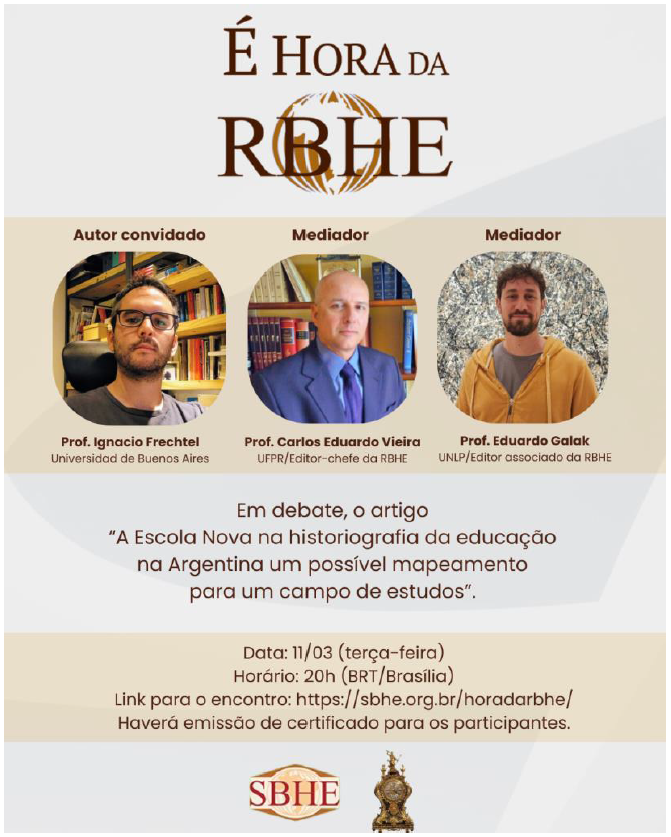
Based on these premises, in March 2025 we launched a bimonthly program entitled "It's Time for RBHE”. Broadcast online via Google Meet, the activity promotes meetings between editors and guest authors to discuss articles recently published by the journal. This activity aims to promote and disseminate the knowledge conveyed by the journal to an audience of specialists and laypeople interested in history and the history of education. From March to December, we held a total of five programs, always with the authors presenting their articles, moderated by RBHE editors, and with the possibility of interaction between researchers and the public. The bimonthly programs take place on Tuesdays at 8 pm, lasting exactly 60 minutes. Initial impressions are very encouraging, as the program has been embraced by the public, who have attended and participated actively. In addition to the event, the programs are shared on the social media of RBHE and SBHE and remain available on the journal's own YouTube channel (https://www.youtube.com/@rbhe-sbhe). Among those responsible for managing RBHE, the enthusiasm in preparing each program is remarkable, as we innovate and have been successful in this undertaking of enormous scientific and educational potential.
Above, we can see the program's first advertisement, featuring in its visual art the image of the 17th-century clock, destroyed by the coup plotters' attacks on the Palácio do Planalto on the fateful January 8, 2023. Once restored, this piece of public heritage art became a symbol of the resilience of democracy and its institutions in Brazil. For this reason, we adopted the old clock to symbolize the demarcation of time, which relates to the program's name, to the temporality inherent in history, and also to the defense of democracy.
Within the scope of these scientific dissemination actions, the continued production of press releases and pitches for the SciELO Blog, prepared by the authors of the articles themselves in partnership with the RBHE team, deserves special mention. The aim is to increase the visibility of published articles and to bring their results closer to diverse audiences. This practice, aligned with open science guidelines, integrates the journal into contemporary circuits of scientific communication and strengthens the public function of the periodical by translating, contextualizing, and disseminating research of high social and historical relevance.
Having presented the changes implemented throughout 2025, let's make some considerations about the routines. Volume 25 published 46 articles, two reviews, and two interviews. Among the articles, we had two thematic dossiers. The first was themed: Historical research on education during the period of the civil-military dictatorship, organized by researchers Eduardo Lautaro Galak, Elizabeth Figueiredo Sá, and Rosa Fátima de Souza Chaloba. This collection included 8 articles, and, according to the organizers, the dossier fulfilled an important function, since “education was one of the sectors most impacted by the authoritarian regime established in 1964 in Brazil, not only by the violence, repression and brutality directed at students and teachers but also by the uses that the military governments made of educational institutions and school culture as an instrument of control and ideological indoctrination” (Galak, Sá, & Chaloba, 2025, p. 1).
The RBHE editorial from 2024, the year of the anniversary of the 1964 coup, also addressed the problem of the dictatorship, revealing RBHE's willingness to problematize this sad episode in the country's recent political history. At that time, we highlighted aspects that are associated with what we are arguing now regarding the importance of scientific dissemination. We argued that "the 21 years of dictatorship left deep marks on Brazilian society, so that the memory and history of this period remain active, even in recent times, generating revisionist interpretations that, with less or no historiographical rigor, aim to glorify the experience of authoritarianism, regimes of exception, torture, exile, and death of the regime's adversaries" (Vieira et al., 2024, p. 3).
The second dossier dealt with Photography as a source of research for the History of Education. and it was organized by the researchers Maria Ciavatta, Maria Augusta Martiarena, and Olivia Morais de Medeiros Neta. This dossier brings together 7 articles, an interview, and articulates three issues:
(i) photography, this marvelous invention that has spanned time since the 19th century and delights our eyes, cell phones, computers, television and film media in the 21st century; (ii) its use as a research source, a document that answers our questions pari passu with traditional written and oral documents; (iii) and the History of Education, which accompanies humanity from generation to generation, shaping coexistence, culture, customs, loves, acceptance, disagreements and prejudices (Ciavatta, Martiarena, & Medeiros Neta, 2025, p. 2).
In this set of articles, we address a permanent theme in historical research, namely, reflection on sources and, in this case, a type of document that requires complex interpretation procedures.
Among the metrics of RBHE, we would like to analyze some numbers that say a lot about the recent functioning of the journal. First, we highlight the average interval of 158 days between the submission of manuscripts on the OJS platform and the final decision of the evaluation process, that is, about 5.2 months. 227 days is the average interval between submission and publication of accepted articles, that is, about 7.6 months. We believe that these numbers, when compared with journals in the broad area of Humanities, are very encouraging, since they positively respond to a widespread complaint from authors regarding the delays in the evaluation and publication processes of articles. The speed of the processes does not imply less rigor in the peer review of manuscripts and meets this fair demand from authors and readers.
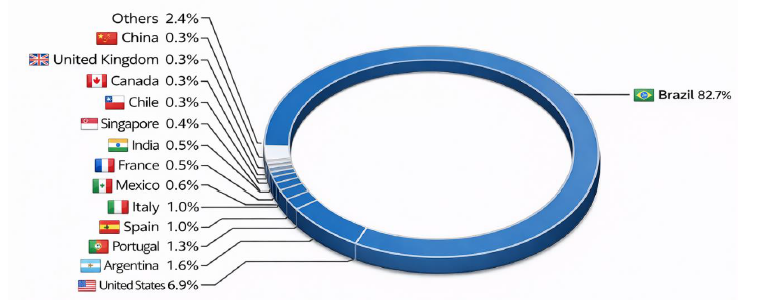
Another important point to highlight is that until 2024, RBHE published approximately 25% of its articles in bilingual versions (Portuguese and English). In 2025, we increased this to 78% of articles published in bilingual versions. We believe that in 2026 we will have even better numbers, as we are investing heavily in the internationalization of the journal. This process is a long one and will require daily work to obtain a return on this investment; however, the indicators of access to the journal reveal promising data, as we can see in the graph below.

Access origin indicators according to the Flag Counter installed in the OJS/RBHE (July 2022-October 2025).
Note that, for much of the period covered by the metric (July 2022 to October 2025), we maintained a moderate bilingual publication profile, with approximately 25% of the articles being bilingual. It was only between January and October 2025 that we substantially increased translations, so it is plausible to believe that the trend of RBHE's penetration abroad will expand in the coming years.
Finally, the actions reported in this editorial demonstrate that the adoption of open science is not limited to the incorporation of new procedures, but implies a reconfiguration of the processes of knowledge production and scientific communication in the field of the history of education. RBHE will remain committed to consolidating this agenda, strengthening the transparency, internationalization, and public character of education and history. Therefore, we invite the community to actively participate in this process by submitting manuscripts, following our initiatives, and contributing to the qualified dissemination of the knowledge produced.
References
-
Ciavatta, M., Martiarena, M. A., & Medeiros Neta, O. M. de. (2025). Fotografia como fonte de pesquisa para a História da Educação. Revista Brasileira de História da Educação, 25(1), e388. https://doi.org/10.4025/rbhe.v25.2025.e388
» https://doi.org/10.4025/rbhe.v25.2025.e388 -
Flag Counter. (n.d.). RBHE visitor statistics. Recuperado em 1º de novembro de 2025, de https://s01.flagcounter.com/more/4Poi/
» https://s01.flagcounter.com/more/4Poi/ -
Fundação Oswaldo Cruz. (2019). O que é ciência aberta? https://mooc.campusvirtual.fiocruz.br/rea/ciencia-aberta/serie1/curso1/aula1.html
» https://mooc.campusvirtual.fiocruz.br/rea/ciencia-aberta/serie1/curso1/aula1.html -
Galak, E. L., Sá, E. F., & Chaloba, R. F. de S. (2025). A pesquisa histórica sobre a educação no período da ditadura cívico-militar. Revista Brasileira de História da Educação, 25(1), e367. https://doi.org/10.4025/rbhe.v25.2025.e367
» https://doi.org/10.4025/rbhe.v25.2025.e367 -
Packer, A. L., & Santos, S. (2019, August 1). Ciência aberta e o novo modus operandi de comunicar pesquisa - Parte I. SciELO em Perspectiva. https://blog.scielo.org/blog/2019/08/01/ciencia-aberta-e-o-novo-modus-operandi-de-comunicar-pesquisa-parte-i/
» https://blog.scielo.org/blog/2019/08/01/ciencia-aberta-e-o-novo-modus-operandi-de-comunicar-pesquisa-parte-i/ -
Vieira, C. E., Galak, E. L., Gondra, J. G., Medeiros Neta, O. M. de, & Campos, R. D. de. (2024). História da educação e a história política. Revista Brasileira de História da Educação, 24(1), e245. https://doi.org/10.4025/rbhe.v24.2024.e245
» https://doi.org/10.4025/rbhe.v24.2024.e245
-
Funding:
The RBHE has financial support from the Brazilian Society of History of Education (SBHE) and the Editorial Program (Call No. 30/2023) of the National Council for Scientific and Technological Development (CNPq).
-
How to cite this editorial:
Vieira, C. E. et al. (2025). RBHE and the principles of Open Science. Revista Brasileira de História da Educação, 25. DOI: https://doi.org/10.4025/rbhe.v25.2025.e397en
-
Data availability:
All data generated or analyzed during this study are included in this published editorial.
-
Licensing:
This editorial is published under the Creative Commons Attribution 4.0 (CC-BY 4) license.
All data generated or analyzed during this study are included in this published editorial.

 Note. Source: adapted from Fiocruz (2019).
 Note. Source: Flag Counter (2025).