
 The schooling of the world through the lenses of the protestant missionary camera: snapshots of the Unevangelized Fields Mission (1931 - 1944)
Abstract
The study focuses on the contributions of the Protestant missionary camera in the formation of a transnational visual narrative of the school experience. To do so, it articulates a set of photographs produced as part of the educational project of the Unevangelized Fields Mission (UFM), between 1932 and 1944, which circulated through the journal Light and Life. The historiographical construction is inspired by conceptual propositions that deal with photography as a dynamic historical document that can be updated and has its own reading statutes. In conclusion, an analytical essay is presented on the visual traces of the UFM educational project, with the aim of contributing to a transnational visual history of education.
Keywords:
missionary photography; indigenous schools; protestant education; transnational visual history
Resumo
O estudo debruça-se sobre as contribuições da câmera missionária protestante na constituição de uma visualidade transnacional da difusão escolar. Para tanto, articula um conjunto de fotografias produzidas no âmbito do projeto educacional da Unevangelized Fields Mission (UFM), entre 1932 e 1944, cuja circulação se deu através do periódico Light and Life. A construção historiográfica inspira-se nas proposições conceituais que tratam a fotografia como um documento histórico dinâmico e atualizável, dotado de estatutos próprios de leitura. A título de conclusão, apresenta-se um ensaio analítico sobre traços da visualidade do projeto educacional da UFM, com o intuito de contribuir para uma história visual transnacional da educação.
Palavras-chave:
fotografia missionária; escolas indígenas; educação protestante; história visual transnacional
Resumen
El estudio se centra en las contribuciones de la cámara misionera protestante en la construcción de una visión transnacional de la difusión escolar. Para ello, articula un conjunto de fotografías producidas en el ámbito del proyecto educativo de la Unevangelized Fields Mission (UFM) entre los años 1932 y 1944, cuya circulación se dio por médio de la revista Light and Life. La construcción historiográfica se desarrolla inspirándose en propuestas conceptuales que consideran la fotografía como un documento histórico dinámico, actualizable y con estatutos propios de lectura. A modo de conclusión, se presenta un ensayo analítico sobre los rasgos de la visión del proyecto educativo de la UFM, con el objetivo de contribuir a una historia visual transnacional de la educación.
Palabras clave:
fotografía misionera; escuelas indígenas; educación protestante; historia visual transnacional
Introduction
The Protestant missionary camera stores a singular testimony to the spread of the modern school since the mid-19th century. As a historical phenomenon, the dissemination of Protestantism in that century is embedded in the shaping process of the Nation-states, in the establishment of universal interdependent relationships, and equally in the production of new ways of seeing and learning, which are boosted by the exchange of images. In this sense, photography, an artifact that began to circulate in a powerful manner from 1888 onwards with the popularization of the Kodak camera, would constitute a fundamental device in the connection and, at the same time, in the production and updating of worlds.
The Protestant missionary movement of the 19th century is considered the most expansive since the schism that occurred within Christianity in the 16th century. Following this assertion is the fact that, while the Catholic Church accompanied the colonizing enterprise from the outset, in Protestantism this shift would only occur increasingly with the gradual forging of human responsibility through the appeal to personal salvation. Thus, the individual touched by God’s revelation would come to feel and understand, in an increasingly vehement way, the burden of responsibility for the salvation of others across the ocean. Fundamental to this process was the establishment of the principle of God’s revelation to each person through a book, the Bible. Reading would then become a central strategy in this project of universalizing the Gospel message and, consequently, in the establishment of schools and literacy experiences wherever missionary Protestantism took root. Teaching everyone to read the Bible in their own language would constitute the main impetus both for the translation of the Scriptures into vernacular languages and for the shaping of educational spaces and reading devices in these multiple frontier projects (Mendes, 2023).
It was in the direction of such traits that Protestantism built their extensive image archives, whose testimonies show traces of the multiplicity of objectives, intentions, circulation of cultures, and modes of reception that underlie the rich visual history of the world’s education.
The aim of this study is to present aspects of the contribution of the Protestant missionary camera to the constitution of a transnational visuality of school dissemination. Taking as a starting point the perspective that photography constitutes an important documentary source for the history of education, this study presents traces of the photographic testimony of the evangelistic-educational project of the Unevangelized Fields Mission (UFM), a missionary society of English origin, organized in 1931, and which, during the established period, operated on 5 continents: South America, Central America, Asia, Africa and Oceania, respectively, in Brazil, Haiti, Baltistan, Indonesia, the Belgian Congo and in Papua New Guinea.
The objective is to map transnational evidence of the spread of the modern school in these images, also highlighting what can be characterized as features specific to the educational project of said Mission.
The insertion of the UFM in the time scope under study occurred mainly among peoples who did not yet know the evangelical message, especially indigenous peoples among whom there was no Protestant missionary work, hence its designation Unevangelized Fields Mission, an understanding that ignored the Christianization already carried out in these places through the Catholic missionary enterprise. In the field of education and reading practices, the agency worked on translating the Bible into indigenous languages, organizing schools and literacy centers, providing theological training to national religious leaders, as well as producing reading devices, engaging in canvassing and organizing bookstores.
The archive accessed for this research consists of 110 issues of the Light and Life (L&L) journal, the main news outlet of the UFM, which circulated primarily in Anglophone countries, according to the following excerpt: “We are not unmindful of the fact that Light and Life is read extensively in Canada, the United States, Australia and New Zealand, and it is always our endeavor to keep this fact before us.” (Our headquarter..., 1939, n. p.). The documentary material reached us via physical mail and was provided by the UFM central office in England. Although the received archive far exceeds the number of years and journals that will be worked on, the period from 1931 to 1944 was chosen, given the limitations of this study.
The journal was distributed via annual subscription, and its editions had a more or less permanent structure, consisting of an editorial from the central office in England, followed by news of the work in the fields, arranged in sections organized by continent, and information about the movements of the Mission’s management teams. The body of images in the journal related to school education, within the established scope, is composed of ten photographs, five of which were selected to make up the analysis presented in the third section, as they represent the central themes that span the series as a whole.
As already mentioned, the empirical analysis was conducted on a set of images that transcends the local context, thus requiring an assessment that takes into account the ideas of exchange, circulation, consumption, and transnationality. Since the 1980s, according to Jacques Revel (2015), the question “how can one think, how can one write a history on a global scale today?” has been insistently posed against a backdrop of globalization. The question seems absolutely pertinent given the spread of an institution with universal pretensions such as the school and, contextualized for this research, can be posed in the following terms: are there possibilities of conceiving a history of education that transcends national histories, starting from photographic images?
In this sense, it is necessary to highlight some theoretical and methodological points that were useful to the thought process in this composition. Firstly, the choice of the term transnational was mobilized referencing a perspective that situates the photographs found beyond the boundaries of a national history of education, without, however, considering them mere reproductions of foreign missionary images and intentions. Secondly, and following this proposition, it was considered that, although the UFM’s educational project is located within a larger current of global schooling, it articulates intentions, sub-projects, actors, institutions, and concepts that are unique to it. Thus, if, on the one hand, it was possible to think of common transnational traces within an image of global schooling contained in the analyzed snapshots, on the other hand, attention was paid to the characteristics and inventiveness of the subjects and projects that comprise them.
From the historiographical field of education, Rebeca Rogers (2019, p. 69), instead of limiting transnational history to a political geography, presents it as a stance, a perspective, “whose contours and methods are still under construction”. This understanding is particularly important for the reflection proposed here, since, while the images presented have as background encounters between different nations, on the other hand, the school experiences photographed take place among peoples originating that are alien to the concept of nationality.
In their study, The Transnational in the History of Education, Vera and Fuchs (2021) present a broad overview of theoretical and methodological approaches, research areas, and trends that permeate the history of education under the transnational conception, even though, according to the authors, they do not explicitly carry such a label. We are primarily interested in the premise that the concept is composed of several historical and social layers, ensuring it with a polysemy to which the historian must pay attention.
This proposal prompts reflection from a perspective of transnationality inherent to the Protestant missionary enterprise, which, among other characteristics, underlies the idea of universal humanity, albeit situated in different civilizational states, and the image of another who is in need of salvation. Transnationality arises from the creation of spaces intersected by the Christian religion, medical knowledge, and Western reading practices, whose political traces allow for a unique observation of cultural exchanges, negotiations, and appropriations that affect all its participants.
Methodologically, the research was undertaken through the following steps: 1) surveying of the school photographs that were presented in Light and Life between 1931 and 1944. In this stage, all images whose captions referenced the terms school and literacy, or that presented classrooms, objects of school material culture, teacher training, as well as those that could be included, even if lacking these descriptors, in the sequence of others related to the chosen themes, were identified; 2) cataloging of the images using the following descriptors: year, location of the image, theme, people photographed, photographer, and original caption; 3) arrangement of all the inventoried images, seeking in them general traces of the UFM’s production of a visuality of its educational project through Light and Life; 4) finally, the constitution of an analytical essay on the photographs found in the intersection with the general narrative of the journal, which is presented in the third section of the article.
Then, the following section will be dedicated to a dialogue with some already systematized theoretical and methodological propositions on the use of images in historiographical construction and which served as conceptual tools for empirical analysis. This manuscript also presents insights drawn from studies dedicated to images produced in missionary contexts, followed by aspects of the general context of the UFM’s educational project. Finally, as already mentioned, an analysis of the selected photographs is provided.
Missionary photography among modes of creating and consuming images
In the field of historiography, since the 1980s, the term visual turn has been used to refer to the broad status established around the testimony of images, which removes them from the position of mere illustration of the narrative. In the wake of the expansion of sources and methods and in dialogue with other fields of thought, images are increasingly understood as artifacts that possess their own statuses of interpretation and that demand a transdisciplinary approach in their use as a historical source. It is known that they are the result of social work in which the production of meanings is at stake and, therefore, underlying culturally conventionalized codes (Franco, 1993). It is also recognized that, in addition to being a witness to history, the image is history itself1 (Burke, 2004). Within this understanding, Nóvoa (2001) emphasizes that, while viewing images and reading texts are practices with their own characteristics, viewing texts and reading images are interdependent processes.
The effectiveness of these ways of seeing and working with visual documents is embedded within the context of other turns, such as the propositions of semiology in the field of linguistics. Thus, following assertions that language extends beyond words, articulating a whole system of signs, the photographic image, for example, was also shifted from the idea of a snapshot of reality to the condition of an index of what was once in front of the camera, whose interpretation occurs in relation to a subject who sees it and who is spanned by political, cultural, and historical conditioning factors. In the same vein, Dubois (2006, p. 26) proposed that photography, far from being a neutral mirror of reality, is “a tool for transposition, analysis, interpretation, even transformation of what is real, in the same way as, for example, language, and like it, is culturally encoded”.
Rich in cultural elements, photographic visuality has, since the 19th century, constituted different ways of seeing and “creating” worlds, hence its growing recognition as a unique historical source. Thinking about photography from the perspective of the cultural historiographical turn challenges us to perceive it as a device that possesses a historicity ranging from its technical composition, which includes the history itself of the photographic camera and image reproduction processes, to deeper aspects concerning its circulation and consumption.
André Rouillé (2009, p. 16), by situating the emergence and diffusion of photography within the context of industrial society and the updates that cause it to emerge and accompany it - that is, changes in the conception of space-time, the growth of metropolises, updates in the field of communications, and the shaping of democracy - determines that this context constitutes for photography its “condition of possibility, its main object, and its paradigm”. Expanding beyond the boundaries of industrial society, missionary photography would speak of other worlds and other rationalities, fabricating visual perceptions and narratives about them, equally traversed by diffuse power/knowledge relations.
Historically, photographic images have been used by Christian missions from various perspectives: as a tool for social denunciation2, to promote the work being done, as an eyewitness account of the needs for which material assistance is requested, and as a strategy for clarifying what one wishes to show. Regarding the spread of the school throughout the world, missionary visual testimony has been increasingly made available in virtual environments, ranging from library and missionary society websites to digitized albums circulating among private individuals, as well as sales pages that negotiate both the physical shipment of the image and its licensing for editorial uses. These exhibitions undoubtedly offer researchers with a keen and insightful perspective a broad visual catalog of such educational experiences.
On the one hand, it is observed that the images created in missionary contexts attested to the idea of space-time compression caused by technology; on the other hand, it is known that they also fabricated distances that, according to the discourse that accompanied them, would only be resolved by practices of Western modernity such as reading and writing, among others. However, under new theoretical and methodological perspectives that emerge from working with images, the visuality produced in missionary contexts can be re-signified from various angles.
In this sense, the invitation made by Walter Benjamin and reiterated by Didi-Huberman (2016, 2017) for an exercise of thought that makes things leave their usual places proves pertinent to the proposed exploration. Assembled and reassembled, restored and, at the same time, open and unfinished, historical knowledge through images, from this perspective, aims to elevate to other levels the complexity that results from the disarticulation of that which is habitual. This process not only brings forth new legibilities and spaces for thought, but also prompts the observer “to constantly take a stance in relation to the specific material and, consequently, to the images of history in general” (Didi-Huberman, 2018, p. 166).
In the field of international studies, the work of T. Jack Thompson (2004), in examining the constitution of Protestant missionary visuality about Africa, seems to support this analytical perspective, especially when articulating the concept of photographic manipulation under the principle that the photographic image is not simply a representation of reality, but also a transfer of a particular worldview held by the photographer. In this sense, the author highlights that the way Europe thought about Africa at the end of the 19th and beginning of the 20th centuries was, to a certain extent, shaped by the images reproduced in numerous journals, magic lantern slides, and missionary books.
Márcia Cristina Almeida’s research (2023), in exploring the processes underlying the visuality constituted between British missionaries of the Church Missionary Society and populations inhabiting the territory of Uganda between 1870 and 1920, highlights the multidimensionality that constitutes missionary visual artifacts, with the latter being traversed by ambivalences, diverse political-cultural spheres and a chain of relationships woven among social agents. From the conceptual possibilities presented in the research, the proposed discussion will make use, in particular, of the conception of the social biography of image that the author articulates in dialogue with other studies. Anchored in this understanding, Almeida (2023, p. 54) reiterates that images, in their diverse material forms, are observed “[...] in the light of their multiple ‘biographies’, that is, from their social displacements and appropriations”, a proposition that seems to us beneficial for understanding the social itinerary of the images presented further ahead.
Paul Jenkins (1993), when investigating the collection of the Basel Mission, a Swiss missionary agency created in 1815 and with significant activity on the African continent, discusses the unequal relationships, which not rarely cross institutional archives, between visual and written sources. By methodologically working with serial images, the author draws attention to changes in techniques, interests, and themes that can be identified in missionary photographic practices when one chronologically follows the photographic production of specific subjects. By cross-referencing sources, the scholar problematizes missionary perceptions of social and cultural environments, as well as the tensions and negotiations that arose around the visual production of indigenous peoples. Would it be possible to recreate similar aspects in the series analyzed here?
As components of a printed publication, the images presented in the next section are part of the photomechanical process, which has been perfected since the end of the 19th century, intended for the mass reproduction of photographic images, mainly in newspapers and journals. Regarding geographic location, the ten images cataloged in the first and second phases of the research are exclusively of the UFM’s school experiences among indigenous peoples of the Belgian Congo and of Brazil. Although the agency has records of schools in Haiti and Papua New Guinea, they are not shown in images in the journal during the established time frame. Among the ten images, five were selected for this study because they represent the general traits that span the larger set.
At the time of the established scope, Congo was being ruled by Belgium, which had taken control of the territory from Leopold II in 1908. Under the agreements of the Berlin Act (1885), the monarch had transformed Congo into private territory, establishing in it a colonial regime that is highlighted by historiography as one of the most violent. According to Munanga (2008), this reality would change little under the Belgian regime. The region was occupied by the Catholic Church, which represented the State and was therefore protected and subsidized by the metropolis, placing the UFM at a disadvantage compared to the Catholic enterprise.
The snapshots of the agency’s school experiments in Brazil coincides with the emergence of the Vargas Era and the entire discursive confluence that began to revolve around the Brazilian indigenous people at that time. The period was marked by the constitution of a rhetoric of nationality that, through a generic conception of indigenous peoples, presented the natives as an example of bravery, tenacity and resistance to foreigners since colonial times, making them the ideal of a legitimately national identity (Garfield, 2000). Based on the broader narrative of Light and Life, it is possible to state that there was also a strong discursive circulation within the transnational context of the UFM regarding the indigenous peoples of Brazil. Lost in the dark forests of the Amazon, it was urgent that the Gospel be presented to these peoples, according to the missionary rhetoric of the agency. The outreach to indigenous peoples constitutes, in the history of the Mission, the primary reason for its undertaking in Brazil, and it was only with the prohibition of foreign presence in indigenous villages, in the early 1940s, that the UFM would extend its action more consistently to urban contexts.
Snapshots of the UFM’s educational project: between clips, montages and captions
Photographic activity emerges for the first time in the analyzed documentation within a text that recounts the journey of a missionary couple sent by the UFM to Shigar, in Baltistan. The narrative is filled with information about the challenges and suffering faced on a journey undertaken in 16 stages, during which, according to H. Bavington, they crossed swamps, forests, snow-covered stretches, and a desert. It is described that, to transport baggage, and also two 15-month-old twin babies, 1,376 coolies3, 560 ponies, and 324 men leading the ponies were needed. At one point in the report, the missionary says he took “several very good photos of the trip” and that he hopes to send them in the next postal service, a reference that indicates both the existence of a portable camera during the journey and a possible undertaking of developing the images himself (Bavington, 1931, pp. 30-31).
Interestingly, interspersed within the narrative entitled Strenuous Journey to Baltistan are two images of missionaries from the agency who were working in the Amazon during the same period. In the first image, one of them is seen lying in a hammock, calmly reading a magazine next to a large bunch of bananas, under the caption Amazonian luxuries. In the second image, whose caption reads Another luxury in Amazonia, five missionaries, all men, smile at the camera while bathing in a waterfall. A paradoxical composition that interrupts the sequence of themes and things through the montage that suspends the cliché, borrowing the expression from Georges Didi-Huberman (2016).
The presentation of contrasts that mess up texts, images, and geographies, shaping ways of seeing and reading, constitutes an important editorial hallmark of Light and Life - intentional or not - and will be equally articulated in the arrangement of school photographs presented in the journal, although not necessarily to suspend things from commonplaces, but, on the contrary, to reaffirm their positions in a visual portfolio that has long been shaped by the European gaze.
While these arrangements, in themselves, constitute a unique picture, full of absences, rich in contrasts and heterochronies that stimulate thought and analysis, they are also marked by difficulties and, sometimes, impossibilities in identifying the circumstances of the images’ production, as well as the photographers and the subjects portrayed, as we will see throughout the study. This fact adds new perspectives to Jenkins’ observations (1993) on the unequal conservation relationship between visual and textual archives, since, even when preserved by being inserted in a reading device, photographs can remain silenced in many aspects.
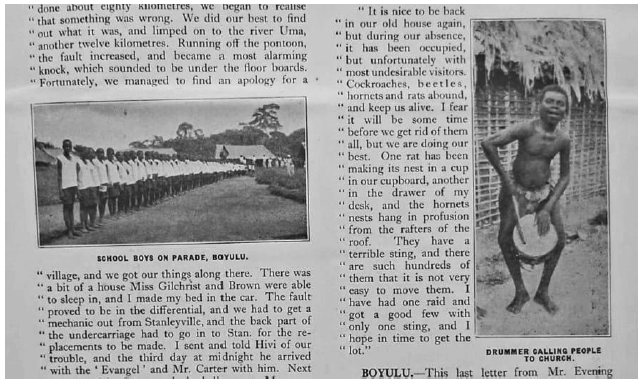
The following clip, Figure 1, shows a composition in which visuality immediately presents paradoxical elements, through which the Mission's role as a mediator and shaper of new realities in the Belgian Congo is affirmed. However, under other possible interpretations, significant elements can be observed in the same montage that also point to other modes of subjectivation that constitute the local cultures and the bodies photographed.
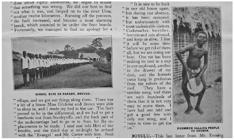
The two images are placed within a text that narrates the return of a missionary couple from England to Congo, their passage through various villages in the region during their return to the missionary station where they worked, as well as the condition of their own residence, infested with wasps and rats. The text only indirectly mentions the schools of Boyulu, the region that gave its name to the UFM’s missionary station where several communities lived, organized in villages. There are no direct references in the narrative to the percussionist on the right, or even to the missionary station school to which the students on the left belonged.
As one can see, the montage presents a clash of worlds in which bodies assume different positions and gestures, complemented by the display of cultural elements that equally speak of the politics that permeate them. From a foreign perspective, the pairing of the figures recalled the already familiar before-and-after tactic common to the missionary visuality circulating at the time. This visual strategy presented the contrasts between an uncivilized pagan world and the success of Christian missions through references that could be compared using images placed side by side.
The reference to the school uniform emphasizes the shaping of new processes of subjectivation and new relationships with the body. As part of a regime of appearances (Dussel, 2005), the bodies dressed in uniforms of the Boyulu schoolboys also expressed the boundaries between the missionary school and its immediate surroundings, reinforcing the idea of a project that intersected discipline, hygiene, moral purity, and a civilizing ideal.
When placed within the intersection of sources, the image also speaks of a visuality serving the approval of the Belgian inspection that supervised the Mission’s actions in that context. A 1932 report, for example, highlights the importance of school uniforms in the eyes of that inspection during the process of granting Personnalité Civile status to the agency, with a request for financial assistance to purchase uniforms for the boys who arrived at the station dressed in old rags, according to the same account (Evening, 1932, p. 5).
The body dressed in uniform, arranged in a long line and stiffening in pose before the photographic device, is presented alongside another that maintains its plasticity and movement and that does not appear as a “before,” but as one that inhabits the same present, this one seemingly full of negotiation of meanings. In the European visual regimes, the percussionist’s props and gestures were nothing more than a reconstruction of the fantasy about this other, whose civilizational state needed to be overcome, thus justifying the Mission’s work.
The Belgian flag, a symbol of order and dominance, intersects in the cutout with the drum, a significant cultural artifact and means of subjectification for the people of Congo. While the first reference points to the UFM’s complicity with Belgium’s colonization project and all that this meant in the organization of its schools, regarding the drum, the journal’s broader narrative contains considerable cultural references that speak of other educational rationalities.
From this context, it is possible to hear not only about the centrality of this artifact in the communities surrounding the Boyulu station, but also about its sophistication as a communication tool. The drum is presented in Light and Life as the telegraph of Congo, a device through which it was possible to tell an entire story and circulate messages from one village to another, whose creation was carried out through a complex and intricate ritual.
The caption inscribed on the image of the percussionist, informing about the summons, through the drum, to Christian worship, can be read under the signs of the negotiations to which the new cultural and learning processes were subjected. These references demonstrate how permeable and adaptable visual and textual narratives are, which, although elaborated with specific intentions, when revisited from new perspectives, can even serve to reconstruct indigenous knowledge and cultural artifacts, thus reaffirming the place of photography as a document open to successive and new articulations, as well as to new political projects.
Through the interweaving of sources, new nuances were added to the visuality produced in the montage, revealing traces of the complexity underlying its creation. From the broader narrative, it is known, for example, that while the drum undeniably fascinated the foreign missionary, it is equally known that he abhorred an instrument that stimulated the body. Thus, in the following excerpt, the bell is evoked as a substitute for the drum, even in the call to Christian worship, suggesting the forgetting and replacement of black people’s history by suppressing their musical instrument at the missionary station:
And so far as the Congolese are concerned, what is older than their wooden drums? Used for signalling, these seem to be as old as the history of the black man. Used by the missionaries, they call the people to prayer day by day and Sunday by Sunday. But what could be newer than a bell to make the call to prayer? It is something new to go with the New News or Good News that we have come to tell. The drum signaled mostly the call to the dance with all its accompanying immorality-the bell only sends out its one message- come to prayers, come to the teaching, come to the Station and hear the things of God (Kerrigan, 1941, n. p, our translation).
As in the clip, the excerpt presents seemingly irreconcilable clashes between worlds and histories. The Christian good news is presented as the antithesis to the history of black people’s history; the bell as an instrument that would replace the drum; the body that prays and dedicates itself to listening to God’s message in stark opposition to the body that dances and consequently indulges in immorality. As a point of reconciliation, there is the ordered and disciplined body of the schoolboy performed in the montage, which is full of unique nuances that emerge from the various intersections between subjects, projects, and contexts that make up the UFM school in the Belgian Congo.
Side by side, photographs, montage, and texts draw attention to an evangelistic-educational project marked by singularities and violence. However, under new perceptions, other perspectives are added to the initial intentions of such visuality and can liberate the present moment “from the destructive cycle of repetition”, thus affirming the possibility “(...) of taking from the discontinuity of times the chances of a reversal” (Didi-Huberman, 2016, p. 4).
As in the previous cutout, the following image, Figure 2, presents traces of the gender relations that permeated the agency’s educational project in Congo, as well as vestiges of the economic and material conditions under which it was constituted, in addition to reinforcing a visuality that connects it to the Belgian colonial regime and the Anglophone Protestant domain.
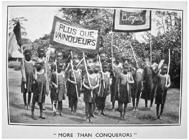
The phrase that intersects image and caption in French and English - plus que vainqueurs; more than conquerors - has, in its reference to a biblical passage4, the affirmation of a Christianization project that, according to the Mission’s discourse, superseded any other. In other words, the articulation of the two languages serves a message that is intended to be superior, universal, and aseptic to any cultural construct. Even the Belgian flags, though numerous, appear visually secondary to this message. From another perspective, however, it is possible to speak of a montage that delivers symbolic elements of European dominance through the confluence of the political and the religious.
The photograph portrays 17 schoolgirls from Boyulu station, whose uniforms feature a type of pocket/emblem on the left side of their chest. All dressed in uniform, the female students, just as the male students in the first cutout, are also barefoot, an absence that dialogues with a kind of transnational image of the unequal economic conditions in which the world’s schooling has taken/takes place.
The image is found within a two-paragraph text by Canadian author Verna Schade, which states that, since returning from the Christmas holidays, the mission station had been enjoying a swing for the children, a new dormitory and a new school for the girls, as well as a house for a native couple who would act as guardians for the schoolgirls. It was also reported that, of the 22 girls who were part of the family, only 17 had returned from term break and that, suddenly, six had left, a shortfall that was beginning to be remedied by the arrival of two new students at the boarding school (Schade, 1938).
The text presents significant elements that resize the reading of the photograph in question. As explained, it is known, for example, that six of the girls in the image were no longer at the station’s boarding school, as they had left. Elsewhere in the journal, it is also noted how volatile the attendance or length of stay of children in UFM school spaces in Congo was. Escapes, the start of seasons like fishing or caterpillar hunting, or simply the will of the children themselves or of their parents could interrupt the stay of boys and girls in the Mission’s educational program, which ended up giving it a character of profound discontinuity, as shown in the following excerpt, according to which, among other pieces of information, out of the nine girls staying at the boarding school at that time, only two were there with the consent of their parents:
With regard to the work amongst girls, the number on the register varied during the year from 7 to 14. Only two of these remained all the time. Altogether, 26 have received instruction for varying periods. The attendance has been very irregular, owing to the fact that the girls are frequently taken by the older people to the forest field or water. They are supposed to ask permission but do not always do so. This year there seem to be better prospects, for although there are only nine scholars, they are all living on the Station, and two of them have come with the consent of their parents to be our first girl boarders. (The Jenkinson..., 1936, n. p.).
Another backdrop to the photograph, presented within the overall context of the journal, concerns the condition of girls in local cultures. Missionary records speak of negotiations by their families shortly after their birth, which, according to the narrative, meant the sale of girls to older, polygamous men. The underlying economic organization of the practice highlights the central role of women in agricultural cultivation, as they were responsible for local farming.
Thus, according to the documentation, as soon as these girls reached a certain age, the colonizing company arranged for them to be sent away from the station to get married, an order that, according to the following excerpt, was late in relation to the families’ urgency in removing the girls from these spaces, signaling a multiplicity of disputes that are reflected in the photograph presented:
We are very burdened for those about to be married. When the government official counts them ready for marriage, they are sent off, although the village people would send them away long before if we did not protest. Each month our girls whose villages are far away, are allowed a weekend visit to their parents. For several months two of them refused to take this holiday. When asked the reason, they replied: ‘‘We do not wish to go because our parents want us to go away on trial to our prospective husbands, or stay in the forest, and we do not want them.” These men are already quite old and haye several other wives, and some are Roman Catholics. (A strange burial..., 1937, n. p., tradução nossa).
The text presents traces of the tensions experienced between the missionary enterprise, the local culture, and the colonizing company, a situation that could be elevated to new configurations by the girls’ own rejection of the Mission’s project. In this sense, if in the previous excerpt the students are presented as responding positively to the agency’s intentions, in the next one, missionary disappointment is observed through other reactions:
After the Conference, when many children came in from the villages, I rejoiced when taking over the work, that the number of girls in the school was double the amount with which Miss Schade had closed before the holidays, but my joy was to be short lived, because only last Saturday, five of my girls ran way. They may, of course, come back, and I am praying with my whole heart that they may. You may ask why they ran away, for they were, I am quite sure, happy on the station. The old urge for their village life was too strong for them, and they could not resist it. They haye never been used to any discipline whatsoever in their life before. Life to them was just getting food and cooking it, and then doing nothing. It seems much harder for the girls to sit down and try learn to read than the boys. (First impressions, 1939, n.p.).
A fresh look at the photograph, from this background, removes any possibility of calmness, even resizing the positivity of the textual message centered on it, as well as the image of unwavering complicity between the interests of the UFM and of those of the colonizing company. Information that reinforces the idea of an intentional creation of a visuality that could never be considered a faithful reflection of reality. Significant cultural, political, religious, and economic disputes were being waged on the stage where it was being forged. The snapshot of the six girls who were no longer at the station, alongside the others who remained - it is unknown for how long -, their bodies, gestures, gazes, and self-agency, nevertheless remain as witnesses to a complex context in which they, too, played an undeniable leading role.
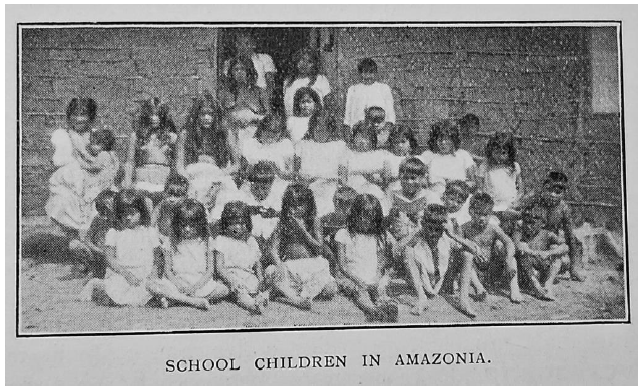
The following image, Figure 3, circulated in Light and Life in June and July 1932 and, according to its caption, depicts a group of schoolchildren in the Amazon.
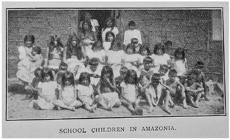
The photograph is embedded in a text whose content makes no reference to it; it does not even mention it. Under the title, Christmas Day Among the Red Skins, the narrative describes, mainly through the use of notes from the diary of missionary Robert Story, the preparations for a Christmas celebration at a mission station that has the Gurupi River, located in the states of Pará and Maranhão, as a geographical reference, and the Amazon, as its geo-missionary area. Finally, the report makes the following mention: “Several Tembé families are building in the mission station” (Story, 1932, L&L, p. 12) - a reference that cannot be taken as certainty of the ethnic belonging of the group portrayed, since, as already stated, the text does not mention the image and, moreover, according to the broader report of the journal, the Mission maintained, during the same period, other schools among different ethnic groups.
It is important to highlight, however, the richness of other data in the image, such as its caption - Schoolchildren in the Amazon -, its temporal record - 1932 -, its agency - a Protestant missionary company -, and the ethno-cultural traits that it presents, even if opaque, given the quality of the reproduction, are powerful enough for an attempt to reconstruct traces of that school experience.
Although the photo caption only mentions children, the presence of young people and adults, albeit in smaller numbers, can be observed in the image. This generational homogenization can be traced back to the classic European understanding of uncivilized peoples as being reduced to a state of childhood, as expressed in Rudyard Kipling’s poem The White Man’s Burden (1899).
The image repeats a format already established in transnational school photographs of the time, in which students, from smallest to largest, are arranged in planes and different positions and on different surfaces. Thus, by connecting caption and pose, it is possible to consider the forging of a discourse through the use of previous visual models that composed the European gaze. This composition, also known as classroom photograph, emerged in Europe in the mid-19th century (Wagnon, 2019) and, as an artifact that accompanied the spread of the modern school, constitutes a rich documentary source for a political, cultural, and material history of school education.
In school images similar to the one shown, the teacher usually appears in the center of the composition or at the ends of one of the rows of students, which, legitimately, can raise the question about the adult woman holding a child in her arms on the left side of the second row. Was she a teacher or assistant, or, simply, like other school experiences in Brazil at the time, just an adult participating in a multi-grade literacy class? (Fagundes & Martini, 2012).
The features and accessories that the image reveals of the participants, in conjunction with its caption, make it possible to say that it was a class of indigenous students. In this regard, it is observed that, next to the woman with the child in her arms, in the third row from the left, two teenage girls are wearing indigenous headdresses. Adding to this detail are the exposed breasts of the same girls, along with a third, older woman whose breasts are also bare, complementing the important message of the exotic and the primitive, powerful for satisfying European curiosity and justifying their sponsorship of a project that intersected salvation and civilization.
The richness of the photograph does not end there, when one observes the encounters and contrasts that compose it. Thus, if there is the presence of headdresses and uncovered bodies, there is also the presence of the reading device in the children’s hands. In the center, some girls, positioned directly to the right of the aforementioned female students, appear to be engrossed in reading, while the third boy from right to left in the second row, seemingly the only child smiling in the photo, holds up a book in his hands. This book is a central tool of the modern school system, but also of missionary Protestantism.
Unlike school practices in Congo, UFM’s educational experiences among indigenous peoples in Brazil are documented without any reference to government inspections. These experiences are marked by indigenous nomadism, which exponentially called into question any idea of continuity, of serialization, of long-term records. In addition to the ephemeral nature of these schools, the missionary interest was primarily in literacy for reading the Bible, which, viewed superficially, may seem simple and insignificant. It was not.
The literacy work carried out by the agency among these peoples took place concurrently with the translation of the biblical text, the main reading tool used in these classes. Furthermore, there are references to the composition of songs in local languages, to grammar books, as well as to literacy books to be used in literacy classes (The story..., 1944). Processes whose complexity, among other practices, meant a turning over of the linguistic foundations of these peoples through the insertion of new ways of seeing and relating to the world and to their own culture.
The next image shows traces of the Mission’s school experience among Kayapó boys. This is a photograph that circulated in Light and Life in January and February of 1944, included in the body of the Amazonia section, which presents the sequence of the Mission’s actions up to 1944, taking as its starting point the work of missionaries who, since 1923, had been working among indigenous people in Brazil.
The immediate references surrounding the image indicate that, in 1941, the agency opened a school among the Kayapó indigenous people who inhabited the Xingu area. It is also narrated that the year 1943 marks the continuation of Horace Banner’s school work with boys from that community, among whom were “[...] the children of some of those who murdered the three Freds” (The story..., 1944, n.p.), important information underlying the shaping of that school experience, and which we will discuss later.
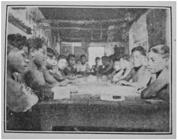
It is possible to notice that this is a countryside photograph (Figure 4), which is likely the reason for its compromised quality, in which 13 boys, mostly shirtless, are gathered around a table on which reading devices can be seen. While several boys stare at the photographer, the first ones observe the books on the table. The teacher’s place is likely empty, despite the caption referencing it.
The blurry photograph intrigues the viewer by not allowing the identification of a painting on the wall in the background, as well as other props present in the image, which appears to be devoid of elements that could connect it to indigenous material culture. Once again, the cross-referencing of sources allowed for the reconstruction of significant information about the existence of this school experience which, like so many others in the history of indigenous education in Brazil, remains unknown.
In a letter presented almost in its entirety, from 1943, Horace Banner speaks of this school which, at the time, was composed of 25 Kayapó boys - almost double the number of boys who appear in the photograph above -, in addition to presenting references about the construction of the missionary station and aspects of the daily life of that indigenous boarding school with its own characteristics:
The Kayapo boys have done everything; very literally, they have re-built their own Mission Station. Together we have built walls, thatched roofs, made and erected fences, cleared forest for planting, raised crops of rice, beans, maize and manioc; we have our ducks and hens; we fish and hunt; we are our own cooks, barbers, tailors, doctors, food-growers, etc. We all live in one big house, though the missionary has a wing to himself. The main hall serves as dining-room, school, and chapel-at night sleeping half the boys who sling their hammocks from wall to wall. (Banner, 1943 n.p.).
The centrality of elements of school practices shown in the photograph is complemented in the text by information about the spatial configuration of the missionary station and aspects of a daily life in which the Kayapó students articulated knowledge from their own culture while acquiring others through contact with the foreign missionary. It is equally plausible to consider that Horace Banner acquired new knowledge by interacting with those boys.
That same year, seven months after the exhibition of the photograph above, another image of the Kayapó boys is presented in Light and Life. Unlike the previous image, in this one, the students, alongside Banner, pose for a photo that is clearly planned, as one can see below in Figure 5:
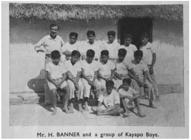
As one can immediately see, the photograph depicts 13 boys and an adult man in front of a thatched-roof house, whose caption, perhaps written by the journal’s editor, reads: “Mr. H. Banner and a group of Kayapó boys.” In the image, the bodies are clothed and take on new positions and gestures, and, similarly to figure 3, seem to repeat the pose for school photos from that time.
It is observed that the photograph, if it were not for the inscription and phenotypic characteristics of the children - identified only by a familiar eye - does not present any reference to the indigenous culture of those portrayed, and it is only when placed subsequently to the previous photograph that it becomes known that its components were the indigenous boys studying at the missionary station shown above.
The connection between the two photographs was further enriched by a third encounter. While searching for visual references of the UFM on the internet, we came across a sample of the same image on the website of the Laboratory of Image and Sound in Anthropology of the Department of Anthropology (LISA) at the University of São Paulo (Figure 6).
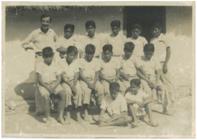
The information accompanying the image in this repository is a significant sample of the possibilities for updates that can be performed on the photographic document through the texts that are added to it during its travels and updates (Edwards, 2023). Thus, while in Light and Life the photograph is presented under elementary references, on LISA’s page new information emerges about its constitution through the exposure of references contained in the inscription on the back of that copy, besides the addition, by the website, of other texts. This interweaving of sources certainly enriches the social biography of the aforementioned image and the history that runs through it by expanding information about its circulation, experiences, agencies, and the subjects that compose it.
KO-KAYAPÓ GOROTIRE-0001. A posed photo of indigenous people dressed in Western clothing. The photo shows the Kayapó leader Kanyonk and others who would later become leaders. Next to him is Horace Banner, a white missionary. Code KO-0001.
Photographer/author: Eva Banner. Support: Paper. Dimensions: 08 X 11. Country: BRAZIL. Orientation: Horizontal. Conservation: Regular. Collection ---. Copies in the archive: 1. Color: B/W. Year of production:194- Location: AI Kayapó. Gorotire village. Notes: Writing in the back: “Horace Banner. Early 1940’s. Gorotires. Chief Kanyonk is on the pictures and others became Kayapo leaders. - Eva Banner (Mrs).” State (FU) of production: PA. Origin/Donation: Lux Vidal. (Ko-kayapó... LISA).
From the outset, it is known from the LISA records that the photograph was taken by Eva Banner, wife of Horace Banner, whose work is silenced in Light and Life, similarly to the omission of the work of other women who were also wives of missionaries during that same period. Horace, for example, is the one who signs all the reports and texts published in the journal about the work carried out. However, in LISA’s digital archive, it is possible to find more photographs under Eva’s signature, prompting future research into her photographic practice.
One of the pieces of information accompanying the snapshot, donated by Professor Lux Vidal from the Department of Anthropology at USP (University of São Paulo), is noteworthy for the addition made to the information written on its back, as shown in the image on the website. Thus, we replicate once again the text inscribed on the back of the photograph, whose composition, judging by the English inscription, may be by an agent of the Mission, possibly Horace or Eva Banner, followed by LISA’s additions:
Inscription on the back of the image: Horace Banner. Early 1940s. Gorotires. Chief Kanyonk is on the pictures and others became Kayapo leaders. - Eva Banner (Mrs). (Ko-kayapó... LISA).
LISA’s presentation text: A posed photo of indigenous people dressed in Western clothing. The photo shows the Kayapó leader Kanyonk and others who would later become leaders. Next to him is Horace Banner, a white missionary. (Ko-kayapó gorotire... n.p., our highlights).
As one can see, part of the inscription on the back of the photograph was used in the website’s presentation to create a new description. These constitutive dynamic draws attention to the generation of the captions and descriptors that are put together with the photographic images, sometimes adding political and cultural perspectives not foreseen in their production, and which are nonetheless an attempt to pre-shape the gaze. In the reference in question, certain elements of the image are highlighted in such a way as to make it, before any other possible interpretation, a visual expression of white and Western cultural domination over indigenous peoples. The text, on the other hand, generalizes the boys’ belonging to a supposed indigenous ethnic homogeneity, except for the reference to Kanyonk.
The inscription in English on the back of the copy presented by LISA allows for the formulation of hypotheses about different temporalities between the creation of this text and the production of the image. It can be observed, for example, that Kanyonk and other boys are mentioned as already being leaders: “The photo shows the Kayapó leader Kanyonk and others who would later become leaders.” An important visual reference that relates to the agency’s strategy of working with boys, in the sense of preparing them for evangelical work among their own people, as seen in the excerpt below:
Not a very big job, perhaps, in these days when manpower is so scarce and other opportunities so numerous. These boys, however, have a special worth. They represent most of the fruits of the witness launched by the Three Freds and carried on under such difficulties until now, and at the same time most of our hopes for the future of the Kayapo tribe.
Fifteen months now separate this little flock from sheer savagedom and the grace of God is getting into their hearts, as enter it must if they are to withstand the heathen onslaught when eventually it comes. (Banner, 1943, n.p.).
The excerpt presents part of a larger visuality that formed the basis of that educational experience, whose inspiration was pastoral care - a characteristic that historically permeates Western teaching and which, in that context, acquired unique contours (Mendes, 2023). Separated from the “pure savagery” of their people, the boys were prepared for a reunion with Kayapó paganism, which they were to resist. Not only that, but to surpass it, because, as potential future leaders, they represented the hope of the Mission.
According to the narrative, among those boys were the sons of the murderers of three UFM missionaries, which adds further information about the context in which that educational experience took place. In 1935, the murder of Fred Roberts and Fred Dawson, both Australians, and the Irishman Fred Wright, by the Kayapó people in the Xingu, would be widely circulated news5, whose impact can be described from several angles: from the increase in evangelical fervor, which would spur the arrival of more missionaries to Brazil through the agency, to the rise in financial contributions for the missionary work carried out. It was only in 1938 that the UFM managed to open a station among the Kayapó, and in that same year, the first grammatical guide in the Kayapó language was compiled by Horace Banner.
It is within this context that the Kayapó school depicted in Figure 4, whose students reappear in Figure 5, emerges in the inscription of Figure 6 as an experience from which results were expected; after all, Kanyonk and other boys who were part of it went on to become leaders of their people.
Final remarks
Throughout this study, photography has been presented as an important document for constructing a visual history of school education, with highlight to the perspective of a transnational visuality that permeates the schooling phenomenon. As an empirical field, the photographic record of Protestant missions stood out, recognized for their prolific role in the global dissemination of school experiences and practices since the 19th century.
The study evidenced photography as a polysemous cultural artifact that can be updated and possesses its own statutes of interpretation. With regard to photographs of Protestant school experiences, it was highlighted that, while initially such artifacts circulated with the aim of strengthening transnational support networks, currently, under new analytical perspectives, these documents offer relevant traces of distinct visual and educational rationalities in the world’s schooling. Repositioned, these same clues can boost the emergence of new historiographical configurations.
The research, by focusing on a collection that transcends national boundaries of production, circulation, and consumption, required the construction of the concept here designated as the transnational visuality of education, in order to refer to ways of seeing and producing images of school experiences and practices that move between cultural, political, and historical contexts. Thus, the contribution of the Protestant missionary camera to this visuality was articulated, based on the premise that missionary records preserve not only shared traces of global schooling, but also specific vestiges and tensions of the projects, subjects, and contexts that constitute them, remaining, therefore, open to resignification.
Analyzed as a series, the visual repertoire of school experiences created within the context of UFM’s contacts with indigenous peoples of the Belgian Congo and of Brazil gave rise to some insights into the encounters, experiences, and power relations underlying its production and circulation.
Firstly, it should be noted that the initial hypothesis that the images of UFM’s school experiences would mostly focus on reading practices and devices was not confirmed. It is the bodies of boys and girls that emerge most powerfully in this visual representation, as the primary target of Christian and school discipline and civility, even though reading is not a minor theme in these images.
Secondly, it should be emphasized that the images analyzed, although spanned by power relations that defined framing and poses aimed, among other intentions, at producing a specific perspective on the subjects and contexts photographed, constitute historical sources that transcend this intentionality. Thus, by recording artifacts, material conditions, gender relations, and other aspects, these photographs compose a transnational visual circuit that documents not only vestiges of modern schooling and missionary purposes, but also specific conditions of their production, as well as traces of the agency of the subjects portrayed.
Thirdly, the power of school photographs in giving visibility to silenced narratives is worth highlighting. When disassembled, removed from their usual places and reassembled under new relationships, images and discourses - including by the very subjects who compose them - they can give rise to new possibilities for the present and the future.
Finally, it is observed that the cross-referencing of sources was fundamental to articulating photography from the perspective of a document open to successive and new updates, without, however, treating it as a historiographical document of secondary importance when placed in correlation with other types of sources. Following this proposition, it is underscored that there are traces of the history of education that can only be accessed through photographic images.
References
- Africa. (1936, May). Light and Life, (5).
-
Almeida, M. C. P. F. (2023). Imagens em missão: colonialismo, visualidade e prática missionária em Uganda (1870-1920) [Tese de doutorado, Universidade de São Paulo]. Repositório USP. https://www.teses.usp.br/teses/disponiveis/8/8138/tde-26042024-121059/pt-br.php
» https://www.teses.usp.br/teses/disponiveis/8/8138/tde-26042024-121059/pt-br.php - A strange burial service. (1937, November). Light and Life, (23).
- Banner, H. (1943, July/August). Light and Life, (61).
- Bíblia Sagrada. (2007). Nova Versão Internacional. Editora Vida.
- Bavington, R. (1941, July/August). Strenuous journey to Baltistan. Light and Life, (53), 34.
- Burke, P. (2004). Testemunha ocular: história e imagem. EDUSC.
- Didi-Huberman, G. (2016). Remontar, remontagem (do tempo). Caderno de Leitura, (47), 1-7.
- Didi-Huberman, G. (2017). Quando as imagens tomam posição. Editora UFMG.
- Didi-Huberman, G. (2018). Remontagens do tempo sofrido. Editora UFMG.
- Dubois, P. (2006). O ato fotográfico e outros ensaios (4ª ed.). Papirus.
-
Dussel, I. (2005). Cuando las apariencias no engañan: una historia comparada de los uniformes escolares en Argentina y Estados Unidos (siglos XIX-XX). Pro-Posições, 16(1), 65-86. https://www.fe.unicamp.br/pf-fe/publicacao/2292/46-dossie-dusseli.pdf
» https://www.fe.unicamp.br/pf-fe/publicacao/2292/46-dossie-dusseli.pdf -
Edwards, E. (Entrevistado). (2023). Fotografia, história e antropologia: uma entrevista com Elizabeth Edwards (A. M. Mauad, Entrevistador). Tempo, 29(1). https://doi.org/10.1590/TEM-1980-542X2023v290116
» https://doi.org/10.1590/TEM-1980-542X2023v290116 - Evening, D. V. (1932, June/July). A short message re shorts. Light and Life, 1(6).
-
Fagundes, J., & Martini, A. C. (2012). Políticas educacionais: da escola multisseriada à escola nucleada. Olhar de Professor, 6(1), 99-118. https://revistas.uepg.br/index.php/olhardeprofessor/article/view/1394
» https://revistas.uepg.br/index.php/olhardeprofessor/article/view/1394 - First impressions. (1939, January). Light and Life, (37).
-
Franco, M. C. (1993). A fotografia como fonte histórica: introdução a uma coleção de fotos sobre a “Escola do Trabalho”. Educação & Revista, (18-19), 27-38. https://periodicos.ufmg.br/index.php/edrevista/article/view/45047
» https://periodicos.ufmg.br/index.php/edrevista/article/view/45047 -
Garfield, S. (2000). As raízes de uma planta que hoje é o Brasil: Os índios e o Estado-Nação na era Vargas. Revista Brasileira de História, 20(39), 15-42. https://www.scielo.br/j/rbh/a/5WGW9qddWRkHSnkrckzLHrx/?format=pdf⟨=pt
» https://www.scielo.br/j/rbh/a/5WGW9qddWRkHSnkrckzLHrx/?format=pdf⟨=pt - Jenkins, P. (1993). The earliest generation of missionary photographers in West Africa and the portrayal of indigenous people and culture. History in Africa, (20), 89-118.
- Kerrigan, G. (1941, July/August). Things new and old. Light and Life, (53).
- Kipling, R. (1899). The White Man’s Burden. McClure’s Magazine, 12(2), 290-291.
- Ko-Kayapó Gorotire-0001. (n.d.). LISA. Ko-Kayapó Gorotire-0001.
-
Mendes, E. S. N. (2023). Protestantismos e a experiência transnacional da Unevangelized Fields Mission: as práticas de leitura em foco (1931-1965) [Tese de doutorado, Universidade de São Paulo]. Repositório USP. https://www.teses.usp.br/
» https://www.teses.usp.br/ -
Meneses, U. T. B. de. (2003). Fontes visuais, cultura visual, história visual: balanço provisório, propostas cautelares. Revista Brasileira de História, 23(45), 11-36. https://doi.org/10.1590/S0102-01882003000100002
» https://doi.org/10.1590/S0102-01882003000100002 - Mr. H. Banner and Kayapo school boys. (1944, January/February). Light and Life, (63).
- Mr. H. Banner and a group of Kayapo boys. (1944, October/November). Light and Life, (66).
- Munanga, K. (2008). A República Democrática do Congo - RDC. In Anais da II Conferência Nacional de Política Externa e Política Internacional: O Brasil no mundo que vem aí (pp. 73-102). Fundação Alexandre de Gusmão.
- Nóvoa, A. (2001). As palavras das imagens - Retratos de professores (séculos XIX-XX). Atlântida - Revista de Cultura, (46), 101-122.
- Our headquarter. (1939, October). Light and Life, (46).
- Revel, J. (2015). A história redescoberta? In P. Boucheron & N. Delalande (Orgs.), Por uma história-mundo (pp. 21-28). Autêntica Editora.
- Rogers, R. (2014). Congregações femininas e difusão de um modelo escolar: uma história transnacional. Pro-Posições, 25(1), 55-74.
- Rouillé, A. (2009). A fotografia, entre documento e arte contemporânea. Editora SENAC.
- Schade, V. (1938, May). Boyulu. Light and Life, (29).
- School children in Amazonia. (1932, June/July). Light and Life, 1(6).
-
Sliwinski, S. (2006). The childhood of human rights: The Kodak on the Congo. Journal of Visual Culture, 5(3), 333-363. https://www.researchgate.net/publication/249666927
» https://www.researchgate.net/publication/249666927 - Story, R. (1932, June/July). Christmas day among redskins. Light and Life, 1(6).
- The Jenkinson party. (1936, April). Light and Life, (4).
- The story of 21 years work among the Indians of Brazil. (1944, January/February). Light and Life, (63).
-
Thompson, T. J. (2002). Light on the dark continent: The photography of Alice Seely Harris and the Congo atrocities of the early twentieth century. International Bulletin of Missionary Research, 26(4), 146-149. https://doi.org/10.1177/239693930202600401
» https://doi.org/10.1177/239693930202600401 -
Thompson, T. J. (2004). Images of Africa: Missionary photography in the nineteenth century: An introduction (Occasional Paper). Centre of African Studies, University of Copenhagen & Centre for the Study of Christianity in the Non-Western World, University of Edinburgh. https://teol.ku.dk/cas/publications/publications/occ._papers/occ_thompson.pdf
» https://teol.ku.dk/cas/publications/publications/occ._papers/occ_thompson.pdf -
Vera, E. R., & Fuchs, E. (2021). O transnacional na história da educação. Educação e Pesquisa, 47, e470100301trad. https://doi.org/10.1590/S1517-97022021470100301trad
» https://doi.org/10.1590/S1517-97022021470100301trad -
Wagnon, S. (2019). The class photo, another school history? Science-Society. https://theconversation.com/the-class-photo-another-school-history-115328
» https://theconversation.com/the-class-photo-another-school-history-115328
-
Note:
This article is part of the dossier “Photography as a Source for Research in the History of Education”. The set of texts was jointly evaluated by the associate editor responsible, within the scope of the RBHE Editorial Board, as well as by the dossier proponents.
-
Peer review rounds:
R1: two invitations; one report received.R2: one invitation; one report received.
-
How to cite this article:
Mendes, E. S. do N. The schooling of the world through the lenses of the protestant missionary camera: snapshots of the Unevangelized Fields Mission (1931 - 1944). Revista Brasileira de História da Educação, 25, e395. DOI: https://doi.org/10.4025/rbhe.v25.2025.e395en
-
1
Visualizing the images as an integral part of a reality that is social and, therefore, dynamic, Ulpiano Meneses (2003, p. 29) will say that such a statement masks the need to “take visual things, first of all, as things, which can be serve a variety of purposes - including documentary ones, depending on the situation and not by essence or original program”.
-
2
We specifically recall here the work of the couple Alice Seeley and John Harris, missionaries of the Congo Balolo Mission, and the denunciation they circulated through the photographic image in slides of the violence of Leopold II's colonial regime in Congo at the beginning of the 20th century (Sliwinski, 2006; Thompson, 2002).
-
3
A prejudiced expression used to refer to Asian manual laborers. The text reveals the difference the missionary establishes when referring to the men and the coolies, determining a significant distinction between the two.
-
4
This refers to the following biblical passage: "But in all these things we are more than conquerors [...]".
-
5
This assertion is based on the overall narrative of the analyzed documentation.
-
Funding:
The RBHE has financial support from the Brazilian Society of History of Education (SBHE) and the Editorial Program (Call No. 30/2023) of the National Council for Scientific and Technological Development (CNPq).
-
Licensing:
This article is published under the Creative Commons Attribution 4.0 (CC-BY 4) license.
-
Data availability:
The data that support the findings of this study are available from the author, upon reasonable request.
The data that support the findings of this study are available from the author, upon reasonable request.

 Note. Source: Light and Life, (5), May 1936, n. p.
 Note. Source:
  Note. Source:
 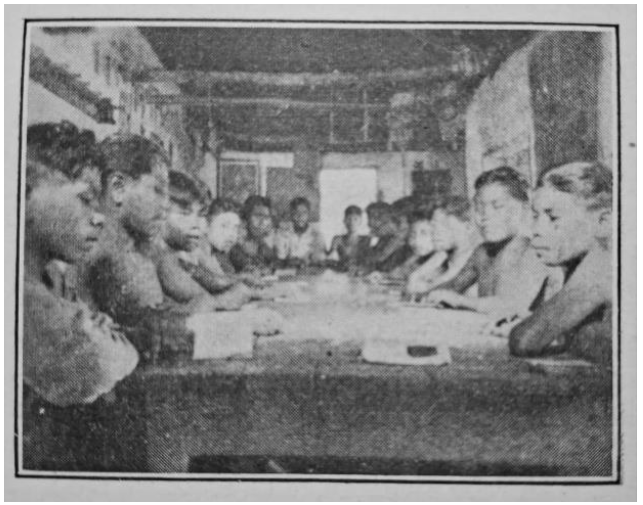 Note. Source: Mr. H. Banner and Kayapo school boys. (1944, January/February). Light and Life, (63), n. p.
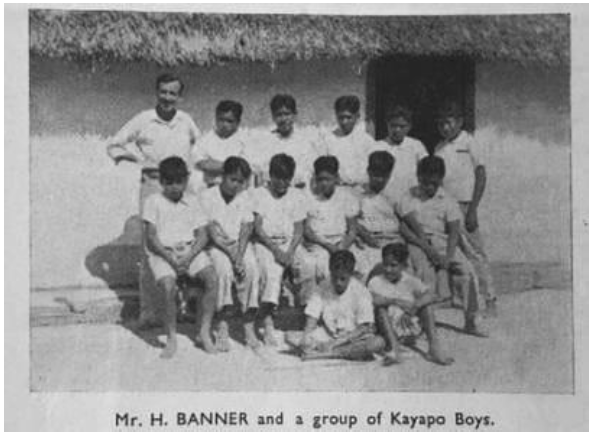 Note. Source: Mr. H. Banner and a group of Kayapo boys. (1944, October/November). Light and Life, (66), n. p.
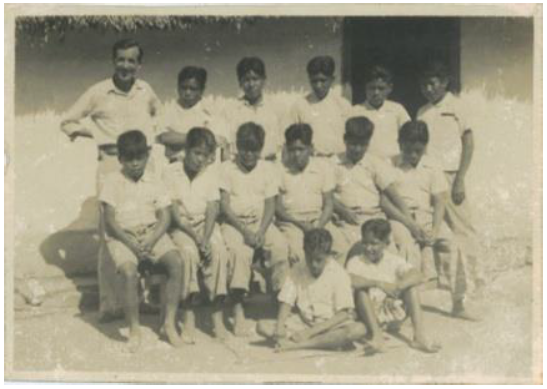 Note. Source: Ko-Kayapó Gorotire-0001. (n.d.). Laboratory of Image and Sound in Anthropology (LISA), University of São Paulo, n. p.