
 Conscious business practices as a driver of reputational capital in SMEs
Abstract
Purpose The purpose of this study is to examine how reputational capital (RC) can be affected by the pillars of Conscious Capitalism as operationalized in conscious business practices (CBPs). Specifically, the practices were measured against four key tenets: higher purpose, stakeholder integration, conscious leadership, and conscious culture.
Theoretical framework RC, from the perspective of the resource-based view (RBV) theory, is considered a scarce and valuable resource that allows companies to achieve a competitive advantage. Specifically, businesses that stand out for their commitment to ethical and conscious business practices leverage their RC to gain legitimacy, credibility, and access to resources.
Design/methodology/approach This study adopted a post-positivist paradigm with a quantitative approach. Data were collected from small and medium-sized enterprises (SMEs) located in the western region of Mexico using an online survey. Using structural equation modeling, 115 valid responses were analyzed to test hypotheses derived from the proposed theoretical model.
Findings The RC of SMEs can be developed by declaring and operating according to a higher purpose and conscious culture. In this sample, stakeholder integration and conscious leadership did not directly impact RC.
Practical & social implications of research Findings contribute to increasing awareness of the impact of implementing conscious business practices as a means of building reputational capital.
Originality/value This study contributes to the literature on RC by exploring its development in SMEs in emerging economies. From a managerial perspective, it highlights the potential for SMEs to gain a competitive advantage by adopting CBPs and enhancing their RC.
Keywords Reputational capital, conscious business practices, Mexican SMEs, Conscious Capitalism.
Keywords:
Reputational capital; Conscious business practices; Mexican SMEs; Conscious Capitalism
1 Introduction
Due to their focus on survival, small and medium-sized enterprises (SMEs) typically prioritize profit maximization in uncertain and highly competitive markets (Sansores-Guerrero et al., 2020). As key drivers of social and economic change, SMEs contribute significantly to income, employment, and overall economic growth, all of which have a profound impact on social welfare and make SME development a global priority (Pichler, 2018). In addition, SMEs contribute to the distribution of wealth, the development of innovative practices, and the rapid promotion of innovation (Ansari et al., 2018).
In Mexico, SMEs represent 99% of all registered companies, constituting 6 million business units and generating 72% of jobs and 52% of the country’s gross domestic product (GDP; Instituto Nacional de Estadística y Geografía, 2019). Mexican SMEs are categorized into three distinct types: microenterprises, with fewer than 10 employees and annual revenues of approximately $235,000; small enterprises, with between 15 and 100 employees and annual revenues of up to $5.8 million; and medium enterprises, with between 100 and 250 employees and annual revenues of around $14.7 million (Banco Bilbao Vizcaya Argentaria, 2024). Unlike SMEs in developing economies, Mexican SMEs face unique challenges characterized by significant structural fragility (Organization for Economic Cooperation and Development, 2020), which exacerbates the obstacles they face, particularly the lack of financial resources. As a result, they often have to finance investment plans with their own assets, demonstrating a remarkable degree of self-sufficiency and sacrifice. However, this independence has its limits and hinders their ability to invest in advanced technologies and research and development activities (Pinzón-Castro et al., 2021).
In spite of these challenges, a significant number of Mexican SMEs are adopting sustainable and socially responsible practices, not only in response to market demand, but also as a strategy to enhance their image and differentiate themselves by demonstrating a commitment to improving social and environmental conditions (Pinzón-Castro et al., 2021). Nonetheless, SME survival and development is related to the management of resources (Woschke et al., 2017), such as reputation, which is sensitive, idiosyncratic, and difficult to imitate (Barney, 1991; Worden, 2003). Reputation is a critical element that makes companies vulnerable and requires meticulous care (Li et al., 2021). According to Chun (2005), this key resource is defined as the accumulated impressions that stakeholders form about the firm. Reputation has also been proven to have a positive impact on firm performance (Agyemang & Ansong, 2017; Rose & Thomsen, 2004).
Despite the importance of building good reputational capital (RC), a strategic intangible resource, it remains unclear how exactly it is built (Dowling & Moran, 2012). Therefore, identifying potential contributors to RC is an important line of research. Since RC is closely tied to a company’s interactions with its stakeholders and environment, one line of inquiry is Conscious Capitalism. This emerging economic philosophy expands the purpose of a business beyond maximizing shareholder value to benefiting all stakeholders (Wickam, 2022). Corporate social responsibility (CSR), a practice that precedes Conscious Capitalism, is a proven reputation-building tool for organizations (Mohtsham & Arshad, 2012). CSR has a significant influence on customer trust and satisfaction, which in turn impacts corporate reputation (Hult et al., 2018; Kim & Kim, 2017; Park et al., 2014). CSR has also gained academic and public attention (Park, 2018), especially as a reputation management tool due to its possible effects on stakeholders (Axjonow et al., 2018).
To pursue this line of research, we opted for the Conscious Capitalism approach over CSR. This decision stems from our view of Conscious Capitalism as an evolutionary step in corporate engagement with society. Unlike CSR, Conscious Capitalism offers a more holistic perspective, rooted in business strategy itself, and addressing not only externalities but a broader range of considerations. In this way, this study highlights how a Conscious Capitalism approach can be a vehicle for building RC. Sisodia et al. (2018) propose Conscious Capitalism as a superstructure for businesses and their raison d’être, considering four mutually reinforcing tenets: 1) higher purpose, 2) stakeholder integration, 3) conscious leadership, and 4) conscious culture. We selected Sisodia’s proposal as it has been developed and promoted for over a decade. Theoretically, it is based on well-established theories such as Freeman’s stakeholder theory (Freeman et al., 2007), Peter Drucker’s managerial theory (Drucker, 1973), Prahalad and Hamel’s contributions to strategy (Prahalad & Hamel, 1994), Greenleaf’s servant leadership (Greenleaf, 1977), Elkington’s triple bottom line (Elkingon, 1998), Porter and Kramer’s shared value (Porter & Kramer, 2011), and Kofman’s conscious business and purpose-driven approaches (Kofman, 2006). From a managerial perspective, it has significantly influenced strategic decision-making in organizations worldwide, with Mexico being one of the contexts where it has been substantially embraced.
This study examines how RC is affected by the pillars of Conscious Capitalism, operationalized in conscious business practices (CBPs). To test the proposed research model, we adapted the Conscious Capitalism Summary Audit (CCSA) of Sisodia et al. (2018) as our data collection tool. As Sisodia is one of the founders of the Conscious Capitalism global movement, the audit is fully aligned with the principles promoted by Conscious Capitalism and facilitates understanding how the pillars are applied in organizations. The questionnaire was sent to a companies listed in a database of 250 Mexican SMEs in the western region of Mexico, and 115 valid responses were analyzed using partial least squares structural equation modeling (PLS-SEM; Ringle et al., 2005). The study revealed that having a higher purpose and a conscious culture have a significant effect on RC, but that conscious leadership and stakeholder integration do not.
This research contributes to the emerging controversy between proponents of the Conscious Capitalism philosophy (Strong & Mackey, 2009) and critics who argue that this theory lacks rigor due to insufficient empirical support (O’Toole & Vogel, 2011; Wang, 2013). Specifically, this study contributes to this debate by providing quantitative measures of CBPs in SMEs. It also adds to the literature on RC by identifying the factors that may contribute to its development (Rodríguez-Aceves et al., 2024). Finally, it broadens the perspective of SMEs in emerging economies by suggesting that the adoption of CBPs required to achieve sustainability will be compensated with RC.
2 Literature review
2.1 Reputational capital
Reputational capital (RC) is a valuable asset for any organization, as it underpins the prosperity of any business. According to Fombrun and van Riel (1997), RC is the tangible and intangible value derived from a company’s positive reputation among stakeholders, which includes trust, credibility, and reliability, which in turn influence competitive advantages such as talent attraction, customer loyalty, and investor confidence. These authors explain that RC, built over time, reflects a company’s consistent performance and ethical conduct that meets or exceeds stakeholder expectations. Because a company’s reputation is shaped by its unique history and sustained through continuous interactions with stakeholders, it becomes difficult for competitors to replicate, making it a powerful source of sustainable competitive advantage (Fombrun & van Riel, 1997; Mohtsham & Arshad, 2012).
Reputation is considered a precious and scarce resource that contributes to building competitive advantage (Bahta et al., 2021); it also shapes unique internal characteristics of firms (Fombrun & van Riel, 1997). Once lost, a good reputation is difficult to recover (Scandizzo, 2011). Its fragility requires careful protection (McGuire et al., 2022). Therefore, companies invest heavily in building and protecting their reputations by improving product quality, maintaining ethical conduct, committing to community engagement, and caring for the environment (De Castro et al., 2006).
Understanding how to build and preserve RC is crucial because “reputation matters” (Hu et al., 2019). Ignoring social and environmental issues can significantly damage a company’s RC (Moretto et al., 2018). The subjective and cognitive nature of RC, based on stakeholder perceptions rather than objective measures, makes it difficult for competitors to identify and replicate the specific actions that lead to a strong reputation (Fombrun & van Riel, 1997). This ambiguity benefits companies by complicating competitors’ efforts to replicate their reputation (Roberts & Dowling, 2002). RC is usually built through long-term historical relationships and interactions with stakeholders; thus, a firm’s reputation results from its historical actions and relationships, which cannot be easily imitated by competitors, making RC a unique resource over time (Hillman & Keim, 2001). The construction of this resource is complex because it involves diverse stakeholder perceptions and multifaceted, interrelated interactions that make it difficult for competitors to replicate (Barney, 1991; Black & Boal, 1994; Dierickx & Cool, 1989). Taken together, these characteristics underscore the strategic importance of RC.
Hence, the characteristics of RC are aligned with the resource-based view. RC can be defined as the value generated by a company’s image in the minds of its stakeholders and is shaped by their perceptions and interactions with the organization.
2.2 Conscious business and Conscious Capitalism
Business consciousness emerged in response to ethical scandals in various companies in the late 1990s and early 2000s (Aburdene, 2005), the systemic threat of climate change due to environmental degradation (Guttmann, 2018), and the recognition of deep socioeconomic inequalities brought about by capitalism (Rehbein, 2020). To address these challenges, the United Nations agreed on 17 Sustainable Development Goals (SDGs) intended to align the efforts of various stakeholders (e.g., governments, public officials, academics, and businesspeople). This includes a firm commitment to global partnership and cooperation to take necessary actions and achieve transformative change by 2030 (Davis et al., 2019). These SDGs have highlighted the increasing importance of integrating consciousness into business by rethinking the purpose of an organization (Aburdene, 2005).
Conscious business practices have emerged as a concept that represents the efforts of organizations to address the needs of multiple stakeholders, rather than simply pursuing financial goals. Orel and Kubátová (2019) define conscious businesses as those that have a higher purpose beyond maximizing profits and/or shareholder returns. Conscious Capitalism requires that positive actions not only propagate the company’s mission, but also promote social justice by integrating this perspective into the company’s mission and operations.
Conscious Capitalism is thus about creating the elements and institutions of social life that sustain and legitimize relationships between individuals in a society; and it aims to benefit all stakeholders, including shareholders (Mackey, 2011), by fostering goodwill, which builds trust and subsequently leads to rapid growth and improved performance.
2.2.1 Higher purpose
Corporate purpose is rooted in management and strategy. While strategy integrates actions, resources, and decisions to solve a problem, achieve a goal, or deliver positions of value and advantage (Zenger, 2023), purpose is an intention that focuses on crafting a desired future (Quinn & Thackor, 2019), including a set of values that employees embrace to guide their actions (Gartenberg et al., 2019). According to Davis (2021), the British Academy declared that the failures of shareholder capitalism can be reversed by companies declaring a purpose that aims to solve the problems of the planet and people without causing new ones, and creating a set of supporting mechanisms that ensure the pursuit of such a purpose.
Although corporate purpose seeks to achieve a higher level of wellbeing for stakeholders, this does not mean that it must be pro-social (Gartenberg et al., 2019). A different view suggests that having a purpose is part of a shift toward business becoming a partner in global problem solving, creating value for a wide range of stakeholders rather than just for the company’s own sake (Kubátová, 2019). Likewise, Sisodia and Gelb (2019) added that having a higher purpose (HP) calls for the essence of business to transcend profit maximization and respond to the call to play a key role in healing humankind and the planet by using its power to provide human health and prosperity.
HP can also increase company performance in at least three ways: 1) by increasing employee effort and productivity through motivation and work engagement derived from the profound meaning of work (van Tuin et al., 2020), 2) by mitigating investors’ short-term perspectives, and 3) by increasing customer loyalty and satisfaction via external stakeholders (Gartenberg et al., 2019). However, because purpose and action cannot be decoupled (Kaplan, 2023), claiming to have a purpose that responds to socially desirable claims without pursuing initiatives that improve outcomes may become a cover for continuing damage. Assuming that a company’s purpose is not only an idealistic statement but also the core of its organizational strategy, we propose the following hypothesis:
-
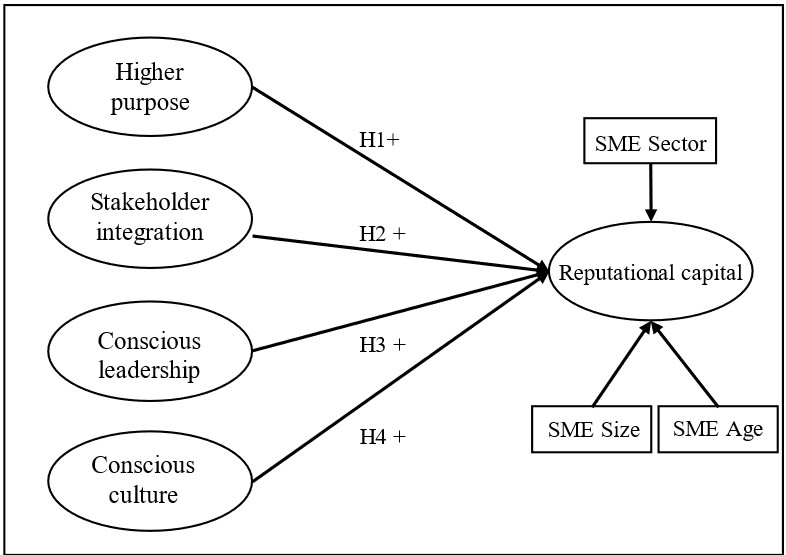
H1: Higher purpose has a positive effect on the RC of SMEs.
2.2.2 Stakeholder Integration
HP is the starting point for a conscious business, since it has the potential to create powerful engagement with stakeholders (Sisodia, 2011). Stakeholder theory reversed the focus on shareholder primacy by emphasizing the construction and maintenance of long-term and sustainable relationships with stakeholders as the key to corporate performance (Freeman et al., 2021). Therefore, stakeholder theory advocates for involving stakeholders and generating value for them by employing a systems thinking approach. This approach takes into account factors such as supply chain continuity, which typically aligns stakeholder behavior with ethical and sustainable practices (Elias et al., 2021).
A conscious business aligns the interests of all stakeholders, not by negotiating trade-offs, but by creating synergies among stakeholders to create value for all. Value creation stakeholder theory asserts that in “an interconnected and interdependent system, each stakeholder must be at once a means and an end” (Freeman et al., 2020, p. 217). This approach is grounded on systems thinking principles– seeing the big picture, focusing on cause and effect, and demystifying either-or thinking (Elias et al., 2021) —– all of which imply a comprehensive view of the business and stakeholder dynamics. Moreover, Kassa and Mentz (2021) argued that tying stakeholders’ and shareholders’ interests together and with the organization’s needs and interests is the central task of organizational design, which is the materialization of a company’s strategy. Since conscious businesses recognize the contributions of all stakeholders and their engagement and interconnectedness as necessary to achieving their purpose, creating value, and flourishing (Orel & Kubátová, 2019), we propose the following hypothesis:
-
H2: Stakeholder integration has a positive effect on the RC of SMEs.
2.2.3 Conscious leadership
Conscious business leaders see themselves as trustees of a business, tasked with nurturing and preserving it for future generations. Conscious business leaders seek the common good and leave a positive mark on the world in addition to making a profit (Marinčič & Marič, 2018). Jones and Brazdau (2015) affirm that CL is a sociocultural construct based on the shared value of reciprocity, and that conscious leaders observe the environment to perceive the interconnectedness of common problems, on which they base a leadership style of shared responsibility and problem solving. Mackey and Sisodia (2013) integrated the practical implications of conscious leadership with spirituality, arguing that such leaders are motivated by the pursuit of an organization's higher purpose and the well-being of its stakeholders, rather than by personal power or enrichment. Conscious leaders act as stewards of their businesses, ensuring they thrive for future generations by seeking the greater good and making a positive impact on the world. They base their leadership on shared responsibility and interconnectedness, driven by a commitment to the organization’s higher purpose and stakeholder well-being rather than personal gain. Thus, we propose the following hypothesis:
-
H3: Conscious leadership has a positive effect on the RC of SMEs.
2.2.4 Conscious culture
A strong organizational culture is an important source of competitive advantage (Barney, 1986) because it builds internal and external relationships. Scholars agree that organizational culture is the set of shared values, beliefs, traditions, attitudes, assumptions. O’Toole and Vogel (2011) affirm that a healthy culture creates a sense of community, which is reflected in high levels of participation in decision-making and shared benefits and ownership of the company. In a conscious culture, justice for all stakeholders is a priority for leaders (Fyke & Buzzanell, 2013), which reconciles caring for people and making the business profitable through trust and accountability (Mackey & Sisodia, 2013). Yusuf et al. (2018) found that scholars have repeatedly established a direct relationship between organizational culture and corporate performance, and their own results demonstrated that transparent communication plays a mediating role between both variables, thereby building trust. Accordingly, trust is the foundation of a corporate reputation, which is woven into a living culture that actively builds strong relationships inside and outside the organization.
Organizational culture has a positive impact on four dimensions of CSR (González-Rodríguez et al., 2019) —– customers, employees, community, and the environment —– and the first two dimensions have proven to have a significant positive influence on corporate reputation. Based on the above arguments, we propose the following hypothesis:
-
H4: Conscious culture has a positive effect on the RC of SMEs.
To illustrate our hypotheses, we propose the following research model (Figure 1).
3 Methodological procedures
This study adopted a post-positivist paradigm with a quantitative approach to explain how reputational capital can be affected by the pillars of Conscious Capitalism, operationalized in conscious business practices. We conducted an empirical study using a cross-sectional survey. The unit of analysis was SMEs, with the respondents being business owners, directors, and managers. The data collection scale was validated through both exploratory and confirmatory factor analysis. Subsequently, the proposed model was tested using structural equation modeling. The post-positivist paradigm was selected due to the complex, context-dependent interactions between the study variables and the subjective assessment of practices based on multiple perceptions and experiences of the respondents (Cavana et al., 2001; Denzin & Lincoln, 2018). Notably, this research paradigm has been successfully employed in previous studies with similar research designs (Aghimien et al., 2024; Peña & Caruajulca, 2024).
3.1 Sample and data collection
The instrument was distributed to members listed in a database of 250 partner SMEs of the Tecnológico de Monterrey, a private university in Mexico. The database is a convenience sample that is sufficiently representative of the diversity of SMEs in the western region of Mexico, including the states of Sinaloa, Chihuahua, Aguascalientes, Sonora, Guanajuato, Michoacán, and Jalisco. This region ranks fourth in the country in terms of GDP (Instituto Nacional de Estadística y Geografía, 2019). We also had access to updated partner contact information, and took advantage of their willingness to collaborate with the university’s initiatives. Data were collected through a self-administered online questionnaire sent via email to all SMEs listed in the database in September of 2022. We asked the directors, owners, and managers of the contacted SMEs to respond (Supplementary Data 1 – Database). After cleaning the data, we obtained 115 valid responses, which, considering the size of the population, constitutes a reliable and valid random sample with 95% confidence (McLeod & Bellhouse, 1983). Table 1 presents demographic information on the participating SMEs.
Of the respondents, 45% were female, 63% were male, 48% were between 21 and 40 years old, and 3% were more than 60 years old. Most respondents were SME directors (70%), managers (24%), and board members (5%; see Table 2), which suggests that the respondents had sufficient knowledge to answer the questions.
3.2 Variable measurement
The study variables were operationalized based on the theoretical work discussed above and reported acceptable levels of construct validity and reliability (Hair Jr. et al., 2017). All items were anchored with a five-point Likert scale ranging from 1 (“totally disagree”) to 5 (“totally agree”). Reputational capital was operationalized using items from previously proposed definitions and measures (Jackson, 2020; see also Appendix A). Conscious Capitalism was operationalized through conscious business practices measured according to four constructs —– higher purpose, stakeholder integration, conscious leadership, and conscious culture (Sisodia, 2011; Sisodia et al., 2018) —– using items adapted from Sisodia et al., (2018) CCSA (see also Appendix A). Due to the high probability of SME demographics influencing RC, we included SME size, age, and sector as control variables in the model. Table 3 presents the results of the scale tests for unidimensionality, discriminant validity, and convergent validity.
All constructs demonstrated high reliability, with Cronbach’s alpha and composite reliability values consistently exceeding 0.70, meeting recommended standards (Fornell & Larcker, 1981). The items met or exceeded the 0.50 significance loading threshold for all constructs (Carmines & Zeller, 1979; Hair Jr. et al., 2017), and all constructs had average variance extracted scores above 0.50. In sum, the evidence suggests the presence of convergent validity.
The discriminant validity of the constructs was determined using the Fornell-Larcker criterion (Fornell & Larcker, 1981). In Table 4, the diagonal values of all constructs are higher than the values to their left in the same row, which demonstrates differences between the constructs.
Moreover, when cross-loading analysis was performed, all items had higher loadings with their associated factors (construct), demonstrating the presence of discriminant validity (Martínez Ávila & Fierro Moreno, 2018; see also Table 5).
Finally, to assess common method bias, we followed Kock’s (2015) approach, which suggests that an inner variance inflation factor of less than 3.3 indicates that a model is free from this bias. In our model, we found that one value related to CL was slightly above the threshold (3.3), while the rest were much lower (< 2.4). Kock and Lynn (2012) suggested a higher tolerance level of 5.0 when using algorithms that incorporate measurement error, such as factor-based PLS-SEM algorithms; therefore, we determined that common method bias was absent from this study.
3.3 Analysis
The proposed model was tested with structural equation modeling (SEM) using SmartPLS 3.0 software (Ringle et al., 2005). SmartPLS was chosen because it is the most appropriate software for small sample sizes (Hair et al., 2019). Moreover, SEM considers measurement errors in the latent variables, resulting in more accurate path coefficient estimates than other methods (e.g., standard multiple regression; Musil et al., 1998). Although the sample size in this study was small, it exceeded the “10 times rule” proposed by Hair et al. (2011), which has been widely used in previous literature (Kock & Hadaya, 2018). This rule states that the sample size should be greater than 10 times the maximum number of inner or outer model links pointing to any latent variable in the model (Hair et al., 2011; Marcoulides & Saunders, 2006). To assess the structural model, a multicollinearity analysis was performed using the outer variance inflation factor (Hair Jr. et al., 2017; Kline, 1998). All values ranged from 1.6 to 2.4, which is less than the cutoff value of 5 (Hair et al., 2019); thus, the absence of collinearity issues can be assumed. Second, we calculated the standardized root mean square residual (Hu & Bentler, 1999) and obtained a value of 0.064, which is less than the threshold value of 0.08, indicating an adequate global model fit (Henseler et al., 2016).
3.4 Results
Likert scales were used to measure the dependent and independent variables. Their means and standard deviations were relatively similar, with conscious culture (CC) having the highest (mean = 4.6) and stakeholder integration (SI) having the lowest (mean = 4.1). Regarding correlation, reputational capital (RC) was significantly correlated with higher purpose (HP), SI, conscious leadership (CL), and CC (Table 6). The highest correlation, between SI and CL, was 0.79, and the lowest, between RC and CL, was 0.55. Notably, the correlations between the three independent variables were highly significant (close to 0.7). Regarding the control variables, SME age had a statistically significant but negative correlation with CC, while SME size had a significant positive correlation with CL (0.424**) and a significant negative correlation with CC (-0.185). SME sector showed no significant correlations.
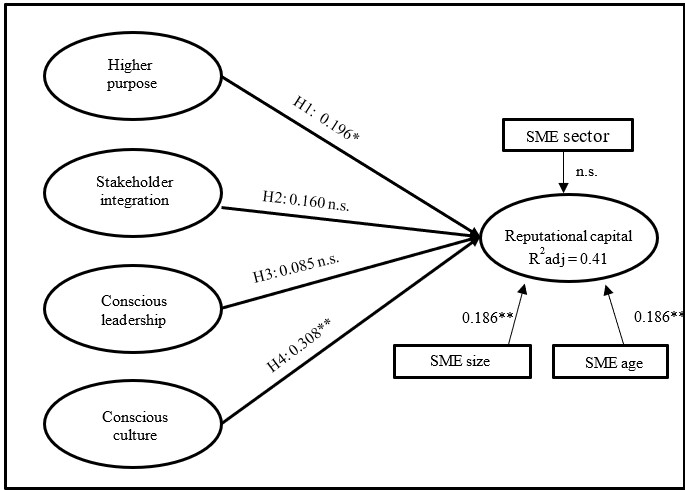
To test the effect of the control variables, we ran the model with each variable category and recorded the adjusted R2 for RC. The results indicate that the SME sector does not have a statistically significant effect on RC; however, the adjusted R2 value increased when SME age, especially 20 years old or more, was included in the model (R2adj = 0.464; β = 0.186; p = 0.015). Similarly, the adjusted R2 value increased when the size of the SME, particularly those with 250 or more employees, was considered (R2adj = 0.439; β = 0.186; p = 0.014). Furthermore, of the four paths, two were significant (Figure 2), with HP (H1) and CC (H4) having p-values of 0.1 and 0.05, respectively, and both explaining 41% of the variance in RC (R2adj = 0.41). CC had the largest effect on RC (β = 0.308), followed by HP (β = 0.196). Neither SI (H2) nor CL (H3) had statistically significant effects on RC, although both had positive effects. In summary, H1 and H4 were supported, but H2 and H3 were not.
Research model: SEM results. Notes: n = 115; **significance at the 0.01 level (two-tailed); *significance at the 0.05 level (two-tailed); ns = not significant
The statistical results suggest that the RC of the sampled SMEs is fostered by CC and defined HP, but not by CL or SI, which was unexpected. In addition, SMEs with more than 250 employees and more than 20 years of experience tended to have more RC. The following section discusses these results in the context of the existing literature.
4 Discussion
Despite the recognized importance of cultivating strong reputational capital (RC) as a valuable yet intangible strategic asset, scholars agree on the persistent ambiguity regarding the precise mechanisms for its development (Dowling & Moran, 2012). Consequently, identifying factors that influence RC continues to be a relevant area of investigation. Given the close alignment of RC with a company’s interactions with stakeholders and its environment, one promising avenue for inquiry lies in Conscious Capitalism. According to Mackey and Sisodia (2013), Conscious Capitalism promotes ethical business practices, social responsibility, and long-term value creation, which may ultimately influence RC. Therefore, this study focuses on assessing how reputational capital can be affected by the pillars of Conscious Capitalism, operationalized through conscious business practices. Specifically, we measured these particular practices against four key tenets: higher purpose, stakeholder integration, conscious leadership, and conscious culture.
Our results indicate that only two out of the four principles of conscious business practices contribute significantly to the reputational capital of Mexican SMEs. Specifically, organizations that emphasize a conscious culture and higher purpose show significant positive effects, while stakeholder engagement and conscious leadership do not show such effects. Consequently, a key implication of this study is that SMEs that foster a higher purpose and a conscious culture are more able to enhance their reputational capital. Below, we provide potential explanations for these findings.
First, higher purpose (HP) has a positive effect on RC (H1). HP strengthens relationships with customers and employees and has a significant positive effect on community perceptions (Sisodia, 2011). This is because being a purpose-driven organization resonates with people due to their tendency to advance personal growth, responsibility, and relationships with others (Amram, 2022), and because HP directs the focus toward creating a desired future (Quinn & Thackor, 2019). Bateson (1972) and Dilts (1996) stated that HP is related to people’s natural need to experience that they are contributing to the larger social system of which they are part. Dupret and Pultz (2021) assert that HP addresses the interdependence of business and society, and that one cannot flourish without the other. As Mohtsham and Arshad (2012) state, corporate activities that benefit the community increase social participation, resulting in positive attitudes toward the business, which in turn increases reputational capital and becomes an important catalyst for shared prosperity and sustainable development. In this sense, HP resonates positively with stakeholders because when it is truly internalized, it aligns decisions, behaviors, conflict management, and even policies and processes, generating trust and loyalty and strengthening the company’s reputation (Mackey & Sisodia, 2013). Consequently, the company can then develop robust support networks and relationships to firmly anchor its competitive advantage (Mohtsham & Arshad, 2012).
Regarding H2, some academics have observed that companies generally abandon social responsibility projects to focus their resources on other areas in times of economic challenges (Karaibrahimoglu, 2010). Reputation is recognized as a type of capital for companies because it can create a competitive advantage. Customers may stick with reputable companies during challenging times, even if they act to conserve resources instead of focusing on stakeholders. In the case of Mexican SMEs, although they recognize the importance of caring for customers, employees, and the community (Ríos-Manríquez et al., 2021), it is not easy to integrate stakeholders into core activities due to resource constraints (Rodríguez-Aceves et al., 2024). The scarcity of resources forces Mexican SMEs to prioritize survival (the short term) over building RC (the long term), which may explain why SI did not show a direct effect on RC in this study (rejecting H2). However, further research is required to explore this relationship in more depth.
Regarding H3, although it is not yet clear what kind of leadership (e.g., value-based, servant, or conscious leadership (CL)) is best suited to Conscious Capitalism, CL focuses on the distinction between ethics and legal compliance (Dion, 2021). Thus, although CL involves identifying patterns of interconnectedness between problems and requires leaders to be neutral and communicate fairly to build flourishing businesses and communities (Mackey, 2011), leaders of Mexican SMEs may face different realities due to the characteristics of Mexican work culture. In a paternal culture in which power is concentrated at the top and employees are seen as incapable of adequately taking care of themselves, Mexican employers make most decisions by themselves and expect employees to dutifully follow orders (Silva, 2017). Hofstede’s (2011) model of cultural dimensions reinforces the claim that Mexican culture has a high power distance, where people accept hierarchy without the need for justification. In this context, the boss is the boss, inequalities are accepted, and workers expect to be told what to do, ideally by a benevolent autocrat. Stakeholder perceptions of leadership as trustworthy and credible are crucial for a company’s RC (Worden, 2003). In Mexico, leaders are usually company owners, and they tend to centralize decision-making, which limits the company’s agility and responsiveness (Molina-Morejón et al., 2024). This may explain why CL did not have a significant impact on RC.
Finally, our results suggest that CC has a positive and significant effect on RC (H4). Values are at the core of a culture, but culture is also shaped by abilities, beliefs, and identity (Zamfir, 2013). According to Bateson’s (1972) and Dilts’ (1996) models of enculturation, values, abilities, beliefs, and identity have a direct impact on the behavior of group members and the way they interact with each other and with stakeholders. Such behavior will consequently affect their environment, whether physical, natural, social, or even business. Thus, culture is an element below the surface of what happens inside organizations, so it has an important impact on how things get done (Barclay, 2015). The positive long-term results of a company with a healthy culture that fosters a strong sense of community (O’Toole & Vogel, 2011) come from the trust of its stakeholders (Dupont & Karpoff, 2020). Therefore, CC will reflect a trustworthy image of the company, which is the essence of reputation (Kowalczyk & Pawlish, 2002).
Although SI and CL do not contribute to RC in a direct and significant way, this does not necessarily mean that they have no impact at all. CL involves putting purpose before profits, creating value for all stakeholders using a systems thinking perspective (Elias et al., 2021), and being sensitive to the organization’s culture (Wickam, 2022). Hence, even though leadership connects with the other three tenets, together with SI, it works behind the scenes: leaders drive flourishing and productive relationships with employees, which shapes the culture, and with stakeholders, building solid networks that provide a sense of meaning for and among themselves. This HP is at the heart of the relationship between culture and company performance, which has been widely studied and demonstrated (Yandi, 2022).
These results contribute support to the enthusiastic advocacy of the Conscious Capitalism philosophy and its premises (Strong & Mackey 2009). Although critics claim that this perspective fails to consider tensions when attempting to reconcile conflicting interests among its stakeholders or between internal challenges and external pressures from the environment, market, and society (Fyke & Buzzanell., 2013), the results of this study suggest that CBPs can indeed be implemented in SMEs to achieve benefits related to strategic intangible resources.
5 Conclusion
Reputational capital (RC) is a critical resource for SMEs in emerging markets, yet how to build it remains unclear (Eigler & Azarpour, 2020). Regarding conscious business practices (CBPs), it has become essential for companies to adopt them, as they are increasingly recognized as the aspirational and accepted way to conduct business (Brockhaus et al. 2017). Our results suggest that SMEs can develop RC by declaring a higher purpose (HP) and living it through the company’s conscious culture (CC), thereby contributing to the literature in three ways. First, this study contributes new knowledge with regards to how RC can be built in Mexican SMEs. Second, it provides evidence of SMEs’ sensitivity to adopting CBPs (instilling a higher purpose and a conscious culture), which can be rewarded with RC. Third, it measures Conscious Capitalism by operationalizing CBPs through Sisodia et al. (2011), Conscious Capitalism Summary Audit (2018). This audit has been proposed as an assessment through which organizations can understand where they stand to begin a transformational journey.
Although the study results are relevant, they are not free from limitations. Methodologically, the use of convenient non-probability sampling and a limited sample size restrict the transferability of the results (Cavana et al., 2001; Denzin & Lincoln, 2018); however, due to the scarcity of research on SMEs in emerging economies, this study still provides valuable insights. We must also acknowledge that this study only consulted owners, managers, and directors. To bolster robustness, it may be beneficial to gather perceptions from a broader range of internal and external stakeholders, as in previous SME studies (e.g., Esposito De Falco et al., 2021; Grama-Vigouroux et al., 2020).
Our post-positivist and quantitative approach allowed us to obtain measurable results by operationalizing the four pillars of Conscious Capitalism in CBPs to explain their impact on SMEs’ reputational capital. However, we acknowledge that it has limitations in capturing more subtle qualitative aspects that could be better captured, for example, by interviewing the respondents or observing the settings where the CBPs take place. Finally, conceptually, Sisodia’s Conscious Capitalism has faced criticism for its theoretical rigor and the lack of data supporting its propositions, particularly regarding financial performance (O’Toole & Vogel, 2011; Wang, 2013).
Future studies should adopt a quantitative approach to explore different configurations of the interrelationship between the four pillars of Conscious Capitalism. Specific aims might include testing whether the actions SMEs take to integrate stakeholders into their strategy and operations result from their HP and CC, which might shed light on how stakeholder integration (SI) mediates or moderates RC. Likewise, examining the model in different cultural contexts (e.g., less paternalistic cultures) could reveal different relationships between conscious leadership (CL) and RC. Finally, testing the model by comparing different manager characteristics may provide valuable insights, as in a previous study that found that the effect of CBPs on RC may differ according to managerial generation (Rodríguez-Aceves et al., 2024).
In summary, this paper contributes to the academic discourse by seeking a deeper understanding of the extent and potential impact of CBPs on RC when adopted by SMEs. Managerially, this is relevant as RC has been shown to have a positive impact on financial performance (Agyemang & Ansong, 2017; Rose & Thomsen, 2004).
Ultimately, the impact of SMEs on the economy and society is undeniable, and adopting conscious business practices – such as a higher purpose enacted through a conscious culture – could reward them with reputational capital, providing them with legitimacy, credibility, and access to resources, thereby increasing their chances of survival while contributing to global sustainability.
SUPPLEMENTARY DATA
Supplementary Data 1 – Database
Supplementary data related to this article can be found online at https://doi.org/10.7910/DVN/VGTTHG
APPENDIX A Measurement Instrument
| Constructs | Items | |
|---|---|---|
| Reputational Capital | RC1 | Clients, suppliers and other stakeholders believe that our company is reliable and that we provide consistently high quality advice, information, labor, goods, or services |
| RC2 | Most of our business partners and allieds are reliable and provide consistently high quality advice, information, labor, goods or services | |
| Higher Purpose | HP1 | Our organization fulfills deep-seated needs of our customers, not just their wants or desires. |
| HP2 | Our customers would be genuinely distraught if we ceased to exist. | |
| HP3 | We have a clear mission and vision of the contribution we want to make to our customers and the community. | |
| HP4 | Our employees find intrinsic satisfaction in their work that goes beyond the salary that they earn. | |
| HP5 | Our employees are convinced that the work of the company delivers positive value to the customer and the community. | |
| Stakeholders Integration | ST2 | We routinely engage stakeholders in dialog and give them a voice in the company’s direction. |
| ST4 | Our company’s relationships with all our stakeholders are characterized by frequent communication and high degrees of mutual trust and goodwill. | |
| Conscious Leadership | CL1 | Our leaders are concerned about the well-being of our employees. |
| CL2 | Our leaders care about the well-being of the community. | |
| CL3 | In our company, we promote integrity and community support. | |
| Conscious Culture | CC1 | The company's culture is based on trust among employees. |
| CC2 | In the company we are open to communication and we are committed to always tell the truth. | |
| CC3 | The company's employees must always act with integrity in the first instance and are empowered to do so. |
-
Evaluation process:
Double Blind Review
-
This article is open data
-
How to cite:
Rodríguez-Aldana, M. L., López-Vázquez, L. P., & Rodríguez-Aceves, L. (2024). Conscious business practices as a driver of reputational capital in SMEs. Revista Brasileira de Gestão de Negócios,26(3), e20230181. https://doi.org/10.7819/rbgn.v26i03.4274
-
Open science:
Marcia Lorena Rodríguez-Aldana; Lilia Patricia López-Vázquez; Lucía Rodríguez-Aceves, 2024, "Conscious Business Practices as a Driver of Reputational Capital in SMEs," https://doi.org/10.7910/DVN/VGTTHG, Harvard Dataverse, V1
-
Financial support:
There are no funding agencies to report.
-
Plagiarism analysis:
RBGN performs plagiarism analysis on all its articles at the time of submission and after approval of the manuscript using the iThenticate tool.
References
- Aburdene, P. (2005). Megatrends 2010: The rise of conscious capitalism Hampton Roads Publishers.
-
Aghimien, D., Aliu, J., Akinradewo, O., Aghimien, L., Aigbavboa, C., & Ditsele-Rapodile, K. (2024). PLS-SEM assessment of the impact of job satisfaction on the organisational commitment of women quantity surveyors.International Journal of Construction Management, 1-9. https://doi.org/10.1080/15623599.2024.2304485
» https://doi.org/10.1080/15623599.2024.2304485 -
Agyemang, O. S., & Ansong, A. (2017). Corporate social responsibility and firm performance of Ghanaian SMEs: Mediating role of access to capital and firm reputation. Journal of Global Responsibility, 8(1), 47-62. http://doi.org/10.1108/JGR-03-2016-0007
» http://doi.org/10.1108/JGR-03-2016-0007 -
Amram, Y. (2022). The intelligence of spiritual intelligence: making the case. Religions, 13(12), 1140. http://doi.org/10.3390/rel13121140
» http://doi.org/10.3390/rel13121140 -
Ansari, M., Soltanifar, E., & Agazadeh, H. (2018). Mapping opportunity recognition among foreign SMEs in Iran: The case of France, Germany, Chine and Turkey. Journal of International Business Administration, 1(1), 115-136. http://doi.org/10.22034/JIBA.2019.8814
» http://doi.org/10.22034/JIBA.2019.8814 -
Axjonow, A., Ernstberger, J., & Pott, C. (2018). The impact of corporate social responsibility disclosure on corporate reputation: A non-professional stakeholder perspective. Journal of Business Ethics, 151(2), 429-450. http://doi.org/10.1007/s10551-016-3225-4
» http://doi.org/10.1007/s10551-016-3225-4 -
Bahta, D., Jiang, Y., Islam, M. R., & Kuyon, J. B. (2021). How does CSR enhance the financial performance of SMEs? The mediating role of firm reputation. Economic Research-Ekonomska Istraživanja, 34(1), 1428-1451. http://doi.org/10.1080/1331677X.2020.1828130
» http://doi.org/10.1080/1331677X.2020.1828130 -
Banco Bilbao Vizcaya Argentaria – BBVA. (2024). ¿Qué son las pymes en México? Conoce todo de ellas.https://www.bbva.mx/educacion-financiera/creditos/que-son-las-pymes-en-mexico.html
» https://www.bbva.mx/educacion-financiera/creditos/que-son-las-pymes-en-mexico.html - Barclay, J. (2015). Conscious culture: How to build a high performing workplace through values, ethics, and leadership Morgan James Publishing.
-
Barney, J. B. (1986). Organizational culture: Can it be a source of sustained competitive advantage? Academy of Management Review, 11(3), 656-665. http://doi.org/10.2307/258317
» http://doi.org/10.2307/258317 -
Barney, J. B. (1991). Firm resources and sustained competitive advantage. Journal of Management, 17(1), 99-120. http://doi.org/10.1177/014920639101700108
» http://doi.org/10.1177/014920639101700108 - Bateson, G. (1972). Steps to an ecology of mind Ballantine Books.
-
Berens, G., & Van Riel, C. B. (2004). Corporate associations in the academic literature: Three mainstreams of thought in the reputation measurement literature. Corporate Reputation Review, 7(2), 161-178. http://doi.org/10.1057/palgrave.crr.1540218
» http://doi.org/10.1057/palgrave.crr.1540218 -
Black, J. A., & Boal, K. B. (1994). Strategic resources: Traits, configurations and paths to sustainable competitive advantage. Strategic Management Journal, 15(Special Issue 2), 131-148. http://doi.org/10.1002/smj.4250151009
» http://doi.org/10.1002/smj.4250151009 -
Brockhaus, S., Fawcett, S. E., Knemeyer, A. M., & Fawcett, A. M. (2017). Motivations for environmental and social consciousness: Reevaluating the sustainability-based view. Journal of Cleaner Production, 143(1), 933-947. http://doi.org/10.1016/j.jclepro.2016.12.027
» http://doi.org/10.1016/j.jclepro.2016.12.027 -
Carmines, E. G., & Zeller, R. A. (1979). Reliability and validity assessment SAGE Publications.. http://doi.org/10.4135/9781412985642
» http://doi.org/10.4135/9781412985642 - Cavana, R. Y., Delahaye, B. L., & Sekaran, U. (2001). Applied business research: Qualitative and quantitative methods J. Wiley.
-
Chun, R. (2005). Corporate reputation: Meaning and measurement. International Journal of Management Reviews, 7(2), 91-109. http://doi.org/10.1111/j.1468-2370.2005.00109.x
» http://doi.org/10.1111/j.1468-2370.2005.00109.x -
Davis, G. F. (2021). Corporate purpose needs democracy. Journal of Management Studies, 58(3), 902-913. http://doi.org/10.1111/joms.12659
» http://doi.org/10.1111/joms.12659 -
Davis, G. F., Scharmer, O., Sisodia, R., & Waddell, S. (2019). Building an inclusive world without committing Type III errors: The need for system transformation. Academy of Management Proceedings, 2019(1), 10268. https://doi.org/10.5465/ambpp.2019.10268symposium
» https://doi.org/10.5465/ambpp.2019.10268symposium -
De Castro, G. M., López, J. E. N., & Sáez, P. L. (2006). Business and social reputation: Exploring the concept and main dimensions of corporate reputation. Journal of Business Ethics, 63(1), 361-370. http://doi.org/10.1007/s10551-005-3244-z
» http://doi.org/10.1007/s10551-005-3244-z - Denzin, N. K., & Lincoln, Y. S. (Eds.) (2018).The SAGE handbook of qualitative research(5th ed.). SAGE Publications.
-
Dierickx, I., & Cool, K. (1989). Asset stock accumulation and sustainability of competitive advantage. Management Science, 35(12), 1504-1511. http://doi.org/10.1287/mnsc.35.12.1504
» http://doi.org/10.1287/mnsc.35.12.1504 - Dilts, R. (1996). Visionary leadership skills Meta Publications.
-
Dion, M. (2021). Conscious capitalism and the organizational propensity to fight corruption. Journal of Financial Crime, 28(3), 686-701. http://doi.org/10.1108/JFC-09-2020-0194
» http://doi.org/10.1108/JFC-09-2020-0194 -
Dowling, G., & Moran, P. (2012). Corporate reputations: Built in or bolted on? California Management Review, 54(2), 25-42. http://doi.org/10.1525/cmr.2012.54.2.25
» http://doi.org/10.1525/cmr.2012.54.2.25 - Drucker, P. (1973). Management: Tasks, responsibilities, practices Harper Collins.
-
Dupont, Q., & Karpoff, J. M. (2020). The trust triangle: Laws, reputation, and culture in empirical finance research. Journal of Business Ethics, 163(2), 217-238. http://doi.org/10.1007/s10551-019-04229-1
» http://doi.org/10.1007/s10551-019-04229-1 -
Dupret, K., & Pultz, S. (2021). Hard/heart worker: Work intensification in purpose-driven organizations. Qualitative Research in Organizations and Management, 16(3–4), 488-508. http://doi.org/10.1108/QROM-07-2020-1989
» http://doi.org/10.1108/QROM-07-2020-1989 -
Eigler, J., & Azarpour, S. (2020). Reputation management for creative workers in the media industry. Journal of Media Business Studies, 17(3–4), 261-275. http://doi.org/10.1080/16522354.2020.1741148
» http://doi.org/10.1080/16522354.2020.1741148 -
Elias, A. A., Donadelli, F., Paiva, E. L., & Bacic Araujo, P. P. (2021). Analysing the complexities of sustainable wood supply chain in the Amazon: A systems thinking approach. International Journal of Logistics Management, 32(4), 1481-1505. http://doi.org/10.1108/IJLM-07-2020-0276
» http://doi.org/10.1108/IJLM-07-2020-0276 - Elkingon, J. (1998). Cannibals with Forks: The Triple Bottom Line of 21st Century Business New Society Publishers.
-
Esposito De Falco, S., Scandurra, G., & Thomas, A. (2021). How stakeholders affect the pursuit of the Environmental, Social, and Governance. Evidence from innovative small and medium enterprises. Corporate Social Responsibility and Environmental Management, 28(5), 1528-1539. http://doi.org/10.1002/csr.2183
» http://doi.org/10.1002/csr.2183 -
Fombrun, C. J., & van Riel, C. B. M. (1997). The reputational landscape. Corporate Reputation Review, 1(1), 5-13. http://doi.org/10.1057/palgrave.crr.1540008
» http://doi.org/10.1057/palgrave.crr.1540008 -
Fornell, C., & Larcker, D. F. (1981). Evaluating structural equation models with unobservable variables and measurement error. JMR, Journal of Marketing Research, 18(1), 39-50. http://doi.org/10.1177/002224378101800104
» http://doi.org/10.1177/002224378101800104 -
Freeman, R. E., Dmytriyev, S. D., & Phillips, R. A. (2021). Stakeholder theory and the resource-based view of the firm. Journal of Management, 47(7), 1757-1770. http://doi.org/10.1177/0149206321993576
» http://doi.org/10.1177/0149206321993576 - Freeman, R. E., Harrison, J. S., & Wicks, A. C. (2007). Managing for stakeholders survival, reputation and success Yale University Press.
-
Freeman, R. E., Phillips, R., & Sisodia, R. (2020). Tensions in stakeholder theory. Business & Society, 59(2), 213-231. http://doi.org/10.1177/0007650318773750
» http://doi.org/10.1177/0007650318773750 -
Fyke, J. P., & Buzzanell, P. M. (2013). The ethics of conscious capitalism: Wicked problems in leading change and changing leaders. Human Relations: Studies Towards the Integration of the Social Sciences, 66(12), 1619-1643. http://doi.org/10.1177/0018726713485306
» http://doi.org/10.1177/0018726713485306 -
Gartenberg, C., Prat, A., & Serafeim, G. (2019). Corporate purpose and financial performance. Organization Science, 30(1), 1-18. http://doi.org/10.1287/orsc.2018.1230
» http://doi.org/10.1287/orsc.2018.1230 -
González-Rodríguez, M. R., Martín-Samper, R. C., Köseoglu, M. A., & Okumus, F. (2019). Hotels’ corporate social responsibility practices, organizational culture, firm reputation, and performance. Journal of Sustainable Tourism, 27(3), 398-419. http://doi.org/10.1080/09669582.2019.1585441
» http://doi.org/10.1080/09669582.2019.1585441 -
Grama-Vigouroux, S., Saidi, S., Berthinier-Poncet, A., Vanhaverbeke, W., & Madanamoothoo, A. (2020). From closed to open: A comparative stakeholder approach for developing open innovation activities in SMEs. Journal of Business Research, 119, 230-244. http://doi.org/10.1016/j.jbusres.2019.08.016
» http://doi.org/10.1016/j.jbusres.2019.08.016 - Greenleaf, R. (1977). Servant leadership: A journey into the nature of legitimate power and greatness Paulist Press.
-
Guttmann, R. (2018). Eco-capitalism: Carbon money, climate finance, and sustainable development Springer.. http://doi.org/10.1007/978-3-319-92357-4
» http://doi.org/10.1007/978-3-319-92357-4 -
Hair Jr., J. F., Matthews, L. M., Matthews, R. L., & Sarstedt, M. (2017). PLS-SEM or CB-SEM: Updated guidelines on which method to use. International Journal of Multivariate Data Analysis, 1(2), 107-123. http://doi.org/10.1504/IJMDA.2017.087624
» http://doi.org/10.1504/IJMDA.2017.087624 -
Hair, J. F., Ringle, C. M., & Sarstedt, M. (2011). PLS-SEM: Indeed a silver bullet. Journal of Marketing Theory and Practice, 19(2), 139-152. http://doi.org/10.2753/MTP1069-6679190202
» http://doi.org/10.2753/MTP1069-6679190202 -
Hair, J. F., Risher, J. J., Sarstedt, M., & Ringle, C. M. (2019). When to use and how to report the results of PLS-SEM. European Business Review, 31(1), 2-24. http://doi.org/10.1108/EBR-11-2018-0203
» http://doi.org/10.1108/EBR-11-2018-0203 -
Henseler, J., Hubona, G., & Ray, P. (2016). Using PLS path modeling new technology research: Updated guidelines. Industrial Management & Data Systems, 116(1), 2-20. http://doi.org/10.1108/IMDS-09-2015-0382
» http://doi.org/10.1108/IMDS-09-2015-0382 -
Hillman, A. J., & Keim, G. D. (2001). Shareholder value, stakeholder management, and social issues: What’s the bottom line? Strategic Management Journal, 22(2), 125-139. http://doi.org/10.1002/1097-0266(200101)22:2<125::AID-SMJ150>3.0.CO;2-H
» http://doi.org/10.1002/1097-0266(200101)22:2<125::AID-SMJ150>3.0.CO;2-H -
Hofstede, G. (2011). Dimensionalizing cultures: The Hofstede model in context. Online Readings in Psychology and Culture, 2(1), 1-26. http://doi.org/10.9707/2307-0919.1014
» http://doi.org/10.9707/2307-0919.1014 -
Hu, L. T., & Bentler, P. M. (1999). Cutoff criteria for fit indexes in covariance structure analysis: Conventional criteria versus new alternatives. Structural Equation Modeling, 6(1), 1-55. http://doi.org/10.1080/10705519909540118
» http://doi.org/10.1080/10705519909540118 -
Hu, X., Huang, H., Shi, J., & Wang, H. (2019). CRA reputation and bond yield: Evidence from the Chinese bond market. Asia-Pacific Journal of Financial Studies, 48(2), 185-209. http://doi.org/10.1111/ajfs.12251
» http://doi.org/10.1111/ajfs.12251 -
Hult, G. T. M., Mena, J. A., Gonzalez-Perez, M. A., Lagerström, K., & Hult, D. T. (2018). A ten country-company study of sustainability and product-market performance: Influences of doing good, warm glow, and price fairness. Journal of Macromarketing, 38(3), 242-261. http://doi.org/10.1177/0276146718787017
» http://doi.org/10.1177/0276146718787017 -
Instituto Nacional de Estadística y Geografía – INEGI. (2019). Censos económicos 2019 https://www.inegi.org.mx/programas/ce/2019/
» https://www.inegi.org.mx/programas/ce/2019/ -
Jackson, M. O. (2020). A typology of social capital and associated network measures. Social Choice and Welfare, 54(2–3), 311-336. http://doi.org/10.1007/s00355-019-01189-3
» http://doi.org/10.1007/s00355-019-01189-3 -
Jones, V., & Brazdau, O. (2015). Conscious leadership, a reciprocal connected practice. A qualitative study on postsecondary education. Social and Behavioral Sciences, 203, 251-256. http://doi.org/10.1016/j.sbspro.2015.08.290
» http://doi.org/10.1016/j.sbspro.2015.08.290 -
Kaplan, S. (2023). The promises and perils of corporate purpose. Strategy Science, 8(2), 288-301. http://doi.org/10.1287/stsc.2023.0187
» http://doi.org/10.1287/stsc.2023.0187 -
Karaibrahimoglu, Y. Z. (2010). Corporate social responsibility in times of financial crisis. African Journal of Business Management, 4(4), 382. http://doi.org/10.5897/AJBM.9000158
» http://doi.org/10.5897/AJBM.9000158 -
Kassa, E. A., & Mentz, J. C. (2021). Towards a human capabilities conscious enterprise architecture. Information (Basel), 12(8), 1-21. http://doi.org/10.3390/info12080327
» http://doi.org/10.3390/info12080327 -
Kim, S. B., & Kim, D. Y. (2017). Antecedents of corporate reputation in the hotel industry: The moderating role of transparency. Sustainability, 9(6), 951. http://doi.org/10.3390/su9060951
» http://doi.org/10.3390/su9060951 - Kline, R. B. (1998). Structural equation modeling Guilford.
-
Kock, N. (2015). Common method bias in PLS-SEM: A full collinearity assessment approach. International Journal of e-Collaboration, 11(4), 1-10. http://doi.org/10.4018/ijec.2015100101
» http://doi.org/10.4018/ijec.2015100101 -
Kock, N., & Hadaya, P. (2018). Minimum sample size estimation in PLS‐SEM: The inverse square root and gamma‐exponential methods. Information Systems Journal, 28(1), 227-261. http://doi.org/10.1111/isj.12131
» http://doi.org/10.1111/isj.12131 -
Kock, N., & Lynn, G. S. (2012). Lateral collinearity and misleading results in variance-based SEM: An illustration and recommendations. Journal of the Association for Information Systems, 13(7), 546-580. http://doi.org/10.17705/1jais.00302
» http://doi.org/10.17705/1jais.00302 - Kofman, F. (2006) Conscious business: How to build value through values Sounds True.
-
Kowalczyk, S. J., & Pawlish, M. J. (2002). Corporate branding through external perception of organizational culture. Corporate Reputation Review, 5(2), 159-174. http://doi.org/10.1057/palgrave.crr.1540172
» http://doi.org/10.1057/palgrave.crr.1540172 - Kubátová, J. (2019). The phenomenon of conscious business—which is ahead—practice or academia? A literature review. In S. Kapounek & V. Kocis Krutilová (Eds.), 21st Annual International Conference (pp. 361-369). Mendel University.
-
Li, H., Jones, O., Harvey, W. S., & Yang, J. (2021). A Daoist perspective on leadership: Reputation-building in Chinese SMEs. International Journal of Entrepreneurial Behaviour & Research, 27(1), 279-300. http://doi.org/10.1108/IJEBR-06-2019-0338
» http://doi.org/10.1108/IJEBR-06-2019-0338 -
List, J. A. (2006). The behavioralist meets the market: Measuring social preferences and reputation effects in actual transactions. Journal of Political Economy, 114(1), 1-37. http://doi.org/10.1086/498587
» http://doi.org/10.1086/498587 -
Mackey, J. (2011). What conscious capitalism really is. California Management Review, 53(3), 83-90. http://doi.org/10.1525/cmr.2011.53.3.83
» http://doi.org/10.1525/cmr.2011.53.3.83 - Mackey, J., & Sisodia, R. (2013). Conscious capitalism: Liberating the heroic spirit of business Harvard Business Press.
-
Marcoulides, G. A., & Saunders, C. (2006). Editor’s comments: PLS: A silver bullet? Management Information Systems Quarterly, 30(2), iii-ix. http://doi.org/10.2307/25148727
» http://doi.org/10.2307/25148727 -
Marinčič, D., & Marič, M. (2018). Conceptualisation of conscious leadership. Skola Biznisa, 1(8), 175-186. https://www.doi.org/10.5937/skolbiz1-20350.
» https://doi.org/https://www.doi.org/10.5937/skolbiz1-20350 -
Martínez Ávila, M., & Fierro Moreno, E. (2018). Aplicación de la técnica PLS-SEM en la gestión del conocimiento: Un enfoque técnico práctico. RIDE Revista Iberoamericana para la Investigación y el Desarrollo Educativo, 8(16), 130-164. http://doi.org/10.23913/ride.v8i16.336
» http://doi.org/10.23913/ride.v8i16.336 -
McGuire, W., Holtmaat, E. A., & Prakash, A. (2022). Penalties for industrial accidents: The impact of the Deepwater Horizon accident on BP’s reputation and stock market returns. PLoS One, 17(6), e0268743. http://doi.org/10.1371/journal.pone.0268743 PMid:35704560.
» http://doi.org/10.1371/journal.pone.0268743 -
McLeod, A. I., & Bellhouse, D. R. (1983). A convenient algorithm for drawing a simple random sample. Journal of the Royal Statistical Society. Series C, Applied Statistics, 32(2), 182-184. http://doi.org/10.2307/2347297
» http://doi.org/10.2307/2347297 -
Mohtsham, S. M., & Arshad, F. (2012). Corporate social responsibility as a source of competitive advantage: The mediating role of social capital and reputational capital. Journal of Database Marketing & Customer Strategy Management, 19(4), 219-232. http://doi.org/10.1057/dbm.2012.19
» http://doi.org/10.1057/dbm.2012.19 -
Molina-Morejón, V. M., Maldonado-Guzmán, G., & Juárez-del Toro, R. (2024). The effects of brand orientation on Mexican SMEs business performance. Advances in Management & Applied Economics, 14(5), 227-240. http://doi.org/10.47260/amae/14512
» http://doi.org/10.47260/amae/14512 -
Moretto, A., Macchion, L., Lion, A., Caniato, F., Danese, P., & Vinelli, A. (2018). Designing a roadmap towards a sustainable supply chain: A focus on the fashion industry. Journal of Cleaner Production, 193(1), 169-184. http://doi.org/10.1016/j.jclepro.2018.04.273
» http://doi.org/10.1016/j.jclepro.2018.04.273 -
Musil, C. M., Jones, S. L., & Warner, C. D. (1998). Structural equation modeling and its relationship to multiple regression and factor analysis. Research in Nursing & Health, 21(3), 271-281. http://doi.org/10.1002/(SICI)1098-240X(199806)21:3<271::AID-NUR10>3.0.CO;2-G PMid:9609512.
» http://doi.org/10.1002/(SICI)1098-240X(199806)21:3<271::AID-NUR10>3.0.CO;2-G -
O’Toole, J., & Vogel, D. (2011). Two and a half cheers for conscious capitalism. California Management Review, 53(3), 60-76. http://doi.org/10.1525/cmr.2011.53.3.60
» http://doi.org/10.1525/cmr.2011.53.3.60 -
Orel, M., & Kubátová, J. (2019). Coworking as a model for conscious business. Journal of Global Responsibility, 10(3), 257-270. http://doi.org/10.1108/JGR-11-2018-0068
» http://doi.org/10.1108/JGR-11-2018-0068 -
Organization for Economic Cooperation and Development – OECD. (2020). COVID-19 in Latin America and the Caribbean: Regional socio-economic implications and policy priorities https://doi.org/10.1787/93a64fde-en
» https://doi.org/10.1787/93a64fde-en -
Park, J., Lee, H., & Kim, C. (2014). Corporate social responsibilities, consumer trust and corporate reputation: South Korean consumers’ perspectives. Journal of Business Research, 67(3), 295-302. http://doi.org/10.1016/j.jbusres.2013.05.016
» http://doi.org/10.1016/j.jbusres.2013.05.016 -
Park, S. B. (2018). Multinationals and sustainable development: Does internationalization develop corporate sustainability of emerging market multinationals? Business Strategy and the Environment, 27(8), 1514-1524. http://doi.org/10.1002/bse.2209
» http://doi.org/10.1002/bse.2209 -
Peña, J., & Caruajulca, P. (2024). The mediating role of organizational culture between transformational leadership and organizational performance in SMEs. Academia (Caracas), 37(2), 301-314. http://doi.org/10.1108/ARLA-10-2023-0172
» http://doi.org/10.1108/ARLA-10-2023-0172 -
Pichler, J. H. (2018). In quest of SME-conducive policy formulation. Entrepreneurial Business and Economics Review, 6(1), 105-113. http://doi.org/10.15678/EBER.2018.060106
» http://doi.org/10.15678/EBER.2018.060106 -
Pinzón-Castro, S. Y., Maldonado-Guzmán, G., & Rodríguez-González, R. M. (2021). The relationship between innovation management, social innovation and sustainable performance in Mexican SMEs. Advances in Management & Applied Economics, 12(1), 85-101. http://doi.org/10.47260/amae/1215
» http://doi.org/10.47260/amae/1215 - Porter, M., & Kramer, M. (2011). Creating shared value: How to Reinvent Capitalism – and Unleash a Wave of Innovation and Growth (Harvard Business Review). HBR.org.
- Prahalad, C. K., & Hamel, G. (1994). Competing for the future Harvard Business School Press.
-
Quinn, R., & Thackor, A. (2019). The economics of the higher purpose: Eight counterintuitive steps to create a purpose-driven organization Berret Kohler Publishers, Inc. https://doi.org/10.2139/ssrn.2362454
» https://doi.org/10.2139/ssrn.2362454 -
Rehbein, B. (2020). Capitalism and inequality. Sociedade e Estado, 35(3), 695-722. http://doi.org/10.1590/s0102-6992-202035030002
» http://doi.org/10.1590/s0102-6992-202035030002 - Ringle, C. M., Wende, S., & Will, A. (2005). SmartPLS 2.0 (beta) PLS-SEM.
-
Ríos-Manríquez, M., Ferrer-Ríos, M. G., & Sánchez-Fernández, M. D. (2021). Structural model of corporate social responsibility. An empirical study on Mexican SMEs. PLoS One, 16(2), e0246384. http://doi.org/10.1371/journal.pone.0246384 PMid:33592072.
» http://doi.org/10.1371/journal.pone.0246384 -
Roberts, W. P., & Dowling, R. G. (2002). Corporate reputation and sustained superior financial performance. Strategic Management Journal, 23(12), 1077-1093. http://doi.org/10.1002/smj.274
» http://doi.org/10.1002/smj.274 -
Rodríguez-Aceves, L., Rodríguez-Aldana, M.L. and López-Vázquez, L.P. (2024). Reputational capital and conscious business practices of small- and medium-sized enterprises in Western Mexico: comparison between millennials and generation X.Corporate Governance, 1-18. ahead-of-print.https://doi.org/10.1108/CG-03-2023-0115
» https://doi.org/10.1108/CG-03-2023-0115 -
Rose, C., & Thomsen, S. (2004). The impact of corporate reputation on performance: Some Danish evidence. European Management Journal, 22(2), 201-210. http://doi.org/10.1016/j.emj.2004.01.012
» http://doi.org/10.1016/j.emj.2004.01.012 -
Sansores-Guerrero, E. A., Navarrete-Marneou, J. E., Alvarado-Peña, L. J., & Licandro, Ó. D. (2020). Diagnóstico situacional en microempresas mexicanas: Fracaso o sobrevivencia empresarial. Revista de Ciencias Sociales, 26(1), 61-76. http://doi.org/10.31876/rcs.v26i1.31311
» http://doi.org/10.31876/rcs.v26i1.31311 -
Scandizzo, S. (2011). A framework for the analysis of reputational risk. The Journal of Operational Risk, 6(3), 41-63. http://doi.org/10.21314/JOP.2011.094
» http://doi.org/10.21314/JOP.2011.094 -
Silva, J. A. (2017). Small and medium-sized businesses in Mexico. Revista Espacios, 38(57), 13-20. https://www.revistaespacios.com/a17v38n57/a17v38n57p13.pdf
» https://www.revistaespacios.com/a17v38n57/a17v38n57p13.pdf -
Sisodia, R. S. (2011). Conscious capitalism: A better way to win. California Management Review, 53(3), 98-108. http://doi.org/10.1525/cmr.2011.53.3.98
» http://doi.org/10.1525/cmr.2011.53.3.98 - Sisodia, R., & Gelb, M. (2019). The healing organization. Awakening the conscience of business to help save the world Harper Collins Leadership.
- Sisodia, R., Henry, T., & Eckschmidt, T. (2018). Conscious capitalism field guide: Tools for transforming your organization Harvard Business Press.
- Strong, M., & Mackey, J. (2009). Be the solution: How entrepreneurs and conscious capitalists can solve all the world’s problems John Wiley and Sons.
-
van Tuin, L., Schaufeli, W. B., Van den Broeck, A., & Van Rhenen, W. (2020). A corporate purpose as an antecedent to employee motivation and work engagement. Frontiers in Psychology, 11, 572343. http://doi.org/10.3389/fpsyg.2020.572343 PMid:33071907.
» http://doi.org/10.3389/fpsyg.2020.572343 -
Wang, C. (2013). Conscious capitalism firms: Do they behave as their proponents say? California Management Review, 55(3), 60-86. http://doi.org/10.1525/cmr.2013.55.3.60
» http://doi.org/10.1525/cmr.2013.55.3.60 -
Wartick, S. L. (2002). Measuring corporate reputation: Definition and data. Business & Society, 41(4), 371-392. http://doi.org/10.1177/0007650302238774
» http://doi.org/10.1177/0007650302238774 -
Wickam, M. J. (2022). Conscious capitalism: An emerging economic philosophy for higher purpose in business. The Journal of Biblical Integration in Business, 25(1). http://doi.org/10.69492/jbib.v25i1.625
» http://doi.org/10.69492/jbib.v25i1.625 -
Worden, S. (2003). The role of integrity as a mediator in strategic leadership: A recipe for reputational capital. Journal of Business Ethics, 46(1), 31-44. http://doi.org/10.1023/A:1024721028328
» http://doi.org/10.1023/A:1024721028328 -
Woschke, T., Haase, H., & Kratzer, J. (2017). Resource scarcity in SMEs: Effects on incremental and radical innovations. Management Research Review, 40(2), 195-217. http://doi.org/10.1108/MRR-10-2015-0239
» http://doi.org/10.1108/MRR-10-2015-0239 -
Yandi, A. (2022). Literature review analysis of the effect of leadership, organizational culture, and work environment on employee productivity. International Journal of Advanced Multidisciplinary, 1(1), 12-24. http://doi.org/10.38035/ijam.v1i1
» http://doi.org/10.38035/ijam.v1i1 -
Yusuf, N. A., Mustaffa, C. S., & Mohamad, B. (2018). External perception of organisational culture and customer based corporate reputation: The mediating role of transparent communication. Journal of Social Sciences Research, 6(Special Issue), 638-645. http://doi.org/10.32861/jssr.spi6.638.645
» http://doi.org/10.32861/jssr.spi6.638.645 - Zamfir, C. M. (2013). The NLP logical levels of culture: A business perspective. Studia Universitatis Babes-Bolyai-Philologia, 58(2), 139-151.
-
Zenger, T. (2023). Editorial: Special issue on corporate purpose. Strategy Science, 8(2), 121-122. http://doi.org/10.1287/stsc.2023.0199
» http://doi.org/10.1287/stsc.2023.0199
-
Responsible Editor:
João Maurício Boaventura
-
Reviewers:
Anto Joseph; one of the reviewers preferred not to disclose his identity
Marcia Lorena Rodríguez-Aldana; Lilia Patricia López-Vázquez; Lucía Rodríguez-Aceves, 2024, "Conscious Business Practices as a Driver of Reputational Capital in SMEs," https://doi.org/10.7910/DVN/VGTTHG, Harvard Dataverse, V1

 Source: Prepared by the authors (2022).