
 The influence of authentic leadership and interactional justice on the well-being of employees in the financial sector: the role of the leader’s affective presence
Abstract
Purpose To investigate how authentic leaders influence their followers' well being at work and to examine the roles of the leader's affective presence and interactional justice in the relationship between authentic leadership and job satisfaction in the financial sector.
Theoretical framework Grounded in the authentic leadership perspective and informed by affective social exchange theory, the study develops hypotheses regarding the roles of the leader's positive affective presence and interactional justice in promoting their followers' well being.
Design/methodology/approach The study employs a quantitative survey design to examine the proposed relationships between authentic leadership, the leader's positive affective presence, interactional justice, and job satisfaction. Validated scales were used to measure each construct, and statistical analyses were conducted to assess direct and mediating effects within the proposed model.
Findings Authentic leadership is positively associated with the leader's positive affective presence, and both predict interactional justice. Positive affective presence and fair interactions mediate the relationship between authentic leadership and job satisfaction.
Practical & social implications of research The study provides novel evidence on the connections between authentic leadership, the leader's affective presence, and interactional justice in predicting job satisfaction, suggesting that the development of authentic leadership capacities can foster a more positive and fair work environment, thereby enhancing quality of work life.
Originality/value The study expands the understanding of the psychosocial mechanisms through which authenticity-based leadership styles promote well being at work. It offers a more comprehensive explanation of the affective and relational processes that support healthy, emotionally high-quality organizational environments.
Keywords:
Authentic leadership; affective presence; interactional justice; job satisfaction
1 Introduction
The global economic crisis triggered by financial scandals in the early 21st century exposed the vulnerability of existing leadership practices, emphasizing the urgent need for ethical, resilient, and socially responsible leadership. Against this backdrop, the theory of authentic leadership (AL) emerged (Luthans & Avolio, 2003), offering a leadership model grounded in self-reflection, transparency, and dedication to the common good (Avolio et al., 2004). This perspective challenges traditional leadership models based exclusively on instrumental effectiveness and responds to the growing call for leaders who can promote positivity and sustainable development within organizations. Recent studies emphasize its importance in stimulating creativity and sustainability in business (e.g., Ribeiro et al., 2020; Cavazotte et al., 2021).
Despite the growing interest in authentic leadership (Gardner et al., 2011, 2024), few studies explain if and through which relational mechanisms it promotes well being and job satisfaction. Employee well being is a key indicator of quality of life (Meier et al., 2023; Judge et al., 2017) and is strongly associated with lower turnover rates, greater engagement and performance, and better mental health (Judge et al., 2017; Meier et al., 2023). This makes well being a strategic issue for contemporary organizations. Therefore, advancing knowledge to elucidate the psychosocial pathways through which authenticity in leadership enhances positive and sustainable experiences in the workplace is essential. The research questions that guide this study are: Is authentic leadership associated with employee well being at work? What are the mediating mechanisms that explain this relationship?
To answer these questions, this study begins with two premises of authentic leadership theory. According to Luthans and Avolio (2003), authentic leaders impact their followers through positive emotions and relationships characterized by transparency in the workplace. Based on these propositions, the study examines the mediating role of two factors associated with these processes: the leader's affective presence and interactional justice. The study integrates these mediators into a single model to offer a more comprehensive understanding of the mechanisms connecting leader authenticity to follower well being. It empirically investigates these propositions using data collected from employees of a mixed-economy company in the Brazilian banking sector.
The study makes three significant contributions to leadership research. First, the study broadens the theoretical scope of AL by integrating affective processes, an aspect often neglected by literature that has prioritized cognitive approaches (Hughes et al., 2018; Gardner et al., 2011, 2024). The research examines the role of the leader's affective presence (Eisenkraft & Elfenbein, 2010; Madrid et al., 2016) in the process of authentic influence in an unprecedented way. This approach lends originality to the study by combining two theoretical strands: affective presence and interactional justice. This combination offers a more sophisticated perspective on the emotional and relational mechanisms that underpin the effectiveness of authentic leaders.
Second, the research contributes to a contextualized analysis of AL by exploring its impact on a sector that has historically faced ethical dilemmas and pressure to produce results: the financial sector. The AL theoretical model assumes that authentic leaders' morality and selflessness are recognized and valued by their followers and the organization (Gardner et al., 2011), regardless of the context in which they operate. However, previous studies suggest that authentic leaders may be less effective in highly competitive contexts (Turano & Cavazotte, 2023), which calls into question the theory's universal applicability. This research addresses this ambivalence by investigating authentic leadership performance in the Brazilian banking sector, which has been marked by crises of ethics and honesty (Lombard & Gibson-Brandon, 2024).
From a practical standpoint, the findings have implications for organizations committed to promoting well being and organizational justice at work, two themes highlighted in the global sustainable development agenda (United Nations Global Compact, 2021). By verifying whether and how authentic leaders positively influence employee job satisfaction, the study provides insight into promoting more humane, ethical, and effective management and leadership development practices.
2 Theoretical Framework and hypotheses
2.1 The authentic leader
Since the 2000s, academic and practical interest in authentic leadership (AL) has intensified, driven by debates among practitioners (George, 2003) and academic events that have established the topic as a key area of leadership research (Cha et al., 2019). Since then, the theory has evolved, with theoretical and empirical advances reinforcing its significance in modern organizations (Gardner et al., 2021, 2024; Gardner & McCauley, 2022a, 2022b).
According to key authors in the field, authentic leaders are individuals who have a deep awareness of their thought processes and actions, as well as the context in which they operate (Avolio et al., 2004). These leaders have high moral character and are confident, hopeful, optimistic, and resilient. They stand out for their solid moral perspective, recognition of their own strengths and weaknesses, and recognition of the strengths and weaknesses of others. They are able to identify each individual's talent and help them transform it into a strength (Luthans & Avolio, 2003).
In an effort to achieve a more robust definition, Lux and Lowe (2024) redefined authentic leadership as a leader's consistent signaling of self-awareness, internalized moral perspective, balanced information processing, and relational transparency based on values. Gardner et al. (2024) corroborate this reformulation, but they emphasize the need to explicitly expand the theory of authentic leadership both conceptually and contextually to deepen the understanding of its nomological network and how it functions in different organizational, cultural, and relational contexts. This study promotes this expansion by analyzing the role of the leader's affective presence and interactional justice.
2.2 The affective presence of the authentic leader
Under the influence of positive psychology, the AL approach presented by Avolio et al. (2004) is based on the idea that positivity impacts the relationship between leaders and their followers. Self-transcendent values and positive emotions directed toward others are two central elements of this theory (Michie & Gooty, 2005). However, despite the importance of affective processes in relationships between authentic leaders and followers (Gardner et al., 2011), a gap remains in the literature. Only one of the 258 studies identified in Gardner et al. (2024) recent systematic review analyzes affective processes.
In this study, we examine these processes through the lens of the Affective Theory of Social Exchange (ATSE) (Lawler, 2001). This theory proposes that, although emotions are experienced individually, they are often interpreted in relational terms – that is, as resulting from social interactions. Based on these theoretical foundations, this study examines the extent to which authentic leadership relates to the perception of the leader's affective presence.
Affective presence (AP) is the tendency to consistently elicit positive or negative affect in others during interactions (Eisenkraft & Elfenbein, 2010). Unlike the intrapersonal nature of the affect trait, AP is an interpersonal trait defined by experiences interacting with others and not by one's own experiences. The feelings evoked in others may differ from those felt by the leader. This means that AP cannot be reduced to emotional contagion – the transfer of one's own affect to individuals with whom one interacts (Madrid et al., 2016).
According to the ATSE, emotions generated during interactions act as reinforcers that strengthen positive social relationships (Lawler, 2001). When authentic leaders interact with their followers from a positive perspective and process information accordingly, they tend to activate positive emotions in these relationships. The authors reinforce this idea, highlighting that such leaders “are more likely to create positive feelings” and “elicit positive emotions in followers” (Avolio et al., 2004, p. 18). Thus, authentic leaders have a more positive affective presence in their interactions because they relate to their followers transparently and ethically, in a manner consistent with their personal values (Avolio et al., 2004). These attitudes promote perceptions of authenticity and arouse positive emotions in followers, strengthening interpersonal bonds. Thus, we propose the following hypotheses:
H1a: AL is positively related to the leader's positive AP
H1b: AL is negatively related to the leader's negative AP
2.3 The perception of interactional justice
Interactional justice (IJ) concerns the human side of organizational procedures (Dal Vesco et al., 2016). Introduced by Bies and Moag (1986), it refers to the quality of interpersonal treatment that people receive when managers make decisions and interact with those affected by them. Cropanzano and Greenberg (1997) define IJ based on two dimensions: interpersonal IJ, referring to respectful, dignified, and courteous treatment from superiors or authorities involved in decision-making (Greenberg, 1990, 1993); and informational IJ, referring to the quality of explanations about adopted procedures and distributed results, including clarity, logic, and sincerity of justifications (Greenberg, 1990, 1993).
Several authors emphasize that authentic leaders strive to do what is right and fair for all stakeholders. They act with transparency and balance and are willing to sacrifice their personal interests for the common good, whether within their work team, organization, community, or society as a whole (Bass & Steidlmeier, 1999; Howell & Avolio, 1992; Luthans & Avolio, 2003). Based on these assumptions, we argue that authentic leaders' self-transcendent and morally oriented behaviors tend to activate positive social exchanges with their followers. These exchanges contribute to the perception of justice (Avolio et al., 2004) – that is, respect and consideration for individual dignity, as well as honest and truthful relationships, which are characteristic of interactional justice (Bies & Moag, 1986; Greenberg, 1993). Thus, we propose the following hypothesis:
H2: AL is positively related to IJ
Leaders' affective states tend to be observable through their facial expressions, body language, and voice intonation. These states can influence others through affective channels, such as emotional contagion, and cognitive channels, such as social cognitions (van Knippenberg & van Kleef, 2016). According to the ATSE (Lawler, 2001), emotions function as internal reinforcers in exchange relationships. This implies that expressions of positive affectivity, such as joy, tranquility, and enthusiasm, promote positive social interactions (Bartels et al., 2022) and consequently favor higher perceptions of IJ. Studies show that leaders' emotional expressions affect their followers' emotions and behaviors (Gooty et al., 2010; van Knippenberg & van Kleef, 2016) and directly influence how leaders are evaluated (Madera & Smith, 2009; Johnson, 2009). Therefore, in this study, we tested the following hypothesis:
H3: The leader's positive AP is positively related to the perception of IJ
2.4 Job satisfaction
Job satisfaction (JS) is an attitude resulting from the positive or negative evaluation of the context and content of one's work. According to Hackman and Oldham (1975), job characteristics such as pay, promotion, supervision, working conditions, and relationships with colleagues are components of JS. JS is considered an important indicator of well being at work, and several studies have found an association between JS and overall life satisfaction (Judge & Klinger, 2008). In addition to its connection with attendance, voluntary turnover, and retirement decisions (Judge & Klinger, 2008), a positive work environment leads to greater productivity (Judge et al., 2017).
Leaders considerably influence how satisfied employees are with their work (Avolio et al., 1999; Mardanov et al., 2008). In this study, based on the ATSE (Lawler, 2001), we propose that authentic leaders promote positive exchanges with their followers, thereby favoring employee JS. Gill and Caza (2018) observed that, through direct interactions between leaders and followers, as well as their indirect impact on the work group, AL is associated with affective states and positive exchanges. While no studies have verified the impact of leaders' positive affective presence on job satisfaction, the literature suggests that it fosters positive work attitudes, such as psychological safety (Madrid et al., 2024). Thus, in this study, we propose the following hypothesis:
H4: The relationship between AL and JS is mediated by the leader's positive AP
According to the demand-resource theory (Demerouti et al., 2001), employee well being (as opposed to stress) is partly determined by perceived control over the environment and the availability of resources, such as social support. As previously discussed, leaders play a significant role in shaping perceptions of justice due to their centrality in interactions with followers, particularly in how actions and decisions are communicated. Fair interpersonal treatment and balanced feedback exchanges that characterize interactional justice can therefore constitute work resources.
Due to their sensitivity to the needs and contributions of their subordinates, as well as their honest and genuine relationships with them (Avolio et al., 2004), authentic leaders provide support at work. They do so by ensuring quality information and care in their interactions with subordinates when communicating decisions that affect them. Thus, as a result of the support received from these superiors during these processes, their subordinates would experience greater satisfaction and well being. Evidence indicates that support at work strongly influences satisfaction, including through hierarchical chains (Erdogan & Enders, 2007). Studies also suggest that IJ is inversely related to stress at work (Fox et al., 2001). Therefore, in this study, we tested the following hypothesis:
H5: The relationship between AL and JS is mediated by the perception of justice in interactions with the leader
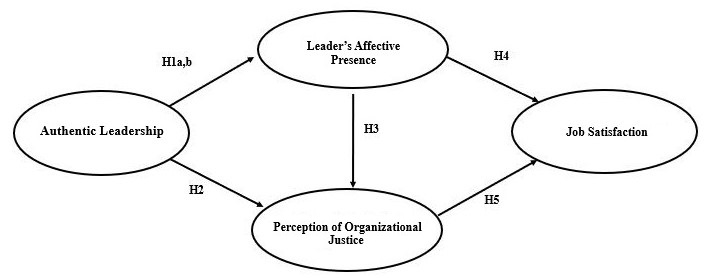
Respectful, transparent, and sensitive communication that attends to individual needs is a hallmark of authentic leadership (Luthans & Avolio, 2003) and acts as a catalyst for positivity in interactions with the leader, evoking consistent positive emotions in followers (Eisenkraft & Elfenbein, 2010; Madrid et al., 2016). These positive emotions facilitate a more assimilative cognitive approach, favoring less critical and more receptive evaluations in interaction contexts and raising the perception of fair treatment in work relationships (Bartels et al., 2022). Together, affective presence and interactional justice operate as complementary mechanisms that explain how authentic leaders strengthen bonds and promote greater satisfaction and well being at work. Figure 1 summarizes the hypotheses investigated in the research.
3 Method
3.1 Procedures and data collection
A quantitative, cross-sectional survey was carried out using a structured questionnaire designed specifically for this study. The research was conducted with employees of a mixed-economy company in the Brazilian banking sector, specifically one of its investment management units. The company has approximately 100,000 employees who are dispersed geographically, and the unit in question has 297 employees, most of whom are concentrated in the same unit. Data were collected via an electronic questionnaire hosted on the Qualtrics system and made available through an email invitation. Questions were sent indiscriminately to leaders and team members at different hierarchical levels. Total anonymity of the participants was ensured, and measures were taken to guarantee confidentiality of the information.
Of the 297 employees invited, 193 responded to the questionnaire, corresponding to a response rate of approximately 65%. While this was not a probabilistic sample, the strategy aimed to cover the entire target population. Thus, the sample can be characterized as a census with partial response based on participant self-selection. No significant differences were found between the respondents' profile and the general population's profile, indicating that the sample is representative of the group analyzed (Supplementary Data 1 – Data set and Codebook).
Of the respondents, 58% are men, 42% are women, and 54.4% have children. The average age is 41, ranging from 24 to 65 years old. Most participants are married or in stable relationships (70.5%), while 22.3% are single. In terms of education, the vast majority have postgraduate degrees (87.6%), predominantly in specializations. The average length of service with the company is 16.6 years, and the average length of time in their current position is 4.1 years. Among the participants, 30.1% hold a leadership position, and 69.9% are in the institution's technical career track. The average length of time working in the same team is 4.6 years, and the average length of time reporting to the leader is 2.1 years.
The minimum required sample size was calculated using G*Power 3.1.9.7 software (Faul et al., 2009). Considering that job satisfaction has the most predictors (eight: four substantive and four control variables), an effect size (f2) of 0.15, statistical power of 0.95, and α = 0.05, the required sample size is 109 observations. Since our sample consisted of 193 valid observations, the sample size criterion was met (Supplementary Data 2 – Appendix A_Questionnaire).
3.2 Measures
The questionnaire consisted of 43 questions, nine of which were related to demographic data. The remaining questions are detailed below.
AL: Sixteen questions were from the Authentic Leadership Inventory (ALI), which was developed by Neider and Schriesheim (2011) and validated in Portuguese by Campos and Rueda (2021). This instrument measures four dimensions that comprise the AL construct: self-knowledge (four items), relational transparency (four items), balanced information processing (four items), and internalized moral perspective (four items). A five-point Likert scale ranging from 1 (strongly disagree) to 5 (strongly agree) was used.
Leader AP: Eight questions were proposed by Eisenkraft and Elfenbein (2010) about the leader's affective states. The instrument is divided into two dimensions and asks participants to assess “to what extent interaction with your team leader generally makes you feel...” The first dimension encompasses four positive affective states: happy, enthusiastic, calm, and relaxed. The second dimension encompasses four negative affective states: bored, sad, stressed, and irritated. A five-point Likert scale was used, ranging from 1 (never) to 5 (always). The instrument was not available in Portuguese and was translated.
Perception of IJ: The instrument was developed by Hodson et al. (1994) and adapted into Portuguese by Rego (2000). It has 17 questions divided into five dimensions: two dimensions of IJ (interpersonal justice and informational justice), procedural justice, distributive justice of rewards, and distributive justice of tasks. To meet the objectives of this research, only the IJ-related dimensions were used, consisting of six questions. A six-point Likert scale was used, ranging from 1 (strongly disagree) to 6 (strongly agree).
JS: Based on Hackman and Oldham's (1975) Job Diagnostic Survey (JDS) instrument, which was translated into Portuguese and validated by Pedroso et al. (2014), four questions related to the dimension of overall job satisfaction were selected from the original group. Respondents were asked to rate each question on a seven-point Likert scale ranging from 1 (strongly disagree) to 7 (strongly agree).
Age, gender, length of time on the team, and length of time at the company were used as control variables. Gender is an important factor in JS (e.g., Abelha et al., 2018), and research indicates significant variations in perceptions of satisfaction between men and women. For example, women tend to report higher levels of satisfaction in areas such as supervision and relationships with colleagues (Bedeian et al., 1992). Age is also a relevant demographic factor because satisfaction tends to increase with age (e.g., Dobrow et al., 2018).
However, length of service, or time spent in a specific position, can negatively influence JS as it increases due to stagnation and a lack of new opportunities (Dobrow et al., 2018). However, time spent in an organization is a consistent predictor of satisfaction, reflecting greater security and stability, especially among men (Bedeian et al., 1992).
4 Analysis of results
We employed Harman's single-factor analysis to evaluate common method bias in the data set (Chang et al., 2010; Podsakoff & Organ, 1986). All indicators of the latent variables were entered into an exploratory factor analysis (EFA). Based on the criterion of eigenvalues greater than 1, this analysis indicated the retention of six latent factors. The eigenvalues of these factors in the sum of the rotated loadings were 5.38, 5.02, 3.81, 3.68, 3.41, and 1.96; these eigenvalues explained 15.83%, 14.79%, 11.21%, 10.83%, 10.03%, and 5.77% of the variance, respectively. Since the sum of the factors accounted for 68.46% of the total variance and the factor with the highest eigenvalue explained only 15.83%, we concluded that the common method variance probably did not substantially influence our results.
Table 1 shows the means, standard deviations, and correlations between the variables of the model studied. Cronbach's α was calculated for each variable to assess the reliability of the instruments used in the study, and the results indicated adequate reliability. In the regression analyses, responses to the scales were aggregated by mean and analyzed as a whole rather than subdivided by dimension.
Multiple regressions were performed for the different dependent variables involved in hypothesis testing using SPSS/Process (Supplementary Data 3 – Appendix B_Data). First, the direct effect of AL on the leader's positive AP was evaluated (Table 2). Demographic factors such as gender, age, length of service on the team, and length of service at the company were included in the analysis for control purposes.
Model 1, which consisted only of control variables, was not statistically significant; no demographic factor significantly affected the leader's positive AP. The demographic characteristics of the participants, such as gender, age, and length of service with the company and superior, were not associated with the leader's positive AP in this sample since the coefficient of determination of this model was not significant (R2 = 0.03).
Model 2, which included the AL variable, had a significant coefficient of determination (R2 = 0.43; F = 28.33; P < 0.001) and a significant regression coefficient for the AL variable (β = 0.66; t = 11.52; P < 0.001). This indicates that 43% of the variation in the leader's positive PA can be explained by variations in the superior's AL. Therefore, there is a positive relationship between the AL perceived by the follower and the leader's positive AP in the sample studied. This result confirms hypothesis H1a.
Next, the direct effect of AL on the leader's negative AP was evaluated (Table 3). The analysis included the same demographic control factors: gender, age, length of service on the team, and length of service at the company.
In the first model, the demographic factors were not statistically associated with the leader's negative AP since the model's coefficient of determination was not significant (R2 = 0.03).
Model 2 included the AL variable and obtained a significant R2 value (R2 = 0.36; F = 21.37; P < 0.001). This indicates that AL is associated with the perception of the leader's negative AP and explains 36% of the variance in this perception in this sample. The regression coefficient of the AL variable was significant (β = −0.59; t = −9.84; P < 0.001). The negative sign indicates an inverse relationship between the variables. As with the negative AP metric, lower scores indicate a less negative leader. Thus, it can be concluded that the more authentic the leadership, the lower the leader's negative AP in this group. These results confirm hypothesis H1b.
The regression coefficient of the time on the team variable was also significant in Model 2 (β = 0.14, t = 2.08, P < 0.05), indicating an association with the leader's negative AP. Thus, controlling for the effects of leadership, the longer an employee remains on a team, the greater the leader's negative AP. This may be because time provides a greater diversity of situations experienced with the leader.
To analyze H2 and H3, a multiple regression was performed to evaluate the impact of AL and the leader's positive AP on the perception of IJ (see Table 4). The demographic control variables were gender, age, time on the team, time at the company, and whether the responding employee held a leadership position.
Model 1, which considered only the effects of demographic factors on the perception of IJ, was not statistically significant (R2 = 0.04).
Model 2 introduces the AL variable as a predictor of the perception of IJ. This model's coefficient of determination was significant (R2 = 0.48, F = 28.36, P < 0.001), as was the regression coefficient of the AL variable (β = 0.69, t = 12.57, P < 0.001). These results indicate that the perception of IJ is statistically associated with the leader's AL.
The third model included the leader's positive AP variable in the analysis, together with the AL variable. This model also presented a statistically significant coefficient of determination (R2 = 0.61; F = 41.59; P < 0.001) and significant regression coefficients for AL (β = 0.37; t = 5.97; P < 0.001) and the leader's positive AP (β = 0.49; t = 7.98; P < 0.001). Additionally, the increase in the coefficient of determination was significant (ΔR2 = 0.13; F = 63.65; P < 0.001). These results indicate that both AL and the leader's positive AP are positively associated with employees' perceptions of IJ, thus confirming hypotheses H2 and H3.
To assess the mediation of the leader's positive AP and the perception of IJ between AL and JS, a hierarchical regression was performed. The following demographic variables were considered for control purposes: gender, age, time on the team, time at the company, and leadership position (Table 5).
In the first model, which used only the demographic variables, the coefficient of determination was significant (R2 = 0.07; F = 2.63; P < 0.05). The regression coefficient for time on the team was significant in relation to JS (β = 0.17, t = 2.05, P < 0.05). Therefore, it can be seen that the longer the time on the team, the greater the job satisfaction among the group of participants.
In Model 2, the AL variable was included as an antecedent of JS. The model's coefficient of determination (R2 = 0.16; F = 6.05; P < 0.001) and the regression coefficient of the AL variable (β = 0.32; t = 4.66; P < 0.001) were both statistically significant, suggesting a positive association between AL and JS.
The third model included the leader's positive AP variable and presented a significant coefficient of determination (R2 = 0.26; F = 9.46; P < 0.001). There was also a significant increase in the coefficient of determination, rising from 0.16 to 0.26 (ΔF = 25.20; P < 0.001). However, the AL variable did not show a significant regression coefficient at this stage when introducing AP reduced its effect on JS. This preliminary result is indicative of mediation (Baron & Kenny, 1986).
Model 4 showed a significant coefficient of determination (R2 = 0.31, F = 10.37, P < 0.001) when the perception of IJ variable was inserted (β = 0.35, t = 3.55, P < 0.001). The increase in R2 was also statistically significant, rising from 0.26 to 0.31 (ΔF = 12.61, P < 0.001). Though the effect of the leader's positive AP on JS showed a slight decrease in this model, the variable remained statistically significant with a regression coefficient of β = 0.25, t = 2.67, and P < 0.01. Since the results of models 3 and 4 satisfy the conditions for statistical mediation (Baron & Kenny, 1986), we can confirm hypotheses H4 and H5.
The Sobel (1982) test was performed to verify the mediations. The results (Sobel AL-AP-JS = 2.03, P < 0.05, and Sobel AL-IJ-JS = 2.62, P < 0.01) confirmed the proposed mediations. The indirect effects were verified using model 6 of the Process macro, which was generated by bootstrapping with 5,000 resamples. The results showed a significant indirect effect of authentic leadership on job satisfaction via the leader's positive affective presence (bAL-AP-JS = 0.26, SE = 0.10, 95% CI = [0.07, 0.47]); a significant indirect effect of authentic leadership on job satisfaction via interactional justice (bAL-IJ-JS = 0.20, SE = 0.14, 95% CI = [0.03, 0.53]); and a significant indirect effect of authentic leadership on job satisfaction via positive affective presence and interactional justice (bAL-AP-IJ-JS = 0.18, SE = 0.09, 95% CI = [0.04, 0.37]).
To verify the possibility of endogeneity, Hausman tests were conducted using demographic variables as instruments in the regression models (Hill et al., 2018). The results of these tests for the three main models (with positive affectivity, interactional justice, and satisfaction as the dependent variables) were not significant; that is, there is no strong evidence that the explanatory variables are endogenous. The results presented above are summarized in Figure 2.

5 Discussion and conclusion
This study tested a theoretical model that positions authentic leadership as a central factor in promoting well being at work. The model also considers the positive affective presence of these leaders and the perception of interactional justice resulting from their behavior as mediating mechanisms that explain how leadership promotes this outcome. The data corroborate the relationship between authentic leadership and job satisfaction, as well as the two proposed mediating mechanisms. In summary, the findings reinforce the idea that authentic leadership contributes to creating an emotionally positive, fair, and satisfying work environment for employees.
From a theoretical point of view, the first relevant finding concerns the connection between authentic behaviors and the affective presence of leaders. The data suggest that authentic leaders, characterized by high levels of morality, transparency, self-awareness, and balanced information processing, are perceived as more affectively positive by their subordinates. Additionally, the results show that authentic behaviors are inversely associated with negative affective presence, suggesting that authenticity mitigates dysfunctional, negative emotional expressions. This empirical evidence supports a central proposition of authentic leadership theory that has not yet been verified empirically: leader authenticity promotes interactions marked by positive emotions (Avolio et al., 2004, p. 18). To the best of our knowledge, these observations are a novel contribution of this study to leadership literature.
Regarding interactional justice, the data show a positive association with authentic leadership. This finding reinforces previous theoretical propositions (Howell & Avolio, 1992; Luthans & Avolio, 2003) that authentic leaders are perceived as fair due to their ethical conduct and relational transparency. In the sample analyzed, authentic leadership, anchored in dimensions such as self-knowledge and the internalization of moral values, seems to promote equitable and respectful interactions and is perceived as fostering both interpersonal and informational justice. Furthermore, the results suggest that the relationship between authentic leadership and interactional justice is due, in part, to authentic leaders' enhanced positive affective presence. Considering the specific organizational and cultural context of the sample (banking professionals), these results constitute an important contribution to leadership and organizational justice studies.
Finally, the findings suggest that authentic leadership is a reliable predictor of employee job satisfaction due to these leaders' positive affective presence and perceived interactional justice. Specifically, positive affective presence fully mediated the relationship between authentic leadership and job satisfaction. This finding suggests that authentic leaders contribute significantly to the well being of their followers due to their positivity (Judge & Klinger, 2008). Additionally, the perception of justice associated with authentic leadership practices was relevant in explaining differences in job satisfaction, suggesting that interactions perceived as fair with authentic leaders contribute to greater satisfaction with the work environment. From the perspective of demand and resource theory (Demerouti et al., 2001), these results attribute to the emotional positivity and interactional justice promoted by authentic leaders the role of psychosocial resources that mitigate work demands and strengthen employee motivation. Thus, promoting authentic leadership directly impacts job satisfaction and represents an organizational strategy that stimulates a healthy, engaged environment sustained by relationships of trust and equity.
From a people management perspective, this research contributes to leader training and new leaders development by highlighting elements that the AL perspective identifies as levers for building a healthier organizational environment. Therefore, it is crucial for leaders in training to develop self-awareness and self-reflection skills to align their actions with these values and maintain consistent behavior. Self-reflection tools and techniques can help leaders better understand their motivations and act more authentically. Furthermore, promoting authentic leadership fosters a culture of integrity where ethical behaviors are reinforced. Professionals exercising leadership who wish to develop in these dimensions should focus on transparency, integrity, and consistency in acting according to values and principles to foster an environment of trust. This environment is essential for effective collaboration and innovation.
Development programs should also focus on leaders' positive affective presence, as it promotes perceptions of fairness and job satisfaction. Positive affective presence is particularly relevant when communicating decisions and their criteria, which are intrinsic to interactional justice. Fair leaders actively listen, provide constructive feedback, and demonstrate empathy in these interactions. This research underscores the significance of these processes for employee well being, emphasizing the pivotal role of a leader's affective presence when providing and receiving feedback. This ensures that feedback is constructive and respectful, thereby enhancing employee satisfaction and improving the work environment.
From a social and institutional perspective, the findings reinforce the need for leadership promotion and evaluation criteria that consider not only technical and strategic skills, but also a leader's ability to generate positive affective connections and encourage fair interactions. HR departments should incorporate behavioral indicators related to authenticity, ethical consistency, and the ability to generate trust as criteria for evaluating managerial aptitude. Institutions that value and develop these competencies can improve well being and engagement indicators and strengthen an organizational culture based on trust, mutual respect, and relational integrity.
It should be noted that this study has some limitations. Cross-sectional correlational studies do not allow for the deduction of cause-and-effect relationships. Future studies should use experimental models to verify the causal effects of authentic behaviors on employee attitudes and the direction of causality in relation to affective presence. Furthermore, it cannot be completely ruled out that the variance explained by the method/source (common method variance) influences the estimation of predictors in the model, albeit minimally. Another limitation of the study is the response rate, as not all invited employees participated in the survey. Since no demographic data were collected from non-respondents, it was not possible to perform a statistical comparison between the groups. However, based on the available information, the profile of the respondents appears compatible with that of the overall population. This minimizes, but does not eliminate, the possibility of nonresponse bias.
The findings are also limited in their applicability due to the study's focus on a single banking organization and its primarily mature, well qualified professionals. Therefore, the associations observed cannot be considered valid for any professional in the financial sector, given the institution's particularities. While this approach yields relevant, context-specific results, the limitations stemming from the focus on a single national context underscore the importance of replicating the study in other financial institutions and in different cultural, institutional, or market contexts.
Future research should expand the sample to include private companies from other sectors and use mixed research methods to collect data from multiple sources. Since the topic of leader AP in organizations is recent and involves several variables, such as mood, feelings, emotional responses, and affective states, it would be interesting to investigate the influence of emotions on the development of AL and the formation of high-performance teams. Another suggestion is to investigate the impact of leaders' negative AP on team performance and the formation of judgments about leaders and their behaviors.
Thus, the results of this research clarify the mechanisms through which authentic leadership influences employee well being and offer valuable empirical foundations for institutional policies and strategic interventions. People are a company's greatest asset, and protecting, developing, and supporting them is a fundamental organizational responsibility. Organizations can strengthen a culture of trust and engagement by integrating development practices focused on affective presence, interactional justice, and ethical consistency. This impacts not only performance, but also long-term organizational health. Promoting working relationships based on authenticity directly responds to sustainable development goals associated with well being and decent work because authentic leadership strengthens these bonds. In a time when professionals feel overwhelmed and are seeking to reestablish their relationship with work to reduce their generalized sense of exhaustion (World Economic Forum, 2022), initiatives to cultivate healthier and more ethical work environments are urgent. These initiatives ensure business sustainability and the health of people and the planet.
Evaluation process:
How to cite:
Financial support:
Research data availability statement - Open science:
Plagiarism analysis:
Disclaimer on the Use of Artificial Intelligence
References
-
Abelha, D. M., Carneiro, P. C., & Cavazotte, F. D. (2018). Transformational Leadership and Job Satisfaction: Assessing the Influence of Organizational Contextual Factors and Individual Characteristics. Revista Brasileira de Gestão de Negócios, 20(4), 516-532. https://doi.org/10.7819/rbgn.v0i0.3949
» https://doi.org/10.7819/rbgn.v0i0.3949 -
Avolio, B. J., Bass, B. M., & Jung, D. I. (1999). Re-examining the components of transformational and transactional leadership using the Multifactor Leadership Questionnaire. Journal of Occupational and Organizational Psychology, 72(4), 441-462. https://doi.org/10.1348/096317999166789
» https://doi.org/10.1348/096317999166789 -
Avolio, B. J., Gardner, W. L., Walumbwa, F. O., Luthans, F., & May, D. R. (2004). Unlocking the mask: A look at the process by which authentic leaders impact follower attitudes and behaviors. The Leadership Quarterly, 15(6), 801-823. https://doi.org/10.1016/j.leaqua.2004.09.003
» https://doi.org/10.1016/j.leaqua.2004.09.003 -
Baron, R., & Kenny, D. (1986). The moderator-mediator variable distinction in social psychological research: Conceptual, strategic, and statistical considerations. Journal of Personality and Social Psychology, 51(6), 1173-1182. https://doi.org/10.1037/0022-3514.51.6.1173 PMid:3806354.
» https://doi.org/10.1037/0022-3514.51.6.1173 -
Bartels, A. L., Nahrgang, J. D., Sessions, H., Wilson, K. S., Wu, L., & Law‐Penrose, J. (2022). With a frown or a smile: How leader affective states spark the leader‐follower reciprocal exchange process. Personnel Psychology, 75(1), 147-177. https://doi.org/10.1111/peps.12445
» https://doi.org/10.1111/peps.12445 -
Bass, B. M., & Steidlmeier, P. (1999). Ethics, character, and authentic transformational leadership behavior. The Leadership Quarterly, 10(2), 181-217. https://doi.org/10.1016/S1048-9843(99)00016-8
» https://doi.org/10.1016/S1048-9843(99)00016-8 -
Bedeian, A. G., Ferris, G. R., & Kacmar, K. M. (1992). Age, tenure, and job satisfaction: A tale of two perspectives. Journal of Vocational Behavior, 40(1), 33-48. https://doi.org/10.1016/0001-8791(92)90045-2
» https://doi.org/10.1016/0001-8791(92)90045-2 - Bies, R. J., & Moag, J. S. (1986). Interactional justice: communication criteria of fairness. In R. J. Lewicki, B. H. Sheppard & M. H. Bazerman (Eds.), Research on negotiation in organizations (pp. 43-55). Greenwich, CT: JAI.
- Campos, M. I., & Rueda, F. (2021). Escala de Avaliação do Líder Autêntico: Confiabilidade e diferenças entre grupos. Revista Psicologia Organizações e Trabalho, 21(3), 1638-1646.
-
Cavazotte, F., Mansur, J., & Moreno, V. (2021). Authentic leadership and sustainable operations: How leader morality and selflessness can foster frontline safety performance. Journal of Cleaner Production, 313, 127819. https://doi.org/10.1016/j.jclepro.2021.127819
» https://doi.org/10.1016/j.jclepro.2021.127819 -
Cha, S. E., Hewlin, P. F., Roberts, L. M., Buckman, B. R., Leroy, H., Steckler, E. L., Ostermeier, K., & Cooper, D. (2019). Being your true self at work: Integrating the fragmented research on authenticity in organizations. The Academy of Management Annals, 13(2), 633-671. https://doi.org/10.5465/annals.2016.0108
» https://doi.org/10.5465/annals.2016.0108 -
Chang, S. J., van Witteloostuijn, A., & Eden, L. (2010). From the editors: Common method variance in international business research. Journal of International Business Studies, 41(2), 178-184. https://doi.org/10.1057/jibs.2009.88
» https://doi.org/10.1057/jibs.2009.88 - Cropanzano, R., & Greenberg, J. (1997). Progress in organizational justice: Tunneling through the maze. In C. L. Cooper & I. T. Robertson (Eds.), International review of industrial and organizational psychology (pp. 317-372). New York: Wiley & Sons.
-
Dal Vesco, G., Beuren, I. M., & Popik, F. (2016). Percepção de justiça na avaliação de desempenho e satisfação do trabalho. Enfoque: Reflexão Contábil, 35(3), 121-138. https://doi.org/10.4025/enfoque.v35i3.28333
» https://doi.org/10.4025/enfoque.v35i3.28333 -
Demerouti, E., Bakker, A. B., Nachreiner, F., & Schaufeli, W. B. (2001). The job demands-resources model of burnout. The Journal of Applied Psychology, 86(3), 499-512. https://doi.org/10.1037/0021-9010.86.3.499 PMid:11419809.
» https://doi.org/10.1037/0021-9010.86.3.499 -
Dobrow, S. R., Ganzach, Y., & Liu, Y. (2018). Time and job satisfaction: A longitudinal study of the differential roles of age and tenure. Journal of Management, 44(7), 2558-2579. https://doi.org/10.1177/0149206315624962
» https://doi.org/10.1177/0149206315624962 -
Eisenkraft, N., & Elfenbein, H. A. (2010). The way you make me feel: Evidence for individual differences in affective presence. Psychological Science, 21(4), 505-510. https://doi.org/10.1177/0956797610364117 PMid:20424091.
» https://doi.org/10.1177/0956797610364117 -
Erdogan, B., & Enders, J. (2007). Support from the top: Supervisors’ perceived organizational support as a moderator of leader–member exchange to satisfaction and performance relationships. The Journal of Applied Psychology, 92(2), 321-330. https://doi.org/10.1037/0021-9010.92.2.321 PMid:17371081.
» https://doi.org/10.1037/0021-9010.92.2.321 -
Faul, F., Erdfelder, E., Buchner, A., & Lang, A. G. (2009). Statistical power analyses using G*Power 3.1: Tests for correlation and regression analyses. Behavior Research Methods, 41(4), 1149-1160. https://doi.org/10.3758/BRM.41.4.1149 PMid:19897823.
» https://doi.org/10.3758/BRM.41.4.1149 -
Fox, S., Spector, P. E., & Miles, D. (2001). Counterproductive work behavior (CWB) in response to job stressors and organizational justice: Some mediator and moderator tests for autonomy and emotions. Journal of Vocational Behavior, 59(3), 291-309. https://doi.org/10.1006/jvbe.2001.1803
» https://doi.org/10.1006/jvbe.2001.1803 -
Gardner, W. L., & McCauley, K. D. (2022a). The gaslighting of authentic leadership. Leadership, 18(6), 801-813. https://doi.org/10.1177/17427150221111056
» https://doi.org/10.1177/17427150221111056 -
Gardner, W. L., & McCauley, K. D. (2022b). The gaslighting of authentic leadership revisited. Leadership, 18(6), 832-840. https://doi.org/10.1177/17427150221111635
» https://doi.org/10.1177/17427150221111635 -
Gardner, W. L., Cogliser, C. C., Davis, K. M., & Dickens, M. P. (2011). Authentic leadership: A review of the literature and research agenda. The Leadership Quarterly, 22(6), 1120-1145. https://doi.org/10.1016/j.leaqua.2011.09.007
» https://doi.org/10.1016/j.leaqua.2011.09.007 -
Gardner, W. L., Karam, E. P., Alvesson, M., & Einola, K. (2021). Authentic leadership: The case for and against. The Leadership Quarterly, 32(6), 101495. https://doi.org/10.1016/j.leaqua.2021.101495
» https://doi.org/10.1016/j.leaqua.2021.101495 -
Gardner, W. L., Karam, E. P., Noghani, F., Cogliser, C. C., Gullifor, D. P., Mhatre, K., Ge, S., Bi, R., Yan, Z., & Dahunsi, D. (2024). ‘Let’s get real’… when we lead: A systematic review, critical assessment, and agenda for authentic leadership theory and research. Journal of Management & Organization, 30(6), 1-27. https://doi.org/10.1017/jmo.2024.68
» https://doi.org/10.1017/jmo.2024.68 - George, B. (2003). Authentic leadership: Rediscovering the secrets to creating lasting value (1st ed.). San Francisco: Jossey-Bass.
- Gill, C., & Caza, A. (2018). An investigation of authentic leadership’s individual and group influences on follower responses. Journal of Management, 44(2), 530-554. https://doi.org/10.1177/0149206314566461.
-
Gooty, J., Connelly, S., Griffith, J., & Gupta, A. (2010). Leadership and affect: A state of science review. The Leadership Quarterly, 21(6), 979-1004. https://doi.org/10.1016/j.leaqua.2010.10.005
» https://doi.org/10.1016/j.leaqua.2010.10.005 -
Greenberg, J. (1990). Organizational justice: Yesterday, today, and tomorrow. Journal of Management, 16(2), 399-432. https://doi.org/10.1177/014920639001600208
» https://doi.org/10.1177/014920639001600208 -
Greenberg, J. (1993). Justice and organizational citizenship: A commentary on the state of the science. Employee Responsibilities and Rights Journal, 6(3), 249-256. https://doi.org/10.1007/BF01419448
» https://doi.org/10.1007/BF01419448 - Hackman, J. R., & Oldham, G. R. (1975). The job diagnostic survey: An instrument for the diagnosis of jobs and the evaluation of job redesign projects New Haven: Department of Administrative Sciences, Yale University.
- Hill, R. C., Griffiths, W. E., & Lim, G. C. (2018). Principles of econometrics (5th ed.). Hoboken: Wiley.
-
Hodson, R., Creighton, S., Jamison, C. S., Rieble, S., & Welsh, S. (1994). Loyalty to whom? Workplace participation and the development of consent. Human Relations; Studies Towards the Integration of the Social Sciences, 47(8), 895-909. https://doi.org/10.1177/001872679404700802
» https://doi.org/10.1177/001872679404700802 - Howell, J. M., & Avolio, B. J. (1992). The ethics of charismatic leadership: Submission or liberation? The Academy of Management Executive, 6(2), 43-54.
-
Hughes, D. J., Lee, A., Tian, A. W., Newman, A., & Legood, A. (2018). Leadership, creativity, and innovation: A critical review and practical recommendations. The Leadership Quarterly, 29(5), 549-569. https://doi.org/10.1016/j.leaqua.2018.03.001
» https://doi.org/10.1016/j.leaqua.2018.03.001 -
Johnson, S. K. (2009). Do you feel what I feel? Mood contagion and leadership outcomes. The Leadership Quarterly, 20(5), 814-827. https://doi.org/10.1016/j.leaqua.2009.06.012
» https://doi.org/10.1016/j.leaqua.2009.06.012 - Judge, T. A., & Klinger, R. (2008). Job satisfaction: Subjective well-being at work. In M. Eid & R. Larsen (Eds.), The science of subjective well-being New York: The Guilford Press.
-
Judge, T. A., Weiss, H. M., Kammeyer-Mueller, J. D., & Hulin, C. L. (2017). Job attitudes, job satisfaction, and job affect: A century of continuity and of change. The Journal of Applied Psychology, 102(3), 356-374. https://doi.org/10.1037/apl0000181 PMid:28125260.
» https://doi.org/10.1037/apl0000181 -
Lawler, E. J. (2001). An affect theory of social exchange. AJS; American Journal of Sociology, 107(2), 321-352. https://doi.org/10.1086/324071
» https://doi.org/10.1086/324071 -
Lombard, E., & Gibson Brandon, R. N. (2024). Do wealth managers understand codes of conduct and their ethical dilemmas? Lessons from an online survey. Journal of Business Ethics, 189(3), 553-572. https://doi.org/10.1007/s10551-023-05372-6
» https://doi.org/10.1007/s10551-023-05372-6 - Luthans, F., & Avolio, B. J. (2003). Authentic leadership development. In K. S. Cameron, J. E. Dutton & R. E. Quinn (Eds.), Positive organizational scholarship (pp. 241-258). San Francisco: Berrett-Koehler.
-
Lux, A. A., & Lowe, K. B. (2024). Authentic leadership: 20-Year review editorial. Journal of Management & Organization, 30(6), 1634-1641. https://doi.org/10.1017/jmo.2024.59
» https://doi.org/10.1017/jmo.2024.59 -
Madera, J. M., & Smith, D. B. (2009). The effects of leader negative emotions on evaluations of leadership in a crisis situation: The role of anger and sadness. The Leadership Quarterly, 20(2), 103-114. https://doi.org/10.1016/j.leaqua.2009.01.007
» https://doi.org/10.1016/j.leaqua.2009.01.007 -
Madrid, H. P., Totterdell, P., Niven, K., & Barros, E. (2016). Leader affective presence and innovation in teams. The Journal of Applied Psychology, 101(5), 673-686. https://doi.org/10.1037/apl0000078 PMid:26783828.
» https://doi.org/10.1037/apl0000078 -
Madrid, H. P., Vasquez, C. A., & Escaffi-Schwarz, M. (2024). Leader affective presence, psychological safety and team proactive problem prevention. Journal of Occupational and Organizational Psychology, 97(2), 516-535. https://doi.org/10.1111/joop.12480
» https://doi.org/10.1111/joop.12480 -
Mardanov, I. T., Heischmidt, K., & Henson, A. (2008). Leader-member exchange and job satisfaction bond and predicted employee turnover. Journal of Leadership & Organizational Studies, 15(2), 159-175. https://doi.org/10.1177/1548051808320985
» https://doi.org/10.1177/1548051808320985 -
Meier, L. L., Keller, A. C., Reis, D., & Nohe, C. (2023). On the asymmetry of losses and gains: Implications of changing work conditions for well-being. The Journal of Applied Psychology, 108(8), 1408-1424. https://doi.org/10.1037/apl0001080 PMid:37023295.
» https://doi.org/10.1037/apl0001080 -
Michie, S., & Gooty, J. (2005). Values, emotions, and authenticity: Will the real leader please stand up? The Leadership Quarterly, 16(3), 441-457. https://doi.org/10.1016/j.leaqua.2005.03.006
» https://doi.org/10.1016/j.leaqua.2005.03.006 -
Neider, L. L., & Schriesheim, C. A. (2011). The Authentic Leadership Inventory (ALI): Development and empirical tests. The Leadership Quarterly, 22(6), 1146-1164. https://doi.org/10.1016/j.leaqua.2011.09.008
» https://doi.org/10.1016/j.leaqua.2011.09.008 -
Pedroso, B., Kovaleski, A., Ferreira, C., Pilatti, L., Gutierrez, G., & Picinin, C. (2014). Desenvolvimento e validação da versão brasileira do Diagnóstico do Trabalho (Job Diagnostic Survey) de Hackman e Oldham. Gestão & Produção, 21(2), 285-301. https://doi.org/10.1590/0104-530X198
» https://doi.org/10.1590/0104-530X198 -
Podsakoff, P. M., & Organ, D. W. (1986). Self-reports in organizational research: Problems and prospects. Journal of Management, 12(4), 531-544. https://doi.org/10.1177/014920638601200408
» https://doi.org/10.1177/014920638601200408 - Rego, A. (2000). Justiça e comportamentos de cidadania. Comportamento Organizacional e Gestão, 6(1), 73-94.
-
Ribeiro, N., Duarte, A., Filipe, R., & Torres de Oliveira, R. (2020). How authentic leadership promotes individual creativity: The mediating role of affective commitment. Journal of Leadership & Organizational Studies, 27(2), 189-202. https://doi.org/10.1177/1548051819842796
» https://doi.org/10.1177/1548051819842796 -
Sobel, M. E. (1982). Asymptotic intervals for indirect effects in structural equations models. In S. Leinhart (Ed.), Sociological methodology (pp. 290-312). San Francisco: Jossey-Bass. https://doi.org/10.2307/270723
» https://doi.org/10.2307/270723 - Turano, L., & Cavazotte, F. (2023). Are principled leaders always considered effective? The role of followers’ business area. In Anais do 47° Encontro da ANPAD, São Paulo, SP. Maringá: Associação Nacional de Pós-Graduação e Pesquisa em Administração.
- United Nations Global Compact. (2021). UN global compact strategy 2021-2023. New York.
-
van Knippenberg, D., & van Kleef, G. A. (2016). Leadership and affect: Moving the hearts and minds of followers. The Academy of Management Annals, 10(1), 799-840. https://doi.org/10.5465/19416520.2016.1160515
» https://doi.org/10.5465/19416520.2016.1160515 - World Economic Forum. (2022). Addressing employee burnout: Are you solving the right problem? World Economic Forum Agenda.

 Note: N = 193; **P < 0.01; ***P < 0.001. Regression coefficient values (β) and coefficients of determination (R2) considering control variables