 Prevalence of frailty in hospitalized older adults with diabetes mellitus: systematic review and meta-analysis
Abstract
Objective To identify the prevalence of frailty in hospitalized older adults with diabetes mellitus based on a synthesis of evidence from the literature.
Method A systematic review was conducted, with searches performed in the MEDLINE, EMBASE, Virtual Health Library (VHL), Scopus, SciELO, and Web of Science databases, as well as in the reference lists of the selected studies. The inclusion criteria were hospitalized older adults diagnosed with diabetes mellitus and physical frailty, with no temporal restrictions. Searches were carried out in January 2025. The guidelines established by the Joanna Briggs Institute for evidence synthesis were followed. A meta-analysis model was used to estimate the prevalence of frailty, and a random-effects model was applied for data synthesis.
Results A total of 2,261 articles were identified, and 12 studies were included in the meta-analysis. Despite the variability observed in the instruments used to assess frailty, a high prevalence of frail individuals (40.4%; 95% CI: 23.0% to 60.5%; I2 = 97.7%, τ2 = 2.2149, p < 0.0001) and pre-frail individuals (34.8%; 95% CI: 22.3% to 49.8%; I2=97.7%, τ2=0.6700, p < 0.0001) was identified among hospitalized older adults diagnosed with diabetes.
Conclusion The findings reinforce the importance of systematic frailty assessment in hospitalized older adults diagnosed with diabetes mellitus as a basis for therapeutic planning and for improving care centered on functional status.
Keywords
Aged; Frailty; Diabetes Mellitus; Meta-analysis; Inpatients.
Resumo
Objetivo Identificar a prevalência de fragilidade em pessoas idosas hospitalizadas com diabetes mellitus a partir de uma síntese das evidências da literatura.
Método Uma revisão sistemática foi realizada, na qual realizaram-se buscas nas bases MEDLINE, EMBASE, Biblioteca Virtual em Saúde (BVS), Scopus, Scielo e Web of Science, bem como nas listas de referências dos estudos selecionados. Os critérios de inclusão foram: pessoas idosas hospitalizadas, diagnosticadas com diabetes mellitus e condição de fragilidade física, sem recortes temporais. As buscas ocorreram em janeiro de 2025. Seguiram-se as diretrizes estabelecidas pelo <italic>Joanna Briggs Institute </italic>para a síntese de evidências. Utilizou-se o modelo de metanálise para estimar a prevalência de fragilidade e o modelo de efeitos aleatórios para a síntese dos dados.
Resultados Um total de 2.261 artigos foram identificados e, para a metanálise, foram incluídos 12 estudos. Apesar da variabilidade observada nos instrumentos empregados para a avaliação da fragilidade, identificou-se alta prevalência de frágeis (40,4% IC 95%; 23% a 60,5%; I2 =97,7%, r2 =2,2149, p<0,0001) e pré-frágeis (34,8%, 22,3% a 49,8%; I2 =97,7%, r2 =0,6700, p<0,0001) entre as pessoas idosas hospitalizadas com diagnóstico de diabetes.
Conclusão Os achados reforçam a importância da avaliação sistemática da fragilidade em pessoas idosas hospitalizadas com diagnóstico de diabetes mellitus, como subsídio para o planejamento terapêutico e a qualificação do cuidado centrado na funcionalidade.
Palavras-chave
Idoso; Fragilidade; Diabetes Mellitus; Metanálise; Pacientes Internados.
INTRODUCTION
Physical frailty is one of the main contributors to functional decline and premature mortality in older adults, as it is characterized as a clinical state marked by increased individual vulnerability when exposed to internal and external stressors1,2. It has become increasingly evident that the risk of frailty in older adults may increase in the presence of chronic diseases, and this association has been demonstrated for diabetes mellitus (DM)3.
Older adults living with DM present high rates of mortality, functional disability, and comorbidities, in addition to a higher risk of falls, cognitive impairment, and polypharmacy4. Global estimates report that DM affects nearly 589 million people aged 20 to 79 years, and if this trajectory persists, it is estimated to affect 853 million individuals by 2050 5. The Diabetes Statistics Report linked to the United States Centers for Disease Control and Prevention (CDC) indicates that the prevalence of DM increases with age, reaching 29.2% (26.4% to 32.1%) among those aged 65 years or older6.
The high prevalence of DM among older adults, together with the substantial rates of physical frailty, significantly compromises the health of hospitalized older adults, resulting in complex clinical interactions and challenging therapeutic management. DM is a risk factor for frailty7, as both conditions share pathophysiological mechanisms, such as insulin resistance and the progressive loss of muscle mass and strength (sarcopenia)8. Insulin resistance, associated with hyperglycemia, diabetic complications, inflammatory cytokines, and endocrine alterations, may contribute to reductions in musculoskeletal mass and muscle weakness, thereby increasing the risk of frailty9. Using genetic data from large European cohorts, a study employing Mendelian randomization investigated the bidirectional causal relationship between DM and frailty. The findings showed that frailty significantly increases the risk of developing type 2 diabetes mellitus, while type 2 diabetes mellitus also increases the risk of frailty10.
Although the literature includes studies addressing the relationship between frailty and DM, an important gap remains regarding the lack of consistent estimates of the prevalence of physical frailty in hospitalized older adults with DM, particularly in contexts of greater clinical vulnerability. The relevance of the present study is grounded in progressive population aging and the high global burden of diabetes mellitus, conditions that together intensify clinical complexity and the risk of adverse outcomes. Thus, estimating the prevalence of frailty in this group is essential to improve therapeutic planning, guide early interventions, and support clinical decision-making, contributing to enhanced hospital care, reduced complications, and the advancement of future research in this field.
In light of the above, this systematic review aimed to identify the prevalence of physical frailty in hospitalized older adults with diabetes mellitus based on a synthesis of evidence from the literature.
METHOD
This study was conducted in accordance with the recommendations of the Joanna Briggs Institute (JBI) Evidence Synthesis Groups11. The study protocol is published on the International Platform of Registered Systematic Review and Meta-analysis Protocols (INPLASY 202510016), doi: 10.37766/inplasy2025.1.0016.
To formulate the research question and guide the literature search, the CoCoPop strategy was used (Co – Condition: frailty; Co – Context: hospital setting; Pop – Population: older adults diagnosed with diabetes mellitus). After applying this strategy, the following research question was defined: What is the prevalence of frailty in hospitalized older adults diagnosed with diabetes mellitus?
The inclusion criteria for study selection were observational studies, including prospective and retrospective cohort studies, case-control studies, cross-sectional studies, and clinical trials; application of validated instruments to assess the variable of interest frailty; inclusion of hospitalized older adults aged 60 years or older of any nationality; publication in any language, with no restriction on publication date; and diagnosis of diabetes mellitus in accordance with the World Health Organization (WHO) diagnostic criteria published in 2018 12. The exclusion criteria were lack of categorization regarding frailty status, duplicate studies indexed in more than one database, case reports, letters to the editor, conference abstracts, dissertations, theses, and monographs. The authors chose not to include gray literature due to the potential risk of compromising the validity and reproducibility of the results, as such materials do not undergo peer review.
The search strategy was tailored to each database and applied in January 2025 in the following sources: the National Library of Medicine (PubMed) via the Medical Literature Analysis and Retrieval System Online (MEDLINE); the Virtual Health Library (VHL); Scientific Electronic Library Online (SciELO); EMBASE; Scopus; and Web of Science. The following Medical Subject Headings (MeSH) terms were used: Aged, Frailty, Frail Elderly, Inpatients, Hospitalization, and Diabetes Mellitus. Boolean operators OR and AND were applied to structure the search strategy based on PubMed MeSH descriptors, as recommended to ensure efficient and accurate retrieval of scientific evidence from biomedical databases.
The search strategy was systematically developed with the support of a specialized librarian, who assisted in the selection of descriptors and the standardization of search combinations, thereby ensuring greater methodological rigor and reproducibility.
Accordingly, the search strategy was as follows: “Aged”[Mesh] OR (Elderly) AND “Frailty”[Mesh] OR (Frailties) OR (Frailness) OR (Frailty Syndrome) OR (Debility) OR (Debilities) OR “Frail Elderly”[Mesh] OR (Elderly, Frail) OR (Frail Elders) OR (Elder, Frail) OR (Elders, Frail) OR (Frail Elder) OR (Functionally Impaired Elderly) OR (Elderly, Functionally Impaired) OR (Functionally Impaired Elderly) OR (Frail Older Adults) OR (Adult, Frail Older) OR (Adults, Frail Older) OR (Frail Older Adult) OR (Older Adult, Frail) OR (Older Adults, Frail) AND “Inpatients”[Mesh] OR (Inpatient) OR “Hospitalization”[Mesh] OR (Hospitalizations) AND “Diabetes Mellitus”[Mesh] OR (Diabetes Mellitus). This strategy was translated into the specific controlled vocabularies of the other search sources and is described in the INPLASY registration (INPLASY 202510016).
Searches were conducted independently by two researchers, who applied the predefined eligibility criteria to the titles and abstracts retrieved. The search results were imported into the Rayyan® reference management software, in which the references were stored, organized, and classified13. After duplicate removal using the reference manager, ineligible studies were excluded.
The number of articles identified, including their distribution by database and aggregated totals, was systematized using the PRISMA flow diagram14. The flow diagram comprehensively details the screening stages, eligibility criteria, and reasons for study exclusion.
To minimize potential selection bias, after the initial refinement performed by the two reviewers, a meeting was held to discuss the selected articles. Disagreements were referred to a third reviewer, and consensus was reached regarding study inclusion or exclusion.
Following full-text reading of the eligible studies, data extraction was performed independently and in duplicate. Extracted data were compiled into a Microsoft Excel® table designed to cover the eligibility criteria. The table was based on JBI instruments11 and included the following variables: author name, year of publication, country, sex, sample size, study design, frailty assessment instrument, and prevalence of frailty. The reference lists of the included primary studies were also manually reviewed in an attempt to identify potentially relevant articles not indexed in the searched databases.
To describe the level of agreement between reviewers, the Kappa statistic was used, which is based on the number of concordant responses, that is, the frequency with which reviewers reached the same decision15. In this study, the kappa agreement index was 0.98, indicating strong or almost perfect agreement between the researchers.
Eligible studies were fully appraised using the Joanna Briggs Institute critical appraisal tools. For cross-sectional studies, the JBI Critical Appraisal Checklist for Analytical Cross-Sectional Studies was applied, whereas for cohort studies, the JBI Critical Appraisal Checklist for Cohort Studies was used11.
For the meta-analysis, heterogeneity among studies was assessed using Cochran’s Q test and the I2 statistic, which enabled the selection of the most appropriate statistical model for estimating the pooled effect. Due to significant variability in study populations and methodologies, a random-effects model was applied, yielding the overall estimates of the prevalence of frailty and pre-frailty.
The results were graphically presented using forest plots, illustrating individual and pooled effects, and funnel plots to assess publication bias using Egger’s test. The robustness of the estimates was evaluated through sensitivity analyses, in which individual studies were sequentially removed to assess their impact on the overall results.
The logit transformation was used to stabilize variance and to transform proportions onto a symmetric and unbounded scale [0,1]. In addition, the inverse-variance method was applied to combine study-specific estimates, assigning greater weight to studies with smaller standard errors. Hypothesis tests were conducted with a significance level of 5%.
As this study used articles retrieved from databases and did not involve human participants, approval by a Research Ethics Committee was not required. The study complies with current ethical standards. In addition, artificial intelligence was not used for writing, data analysis, or the preparation of this study.
DATA AVAILABILITY
The complete dataset supporting the results of this study has been made available in the Figshare repository and can be accessed via the doi: 10.6084/m9.figshare.30907523 16.
RESULTS
The database searches yielded 2,261 studies; 653 were excluded as duplicates, and 1,608 were selected for title and abstract screening. Of these, 1,589 articles were excluded based on title and abstract review, resulting in 19 studies selected for full-text reading. After completion of this stage, 11 articles were excluded and four new studies were added through other methods, namely reference checking of primary studies, resulting in a total of 12 articles included in the review. Figure 2 presents the Preferred Reporting Items for Systematic Reviews and Meta-Analyses PRISMA flow diagram used to illustrate the study selection process for this systematic review14.
.

Estimated prevalence of frailty among hospitalized older adults with diabetes mellitus. Curitiba, PR, Brazil, 2025.
The reviewers included all studies that met the inclusion criteria and discussed the methodological limitations identified. A total of 3,542 participants were included in the meta-analysis, with sample sizes ranging from 101 to 1,652 participants. A predominance of males was observed in 50% of the studies, followed by females in 33.3%, while sex was not reported in 16.6% of the studies.
Methodological quality assessment scores indicated that most articles were of moderate to high quality. All articles, regardless of their methodological quality ratings (Chart 1), were subjected to data extraction and synthesis.
Distribution of the characteristics of the studies included in the corpus of the systematic review. Curitiba, PR, Brazil, 2025.
Distribution of the results of the methodological quality assessment of the articles included in the study. Curitiba, PR, Brazil, 2025.
Among the countries in which the studies were conducted, China predominated (33.3%), followed by Vietnam (16.6%). The most frequently used instrument to assess frailty was the Frail Scale (53.8%), followed by the Clinical Frailty Scale (15.3%), the Frailty Index (7.7%), the Frailty Risk Score (FRS) (7.7%), the combined use of the Frail Scale and the Clinical Frailty Scale (7.7%), and the Fried Phenotype combined with the Reported Edmonton Frail Scale (REFS) (7.7%). Regarding study design, 58.3% were cross-sectional studies, 8.3% were multicenter cross-sectional studies, 8.3% were retrospective cohort studies, 8.3% were prospective cohort studies, and 16.6% were multicenter prospective cohort studies.
Table 1 presents the distribution of the characteristics of the studies that comprised the corpus of the systematic review, including the following variables: author and year, country of origin, sample size, sex, study design, frailty assessment instrument, and prevalence of frailty and pre-frailty.
The pooled prevalence of frailty among hospitalized older adults with diabetes across all included studies was 40.4% (23.0% to 60.5%), I2 = 97.7%, τ2 = 2.2149, p < 0.0001, and the pooled prevalence of pre-frailty was 34.8% (22.3% to 49.8%), I2 = 97.7%, τ2 = 0.6700, p < 0.0001 (Figure 2).
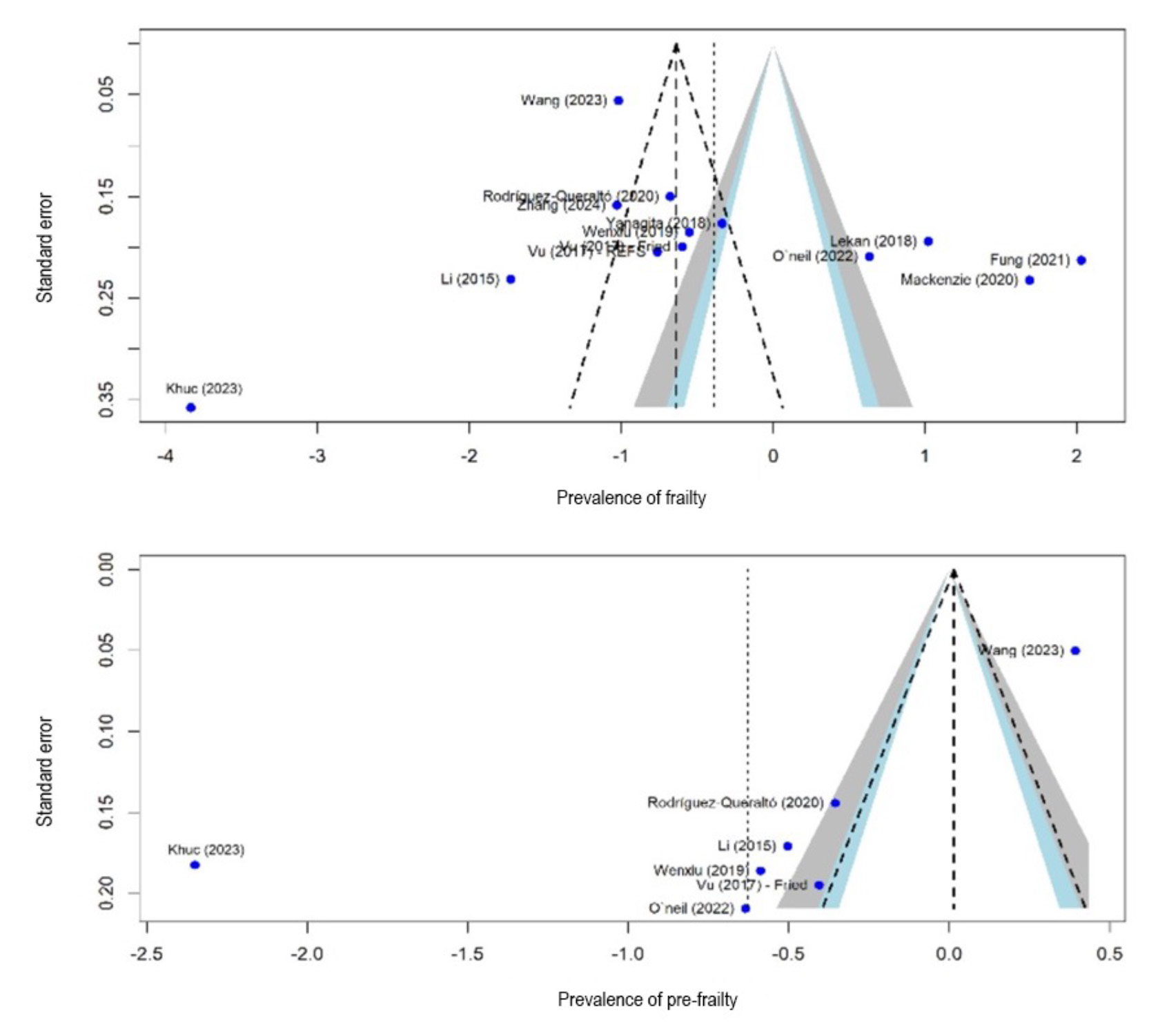
The funnel plot for frailty prevalence shows asymmetry, with a greater concentration of studies on the right side representing higher prevalences and fewer studies on the left side representing lower prevalences, with no statistically significant evidence of asymmetry (t = 1.33, p = 0.2113). In the funnel plot for pre-frailty prevalence, there was statistically significant evidence of asymmetry (t = -3.22, p = 0.0234) (Figure 3).

DISCUSSION
The present systematic review with meta-analysis demonstrated a high prevalence of frailty (40.4%) and pre-frailty (34.8%) among hospitalized older adults with diabetes mellitus, indicating that most individuals in this population exhibit some degree of physiological vulnerability during hospitalization. These findings exceed the prevalences observed in community-based settings29, supporting the hypothesis that the combination of diabetes and hospitalization increases frailty risk.
Other marked differences in frailty status are observed between community-dwelling and hospitalized older adults. Community-dwelling older adults show a lower prevalence of physical frailty and a higher prevalence of pre-frailty30. It is evident that the coexistence of diabetes mellitus and frailty acts as a strong predictor of hospitalization, which explains the higher proportion of frail older adults with diabetes in the hospital setting. This profile reflects more severe health conditions among hospitalized individuals, as they already present reduced physiological reserves and lower resistance to stressors, with an increased risk of severe complications and recurrent hospitalizations31.
The substantial heterogeneity among the estimates of the included studies, with prevalences ranging from 2.1%22 to 88.4%28, suggests a strong influence of methodological and conceptual factors. Such discrepancies may stem from differences in assessment instruments, adopted cutoff points, classification strategies that are dichotomous or multilevel, as well as from the clinical and sociodemographic characteristics of the samples. This pattern is widely discussed in the literature, which recognizes the lack of standardization in frailty measurement as one of the main determinants of variability in prevalence estimates.
The heterogeneity observed across studies may reflect differences in frailty status, morbidity profiles, and nutritional and functional status, elements associated with the progression of frailty in the hospital setting. Although these characteristics were not the primary focus of the present investigation, they contribute to the interpretation of the observed discrepancies. Among older adults diagnosed with diabetes mellitus, an association was observed between pre-frailty or frailty and female sex22, older chronological age18,23,26,28, lower income22, and low educational attainment18,22.
In addition, frailty was associated with longer duration of diabetes diagnosis22, a higher number of morbidities22, poor nutritional status18,19, lower body weight and systolic blood pressure26, the presence of cardiovascular diseases18,23,27, cancer and gastrointestinal diseases23, cerebrovascular and renal diseases23,28, cognitive impairment19, lower scores for instrumental activities of daily living17,19, as well as impaired mobility and diabetic nephropathy17.
These results corroborate previous studies on the relationship between these conditions and frailty in older adults with diabetes29 and in those with multimorbidity30. The presence of these factors may influence transitions in frailty status, particularly among hospitalized older adults, while also highlighting certain modifiable characteristics that can be incorporated into care management and treatment strategies for hospitalized older adults29.
Although the studies reported data on frailty in older adults with diabetes, their objectives were highly heterogeneous, including assessment of functional fitness in frail older adults24; evaluation of the association between diabetes mellitus and associated factors18,19,22, specifically multimorbidities26, acute coronary syndrome27, and hospital outcomes17,20,25; assessment of the relationship between dysglycemia and frailty in older adults using insulin28; and evaluation of risk factors for frailty, including glycated hemoglobin26, as well as hypoglycemic treatment in relation to therapeutic targets and hospital outcomes21.
The funnel plot for frailty prevalence did not demonstrate publication bias. It was observed that two studies17,22 were outside the expected funnel limits, indicating that their estimates may be under- or overestimated. Studies with more precise frailty estimates and smaller standard errors were located closer to the top of the plot23 and or clustered around the central line of the funnel27.
The main strengths of this study include the adoption of a systematic and comprehensive search strategy, methodological quality assessment, a standardized data extraction process, as well as the quantitative synthesis of results, presented using forest plots, and the application of statistical tests to assess publication bias. Nevertheless, some limitations should be considered when interpreting the findings. These include heterogeneity among the analyzed populations, sample sizes that are not always representative of the target population, the diversity of instruments used to assess frailty, variability in the classification of frailty status—either dichotomous or tripartite—and the exclusion of gray literature.
CONCLUSION
The prevalence of frailty among hospitalized older adults with diabetes mellitus was high, affecting 75.2% of the analyzed population, of whom 40.4% were classified as frail and 34.8% as pre-frail. The identification of both the prevalence and the coexistence of these two conditions highlights the clinical risks faced by hospitalized older adults.
This study provides an original contribution by consolidating prevalence estimates specifically for hospitalized older adults with diabetes, thereby addressing an important gap in the literature and support therapeutic planning. The findings also contribute to the improvement of care protocols and to the guidance of interdisciplinary strategies centered on functionality, in line with guidelines for older adult care in the hospital setting.
The results of this review indicate the need for future studies with longitudinal and multicenter designs capable of monitoring the progression of frailty among hospitalized older adults diagnosed with diabetes mellitus. The importance of standardizing frailty assessment instruments is emphasized, as well as conducting studies that investigate the association of frailty with clinical, functional, and economic outcomes. Furthermore, research evaluating multidimensional interventions and the systematic incorporation of frailty assessment into care protocols may contribute to improved clinical decision-making and to the qualification of care centered on functionality.
References
- 1 Dent E, Morley JE, Cruz-Jentoft AJ, Woodhouse L, Rodríguez-Mañas L, Fried LP, et al. Physical frailty: ICFSR international clinical practice guidelines for identification and management [Internet]. J Nutr Health Aging. 2019;23(9):771-87. [acesso em: 31 dez. 2025]. Disponível em: https://doi.org/10.1007/s12603-019-1273-z
- 2 Morley JE, Vellas B, Abellan van Kan G, Anker SD, Bauer JM, Bernabei R, et al. Frailty consensus: a call to action [Internet]. J Am Med Dir Assoc. 2013;14(6):392-7. [acesso em: 31 dez. 2025]. Disponível em: https://doi.org/10.1016/j.jamda.2013.03.022
- 3 Aguayo GA, Hulman A, Vaillant MT, Donneau AF, Schritz A, Stranges S, et al. Prospective association among diabetes diagnosis, HbA1c, glycemia, and frailty trajectories in an elderly population [Internet]. Diabetes Care. 2019;42(10):1903-11. [acesso em: 31 dez. 2025]. Disponível em:https://doi.org/10.2337/dc19-0497
- 4 American Diabetes Association. Older adults: standards of medical care in diabetes—2018 [Internet]. Diabetes Care. 2018;41(Suppl 1):S119-25. [acesso em: 31 dez. 2025]. https://doi.org/10.2337/dc18-S011
-
5 International Diabetes Federation. IDF Diabetes Atlas. [Internet]. 2025 [citado em 2025 Oct 10]. Disponível em: https://diabetesatlas.org.
» https://diabetesatlas.org. -
6 Centers for Disease Control and Prevention. National Diabetes Statistics Report, 2025. Atlanta: CDC; 2025 [Internet]. [acesso em 31 dez 2025]. Disponível em: https://www.cdc.gov/diabetes/php/data-research/index.html.
» https://www.cdc.gov/diabetes/php/data-research/index.html. - 7 Hanlon P, Fauré I, Corcoran N, Butterly E, Lewsey J, McAllister D, et al. Frailty measurement, prevalence, incidence, and clinical implications in people with diabetes: a systematic review and study-level meta-analysis [Internet]. Lancet Healthy Longev. 2020;1(3):e106-16. [acesso em 31 dez 2025]. Disponível em: https://doi.org/10.1016/S2666-7568(20)30014-3
- 8 Umegaki H. Sarcopenia and frailty in older patients with diabetes mellitus [Internet]. Geriatr Gerontol Int. 2016;16(3):293-9. [acesso em 31 dez 2025]. Disponível em: https://doi.org/10.1111/ggi.12688
- 9 Yanase T, Yanagita I, Muta K, Nawata H. Frailty in elderly diabetes patients [Internet]. Endocr J. 2018;65(1):1-11. [acesso em 31 dez 2025]. Disponível em: https://doi.org/10.1507/endocrj.EJ17-0390
- 10 Gao Y, Gao Y, Li Y, Zhang Q, Wang Y. Causal associations of frailty and type 2 diabetes mellitus: a bidirectional Mendelian randomization study [Internet]. Medicine (Baltimore). 2025;104(10):e41630. [acesso em 31 dez 2025]. Disponível em: https://doi.org/10.1097/MD.0000000000041630
-
11 Aromataris E, Munn Z, editores. JBI Manual for Evidence Synthesis. Adelaide: Joanna Briggs Institute; 2020. Disponível em: https://jbi-global-wiki.refined.site/space/MANUAL/355599504.
» https://jbi-global-wiki.refined.site/space/MANUAL/355599504. - 12 Anno T, Mune T, Takai M, Kimura T, Hirukawa H, Kawasaki F, et al. Decreased plasma aldosterone levels in patients with type 2 diabetes mellitus: a possible pitfall in diagnosis of primary aldosteronism [Internet]. Diabetes Metab. 2019;45(4):399-400. [acesso em 31 dez 2025]. Disponível em: https://doi.org/10.1016/j.diabet.2018.06.003
- 13 Ouzzani M, Hammady H, Fedorowicz Z, Elmagarmid A. Rayyan—a web and mobile app for systematic reviews [Internet]. Syst Rev. 2016;5(1):210. [acesso em 31 dez 2025]. Disponível em: https://doi.org/10.1186/s13643-016-0384-4
- 14 Page MJ, McKenzie JE, Bossuyt PM, Boutron I, Hoffmann TC, Mulrow CD, et al. The PRISMA 2020 statement: an updated guideline for reporting systematic reviews [Internet]. BMJ. 2021;372:n71. [acesso em 31 dez 2025]. Disponível em: https://doi.org/10.1136/bmj.n71
- 15 Hulley SB, Cummings SR, Browner WS, Grady DG, Newman TB. Designing clinical research. 4th ed. Philadelphia: Wolters Kluwer, Lippincott Williams & Wilkins; 2013. 367p.
-
16 Cechinel C, Rodrigues JAM, Lenardt MH, Aristides MM. Prevalence of frailty in hospitalized older adults with diabetes mellitus: systematic review and meta-analysis [Internet]. Figshare; 2025. [acesso em 31 dez 2025]. Disponível em: https://doi.org/10.6084/m9.figshare.30907523
» https://doi.org/10.6084/m9.figshare.30907523 - 17 Li Y, Zou Y, Wang S, Li J, Jing X, Yang M, et al. A pilot study of the FRAIL scale on predicting outcomes in Chinese elderly people with type 2 diabetes [Internet]. J Am Med Dir Assoc. 2015;16(8):714.e7-714.e12. [acesso em 31 dez 2025]. Disponível em: https://doi.org/10.1016/j.jamda.2015.05.019.
- 18 Vu HTT, Nguyen TX, Nguyen TN, Nguyen AT, Cumming RG, Hilmer SN, et al. Prevalence of frailty and its associated factors in older hospitalised patients in Vietnam [Internet]. BMC Geriatr. 2017;17(1):216. [acesso em 31 dez 2025]. Disponível em: https://doi.org/10.1186/s12877-017-0609-y.
- 19 Wenxiu C, Xiaopeng H, Lin B, Zhao W, Yang L, Jing L. Analysis of frailty and its influencing factors in inpatients with type 2 diabetes [Internet]. Chin J Pract Nurs. 2019;35(18):1618-23. [acesso em 31 dez 2025]. Disponível em: https://caod.oriprobe.com/articles/56987331/Analysis_of_frailty_and_its_influencing_factors_in.htm.
- 20 MacKenzie HT, Tugwell B, Rockwood K, Theou O. Frailty and diabetes in older hospitalized adults: the case for routine frailty assessment [Internet]. Can J Diabetes. 2020;44(3):241-245.e1. [acesso em 31 dez 2025]. Disponível em: https://doi.org/10.1016/j.jcjd.2019.07.001
- 21 O’Neil H, Pearce M, Husband A, Todd A. Investigating the relationship between harm and over- or under-treatment of frail patients living with diabetes, admitted to hospital [Internet]. Pract Diabetes. 2022;39(3):23. [acesso em 31 dez 2025]. Disponível em: https://doi.org/10.1002/pdi.2395
- 22 Khuc AHT, Doan VT, Le TT, Ngo TT, Dinh NT, Tran TP, et al. Determinants of frailty among patients with type 2 diabetes in urban hospital [Internet]. Hosp Top. 2021 3;101(3):215-22. [acesso em 31 dez 2025]. Disponível em: https://doi.org/10.1080/00185868.2021.2005501
- 23 Wang Y, Li R, Yuan L, Yang X, Lv J, Ye Z, et al. Association between diabetes complicated with comorbidities and frailty in older adults: a cross-sectional study [Internet]. J Clin Nurs. 2023;32(5-6):894-900. [acesso em 31 dez 2025]. Disponível em: https://doi.org/10.1111/jocn.16442
- 24 Zhang H, Wang J, Xi J, Xu J, Wang L. Functional fitness and risk factors of older patients with diabetes combined with sarcopenia and/or frailty: a cross-sectional study. Nurs Open. 2024;11(1):e2042. [acesso em 31 dez 2025]. Disponível em: https://doi.org/10.1002/nop2.2042
- 25 Lekan DA, McCoy TP. Frailty risk in hospitalised older adults with and without diabetes mellitus [Internet]. J Clin Nurs. 2018;27(19-20):3510-21. [acesso em 31 dez 2025]. Disponível em: https://doi.org/10.1111/jocn.14529
- 26 Yanagita I, Fujihara Y, Eda T, Tajima M, Yonemura K, Kawajiri T, et al. Low glycated hemoglobin level is associated with severity of frailty in Japanese elderly diabetes patients [Internet]. J Diabetes Investig. 2018;9(2):419-25. [acesso em 31 dez 2025]. Disponível em: https://doi.org/10.1111/jdi.12698
- 27 Rodríguez-Queraltó O, Formiga F, Carol A, Llibre C, Martínez-Sellés M, Marín F, et al. Impact of diabetes mellitus and frailty on long-term outcomes in elderly patients with acute coronary syndromes [Internet]. J Nutr Health Aging. 2020;24(7):723-9. [acesso em 31 dez 2025]. Disponível em: https://doi.org/10.1007/s12603-020-1408-0
- 28 Fung E, Lui LT, Huang L, Cheng KF, Lau GHW, Chung YT, et al. Characterising frailty, metrics of continuous glucose monitoring, and mortality hazards in older adults with type 2 diabetes on insulin therapy (HARE): a prospective, observational cohort study [Internet]. Lancet Healthy Longev. 2021;2(11):e724-35. [acesso em 31 dez 2025]. Disponível em: https://doi.org/10.1016/S2666-7568(21)00251-8
- 29 Qiu Y, Li G, Wang X, Liu W, Li X, Yang Y, Wang L, Chen L. Prevalence of multidimensional frailty among community-dwelling older adults: A systematic review and meta-analysis [Internet]. Int J Nurs Stud. 2024;154:104755. [acesso em 31 dez 2025]. Disponível em: https://doi.org/10.1016/j.ijnurstu.2024.104755
- 30 Melo Filho J, Moreira NB, Vojciechowski AS, Biesek S, Bento PCB, Gomes ARS. Frailty prevalence and related factors in older adults from southern Brazil: A cross-sectional observational study [Internet]. Clinics (Sao Paulo). 2020;75:e1694. [acesso em 31 dez 2025]. Disponível em: https://doi.org/10.6061/clinics/2020/e1694
- 31 Miao Z, Zhang Q, Yin J, Li L, Feng Y. Impact of frailty on mortality, hospitalization, cardiovascular events, and complications in patients with diabetes mellitus: a systematic review and meta-analysis [Internet]. Diabetol Metab Syndr. 2024;16:116. [acesso em 31 dez 2025]. Disponível em: https://doi.org/10.1186/s13098-024-01352-6
Edited by
-
Edited by
Larissa Neves Quadros