 Most prevalent morbidities among older Brazilian adults according to sex, age groups, and major regions
Abstract
Objective To identify the most prevalent morbidities among older Brazilian adults in 2013 and 2019 and their percentage variation according to sex and age groups in the country’s major regions.
Method This cross-sectional study used data from the 2013 and 2019 National Health Survey, including older adults aged 60 years or over who answered the selected resident questionnaire (2013: n=11,177; 2019: n=22,728). Complex sample analyses with sampling weights were performed, estimating prevalences and confidence intervals to ensure the representativeness of the results. Percentage variation was calculated using the formula [(value at the later time ÷ value at the earlier time) − 1] × 100. Associations between variables were assessed using Pearson’s chi-square test (p<0.05).
Results The most prevalent morbidities in both years were hypertension, chronic back problems, hypercholesterolemia, diabetes mellitus, and arthritis or rheumatism. These conditions were more prevalent among younger older adults, females, and residents of the Southeast region. Overall, an increase in the percentage variation of morbidities among older adults was observed across the years analyzed, according to the Brazilian regions, although with important disparities by sex and age groups.
Conclusion The distribution of morbidities revealed inequalities according to sex, age groups, and regions, reflecting disparities in the aging process of the Brazilian population. These findings enhance the understanding of regional inequalities and support managers and healthcare professionals in organizing equitable care for older adults, guiding the development of public policies and clinical practice in geriatrics and gerontology.
Keywords
Morbidity; Chronic Disease; Aging; Health of the Elderly; Geriatrics.
Resumo
Objetivo identificar as morbidades mais prevalentes em pessoas idosas brasileiras nos anos de 2013 e 2019 e sua variação percentual, de acordo com o sexo e grupos etários, nas grandes regiões do país.
Método estudo transversal, com dados da Pesquisa Nacional de Saúde de 2013 e 2019, incluindo pessoas idosas de 60 anos de idade ou mais que responderam ao questionário do morador selecionado (2013: n=11.177; 2019: n=22.728). Realizaram-se análises de amostra complexa com pesos amostrais, estimando as prevalências e intervalos de confiança para a representatividade dos resultados. A variação percentual foi calculada pela fórmula [(valor no momento posterior ÷ valor no momento anterior) -1] ×100. As associações entre variáveis foram realizadas por meio do teste Qui-quadrado de Pearson (p<0,05).
Resultados as morbidades mais prevalentes em ambos os anos foram hipertensão arterial sistêmica, problema crônico de coluna, hipercolesterolemia, diabetes mellitus e artrite ou reumatismo. Foram mais prevalentes em pessoas idosas jovens, do sexo feminino e da região sudeste. Observou-se, de forma geral, um aumento na variação percentual das morbidades entre as pessoas idosas nos anos analisados, segundo as regiões brasileiras, embora com disparidades importantes de acordo com o sexo e grupos etários.
Conclusão A distribuição das morbidades revelou desigualdades de acordo com o sexo, grupos etários e regiões, refletindo disparidades no envelhecimento da população brasileira. Essas evidências ampliam a compreensão das desigualdades regionais e subsidiam gestores e profissionais na organização do cuidado à saúde da pessoa idosa com equidade, orientando a formulação de políticas públicas e a prática clínica em geriatria e gerontologia.
Palavras-chave
Morbidade; Doença Crônica; Envelhecimento; Saúde do Idoso; Geriatria.
INTRODUCTION
An increase in noncommunicable chronic diseases (NCDs) has been observed among the older population, concurrently with population aging and the epidemiological transition1. Noncommunicable chronic diseases are among the leading causes of disability and premature mortality worldwide, accounting for approximately 71% of all deaths. In this context, older adults are the most affected, resulting in significant impacts on their quality of life and generating substantial costs for healthcare systems2. In Brazil, in 2019, noncommunicable chronic diseases accounted for more than 734,000 deaths, representing approximately 55% of all deaths in the country1.
Previous studies have highlighted the importance of investigating the health of older adults, particularly regarding the most prevalent morbidities3-6. International3,4 and national5,6 research has shown differences according to sex and age groups, with the oldest old (80 years of age or older) women exhibiting higher prevalence of multimorbidity (two or more morbidities in the same individual) when up to 25 diseases and greater life expectancy are considered.
Within the context of Brazil’s demographic transition, the older population has increased markedly, especially among those aged 80 years or over, compared with other age groups7. This phenomenon has triggered significant changes in morbidity and mortality patterns, with substantial regional diversity influenced by socioeconomic, cultural, and racial disparities, access to healthcare services, urbanization, and other factors7.
Clarifying potential regional differences is essential for improving understanding and for developing effective strategies aimed at preventing health conditions and organizing healthcare delivery. This enables the recognition of specificities that are often rendered invisible by regional inequalities, contributing to the promotion of health and quality of life among older adults6.
Few studies have examined the epidemiology of the most prevalent morbidities among older Brazilian adults within a regional framework, particularly considering sex, age groups, and temporal comparisons. This study seeks to address this gap in the literature, as understanding such diversity is essential for formulating more equitable public health policies and for delivering comprehensive healthcare to this population, especially considering Primary Health Care (PHC) as the main entry point into the Unified Health System (SUS)5,6.
Thus, comparative analysis enables healthcare professionals to identify the most relevant aspects to be addressed in the assessment and monitoring of older adults’ health, while also supporting decision-makers in developing or adjusting public policies. Therefore, this study aims to identify the most prevalent morbidities among older Brazilian adults in 2013 and 2019 according to sex and age groups across the country’s major regions.
METHODS
This was a cross-sectional study using individual data from the Brazilian National Health Survey (PNS). This is the most comprehensive health survey conducted in Brazil and consists of a nationally representative household-based survey carried out in 2013 and 2019 across the country’s major regions. It was developed by the Brazilian Institute of Geography and Statistics (IBGE) in partnership with the Ministry of Health. The methodology of the National Health Survey is internationally validated and allows for statistically rigorous comparison of regional realities in Brazil8. This study followed the recommendations of the Strengthening the Reporting of Observational Studies in Epidemiology (STROBE) guidelines for reporting observational studies.
The study population consisted of older adults aged 60 years or older residing in all Brazilian states. The sample included older adults who completed the selected resident questionnaire (2013: 11,177; 2019: 22,728). In both editions of the National Health Survey, sampling followed a three-stage cluster design. In the first stage, the primary sampling units were census tracts randomly selected. In the second stage, a random number of households was selected within each tract, and in the third stage, one resident was randomly selected in each sampled household8.
Publicly available data were obtained between April and June 2023 from the 2013 and 2019 National Health Survey databases, accessible on the IBGE website.
To assess the most prevalent morbidities, 14 noncommunicable chronic diseases included in both editions of the National Health Survey were considered, according to the survey’s specific modules. Morbidities were identified using Module H on noncommunicable chronic diseases. The questions and their respective codes were: hypertension (Q002), diabetes mellitus (Q030), hypercholesterolemia (Q060), heart disease (Q063), cerebrovascular disease (Q068), asthma (Q074), arthritis/rheumatism (Q079), chronic back problem (Q084), work-related musculoskeletal disorder (Q088), depression (Q092), lung disease (Q116), cancer (Q120), and chronic kidney failure (Q124).
The identification of noncommunicable chronic diseases was based on the question: “Has any physician ever given you a diagnosis for this disease?”, with dichotomous response options (yes/no). For chronic back pain, the survey relied on participants’ self-reports, whereas for depression and mental health, previous diagnoses made by a mental health professional (psychiatrist or psychologist) were considered.
Based on a ranking derived from the prevalence analysis of all morbidities included in both editions of the National Health Survey, the five most prevalent morbidities in Brazil were selected for analysis (hypertension, chronic back problem, hypercholesterolemia, diabetes mellitus, and arthritis or rheumatism), as these accounted for more than 50% of all morbidities among older Brazilian adults.
Sociodemographic variables were drawn from different modules of the National Health Survey. Sex was identified in Module A – General Characteristics of Household Residents, question Q001: “What is your sex?” (male; female). Age was obtained from question Q002 of the same module: “How old are you in completed years?”, and categorized into three age groups (60–69, 70–79, and ≥80 years). The region of residence was derived from the geographic location of the household, recorded in the identification and territorial classification block of the questionnaire, following the official IBGE division into five major regions: North, Northeast, Southeast, South, and Central-West. Educational level was obtained from Module C – Education Characteristics, question Q025: “What is the highest level of schooling you attended and completed?”, categorized as no schooling, primary education, secondary education, and higher education. Perceived health status was extracted from Module J – Lifestyle and Health Perception, question Q001: “In general, how would you rate your health?” The response options were very good, good, fair, poor, and very poor; for analysis, categories were grouped as very good/good, fair, and poor/very poor.
For sample characterization, two groups of older adults were considered: a younger group (60–79 years) and an older group (80 years or over), following previous research on aging and morbidity distribution9-13. Variables were analyzed by sex and age group within the regional context. Considering the complex sampling design, sampling weights for the primary sampling unit, individual, and stratum were applied in all analyses, ensuring the representativeness of data for older Brazilian adults. For sample characterization, categorical variables were presented using relative frequencies (%) and 95% confidence intervals (95% CI). Morbidity prevalences and their respective 95% CIs were estimated according to survey year, sex, and age group across Brazil’s major regions.
Associations between variables were analyzed using Pearson’s Chi-square test with a 95% confidence level. Associations were considered statistically significant when the p-value was <0.05. Percentage variation was calculated as follows: [(value at the later time ÷ value at the earlier time) − 1] × 100, in accordance with a previous study comparing percentages across the two editions of the National Health Survey14.
This study used only secondary, public, and anonymized data from the National Health Survey, whose data collection was approved by the National Research Ethics Commission (CONEP) under opinions Nº 328,159/2013 and Nº 3,529,376/2019, in compliance with National Health Council Resolution Nº 466/12. The present analysis, involving public data with no possibility of participant identification, also complies with the guidelines of National Health Council Resolution Nº 510/2016.
DATA AVAILABILITY
The full dataset supporting the results of this study is publicly available on the National Health Survey website and can be accessed at https://www.pns.icict.fiocruz.br/bases-de-dados/
RESULTS
Table 1 presents the proportional distribution of the relative frequencies of sociodemographic and health-related variables of older adults in 2013 and 2019, as well as the percentage variation for Brazil and its major regions. In both years, higher proportions of women, individuals aged 60-79 years, and those with incomplete primary education were observed in Brazil and in its regions. A greater proportion of very good/good perceived health status was found in the Southeast, South, and Central-West regions, whereas fair perceived health was more prevalent in the North and Northeast regions.
Characteristics of older adults in 2013 (N = 11,177) and 2019 (N = 22,728), in percentages and 95% Confidence Intervals (95% CI). National Health Survey, Brazil, 2013 and 2019.
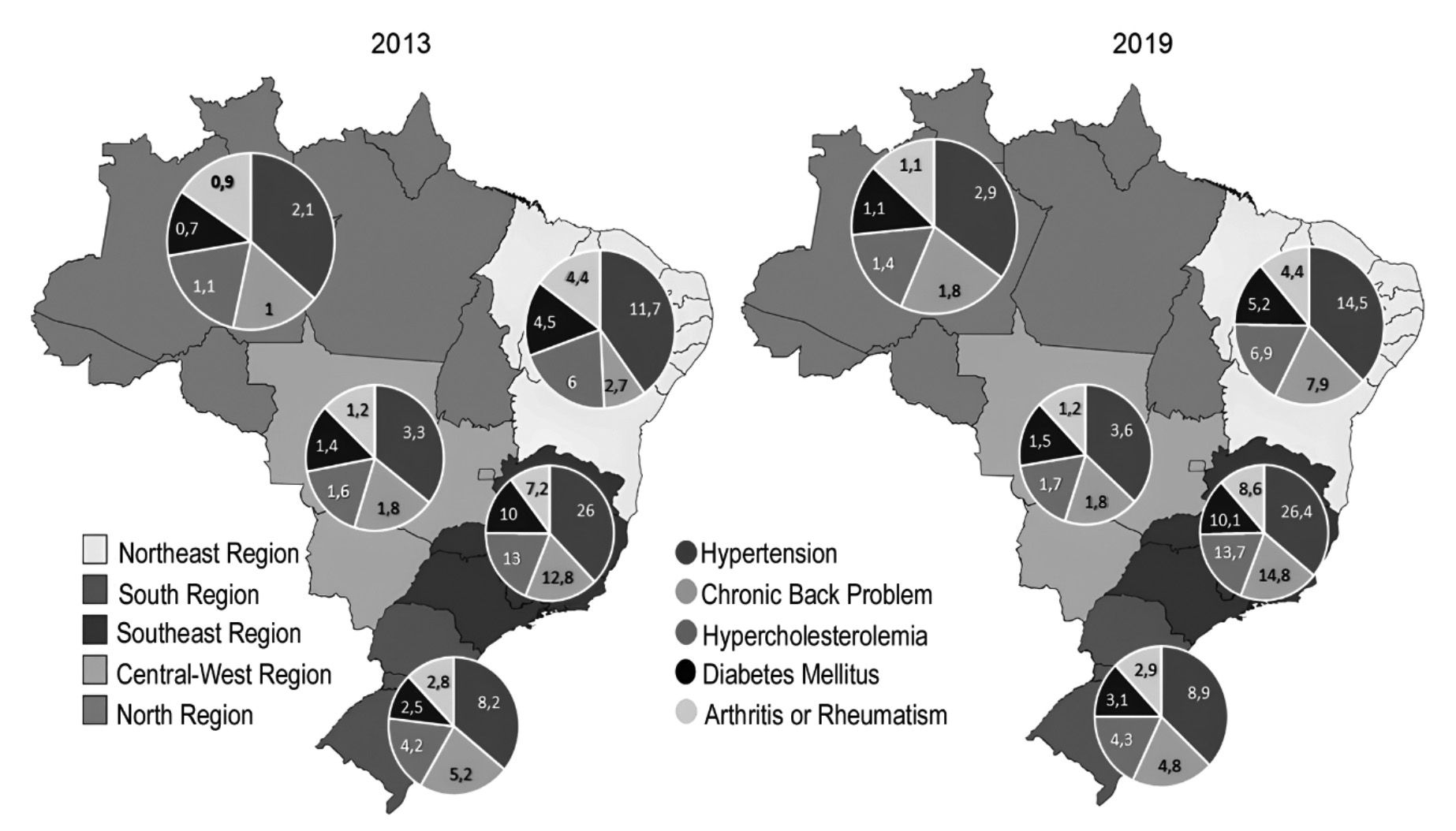
Figure 1 shows the proportional distribution of morbidity prevalences among older adults in the major Brazilian regions in 2013 and 2019. The most prevalent morbidities were, respectively: hypertension, chronic back problem, hypercholesterolemia, diabetes mellitus, and arthritis or rheumatism. Morbidities were consistently more prevalent in the Southeast, Northeast, and South regions. Hypertension was the leading chronic condition nationwide, with the highest percentage observed in the Southeast.

Distribution of morbidity prevalences among older adults in the major Brazilian regions. National Health Survey (2013: n = 11,177; 2019: n = 22,728), Brazil.
According to Table 2, hypercholesterolemia and diabetes mellitus showed significant percentage increases among men, whereas arthritis or rheumatism showed a percentage decrease in Brazil (-19.4%) and across all regions, especially in the Northeast (-40.6%). Conversely, among women, a significant increase in arthritis or rheumatism was observed, followed by chronic back problem and hypertension.
Distribution of prevalences and 95% Confidence Intervals (95% CI) of morbidities among older Brazilian adults according to sex and percentage variation between the years 2013 (n = 11,177) and 2019 (n = 22,728) in the major Brazilian regions. National Health Survey, Brazil, 2013 and 2019.
Important differences in percentage variation of morbidities between sexes were observed: in the North, the largest difference was the increase in chronic back problem among men; in the Northeast, hypercholesterolemia increased mainly among men; in the Southeast, arthritis or rheumatism increased among women and decreased among men; in the South, diabetes mellitus increased primarily among women; and in the Central-West, hypertension increased substantially among men. Furthermore, the Southeast and South regions presented percentages of hypertension higher than those observed in Brazil overall, according to sex, in both years.
Regarding age groups (Table 3), the Central-West region showed morbidity percentages higher than those identified in Brazil in both 2013 and 2019, whereas the Southeast and South regions showed higher percentages only in 2013. The greatest percentage variations were found in the increase in chronic back problem among younger older adults and in hypercholesterolemia among the oldest old in the North region. In the Northeast region, a substantial increase in chronic back problem was observed among the oldest old. 60-79 years.
Distribution of prevalences and 95% Confidence Intervals (95% CI) of morbidities among older Brazilian adults according to age groups and percentage variation between the years 2013 (n = 11,177) and 2019 (n = 22,728) in the major Brazilian regions. National Health Survey, Brazil, 2013 and 2019.
DISCUSSION
The present study provides a comprehensive and representative analysis of the most prevalent morbidities among older Brazilian adults across regions. The analysis of proportional distributions according to sex and age groups at two distinct time points offers a broad understanding of the complexities of aging and contributes to advancing knowledge in geriatrics and gerontology.
Accelerated population aging in Brazil and its regions is evident, with the Southeast, Northeast, and South presenting the highest proportions of older adults in both years analyzed. The highest proportion of younger older adults was identified in the North region in 2013 and in the Central-West region in 2019, whereas the highest proportion of the oldest old was observed in the Northeast region in both years. This study reaffirms the country's regional disparities, especially in health, underscoring the need for regionally tailored actions7.
Although chronic diseases have increased in the population, the perception of “very good/good” health also increased across all regions (especially in the North and South), whereas the perception of “poor/very poor” health decreased (except in the Southeast). However, studies show that the presence of chronic diseases is associated with worse self-rated health among older adults, particularly women, suggesting that this indicator remains highly subjective15,16.
Corroborating the results of this study, a cross-sectional study conducted in Minas Gerais with 1,691 older adults aged 60 years and over, considering 25 noncommunicable chronic diseases, found the most prevalent morbidities to be hypertension (61.9%), followed by chronic back problem (48.6%)17. In the present study, these two morbidities were proportionally more prevalent in most Brazilian regions in both years, except in the North and Southeast regions in 2013, where hypertension and hypercholesterolemia were more prevalent.
Hypertension was also identified as the morbidity with the highest percentage of self-report among older adults in national17,18 and international19,20 studies. A time-series study using data from the Brazilian Surveillance System of Risk and Protective Factors for Chronic Diseases showed that self-reported hypertension increased significantly among older adults according to sex and age groups21.
Cardiovascular diseases are the leading causes of death in Brazil and worldwide, with hypertension, diabetes mellitus, and hypercholesterolemia being the main risk factors21. Significant differences were observed in the prevalence of diabetes mellitus across regions and between sexes, with higher prevalence among men in the Southeast region and among women in the Central-West region in both years. Hypercholesterolemia showed the greatest percentage increase between the years in the oldest old in the North region, although this is the region with the lowest overall proportion of older adults22.
These regional differences may be influenced by sociocultural specificities, which should be considered in the planning of public policies and health actions8,11. These morbidities require continuous control to prevent cardiovascular complications, which is directly related to patient adherence to treatment. In this regard, healthcare professionals must understand the factors that hinder adequate treatment, particularly among the oldest old, and develop health education strategies for correct medication use, educational groups that promote healthy lifestyles, and longitudinal and multidimensional follow-up of morbidities23.
Chronic back problem showed the largest increase from 2013 to 2019 in the North region among both sexes and in the younger older adult age group. According to the IBGE, in 2019, spine-related diseases were the most common among residents of Rondônia and may be related to work activities characteristic of the North region, such as extractivism and agriculture/livestock24. This morbidity is highly prevalent and is associated with demographic, socioeconomic, and lifestyle factors17. It results in negative impacts on health conditions and requires intensified prevention, especially among younger age groups, as the severity of this problem increases with advancing age17.
Arthritis or rheumatism showed a substantial reduction between the years among men, both nationwide and across all regions, whereas an increase was observed among women, except in the South region. Although no other studies with this specific focus were identified, it is important to consider that the occurrence of this condition in older adults may be influenced by several factors, such as genetics, obesity, diet, and activities/occupation, which differ across sexes, age groups, and regions and may lead to decreased functional capacity25.
The Southeast region presented the highest prevalence of morbidities. It stands out as the most populous and urbanized region, with the greatest population density in the country, in addition to being considered the region with the highest Gross Domestic Product (GDP)26. Aging in large urban centers is heterogeneous and shaped by factors such as average income and urban development processes, which demand distinct public policies. Furthermore, there is a feminization of aging in urban settings, marked by greater female migration from rural to urban areas, combined with women’s greater longevity27.
Brazilian regions present significant sociocultural disparities that may influence the different prevalence of morbidities among sex and age subgroups. The literature indicates that territorial, social, economic, and cultural inequalities significantly affect the socioeconomic and demographic conditions of the older population, reinforcing its heterogeneous distribution in Brazil11. Moreover, longevity is associated with social inequalities, resulting in distinct patterns of population growth and aging across Brazilian regions28.
The morbidities investigated were more prevalent among older women, who also represent the majority of the population assessed. In general, women show greater concern with health conditions than men, resulting in more frequent use of healthcare services, which may partially explain the higher percentage of diagnoses of noncommunicable chronic diseases. However, according to studies using public data, women experience higher life expectancy with functional disability compared with men, across all ages and regions of Brazil29.
Additionally, the distribution of morbidities was proportionally higher among younger older adults, as this group is considerably larger. This result may also be partially explained by the fact that most diagnoses of noncommunicable chronic diseases occur in the younger older adult age group. This may be due to the earlier onset of several chronic conditions and improved access to healthcare in this group, whereas monitoring and treatment levels tend to be lower among the oldest old30. Other studies assessing the presence of morbidities across older adult age groups have also found higher prevalence in the oldest age group11.
It is important to consider the remarkable heterogeneity of biological age among individuals within the same age category. Furthermore, social disparities, which are already evident among older adults in Brazil, become even more pronounced among individuals aged 80 years and over12. These findings reinforce the importance of health promotion strategies adapted by sex and age group, while addressing social inequalities.
One limitation of this study relates to potential recall bias due to the use of self-reported information, as well as disparities in educational levels across regions, which may have influenced morbidity estimates. Another limitation concerns the absence of objective clinical measures to confirm diagnoses and other variables. Additionally, it was not possible to directly control the quality and standardization of data collection procedures or variable categorization, as previously collected secondary data were used. The exclusion of socioeconomic status from the main analyses may also have restricted the understanding of socioeconomic inequalities associated with morbidities.
Nevertheless, this study provides relevant data on the morbidity profile of older Brazilian adults, stratified by sex, age groups, and regions, based on a nationally representative sample. The findings contribute to the planning of actions aimed at preventing and managing chronic diseases, particularly within the context of Primary Health Care. The comparative analysis between 2013 and 2019 enables the identification of trends and the prioritization of strategies adapted to the epidemiological and regional context of the country, promoting greater equity.
CONCLUSION
The most prevalent morbidities were, respectively, hypertension, chronic back problem, hypercholesterolemia, diabetes mellitus, and arthritis or rheumatism, both in Brazil and across its regions. The distribution of morbidities was more prevalent among younger older adults, women, and residents of the Southeast region, despite notable differences across subgroups. Overall, we observed an upward trend in the percentage variation of morbidities among older adults between 2013 and 2019 across the Brazilian regions.
This study makes an important contribution to public health research, particularly in geriatrics and gerontology, by providing data on the distribution of morbidities among older Brazilian adults according to sex- and age-specific subgroups, as well as regional disparities. Identifying regional patterns and inequalities highlights the need for more tailored and integrated public health strategies to address the health challenges faced by this population.
For future studies, the monitoring and follow-up of these morbidities within regional contexts is recommended, considering their specific characteristics, to obtain a longitudinal understanding of the health profile of older adults in Brazil, given the importance of identifying health needs to promote quality of life and equitable healthy aging.
References
-
1 Feliciano SC da C, Villela PB, Oliveira GMM. Associação entre a Mortalidade por Doenças Crônicas Não Transmissíveis e o Índice de Desenvolvimento Humano no Brasil entre 1980 e 2019 [Internet]. Arq Bras Cardiol. 2023 [Acesso em 2025 Nov 13]; 120:e20211009. Disponível em: https://doi.org/10.36660/abc.20211009
» https://doi.org/10.36660/abc.20211009 - 2 Silva MS, Assumpção D, Stolses P, Francisco B, Yassuda MS, Neri A, et al. Doenças crônicas não transmissíveis considerando determinantes sociodemográficos em coorte de idosos [Internet]. Rev Bras Geriatr Gerontol. 2021 [Acesso em 2025 Nov 13];25:e210204. Disponível em: https://doi.org/10.1590/1981-22562022025.210204.pt
- 3 Sharma SK, Nambiar D, Ghosh A. Sex differences in non-communicable disease multimorbidity among adults aged 45 years or older in India [Internet]. BMJ open. 2023 [Acesso em 2025 Nov 13];13(3):e067994. Disponível em: https://doi.org/10.1136/bmjopen-2022-067994
- 4 Patel P, Muhammad T, Sahoo H. The burden of disease-specific multimorbidity among older adults in India and its states: evidence from LASI [Internet]. BMC Geriatr. 2023 [Acesso em 2025 Nov 13];23(1):53. Disponível em: https://doi.org/10.1186/s12877-023-03728-1
- 5 Oliveira-Figueiredo DST de, Silva MPGPC, Feitosa PY de O, Leite BC, Rocha FL, Andrade LDF de. Qual é a carga de multimorbidade e os fatores associados à sua ocorrência em pessoas idosas brasileiras? [Internet] Rev Bras Enferm. 2024 [Acesso em 2025 Nov 13];77:e20220809. Disponível em: https://doi.org/10.1590/0034-7167-2022-0809pt
- 6 Melo LA de, Lima KC de. Prevalência e fatores associados a multimorbidades em idosos brasileiros [Internet]. Ciênc Saúde Coletiva. 2020 [Acesso em 2025 Nov 13];25(10):3869-77. Disponível em: https://doi.org/10.1590/1413-812320202510.34492018
-
7 Ministério da Saúde (BR). Plano de Ações Estratégicas para o Enfrentamento das Doenças Crônicas e Agravos não Transmissíveis no Brasil 2021-2030. Ministério da Saúde, Secretaria de Vigilância em Saúde, Departamento de Análise em Saúde e Vigilância de Doenças Não Transmissíveis [internet]. Brasília: Ministério da Saúde, 2021 [Acesso em 2024 Nov 13]. Disponível em: https://www.gov.br/saude/pt-br/centrais-de-conteudo/publicacoes/svsa/doencas-cronicas-nao-transmissiveis-dcnt/09-plano-de-dant-2022_2030.pdf
» https://www.gov.br/saude/pt-br/centrais-de-conteudo/publicacoes/svsa/doencas-cronicas-nao-transmissiveis-dcnt/09-plano-de-dant-2022_2030.pdf -
8 Souza Júnio PRBS, Szwarcwald CL, Almeida WSA, Damacena GN, Pedroso MM, Sousa CAM et al. Comparação de desenhos amostrais das duas edições da Pesquisa Nacional de Saúde, 2013 e 2019 [Internet]. Cad Saúde Pública. 2022 [Acesso em 2024 Nov 13]; 38:e00164321. Disponível em: https://doi.org/10.1590/0102-311x00164321
» https://doi.org/10.1590/0102-311x00164321 - 9 Andrade BF, Thumé E, Facchini LA, Torres JL, Nunes BP. Education and income-related inequalities in multimorbidity among older Brazilian adults [Internet]. PLoS ONE. 2022 [Acesso em 2024 Nov 13];17(10):e0275985. Disponível em: https://doi.org/10.1371/journal.pone.0275985
- 10 Forman DE, Maurer MS, Boyd C, Brindis R, Salive ME, Horne FM, et al. Multimorbidity in Older Adults With Cardiovascular Disease [Internet]. J Am Coll Cardiol. 2018 [Acesso em 2024 Nov 13];71(19):2149-61. Disponível em: https://doi.org/10.1016/j.jacc.2018.03.022
- 11 Santos BL, Vasconcelos Rocha S, Souza Lessa R, Alves Vilela AB. Multimorbidade em idosos de um município do nordeste brasileiro: prevalência e fatores associados [Internet]. Rev Salud Pública. 2019 [Acesso em 2024 Nov 13];21(5):1-7. Disponível em: https://doi.org/10.15446/rsap.V21n5.77775
- 12 Ribeiro A, Ribeiro Sgambato M, Pereira C, Cardoso Meira K, Salles-Costa R, Alves Ferreira A. Social inequalities among Brazilian older adults: a secondary cross-sectional analysis of a national survey [Internet]. Geriatr Gerontol Aging. 2022 [Acesso em 2024 Nov 13];16:330-9. Disponível em: https://doi.org/10.53886/gga.e0220017
- 13 Rashmi R, Mohanty SK. Examining chronic disease onset across varying age groups of Indian adults using competing risk analysis [Internet]. Sci Rep. 2023 [Acesso em 2024 Nov 13];13(1):5848. Disponível em: https://doi.org/10.1038/s41598-023-32861-5
- 14 Oliveira PPV, Pereira VOM, Stopa SR, Freitas PC, Szklo AS, Cavalcant TM et al. Indicadores referentes à cessação do comportamento de fumar no Brasil, Pesquisa Nacional de Saúde, edições 2013 e 2019 [Internet]. Epidemiol Serv Saúde. 2022 [Acesso em 2024 Nov 13];31:e2021388. Disponível em: http://doi.org/10.1590/SS2237-9622202200005.especial
- 15 Rocha FC, Peixoto Neto NP, Andrade GF, Carneiro JA, Costa FM. Factors associated with worsening of self-rated health in older people: a longitudinal study. Rev Bras Geriatr Gerontol [Internet]. 2021 [Acesso em 2024 Nov 13];24:e210213. Disponível em: https://doi.org/10.1590/1981-22562021024.210213
- 16 Silva MF, Assumpção D, Francisco PMSB, Neri AL, Yassuda MS, Borim FSA. Morbidades e associações com autoavaliação de saúde e capacidade funcional em idosos [Internet]. Rev Bras Geriatr Gerontol. 2021 [Acesso em 2024 Nov 13];23(5):e200311. Disponível em: https://doi.org/10.1590/1981-22562020023.200311
- 17 Tavares DM dos S, Pelizaro PB, Pegorari MS, Paiva MM de, Marchiori GF. Prevalência de morbidades autorreferidas e fatores associados entre idosos comunitários de Uberaba, Minas Gerais, Brasil [Internet]. Ciênc Saúde Coletiva. 2019 [Acesso em 2024 Nov 13];24:3305-3313. Disponível em: https://doi.org/10.1590/1413-81232018249.31912017
- 18 Malta DC, Bernal RTI, Prates EJS, Vasconcelos NM de, Gomes CS, Stopa SR, et al. Self-reported arterial hypertension, use of health services and guidelines for care in Brazilian population: National Health Survey, 2019 [Internet]. Epidemiol Serv Saúde. 2022 [Acesso em 2024 Nov 13];31:e2021369. Disponível em: http://doi.org/10.1590/SS2237-9622202200012.especial
- 19 Benetos A, Petrovic M, Strandberg T. Hypertension management in older and frail older patients [Internet]. Circ Res. 2019 [Acesso em 2024 Nov 13];124(7):1045-1060. Disponível em: https://doi.org/10.1161/CIRCRESAHA.118.313236
- 20 Hu Y, Wang Z, He H, Pan L, Tu J, Shan G. Prevalence and Patterns of Multimorbidity in China during 2002-2022: A Systematic Review and Meta-Analysis [Internet]. Ageing Res Rev. 2023 [Acesso em 2024 Nov 13];93:102165. Disponível em: https://doi.org/10.1016/j.arr.2023.102165
- 21 Silva AG da, Andrade FMD de, Ribeiro EG, Malta DC. Tendências temporais de morbidades e fatores de risco e de proteção para doenças crônicas não transmissíveis em pessoas idosas residentes nas capitais brasileiras [Internet]. Rev Bras Epidemiol. 2023 [Acesso em 2024 Nov 13];26:e230009. Disponível em: https://doi.org/10.1590/1980-549720230009.supl.1.1
-
22 Instituto Brasileiro de Geografia e Estatística. Pirâmide etária 2022 [Internet] Instituto Brasileiro de Geografia e Estatística, 2022 [Acesso em 2024 Set 2]. Disponível em: https://educa.ibge.gov.br/jovens/conheca-o-brasil/populacao/18318-piramide-etaria.html#:~:text=No%20Brasil%2C%20de%202010%20a,de%2028%20para%2033%20anos)
» https://educa.ibge.gov.br/jovens/conheca-o-brasil/populacao/18318-piramide-etaria.html#:~:text=No%20Brasil%2C%20de%202010%20a,de%2028%20para%2033%20anos - 23 Firmo JOA, Peixoto SV, Loyola Filho AI, Souza-Júnior PRB, Andrade FB, Lima-Costa MF, et al. Comportamentos em saúde e o controle da hipertensão arterial: resultados do ELSI-BRASIL [Internet]. Cad Saude Publica. 2019 [Acesso em 2024 Nov 13];35:e00091018. Disponível em: https://doi.org/10.1590/0102-311X00091018
-
24 Instituto Brasileiro de Geografia e Estatística. Percepção do estado de saúde, estilos de vida, doenças crônicas e saúde bucal: Brasil e grandes regiões [internet]. Pesquisa nacional de saúde 2019. [Acesso em 2025 Jun 30]. Disponível em: https://biblioteca.ibge.gov.br/visualizacao/livros/liv101764.pdf
» https://biblioteca.ibge.gov.br/visualizacao/livros/liv101764.pdf - 25 Tarigan SW, Br Saragih JW, Marbun M. Factors That Influence the Occurring of Rematoid Atritis (RA) in the Elderly in the Region of Puskesmas Raya Pematang Siantar 2021 [Internet]. Sci Midwifery. 2021[Acesso em 2024 Nov 13];9(2):561-566. Disponível em: https://doi.org/10.35335/midwifery.v9i2.744
-
26 Guimarães CA. Sudeste concentra mais de um terço das áreas urbanizadas do país [Internet]. Agência IBGE 2022 [Acesso em 2025 Nov 13]. Disponível em: https://agenciadenoticias.ibge.gov.br/agencia-noticias/2012-agencia-de-noticias/noticias/35585-sudeste-concentra-mais-de-um-terco-das-areas-urbanizadas-do-pais
» https://agenciadenoticias.ibge.gov.br/agencia-noticias/2012-agencia-de-noticias/noticias/35585-sudeste-concentra-mais-de-um-terco-das-areas-urbanizadas-do-pais - 27 Dota EM, Luiz A, Moraes Rodrigues R, Freitas MH. Dinâmica espacial do envelhecimento em grandes aglomerações urbanas [Internet]. Desenvolv Socioeconômico em Debate. 2023 [Acesso em 2025 Nov 13];9(1):27-44. Disponível em: https://doi.org/10.18616/rdsd.v9i1.7815
- 28 Ribeiro EC SAR, Ghiggino LT, Valentim AAF, Meira KC, Castro Júnior PCP, Ferreira AA. Fatores sociodemográficos associados a não longevidade e longevidade em idosos no Brasil [Internet]. Estud Interdiscip Envelhec. 2024 [Acesso em 2025 Nov 13];29. Disponível em: https://doi.org/10.22456/2316-2171.134979
- 29 Camargos MCS, Gonzaga MR, Costa JV, Bomfim WC. Estimativas de expectativa de vida livre de incapacidade funcional para Brasil e Grandes Regiões, 1998 e 2013 [Internet]. Ciênc Saúde Coletiva. 2019 [Acesso em 2025 Nov 13];24(3):737-47. Disponível em: https://doi.org/10.1590/1413-81232018243.07612017
- 30 Yuan X, Chen S, Sun C, Lu Y. A novel early diagnostic framework for chronic diseases with class imbalance [Internet]. Sci Rep. 2022 [Acesso em 2025 Nov 13];12(1):8614. Disponível em: https://doi.org/10.1038/s41598-022-12574-x
Edited by
-
Edited by
Andressa Coelho Gomes