
 Profile and practices of municipal managers in older persons’ health care: perspectives and challenges in the Amazonian context
Abstract
Objective To analyze the profile of managers responsible for implementing health policies for older persons.
Methodology This is a descriptive, exploratory, cross-sectional study with a quantitative approach. Data were collected in 2024 from municipal managers responsible for older persons’ health care. A synchronous remote interview technique was used, involving the administration of an online questionnaire and real-time recording of responses by the researcher.
Results The study reveals a profile predominantly composed of young women, with a mean age of 40.4 years (±8.7), holding temporary positions within municipal health departments, with an average tenure of 2.5 years (±3.1) in their roles, and trained as nurses. The findings also indicate that 89.2% of respondents share management responsibilities with other health programs, 65.7% are unaware of legal frameworks and guiding documents, 54.3% have prior management experience, and 45.7% do not participate in Municipal Councils for Older Persons (CMPI).
Conclusion The study highlights weaknesses in the management of older persons’ health policies, expressed by limited training in aging and public health policy management, employment instability, and the need to improve working conditions to avoid disruptions in work processes. Investment in continuous professional development is recommended, along with strategies to reduce staff turnover and workload among technical staff, ensuring management capable of promoting care pathways aligned with the specific needs of the older population in the Amazon region.
Keywords
Primary Health Care; Aged; Professional Training; Health Policy; Health Management.
Resumo
Objetivo Analisar o perfil de gestores responsáveis pela implementação das políticas de saúde da pessoa idosa.
Metodologia Trata-se de uma pesquisa descritiva, exploratória, transversal e de abordagem quantitativa. Os dados foram coletados pelo pesquisador em 2024 junto aos gestores municipais da saúde da pessoa idosa. Utilizou-se a técnica de entrevista remota (síncrona) com a aplicação de um questionário on-line e o registro imediato das informações pelo próprio pesquisador durante o diálogo.
Resultado O estudo evidencia um perfil de jovens mulheres, com idade média de 40,4 anos de idade (±8,7), vinculados temporariamente com a Secretaria de Saúde, atuam em média a 2,5 anos (±3,1) na pasta e são Enfermeiros. Aponta ainda, que 89,2% dos entrevistados compartilham da gestão com outras ações em saúde, 65,7% desconhecem os marcos legais e outros documentos norteadores, 54,3% possuem experiência prévia em gestão bem como, 45,7% não participam de Conselhos Municipais de Direitos para Pessoa Idosa.
Conclusão O estudo evidencia fragilidades na gestão da pasta, expressadas por: baixa formação em envelhecimento e gestão das políticas públicas de saúde, vulnerabilidade de vínculo empregatício e a necessidade de desprecarização do trabalho a fim de que, não haja solução de continuidade nos processos de trabalho. Recomenda-se investir em estratégias de capacitação profissional contínua, evitar a rotatividade e sobrecarga laboral dos técnicos a fim de, assegurar uma gestão que impulsione uma linha de cuidado adequada às demandas específicas da população idosa amazônica.
Palavras-chave
Atenção Primária à Saúde; Idoso; Capacitação Profissional; Política de Saúde; Gestão em Saúde.
INTRODUCTION
Although Brazil has advanced legislation for older persons, its practical implementation still faces challenges, requiring greater efforts to ensure autonomy and healthy aging amid demographic changes. For the first time, the number of older persons has exceeded that of young people aged 15 to 24 years (14.8%)1. From this perspective, care is guided by the National Policy for the Health of Older Persons (PNSPI), aligned with the World Health Organization (WHO), which seeks to strengthen intersectorality, improve the quality of care, and expand access within the Health Care Network (RAS)1,2.
In the state of Amazonas, geographic, climatic, and socioeconomic barriers impose multidimensional constraints. Overcoming these distances and service gaps requires innovative solutions that address the specific needs related to access to health care and improvements in lifestyle habits2.
Such territorial singularities demand that managers demonstrate strategic and governance capacity, enabling them to operate under conditions of limited institutional capacity and adapt care to riverine and Indigenous contexts, in order to ensure that the PNSPI is effective in hard-to-reach areas.
It is noteworthy that the growth rate of the older population in Amazonas, according to the most recent census, showed an increase of 3.5%, reaching 8.8% of the total population over a ten-year period. In Manaus, this group represents 10% of the population, equivalent to 237,000 individuals aged over 60 years1.
In this context, the current epidemiological profile in Brazil requires a model of care capable of meeting population health needs through an organized and coordinated RAS, including the development of care pathways, definition of competencies, and articulation among points of care3. Such networks were established to overcome fragmentation and ensure comprehensiveness of care through different services, as well as to promote active and healthy aging4.
From this perspective, Primary Health Care (PHC) assumes a strategic role as the preferred entry point into the RAS. According to its guiding principles, PHC organizes care by integrating health promotion, prevention, and treatment, while coordinating care networks to enhance longevity and quality of life. These attributes ensure comprehensive and effective care for older adults within the Brazilian Unified Health System (SUS), from entry into the RAS to longitudinal care, ensuring the efficient use of public resources, in accordance with the principle of economic efficiency5,6.
Within this framework, the Unified Social Assistance System (SUAS) emerges as a key partner within the SUS in the care of older adults, bringing together public authorities and civil society7. This integration highlights the need for qualified managers capable of using evidence and a holistic perspective to overcome the challenges of the Amazonian context and ensure the effectiveness of public policies8.
Given this context, analyzing the profile of managers responsible for health policies for older adults is essential to improve management practices, shed light on the lived realities, and reinforce the need for ongoing professional development to promote healthy aging.
METHODS
This is a descriptive, exploratory, cross-sectional study with a quantitative approach, using municipalities in the state of Amazonas as the research setting. A data collection instrument was developed and adapted from an ongoing project: “Qualification of municipal managers of the health policy for older adults in the state of Pernambuco: action research.” All closed-ended questions were configured as single-response items, resulting in a final version comprising 31 questions distributed across three thematic blocks.
The study setting included the 62 municipalities of Amazonas. Its population currently totals 3,941,613 inhabitants, of whom 4.2% are aged over 60 years1. The study population consisted of municipal managers responsible for older adult health actions, designated by the State Health Department.
The sample included all professionals active during the study period, with a final participation of 35 managers. At least two contact attempts (message/phone call) were made with each professional. Non-participation may be related to operational limitations, divergent political priorities, lack of awareness regarding the study’s impact, logistical barriers, or possible institutional resistance to exposing vulnerabilities.
In this sense, the low participation compromises the representativeness of the study by introducing selection bias, reflecting only the realities of the most engaged or better-structured contexts. This limitation restricts the analysis of regional and socioeconomic diversity and may result in public policies that fail to address challenges faced by smaller municipalities or those with lower administrative capacity.
Non-participation cases were classified as sample attrition that might have been mitigated if data collection had occurred in person; however, this strategy was not feasible due to long intermunicipal distances, extended duration of river travel, and the high cost of air transportation.
Data were collected in 2024 from municipal managers of older adult health care using a synchronous remote interview technique, involving the administration of an online questionnaire and immediate recording of responses by the researcher. For those who accepted the invitation, individual contact (audio/video) was established to present the project and conduct a full reading of the Informed Consent Form (ICF). After agreement and signing of the ICF, the online questionnaire was administered, and responses were recorded simultaneously.
To characterize the managers’ profile, an exploratory data analysis was performed using JAMOVI software, version 2.3.28, including the description of quantitative variables (mean and standard deviation) and absolute (n) and relative (%) frequencies for categorical variables.
For qualitative data, Bardin’s content analysis framework9 was employed, following the stages of pre-analysis (transcription and organization), material exploration (coding), and categorization of semantic elements. All stages and analytical procedures were conducted by the researcher, including reading, coding, and grouping. Based on this process, a deeper interpretative effort was undertaken to support the theoretical reconstruction of the analyzed data.
Subsequently, the researcher performed a final review to validate meanings and construct thematic categories. The categorization process, structured around central ideas identified as Recording Units (RU)9, allowed the emergence of three analytical categories in the dataset: deficit in professional training, precarious labor conditions, and institutional fragility.
The research project was submitted to the Research Ethics Committee of the Universidade Federal do Amazonas (Opinion No. 7,175,387). Ethical aspects were observed in accordance with Resolution No. 466/12 of the National Health Council (CNS).
It is noteworthy that the data in this study were properly anonymized, ensuring the protection of individual information. Their reuse will be authorized only under previously established conditions, directed toward scientific and institutional purposes.
DATA AVAILABILITY
The dataset is not publicly available due to the protection of participants’ privacy and may be accessed only upon request to the corresponding author.
RESULTS
Data analysis showed that among the 62 eligible individuals, 56.5% agreed to participate. However, even after at least two contact attempts, by message or telephone call, a non-response rate of 43.5% was recorded and classified as sample attrition.
Based on single-response items, the results were structured into three thematic axes: 1. Sociodemographic identification; 2. Education and professional background; and 3. Comprehensive health care for older adults.
The municipal management of health actions for older adults in Amazonas shows a profile predominantly composed of young women, with 68.6% identifying as female. The results also indicate that the mean age of participants was 40.4 years (±8.7), which is consistent with findings from another study10.
Regarding age distribution, most participants were between 25 and 34 years (46%). However, it should be noted that studies focusing on managers of older adult health actions remain scarce. Concerning place of residence and work, 100% of respondents both lived and worked in their respective municipalities.
The data indicate that 100% of participants had completed higher education. Regarding undergraduate background, 51.4% were nurses, while the remaining 48.5% were professionals from other fields, as described in Table 1. In line with this finding, a survey conducted by the National Council of Municipal Health Secretariats (CONASEMS) in the Northern region between 2017 and 2020 found that 54.4% of individuals in leadership positions were nurses, highlighting their predominance in decision-making processes within public services and their contribution to municipal management of the SUS10. The mean time since completion of higher education was 9.3 years (±7.1) (Table 1).
Distribution of managers according to level of education, undergraduate degree, postgraduate education, and field of most recent postgraduate training. Manaus, AM, 2025.
Among respondents, 88.6% had completed postgraduate education, of whom 62.9% had completed a specialization. Regarding the field of their most recent postgraduate training, 28.6% reported Public Health or a related field (Table 1); however, only one individual specialized in Gerontology. In this study, the term Public Health encompasses Collective Health, a Latin American interdisciplinary approach integrating social sciences and public health.
Participation in complementary training in Public Health or Gerontology was reported by 71.4% of professionals. Among these, one-third of the training programs had a duration of less than 20 hours. It was also observed that most municipalities did not regularly offer training courses, which may negatively impact the promotion of self-care and independence among older adults. Among professionals who participated in training, 54.3% were able to identify them, and of these, 48.6% reported having attended training in Gerontology (Table 2).
Distribution of managers according to participation in complementary training, training type, frequency, and classification. Manaus, AM, 2025.
It was also observed that 42.9% of participants reported the availability of health training in their municipality of practice. Regarding the most recent training, 33.5% reported that it addressed multidimensional assessment, while 13.5% reported comprehensive care for older adults. In terms of frequency, 33.3% of respondents indicated that training sessions were conducted semiannually (Table 2).
Regarding employment status, the study revealed that 65.7% were temporary employees, 17.1% held appointed positions, and 8.5% were permanent civil servants. The data also show that 82.9% of participants combined management responsibilities with other activities, while 8.6% were exclusively dedicated to these demands but received no additional compensation, and 5.7% were compensated and worked exclusively in management roles (Table 3). It is noteworthy that the mean duration of work in the management of older adult health is 2 years.
When categorized by time in management of Older Adult Health, the data show that 34.3% of professionals had been in the role for less than one year, while 62.9% had between 1 and 10 years in this role. Regarding previous management areas, 51.4% had developed managerial activities in the health sector (Table 3). It is noteworthy that 100% of respondents were responsible for managing the program at the time of the interview.
The data indicate that, regarding knowledge of legal frameworks, 28.6% cited the Statute of Older Adults. However, in self-assessment regarding the PNSPI, 51.4% reported having a good level of knowledge. Concerning knowledge of policy guidelines and manuals, 74.3% stated they were familiar with them (Table 4).
Distribution regarding knowledge of policies. guidelines. and provision of care for older adults. Manaus, AM, 2025.
Regarding the existence of specific goals for older adults’ health demands, 45.7% of professionals reported that such objectives were included in the municipal health plan. Concerning the existence of care pathways, 40% indicated that they existed but had not been formally published, while 31.4% reported their absence. With respect to home care programs, 85.7% stated that these existed only within primary health care.
When asked to evaluate actions ensuring care for older adults, 40% rated them as good and 22.9% as excellent. Regarding the existence of a Municipal Councils for Older Persons (CMPI) and the participation of the Municipal Health Department (SMS), the results showed that 45.7% reported that no CMPI was in operation in their municipality (Table 4).
Figure 1 presents the main limitations for the implementation of older persons’ health policies in municipalities. Content analysis according to Bardin9 allowed these limitations to be grouped into three central categories: deficit in professional training, evidenced by lack of knowledge of legal frameworks and limited specific training in aging; precarious employment conditions, marked by high turnover and temporary contracts, which compromise continuity of actions and comprehensiveness of care; and institutional fragility, expressed in the absence of consolidated care pathways, low representation in municipal councils, and difficulties in intersectoral coordination. These findings indicate that the identified barriers go beyond isolated issues and reflect structural constraints in health management.
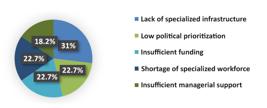
Similarly, it is observed that management weaknesses are not restricted to the technical dimension but result from the combination of training gaps, contractual instability, and insufficient governance mechanisms. The analysis showed that these factors compromise the effectiveness and sustainability of public policies aimed at older adults. Thus, the need for continuous investment in professional training, improvement of employment conditions, and strengthening of institutional capacity is highlighted, with a view to consolidating care pathways capable of responding to the demands of population aging in Amazonas.
DISCUSSION
The management of older adult health actions in municipalities of Amazonas reveals a profile predominantly composed of young women, highlighting a marked trend toward workforce feminization11. This phenomenon stems from the historical association of care with the female gender, consolidated sociocultural patterns, and the significant presence of women in health professions, both in service provision and in the coordination of health policies.
The mean age of managers in municipalities of Amazonas, estimated at 40 years, is consistent with findings from other studies10,12, reinforcing the notion that maturity is a requirement for assuming management positions. However, it is observed that the most frequent age group falls between 25 and 34 years, which may bring innovation and dynamism, but also challenges related to limited experience in policies targeting this population. It is also noteworthy that there is a scarcity of studies specifically addressing managers of older adult health actions, which limits more robust and in-depth comparisons.
Regarding educational background, this study indicates a predominance of nurses in the management of health actions for older adults. These findings emphasize the central role of this professional category in decision-making processes within public services, which can be attributed to their training focused on leadership, service organization, and comprehensive care, particularly in Primary Health Care, making them well-suited for coordination and health policy management roles13.
With respect to complementary training, the results show that most respondents have limited training in aging; only one participant reported having a specialization in Gerontology. Furthermore, most municipalities do not regularly offer training programs for professionals, which may negatively impact the promotion of self-care and independence among older adults.
Thus, it becomes evident that, despite advances in legislation through the development of strategies and instruments for the care of the older population, these measures are ineffective without engagement from professionals and governmental bodies, both essential to effective public policy implementation and health care delivery14.
To operationalize and implement such policies, it is necessary to establish specific goals to define and adapt plans, projects, and activities within the health sector, facilitating periodic monitoring, strategic planning, and timely intervention in outcomes, so that they remain consistent and effective over time15. This study identified municipalities that already incorporate actions targeting older adults within their Municipal Health Plans, demonstrating concern for the improvement, maintenance, and recovery of functional capacity in this population.
In this context, the relevance of Municipal Councils for Older Persons (CMPI) is highlighted, as they are essential to ensure the effectiveness of public policies through oversight and social participation of this group16. However, the study shows that most municipalities do not have a functioning council, resulting in a gap in representation and weakened social control. This scenario limits the development of inclusive policies and demonstrates that, even in the presence of clear guidelines from the PNSPI, there is influence from the executive branch over their creation and operation, hindering the implementation of intersectoral policies17,18. Therefore, ensuring their operation is essential to consolidate social participation and integrate aging into municipal planning.
Regarding prior management experience, the data reveal a predominance of professionals with less than one year in the role, which may be associated with political turnover, scarcity of specialized professionals, and the relatively young profile of the workforce. This situation may lead to weakened management, risk of discontinuity, and reduced effectiveness of policies13.
Concerning previous management roles, 45.7% of participants had no prior experience in other areas. It is noteworthy that the average duration of work in the management of older adult health is two years, which may be related to limited familiarity with policies addressing older adults among respondents. It is important to recall that the PNSPI and the Statute of Older Adults guide social and health actions to ensure rights and protection, requiring shared responsibilities across sectors and encouraging autonomy and active participation of older adults in society19.
Accordingly, the average duration observed in this study reflects high turnover among professionals, most of whom are employed under temporary or appointed contracts. The absence of stable employment ties may compromise the longitudinality of care, lead to disorganization within the health system, and negatively affect the quality of care provided. Moreover, professionals working under precarious conditions, without access to rights and benefits, tend to show lower engagement in the consolidation of long-term public policies20.
Another aspect to be highlighted is the diversity of employment arrangements, ranging from tenured civil servants to contracts under the Consolidation of Labor Laws (CLT), with a large proportion of professionals being temporarily hired or occupying appointed positions. The coexistence of these different arrangements reflects regional complexity, marked by difficulties in workforce retention, political influence, and even budgetary constraints affecting hiring practices, which may contribute to precariousness and institutional fragility21.
In light of this, the study highlights the need to address precarization of labor in the public sector. The National Humanization Policy (PNH), together with occupational health policies, provides guidance for this process, aiming to ensure compliance with constitutional principles and the democratization of access to public services, enabling workers to effectively mediate the relationship between society and the State22.
Regarding exclusive dedication to managerial responsibilities, most participants reported performing duties inherent to their professional roles in parallel with their managerial functions, which may lead to work overload and hinder the acquisition of specific training focused on older adult health. Given the impracticality of assigning a dedicated professional exclusively to these demands, since most municipalities are small, training focused on understanding life cycles and their specificities may contribute to a more comprehensive perspective among technical staff.
This study reveals that, although most municipalities reported having a defined care pathway, few have formally published and implemented it. This indicates weaknesses in the articulation and integration of multidisciplinary actions, compromising comprehensive and longitudinal patient care. The literature highlights that a well-structured care pathway positively influences the reorganization of care for older adults, the quality of healthy aging, and the sustainability of the Brazilian health system23.
Within the care pathway, the Older Person’s Health Handbook is a low-complexity tool that enables individualized record-keeping, encourages self-care, supports longitudinal follow-up, facilitates care planning and allows multidimensional assessment of older adults17. Although cited by many managers, the literature attributes its underuse to lack of knowledge, unavailability of the instrument in Basic Health Unit (BHU), and limited time for completion, which may negatively affect the health and quality of life of older adults24. Nevertheless, its use reflects an intention to improve health outcomes and optimize financial resources.
Accelerated population aging, driven by scientific advances, urbanization, and declining birth and mortality rates, poses new challenges to the effectiveness and sustainability of public policies. This scenario requires the reformulation of public policies that promote intersectoral actions to extend life expectancy and mitigate social inequalities, ensuring comprehensive care for older adults25.
In this context, the predominance of nurses in public health management results from the interaction between organizational factors, such as training oriented toward leadership, lack of specific training, and precarious employment conditions, and federative factors, including political turnover, decentralization of the SUS, and territorial inequalities. In municipalities of Amazonas, this combination of institutional fragility and precarization compromises the implementation of the PNSPI, hindering logistics, technical support, and continuing education, as well as weakening regional coordination, leading to discontinuity of actions and increased vulnerability to adverse regional conditions19.
The limitations of this study include the voluntary participation of only 35 managers (56.5%), even after at least two contact attempts by telephone. This limitation could have been minimized through in-person data collection, which was not feasible due to long intermunicipal distances, extended river travel time, and the high cost of air transportation in the region.
CONCLUSION
The findings indicate weaknesses in the management of older adult health care in the municipalities studied, characterized by limited experience among managers in aging-related issues and public management. It is therefore imperative to invest in continuous training and to implement strategies to reduce staff turnover and workload, ensuring management capable of effectively promoting care pathways aligned with population needs.
In the Amazonian context, understanding local specificities, such as low population density, traditional populations (Indigenous peoples, quilombola communities, and especially riverine populations), and their distinct ways of life along rivers or in isolated areas, is essential, as these factors represent structural challenges. Overcoming such barriers is fundamental to achieving universality, comprehensiveness, and continuity of care for older adults.
Among the most relevant aspects identified in this study are limited training in aging, lack of knowledge of public policies and employment instability. These factors may lead to discontinuity in longitudinal care, compromise the quality of services, and result in disorganization of the health system.
Potential strengths include the presence of specific goals in municipal plans and the use of instruments aimed at improving the quality of care, which support the organization of health team activities and enable monitoring by family members. However, the operationalization of public policies within the SUS requires health managers with continuous learning capacity, who prioritize innovative solutions, address the diverse health needs of urban and rural older populations, and promote social participation toward a more just, inclusive and equitable society.
Investment in continuing education and strategies to reduce staff turnover and workload is recommended, ensuring management capable of promoting appropriate care pathways. Furthermore, it is imperative to prioritize policies targeting individuals aged 60 years and older. These findings are expected to support future research and contribute to the implementation of health policies for older adults in alignment with local realities.
It is also important to acknowledge methodological limitations of the study, such as the use of a convenience sample, high attrition rate (43.5%), self-reported data, and the descriptive nature of the analysis. These factors may limit the generalizability of the findings and the establishment of causal relationships, without diminishing the relevance of the evidence produced as a basis for reflection and for improving the management of older adult health care.
References
-
1 IBGE. Instituto Brasileiro de Geografia e Estatística. Censo Demográfico 2022 [Internet]. [citado em 21 fev. 2025]. Disponível em: https://www.ibge.gov.br/estatisticas/sociais/trabalho/22827-censo-demografico-2022.html
» https://www.ibge.gov.br/estatisticas/sociais/trabalho/22827-censo-demografico-2022.html - 2 Gama ASM, Fernandes TG, Parente RCP, Secoli SR. Inquérito de saúde em comunidades ribeirinhas do Amazonas, Brasil. Cad Saude Publica. 2018;34(2): e00002817. Doi:10.1590/0102-311x00002817
- 3 Nunes AM. Integração entre atenção primária à saúde e atenção especializada: paralelos entre a experiencia Brasileira e Portuguesa. Revista Gerencia y Políticas de Salud. 2020;19:1–21. Doi:10.11144/Javeriana.rgps19-38.iaps
- 4 Landim ELAS, Guimarães M do CL, Pereira APC de M. Rede de Atenção à Saúde: integração sistêmica sob a perspectiva da macrogestão. Saúde em Debate. 2019;43(spe5):161–73. Doi:10.1590/0103-11042019s514
- 5 Cesário VAC, Santos MM dos, Mendes TC de O, Souza Júnior PRB de, Lima KC de. Tendências de acesso e utilização dos serviços de saúde na APS entre idosos no Brasil nos anos 2008, 2013 e 2019. Cien Saude Colet. 2021;26(9):4033–44. Doi:10.1590/1413-81232021269.08962021
-
6 Brasil. Ministério da Saúde. Portaria Nº 4.279, de 30 de dezembro de 2010. Estabelece diretrizes para a organização da Rede de Atenção à Saúde no âmbito do Sistema Único de Saúde (SUS). Brasília: Ministério da Saúde; 2010 [citado em 13 jan. 2025]. Disponível em: https://bvsms.saude.gov.br/bvs/saudelegis/gm/2010/prt4279_30_12_2010.html
» https://bvsms.saude.gov.br/bvs/saudelegis/gm/2010/prt4279_30_12_2010.html -
7 Ministério do Desenvolvimento e Assistência Social, Família e Combate à Fome. Assistência Social é uma política pública: um direito de todo cidadão que dela necessitar. Brasília: Presidência da República; 2024 [citado em 18 jul. 2025]. Disponível em: https://www.gov.br/mds/pt-br/acoes-e-programas/suas
» https://www.gov.br/mds/pt-br/acoes-e-programas/suas - 8 Miguez SF, Souza RCB, Pinheiro R. Territórios da gestão socioambiental e saúde na Amazônia. Saúde em Debate. 2024;48(spe1): e8734. Doi:10.1590/2358-28982024e18734p
- 9 Valle PRD, Ferreira JDL. Análise de conteúdo na perspectiva de Bardin: contribuições e limitações para a pesquisa qualitativa em educação. Educação em Revista. 2025;41: e49377. Doi:10.1590/0102-469849377
- 10 Arcari JM, Barros APD, Rosa RS, Marchi R, Martins AB. Perfil do gestor e práticas de gestão municipal no Sistema Único de Saúde (SUS) de acordo com porte populacional nos municípios do estado do Rio Grande do Sul. Cien Saude Colet. 2020;25(2):407–20. Doi:10.1590/1413-81232020252.13092018
- 11 Gomes et al. Perfil dos gestores da atenção primária em saúde, desafios e oportunidades. Com. Ciências Saúde. 2022; 33(1):83-96. Doi: 10.51723/ccs.v33i01.1108
- 12 Portes VM, Dallegrave D. Cargos de Gestão em Saúde: a (in)visibilidade de Gênero, Raça e Profissão. Saúde em Redes. 2020;6(2):137–51. Doi:10.18310/2446-4813.2020v6n2p137-151
- 13 Carvalho ALB, Ouverney ALM, Carvalho MGO, Machado NMS. Enfermeiros (as) gestores (as) no Sistema Único de Saúde: perfil e perspectivas com ênfase no Ciclo de Gestão 2017-2020. Cien Saude Colet. 2020;25(1):211–22. Doi:10.1590/1413-81232020251.29312019
- 14 Souza MFM, Malta DC, França EB, Barreto ML. Transição da saúde e da doença no Brasil e nas Unidades Federadas durante os 30 anos do Sistema Único de Saúde. Cien Saude Colet. 2018;23(6):1737–50. Doi:10.1590/1413-81232018236.04822018
- 15 Orué AL, Araújo KD, Bello H, Rafacho BPM, Pastorello CCVG, Macedo MLR, et al. Perfil das áreas técnicas de alimentação e nutrição de Mato Grosso do Sul, Brasil: organização para tomadas de decisão. Cien Saude Colet. 2023;28(5):1525–38. Doi:10.1590/1413-81232023285.12192022
-
16 Brasil. Ministério da Saúde. Secretaria de Atenção à Saúde. Departamento de Ações Programáticas e Estratégicas. Orientações técnicas para a implementação de Linha de Cuidado para Atenção Integral à Saúde da Pessoa Idosa no Sistema Único de Saúde – SUS [recurso eletrônico] [Internet]. 2018 [citado 13 de março de 2026]. Disponível em: http://bvsms.saude.gov.br/bvs/publicacoes/linha_cuidado_atencao_pessoa_idosa.pdf
» http://bvsms.saude.gov.br/bvs/publicacoes/linha_cuidado_atencao_pessoa_idosa.pdf - 17 Oliveira WIF, Mendes TCO, Lima KC. Desafios para o funcionamento dos conselhos dos direitos da pessoa idosa e seus reflexos sociais. Revista Brasileira de Geriatria e Gerontologia. 2023;26: e220165. Doi:10.1590/1981-22562023026.220165
- 18 Torres KRBO, Campos MR, Luiza VL, Caldas CP. Evolução das políticas públicas para a saúde do idoso no contexto do Sistema Único de Saúde. Physis: Revista de Saúde Coletiva. 2020;30(1):e22016. Doi:10.1590/s0103-73312020300113
- 19 Moura DCN, Pinto JR, Aragão AEA. Perfil dos profissionais atuantes na gestão em saúde frente ao novo modelo de reorganização do SUS: a regionalização. Tempus Actas de Saúde Coletiva. 2016;10(1):75-93. doi:10.18569/tempus.v10i1.1577
- 20 Anéas, TV. Gestão do trabalho e o cuidado na atenção primária à saúde durante a pandemia de COVID-19 no município de São Paulo (SP), Brasil. 3485Ciência & Saúde Coletiva, 28(12):3483-3493, 2023. Doi: 10.1590/1413-812320232812.06062023
- 21 Silva PMC, Souza KR, Teixeira LR. Política de desprecarização do trabalho em saúde em uma instituição federal de C&T: a experiência de professores e pesquisadores. Trabalho, Educação e Saúde. 2017;15(1):95–116. Doi:10.1590/1981-7746-sol00048
- 22 Veras RP, Oliveira M. Envelhecer no Brasil: a construção de um modelo de cuidado. Cien Saude Colet. 2018;23(6):1929–36. Doi:10.1590/1413-81232018236.04722018
- 23 Santiago AGM, Lima AOP, Silva FRE, Albuquerque FAM, Ferreira FDW, Santos MVL, et al. Utilização da caderneta de saúde da pessoa idosa na atenção primária: revisão integrativa / Use of the child’s health chair in primary care: integrative review. Brazilian Journal of Health Review. 2021;4(4):14397–411. Doi:10.34119/bjhrv4n4-003
- 24 Castro FF, Souza CRS, Diniz CX, Parmejiani EP, Santos FS, Nascimento JN, et al. Idosos ribeirinhos da amazônia brasileira no enfrentamento da covid-19. Em: Enfermagem gerontologica no cuidado do idoso em tempos da COVID 19. Editora ABEn; 2020. p. 142–9. Doi:10.51234/aben.20.e02.c20
- 25 Campos MESM, Martins S, Aguiar CC. Estudos sobre Conselhos de Direitos da Pessoa Idosa no Brasil. Desenvolvimento em Questão. 2023;21(59):e11274. Doi:10.21527/2237-6453.2023.59.11274
Edited by
-
Edited by
Cristian Arnecke Schröder

