
 Henri Lefebvre and the Third Space: Toward Another Critical Reading of Latin American Urbanization
Abstract
Drawing on Henri Lefebvre’s notion of the “third space,” this article develops a critical approach to the production of urban space that foregrounds the symbolic, poetic, and political force of collective and non-normative uses. Conceived as a space of appropriation, transgression, and production of meaning, the third space emerges as both a methodological and epistemological lens for reimagining the urban from a Latin American perspective. This approach challenges the functionalist paradigms of neoliberal urbanization while also advancing beyond earlier Latin American epistemologies that have remained only marginally attentive to spatial analysis. Adopting an exploratory-analytical and theoretical-critical approach, the study examines contemporary urban experiences that have activated the symbolic dimension of the city-such as occupations and public facilities-in order to identify critical categories and emergent forms of spatial production. By reinscribing enjoyment, excess, and alterity into spatial experience, the article argues that these practices constitute empirical fields for reflection and experimentation, opening breaches for a situated, sensitive, and insurgent production of urban knowledge.
Keywords:
Urban Space; Right to the City; Urban Insurgencies; Monumentality; Third Space; Poetics of Excess; Latin America
Resumo
Partindo da noção de “terceiro espaço” em Henri Lefebvre, este artigo propõe uma abordagem crítica da produção do espaço urbano centrada na potência simbólica, poética e política dos usos coletivos e não normativos. Entendido como espaço de apropriação, transgressão e produção de sentido, o terceiro espaço se configura como chave metodológica e epistemológica para reimaginar o urbano a partir da América Latina. Essa perspectiva não apenas coloca em xeque os paradigmas funcionalistas da urbanização neoliberal, mas também ultrapassa epistemologias latino-americanas pretéritas ainda carentes de uma abordagem espacial. De caráter exploratório-analítico e teórico-crítico, a investigação examina experiências urbanas contemporâneas que ativam a dimensão simbólica da cidade - como ocupações e equipamentos públicos - para identificar categorias críticas e formas emergentes de produção do espaço. Ao reinscrever o gozo, o excesso e a alteridade na experiência espacial, argumenta-se que tais práticas constituem campos empíricos de reflexão e experimentação, abrindo brechas para uma produção de conhecimento urbano situada, sensível e insurgente.
Palavras-chave:
Espaço Urbano; Direito à Cidade; Insurgências Urbanas; Monumentalidade; Terceiro Espaço; Poéticas do Excesso; América Latina
Introduction
With nearly 80% of its population residing in urban areas-a proportion exceeded only by North America and far higher than those of Africa and Asia (ONU-Habitat, 2024)-Latin America has experienced an accelerated urbanization process that anticipated by nearly four decades a global trend that would only consolidate in 2007. More than a matter of speed, however, this trajectory is distinctive for the ways in which inequalities have actively structured the production and organization of urban space across the region.
This particular configuration eludes the generalizations embedded in the category of the “Global South” and situates the Latin American urban experience within a far broader critique of hierarchies in urban thought. A range of theoretical interventions has challenged the Euro-North American centrality of urban studies by rejecting the logic of exception and seeking to displace the center of theory toward experiences previously marginalized. The notion of an ecology of knowledge (Santos, B., 2007), informal epistemologies of planning (Roy, 2005), the proposal of ordinary cities (Robinson, 2006), and critiques of Eurocentric planetary urbanization (Brenner, 2013) figure among the most prominent efforts. However, by subsuming profoundly distinct social formations under the sign of the “Global South”, this critical turn may obscure consolidated intellectual traditions-such as those in Latin America-whose theoretical production has been both systematic and situated. As Pablo Palomino (2019) cautioned, although useful for contesting Eurocentrism, the term frequently erases the historical density of certain regions, replacing them with a homogeneous image of planetary subalternity. Its generic application thus tends to deprive local contributions of their broader conceptual reach.
This article argues for reclaiming Latin America as an analytical framework in its own right- both as a locus of articulation and a territory of theoretical production.1 Its guiding hypothesis is that Latin American urbanization, shaped by a singular historical trajectory-early, unequal, and segregated-offers a privileged vantage point from which to observe the contemporary impasses of the urban condition. As César Simoni Santos (2017) observed, at a moment when much of the world appears to be experiencing the forms of social fracture that for decades have characterized the region, it becomes especially timely to reconsider its local debate.
In our view, such a reassessment calls for a return to the theory of the production of space through a Lefebvrian lens-not as doctrine, but as a critical instrument for thinking the contemporary urban condition. Against a backdrop of the paradoxical coexistence of advances in material indicators and the deterioration of urban conditions, the diagnosis formulated by Calderón and Castells (2021) of “inhuman development” proves particularly illuminating. Although Latin American neo-developmentalism has fostered growth and redistribution, it largely disregarded the social and environmental costs of urbanization. The outcome has been the consolidation of metropolises increasingly hostile to the majority, in which quantitative gains in income, health, and education coexist with the precaritization of housing, mobility, environmental conditions, and overall urban quality (Calderón; Castells, 2021, p. 48-9).
This contradiction powerfully renews the critique articulated by Henri Lefebvre during the 1960s and 1970s by re-centering space and the urban as core categories of social analysis. For Lefebvre (2016a, p. 55), the urban requires a practico-material foundation inseparable from reflection on its potentialities: a concrete morphology through which social virtualities may be embodied. As he cautions, “If they do not find them, these possibilities go into decline and are bound to disappear.”2 The city thus emerges as a potential site for the realization of urban society, while the critique of space becomes inseparable from the critique of urban form-as a demand for its material realization. This perspective, in turn, assigns to urban thought-particularly architecture and urban design-the task of considering not only plans or infrastructures, but the conditions of possibility through which the urban, understood as a process of socialization, may be realized. It is this critical orientation-attentive to the unequal production of space and to the sensitive forms of social life-that guides the reflection developed throughout this article.
Thus, as a point of departure, this article takes as its premise that Latin American urban theories, despite having broken with several reductionist epistemologies, still tend to lack an explicitly spatial perspective. On this basis, it proposes a renewed engagement with Lefebvrian thought in order to foreground elements intrinsic to its critique of space that have often been sidelined in favor of a more pragmatic deployment of the right to the city. Within this framework, the notion of the “third space” emerges as a horizon of (spatial) contestation that articulates poetry, appropriation, and jouissance-enjoyment, and excess (Lefebvre, 2000, 2014)-and points toward a path capable of revealing the potency of contemporary urban practices.
Methodologically, the investigation adopts an exploratory-analytical and theoretical-critical character, guided by Lefebvre’s proposition of “an inventory of accumulated experience that learns from failure and seeks to bring the possible into being through a scientifically informed maieutics” 3 (Lefebvre, 1971, p. 149). Conceived as an exercise in producing “a science of the city”4 (Lefebvre, 2016a, p. 106)-a necessary stage in the construction of a critical science of space-this approach seeks to examine situated spatial products and practices in relation to broader theoretical reflection, in order to formulate syntheses that indicate alternative possibilities for the production of space (Lefebvre, 2000). Such possibilities may emerge either through forms of collective appropriation or through disciplinary strategies, understood here as efforts to reactivate the horizon of the right to the city.
The selection of concrete examples has been based primarily on two interrelated criteria: (1) a monumental dimension, understood as a symbolic relation to the city; and (2) the potential to materialize the concept of appropriation embedded in the third space. Priority has been given to experiences that appear to sustain alternative realities-urban utopias-along two opposing directions: on the one hand, State-produced architecture (top-down), associated with disciplinary strategies of urban design; on the other, spatial appropriations originating in civil society (bottom-up).
Thus, the cases do not function as illustrations of prior theoretical formulations, but rather as fields of observation that inform a conceptual return grounded in Latin America-where theory, far from mere description or negative critique, constitutes both understanding and the production of knowledge on space (Lefebvre, 2000).
1. Projects for a Latin American Urbanism
The Latin American urban condition has long been treated as an object of systematic interpretation. Efforts to define the “Latin American city”-understood as an entity endowed with its own dynamics-may be traced back at least to between the 1950s and 1970s and may be interpreted as a genuine “invention” or “cultural construction” of the meanings associated with this urban category (Gorelik, 2005, p. 112). Within this context, the Economic Commission for Latin America and the Caribbean (ECLAC) and structuralist thought oscillated between theories of modernization-of a structural-functionalist register, influenced by the dualist vision of the “folk-rural-urban continuum” of the Chicago School-and formulations of dependent urbanization advanced by Manuel Castells and Aníbal Quijano. In the latter perspective, marginality was understood as the outcome of urbanization under conditions of dependency imposed by coloniality and the dominance of imperial capital (Castells, 1973).
Castells’ influential theses, while breaking both with the dualist analyses characteristic of modernization sociology and with the inverted regional idealism in the condition of marginality, ultimately reduced the Latin American city to yet another totalizing schema. From this perspective, space occupied a subordinate position in relation to the circuits of production, circulation, and consumption. Thus, the simplistic dualism that had once animated the spearhead of developmentalism gave way to another-no more compelling-, in which Latin American history appeared as little more than a “succession of dependencies” (Singer, 1973, p. 288), leaving no room for rupture or escape from the logic of capital.
Pedro Arantes (2009) identified this gap in formulations of the Latin American city, encompassing both ECLAC theses and their critical revisions developed by theorists associated with the Brazilian Center for Analysis and Planning (CEBRAP) and the Faculty of Architecture, Urbanism, and Design at the Universidade de São Paulo (FAU-USP). As he underscored, a persistent division prevails between (urban) space and socioeconomic spheres, such that the former almost invariably appears as a mere support for or reflection of the latter. Urban space is thus treated as a “direct manifestation of the economy and politics, without an understanding of its own dynamics and categories” (Arantes, 2009, p. 120). By excluding the sphere of mediation-a constitutive element of the urban (Lefebvre, 2008, 2016a)-the city is immediately reduced to “urban economy, collective consumption, the labor market, the middle classes, or the State” (Arantes, 2009, p. 120).
In light of these theoretical and analytical limitations, this study proceeds from several fundamental premises. First, historically, the Latin American city has never been confined to a merely descriptive category; rather, it has been deeply entwined with diverse projects aimed at transforming reality-at times through institutional strategies, such as large-scale national construction initiatives (Gorelik, 2005), and at others through mobilizations within civil society, characteristic of the Gramscian turn (Dagnino, 1998) that marked the emergence of new political subjects.
Second, both in the ECLAC formulations of modernization or in their critiques advanced by dependency theories, the same rigid dualistic schemes recur-such as development versus underdevelopment, center versus periphery, structure versus superstructure. Oscillating between inferiority complexes and corrosive skepticism, these major interpretive models, when deployed in a totalizing manner, tend to exclude the very residues generated by their own logical and representational frameworks.
The main consequence of this has been the relative scarcity of critical theories of Latin American cities with an eminently spatial character, since spatial approaches have generally followed in the wake of socioeconomic debates. The eloquence of teleological rationality, guided by calculation-another expression of technocratic pragmatism-remains among the most difficult burdens to relinquish, both on the right and on the left.5
Against this backdrop, the study seeks to recover the critical, spatial, and urban potential of Henri Lefebvre’s thought as a point of departure for revealing possible paths toward (re)cognizing the Latin American city. It is argued that his critique, although frequently reduced to the instrumentalized emblem of the “right to the city”-converted into a slogan or a “conceptual umbrella” (Purcell, 2002; Schmid, 2012b; Marcuse, 2012), internationally institutionalized through legislation, agendas, and programs of urban governance (Kuymulu, 2013), or rapidly absorbed by claims-based agendas in countries such as Brazil (Medrano et al., 2017)6-extends well beyond an analysis of the vicissitudes of urban practices, insofar as it affirms their inherently spatial dimension.
Lefebvre’s tridimensional, dialectical, and spatial approach-widely discussed and elaborated in both the national and international literature (Shields, 1999; Elden, 2004; Goonewardena et al., 2008; Stanek, 2011; Butler, 2012; Damiani, 2012; Schmid, 2012a; Santos, C., 2019)-is radical in that it embraces difference, insurrection, and subversion, and does so in and through space. This signifies that, by spatializing itself through practico-material reality and by integrating affects, imaginaries, and desires, society inevitably displaces mental representations that once appeared coherent and static. It appropriates them and restores to the world its character as a work (Seabra, 1996), not only through productive labor but through the creative and poetic praxis characteristic of the Marxian “total man” (Kipfer, 2009).
Thus, by making explicit the levels, dimensions, moments, or processes involved in the production of space-expressed in the various triads-spatial dialectics manifests itself as part of a method, a “way” or “path” (voie), linked to a “a strategic hypothesis, that is to say, with a long-range theoretical and practical project”7 (Lefebvre, 2000, p. 73), which extends beyond a mere political project.
In Lefebvre, knowing space is not exhausted by its intelligibility or its perceptibility; it also requires imagining and desiring its transformation. Rather than advancing a closed theory grounded in the systematic demonstration of concepts, the Lefebvrian strategy directs attention toward a “zone of interest”. In concrete terms, it is the urban problematic that most clearly reveals this strategy for knowing space. As a specific mode of the spatialization of society-structured through the dialectic of centrality and simultaneity (Lefebvre, 2008, 2016a)-the urban brings together socially, politically, economically, and morphologically distinct localities. This tendency, increasingly operative on a global scale, poses the challenge of constructing an urban epistemology capable of moving beyond traditional anchor points, such as the dichotomies between city and countryside, city and habitat, as well as the previously mentioned dualisms. As Neil Brenner (2013) argued, it is necessary to go beyond the search for an “outside” of the urban.
The dialectic of urban form and its contents, by involving contradictory elements-centralization and dispersion, transparency and concealment, gathering and violence, freedom and repression-fosters its permanent transgression. Thus, at this moment, the urban reveals itself as partially real and partially virtual, induced yet also inducing, product and producer. It is precisely this hybrid, dynamic character of urban space that gives rise to discontinuities: insofar as the urban form actively draws difference toward itself, whereby contradiction is not external to its production but constitutive of it. Urban form “absorbs other contents as well, combines them actively in a totality or virtual synthesis”, thereby generating “a virtual object, the urban”8 (Lefebvre, 2008, p. 112-13). This tendency not only defines but exceeds the immediately observable configurations of the city, outlining a field of becoming in which the possible and the impossible are continually redefined. In doing so, it activates multiple temporalities and rhythms, incorporates unrealized virtualities, and sustains its capacity to become another.
2. The third space: between the poetic and the enjoyment
Mobilizing difference as a critical operator, the pathways outlined by Lefebvre effect a rupture with both totalizing visions and ostensibly autochthonous fragmentary discourses, producing a theoretical inflection that seeks to overcome the subsumption of the urban under industrial-capitalist logic and its corresponding representational regimes. This inflection is articulated along two principal lines. On the one hand, it emerges through the notion of the ludic city, composed of spaces appropriated for a “renewed fête”-which cannot be reduced to formalized centers of leisure and sport. “Centrality of play which is the restoration of the meaning of the oeuvre that philosophy and art can bring so as to prioritize time over space, not forgetting that time comes to inscribe itself and to be written in a space - and thus replace domination by appropriation”9 (Lefebvre, 2016a, p. 131-32). On the other hand, it takes shape through [architectural] poetics (Lefebvre, 2014), so as to bring imaginaries, desire, residues-everyday life-as well as moments of deviation (détournement), and enjoyment (jouissance) into focus.
As is well known, Lefebvre overcame not only the historicist finitude of Hegelian rationalism (Lefebvre, 1971), but also orthodox Marxism-whether in the guise of Stalinist dogmatism or of pragmatic reductions that often converge with the same economistic and technocratic teleological perspectives found on the political right (Lefebvre, 1972, 1991).10 He likewise reframed phenomenological approaches, whose emphasis on corporeality often tended to neglect social and historical relations, as well as linguistic and semiological approaches, in which schemas frequently reduced the concrete complexity of life to overly rigid formal structures. More precisely, Lefebvre dialectically sublated these perspectives, appropriating their insights while displacing them onto another level of analysis. At the same time, he surpassed them, in a Nietzschean sense of the untimely, mobilizing the irony inherent in such a gesture (Lefebvre, 1971).
Through his tridimensional dialectic-of a morphological nature (Santos, C., 2019)-Lefebvre restored to space its character as a work, a conception that exceeds and resists “Marxist representations of the superstructure” (Lefebvre, 1983, p. 27). This notion of work is broad, encompassing not only the arts but also architecture, the city, the urban, monuments, everyday life, and individuality itself. Accordingly, in Lefebvre (1972, 1978), the production of urban space-understood as a city-as-work rather than merely city-as-product-takes shape through a highly specific dialectical relation between poiesis and praxis, between appropriation, or creative impulse, and domination, or operative repetition, within everyday life. In this sense, urban space has the capacity to destabilize forms and institutions without dispensing with them altogether. Provided it is not obliterated by repetitive and technocratic praxis, “the concept of work encompasses that of a meaningful ensemble,” so that “fields of meaning” such as those found in music, image, and inhabiting “can only be conceived, in their particularities, as pieces of work” (Lefebvre, 1972, p. 127).
Hence, the meanings of appropriation and production are clarified in space and are fully realized through times and moments, poetic creation, and the rhythms of life; more specifically, through fruition, pleasure, enjoyment-jouissance:11
Only by means of the critical study of space, in fact, can the concept of appropriation be clarified. It may be said of a natural space modified in order to serve the needs and possibilities of a group that it has been appropriated by that group. Property in the sense of possession is at best a necessary precondition, and most often merely an epiphenomenon, of ‘appropriative’ activity, the highest expression of which is the work of art. An appropriated space resembles a work of art, which is not to say that it is in any sense an imitation work of art. Often such a space is a structure - a monument or building - but this is not always the case: a site, a square or a street may also be legitimately described as an appropriated space. Examples of appropriated spaces abound, but it is not always easy to decide in what respect, how, by whom and for whom they have been appropriated [...] The true space of pleasure12, which would be an appropriated space par excellence, does not yet exist. Even if a few instances in the past suggest that this goal is in principle attainable, the results to date fall far short of human desires.13 (Lefebvre, 2000, p. 192-4. Bold emphasis added; italics in the original)
Difference unfolds in and through space to the extent that it generates displacements and decentering, including habitual meanings grounded in the very notion of praxis. Praxis, in turn, may lose its revolutionary potential and become repetitive when it fails to subvert conventional representations14 that “circulate, but around fixities: institutions, symbols, and archetypes” (Lefebvre, 1983, p. 28).
The production of difference is linked to the metamorphosis of the sign, that is to say, to the poetry of everyday life (Schmid, 2012a), through which space is opened to the other by way of contradiction. Thus, “[I]n the course of the struggle that overcomes the contradiction between work and play the poet rescues the word from death,” while “the contradiction between social thought and social action [is] supplemented by the third factor of the creative and poetic act”15 (Schmid, 2012a, p. 95). Difference-or the differential-erupts from that which resists representation, at least in its a priori forms. It emerges from the remainder, from the residue, from the seemingly irrelevant-in short, from everyday life. It is precisely on this terrain that Lefebvrian concrete utopia reinstates jouissance-fruition, pleasure, play, enjoyment-within the horizon of the possible, opposing the primacy of work and utility. In doing so, it provokes both the universe of capital and the ascetic ethos of orthodox Marxism. Imbued with the untimely character typical of the Dionysian impulse described by Nietzsche, jouissance functions as a principle of transgression, disrupting established norms and a rupture with dominant logics.
It is within this conceptual horizon that the distinction between urbanism and architecture is delineated. In contrast to the distant and macrosociological order of urbanism, architecture is tied to a proximate, microsociological order, anchored in the practices of inhabiting . This distinction, rather than merely a difference of scale, refers to distinct modes of thought and imagination, unfolding into the opposition between abstract utopia and concrete utopia.16 The latter, associated with jouissance, is oriented toward the creation of a new space that not only escapes the dominant logic but destabilizes it-hence its affinity with architecture. This utopian divergence renders explicit the specificities of architecture vis-à-vis urbanism: whereas abstract utopia becomes operative,17 concrete utopia adopts a negative stance-in the Nietzschean sense-by relinquishing the existing social order and opening itself to the possible.
Such subversion foregrounds the primacy of non-work over productivism; of excess over accumulation or economy; and of the gift over exchange. At the spatial level, this perspective translates into an abundance of meanings that permeate monuments and places-which are never under the absolute control of their producers-as well as lived space, produced by the body and its rhythms.18 In either case, enjoyment resonates with what Bataille (2013) conceptualized as “unproductive expenditure”: a transgressive and revolutionary-indeed insurgent-force, since “[R]evolution and subversion are complementary: revolution acts on the political level, and subversion acts to destroy the political […]. New contradictions arose between revolution and subversion just as they had between domination and appropriation” (Lefebvre, 2014, p. 73).
It follows that, rather than constituting a theory, dialectical thought entails a method that, by avoiding logical-mathematical redundancy, identifies the residues (Lefebvre, 2016b) that arises from the contradictions inherent in systematizing endeavors themselves. It is at this juncture that spaces of appropriation and mediation emerge-the so-called “third spaces”. Partially real and partially fictitious-and not coincidentally mobilized in the third chapter of La production de l’espace (2000), entitled “Spatial Architectonics”-the third space is realized through mediations and decentering. For this reason, as Christian Schmid (2012a) has argued, rather than constituting a fixed, consolidated, or total representation of spatial practices-an assumption implicit in postmodern readings such as that of Edward Soja (1996)-third space gives form to processes of spatialization, or of the production of spatialities. Henri Lefebvre illustrates this spatial dynamic in the following terms:
By means of such theatrical interplay bodies are able to pass from a ‘real’, immediately experienced space (the pit, the stage) to a perceived space - a third space which is no longer either scenic or public. At once fictitious and real, this third space is classical theatrical space. To the question of whether such a space is a representation of space or a representational space, the answer must be neither - and both. Theatrical space certainly implies a representation of space - scenic space - corresponding to a particular conception of space (that of the classical drama, say - or the Elizabethan, or the Italian). The representational space, mediated yet directly experienced, which infuses the work and the moment, is established as such through the dramatic action itself.19 (Lefebvre, 2000, p. 218, bold emphasis added; italics in the original)
Third spaces do not conform to traditional institutions-such as the State, private property, law, functionality, or utility-nor to established paradigms grounded in binary oppositions, including state and civil society, public and private, inside and outside, developed and underdeveloped, center and periphery, or structure and superstructure. Precisely for this reason, they enable a displacement of the concepts and perceptions initially brought into play. Such spaces involve work understood as a collective and creative production-and therefore poetic-that erupts from margins and interstices, or perhaps from pores, as suggested by Stavrides (2006). As a public and collective work, productive activity proper-poiesis-is at once unknown as such and socially affirmed. Through this process, “everyday life must become a work and cease to be an institution. It must become a work, the work of each of those who live it, of those who encounter one another within it, whether successfully or through failure” (Lefebvre, 1972, p. 42).
3. The building-as-festival: some horizons of the occupations in São Paulo
Certain contemporary practices of occupation and collective appropriation-both material and symbolic-reconfigure urban space through what, in Lefebvrian terms, may be described as an insurrection of use, giving rise to new territorialities through qualitative transformations that constitute the work (Seabra, 1996). Rather than reiterating circuits of peripheralization and the normative imaginaries of habitat, these experiences open up new horizons of political and spatial action, closer to what Lefebvre conceived as the right to the city (Trindade, 2017; D’Ottaviano, 2021). In a context in which citizenship in Brazil has been characterized as “inclusively inegalitarian” (Holston, 2013, pp. 28, 98) and marked by the circulation of “ideas out of place” (Schwarz, 2014), insurgency emerges as a distinctive feature of this citizenship, as it seeks to respond to the vicissitudes of urban reality.
An emblematic example is the 9 de Julho Occupation in the center of São Paulo (Figure 1).20 Originally built in the 1940s to house the Instituto Nacional do Seguro Social (National Institute for Social Security) (INSS) and later abandoned, the building was occupied in 1997 by the group that later founded the Movimento Sem Teto do Centro Central (MSTC, São Paulo “Roofless” Movement), affiliated with the Frente de Luta por Moradia (FLM, Housing Struggle Front). In 2016, after coordinating 31 occupations across the city, the movement secured a 30-year concession of use for the property, allocating it to a social rental program and to cultural activities open to the community (Ferrari, 2019). Today, it continues solidarity initiatives, such as producing meals from its community garden, thereby reaffirming its social role in the territory.
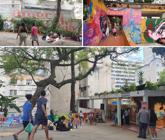
Thus, the 9 de Julho Occupation became more than a merely functionalized dwelling-in the Lefebvrian sense of segregated habitat-and instead emerged as a site of insurgent appropriation. Supported by a network of artists, intellectuals, and professionals committed to the cause, the occupation’s kitchen-organized according to the principles of solidarity economy, organic agriculture, and self-management-offers Sunday lunches to the public. Marked by the prominent involvement of women, such as Carmen Silva,21 the kitchen constitutes a space of sharing, care, and solidarity.
Its common areas function simultaneously as setting and stage for cultural events and meeting spaces, blurring the boundaries between public and private and, in a sense, poetizing its relationship with the city by rendering both the materiality and the symbolism of the building porous (Figure 1). Words, images, and bodies are inscribed on its walls (Figure 2) through an almost performative dynamic, reinforcing the theatrical character-typical of the Lefebvrian “third space”-of these produced spatialities. Hence, the building is reinscribed as a collective and living work, activating, from a Benjaminian perspective (Walter Benjamin, 2011), a struggle over urban memories-and over ruins; not the official ruins crystallized within hegemonic discourses, but those produced at the margins, amid silences and historical acts of resistance.
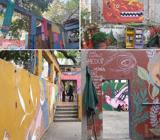
On the horizon of jouissance and excess, the building suspends uses limited to functional or market-driven purposes and is transformed-albeit provisionally-into an urban monument (Ferrari, 2019), a site where struggle and resistance are momentarily transformed into a festival. With formative and ludic spaces-such as a carpentry workshop, library, common and workshop rooms, playroom, and the kitchen itself-the building-monument emerges as a symbol denouncing urban emptiness, real estate speculation, and segregation, in the terms of Carmen Silva (Kachani, 2018). These insurgent uses re-signify the territory, enabling, as Ferrari (2019, p. 101) proposes, a “third way” between art, architecture, and public space.
In this perspective, the right to the city is not limited to access to housing or urban infrastructure-which, although fundamental, remain tied to the logic of mere survival and spatial economy (Lefebvre, 2000). Here, it also involves claiming the space of enjoyment-jouissance, of excess, expenditure, and unproductive use. It is this excess-which necessarily entails a certain waste-that provides the vital energy required so that “[I]t modifies space or generates a new space.”22 (Lefebvre, 2000, p. 206).
In a city such as São Paulo, faced with a growing number of vacant properties in the city center and despite the risk of violent reprisals, 105 underutilized buildings were occupied between 1997 and 2012 (Trindade, 2017). Notable examples include the Dandara, Maria Domitila, Cambridge, and Lord occupations, many of which have relied on technical assistance from architectural firms or collectives for the requalification of the buildings and the production of housing units. Particular attention should also be given to the Prestes Maia Building, currently regarded as the largest vertical occupation in Latin America23 and identified as the first “social housing retrofit” (Prefeitura de São Paulo, 2025). This experience positions Brazil as a pioneer for inaugurating a trajectory that places the limits between property and appropriation under tension.24
Moreover, by disrupting the institutional modus operandi and operating through its interstices, such movements reposition the genuine meaning of the tactical-far beyond the simplified notion promoted by so-called “tactical urbanism”,25 which, once transformed into slogan and propaganda, eclipses the dimension of struggle intrinsic to urban movements (Spataro, 2015), as well as the activist ethos inherent to citizenship (Mould, 2014). For Lefebvre (2000), the tactical, through appropriation and enjoyment, seeks to restore a code of use and a mode of apprehending space. In the sense later consolidated by Michel de Certeau (1994), the French Jesuit historian who belonged to the same academic circles as Lefebvre26 and maintained close theoretical engagement with Latin American experiences, tactics are associated with the dynamics of everyday life and with modes of use akin to poetic making.
Occupation-both as a process and as a term of struggle-, in Brazil, embodies a spatial singularity that is at once urban (by calling into question the foundations of private property upon which the modern city has been established), poetic (by materially and symbolically reinscribing the ruins of the existing city), and insurgent (through appropriation, play, festivity, and spatial jouissance, to the detriment of the prevailing order).
The insurgent character of these occupations is not without limits: the reach of such events often remains restricted to middle-class groups, and many operate as temporary solutions for people experiencing homelessness, ultimately leading to subsequent relocation within peripheral housing programs. Even so, by temporarily suspending the logic of habitat in favor of the urgency of inhabiting, these experiences open up fissures through which a poetics of urban space can emerge.
Lastly, these movements introduce new elements into urban contradictions under the aegis of capitalism. In peripheral areas, a productive coexistence may be observed between formality and informality, legality and illegality, in which the law is enforced selectively-according to what may be described, in Lefebvrian lexicon, as a strategy-thus ensuring the reproduction of habitual transgressions by certain groups (Maricato, 2003; Holston, 2013). In these segregated territories, illegality is often tolerated by the very rules of the game precisely because they remains outside circuits of visibility. Conversely, even as they expose systematic violations and irregularities of the rights to housing and to the city, enshrined in the Constitution and the City Statute (Arts. 2 and 39), popular urban occupations continue to bear the weight of the stigma of illegality.
In the abstract, alienated, and pretentiously homogeneous space of capital-characterized by the ideology of silence, nonviolence, and consensus, i.e., by the denial of class struggle-“there is to be no fighting over who should occupy a particular spot; spaces are to be left free, and wherever possible allowance is to be made for ‘proxemics’- for the maintenance of ‘respectful’ distances” (Lefebvre, 2000, p. 69). Nevertheless, what remains unseen is that within it there operates
a logic and a strategy of property in space: ‘places and things belonging to you do not belong to me’. The fact remains, however, that communal or shared spaces, the possession or consumption of which cannot be entirely privatized, continue to exist. Cafes, squares and monuments are cases in point. (Lefebvre, 2000, p. 69)
In light of the insufficient reach of democratic deliberative spheres, subversion, activism, and protest emerge as ways of making explicit the “structural asymmetries of power that characterize political conflict in the real world and force marginalized groups to adopt disruptive tactics of collective mobilization in order to impose their claims into the public sphere” (Trindade, 2018, p. 21). Occupations thus reveal that concrete disputes unfold not only in space, but also through it.
4. The monumentality of everyday life and another citizenship
Monumentality and the monument occupy a privileged place in Lefebvre’s reflection on the architectural-urban dimension in the production of space. Throughout his work, these terms emerge as ambivalent, potentially contradictory categories: on the one hand, they are historically linked to the inscription of power in space; on the other, they condense social contents and function as supports of collective life, opening up the possibility of a spatial experience as work. In The Urban Revolution (2008), Lefebvre emphasized the monument as a spatial form associated with the consecration of hegemonic power in history-linked to institutions such as the church, the State, and the university.
In this same book, as well as in La production de l’espace (Lefebvre, 2000), the analysis shifts and deepens: Lefebvre understands monumental space also as a site of collective life and of relations of production, of work and non-work, in which “this space is indeed condensed […] [and] becomes the metaphorical and quasi-metaphysical underpinning of a society” (Lefebvre, 2000, p. 259). Lefebvre conceives monumental space as a symbolic instance of long duration, successively appropriated by different institutions that inscribe within it their own signs of power. Lacking a fixed meaning, its forms are reappropriated over time-at times to consecrate faith, at others to affirm authority, or to stage the nation. This historical movement of successive resignification is what the author terms “a play of substitutions”.
Monuments-both symbolic and transfunctional-may figure as significant spatial works, capable of projecting an “elsewhere” and announcing a concrete utopia. As Lefebvre argued, “[T]he great monuments were transfunctional (cathedrals)”,27 as were transcultural tombs, insofar as they exceeded immediate utility and inscribed within space traces of alterity and social imagination. Through scale, verticality, or expressive force, the monument inaugurates another order of urban experience, one that proclaims dimensions distinct from those of the ordinary routines of everyday life (Lefebvre, 2008, p. 30).
However, within the context of capitalist modernity, Lefebvre identified a decisive inflection (Lefebvre, 2014, p. 18): the meaning attributed to the monument dissolves under the combined impact of political transformations (the bourgeois democratic revolution), economic transformations (industrialization and capitalism), and social transformations (urban expansion and the rise of the working classes). In this process, the monument is progressively supplanted by the building-an essentially technical and functional construct, largely devoid of symbolic density. Whereas the monument embodied collective meaning-it was itself a producer of meaning-the modern building operates as a functional sign, repeatable and fragmented, reduced to signification. Lefebvre sharply criticizes the theoretical confusion between these two levels. Signification refers to the technical articulation among signs, while meaning emerges only through appropriated, lived spatial experience, endowed with temporal depth and symbolic thickness. This distinction is essential for understanding why, within the logic of abstract space, buildings cannot replace monuments as works: they lack the capacity to condense meanings and to project collective imaginaries. From this perspective, the symbolic efficacy of architectural and urban space derives not solely from its forms or technical prescriptions, but from the ways in which those forms are lived, accepted, or contested by social subjects. It is through this process of appropriation-sometimes naturalized, sometimes conflictual-that space becomes meaningful. The difference between a space that merely organizes life and one that transforms it resides precisely here: in its capacity to become a work in the double Lefebvrian sense-both as social production and as the construction of meaning.
These considerations converge with the critical analysis of a set of contemporary projects involving public facilities and spaces in Latin America,28 whose materiality and form reveal ethical-aesthetic disputes surrounding the production of urban space. Although institutionalized and embedded within state dynamics, these initiatives mobilize symbolic and infrastructural investments oriented toward broad processes of social transformation. Across different national and administrative contexts, the articulation may be observed between sectoral public policies and urban strategies aimed at territorial upgrading, the expansion of access to citizenship, and the creation of new urban landmarks. Emblematic examples include the Unified Educational Centers (CEUs) in São Paulo, conceived as multifunctional public centralities that integrate cultural, educational, and sports facilities within peripheral territories; the Parques Biblioteca (Park Libraries), the Unidades de Vida Articulada (UVAs - Articulated Life Units -consisting of a water-supply infrastructure converted into public spaces), and the Colegios de Calidad (High-quality public schools) implemented in Medellín which reconfigure urban space through civic infrastructures and community pacts; the Mi México Late program in Mexico, encompassing more than 750 interventions in vulnerable areas that combine urban design, architecture, and national urban policy; and, finally, the Quiero Mi Barrio (I Love My Neighborhood) program in Chile, which upgrades the public space of neighborhoods produced through massified and anti-urban public housing policies, seeking to recover collective identity and promote territorial equity. By condensing multiple meanings (technical, social, and symbolic) around the built environment, these experiences may be analyzed as contemporary manifestations of monumentality.
When both the specificities of each national context and the common conditions of these experiences are considered-namely their inscription in territories marked by socio-spatial segregation, urban precariousness, and social vulnerability-they give rise to multiple possibilities for critical interpretation that exceed the scope of the present analysis. What concerns us here, however, is to underscore a recurring feature: in many cases, the spatial outcomes of these programs exceed the condition of isolated architectural interventions and come to operate as reconfigurations of urban infrastructures, facilities, and neighborhoods. Beginning at the architectural scale, what becomes monumentalized varies: in some cases it is the roof, as in the Orquideorama, in Medellín (Figure 3); in others it is the ground, as in the Parque de los Deseos [Park of Desires] (Figure 4), the Parque de los Pies Descalzos [Barefoot Park] (Figure 5), and the Colegio Antonio Derka (Figure 6), all in Medellín. Elsewhere, monumentality emerges from the transitive relations between domesticity, materiality, and landscape, as in the Parque Prado and Parques del Río in Medellín (Figure 7), and the Parque Cantinho do Céu [Little Corner of Heaven Park], in São Paulo (Figure 8), among other disciplinary strategies of architecture and urbanism still under study.
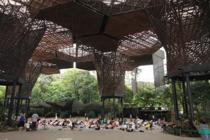

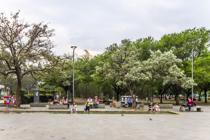
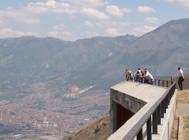
The most significant interventions within the corpus of analyzed projects are those in which the radicalization of aesthetic potency and symbolic-spatial projection appears to mobilize a drive toward collective sensitization. In doing so, they distance themselves from what might otherwise be hastily interpreted as spectacle or self-centered objecthood. This is so, first, because their imagistic dimension does not seek to conceal or replace the real, even as it intensifies and radicalizes certain of its aspects. Above all, however, these interventions avoid objectness insofar as they are traversed by the broader, more plural spatial and programmatic tendencies previously mentioned.29
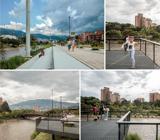

These works appear to experiment with forms of monumentality no longer associated exclusively with state power or institutional centrality, but instead rooted in ordinary practices, collective appropriations-often performed through enjoyment-and sensitive transformations of the landscape.30 The disciplinary spatial strategies deployed in these projects operate as mediations between technique, public policy, and everyday urban life, opening breaches for deviation (Lefebvre, 2014, p. 92). As critical, and at times provisional,31 architectural reactions to the logics of fragmentation, segregation, and de-symbolization characteristic of neoliberal urbanism, these interventions do not aspire to a total transformation of the urban. Instead, they advance situated actions of spatial transformation, capable of (re)enacting a concrete utopian dimension within existing dynamics and spaces.
Recognizing this shared phenomenon of producing public architecture oriented toward social justice also entails confronting the limits of citizenship in the Latin American context. As Milton Santos (2012) argued, currently, citizenship remains incomplete insofar as it is exercised within territories that reproduce inequalities rather than secure rights. What is at stake, therefore, is not merely access to services or the redistribution of resources, but the assertion of an expanded conception of citizenship-one that integrates territory, lived space, and the “framework of life”, understood as the material and immaterial conditions that sustain human fulfillment within a new civic-territorial model. It is precisely at this threshold between the institutional arrangements and the lived experience that monumentality acquires a processual character and, in a Lefebvrian sense, reopens the horizon of a third space-of appropriation, mediation, and collective invention-where work and life blur to open up possibilities for the urban.
Final remarks
By examining a selection of critical projects from Latin American urbanization, this article has demonstrated how, at different moments, such initiatives have sought to render visible the articulations between destructive social processes and their structural determinations, rooted in peripheral capitalism and conservative modernization. Even within a system that appears increasingly closed, possible emancipatory meanings have managed to persist. The Lefebvre-inspired contribution effects a radical inversion of perspective without disregarding the economic imperatives that bear upon the production of space. By reinstating inhabiting and the symbolic dimension as the point of departure for a critique of the urban, it also advances a distinct methodological orientation-one attuned to praxis, the body, and the sensible forms through which spatial experience is constituted. It is to this method that the present article has sought to refer, acknowledging the inescapable task of a scientific agenda committed to the transformation of a world traversed by multiple crises-social, environmental, and civilizational.
A situated point of departure is thus asserted-Latin America-anchored in a pre-existing theoretical debate and in concrete experiences that render palpable what remains latent: spaces that give form and symbolic density to a collectivizing social drive, while displacing and re-enacting historically instituted spatial codes and paradigms. At the limit, what is at stake is the contestation of the very horizon of the urban and of the possible, within which the right to the city must be reaffirmed-although this time as an effective process of collective appropriation.
The practices under consideration challenge conventions (Lefebvre, 2000), by extrapolating the established order (Lefebvre, 2014), thereby disrupting the spatial codes and paradigms. The issue, therefore, is not the provision of housing as an end in itself-confined to the level of habitat-but the mobilization toward inhabiting (habitar); nor is it the legitimation of exclusively institutional memories through monumental form, but rather the creation of spaces that allow everyday life to exceed its prescribed limits. In this sense, in both cases, the building or facility becomes visibly porous through a materiality that invites common relations, collective uses, encounters, and passages. In doing so, it prevents resists being confined to the monofunctionality of an exclusively private or institutional status.
Through this process, its image and the representations conventionally attributed to it are likewise displaced. In the “third space,” other metaphors of everyday life are enacted, suspending those that bind property to the private sphere and the urban to institutional order. It is toward this spatial potency-a latent dimension, though not yet fully activated in the formulations on the Latin American city discussed earlier-that these experiences direct our gaze. The metamorphosis into possible spatialities gives rise to privileged sites that initiate discontinuities, both in relation to hegemonic modes of thought grounded in dichotomous or strictly operative paradigms, and to existing spatial practices and “textures”, which remain resistant to change-such that
the texture of space affords opportunities not only to social acts with no particular place in it and no particular link with it, but also to a spatial practice that it does indeed determine, namely its collective and individual use: a sequence of acts which embody a signifying practice even if they cannot be reduced to such a practice.32 (Lefebvre, 2000, p. 70. Emphasis in the original)
Ultimately, these signposts toward the third space reveal openings and deviations through which architecture-rather than remaining confined to a condition of mere “sublime uselessness” (Tafuri, 1985), a perspective that culminates in spatial and political paralysis (Jameson, 1985)-emerges as a potential force capable of producing ruptures in the capitalist logic of territorial management. Instead, as Jameson observed, Lefebvre’s work makes it possible to articulate space and superstructure, material production and utopian imagination, thereby rehabilitating the symbolic field as a terrain of counter-hegemonic dispute. From a “neo-Gramscian” perspective, Jameson thus proposes that space-and, in this sense, architecture, activated as a “mode of imagination” (Stanek , 2014, p. xiii)-be conceived as an instance of cultural elaboration of possible futures. In this context, the enclave-or, as discussed herein, occupation and the monument-figures as a strategic locus in which new forms of sociability emerge and reconfigure, albeit partially, the fabric of dominant spatiality.
This symbolic colonization of space anticipates, even if provisionally, other forms of life. Spatial utopian ideas-alternative conceptions of the city, inhabiting, and everyday life-come to share the same status of objectivity as material buildings: both operate within a field of forces that acts upon the present, even when they do not immediately crystallize as political projects. These conditions of possibility acquire heightened significance when situated in Latin America, where the uneven development of world history creates openings for the concrete emergence of spatial and political forms that are unviable in hegemonic centers. As Jameson (1985, p. 72) argues, “in the Second and Third Worlds, of projects and constructions that are not possible in the First: this concrete existence of radically different spaces elsewhere […] is what objectively opens the possibility for the coming into being and development of ‘counter-hegemonic values’ here”.
Open Data
The entire dataset supporting the results of this study was published in the article itself.
References
-
ARANTES, P. F. Em busca do urbano: marxistas e a cidade de São Paulo nos anos de 1970. Novos Estudos Cebrap, n. 83, p. 103-27, 2009. Disponível em: https://www.scielo.br/scielo.php?script=sci_arttext&pid=S0101-33002009000100007&lng=en&nrm=iso Acesso em: 15 abr. 2021.
» https://www.scielo.br/scielo.php?script=sci_arttext&pid=S0101-33002009000100007&lng=en&nrm=iso - BATAILLE, G. A parte maldita: precedida pela “noção de dispêndio”. Belo Horizonte: Autêntica, 2013.
- BENJAMIN, W. Origem do drama trágico alemão São Paulo: Autêntica, 2011.
- BRENNER, N. Introduction: Urban Theory without an Outside. In: BRENNER, N. (Ed.). Implosions/Explosions: Towards a Study of Planetary Urbanization. Berlin: Jovis, 2013.
- BUTLER, C. Henri Lefebvre: Spatial Politics, Everyday Life, and the Right to the City. New York: Routledge, 2012.
- CALDERÓN, F.; CASTELLS, M. A nova América Latina São Paulo: Zahar, 2021.
- CASTELLS, M. Imperialismo y urbanización en América Latina Barcelona: Gustavo Gili, 1973.
- CERTEAU, M. de. A invenção do cotidiano: 1. Artes de Fazer. Petrópolis: Vozes, 1994.
- DAGNINO, E. Culture, Citizenship, and Democracy: Changing Discourses and Practices of the Latin American Left. In: ALVAREZ, S. E.; DAGNINO, E.; ESCOBAR, A. (Orgs.). Cultures of Politics, Politics of Cultures: Re-visioning Latin American Social Movements. Boulder: Westview Press, 1998. p. 33-63.
-
DAMIANI, A. L. Introdução a elementos da obra de Henri Lefebvre e a geografia. Revista do Departamento de Geografia, p. 254-83, 2012. Disponível em: https://doi.org/10.7154/RDG.2012.0112.0013. Acesso em: 3 jan. 2026.
» https://doi.org/10.7154/RDG.2012.0112.0013 - D’OTTAVIANO, C. Habitação, autogestão & cidade Rio de Janeiro: Letra Capital; Observatório das Metrópoles, 2021.
- ELDEN, S. Understanding Henri Lefebvre: Theory and the possible. Nova Iorque; Londres: Continuum, 2004.
- FERRARI, E. C. De terra, pedra e palavra: ocupação-monumento. 2019. Dissertação (Mestrado em Artes) - Escola de Comunicação e Artes, Universidade de São Paulo, São Paulo, 2019.
- GOONEWARDENA, K. et al. (Eds.). Space, Difference, Everyday Life: Reading Henri Lefebvre. New York; Oxon: Routledge, 2008.
-
GORELIK, A. A produção da “cidade latino-americana”. Tempo Social, v. 17, n. 1, p. 111-33, 2005. Disponível em: https://www.scielo.br/j/ts/a/PbtdgkddPYMwWS9CRkkTyZK/?lang=pt Acesso em: 1º maio 2021.
» https://www.scielo.br/j/ts/a/PbtdgkddPYMwWS9CRkkTyZK/?lang=pt - HOLSTON, J. Cidadania insurgente São Paulo: Companhia das Letras, 2013.
- JAMESON, F. Architecture and the Critique of Ideology. In: OCKMAN, J. (Ed.). Architecture Criticism Ideology Princeton: Princeton Architectural Press, 1985. p. 51-87.
-
KACHANI, M. Por dentro da ocupação 9 de Julho. O Estado de S. Paulo, 11 set. 2018. Disponível em: https://www.estadao.com.br/brasil/inconsciente-coletivo/por-dentro-da-ocupacao-9-de-julho /. Acesso em: 3 jan. 2026.
» https://www.estadao.com.br/brasil/inconsciente-coletivo/por-dentro-da-ocupacao-9-de-julho - KIPFER, S. Preface to the New Edition. In: LEFEBVRE, H. Dialectical Materialism Minneapolis: University of Minnesota Press, 2009.
- KUYMULU, M. B. The Vortex of Rights: “Right to the City” at a Crossroads. International Journal of Urban and Regional Research, v. 37, n. 3, p. 923-40, 2013.
- LEFEBVRE, H. O fim da história Lisboa: Publicações Dom Quixote, 1971.
- LEFEBVRE, H. Contra los tecnócratas Buenos Aires: Granica, 1972.
- LEFEBVRE, H. El manifiesto diferencialista Ciudad de México: Siglo XXI Editores, 1975.
- LEFEBVRE, H. Tiempos equívocos Barcelona: Editorial Kairós, 1976.
- LEFEBVRE, H. De lo rural a lo urbano 4. ed. Barcelona: Ediciones Península, 1978.
- LEFEBVRE, H. La presencia y la ausencia: contribución a la teoría de las representaciones. Ciudad de México: Fondo de Cultura Económica, 1983.
- LEFEBVRE, H. Lógica formal, lógica dialética Rio de Janeiro: Civilização Brasileira, 1991.
- LEFEBVRE, H. La production de l’espace Paris: Anthropos, 2000.
- LEFEBVRE, H. Rhythmanalysis: Space, Time and Everyday Life. London: Continuum, 2004.
- LEFEBVRE, H. A revolução urbana Belo Horizonte: Editora UFMG, 2008.
- LEFEBVRE, H. Toward an Architecture of Enjoyment Minneapolis: University of Minnesota Press , 2014.
- LEFEBVRE, H. O direito à cidade São Paulo: Centauro, 2016[2016a].
- LEFEBVRE, H. Metaphilosophy London: Verso, 2016 [2016b].
- MARCUSE, P. Whose Right(s) to What City? In: BRENNER, N.; MARCUSE, P.; MAYER, M. (Orgs.). Cities for People, Not for Profit: Critical Urban Theory and the Right to the City. London: Routledge, 2012.
-
MARICATO, E. Metrópole, legislação e desigualdade. Estudos Avançados, v. 17, n. 48, p. 151-66, 2003. Disponível em: https://revistas.usp.br/eav/article/view/9928 Acesso em: 26 maio 2025.
» https://revistas.usp.br/eav/article/view/9928 - MARX, K. Manuscritos econômico-filosóficos São Paulo: Boitempo, 2004.
-
MEDRANO, L. S. et al. A presença de Henri Lefebvre no debate acadêmico contemporâneo da arquitetura. PARC: Pesquisa em Arquitetura e Construção, v. 8, n. 3, p. 170-80, 2017. Disponível em: https://doi.org/10.20396/parc.v8i3.8650261. Acesso em: 20 jan. 2018.
» https://doi.org/10.20396/parc.v8i3.8650261 -
MOULD, O. Tactical Urbanism: The New Vernacular of the Creative City. Geography Compass, v. 8, p. 529-39, 2014. Disponível em: https://doi.org/10.1111/gec3.12146. Acesso em: 3 jan. 2026.
» https://doi.org/10.1111/gec3.12146 - ONU-HABITAT. World Cities Report 2024: Cities and Climate Action. Nairobi: United Nations Human Settlements Programme, 2024.
-
PALOMINO, P. On the Disadvantages of “Global South” for Latin American Studies. Journal of World Philosophies, v. 4, n. 2, p. 22-39, 2019. Disponível em: https://scholarworks.iu.edu/iupjournals/index.php/jwp/article/view/3113 Acesso em: 30 maio 2025.
» https://scholarworks.iu.edu/iupjournals/index.php/jwp/article/view/3113 -
PREFEITURA DE SÃO PAULO. Reformado, residencial Prestes Maia é entregue pela Prefeitura e entra para a história como primeiro retrofit social. Prefeitura de São Paulo, 7 abr. 2025. Disponível em: https://prefeitura.sp.gov.br/w/reformado-residencial-prestes-maia-%C3%A9-entregue-pela-prefeitura-e-entra-para-a-hist%C3%B3ria-como-primeiro-retrofit-social Acesso em: 3 jan. 2026.
» https://prefeitura.sp.gov.br/w/reformado-residencial-prestes-maia-%C3%A9-entregue-pela-prefeitura-e-entra-para-a-hist%C3%B3ria-como-primeiro-retrofit-social -
PURCELL, M. Excavating Lefebvre: The Right to the City and its Urban Politics of the Inhabitant. GeoJournal, n. 58, p. 99-108, 2002. Disponível em: https://doi.org/10.1023/B:GEJO.0000010829.62237.8f. Acesso em: 8 nov. 2021.
» https://doi.org/10.1023/B:GEJO.0000010829.62237.8f - ROBINSON, J. Ordinary Cities: Between Modernity and Development. London: Routledge , 2006.
-
ROY, A. Urban Informality: Toward an Epistemology of Planning. Journal of the American Planning Association, v. 71, n. 2, p. 147-58, 2005. Disponível em: https://doi.org/10.1080/01944360508976689. Acesso em: 3 jan. 2026.
» https://doi.org/10.1080/01944360508976689 - SANTOS, B. S. Para além do pensamento abissal: das linhas globais a uma ecologia de saberes. Novos Estudos Cebrap , v. 79, p. 71-94, 2007.
-
SANTOS, C. S. Da marginalidade à segregação: contribuições de uma teoria urbana crítica. Economía, Sociedad y Territorio, v. xvii, n. 55, p. 619-46, 2017. Disponível em: https://doi.org/10.22136/est2017754. Acesso em: 20 jan. 2026.
» https://doi.org/10.22136/est2017754 -
SANTOS, C. S. Henri Lefebvre e a morfologia de uma dialética espacial. GEOUSP - Espaço e Tempo, v. 23, n. 3, p. 525-50, 2019. Disponível em: https://www.revistas.usp.br/geousp/article/view/163150 Acesso em: 2 dez. 2020.
» https://www.revistas.usp.br/geousp/article/view/163150 - SANTOS, M. O espaço do cidadão São Paulo: Edusp, 2012.
-
SCHMID, C. A teoria da produção do espaço de Henri Lefebvre: em direção a uma dialética tridimensional. GEOUSP - Espaço e Tempo , v. 16, n. 3, p. 89-109, 2012 [2012a]. Disponível em: https://revistas.usp.br/geousp/article/view/74284 Acesso em: 31 maio 2025.
» https://revistas.usp.br/geousp/article/view/74284 - SCHMID, C. Henri Lefebvre, the Right to the City, and the New Metropolitan Mainstream. In: BRENNER, N.; MARCUSE, P.; MAYER, M. (Orgs.). Cities for People, Not for Profit: Critical Urban Theory and the Right to the City . London: Routledge , 2012 [2012b].
- SCHWARZ, R. As ideias fora do lugar. In: SCHWARZ, R. As ideias fora do lugar: ensaios selecionados. São Paulo: Companhia das Letras , 2014.
- SEABRA, O. C. de L. A insurreição do uso. In: MARTINS, J. de S. (Org.). Henri Lefebvre e o retorno à dialética São Paulo: Hucitec, 1996.
- SHIELDS, R. Lefebvre, Love and Struggle: Spatial Dialectics. New York; London: Routledge , 1999.
- SINGER, P. Urbanización, dependencia y marginalidad en América Latina. In: CASTELLS, M. Imperialismo y urbanización en América Latina . Barcelona: Gustavo Gili , 1973.
- SOJA, E. W. Thirdspace: Journeys to Los Angeles and Other Real-and-Imagined Places. Cambridge, MA: Blackwell, 1996.
-
SPATARO, D. Against a De-politicized DIY Urbanism: Food Not Bombs and the Struggle over Public Space. Journal of Urbanism: International Research on Placemaking and Urban Sustainability, v. 9, n. 2, p. 185-201, 2015. Disponível em: https://doi.org/10.1080/17549175.2015.1056208. Acesso em: 3 jan. 2026.
» https://doi.org/10.1080/17549175.2015.1056208 - STANEK, Ł. Henri Lefebvre on Space: Architecture, Urban Research, and the Production of Theory. Minneapolis: University of Minnesota Press , 2011.
- STANEK, Ł. Introduction: A Manuscript Found in Saragossa. In: Toward an Architecture of Enjoyment Minneapolis: Minnesota University, 2014.
- STAVRIDES, S. Heterotopias and the Experience of Porous Urban Space. In: FRANCK, K.; STEVENS, Q. (Eds.). Loose Space: Possibility and Diversity in Urban Life. Oxon: Routledge, 2006.
- TAFURI, M. Projeto e utopia Lisboa: Presença, 1985.
- TRINDADE, T. A. Protesto e democracia: ocupações urbanas e luta pelo direito à cidade. Jundiaí: Paco, 2017.
-
TRINDADE, T. A. A relação entre protesto e deliberação: reflexões para o aprofundamento do debate. Opinião pública, v. 24, n. 1, p. 1-28, 2018. Disponível em: https://doi.org/10.1590/1807-019120182411. Acesso em: 28 maio 2025.
» https://doi.org/10.1590/1807-019120182411
-
1
The discussion presented here arises from the dialogue between two parallel research trajectories: the doctoral research Do habitat ao habitar poiético: participação, apropriação e utopia em Henri Lefebvre [From Habitat to Poietic Inhabiting: Participation, Appropriation, and Utopia in Henri Lefebvre] (NAKAHARA, C. A. M. M., Do habitat ao habitar poiético: participação, apropriação e utopia em Henri Lefebvre 2021). Doctoral thesis (Doctorate in History and Foundations of Architecture and Urbanism) - School of Architecture and Urbanism, Universidade de São Paulo, São Paulo, 2021. Available at: https://doi.org/10.11606/T.16.2021.tde-10012022-130103. Accessed on: January 22, 2026, and the postdoctoral research project Identificação e análise de projetos contra-hegemônicos [Identification and Analysis of Counter-Hegemonic Projects] (Wilderom, 2021-2023). We extend our thanks to FAPESP for funding the postdoctoral research (Grant no. 20/11816-5) and the research group Pensamento Crítico e Cidade Contemporânea [Critical Thought and the Contemporary City] (PC3-FAUUSP) for the discussions that have formed the backdrop of this article. In particular, we dedicate this work to the memory of Luiz Recamán, whose intellectual and human presence remains a central inspiration for the reflections developed herein.
-
2
N.B. For direct citations the English version was used of LEFEBVRE, H. Writings on Cities. Oxford: Blackwell, (1996, p. 103). Translated by Eleonore Kofman and Elizabeth Lebas.
-
3
This and all other non-English citations hereafter have been translated by the authors.
-
4
N.B. For direct citations the English version was used of LEFEBVRE, H. Writings on Cities. (1996, p. 94).
-
5
In this sense, even the examples that Arantes employs to claim categories specific to the “production of the city,” when they move away from the broader meanings associated with the urban—“centrality and the material expression of power and wealth”—and seek more tangible definitions, rarely escape the modalities of space frequently linked to economic spheres. Thus, even when dialectically conceived, space appears at times under the dominion of capital—“labor in construction”, “private property and land rent”, “real estate accumulation circuits and their relation to capital in general”, “forms of urban action by the State in the distribution of social wealth”—and at other times confined to urban services—“the logic of private and public investment, the location of infrastructures” (Arantes, 2009, p. 120).
-
6
For a comprehensive treatment of this discussion, see the doctoral thesis Do habitat ao habitar poiético: participação, apropriação e utopia em Henri Lefebvre [From Habitat to Poietic Inhabiting : Participation, Appropriation, and Utopia in Henri Lefebvre] (Nakahara, C. A. M. M., 2021). Doctoral thesis (Doctorate in History and Foundations of Architecture and Urbanism) - Faculty of Architecture and Urbanism, Universidade de São Paulo, São Paulo, 2021. Available at: https://doi.org/10.11606/T.16.2021.tde-10012022-130103. Accessed: January 22, 2026).
-
7
N.B. For direct citations the English version was used of LEFEBVRE, H. The Production of Space. Oxford: Blackwell. (1991, p. 60). Translated by Donald Nicholson-Smith.
-
8
N.B. For direct citations the English version was used of LEFEBVRE, H. The Urban Revolution. Minneapolis: University of Minnesota Press. (2003, p .122). Translated by Robert Bononno.
-
9
N.B. For direct citations the English version was used of LEFEBVRE, H. Writings on Cities. (1996, p. 171).
-
10
For these reasons, as César Simoni Santos (2019) emphasizes, considering Henri Lefebvre solely from the perspective of a mere continuity of Marxist thought may result in a series of pitfalls. Lefebvre’s strategic distancing from the mature Marx and from Hegel—or, more precisely, from Marxology and the philosophy of the State—was imperative and precisely what prompted him to undertake a double movement. First, he delved more deeply into the writings of the young Marx—especially the Manuscritos econômico-filosóficos [Economic and Philosophical Manuscripts] (Marx, K., Economic and Philosophical Manuscripts. [Economic and Philosophical Manuscripts] São Paulo: Boitempo, 2004)—in which there existed a certain interchangeability between the meanings of production and appropriation, even though, in Lefebvre’s view (2000), these concepts in Marx still remained highly dependent on ideas of (technical) domination and labor. In his words, “Marx had not entirely abandoned the search for a specific human nature, but he rejected any idea that it might be constituted by laughter, by play, by the awareness of death, or by ‘residence’; rather, it lay in (social) labour and - inseparably - in language”. (Lefebvre, 2000, pp. 191-92).* Hence, it was “necessary to restore in its full scope the concept of production, reduced by economism to the production of things, that is, of commodities” (Lefebvre, 1983, p. 27). This movement would lead him to a second step: drawing closer to thinkers very rarely mobilized by orthodox Marxism, such as Nietzsche and Heidegger, in order to attend to corporeal, desirous, and poetic aspects. * N.B. For direct citations the English version was used of LEFEBVRE, H. The Production of Space. (1991, p. 165)
-
11
This position is expressed with particular clarity in Toward an Architecture of Enjoyment (2014), translated from the original French manuscript Vers une architecture de la jouissance. At the request of his former student, Mario Gaviria, Lefebvre was commissioned (commande) to write on an “architecture of pleasure” (plaisir). It was on this occasion that Lefebvre chose to alter the title, replacing plaisir (pleasure) with jouissance (enjoyment). This poetic displacement enabled him to stage a double provocation: on the one hand, directed at the asceticism of Marxist thought in architectural debates; on the other, at the critique of architectural ideology developed by Manfredo Tafuri. Strategically employed by Lefebvre, the term jouissance carries multiple connotations in French, ranging from amusement and pleasure to voluptuousness, fruition, diversion, ecstasy, and enjoyment.
-
12
Although jouissance is rendered here as “pleasure”, translations of Henri Lefebvre often prefer “enjoyment”, which indeed has been used throughout this article. The French term jouissance, however, carries a broader semantic range that exceeds both English equivalents, connoting an intensified, embodied, and sometimes transgressive mode of lived experience associated with appropriation, use, and the affective fullness of everyday life.
-
13
N.B. For direct citations the English version was used of LEFEBVRE, H. The Production of Space. (1991, p. 165-167).
-
14
In Lefebvre, representations are not confined to ideologies or superstructures—a recurring ambiguity across various Marxist interpretations—but instead constitute forms, institutions, and modes of thought that relate dialectically to the concreteness of life, including its times and temporalities, rhythms, measures, and measurements. This conception stands in opposition both to formalism—understood as abstract and static idealism—and to a content-centered approach, which, by fixating exclusively on content, positions itself at the antipodes of form and structure. Whether in the version of orthodox materialism or in the apologia of singular narratives, a content-centered approach does not escape reductionisms that impoverish spatial and symbolic experience. None of these approaches, taken in isolation, is capable of accounting for the complexity of the production of space and everyday life.
-
15
N.B. For direct citations the English version was used of SCHMID, C. Henri Lefebvre’s theory of the production of space: towards a three-dimensional dialectic, in Space, Difference, Everyday Life - Reading Henri Lefebvre. Edited by Kanishka Goonewardena, Stefan Kipfer, Richard Milgrom and Christian Schmid. New York: Routledge. (2008, p. 32-33).
-
16
Jouissance inaugurates an expanded reflection on the nature of designed space, whether architectural or urban. In light of this understanding, Stanek (2014.), in dialogue with Lefebvre, underscores that “[W]hile abstract utopia embraces current urbanization protocols and extends them into the future, concrete utopia “begins with jouissance and seeks to conceive of a new space, which can only be based on an architectural project.” whereas abstract utopia embraces existing protocols of urbanization and projects them into the future, concrete utopia ‘begins with jouissance and seeks to conceive a new space, one that can only be grounded in an architectural project’” (Stanek, 2014, p. xxxvi-xxxvii). Thus, the right to the city is shown to transcend mere access to infrastructure, expanding the meaning of citizenship by incorporating jouissance as an element capable of activating a negative dimension—one that calls into question the very representations prevailing in contemporary urban realities.
-
17
In this case, we refer specifically to Manfredo Tafuri’s text “Operative Criticism,” a chapter from Theories and History of Architecture (1980), originally published as Teorie e storia dell’architettura in 1968 (TAFURI, M. Operative Criticism. In: Theories and History of Architecture. New York: HarperCollins Publishers, 1980).
-
18
Thus, in addition to pointing toward a horizon of appropriation within the contradictions of regulated everyday life, such a position reveals a political character, by transforming the sphere of inhabiting into a stage of struggle and resistance, and a materialist character, both in the historical-Marxist sense and in the corporeal sense, insofar as it emphasizes the physical, organic, and rhythmic dimensions of the body.
-
19
N.B. For direct citations the English version was used of LEFEBVRE, H. The Production of Space. Oxford: Basil Blackwell Ltd. (1991, p 188). Translated by Donald Nicholson-Smith.
-
20
The analysis presented herein is based on a doctoral research, Do habitat ao habitar poiético: participação, apropriação e utopia em Henri Lefebvre [From Habitat to Poietic Inhabiting: Participation, Appropriation, and Utopia in Henri Lefebvre] (NAKAHARA, C. A. M. M., 2021). Doctoral thesis (Doctorate in History and Foundations of Architecture and Urbanism) - Faculty of Architecture and Urbanism, Universidade de São Paulo, São Paulo, 2021. Available at: https://doi.org/10.11606/T.16.2021.tde-10012022-130103. Accessed on: January 22, 2026), which drew on Lefebvrian theory—especially his discussion of inhabiting as poetic (Henri Lefebvre, 2016a, 2008)—to examine contemporary participatory practices in housing production. It found that participation and the right to the city, when employed instrumentally or in an institutionalized manner, reveal the persistence of an operative rationality and representations that must be dialectically overcome by critical architectural thought. Within this framework, poetic making and appropriation, situated in the horizon of inhabiting proved to be potent means for challenging and transcending these still-prevalent paradigms.
-
21
A native of the state of Bahia and one of the main leaders of the MSTC in São Paulo, she starred in the film Era o Hotel Cambridge by Eliane Caffé. Her significant role as a leader in the occupations in central São Paulo has been frequently portrayed by the media.
-
22
N.B. For direct citations the English version was used of LEFEBVRE, H. The Production of Space. (1991, p. 177)
-
23
According to data from EFE (Santandreu, 2018), the Prestes Maia Building ranked second until 2015, when the so-called Torre de David [Tower of David]—the largest at the time—was evacuated by the government (Santandreu, A. “Edifício Prestes Maia, o maior símbolo das ocupações na América Latina” [The Prestes Maia Building, the most prominent symbol of occupations in Latin America]. UOL, May 10, 2018). Available at: https://noticias.uol.com.br/ultimas-noticias/efe/2018/05/10/edificio-prestes-maia-o-maior-simbolo-das-ocupacoes-na-america-latina.htm. Accessed on: January 3, 2026).
-
24
In this regard, it is also worth highlighting the participation of these experiences in the 14th São Paulo International Architecture Biennial, held in September and October 2025.
-
25
Frequently associated with Mike Lydon, “tactical urbanism” becomes yet another legitimized and propagandistic mechanism, one that homogenizes and diminishes the entire historical trajectory of urban struggles.
-
26
Although cross-references between the authors are scarce or virtually nonexistent, it should be noted that, in the introduction to The Practice of Everyday Life, Michel de Certeau (1994) refers to Lefebvre in a footnote, explicitly crediting the French philosopher with investigations into everyday life.
-
27
N.B. For direct citations the English version was used of LEFEBVRE, H. The Urban Revolution. (2003, p. 22).
-
28
This is a qualitative study of an exploratory and comparative nature, derived from the postdoctoral research project Identificação e análise de projetos contra-hegemônicos [Identification and analysis of counter-hegemonic projects] (Wilderom, 2021-2023), cited above, which was dedicated to the development of an analytical protocol and a methodological framework for identifying counter-hegemonic dimensions in Latin American architectural production. The study articulated two complementary axes: (1) a theoretical-critical problematization grounded in Lefebvre’s theory on the production of space (see see Recamán, L.; Wilderom, M. O sentido das possibilidades de uma contra-hegemonia na arquitetura [The meaning of the possibilities of counter-hegemony in architecture]. V!RUS, no. 24, 2022); and (2) a comparative selection of contemporary case studies, conducted with the support of undergraduate research assistants. The resulting corpus constitutes a critical inventory (Lefebvre, 1971), produced through the analysis of more than one thousand projects initially mapped across five countries—Argentina, Brazil, Chile, Colombia, and Mexico—and through the systematization of approximately fifty technical-descriptive files. These files concentrate on projects that exhibit: (1) the reconfiguration of conventional architectural programs, integrating physical and relational dimensions; and (2) architectural forms situated in dialogue with local patterns of occupation, construction technologies, and existing typologies.
-
29
This analysis is developed in greater depth in WILDEROM, M. Monumentalizing the Everyday. Log Magazine, no. 62, 2025.
-
30
See WILDEROM, M. Urban Landscapes Reclaimed: Architectural Reactions Reframing Infrastructure. DeArq, No. 33, May 2022.
-
31
The ideas of provisional pact and architectural reaction find resonance in the publications of Plan:b Arquitectos, which, through a theoretical-practical reflection, conceive design as a continuous negotiation with context. This approach is articulated in works such as Arquitectura en espera (2005), Acuerdos parciales (2006), Arquitectura a la inversa (2016), and 12 proyectos en 120 restricciones (2019).
-
32
N.B. For direct citations the English version was used of LEFEBVRE, H. The Production of Space. (1991, p. 57).
-
Information on the use of Artificial Intelligence
Search, systematization, and final organization of references: ChatGPT.Organization of databases and the respective preparation of charts, tables, and graphs: No.Final text review for grammar and spelling improvement, to comply with formal language standards: ChatGPT.
-
Editors
Maria do Livramento Miranda Clementino - https://orcid.org/0000-0001-7972-4869Rodrigo José Firmino - https://orcid.org/0000-0002-0831-6603Sara Raquel Fernandes Queiroz de Medeiros - https://orcid.org/0000-0003-0712-6135
-
Dossier Editors
Jeroen Johannes Klink - https://orcid.org/0000-0001-6264-001XVictor Ramiro - https://orcid.org/0000-0002-4854-7553Guillermo Jajamovich - https://orcid.org/0000-0001-9628-2468

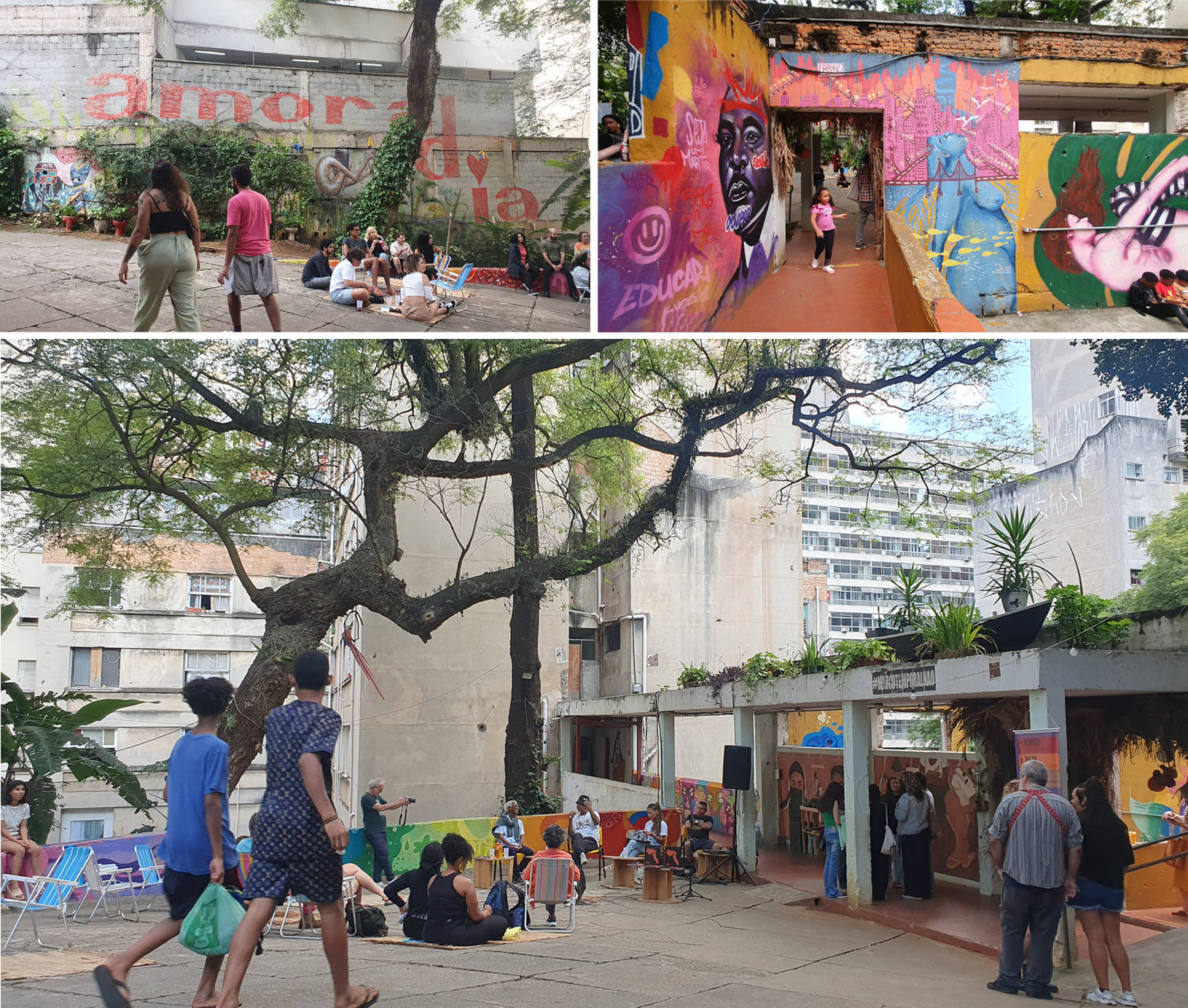 Source: Carolina Nakahara.
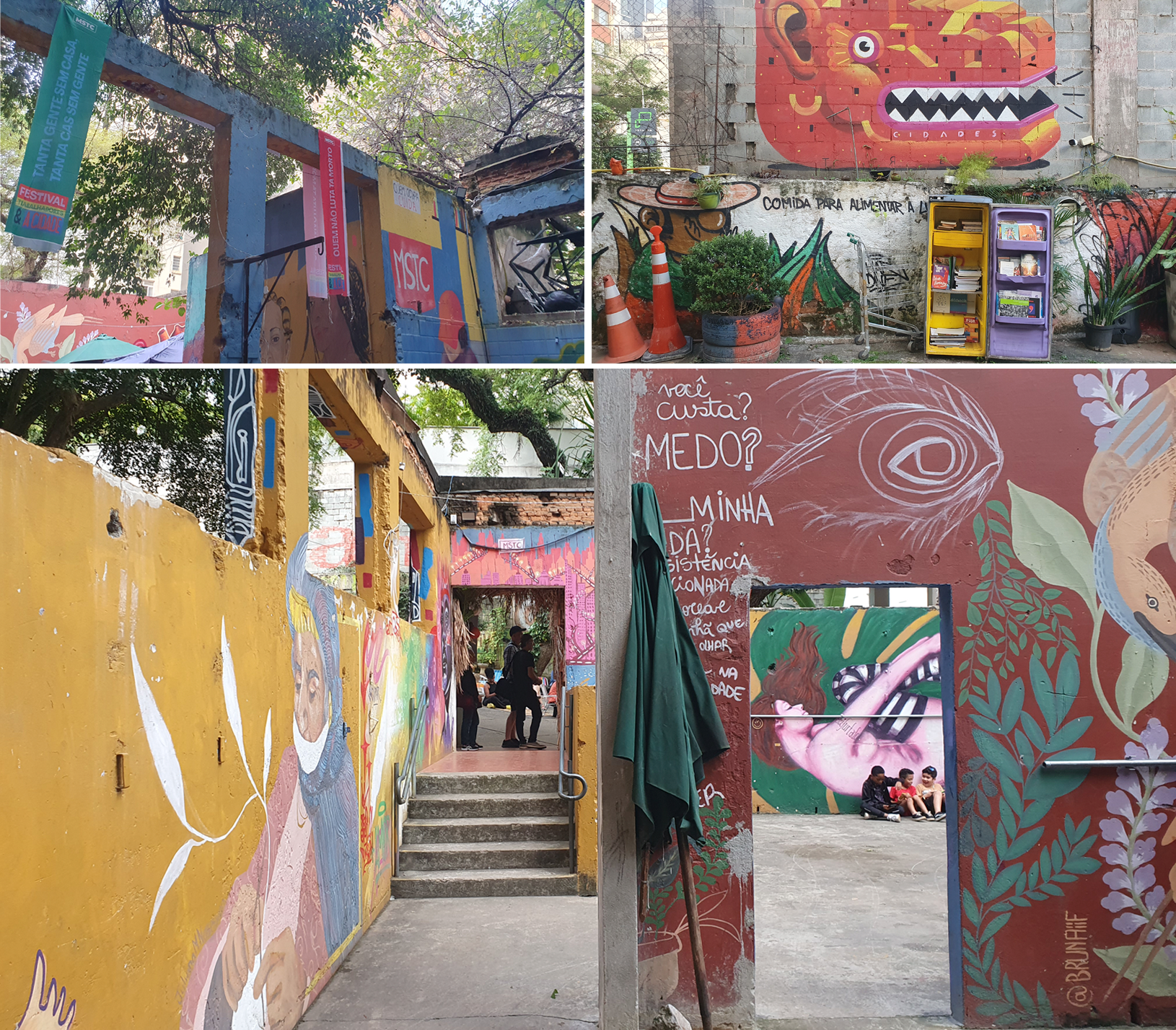 Source: Carolina Nakahara.
 Source: Mariana Wilderom.
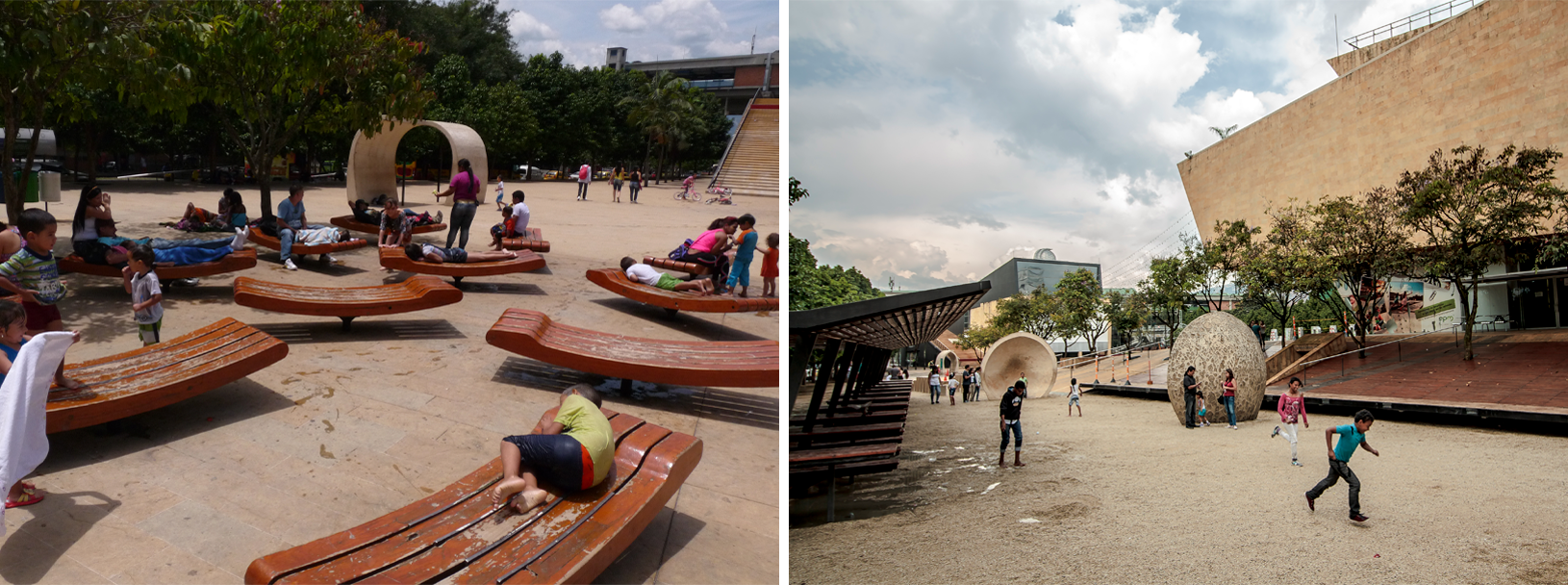 Source: Mariana Wilderom.
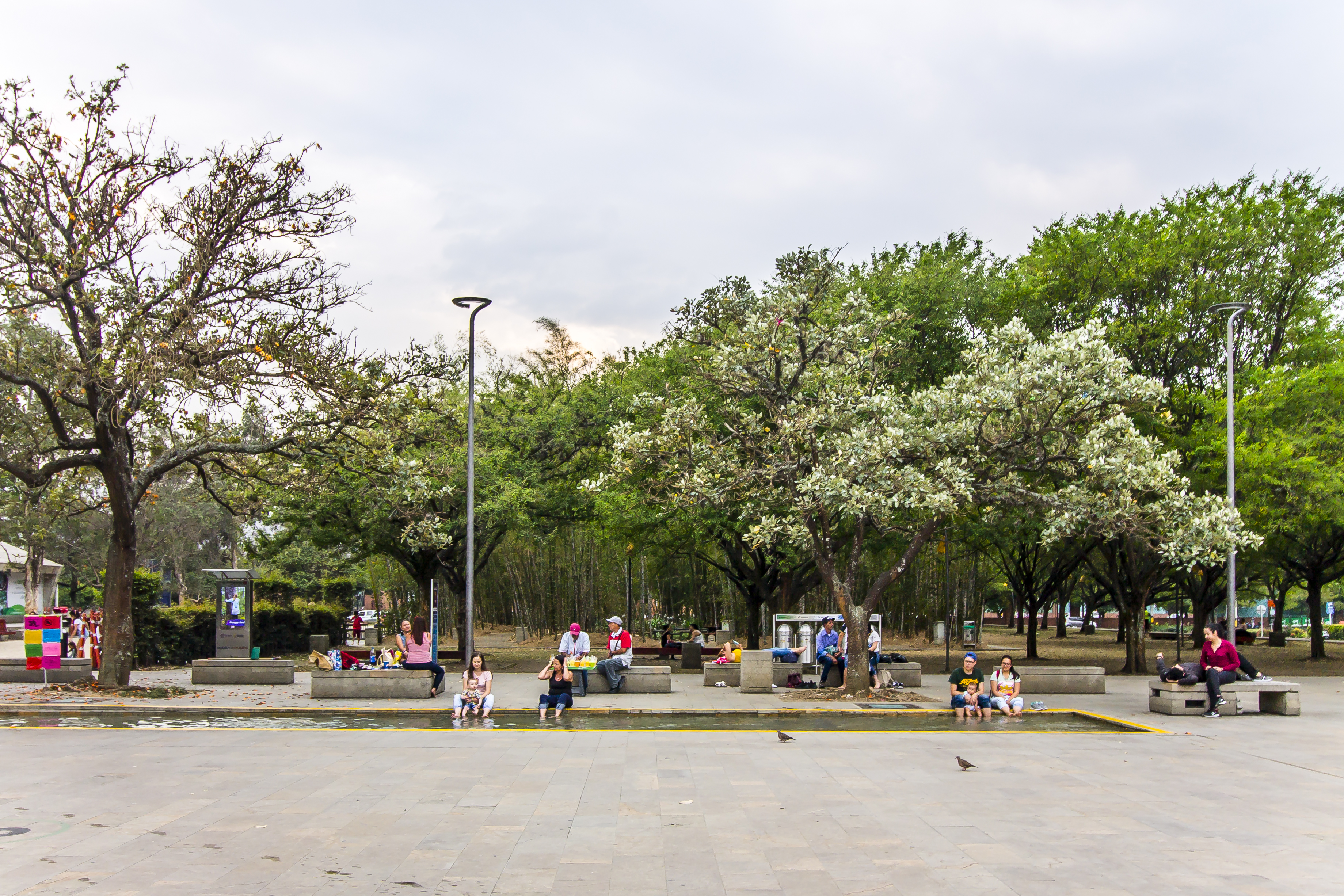 Source: Mariana Wilderom.
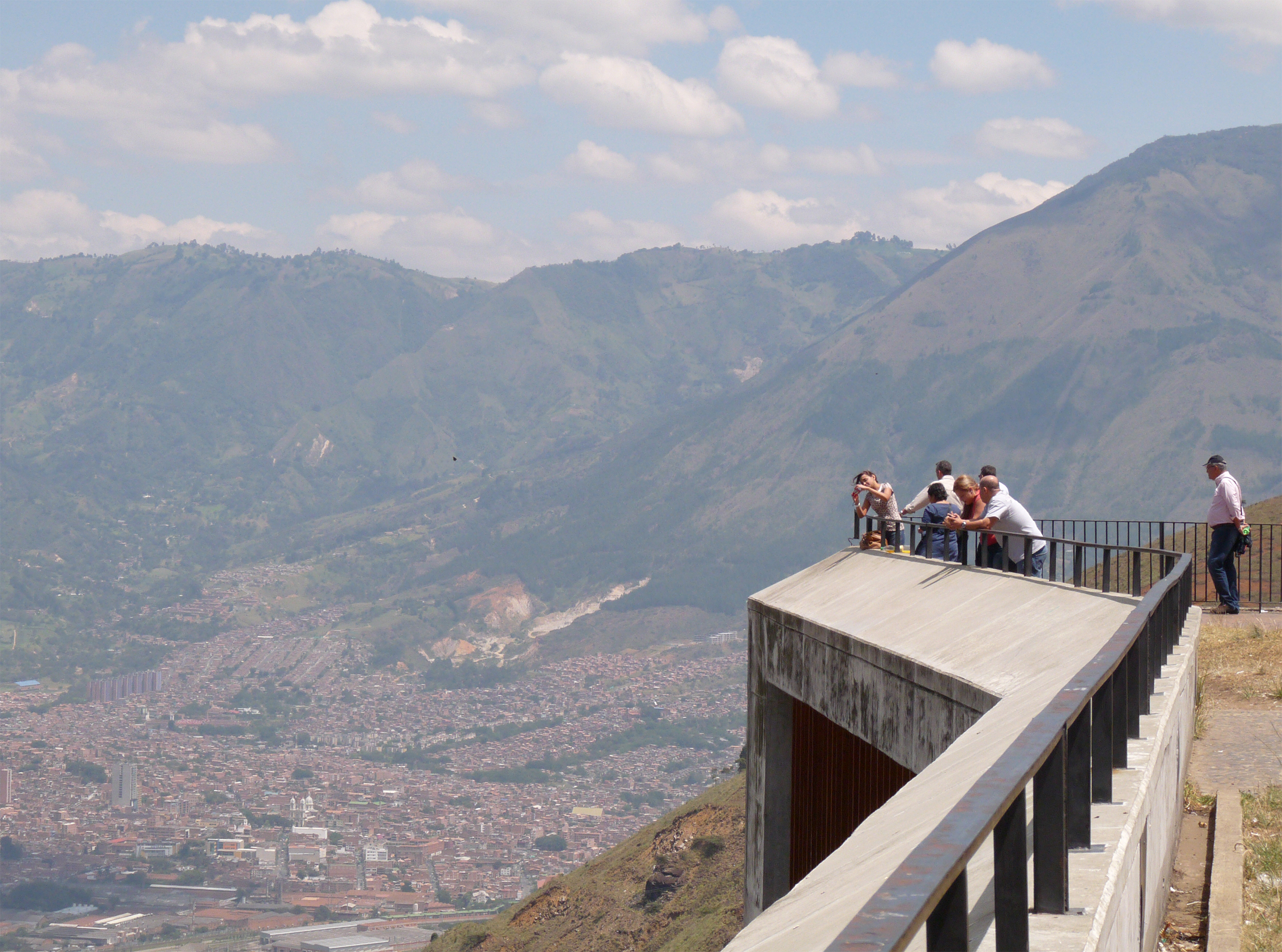 Source: Mariana Wilderom.
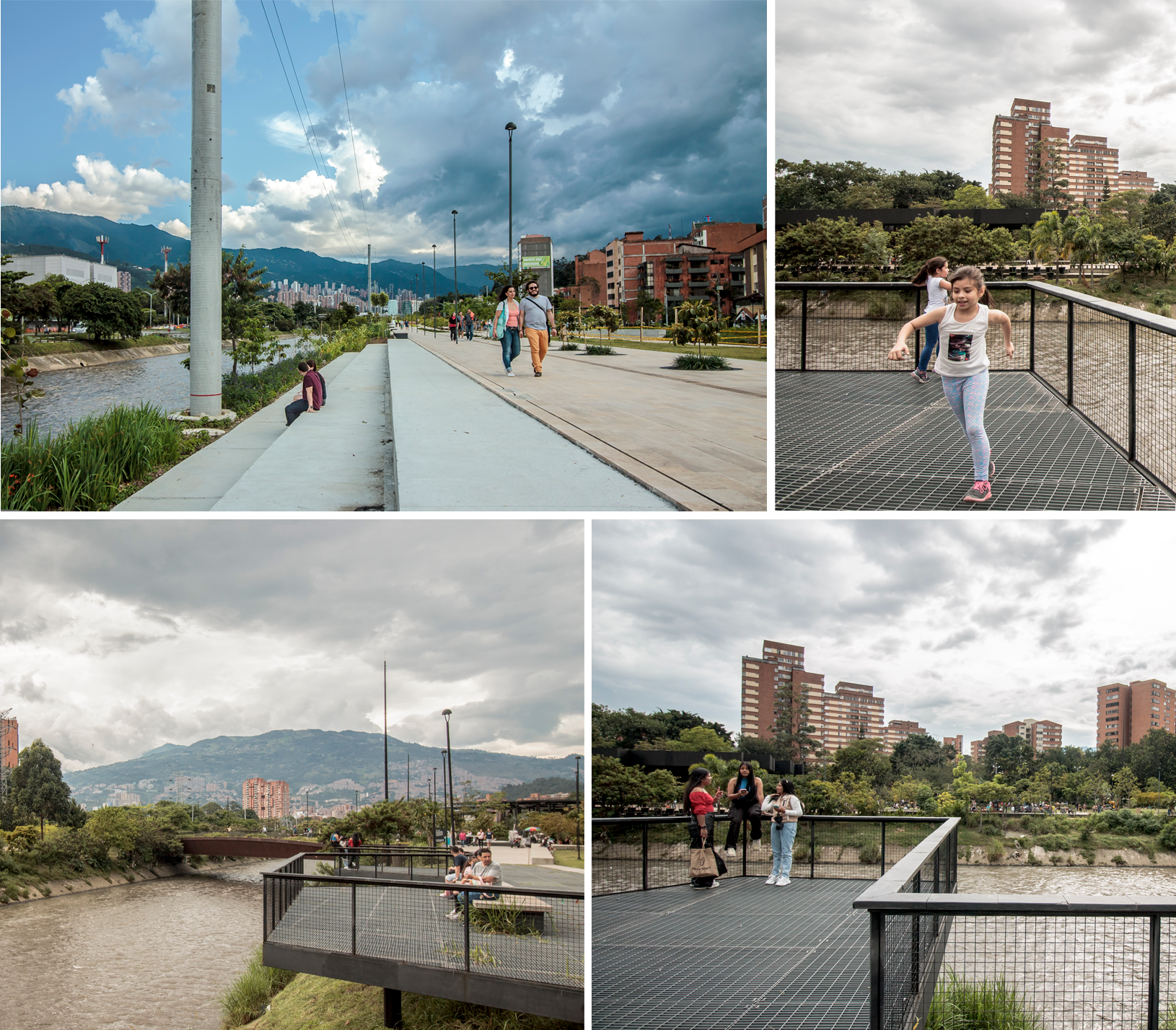 Source: Mariana Wilderom.
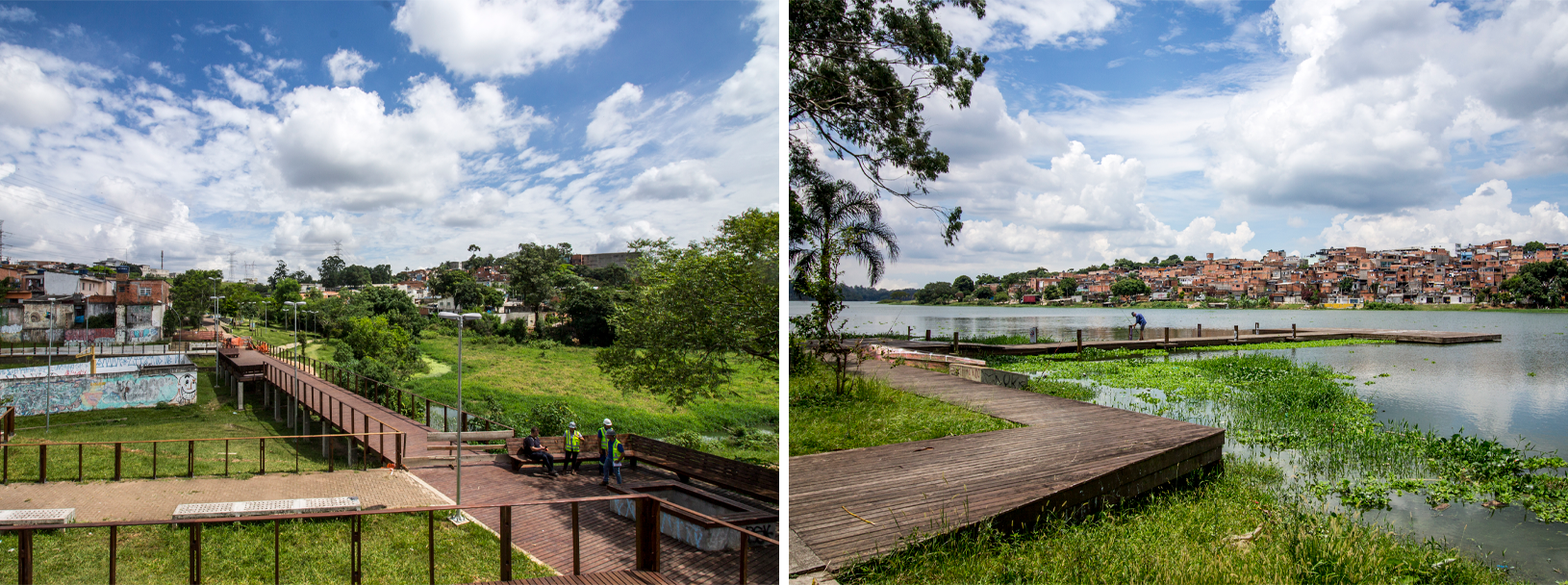 Fonte: Mariana Wilderom.