
 Urban Reform and the Common Good: a bill for the regularization of land tenure in favelas during the early 1960s
Abstract
This article addresses the elaboration of a precursor Bill for Land Tenure Regularization in favelas that was presented to the Belo Horizonte City Council in July 1963 by Dimas Perrin, then a lawyer for the Federation of Favelado Workers of Belo Horizonte (FTFBH). It demonstrates that this bill was part of a complex plot surrounding the struggle for access to urban land. On the one hand, it was based on the national debate on Urban Reform and the investigation of alternatives for popular housing; on the other, it was supported by strong actions of Catholic Action (AC) and Popular Action (AP) in the favelas of the capital of Minas Gerais and the FTFBH.
Keywords:
Housing Policies; Social Movements; History of Urbanism; Land Tenure Regularization; Urban Planning Instruments; Urban Reform
Resumo
O presente artigo aborda a elaboração de um projeto de lei precursor para regularização da posse em favelas, apresentado à Câmara Municipal de Belo Horizonte, em julho de 1963, por Dimas Perrin, então advogado da Federação dos Trabalhadores Favelados de Belo Horizonte (FTFBH). Demonstra-se que esse PL se insere em uma complexa trama em torno da luta pelo acesso à terra urbana. Por um lado, ele se calca no debate nacional sobre a Reforma Urbana e na investigação de alternativas para habitação popular; por outro, na forte atuação da Ação Católica (AC) e da Ação Popular (AP) junto às favelas da capital mineira e à FTFBH.
Palavras-chave:
Políticas Habitacionais; Movimentos Sociais; História do Urbanismo; Regularização da Posse; Instrumentos Urbanísticos; Reforma Urbana
Introduction
Petrópolis, July 24, 1963: Following the inaugural session held in the auditorium of the Ministry of Education and Culture, the Seminar on Housing and Urban Reform (SHRU, 1963)-which addressed, among other issues, principles for formulating a national housing policy and urban planning (Fernandes, 2019)-relocated to the Hotel Quitandinha. Meanwhile, almost 400 kilometers away, attorney Dimas Perrin submitted Bill No. 132/1963 (Belo Horizonte, 1963b) to the City Council of Belo Horizonte, which proposed a solution for the regularization of land tenure in the city’s favelas. Although these events were not directly connected, both formed part of a complex web of debates and proposals surrounding Urban Reform, which gained public prominence in the early 1960s, and intensified during the administration of President João Goulart (1961-1964).
With its legislative process halted and subsequently shelved following the 1964 military coup, Perrin’s pioneering bill for tenure regularization differed significantly from the models developed during the redemocratization period. Nearly two decades elapsed between the submission of this bill from the enactment of the first municipal laws on land regularization in Brazil: Law No. 3,532/1983 (Belo Horizonte, 1983), which established the Municipal Program for the Favela Regularization of Belo Horizonte (Profavela)2 and officially recognized favelas through the creation of Special Sector 4 (SE-4); and Law No. 14,511/1983-the Land Use and Occupation Law of Recife (Recife, 1983)-which established Special Zones of Social Interest (ZEIS). Unlike these laws, which marked the emergence of what Fernandes and Pereira (2010) termed the “Brazilian formula” for the regularization of favelas, i.e., the combination of legal recognition via zoning and tenure regularization, Perrin’s proposal called for the expropriation of land occupied by favela residents and its transfer to the Department of Low-Income Neighborhoods and Housing (DBP), a municipal agency created in 1955, which would then be responsible for granting land rights to the occupants.
Dimas Perrin’s proposal was even more audacious than Federal Law No. 2,875 of 1956 (Brazil, 1956)-commonly known as the Favela Law-which, in addition to authorizing funds for the construction of affordable housing in the cities of Rio de Janeiro, Recife, Vitória, and São Paulo, prohibited new evictions of favela residents in the Federal District for a period of two years (ibid.; Gonçalves, 2018). Breaking with previous national legislation, the bill introduced by the Minas Gerais councilor was the first to assert that favelas should no longer be regarded as provisional 3.
Graduating in law in 1962 from the Pontifícia Universidade Católica of Minas Gerais, Perrin drafted this bill as one of his first acts as legal counsel for the Federation of Favela Workers of Belo Horizonte (hereafter referred to as FTFBH)4, founded in 1959. A laborer, union leader, communist, and newly sworn-in city councilor5, he was far from a political novice: since the early 1950s, he had been involved in strikes and demonstrations, and even sought medical treatment in the Soviet Union for sequelae resulting from torture endured during his imprisonment in 1954 (Perrin, 1979). Despite his political background, his justification for the bill submitted to the City Council scarcely engaged with the debate on Urban Reform. Instead, he grounded his proposal in the Catholic notion of the Common Good. While the appeal to encyclicals and Thomistic concepts might seem somewhat unexpected in his writing, it nevertheless echoed the environment in which the bill was conceived.
This article seeks to contribute to the understanding of the relationship between the construction of urban planning instruments and the networks of agency that form around them-networks that often extended beyond the boundaries of specialized technical debate. It argues that the bill drafted by attorney Dimas Perrin was embedded in a complex web of actors and interests, in which access to urban land emerged as the key element linking diverse group formations in Belo Horizonte. Situated within this fabric, the proposal was not only grounded in the national debate on Urban Reform and in the search for alternative affordable housing solutions, but also in the active involvement of Catholic Action (CA) and Popular Action (AP) with the favelas of Belo Horizonte and the Federation of Favela Workers of Belo Horizonte (FTFBH).
To this end, the analysis begins with a close reading of the text contained in Bill No. 132/1963 (Belo Horizonte, 1963b), with the aim of situating it within the broader contemporary debates on Urban Reform. It then adopts methodological strategies drawn from microhistory (Revel, 1998), to examine the bill’s conceptual underpinnings, particularly its engagement with debates on private property and the notion of the Common Good within the Catholic Left more broadly, and in the specific context of the groups involved in the favela movement in Belo Horizonte. Beyond the bill itself, preserved in the Municipal Council Collection of the Public Archives of Belo Horizonte, this study draws on a wide array of primary sources, including legislation, newspaper articles, testimonial accounts authored by key participants, the Foundational Document of Popular Action, and records from both the Department of Political and Social Order (DOPS) and the Public Archives of Minas Gerais (APM).
1. Forms of land tenure regularization
According to Perrin, Bill No. 132/1963 (Belo Horizonte, 1963b) was “extensively discussed and finalized by the Federation”6 (Perrin, 1979, p. 107) in meetings held across all the Unions for Collective Defense (UDCs)-local grassroots organizations that formed the foundation of the FTFBH’s work in the favelas, numbering over forty at the time7. The bill was clearly a response to the growing search for alternatives to the favela removal processes underway in Belo Horizonte, an issue that had been the focus of negotiations between the movement and various authorities and government officials since the First Congress of Favela Residents, held in the city in April 1962 (Milhares…, 1962).
Proposals for the expropriation of the occupied lands and the formulation of a project that would enable both the urbanization of the favelas and residents to purchase the plots on which they lived had already been submitted in November 1962 to the newly elected mayor Jorge Carone (Carone […], 1962). In March 1963, the FTFBH presented a program8 that, among other measures, provided for the creation of “subdivisions tailored to each favela, according to its topography and density, defining plot allocations for each resident, along with the opening of streets to ensure circulation within the favela” (Programa […], 1963, p. 6). The movement’s leadership advocated for land tenure regularization as a more viable alternative to the DBP’s proposal of relocating residents to plots in other parts of the city, emphasizing that “at least 80 percent of favela residents [...] cannot afford to build” (ibid.).
Despite being deep rooted in the local context, it is clear that the solution proposed by Dimas Perrin (Figure 1) engaged with the broader contemporary debate on Urban Reform, as well as with the range of existing alternatives at the time for access to land and housing. Among the nineteen articles of the bill, several key elements are of particular note, which will be discussed throughout this section: (i) the expropriation of lands occupied by favelas as a prerequisite for the regularization of tenure; (ii) a guarantee of security of tenure without full private property rights-an aspect that, by the early 1980s, would become unacceptable to the Pastoral da Favela9 in Belo Horizonte (Fernandes; Pereira, 2010); (iii) the concession of individual or condominium plots on a paid basis, with no possibility of transfer or rental to third parties; (iv) the establishment of a ceiling on monthly payments for the paid concession, set at 5% of the head of the household’s income; and (v) the expansion of the DBP’s scope of action beyond the real estate operations originally defined in the law that created it in 1955.

Dimas Perrin, in June 1962, negotiating with military police during an eviction operation targeting the residents of Vila Camponesa, a favela located in the eastern zone of Belo Horizonte
Although full private property rights were guaranteed under the first two Brazilian Constitutions following the Proclamation of the Republic, the 1934 Constitution (Brazil, 1934) introduced limitations to this right, establishing that property could no longer be exercised in opposition to the social or collective interest. The 1946 Constitution (ibid., 1946), in turn, further advanced this principle by establishing, in Article 147, that “the use of property shall be conditioned on social well-being” and by stating that the law should “promote the fair distribution of property, ensuring equal opportunity for all” (ibid.). It was under the administration of President João Goulart, of the Brazilian Labor Party (PTB), that Law No. 4,132 (Brazil, 1962) was enacted, defining the circumstances under which expropriation in the social interest, as provided for in Article 147 of the 1946 Constitution (ibid., 1946) could occur. Notably, items five and six of the law directly addressed the issue of favela residents by authorizing this expropriation to be applied “to regularize squatters on urban land where, with the explicit or tacit tolerance of the owner, they have built their homes, forming residential clusters of more than ten families,” and for the “construction of low-income housing” (ibid., 1962). This legal framework-specifically, the possibility of expropriation in the public interest, either to secure squatters’ tenure on urban land or to build low-income housing-constituted, the core of Dimas Perrin’s proposal.
Based on the aforementioned provisions and in fulfillment of his campaign promises, Mayor Jorge Carone issued Municipal Decree No. 1,105 on July 8, 1963, (Belo Horizonte, 1963a), expropriating nineteen eucalyptus-planted plots in Belo Horizonte, all owned by one of the city’s most notorious grileiros10, businessman Antônio Luciano Pereira Filho11. Although Carone’s decree was not explicitly cited in the text, Dimas Perrin’s bill was submitted two weeks after its publication and was presumably intended to determine the fate of those plots subject to expropriation. In this regard, Article 1 of the bill stated that: “The plots of land belonging to the Municipality and currently occupied by favela residents are hereby transferred to the Municipal Department of Low-Income Neighborhoods and Housing” (Belo Horizonte, 1963b). The absence of a precise definition of the location of these plots, which should have been indicated in an annexed map that was never attached,12 the bill’s legislative process and ultimately led to it being shelved under the civil-military dictatorship.
According to the bill, the lands transferred to the DBP were to remain public property under the stewardship of that agency, which would be responsible for their “concession to the current occupants” (Belo Horizonte, 1963b, p. 10). Unlike the provisions later established by Federal Law No. 13,465/2017 (Brazil, 2017), Perrin’s proposal did not permit the regularization of tenure to be converted into the acquisition of full private ownership of land. Property rights were recognized solely over the building itself13, remaining legally separate from ownership of the land. What was effectively granted was the right of superficies-avant la lettre-to occupants who met the following criteria: a minimum of two years of residence in Belo Horizonte14, engaged in paid employment, and with no record of having owned any real estate within the previous five years. The bill also anticipated the need for subsequent regulation that, in addition to enforcing the aforementioned requirements, would establish further conditions for “obtaining the benefits provided by this law” (Belo Horizonte, 1963b, p. 11).
The substantive change between the FTFBH’s initial proposal and the bill submitted by Dimas Perrin to the City Council lies in the form of access to land: whereas the original text referred to “sale”, the PTB councilor’s bill adopted the term “concession”. This did not imply, however, free usufruct of public land but rather a paid concession, through which residents would secure their tenure via recurring payments proportional to the head of the household’s income. No fixed term was established for the duration of this concession; it was simply defined as long-term, with fixed contributions subject to an annual interest rate of 5% (Article 7 of Bill No. 132/1963). The plots were to have an approximate size of 180 m². In a revised version, submitted and attached to the proceedings by the same author on August 29, 196315, it was clarified that parcel sizes could vary to accommodate existing buildings and that lots would be granted under a condominium arrangement whenever multiple structures existed and the occupants reached a mutual agreement-thus reinstating, in this regard, the provisions of the original FTFBH proposal.
Subletting was strictly prohibited and constituted grounds for termination of the concession. The transfer of plots to third parties, meanwhile, was contingent upon prior authorization from the Department of Low-income Neighborhoods and Housing. In essence, the legal instrument represented a hybrid between emphyteusis16 and leasehold, given that the concession of the right of use, which enables the paid or unpaid granting of public land for various purposes, including urbanization and socially oriented uses, would only be formally established in Brazilian law four years later, through Decree-Law No. 271 of 1967 (Brazil, 1967).
In proposing a low-income housing solution based on the paid concession of public land, Dimas Perrin was not alone. Indeed, proposals grounded in similar principles-public ownership of the land and monthly payments tied to workers’ wages-were being discussed contemporaneously in other parts of Brazil. One such proposal, authored by sociologist Edgardo Pires Ferreira, then a candidate for state deputy for the Christian Democratic Party (PDC), was reported in the newspaper Jornal do Brasil (Autor [...], 1962) and submitted to the administration of Carlos Lacerda in the state of Guanabara17. Ferreira advocated for the sale of favela land to the residents themselves under a condominium arrangement, with payments spread over 36 monthly installments, each equivalent to 7% of the buyer’s salary. A second proposal, presented by architect Lauro Bastos Birkholz, director of the Center for Urban Research and Studies at FAU-USP, was introduced during the 1963 Housing and Urban Reform Seminar (SHRU, 1963). His proposal involved allocating municipal public land for the construction of residential complexes (Birkholz apud O drama […], 1963). Residents would finance the construction costs through monthly payments equivalent to 25% of their salary. “The city, in turn, would retain ownership of the land, charging 5% of the buyer’s salary for its use [...] in order to cover the costs of urbanizing the site”18 (ibid., p. 45). The news report presenting Birkholz’s proposal highlighted its ambiguous nature, situated between usufruct, which could not be monetized, and emphyteusis, which, according to the columnist, was destined for extinction (ibid.). Notably, in both Birkholz’s and Perrin’s proposals, the land would remain public, and the 5% wage-based fee would be allocated to finance urbanization and to maintaining the program.
Despite the differing political orientations of the authors mentioned, a common subtext runs through these proposals: the national resonance of the Cuban Urban Reform. Enacted through the law of October 14, 1960, Fidel Castro’s Urban Reform (Cuba, 1960) affirmed the right to housing and sought to implement it in three stages. The first two phases echo and are reconfigured in the aforementioned proposals: the amortization of rented housing through the amounts paid in rent, with a maximum term of twenty years; and access to state-built housing under a regime of permanent usufruct, with monthly payments set at 10% of the household’s income. As in Dimas Perrin’s proposal, the subletting of properties granted by the Cuban state was strictly prohibited.
Beyond merely identifying the similarities between the proposals, it is crucial to highlight that the enactment of the Cuban law brought the issue of Urban Reform to the forefront of the Brazilian press (Figure 2). Just two days after the law was enacted, on October 16, 1960, the Jornal do Brasil ran the headline: “Cuba carries out Urban Reform: tenants become owners” (Cuba faz [...], 1960). Whereas in the previous decade this expression had either been absent from public discourse or used interchangeably with urban improvement projects, the 1960s saw a marked expansion of the debate19 within the broader context of the reformas de base (a set of structural reforms proposed in Brazil during the early 1960s). This shift prompted politicians across the ideological spectrum to weigh in on the Cuban case. Carlos Lacerda, for example, in his first press conference after being elected governor of Guanabara, dismissed the Cuban Urban Reform as “poor urbanism” (Lacerda [...], 1960a) and “madness” (Lacerda [...], 1960b). Brizola, by contrast, drew inspiration from it to propose the expropriation of 10% of the undeveloped plots surrounding the city of Porto Alegre, as a strategy to address the favela issue (Brizola [...], 1962). Similarly, Sérgio Magalhães, then a federal deputy for PTB, introduced Bill No. 2,975/1961 (Brazil, 1961)20, in the Chamber of Deputies, which sought to enable tenants to become homeowners, mirroring the Cuba model by “transforming rent payments into long-term installments toward the purchase price” (Brazil, 1961, apud Abranches, 1962, p. 6).
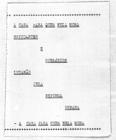
At the local level, several documents reveal how the debate on the Cuban Urban Reform resonated within the favela movement of Belo Horizonte. Following the Bay of Pigs invasion in 1961, the FTFBH publicly expressed its support for Fidel Castro’s revolution (Federação [...], 1961). Among the materials from the DOPS collection at the Arquivo Público Mineiro [Minas Gerais State Public Archives], a leaflet was found that circulated in the favelas of Belo Horizonte explicitly referencing the Urban Reform (Figure 3). Complementing this were two articles published in the first issue of O Barraco [The Shack]-the FTFBH bulletin, which was circulated between 1962 and 1964 alongside the Belo Horizonte weekly Binômio-which reported the achievements of the Cuban Revolution, including one authored by Fidel Castro himself. The text, titled “Housing in Cuba”, and published anonymously-as was common for most pieces published in the bulletin-highlighted that, following the enactment of the Urban Reform Law (Cuba, 1960), “all tenants became property owners” (A Habitação [...], 1962, p. 4).
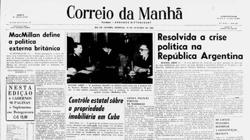
Front page of Correio da Manhã (October 16, 1960), featuring the news of Fidel Castro’s Urban Reform Law with the headline: “State control over real estate property in Cuba.”
While the Cuban Urban Reform undoubtedly resonated within the Brazilian context, the similarities observed in the proposals of Edgardo Pires Ferreira, Lauro Bastos Birkholz, and Dimas Perrin cannot be attributed solely to its influence. Although the Cuban law also established access to housing through permanent usufruct combined with monthly payments, it set this contribution at 10% of household income, a higher rate than those proposed in Brazil. In the aforementioned Brazilian proposals, the portion of income allocated to securing urban land ranged from 5% to 7% of the head of household’s income-whether for purchase, as in Ferreira’s case, or for the maintenance of usufruct, as in the proposals of Birkholz and Perrin. This alignment is clearly not coincidental. Rather, these figures reflect median values already practiced by the Institutos de Aposentadoria e Pensão [Institutes of Pensions and Retirement] (IAPs). The IAPs, which were responsible for a significant share of social housing production in the period prior to 1964 (Bonduki, 2014), had monthly contribution rates, established in their founding legislation, ranging from 3% to 8% of the worker’s salaries.
A closer analysis of Perrin’s bill reveals additional elements that align the proposed solution for the regularization of favelas more with the operational and funding model of the IAPs. It is therefore not limited to the adoption of a fixed contribution based on the workers’ salary; it also incorporates a proposal to expand role of the DBP, mirroring the functions performs by the pension institutes.
Under the bill, the DBP was tasked not only with managing the public land transferred to it but also for administering the funds generated from its onerous concession. According to Article 9, payments were to be made directly at a bank and earmarked “exclusively to cover urbanization works in favela areas or the expropriation of other areas” (Belo Horizonte, 1963b, p. 11). The bill further stipulated that the DBP would be responsible for: (a) executing urbanization works in the favelas-which, beyond basic infrastructure such as water, electricity, and sewage, also included the construction of gardens, schools, sports fields, and playgrounds (Article 13); (b) carrying out new expropriations (Article 12); and (c) providing loans or selling construction materials to favela residents seeking to improve their homes21 (ibid.)
In its original mandate, the DBP was responsible for the planning and development of affordable neighborhoods and housing and, to that end, was authorized to conduct real estate operations, including the sale of lots and houses, manage assets under its control, and enter into agreements (Belo Horizonte, 1955). While the first two functions set out in the bill could be seen as an expansion of the DBP’s role-given that the agency, created eight years earlier, was originally focused on producing affordable housing rather than favela re-urbanization-they still fell within the domain of real estate operations. The third, however, went beyond that scope and moved closer to financial operations.
While the combination of these functions may seem unusual today, it is important to remember that, at the time, the IAPs engaged in a wide range of activities beyond their primary function (Bonduki, 2014). Among these was the ability to provide benefits to members through loan portfolios, including simple loans, mortgage-based credit and other forms of housing finance22.
The similarity between Perrin’s proposal for the DBP and the operational model of the IAPs is evident in two key aspects: the combination of real estate operations with loan-based financing, and the requirement of monthly payments for usufruct of the land. Although this situation varied, the 1966 Favela Census of Belo Horizonte reported that nearly half of the residents in these territories were contributors to one of the IAPs (Minas Gerais, 1966). In some favelas, this figure was close to the totality of household heads. Under pressure from the favela movement, Amintas de Barros, mayor of Belo Horizonte from 1959 to 1962, even sent a telegram to President João Goulart requesting that favela residents who contributed to the IAPs be given priority in access to the institutes’ real estate portfolios (Prefeito [...], 1962). Within this context, it is reasonable to infer that Dimas Perrin’s proposal envisioned the DBP as a mechanism to serve this segment of the population, which was excluded from accessing housing produced by the IAPs.
2. The notion of the Common Good
In this regard, the words of Pope Pius XII are quite clear […] when he teaches that the first and most fundamental right is that which grants humankind, by virtue of being alive, the right to use the material goods of the earth. He draws our attention to private property, affirming that it is indeed a right, but a secondary one-one that cannot override the other (the common use of the land), for this is the first and fundamental right (Perrin, 1963, p. 2).
Dimas Perrin’s invocation, in the justification of his bill, of Pope Pius XII’s 1941 radio message-delivered by a pontiff who, years later, would explicitly condemn collaboration between Catholics and communists (Pius XII, 1949)-lays bare the contradiction between Perrin’s own political orientation and the very foundation he cited in its defense. At the same time, in a context marked by significant renewal within the Catholic Church, spurred by the opening of the Second Vatican Council (1962-1965) under Pope John XXIII, his appeal resonated with both wings of Catholicism-conservatives and progressives. This was possible because it was grounded in the Thomistic notion of the Common Good, which provides doctrinal legitimacy for imposing limits on private property.
Thus, it becomes clear that there was no coincidence in the discrepancy between the repeated emphasis on the term “Common Good” throughout the three-page justification for Bill No. 132/1963 and the single reference to Urban Reform.
We are all convinced that the role of any politician is to pursue the common good. The common good, however, is neither the private good of each individual nor the sum of individual goods. It is human well-being-it is the good of the collective. The common good benefits the parts, although it is not merely a simple sum of the particular interests of each part. The primary function of authorities and of the people’s representatives is to lead and guide everyone’s work toward the common good. Hence the need for the mobilization of all, not just of a few, for it is not fair that some take advantage of the labor of others. The pursuit of the common good is a duty, not merely a right (Perrin, 1963, p. 3, emphasis added).
By invoking the notion of the Common Good and citing the argument of Pope Pius XII, the councilor closely adhered to the argumentative framework set forth in the controversial encyclical Mater et Magistra23 (1961) by John XXIII. The defense of a clear position by the Catholic Church regarding social issues, and in support of the social function of private property was grounded in this document, which itself drew upon earlier papal teachings: “[…] private ownership of property, including that of productive goods, is a natural right which the State cannot suppress. But it naturally entails a social obligation as well. It is a right which must be exercised not only for one’s own personal benefit but also for the benefit of others” (John XXIII, 1961). This position was further reinforced in the encyclical Pacem in Terris (ibid., 1963), published two years later, which likewise emphasized the notion of the Common Good. Together, these papal documents provided a foundation for the socially engaged agenda embraced by progressive sectors of the Catholic Church.
These encyclicals were not isolated acts but part of a broader wave of transformations within Catholicism that began in the mid-twentieth century. Faced with the challenges of secularization and a global decline in the number of adherents24, the Church sought to draw closer to the population (Bonato, 2014). In this context, Latin America assumed particular interest, as it was home to the largest share of the world’s Catholics-accounting for 40.38% of the total Catholic population in 1970 (Porto; Barcellos de Souza; Nobre, 2019). Nevertheless, the Church’s religious hegemony in the subcontinent appeared to be under threat in the face of the Cuban Revolution and the potential spread of communism.
At that moment, the activities linked to Catholic Action (CA) gained particular prominence. Established in Brazil in 1935 as an “instrument for coordinating and organizing the work of laypeople in the evangelizing mission” (Freire; Sydow, 2016, p. 45), CA soon became a platform through which “young intellectuals discovered politics and activism” (Pontual, 2017). Through its specialized branches-such as Catholic Student Youth (JEC), Catholic University Youth (JUC), Catholic Workers’ Youth (JOC), among others-CA sought to transform society in accordance with the Church’s social doctrine. The movement known as the Catholic Left simultaneously drew on the intellectual influences of Lebret, Mounier, and Chardin, as well as the Cuban Revolution of 1959 (Lima; Arantes, 1984). Reinterpreting the Gospel through a Marxist lens, this praxis, centered on social issues, gave rise to what Löwy (2016) would later describe as “Liberation Christianity”-a current of thought that, by the 1970s, would crystallize into Liberation Theology.
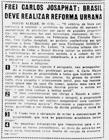
Among the prominent figures in this movement, Friar Carlos Josaphat, in a lecture delivered in 1961 (Figure 4), argued that “Urban Reform [should not be] a privilege of Cuba; Brazil should initiate studies to implement this measure” (Frei Carlos [...], 1961, p. 4). In his call to action, expressed in the book Evangelho e Revolução Social [Gospel and Social Revolution] (Josaphat, 1962), the friar cited Karl Marx and grounded his social commitment in religious doctrine:
Marx defined his happiness with this single word: struggle. [...] As for the current and dominant regimes, sustained by the support of privileged classes whose interests they serve, the Christian position must be one of nonconformity and repudiation. To make use of these distorted forms of political and social organization for the benefit of religious institutions and activities would be to betray the Gospel twice: by becoming complicit in established injustice and by compromising the religion of truth, binding it to mechanisms of iniquity (Josaphat, 1962, p. 69-71).
In Belo Horizonte-as in other Brazilian and Latin American cities (Giannotti; Gonçalves, 2018; Lida, 2012)-actors linked to Catholic Action organizations were directly or indirectly involved in favela movements25. This engagement helps to explain the connection between Urban Reform and the notion of the Common Good present in the justification text of Perrin’s bill (1963).
A key figure in this network was Father Francisco Lage, a Lazarist priest born in 1917 in the town of Ferros, in the state of Minas Gerais. After spending time in Salvador and Rio de Janeiro, during which he established contact with Dom Hélder Câmara, Lage returned to Belo Horizonte in 1948, where he assisted Father Agnaldo Leal in organizing the JOC, JUC, and JEC (Drummond, 1960). Appointed parish priest in what was then a peripheral neighborhood of Belo Horizonte, he requested permission from Bishop Dom Cabral to attend meetings in Vila Marmiteiros, a nearby favela, where he worked between 1948 and 1953. There, in 1948, Father Lage founded the first Collective Defense Association (UDC) of Belo Horizonte, with the aim of resisting repossessions and evictions (Lage, 1988; Oliveira, 2021). This organization soon inspired leaders in other favelas, leading to the expansion of UDCs, which later formed the foundation of the FTFBH in 1959. Two additional UDCs were created by Father Agnaldo Leal26, a close friend of Father Lage (Oliveira, 2022). From 1952 onward, the Dominican friars-especially Friar Mateus da Rocha-were responsible for organizing the JEC, a collective instrumental in the political education of leaders who would become JUC activists (Freire; Sydow, 2016), among whom were Herbert José de Souza, known as “Betinho”, Henrique Novais, Vinícius Caldeira Brant, and Vilmar Faria.
These JUC-affiliated leaders soon expanded their influence beyond the boundaries of the School of Economic Sciences at the Universidade Federal de Minas Gerais (UFMG)27, becoming prominent not only in the state capital of Minas Gerais but also at a national level, particularly within the National Union of Students (UNE). Between 1961 and 1962, Herbert de Souza and Vinícius Caldeira Brant organized the newspaper Ação Popular, which would later lend its name to the political party founded in May 1962 (Albano et al., 2017). The idea of creating an organization independent of the control of the Catholic Church arose in response to the decision by the Episcopal Commission for the Apostolate of the Laity to “prohibit JUC members from running for any type of office in student political organizations starting in 1962” (ibid., p. 18). Conceived during meetings promoted by the JUC and formally established in February 1963-with the approval of its foundational document during its first congress, held in Salvador-Ação Popular (AP) thus emerged as a secular movement shaped by the radicalization of Marxist influence among students. Nevertheless, it continued to unite progressive Catholics and secular activists, supported by members of the clergy.
Although it remained closely tied to the student movement, AP did not confine its activities to issues related to education. In one of its foundational texts, Juventude cristã hoje [Christian Youth Today] (Souza, 1979 [1962]), Betinho reflected on the political and social engagement of the JUC and argued for the need to replace private property with social property, which, in his view, embodied the realization of the Common Good:
It was at the ten-year JUC meeting, held in 1960 in Guanabara, that a new stance toward social issues was established for university students, as a fundamental requirement of fidelity to the Gospel itself. We were not innovating. We repeated, along with all the Popes, the condemnation of capitalism and the need for a fairer and more humane structure, in which social property would replace the private property of the liberal system. Thus, it would become an effective function of what so many like to call the common good (Souza, 1979 [1962], p. 110).
The imperative to challenge private property under capitalism and the advocacy of the socialization of the means of production as a way to address social inequality were likewise articulated in AP’s foundational document (1979 [1963]):
It is not private property in the abstract that matters for the historical perspective we are outlining. It is the private appropriation of the capitalist means of production. This constitutes the root cause of the profound distortions that have shaped the historical evolution of the processes of socialization developed under the sign of capitalism-distortions that, above all, undermine the human condition: the primary sphere of their vital needs, the moral imperative of human dignity, and the space of their freedom (Ação Popular, 1979 [1963], p. 121).
It is therefore understandable that AP, in Belo Horizonte, also engaged with the movement of favela workers, having a specific branch dedicated to this purpose. It collaborated with-and contested space against-other groups already active in these communities. Father Lage (Figure 5) was an important point of reference for the young activists linked to AP in the capital of Minas Gerais (Lima; Arantes, 1984). He frequently contributed to the Ação Popular28 (Revista…, 1962) and even participated, alongside Father Alípio de Freitas, in the founding of AP (Lage, 1988). While serving in the administration of João Goulart, helping to create the National Commission for Rural Unionization (Lage, 1988), Father Lage also took part in the First Congress of Favela Residents, held on April 28, 1962, where he delivered a speech on “the housing problem, urban reform, vacant lots owned by a few individuals, and the need for favela residents to unite within the UDCs” (Bambirra, 1964, p. 6).

Padre Lage (second from the left) at the main table of the First Congress of Favela Residents, held in Belo Horizonte on April 29, 1962
The presence of an AP sector in the favelas was not limited to the involvement of young people responsible for literacy projects or legal assistance-such as Henrique Novais, who served as a lawyer for the UDC in the Nossa Senhora dos Anjos favela29. Some favela residents, leaders of these grassroots bases associated with the FTFBH, even participated in AP meetings and attended its congress held in November 1963 in the city of Sete Lagoas in the state of Minas Gerais. This was the case of Felipe Cupertino30 (UDC Nossa Senhora dos Anjos), Vicente Gonçalves31 (UDC Morro do Querosene), José Bonifácio32 (UDC Vila Santa Rita de Cássia), and Luiz Francisco de Souza33 (UDC Vila Vicente de Paula, formerly Marmiteiros). Together with other groups active in the favelas, these AP leaders soon moved toward concrete action in the territory, responding to the call of their foundational document.
Without awaiting the legal resolution of the aforementioned Municipal Decree 1,105/1963 (Belo Horizonte, 1963a), authored by Mayor Jorge Carone, and while Bill 132/1963 (ibid., 1963b) was still under consideration by the City Council, an organized process of occupation began in several areas designated for expropriation. In August 1963, favela residents, clergy, communists, labor activists, members of the Popular Culture Movement (MCP) and the Marxist Revolutionary Workers’ Political Organization (Polop), unionists, and students affiliated with the Catholic Left and AP joined forces to occupy areas located along the BR-31 Highway-now part of the BR-040, near the Ring Road-as well as other locations near Amazonas Avenue in Belo Horizonte and Cidade Industrial in Contagem. These settlements, named Padre Alípio, Frei Josaphat, Padre Lage, João XXIII, and Operário-Estudantil, paid tribute to progressive Catholic leaders and referred to the social movements linked to the housing agenda in the capital.
In this context, it becomes clear that the notion of the Common Good and the defense of Urban Reform were linked not merely as rhetorical strategies employed by Dimas Perrin to persuade his fellow City Council members. Rather, both circulated together as central elements within the broader struggle for land tenure regularization in Belo Horizonte. Indeed, even politicians from Minas Gerais with sharply opposing political orientations ultimately converged around similar positions.
Reporting on a speech by Magalhães Pinto, founder of the National Democratic Union (UDN) and then head of the Minas Gerais executive branch, at an event held in Araxá in June 1962-which brought together sixteen governors to discuss strengthening the federation and advancing basic reforms34-the Jornal do Brasil editorial expressed surprise at his stance:
[Magalhães Pinto] spoke not only of agrarian reform but also of urban reform. He called on the assembly to consider how to eliminate the requirement of prior cash compensation in cases of expropriation for public interest. […] He even had the audacity to cite that oft-overlooked passage from Mater et Magistra, in which the current Bishop of Rome affirms that the right of every person to use material goods for their own sustenance must take precedence over any other economic right, including the right to private property. […] In short, a speech to which certain highly vested sectors of our public life will be able to respond in only two ways: either by erecting a wall of silence or by openly accusing it of being inspired by communism (Espírito [...], 1962, p. 6).
3. The decline of an Urban Reform Project
The creation of the Department of Low-Income Neighborhoods and Housing [...] was not enough to bring about the intended solution. This solution will possibly be achieved through the measures and provisions contained in this bill, the result of the experience and the brilliant intelligence of its distinguished author (Val, 1963, p. 7-8).
As the above quotation reveals, the opinion issued by the Committee on Legislation and Justice of the Belo Horizonte City Council was extremely favorable to Dimas Perrin’s bill. In addition to the statement from its rapporteur, Ruy da Costa Val, Councilor Tancredo Guimarães also commended his colleague’s initiative, affirming that the Council would support the proposal, and noted that no legal obstacle had been identified that could prevent its progress (Belo Horizonte, 1963b). However, the absence of an attached map specifying which plots would be affected by the proposed law required a statement from the Executive before the bill could be submitted for consideration to the councilmembers, resulting in a delay in its proceedings.
Two letters with the same request were sent by the president of the City Council to Mayor Jorge Carone in 1963, one in October and another in December. During this period and in the months that followed, several public demonstrations in support of the bill were organized by the FTFBH and reported in the press. Some of these were even formally recorded by the City Council and incorporated into the legislative process, such as the telegram of support sent by the Association of Widows of the State of Minas Gerais.
Despite all this mobilization in its defense, on July 22, 1964, Bill 132 was ultimately shelved without ever being voted on. The final determination was that the issue had already been addressed by another project “drafted at the request of the Intervention Committee of the Federation of Favela Residents” (Belo Horizonte, 1963b, p. 19), a repressive body imposed on the FTFBH35. The case of the organized occupations along the BR-31 Highway was the central element that triggered the opening, in May 1964, of Inquiry DVS-096 by the Social Surveillance Division (DVS), which investigated politicians, clergy, community members, students, and leaders of the FTFBH. This process resulted in charges, convictions, and imprisonment of several of its leaders, including Dimas Perrin himself. Father Lage, however, was arrested immediately after the coup, in April 1964, accused of subversive activities36, becoming the first religious figure in Minas Gerais to be imprisoned by the dictatorship.
Under the military regime, AP became clandestine and radicalized. The issue of favela formation came to be treated as a police matter. The FTFBH, in turn, would only reemerge in the mid-1970s and, in 1978, was renamed the Union of Peripheral Workers (Somarriba; Valadares; Afonso, 1984).
Final remarks
Beyond establishing a precedent that aids in understanding how instruments for favela regularization were developed in Brazil, Bill 132/1963-examined in this study-opens the door to investigating the relationship between the Urban Reform demanded by social movements within the context of João Goulart’s “base reforms” debate and the discourse within the specialized community of architects and urban planners, whose key event was the Housing and Urban Reform Seminar (SHRU, 1963) held in Petrópolis. Drawing inspiration from the Cuban Urban Reform and the concept of social property-also advocated by AP-the bill presented by Perrin sought to take “concrete steps toward implementing an urban reform according to [Brazilian] possibilities” (Perrin, 1963, p. 5).
In this context, Bill 132/1963 emphasized the redevelopment of existing favelas as the most economically and socially viable solution (Belo Horizonte, 1963b), foreseeing the regularization of land tenure grounded in the Thomistic notion of the Common Good. Conversely, the final document of the SHRU, while denouncing housing conditions in favelas, tenements, and shantytowns and advocating for a prominent role of the State in addressing this issue, prioritized the mass production of low-income housing. Among its recommendations for a National Housing Policy, only one suggested “adopting emergency measures aimed at improving the conditions of habitability clusters of substandard housing” (SHRU, 1963, p. 23), with no mention of anything regarding urban tenure security.
Thus, although never enacted, Bill 132/1963 (Belo Horizonte, 1963b) nonetheless reveals how, through the efforts of the FTFBH and various supporting actors, the debate over urban land tenure security had reached an advanced stage in Belo Horizonte on the eve of the 1964 Coup. The ensuing repression, however, delayed for two decades the approval of a new bill for the regularization of favelas in the city-the Profavela (Belo Horizonte, 1983)-which, in contrast to Dimas Perrin’s proposal, was grounded in the defense of full individual ownership rights rather than the principle of social property.
References
- A HABITAÇÃO em Cuba. O Barraco, n. 1, p .4, jan. 1962.
- ABRANCHES, C. D. Guerra à propriedade. Jornal do Brasil, p.6, 26 jan. 1962.
- AÇÃO POPULAR. Ação Popular: Documento-base [1963]. In: LIMA, L. G. S. Evolução política dos católicos e da Igreja Católica no Brasil. Hipóteses para uma interpretação. Petrópolis: Vozes, 1979. p. 118-144.
- ALBANO, M. C. P.; SILVA, J. P. da; SANTOS, R. K. dos; SOARES, R. M.; SANTOS, V. P. dos. A posição das Igrejas Cristãs durante o Governo Militar. In: VALADARES, C. A. M. et al (org.). Comissão da Verdade em Minas Gerais: Relatório final. Belo Horizonte: COVEMG, 2017. v. 4.
- APM. Arquivo Público Mineiro. Fundo DOPS, Pasta 0119, 196-.
- AUTOR levará ao Governo plano para urbanizar as favelas da Guanabara. Jornal do Brasil, p. 10, 19 ago. 1962.
- BAMBIRRA, S. Testemunho de 29 de abril de 1964. In: APM. Arquivo Público Mineiro. Fundo DOPS, Pasta 0173, 1964. p. 6-8.
- BELO HORIZONTE. Decreto Municipal 1.105, de 8 de julho de 1963. Declara de interêsse social, para efeito de desapropriação, áreas de terrenos destinados a construção de casas populares e obras e serviços públicos. Diário Oficial do Município de Belo Horizonte: Belo Horizonte, 8 jul. 1963a.
-
BELO HORIZONTE. Lei nº 517, de 29 de novembro de 1955. Cria o Departamento Municipal de Habitação e Bairros Populares, institui a Taxa de Habitação Popular e dá outras providências. Disponível em: https://www.cmbh.mg.gov.br/atividade-legislativa/pesquisar-legislacao Acesso em: set. 2024.
» https://www.cmbh.mg.gov.br/atividade-legislativa/pesquisar-legislacao - BELO HORIZONTE. Lei nº 3.532 de 6 de janeiro de 1983. Autoriza o Executivo Municipal a criar o Programa Municipal de Regularização de Favelas - Profavela e dá outras providências. Diário Oficial do Município de Belo Horizonte: Belo Horizonte, 6 jan. 1983.
- BELO HORIZONTE. Projeto de Lei 132 de julho de 1963. Autoriza a cessão de terras da Prefeitura Municipal de Belo Horizonte para o Departamento de Bairros e Habitações Populares para os fins mencionados. Belo Horizonte: Arquivo Público da Cidade de Belo Horizonte: Fundo da Câmara Municipal de Belo Horizonte, 1963b.
- BONATO, M. Igreja Católica e modernização social A crise do catolicismo a partir da experiência missionária de um grupo de jovens italianos em Belo Horizonte nos anos 1960. 2014. Tese (Doutorado) - Faculdade de Filosofia, Letras e Ciências Humanas, Universidade de São Paulo, São Paulo, 2014.
- BONDUKI, N. Os pioneiros da habitação social São Paulo: Unesp: Sesc, 2014.
-
BRASIL. [Constituição (1934)]. Constituição dos Estados Unidos do Brasil, de 16 de julho de 1934. Disponível em: https://www.planalto.gov.br/ccivil_03/constituicao/constituicao34.htm Acesso em: set. 2024.
» https://www.planalto.gov.br/ccivil_03/constituicao/constituicao34.htm -
BRASIL. [Constituição (1946)]. Constituição dos Estados Unidos do Brasil, de 18 de setembro de 1946. Disponível em: https://www.planalto.gov.br/ccivil_03/constituicao/constituicao46.htm Acesso em: set. 2024.
» https://www.planalto.gov.br/ccivil_03/constituicao/constituicao46.htm -
BRASIL. Decreto-Lei nº 271, de 28 de fevereiro de 1967. Dispõe sôbre loteamento urbano, responsabilidade do loteador, concessão de uso e espaço aéreo e dá outras providências. Diário Oficial da União: Brasília, DF, 28 fev. 1967. Disponível em: https://www.planalto.gov.br/ccivil_03/decreto-lei/del0271.htm Acesso em: set. 2024.
» https://www.planalto.gov.br/ccivil_03/decreto-lei/del0271.htm - BRASIL. Lei nº 2.875 de 19 de setembro de 1956. Autoriza o Poder Executivo a abrir, pelo Ministério da Justiça e Negócios Interiores, os créditos especiais, respectivamente, de Cr$ 50.000.000,00, Cr$ 20.000.000,00, Cr$ 50.000.000,00 e Cr$ 20.000.000,00 para auxiliar a Cruzada de São Sebastião, do Distrito Federal, o Serviço Social contra o Mocambo, de Recife, a Prefeitura Municipal de São Paulo e a Prefeitura Municipal de Vitória na melhoria das condições de habitação dos favelados, e dá outras providências. Diário Oficial da União: Rio de Janeiro, 24 set. 1956.
-
BRASIL. Lei nº 4.132, de 10 de setembro de 1962. Define os casos de desapropriação por interesse social e dispõe sobre sua aplicação. Diário Oficial da União: Brasília, DF, 7 nov. 1962. Disponível em: https://www.planalto.gov.br/ccivil_03/LEIS/L4132.htm Acesso em: set. 2024.
» https://www.planalto.gov.br/ccivil_03/LEIS/L4132.htm -
BRASIL. Lei nº 13.465, de 11 de julho de 2017. Dispõe sobre a regularização fundiária rural e urbana. Disponível em: https://www.planalto.gov.br/ccivil_03/_ato2015-2018/2017/lei/l13465.htm Acesso em: set. 2024.
» https://www.planalto.gov.br/ccivil_03/_ato2015-2018/2017/lei/l13465.htm - BRASIL. Projeto de Lei nº 2.975/1961. Dispõe sobre a desapropriação e venda de imóveis residenciais, aos inquilinos locados há mais de 10 anos. Diário do Congresso Nacional: Brasília, DF, 29 maio 1961.
- BRIZOLA apoiará favelados na luta pelos terrenos loteados. Jornal do Brasil 1o de Fevereiro de 1962.
- CARONE recebe memorial da Federação com reivindicações das favelas de BH. Binômio, Belo Horizonte, p. 6, 19 nov. 1962.
- CONTROLE estatal da propriedade em Cuba. Correio da Manhã Ed. 20.275, p. 1, 16 out. 1960.
-
CUBA. Ley de Reforma Urbana de 14 de outubro de 1960. Boletin del Instituto de Derecho Comparado de México, n. 41, 1961. Disponível em: https://revistas-colaboracion.juridicas.unam.mx/index.php/boletin-derecho-comparado/article/view/9664/8749 Acesso em: set. 2024.
» https://revistas-colaboracion.juridicas.unam.mx/index.php/boletin-derecho-comparado/article/view/9664/8749 - CUBA faz a Reforma Urbana: inquilinos passam a donos. Jornal do Brasil , p. 2, 16 out.1960.
- DRUMMOND, R. Padre faz greve em Belo Horizonte. Alterosa, p. 60-64, 15 abr. 1960.
- ESPÍRITO de Araxá? Jornal do Brasil , p. 6, 10 jun.1962.
- FEDERAÇÃO dos Favelados deu apoio a Fidel. Última Hora, p. 9, 24 abr. 1961.
- FERNANDES, A. Reforma Urbana no Brasil: inquietações e explorações acerca de sua construção enquanto campo e política. In: LEME, M. C. (org.). Urbanismo e política no Brasil dos anos 1960 São Paulo: Annablume, 2019. p. 63-98.
- FERNANDES, E.; PEREIRA, H. D. Legalização das favelas: Qual é o problema de Belo Horizonte? Planejamento e políticas públicas - PPP, n. 34, jan.-jun. 2010.
- FREI CARLOS J. Brasil deve realizar Reforma Urbana. Última Hora, p. 4, 2 dez. 1961.
- FREIRE, A.; SYDOW, E. Frei Betto: biografia. Rio de Janeiro: Civilização Brasileira, 2016.
- GIANNOTTI, E.; GONÇALVES, R. S. La guerra fría en las favelas y las poblaciones, 1945-1964. Una disputa entre comunistas e Iglesia Católica. Izquierdas, Santiago, v. 49, p. 642-662, 2020.
- GONÇALVES, R. S. Favelas do Rio de Janeiro História e Direito. Rio de Janeiro: Ed. PUC Rio, 2018.
-
JOÃO XXIII. Mater et Magistra Santa Sé, 15 maio 1961. Disponível em: https://www.vatican.va/content/john-xxiii/pt/encyclicals/documents/hf_j-xxiii_enc_15051961_mater.html Acesso em: set. 2024.
» https://www.vatican.va/content/john-xxiii/pt/encyclicals/documents/hf_j-xxiii_enc_15051961_mater.html -
JOÃO XXIII. Pacem in terris Santa Sé, 11 abr. 1963. Disponível em: https://www.vatican.va/content/john-xxiii/pt/encyclicals/documents/hf_j-xxiii_enc_11041963_pacem.html Acesso em: maio 2024.
» https://www.vatican.va/content/john-xxiii/pt/encyclicals/documents/hf_j-xxiii_enc_11041963_pacem.html - JORNAL de Imprensa. Binômio, Belo Horizonte, 3 dez. 1963.
- JOSAPHAT, Carlos. Evangelho e Revolução Social São Paulo: Loyola, 1962.
- LACERDA diz o que será seu governo na primeira coletiva. Jornal do Brasil , p. 4, 27 out. 1960a.
- LACERDA muda de tom: “Porei uma pedra sobre o passado”. Última Hora , p. 4, 27 out. 1960b.
- LAGE, F. O padre do diabo A igreja ausente na hora da mudar. Rio de Janeiro: EMW, 1988.
- LIDA, M. Catolicismo y sensibilidad antiburguesa: La Iglesia Católica en una era de desarrollo, 1955-1965. Quinto sol, v. 16, n. 2, p. 1-20, 2012.
- LIMA, H.; ARANTES, A. História da Ação Popular: da JUC ao PCdoB. São Paulo: Alfa Omega, 1984.
- LÖWY, M. O que é Cristianismo da Libertação: religião e política na América Latina. São Paulo: Fundação Perseu Abramo: Expressão Popular, 2016.
- MILHARES de trabalhadores na reunião inaugural do congresso. Estado de Minas, Belo Horizonte, 29 abr. 1962.
- MINAS GERAIS. Levantamento da População Favelada de Belo Horizonte Belo Horizonte: Secretaria do Estado do Trabalho e Cultura Popular, 1966.
- O DRAMA da Habitação Popular. Habitat, v. 13, n. 7, p. 44-45, 1963.
-
OLIVEIRA, S. S. R. de. A Comissão de Desfavelamento e as representações da pobreza em Belo Horizonte na década de 1950. Revista Brasileira de Estudos Urbanos e Regionais, 23, 2021. DOI: https://doi.org/10.22296/2317-1529.rbeur.202119pt.
» https://doi.org/10.22296/2317-1529.rbeur.202119pt - OLIVEIRA, S. S. R. de. O “desfavelamento” em Belo Horizonte: política urbana, habitação popular e assistência social no âmbito municipal (1940-1959). Revista de História Regional, v. 27, n. 1, p. 223-253, 2022.
- PERRIN, D. Justificativa. In: BELO HORIZONTE: Projeto de Lei 132 de julho de 1963. Belo Horizonte: Arquivo Público da Cidade de Belo Horizonte; Fundo da Câmara Municipal de Belo Horizonte, 1963. p. 4-6.
- PERRIN, D. Depoimento de um torturado Rio de Janeiro: Nova Cultura, 1979.
- PIO XII, Decretum, 1º jul 1949. Acta Apostolicae Sedis (AAS), 1949, p. 334.
-
PONTUAL, V. Lebret, intérprete da América do Sul: um enigma decifrado e um conceito construído. urbe Rev. Bras. de Gest. Urbana, v. 9, n. 2, 2017. DOI: https://doi.org/10.1590/2175-3369.009.002.AO06.
» https://doi.org/10.1590/2175-3369.009.002.AO06 -
PORTO, H.; BARCELLOS DE SOUZA, G.; NOBRE, M. Entre a Igreja Católica e o Terceiro Setor: relações transescalares e a atuação da AVSI em Belo Horizonte. Revista Indisciplinar, n. 17, p. 394-427, 2020. DOI: https://doi.org/10.35699/2525-3263.2020.26345.
» https://doi.org/10.35699/2525-3263.2020.26345 - PREFEITO da capital pede prioridade para casa própria aos favelados. Telegrama endereçado ao presidente João Goulart. Estado de Minas, p. 5, 1º maio 1962.
- PROGRAMA da Federação não acredita na eliminação radical das favelas. Binômio, Belo Horizonte, p. 6, 11 mar. 1963.
- RECIFE. Lei nº 14.511/1983. Define diretrizes para o uso e ocupação do solo, e dá outras providências. Diário Oficial da Prefeitura do Recife: Recife, 17 jan. 1983.
- REVEL, J. Microanálise e a construção do social. In: REVEL, J. (org.). Jogos de escala Rio de Janeiro: FGV, 1998. p.15-38.
- REVISTA francesa reconhece mistificação na notícia sobre jornal “Ação Popular”. Jornal do Brasil , p. 8, 15 ago. 1962
- SHRU. Seminário de Habitação e Reforma Urbana. Arquitetura IAB, v. 2, n. 8, p. 17-24, 1963.
- SOMARRIBA, M. das M. G.; VALADARES, M. G.; AFONSO, M. R. Lutas urbanas em Belo Horizonte Petrópolis: Vozes ; Belo Horizonte: FJP, 1984.
- SOUZA, H. J. Juventude Cristã hoje [1962]. In: LIMA, L. G. S. Evolução política dos católicos e da Igreja Católica no Brasil Hipóteses para uma interpretação. Petrópolis: Vozes , 1979. p. 108-117.
- VAL, R. da C. Parecer da Comissão de Justiça. In: BELO HORIZONTE. Projeto de Lei 132 de julho de 1963. Arquivo Público da Cidade de Belo Horizonte. Belo Horizonte: Fundo da Câmara Municipal de Belo Horizonte, 1963. p. 7-8.
-
1
This research was funded by the Research Support Foundation of the State of Minas Gerais (FAPEMIG). A preliminary version of this article was presented at the 18th SHCU (Seminar on the History of the City and Urbanism), held in Natal in 2024.
-
2
All Brazilian acronyms used throughout this article have been maintained in their Portuguese version.
-
3
In this regard, Dimas Perrin’s proposal bore certain similarities to the draft bill—never submitted to the legislature but located by Gonçalves (2018) in the Division of Political and Social Police (DPS) Collection of the Public Archives of the State of Rio de Janeiro (Aperj)—prepared in 1954 by Magarinos Torres, legal counsel for the Union of Favela Workers (UTF) of Rio de Janeiro. Although both proposals were based on the expropriation of land occupied by favelas, the UTF’s draft did not resolve the question of how the land would be transferred to the residents. The bill analyzed in this article was more detailed, introduced innovative mechanisms for enabling access to urban land, and also differed in the rationale underpinning its justification.
-
4
The FTFBH was a movement active between 1959 and 1964 in the state capital of Minas Gerais, aligned with left-wing groups in advocating for residents’ rights and proposing urban reform initiatives. The relationships and parallels between the FTFBH and the Union of Favela Workers (UTF) in Rio de Janeiro (1954-1964) have already been examined by Samuel Silva Rodrigues de Oliveira (2014) in his doctoral dissertation: Trabalhadores favelados: identificação das favelas e movimentos sociais no Rio de Janeiro e em Belo Horizonte [Favela Workers: identifying the favelas and social movements in Rio de Janeiro and Belo Horizonte] (2014, PhD dissertation in History, Politics, and Cultural Assets, Center for Research and Documentation of Contemporary History of Brazil, Fundação Getulio Vargas, Rio de Janeiro).
-
5
Perrin filed the proposal with the City Council only a few days after assuming office on July 15, 1963.
-
6
This and all other non-English citations hereafter have been translated by the authors.
-
7
At the time of the First Congress of Favela Workers, there were 42 UDCs affiliated. APM. Arquivo Público Mineiro. DOPS Collection, Folder 0121.
-
8
This program was developed with the assistance of the lawyer who preceded Dimas Perrin at the FTFBH, former state deputy Fabrício Soares, regarded as one of the key figures within the labor movements in Belo Horizonte. According to Oliveira (2014), it was Fabrício Soares who visited the favelas and the Federation’s assemblies, discussing proposals for a democratic urban reform in the country, rejecting the removal of favelas, and reaffirming the right to housing.
-
9
This was a Catholic Church-affiliated grassroots organization that emerged in several Brazilian cities, particularly in Belo Horizonte, during the 1970s and 1980s, as part of a broader movement, linked to Liberation Theology, and focused on providing social, political, and spiritual support to favela residents.
-
10
Grileiro is a Brazilian term for a land grabber who illegally claims ownership of land, often by forging property titles, particularly over public or vacant lands.
-
11
At the time, Antônio Luciano’s land grabbing activities were being publicly denounced by favela residents (Tinti…, 1962) and was later corroborated by the Land Pastoral Commission of Minas Gerais (1983). TINTI spoke with presidents and received an axe to cut down eucalyptus trees. Binômio, Belo Horizonte, February 18, 1962. COMISSÃO PASTORAL DA TERRA DE MINAS GERAIS. Open Letter to the Authorities, to the Communities, and to the People of Minas Gerais. Comissão da Verdade, Cedefes Archive. Contagem, September 23, 1983. Available at: http://www.comissaodaverdade.mg.gov.br/bitstream/handle/123456789/1771/Acervo%20CEDEFES%20-%20Imag.%20CDFS-2113-2114.PDF?sequence=1&isAllowed=y. Accessed on: September 2024.
-
12
The initial opinions were favorable to the proposal but referred it to the mayor for clarification regarding the location of these lands.
-
13
The separation between the right of superficies and ownership of the plot is not explicitly stated in the body of the bill (nor could it be, as this is a legal construct introduced in the 2002 Civil Code). Nonetheless, something analogous is implied in Articles 6—which specified that, in cases where removals were necessary for the execution of urban works, only the building would be subject to compensation, not the land—and 8, which stated that, in cases of violation of the prohibition against leasing to third parties, the land concession would be revoked and the building expropriated (Belo Horizonte, 1963b). It is important to note, however, that a similar separation between land ownership and building ownership already existed under the emphyteusis regime.
-
14
This condition had already been established in the FTFBH’s proposal submitted to Jorge Carone in November 1962 (Carone…, 1962).
-
15
On August 29, 1963, Perrin submitted a substitute draft, with minor amendments to the wording of the original proposal, which was attached to the proceedings of Bill No. 132/63 (Belo Horizonte, 1963b) in September of the same year. The councilor justified the submission of the substitute draft by stating that he “found it necessary to better define certain provisions in light of the collective interests of both parties, the favela residents and the administration” (Belo Horizonte, 1963b, p. 3).
-
16
In contrast to Dimas Perrin’s proposal, emphyteusis contracts were typically formalized based on the annual payment of the foro (ground rent). Although the 1916 Civil Code provided for emphyteusis only between living entities —with no mention of the leasehold of public lands—various Brazilian municipalities and states continued to apply it to properties within their public patrimony. In the case of Belo Horizonte, Law No. 138 of 1917 had already established the possibility of leasing public land under emphyteusis. This instrument was used to enable the city’s first workers’ housing developments—Municipal Laws No. 178 of 1919 and No. 335 of 1928—in which clauses of inalienability and immunity from seizure were included. Although the application of this mechanism varied over time, Vila Concórdia, in 1928, was the first workers’ housing project implemented by the public authorities in Belo Horizonte through emphyteusis. Nevertheless, it allowed the option of acquiring full ownership upon payment of fifty annual foro installments—see, on this point, Lima (2009). BRASIL. Law No. 3,071 of January 1, 1916. Civil Code of the United States of Brazil. Diário Oficial da União: Rio de Janeiro, January 5, 1916. Available at: https://www.planalto.gov.br/ccivil_03/leis/13071.htm. Accessed on: Sept. 2024. BELO HORIZONTE. Law No. 138 of October 16, 1917. Provides for the Deliberative Council and other provisions. Diário Oficial do Município: Belo Horizonte, Oct. 16, 1917. BELO HORIZONTE. Law No. 178 of October 6, 1919. Creates workers’ housing. Diário Oficial do Município: Belo Horizonte, Oct. 6, 1919. Available at: https://leismunicipais.com.br/a/mg/b/belo-horizonte/lei-ordinaria/1919/18/178/lei-ordinaria-n-178-1919-cria-vilas-proletarias?q=Lei%20178%20de%201919. Accessed: Sept. 2024. BELO HORIZONTE. Law No. 335 of April 4, 1928. Diário Oficial do Município: Belo Horizonte, Apr. 4, 1928. LIMA, J. M. F. Bairro Concórdia em Belo Horizonte: entrave ou oportunidade de negócio? 2009. Master’s thesis (Architecture and Urbanism) - School of Architecture, Universidade Federal de Minas Gerais, Belo Horizonte, 2009.Accessed on: Sept. 2024. BELO HORIZONTE. Law No. 138 of October 16, 1917. Provides for the Deliberative Council and other provisions. Diário Oficial do Município: Belo Horizonte, Oct. 16, 1917. BELO HORIZONTE. Law No. 178 of October 6, 1919. Creates workers’ housing. Diário Oficial do Município: Belo Horizonte, Oct. 6, 1919. Available at: https://leismunicipais.com.br/a/mg/b/belo-horizonte/lei-ordinaria/1919/18/178/lei-ordinaria-n-178-1919-cria-vilas-proletarias?q=Lei%20178%20de%201919. Accessed: Sept. 2024. BELO HORIZONTE. Law No. 335 of April 4, 1928. Diário Oficial do Município: Belo Horizonte, Apr. 4, 1928. LIMA, J. M. F. Bairro Concórdia em Belo Horizonte: entrave ou oportunidade de negócio? 2009. Master’s thesis (Architecture and Urbanism) - School of Architecture, Universidade Federal de Minas Gerais, Belo Horizonte, 2009.
-
17
We were unable to obtain information regarding its reception or whether it was subsequently forwarded.
-
18
Although the columnist in Habitat magazine did not explicitly mention it, he was likely referring to Federal Law No. 2,437 of 1955 (Brazil, 1955), which established a twenty-year time limit for emphyteusis, allowing the leaseholder (foreiro) to redeem the land after that period. This temporal limitation was not contemplated in either Perrin’s or Birkholz’s proposals. BRAZIL. Law No. 2,437 of March 7, 1955. Amends provisions of the Civil Code. Diário Oficial da União: Rio de Janeiro, Mar. 7, 1955.
-
19
As a point of reference, 1,870 occurrences of the term “urban reform” were found in the 284 periodicals catalogued in the Brazilian Digital Newspaper Archive (Hemeroteca Digital Brasileira) for the period from 1960 to 1969—most of them between 1960 and 1964. In the previous decade, only twelve occurrences were identified, despite the significantly larger collection of 405 newspapers and magazines.
-
20
The bill was even discussed in a plenary session of the City Council in May 1961 but was shelved in November 1969.
-
21
Articles 14 and 15, included in the revised bill of August 29, 1963, stipulated that “The D.B.P. shall facilitate, through cash loans or by selling construction materials at low prices, interest-free and with long-term repayment, to any favela resident who is either able to relocate to another area” or “in need of improving their shack” (Belo Horizonte, 1963b). It is of note that the new version presented by Perrin in August closely mirrors the draft bill prepared by the UTF—which was never submitted to the Rio de Janeiro City Council—and which proposed that the City provide financing to favela residents “so that they could build houses on site” (Gonçalves, 2018, p. 173).
-
22
By way of example, consider the legislation that established the Instituto de Aposentadoria e Pensões dos Industriários [Institute of Industrial Pensions and Retirement] (Brazil, 1936) and the Instituto de Aposentadoria e Pensões dos Comerciários [Institute of Commercial Pensions and Retirement] (ibid., 1934a), as well as the decree that regulated the Instituto de Aposentadoria e Pensões dos Bancários [Institute of Bank Workers Pension and Retirement] (ibid., 1934b). BRAZIL. Law No. 367, of December 31, 1936. Created the Instituto de Aposentadoria e Pensões dos Industriários, under the Ministry of Labor, Industry, and Commerce, and provides other provisions. Diário Oficial da União: Rio de Janeiro, Dec. 31, 1936. Available at: https://legislacao.presidencia.gov.br/atos/?tipo=LEI№=367&ano=1936&ato=0290TSU9kMVpXTe1a. Accessed: Sept. 2024. BRAZIL. Decree No. 24,273, of May 22, 1934. Creates the Instituto de Aposentadoria e Pensões dos Comerciários, regulates its operation, and provides other provisions. Diário Oficial da União: Rio de Janeiro, Jul. 11, 1934a. Available at: https://www2.camara.leg.br/legin/fed/decret/1930-1939/decreto-24273-22-maio-1934-526828-publicacaooriginal-1-pe.html. Accessed: Sept. 2024. BRAZIL. Decree No. 54, of September 12, 1934. Approves the regulations of the Instituto de Aposentadoria e Pensões dos Bancários. Diário Oficial da União: Rio de Janeiro, Sept. 20, 1934b. Available at: https://www2.camara.leg.br/legin/fed/decret/1930-1939/decreto-54-12-setembro-1934-498226-publicacaooriginal-1-pe.html. Accessed: Sept. 2024.
-
23
N.B. For direct citations, the English version was used of Mater Et Magistra, Encyclical of Pope John XXIII On Christianity and Social Progress. May 15, 1961. Available at: https://www.vatican.va/content/john-xxiii/en/encyclicals/documents/hf_j-iii_enc_15051961_mater.html. Accessed on: June 21, 2025.
-
24
Between the early twentieth century and the 1970s, the Catholic share of the world’s population declined from 68% to 38% (Beozzo, 2003, apud Bonato, 2014).
-
25
The Movimento de Cultura Popular (Popular Culture Movement) in Recife (1959-1964) was also marked by tensions between Catholics and communists, as demonstrated in the master’s thesis by Fábio Silva de Souza (2014). Regarding the work of Catholic Action in the favelas of Rio de Janeiro, we also refer to The Invention of the Favela by Lícia Valladares (2005). The conflict between Catholics and communists within the pobladores movement in Santiago, Chile, was analyzed by Castells in Luttes Urbaines (1975). SOUZA, F. S. de. O Movimento de Cultura Popular do Recife (1959-1964). 2014. Master’s thesis (History) - Faculty of Philosophy, Languages, and Humanities, Universidade de São Paulo, São Paulo, 2014. VALLADARES, L. do P. A invenção da favela: do mito de origem a favela.com [The Invention of the Favela: From the Origin Myth to Favela.com]. Rio de Janeiro: FGV Editora, 2005. CASTELLS, M. Luttes Urbaines. Paris: Maspero, 1975.
-
26
In 1952, this parish priest organized the UDC of the Cerâmica favela—which was removed due to the construction of the Santa Lúcia Dam—and, in 1958, the UDC of Morro do Querosene (Watanabe; Braga, 1966). WATANABE, H.; BRAGA, W. S. Morro do Querosene: Some Aspects of the Formation of a Favela [Morro do Querosene: Some Aspects of the Formation of a Favela]. Belo Horizonte: Student Directory of the Faculty of Philosophy of the Universidade de Minas Gerais; Department of Neighborhoods and Low-Income Housing, 1960.
-
27
Among the JUC members from Minas Gerais, only Henrique Novais was not a student at the School of Economic Sciences at UFMG (Lima; Arantes, 1984).
-
28
Upon concluding their work editing the newspaper Ação Popular in December 1962, the group responsible for editing decided to focus on publishing books. According to a report published in Binômio, which covered the group’s output, the first editorial project was authored by Father Lage: Cristianismo e a revolução brasileira [Christianity and the Brazilian Revolution] (Jornal […], 1963).
-
29
APM. Public Archive of Minas Gerais. DOPS Collection, Folder 3932.
-
30
APM. Public Archive of Minas Gerais. DOPS Collection, Folder 3932.
-
31
APM. Public Archive of Minas Gerais. DOPS Collection, Folder 3932.
-
32
APM. Public Archive of Minas Gerais. DOPS Collection, Folder 0695.
-
33
APM. Public Archive of Minas Gerais. DOPS Collection, Folder 3932.
-
34
Despite this speech at the event in Araxá, it is important to remember that there was no real adherence to João Goulart’s agenda. Magalhães Pinto would soon become one of the orchestrators of the 1964 coup.
-
35
Although it retained the FTFBH in its name, the Interventoria was a repressive body that, shortly after the Military Coup, contributed to the criminalization of the movement and its dissolution in August 1964, citing the seizure of “a large quantity of materials disseminating communist doctrine” (DVS, 1964, p. 149). DVS. Inquiry DVS 96. In: APM. Public Archive of Minas Gerais. DOPS Collection, Folder 3932, 1964.
-
36
APM. Public Archive of Minas Gerais. DOPS Collection, Folder 0173.

 Source:
  Source:
  Key: A Home For Those Who Live In It - Students and Workers Will Fight For Urban Reform. Source:
  Source:
  Source: