
 Completeness and timeliness of records of SARS due to COVID-19 in the SIVEP-Gripe System, Brazil 2020-2023
ABSTRACT
Objective: To evaluate the completeness and timeliness of records of severe acute respiratory syndrome (SARS) due to COVID-19 in the SIVEP-Gripe system in Brazil, from 2020 to 2023.
Methods: This was a descriptive study based on secondary, public, and anonymized data from SIVEP-Gripe, comprising 2,200,796 SARS due to Covid-19 records. Sixty-six sociodemographic, clinical, hospitalization, outcome, and treatment variables were analyzed. Completeness was classified according to Romero and Cunha (2006). Timeliness was assessed through the intervals between symptom onset and notification, notification and data entry, and notification and case closure, considering historical surveillance parameters (7, 30, and 60 days, respectively).
Results: There was a predominance of variables classified as having very poor completeness throughout the analyzed period, despite a slight improvement in the good and excellent completeness classifications between 2020 and 2023. Regional heterogeneity was observed; Amapá, Mato Grosso do Sul, Santa Catarina, and Paraná achieved higher proportions of satisfactory completion, whereas Tocantins, Pernambuco, Mato Grosso, Rondônia, and Alagoas had the worst performance. Between 2020 and 2023, the average notification time decreased from 13 to 7 days. Data entry was performed on time in over 90% of records in most states, while case closure remained around 86%. Nevertheless, the 90% target for timely notification was not achieved.
Conclusion: Despite improvements in the timeliness of records, completeness remained unsatisfactory and uneven across states. These findings highlight the need to strengthen data entry practices and invest in continuous training and systematic monitoring to ensure more consistent data for surveillance and public health planning.
Keywords:
Covid-19; Severe acute respiratory syndrome; Health information systems; Data accuracy
RESUMO
Objetivo: Analisar a completude e a oportunidade dos registros de Síndrome Respiratória Aguda Grave (SRAG) por COVID-19 no Sistema de Informação da Vigilância Epidemiológica da Gripe (SIVEP-Gripe), no Brasil, entre 2020 e 2023.
Métodos: Estudo descritivo, baseado em dados secundários públicos e anonimizados do SIVEP-Gripe, referentes a 2.200.796 registros de SRAG por COVID-19. Foram analisadas 66 variáveis sociodemográficas, clínicas, de hospitalização, evolução e tratamento. A completude foi classificada segundo critérios de Romero e Cunha (2006). A oportunidade foi medida pelos intervalos entre início dos sintomas e notificação, notificação e digitação, e notificação e encerramento, considerando parâmetros históricos da vigilância (7, 30 e 60 dias, respectivamente).
Resultados: Observou-se predominância de variáveis classificadas com completude muito ruim ao longo do período analisado, apesar de discreta melhora nas classificações boa e excelente entre 2020 e 2023. Houve heterogeneidade regional: Amapá, Mato Grosso do Sul, Santa Catarina e Paraná obtiveram maiores proporções de preenchimento satisfatório, enquanto Tocantins, Pernambuco, Mato Grosso, Rondônia e Alagoas tiveram pior desempenho. Entre 2020 e 2023, o tempo médio de notificação reduziu de 13 para 7 dias. A digitação superou 90% de registros oportunos na maioria dos estados, enquanto o encerramento permaneceu em torno de 86%. Ainda assim, a meta de 90% de notificações oportunas não foi alcançada.
Conclusão: Apesar dos avanços na agilidade dos registros, a completude manteve-se insatisfatória e desigual entre estados. Esses achados evidenciam a necessidade de aprimorar o preenchimento das fichas e investir em capacitação e monitoramento sistemático, a fim de assegurar dados mais consistentes para a vigilância e o planejamento em saúde.
Palavras-chave:
COVID-19; Síndrome respiratória aguda grave; Sistemas de informação em saúde; Qualidade dos dados
INTRODUCTION
The COVID-19 pandemic had global impacts on health and the economy1, highlighting the need for information systems capable of supporting timely decision-making. According to official data from the Ministry of Health, more than 39 million cases of the disease were recorded by December 2023. Of these, 2 million were classified as severe, resulting in 714,000 deaths2.
In Brazil, surveillance for severe acute respiratory syndrome (SARS), implemented in 2009 following the influenza pandemic, became strategic during the COVID-19 emergency, as it enables the monitoring of hospitalizations and deaths associated with SARS-CoV-23.
However, ensuring effective and continuous case monitoring requires high-quality, reliable, and accurately populated health information systems (HIS). These systems must contain complete, up-to-date data recorded with precision and timeliness to provide adequate support for planning, decision-making, and the implementation of actions by managers4,5,6.
In this regard, completeness and timeliness are essential attributes of information systems, directly related to their performance7,8. Completeness refers to the proportion of records in a system that contain values other than “unknown” or “null”, quantifying the extent to which information system records are complete. Timeliness, in turn, indicates the speed at which information is made available for decision-making and is crucial for immediate actions, such as interrupting disease transmission chains9.
The importance of data completeness and timeliness becomes even more evident in public health emergency contexts, such as the COVID-19 pandemic, where information quality directly impacts decision-making. National and international studies have highlighted weaknesses in information systems during health emergencies, including low completeness and delays in data availability10. In Brazil, research conducted during the pandemic evaluated record quality at the state level or within single-year timeframes3,11,12; however, analyses covering longer periods and on a national scope remain scarce.
Given this gap, the present study aimed to analyze the completeness and timeliness of records of SARS due to COVID-19 in the Influenza Epidemiological Surveillance Information System (SIVEP-Gripe) in Brazil between 2020 and 2023.
METHODS
This was a descriptive study on the quality of records regarding SARS due to COVID-19. In Brazil, SARS notification is mandatory and carried out via the SIVEP-Gripe information system, which stores clinical, epidemiological, and outcome data entered by the notifying hospital. Since 2020, the system has undergone updates to incorporate advancing knowledge about COVID-19 and to meet epidemiological surveillance needs13.
The study population consisted of SARS records with a final classification of COVID-19, notified in Brazil between March 1, 2020, and December 31, 2023, according to the epidemiological calendar. Case definition was based on the “Final case classification” field, including cases recorded under option 5, “SARS due to COVID-19”. Data were obtained from a public, anonymized database available on the website https://opendatasus.saude.gov.br/dataset/, updated on January 29, 2024.
Record quality was assessed by analyzing the completeness and timeliness of notification, data entry, and case closure for COVID-19-related SARS records in Brazil. Sixty-six variables from the SARS notification form were included; they were selected as representative of key items within each category, covering sociodemographic information (sex, age, pregnancy status, race/color, education, occupation), clinical characteristics and symptoms (nosocomial case, flu syndrome outbreak, fever, cough, sore throat, dyspnea, respiratory distress, oxygen saturation <95%, diarrhea, vomiting, abdominal pain, fatigue, loss of smell and taste, other symptoms), pre-existing conditions (risk factors, cardiovascular disease, hematological disease, Down syndrome, liver disease, asthma, diabetes, neurological disease, lung disease, immunodeficiency, kidney disease, obesity, body mass index [BMI] details), immunization and treatment (COVID-19 vaccine, date of 1st dose, date of 2nd dose, influenza vaccine, antiviral use, specific antiviral, other, treatment start date), and hospitalization and outcome (admission date, state/federative unit of admission, municipality of admission, intensive care unit (ICU) admission, ICU entry and exit dates, use of ventilatory support, X-ray, CT scan, sample collection and result, case closure criteria, case outcome, discharge or death date, closure date). In 2020, 63 variables were analyzed, as the three variables related to COVID-19 vaccination were only incorporated into the system in subsequent years.
To calculate the completeness of each variable, the numerator used was the number of COVID-19-related SARS records in which the field was properly filled out (i.e., not marked as “unknown” or “null”), while the denominator was the total number of COVID-19-related SARS records. The result was multiplied by 100 to obtain relative frequency. Completeness quality was classified according to adapted Romero and Cunha criteria14, which categorize completeness levels as excellent (>95%), good (91-95%), fair (71-90%), poor (50-70%), and very poor (<50%). Subsequently, the proportion of variables in each classification category was calculated.
Notification timeliness refers to the speed with which a case is reported to health authorities; it is assessed based on the time interval (in days) between the date of symptom onset and the date of notification. This is a crucial indicator of the surveillance system’s agility in enabling rapid and effective control measures15.
Timeliness of data entry refers to the speed of inputting data into the system, evaluated by the time interval between the notification date and the data entry date. Timeliness of case closure refers to the timeframe for completing the investigation and recording the final classification (confirmed/discarded) and outcome (recovery/death) of a notified case, measured by the difference between the notification date and the record closure date. The parameters adopted for timeliness were those historically used by epidemiological surveillance, in accordance with the Manual of Standards and Routines for the Notifiable Diseases Information System (Sinan). Accordingly, a notification was considered timely if made within seven days of symptom onset, data entry if performed within 30 days of notification, and case closure if completed within 60 days of the notification date16.
To calculate the percentage of timely notifications, data entries, and case closures, the number of records made within the timeframe defined as timely was used as the numerator, while the total number of COVID-19-related SARS records served as the denominator. The Ministry of Health establishes a benchmark requiring that more than 90% of records be notified and closed in a timely manner17.
Regarding the analysis of notification time, no specific exclusion of extreme or inconsistent values was carried out; the data were analyzed exactly as provided in the database. It should be noted that, as the data were secondary, anonymized, and in the public domain, it was not possible to conduct an in-depth cleaning of the dataset, such as identifying duplicates or correcting potential individual inconsistencies.
Data extraction and descriptive statistical analysis were performed using R software, version 4.1.2. As the confidentiality and privacy of the information were ensured, there was no need to submit the study to a research ethics committee, in accordance with National Health Council Resolution No. 510/2016, which waives the requirement for ethical review for research using publicly accessible information.
Data availability statement:
The data used in the study are derived from a public, anonymized database available on OpenDataSUS, as described in the Methods section (“The data were obtained from a public, anonymized database available on the OpenDataSUS website, updated on January 29, 2024”). Additionally, the entire dataset supporting the results of this study is available upon request to the corresponding author.
RESULTS
Between 2020 and 2023, 2,200,796 records of SARS due to COVID-19 in Brazil were analyzed: 1,198,507 in 2020, 4,294,934 in 2021, 1,568,476 in 2022, and 161,459 in 2023. A predominance of variables classified as having “very poor” completeness was observed throughout the analyzed period, although there was a progressive reduction from 38.1% in 2020 to 30.3% in 2023. Conversely, variables classified as having a “good” level of completeness increased from 7.9 to 12.1% during the same period (Table 1). The highest volume of notifications occurred in 2021, followed by a sharp decline in subsequent years; however, high proportions of incomplete data persisted in the records.
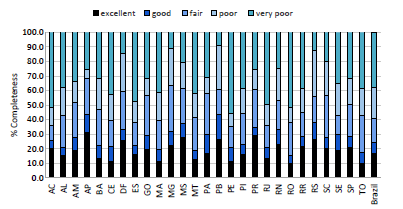
The states of Amapá, Mato Grosso do Sul, Santa Catarina, and Paraná showed the highest proportions of variables classified as “good” and “excellent”, collectively achieving a satisfactory completion rate of approximately 40 to 45%. In contrast, Tocantins, Pernambuco, Mato Grosso, Rondônia, and Alagoas exhibited the poorest performance, with a predominance of “poor” and “very poor” categories exceeding 50%. Nationally, it was observed that approximately 30% of the variables remained at unsatisfactory levels (“poor” and “very poor”) (Figure 1).

Percentage of variables of cases of COVID-19-related severe acute respiratory syndrome according to level of completeness and federative unit of residence, Brazil, 2020-2023.
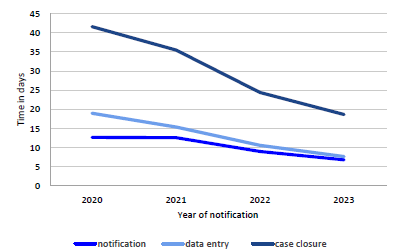
The analysis of timeliness (Figure 2) showed a significant reduction in the average processing intervals for records. The time between symptom onset and notification decreased from 13 to 7 days. Similarly, the average intervals for data entry and case closure were reduced by more than 50%, demonstrating greater efficiency in the record workflow and the finalization of case forms.

Average time interval (in days) between notification, data entry, and case closure for severe ccute respiratory syndrome due to COVID-19 in Brazil, 2020-2023.
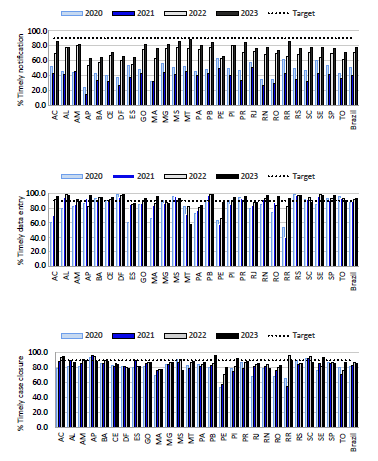
Figure 3 presents the percentage of records notified, entered, and closed in a timely manner across Brazilian states. In 2020, only 50% of COVID-19-related SARS records in the country were notified within seven days of symptom onset. By 2023, this figure had risen to 76.9%. Mirroring the national trend, all states showed improvement in timely notification. Despite these advances, no state met the target of having 90% of cases notified within the recommended timeframe.

Percentage of timely notification, data entry, and case closure for severe acute respiratory syndrome due to COVID-19, by Brazilian federative unit, 2020-2023.
The assessment of data entry timeliness in Brazil revealed that, in 2020, over 87% of case forms were entered within 30 days of the notification date, a figure that rose to 93% in 2023. Most states increased their proportion of timely data entry over the years, meeting the 90% target set by the Ministry of Health. However, Espírito Santo, Mato Grosso, Pará, Pernambuco, and Rio de Janeiro were the states that failed to meet this benchmark (Figure 3).
Regarding timely closure within 60 days of the notification date, it was observed that during the analyzed period, approximately 86% of cases in Brazil were closed in a timely manner, with little variation across the years. The states that closed more than 90% of cases on time were Acre, Amapá, Mato Grosso do Sul, Paraíba, Piauí, Roraima, Santa Catarina, and Sergipe. Concerning timeliness targets, only the goal for timely data entry was met in 2022 and 2023, while the others remained below the established benchmarks (Figure 3).
DISCUSSION
In this study, we analyzed the completeness and timeliness of COVID-19-related SARS records in the SIVEP-Gripe system. Completeness was found to be unsatisfactory, with 59% of variables classified as “poor” or “very poor”. Conversely, there was a significant reduction in the time taken for notification, data entry, and case closure, indicating greater speed in the system’s data input process. These findings corroborate previous studies3,12 that also identified low completeness in SARS records. Although the decrease in the number of records in 2022 and 2023 accelerated notification and closure processes, there was no proportional improvement in the quality of data entry, suggesting that operational speed was not matched by improvements in data consistency.
Heterogeneity was observed across federative units, with states such as Amapá, Mato Grosso do Sul, Santa Catarina, and Paraná showing better completeness levels, while others such as Tocantins, Pernambuco, and Rondônia showed unsatisfactory performance. This suggests structural inequalities in the organization of epidemiological surveillance. These differences may reflect variations in technological infrastructure, staff training, and operational recording workflows, including the use of paper forms followed by manual data entry. Previous studies also indicate that regional inequalities directly impact the quality of health information systems7. It should be noted that SIVEP-Gripe is a complex system involving multiple variables and operational instabilities; it underwent successive updates during the pandemic, which may have affected record quality. Furthermore, access to the system is not universal across health services, a factor that may influence the timeliness of notifications.
Low data completeness may be linked to operational and organizational factors, such as heavy workloads during critical pandemic periods, the prioritization of patient care over detailed data recording, and the perception of reporting as merely a bureaucratic task. Furthermore, a lack of understanding regarding the epidemiological importance of certain variables can contribute to incomplete form filling15. These factors are particularly significant given the substantial rise in notifications between 2020 and 2021, a period when the system faced immense demand.
Regarding timeliness, a significant reduction was observed in the average time between symptom onset and notification, dropping from 13 to 7 days between 2020 and 2023, alongside improvements in data entry and case closure intervals. These findings indicate that epidemiological surveillance services progressively adapted throughout the pandemic, achieving greater agility in information processing. However, despite this progress, the target of 90% timely notifications was not met in any federative unit, highlighting persistent limitations in the system’s capacity for timely response.
Similarly, while data entry rates exceeded 90% in most states in recent years, the rate of case closures remained around 86%, falling short of the recommended benchmark. This result suggests that more complex stages of the process, such as case investigation and finalization, continue to challenge surveillance services, even after the system became well-established during the pandemic.
At the onset of the health crisis, pandemic management required rapid responses and the adaptation of information systems for real-time data collection, analysis, and dissemination, elements essential for understanding the epidemiological landscape and making informed decisions. To achieve this, the data needed to be complete, reliable, and timely18,19.
During the early years of the pandemic, reporting delays may have been exacerbated by limitations within SIVEP-Gripe - which initially lacked specific fields for COVID-19 - as well as frequent system instability and a lack of interoperability with other systems, such as the Laboratory Environment Management System. Compounding this issue was the lack of systematic training for the professionals responsible for filling out the reporting forms7.
The observed poor data quality may be linked to periods of inaccessibility regarding SIVEP-Gripe data, often referred to as “data blackouts”. Notable instances include the suspension of the Coronavirus dashboard in June 2020 for political reasons, as well as a subsequent period of inaccessibility in December 2021 that lasted at least 30 days. Against this backdrop, the federal government proposed arbitrary changes to variable measurements and reporting standards that were inconsistent with international epidemiological guidelines20. Such events can compromise the generation of reliable indicators and the capacity for rapid response, while also hindering the identification of significant events and impeding the formulation of appropriate recommendations21.
This study enabled a comprehensive analysis of COVID-19 data quality in Brazil over four years of the pandemic, providing insights to improve record-keeping in the SIVEP-Gripe system. While the study yields important findings for surveillance and the assessment of health information quality, it has limitations: the analysis was restricted to confirmed cases rather than the full set of cases recorded in the system, and the dataset was not cleaned to remove duplicates or inconsistencies because of lack of access to individual-level data.
A key strength is the novel joint analysis of record completeness and timeliness, providing evidence to support proposals for improving data entry and system operations. A SIVEP-Gripe system that yields higher-quality, timely data contributes to effective territorial monitoring and more informed public health decision-making.
Data recording, processing, and analysis within HIS still face challenges. According to Melo and Soares6, difficulties associated with HIS include the lack of policies incentivizing accurate data entry, which hinders the generation of correct information and, consequently, the implementation of effective measures22.
The results indicate that, although processes have become faster, this has not been matched by consistent improvements in the quality of data entry. This underscores the need to implement periodic record assessment routines and strategies to enhance information quality within epidemiological surveillance services.
Despite the observed limitations, SIVEP-Gripe stands out as a fundamental system for epidemiological surveillance, particularly during emergencies. As one of the few online systems offering rapid data access, it enables timely analysis and supports decision-making. This feature distinguishes it from other systems, such as Sinan Net, which while equally relevant involves less agile workflows for information availability.
Furthermore, it is essential to establish continued training processes for the professionals involved in reporting to ensure the standardization and reliability of the information. Policies for ongoing training, periodic evaluations, active supervision, and systematic monitoring of data quality are crucial for reducing regional disparities and ensuring reliable data, which are indispensable for planning public health actions.
REFERENCES
-
1. Moura EC, Silva EM, Sanchez MN, Cavalcante FV, Oliveira LG, Oliveira A, et al. Disponibilidade de dados públicos em tempo oportuno para a gestão: análise das ondas da COVID-19. Rev Saúde Pública 2022; 56: 49. https://doi.org/10.1590/SciELOPreprints.2316
» https://doi.org/https://doi.org/10.1590/SciELOPreprints.2316 -
2. Brasil. Ministério da Saúde. Painel Coronavírus [Internet]. Brasília: Ministério da Saúde; 2024 [accessed on Sep 18, 2025]. Available at: https://covid.saude.gov.br/
» https://covid.saude.gov.br/ -
3. Maciel EL, Jabor PM, Gonçalves Jr E, Siqueira PC, Prado TN, Zandonade E. Estudo da qualidade dos dados do painel COVID-19 para crianças, adolescentes e jovens, Espírito Santo, Brasil, 2020. Esc Anna Nery 2021; 25(spe): e20210049. https://doi.org/10.1590/2177-9465-EAN-2021-0049
» https://doi.org/https://doi.org/10.1590/2177-9465-EAN-2021-0049 -
4. Siqueira PC, Maciel ELN, Catão RC, Brioschi AP, Silva TCC, Prado TN. Completude das fichas de notificação de febre amarela no estado do Espírito Santo, 2017. Epidemiol Serv Saude 2020; 29(3): e2019402. https://doi.org/10.5123/S1679-49742020000300014
» https://doi.org/https://doi.org/10.5123/S1679-49742020000300014 -
5. Massoudi BL, Sobolevskaia D. Keep moving forward: health informatics and information management beyond the COVID-19 pandemic. Yearb Med Inform 2021; 30(1): 75-83. https://doi.org/10.1055/s-0041-1726499
» https://doi.org/https://doi.org/10.1055/s-0041-1726499 - 6. Melo HMC, Soares DJ. A importância do sistema de informação na gestão do Sistema Único de Saúde. Redenção: UNILAB; 2018.
-
7. Lana RM, Coelho FC, Gomes MFC, Cruz OG, Bastos LS, Villela DAM, et al. Emergência do novo coronavírus (SARS-CoV-2) e o papel de uma vigilância nacional em saúde oportuna e efetiva. Cad Saude Publica 2020; 36(3): e00019620. https://doi.org/10.1590/0102-311X00019620
» https://doi.org/https://doi.org/10.1590/0102-311X00019620 -
8. World Health Organization. Communicable disease surveillance and response systems: guide to monitoring and evaluating [Internet]. Geneva: WHO; 2006 [accessed on Sep 10, 2025]. Available at: https://iris.who.int/server/api/core/bitstreams/6c51bddd-d792-469a-9fb3-8f4eeb7c0e7c/content
» https://iris.who.int/server/api/core/bitstreams/6c51bddd-d792-469a-9fb3-8f4eeb7c0e7c/content -
9. Doyle TJ, Glynn MK, Groseclose SL. Completeness of notifiable infectious disease reporting in the United States: an analytical literature review. Am J Epidemiol 2002; 155(9): 866-74. https://doi.org/10.1093/aje/155.9.866
» https://doi.org/https://doi.org/10.1093/aje/155.9.866 -
10. Costa-Santos C, Neves AL, Correia R, Santos P, Monteiro-Soares M, Freitas A, et al. COVID-19 surveillance data quality issues: a national consecutive case series. BMJ Open 2021; 11(12): e047623. https://doi.org/10.1136/bmjopen-2020-047623
» https://doi.org/https://doi.org/10.1136/bmjopen-2020-047623 -
11. Corrêa PRL, Ishitani LH, Abreu DMX, Teixeira RA, Marinho F, França EB. A importância da vigilância de casos e óbitos e a epidemia da COVID-19 em Belo Horizonte, 2020. Rev Bras Epidemiol 2020; 23: e200061. https://doi.org/10.1590/1980-549720200061
» https://doi.org/https://doi.org/10.1590/1980-549720200061 -
12. Ribas FV, Custódio ACD, Toledo LV, Henriques BD, Sediyama CMNO, Freitas BAC. Completude das notificações de síndrome respiratória aguda grave no Brasil durante a pandemia de COVID-19, 2020. Epidemiol Serv Saude 2022; 31(2): e2021366. https://doi.org/10.1590/S1679-49742022000200004
» https://doi.org/https://doi.org/10.1590/S1679-49742022000200004 -
13. Brasil. Ministério da Saúde. Secretaria de Vigilância em Saúde. e-SUS Sinan: manual de instruções [Internet]. Brasília: Ministério da Saúde; 2022 [accessed on Sep 15, 2025]. Available at: https://www.gov.br/saude/pt-br/centrais-de-conteudo/publicacoes/svsa/vigilancia/e-sus-sinan-manual-de-instrucoes/view
» https://www.gov.br/saude/pt-br/centrais-de-conteudo/publicacoes/svsa/vigilancia/e-sus-sinan-manual-de-instrucoes/view -
14. Romero DE, Cunha CB. Avaliação da qualidade das variáveis sócio-econômicas e demográficas dos óbitos de crianças menores de um ano registrados no Sistema de Informações sobre mortalidade do Brasil, 1996/2001. Cad Saude Publica 2006; 22(3): 673-84. https://doi.org/10.1590/S0102-311X2006000300022
» https://doi.org/https://doi.org/10.1590/S0102-311X2006000300022 -
15. Lima CRA, Schramm JMA, Coeli CM, Silva MEM. Revisão das dimensões de qualidade dos dados e métodos aplicados na avaliação dos sistemas de informação em saúde. Cad Saude Publica 2009; 25(10): 2095-109. https://doi.org/10.1590/S0102-311X2009001000002
» https://doi.org/https://doi.org/10.1590/S0102-311X2009001000002 -
16. Brasil. Ministério da Saúde. Secretaria de Vigilância em Saúde. Departamento de Vigilância Epidemiológica. Sistema de Informação de Agravos de Notificação - Sinan: normas e rotinas [Internet]. Brasília: Ministério da Saúde; 2006 [accessed on Sep 1, 2025]. Available at: https://portalsinan.saude.gov.br/images/documentos/Aplicativos/sinan_net/Manual_Normas_e_Rotinas_2_edicao.pdf
» https://portalsinan.saude.gov.br/images/documentos/Aplicativos/sinan_net/Manual_Normas_e_Rotinas_2_edicao.pdf -
17. Brasil. Ministério da Saúde. Secretaria de Vigilância em Saúde. Departamento de Vigilância Epidemiológica. Sistema de Informação de Agravos de Notificação-Sinan: normas e rotinas [Internet]. Brasília: Ministério da Saúde; 2006 [accessed on Sep 1, 2025]. Available at: https://bvsms.saude.gov.br/bvs/publicacoes/sistema_informacao_agravos_notificacao_sinan.pdf
» https://bvsms.saude.gov.br/bvs/publicacoes/sistema_informacao_agravos_notificacao_sinan.pdf - 18. Neri SCC. A qualidade dos dados dos sistemas de informação em saúde aplicados na atenção à saúde materno-infantil [tese de doutorado]. Salvador: Universidade Federal da Bahia; 2016.
-
19. Clare T, Twohig KA, O’Connell AM, Dabrera G. Timeliness and completeness of laboratory-based surveillance of COVID-19 cases in England. Public Health 2021; 194: 163-6. https://doi.org/10.1016/j.puhe.2021.03.012
» https://doi.org/https://doi.org/10.1016/j.puhe.2021.03.012 -
20. Carvalho CA, Carvalho VA, Campos MAG, Oliveira BLCA, Diniz EM, Santos AM, et al. Delay in death reporting affects timely monitoring and modeling of the COVID-19 pandemic. Cad Saude Publica 2021; 37(7): e00241320. https://doi.org/10.1590/0102-311X00241320
» https://doi.org/https://doi.org/10.1590/0102-311X00241320 -
21. Villela DAM, Gomes MFC. O impacto da disponibilidade de dados e informação oportuna para a vigilância epidemiológica. Cad Saude Publica 2022; 38(7): e00115122. https://doi.org/10.1590/0102-311X00115122
» https://doi.org/https://doi.org/10.1590/0102-311X00115122 -
22. Braz RM, Tauil PL, Santelli ACFS, Fontes CJF. Avaliação da completude e da oportunidade das notificações de malária na Amazônia brasileira, 2003-2012. Epidemiol Serv Saude 2016; 25(1): 21-32. https://doi.org/10.5123/S1679-49742016000100003
» https://doi.org/https://doi.org/10.5123/S1679-49742016000100003

 Source: SIVEP-Gripe, January 29, 2024.
 Source: SIVEP-Gripe, January 29, 2024.
 Source: SIVEP-Gripe, 29/01/2024.