 The Invisibility of Street Know-How in the Training of Circus Artists in Brazil
ABSTRACT
The Invisibility of Street Know-How in the Training of Circus Artists in Brazil – The relationship between circus schools in Brazil and the training of artists who perform in street and open spaces was the goal of this study. Five schools were analyzed through a review of pedagogical programs, interviews with teachers and coordinators, and a questionnaire completed by former students. Despite the recognition of the street as a relevant space for performing and its high demand, there is no systematic approach aimed at developing specific skills for street circus performance, suggesting the institutionalized absence of this know-how in the training provided by the schools studied.
Keywords:
Circus; Street Art; Circus School; Street Circus; Artistic Training
RESUMO
A Invisibilidade dos Saberes da Rua na Formação do Artista Circense no Brasil – A relação entre escolas de circo no Brasil e a formação de artistas que atuam no contexto das performances de circo de rua consistiu no objetivo da pesquisa que deu origem a este artigo. Analisamos cinco escolas, uma de cada região do país, por meio da revisão de projetos pedagógicos, entrevistas com docentes e coordenadores, e um questionário respondido por alunos egressos. Identificamos que, apesar do reconhecimento da rua como um espaço cênico relevante e da alta demanda, não há uma abordagem sistemática voltada ao desenvolvimento de competências específicas para a performance de circo de rua, sugerindo a ausência institucionalizada desses saberes na formação oferecida nas escolas estudadas.
Palavras-chave:
Circo; Arte de Rua; Escola de Circo; Circo de Rua; Formação Artística
RESUME
L’lnvisibilité des Connaissances de la Rue dans la Formation des Artistes de Cirque au Brésil – La relation entre les écoles de cirque au Brésil et la formation des artistes qui travaillent dans le contexte des spectacles de cirque de rue était l’objectif de la recherche qui a donné naissance à cet article. Nous avons analyse cinq écoles, une de chaque region du pays, à travers une revue de projets pédagogiques, des entretiens avec des enseignants et des coordinateurs et un questionnaire répondu par les étudiants diplômés. Nous avons identifié que, malgré la reconnaissance de la rue comme espace scénique pertinent et la forte demande, il n’existe pas d’approche systématique visant à développer des compétences spécifiques pour le spectacle de cirque de rue, suggérant l’absence institutionnalisée de ces connaissances dans la formation offerte dans les écoles étudiées.
Mots-clés:
Cirque; Art de Rue; Ecole de Cirque; Cirque de Rue; Education Artistique
The streets and the circus artists
Artistic performances in the streets, squares, alleys and other unconventional spaces – referred to as streets, whether public or private – represent a secular and multidisciplinary phenomenon (dance, music, theater, circus, among others). With an uninterrupted historical flow, this cultural movement demonstrates an effervescent presence in the contemporary Brazilian context. Nevertheless, recent studies has questioned the role of the professional circus schools that have been set up in Brazil since the 1980s in training the next generation of artists to work in these spaces (Matheus, 2016; Barreto, 2018; Leles, 2022).
I fact, some studies shows that circus artists who perform on the street1 have developed their own means of learning, based an informar education that includes on exchange, self-education, and oral transmission (Duprat, 2014; Barreto, 2016). At the same time, highlight that the circus schools have been receiving students who perform or wish to perform in this context (Barreto, 2022).
The increase in circus schools in Brazil (Barreto; Duprat; Bortoleto, 2022), similar to what happens in several other countries (Infantino, 2021; Cloutier; Laplante, 2002; Salaméro, 2015), has attracted all sorts of people wishing to become a professional circus artist. Theater, dance (Matheus, 2016) and street performers (saltimbancos as they were called for centuries) have been approaching these schools and challenging them to provide the training that will enable students to become professionals and artistically sustainable in the future. At the same time, the number of festivals and other events that include street performances is multiplying worldwide, opening up countless professional opportunities2.
Considering the important role that circus schools have taken, training a significant part of the professional artists performing in the region, as well as the diversity of artistic possibilities available to circus performers, including street performances, we ask how these schools are contributing to this segment. As such, the research presented here, an excerpt from the doctoral study entitled Quando o Circo Atravessa a Rua: a formação do artista e sua relação com os espaços públicos (When Circus Crosses the Street: the training of performers and their relationship with public spaces) (Barreto, 2022), investigated how some of the leading professional circus schools in Brazil approach the knowledge specific to street performance in the training process they offer.
The circus schools studied in this research were selected based on the following criteria: geographical location - one in each of Brazil’s five regions; provision of training aimed at professional work in the circus sector, regardless of the formal recognition of the courses; existence of documents that indicate the systematization of the training process – such as course programs or pedagogical projects or outlines; duration of the course – prioritizing those with the most number of hours; and the relevance of the school in its locality/region – as indicated by the circus community. The field study has included semi-structured interviews with circus schools’ directors (5) and two teachers per school (10), all of whom had more than five years’ experience. In addition, a questionnaire have been filled by former students of the five schools (97 valid responses).
The street as performative space
In Brazil, it was sedimented an narrative of the street as a dangerous space (Da Matta, 1984), where no performer would choose to be and which is seen solely as a space for art out of necessity and lack of access to cultural facilities such as theaters, circuses and concert halls. However, “current circumstances show that the struggle for public space is intensifying every day” (Turle; Trindade, 2016. p. 12). More events and institutions, under the pretext of democratizing art, choose the public space as a venue for artistic performances. In fact, the 20th century is considered, in the history of theater, to be the century of the “explosion of space”3 (Roubine, 1982), after the “crisis of representation”4 (Dias, 2020) established at the end of the 19th century opened the way for performances and contemporary theater to extrapolate the limits of the theatrical building and immerse themselves in multiplicity and diversity (Kosovski, 2005). According to Roubine, “[...] theater can now be performed anywhere – preferably avoiding those buildings that used to be called theaters” (Roubine, 1982, p. 117). The “street” have also consolidated as an important locus for circus performance in Brazil.
In the context of the Foucault’ “society of control” (Foucault, 2013), including the case of Brazil, there has been a growing curtailment of the free expression of art in public spaces, an attempt to delimit culture and where it can be displayed. Laws regulating shows by street performers have been passed and discussed (Buchiniani, 2016; Santos, 2014), significantly affecting circus performers. In many cities, the need for a performance permit is governed by laws that, under the pretext of protecting the performer and the citizen, limit the freedom to perform on the streets, while at the same time changing the way the street is seen as a legitimate space for art, generating a field of dispute (Bourdieu, 2004), which may be affecting art education institutions, including schools, conservatories and universities.
It’s not uncommon for street circus performers to note the lack of social recognition and the marginalization (Barreto, 2018) in the face of a society that has been conditioned, over time, to the “growing appreciation of private life and the needs arising from this new way of life” (Turle, 2016, p. 15), considering private services, a priori, to be of better quality, which is not always correct. It is on the street that many performers work and earn their living (Barreto, 2023). When they are not subsidized by public or private resources, street circus performers live off the voluntary contribution of the public, known as a chapéu (passing the hat) (Elkins, 2022). This implies an absolutely different relationship between the performer and the audience (Chacovachi, 2018). In fact, there is a specific know-how needed to perform in this context.
In other venues, such as the theaters, big top and other closed/private spaces, the relationship between the quality of the show and the amount received is less direct, i.e. whether you like the show or not, the ticket price has already been paid at the box office. In street performances, it is the audience who decides how much they want to pay, so the quality of the show, the engagement with the audience and many other aspects directly influence the amount of the contribution, which makes specific training for street performance even more important (Chacovachi, 2018). This particularities give rise to a wide range of know-how needed to perform in this artistic segment.
The pedagogical dimension
Based on his experiences with pubic venues5, Licko Turle said: “From a pedagogical point of view, what was clear to the street collectives is that, just like any other stage element, this game of traversing show/city also requires knowledge and practice” (Turle, 2016, p. 105). In other words, in order to deal with the challenges that the public space presents when putting on a performance, it is necessary to master this specific know-how. And this mastery requires appropriated studies and performance experience.
In theory, the street is always open and available, which makes it a great space for learning, both for the performers and the public, thereby constituting the pedagogical process of learning (Baffi, 2009; Puccetti, 2017). However, if the performer has no contact with the street, no training or any previous knowledge, it can be a discouraging experience: “The first few times entering the space was frustrating because I couldn’t establish contact with the public” (Silva, 2017, p. 36). Reports about the particularities and challenges of performing on the street are plentiful and some highlight the stress caused by the first entry into street performances: “[...] the first few times I tried doing traffic lights, that sort of thing, I couldn’t do anything. My embarrassment wouldn’t let me do anything” (Barreto, 2017, p. 156), said Jairo Lopez in an interview. There have been performers who have inexplicably failed at moves they could do without blinking an eye, others who have returned home devastated due to the aggressive reactions of passers-by, and performers who, due to the frustration of their first experiences, have given up performing on the street (Barreto, 2018). These are situations that could have been avoid if there had been preparation for them in the circus school’ training process. Despite of these difficulties, circus performers continue to perform the streets.
Vocational circus schools in Brazil
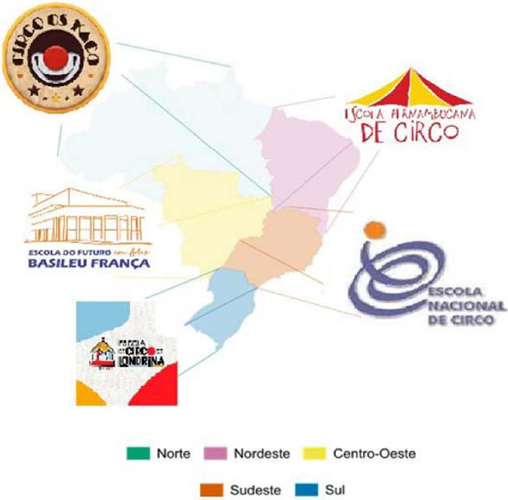
For this study, five circus schools were selected according to the following criteria: geographical location (one from each of Brazil’s regions); provide a professional training program (availability of the pedagogical project or other document that signaled the systematization of the training process; length of the course, with preference given to the longer ones; representativeness of the school in the locality/region). In total, 293 circus schools were identified and one was chosen from each region of the country, totaling five institutions6 (Figure 1).
To analyze the chosen institutions, semi-structured interviews were used with the coordinators/directors (5) and two teachers at each school (10), all of whom had worked at the respective schools for more than five years. In addition to the interviews, a questionnaire was sent to the graduates of the five schools surveyed, using the contacts provided by them, social networks and other means using the Snowball method (Vinuto, 2014). 97 valid responses were considered. A descriptive statistical analysis of the quantitative data and a content analysis of the qualitative data were carried out (Bernard, 2017).
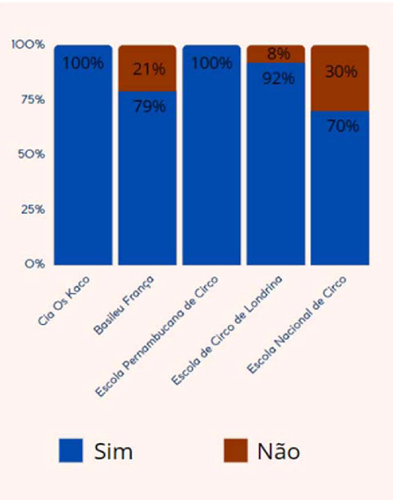
None of the circus schools have systematized training for performing in public spaces in their pedagogical program. We found no evidence of street performance’ know-how in the provided training. Contradictorily, two out five schools were set up by street performers. However, not even they deal with the subject in a formal way. Sometimes, always subtly and informally, this know-how is indirectly covered in debates during history lessons or external activities. Data obtained from graduates shows that street performance is very common among performers who graduated from these schools (Graph 1). Out of a total of 97 responses, 79 (81%) said they had already worked in public spaces (the street), compared to only 18 (19%) who said they had not had this artistic experience.
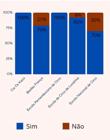
Have you performed in public spaces (squares, parks, traffic lights)? (Blue = Yes [Sim]; Brown = No [Não]). Source: Authors’ own material.
We noticed that public spaces are a potential venue for most of the performers who took part in the research. This coincides with another recent study on the training of clowns in Brazil (Braccialli, 2022), which indicates the importance of street performance among Brazilian clowns, also a fundamental characteristic of the know-how employed by the main trainers in this sector.
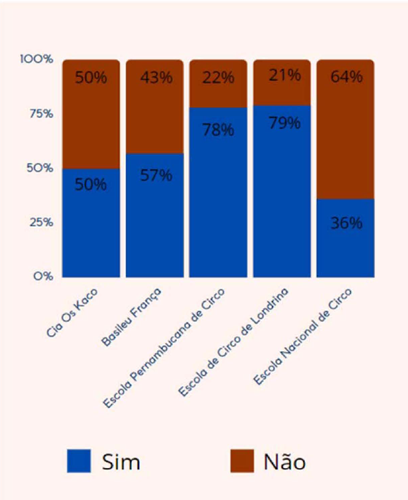
Paradoxically, more than half of the graduates (55%) reported circus schools’ had provided training activities that enabled them to work on the streets (Graph 2), suggesting that the institutions cover this know-how informally.
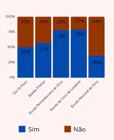
Did the school you attend provide any type of specific preparation for performing in public spaces? (Blue = Yes [Sim]; Brown = No [Não]). Source: Authors’s own material.
Contrasting data from Graphs 1 and 2, 81% of the graduates (79 responses) said they had already worked in public spaces, compared to only 55% (53 responses) who said they had undergone training activities that prepared them to work in these spaces. This means that a large proportion of artists have worked in the street without having been prepared for it. In fact, 33 graduates who said they had already worked in the street replied that their schools did not provide specific training activities, which means that almost 42% of the 79 graduates who have worked in the street did so without having been prepared by the institutions they attended. The testimonies of the graduates reveal a contradiction between the needs that this artistic sector has demonstrated and the training that has been offered by the schools.
Despite these figures, we believe that each school, within its own context, deals with the issue of performing in public spaces in a different way. For example, in one of the institutions, we saw that, although it held performances in squares as part of its routine activities, half of its graduates stated that the institution did not offer preparation for street performance. Thus, they did not consider these performances to be part of their training. However, only one of them said they had found it difficult to perform in squares. In fact, the street is the space where the school’s graduates feel most at home and from where many of them make their living. The venue they found most difficult was events, a situation confirmed by one of their teachers: “They don’t want to, saying: ‘no, I’m a performer, I’m not an entertainer” (Barreto, 2022, p. 108). As it is a small town, the team of trainers believes that events could be more lucrative than public spaces, but they encounter resistance from the students, who prefer to perform at traffic lights.
Where this institution’s graduates encounter problems is where another school has found a solution. According to its coordinator, a large part of the money that keeps the school going comes from events. By contract, students are not allowed to perform on the streets, as one of the institution’s functions is precisely to get children off the streets: “[...] one of the clauses of the project is that the children who are part of it, the performers who are part of the Escola Pernambucana de Circo cannot perform on the streets” (Barreto, 2022, p. 171). Despite this, 100% of the school’s graduates said they had already performed in public spaces. Although 78% of its graduates considered that the school offered preparation for performing in public spaces, this was one of the spaces most cited as the place where they found it most difficult to perform, along with the theater (44% each). As a circus school with a clear social focus, in the opinion of the school’s educators, there would be a conflict in offering training activities that regard the street itself as a desirable place to work. However, for the graduate performers, the streets are an effective field of work, and specific preparation to work in these spaces would be of enormous value in their training.
In two schools, graduates who have never performed on the streets represent 30% and 21%, respectively. The first of these is also the institution with the highest rate of graduates who say that the school didn’t prepare them for it (64%). The other, in third place, also has a significant rate (43%). Coincidence or not, these are the two schools that offer certified technical training, adhering to specific regulations on technical-artistic education, and have the strictest structuring of their curricula. Could it be that the institutional rules make it difficult for the institutions to dialog with popular know-how? It seems that institutional recognition reinforces the paucity in the training of artists to work in public spaces.
Is the street performance know-how invisible to the Brazilian circus schools?
In less than half a century, we’ve seen circus schools go from a novelty to one of the main means of training in Brazil. The short period of the first circus school in Brazil - Piolim Academy of Circus Arts (from 1978 to 1983) - did not prevent the emergence of a huge change in the panorama of circus education in the country. Although we must recognize that the circus is currently taught in numerous ways and in the most diverse spaces, making it difficult to gain a detailed understanding of these processes and their impact on the sector, there is no doubt about the importance of circus schools, as Duprat (2014) pointed out a decade ago.
We also know that the performance of circus artists on the street is still relevant, challenging the circus schools to review their processes. We noticed specific actions and even a discourse that recognizes the importance of this knowledge, but the study shows the absence of systematic action and formal recognition, including in terms of curriculum structure. It seems to be very important the dialog between formal training and empirical know-how regarding street performance. This relation is fragile and possibly reveals apre-conception of this artistic perspective.
Although the street is a place with an effervescent value for the Brazilian culture, street circus know-how does not have its place in the pedagogical projects of the schools studied, which is a major gap in the training of professionals, especially considering the fact that a significant proportion of the graduates consulted declared that they work in public spaces. Perhaps the difficulty is not the presence of street circus teaching in schools, but rather perceiving street circus as an artistic expression that deserves the same attention and respect as any other form of professional activity.
The circus schools studied do not consider the street as a performance space with specificities that require specific training/education. The street performance knowledge is still “invisible”, having a secondary and non-formalized place in the curricula. Thus, it depends on exchanges between students, teachers with some experience in the subject and, sometimes, opportunities to perform in these spaces or attend festivals/shows that offer this type of performance.
As the famous Brazilian educator Paulo Freire (1996, p. 9) suggests, “training involves much more than purely training the learner in the performance of skills”, insofar as this process needs to recognize reality and respect the popular know-how imbricated in society across all its layers, without prejudice. The dialogical relationship between circus schools and all circus artists’ professional practice, which includes street performance, requires a drastic review and, perhaps, a change in curricular policies.
Notes
-
1
In this paper, the term street will be used to refer to public space, encompassing parks, squares, traffic lights, among others, in parallel with the term street theater “[...] to work with the idea that the street really means, in the case of the expression ‘street theater’, all those public spaces that are not conventional theatrical venues (whether they have an Italian stage or not)” (Carreira, 2001, p. 150).
-
2
Festivals such as Avignon (France), Montreal Complètemant Cirque (Canada), Festival Internacional de Circo e Arte de Rua (Brazil), among others, offer street circus performances as an official part of the program.
-
3
Concept developed by Jean-Jacques Roubine in A Linguagem da Encenação Teatral (1982).
-
4
“Crisis in which the nexus between the words (the representation) and the things (the represented) seems to have been lost” (Dias, 2020, n. p.).
-
5
Experience undertaken by the Rio de Janeiro group Tá na Rua. Further information in Teatro(s) de Rua do Brasil: a luta pelo espaço público (Turle, 2016).
-
6
The location of the schools is available at: https://www.fef.unicamp.br/fef/posgraduacao/gruposdepesquisa/circus/mapa. Accessed on: November 02, 2023.
-
The original text, translated by Tony O’Sullivan, is also published in Portuguese in this issue of the journal.
Availability of research data:
the data set supporting the results of this study is published in the article itself.
References
-
BAFFI, Diego Elias. Olha o Palhaço no Meio da Rua: o palhaço itinerante e o espaço público como território de jogo poético. 2009. Dissertação (Mestrado em Artes) — Programa de Pós-graduação em Artes, Instituto de Artes, Universidade Estadual de Campinas, Campinas, 2009. Disponível em: https://www.circonteudo.com/trabalho-academico/olha-o-palhaco-no-meio-da-rua-o-palhaco-itinerante-e-o-espaco-publico-como-territorio-de-jogo-poetico-pdf/. Acesso em: 01 dez. 2023.
» https://www.circonteudo.com/trabalho-academico/olha-o-palhaco-no-meio-da-rua-o-palhaco-itinerante-e-o-espaco-publico-como-territorio-de-jogo-poetico-pdf/. - BARRETO, Lua. Relações de Ensino/Aprendizagem do Artista Circense que Se Apresenta na Rua. In: CONGRESSO DA ABRACE, 9., 2016, Uberlândia. Anais [...] Uberlândia: ABRACE, 2016.
- BARRETO, Lua Mônica Alves. As Performances do Circo na Rua: escolhas, expectativas e aprendizado do saltimbanco contemporâneo. 2017. 215 f. Dissertação (Mestrado em Performances Culturais) – Programa de Pós-graduação Interdisciplinar em Performances Culturais, Escola de Música e Artes Ciências, Universidade Federal de Goiás, Goiânia, 2017.
- BARRETO, Lua. Saltimbancos Contemporâneos: seu aprendizado, suas escolhas e expectativas. Goiânia: Espaço Acadêmico, 2018.
- BARRETO, Lua Mônica Alves. Quando o Circo Atravessa a Rua: a formação do artista e sua relação com os espaços públicos. 2022. Tese (Doutorado em Educação Física) — Programa de Pós-graduação em Educação Física, Faculdade de Educação Física, Universidade Estadual de Campinas, Campinas, 2022.
-
BARRETO, Lua. As Particularidades do Circo de Rua: uma experiência. Urdimento: Revista de Estudos em Artes Cênicas, Florianópolis, v. 1, n. 46, p. 1-23, abr. 2023. Disponível em: https://revistas.udesc.br/index.php/urdimento/article/view/23177. Acesso em: 01 dez. 2023.
» https://revistas.udesc.br/index.php/urdimento/article/view/23177. - BARRETO, Lua Mônica; DUPRAT, Rodrigo Mallet; BORTOLETO, Marco Antonio Coelho. De Norte a Sul: mapeando a formação em circo no Brasil. Urdimento: Revista de Estudos em Artes Cênicas, Florianópolis, v. 3, n. 42, p. 1-32, 2021.
- BERNARD, H. Russell. Research Methods in Anthropology: qualitative and quantitative approaches. Lanham: Rowman & Littlefield, 2017.
- BOURDIEU, Pierre. A Formação do Habitus Econômico. Sociologia: Revista da Faculdade de Letras da Universidade do Porto, Porto, v. 14, 2004.
-
BRACCIALLI, Felipe. A Arte de Formar Palhaços e Palhaças no Brasil. 2022. Tese (Doutorado em Educação Física) – Programa de Pós-graduação em Educação Física, Faculdade de Educação Física, Universidade Estadual de Campinas, Campinas, 2022. Disponível em: https://repositorio.unicamp.br/acervo/detalhe/1246850. Acesso em: 01 dez. 2023.
» https://repositorio.unicamp.br/acervo/detalhe/1246850. -
BUCHINIANI, Rodrigo Guimarães et al. Liberdade de Expressão Artística e o Espaço Público: uma interpretação constitucional. 2016. Dissertação (Mestrado em Direito) – Programa de Estudos Pós-Graduados em Direito, Faculdade de Direito, Pontifícia Universidade Católica de São Paulo, São Paulo, 2016. Disponível em: https://tede2.pucsp.br/handle/handle/7050. Acesso em: 01 dez. 2023.
» https://tede2.pucsp.br/handle/handle/7050. - CARREIRA, André Luiz Antunes Netto. Teatro de Rua como Apropriação da Silhueta Urbana: hibridismo e jogo no espaço inóspito. Trans/Form/Ação, v. 24, p. 143-152, 2001.
- CARREIRA, André. Teatro de Rua: Brasil e Argentina nos anos 1960 – uma paixão no asfalto. São Paulo: Aderaldo & Rothschild, 2007.
- CHACOVACHI, Palhaço. Manual e Guia do Palhaço de Rua. La Plata: Contramar, 2018.
-
CLOUTIER, Louis-Philippe; LAPLANTE, Valérie. Arts du Cirque: comparaison Quebec vs France. 2001. Disponível em: https://www.mcc.gouv.qc.ca/fileadmin/documents/publications/brodepli/cirque.pdf. Acesso em: 01 dez. 2023.
» https://www.mcc.gouv.qc.ca/fileadmin/documents/publications/brodepli/cirque.pdf. - DA MATTA, Roberto. O que Faz o Brasil, Brasil? Rio de Janeiro: Rocco, 1984.
-
DIAS, Luciana da Costa. Crise da Representação, Virada Performativa e Presença: possibilidades rumo a uma Filosofia-Performance. Revista Brasileira de Estudos da Presença, Porto Alegre, v. 10, p. e92575, 2020. Disponível em: https://www.scielo.br/j/rbep/a/PG3tkyfgtyfcNpLmfZJhRzs/?lang=pt. Acesso em: 16 nov. 2024.
» https://www.scielo.br/j/rbep/a/PG3tkyfgtyfcNpLmfZJhRzs/?lang=pt. -
DUPRAT, Rodrigo Mallet. Realidades e Particularidades da Formação do Profissional Circense no Brasil: rumo a uma formação técnica e superior. 2014. Tese (Doutorado em Educação Física) - Programa de Pós-graduação em Educação Física, Faculdade de Educação Física, Universidade Estadual de Campinas, Campinas, 2014. Disponível em: https://repositorio.unicamp.br/acervo/detalhe/928705. Acesso em: 01 dez. 2023.
» https://repositorio.unicamp.br/acervo/detalhe/928705. -
ELKINS, Meg; FRY, Tim R. L. Beyond the Realm of Cash: street performers and payments in the online world. Journal of Cultural Economics, v. 46, p. 231-248, 2022. Disponível em: https://doi.org/10.1007/s10824-021-09421-8. Acesso em: 23 set. 2023.
» https://doi.org/10.1007/s10824-021-09421-8. - FOUCAULT, Michel. Vigiar e Punir. Brasil: Leya, 2013.
- FREIRE, Paulo. Pedagogia da Autonomia: saberes necessários à prática educativa. São Paulo: Paz e Terra, 1996.
- INFANTINO, Julieta Lorena. “El Circo que Hacemos Hoy”: posibilidades, recorridos y limites en la resignificación del arte circense en Argentina. ArtCultura, Uberlândia, Universidade Federal de Uberlândia, v. 23, n. 43, p. 242-261, jul./dez. 2021.
- KOSOVSKI, Lidia. A Casa e a Barraca. In: TELLES, Narciso; CARNEIRO, Ana (Org.). Teatro de Rua: olhares e perspectivas. Rio de Janeiro: E-papers, 2005. P. 8-19.
-
LELES, Marilia Teodoro de. A Formação do Artista Circense Goiano: olhares e deslocamentos entre o circo Basileu França e o circo Laheto. 2018. Dissertação (Mestrado em Performances Culturais) – Programa de Pós-graduação Interdisciplinar em Performances Culturais, Faculdade de Ciências Sociais, Universidade Federal de Goiás, Goiânia, 2018. Disponível em: https://repositorio.bc.ufg.br/tede/items/47d9ee1f-9c91-4f3f-8cc4-d24c8ea70da5. Acesso em: 23 set. 2023.
» https://repositorio.bc.ufg.br/tede/items/47d9ee1f-9c91-4f3f-8cc4-d24c8ea70da5. -
MATHEUS, Rodrigo Inácio Corbisier. As Produções Circenses dos Ex-alunos das Escolas de Circo de São Paulo, na Década de 1980 e a Constituição do Circo Mínimo. 2016. Dissertação (Mestrado em Artes) – Instituto de Artes, Universidade Estadual Paulista, São Paulo, 2016. Disponível em: https://repositorio.unesp.br/items/2a3122e1-7d05-462c-b1dc-fb8eb2747348. Acesso em: 23 set. 2023.
» https://repositorio.unesp.br/items/2a3122e1-7d05-462c-b1dc-fb8eb2747348. -
PUCCETTI, Ricardo. A Travessia do Palhaço: a busca de uma pedagogia. 2017. Dissertação (Mestrado em Artes da Cena) – Programa de Pós-graduação em Artes da Cena, Instituto de Artes, Universidade Estadual de Campinas, Campinas, 2017. Disponível em: https://repositorio.unicamp.br/acervo/detalhe/984620. Acesso em: 23 set. 2023.
» https://repositorio.unicamp.br/acervo/detalhe/984620. - ROUBINE, Jean-Jacques. A Explosão do Espaço. In: ROUBINE, Jean-Jacques. A Linguagem da Encenação Teatral. Rio de Janeiro: Zahar, 1982.
-
SALAMÉRO, Émilie. Les Modes de Reconnaissance des Artistes de Cirque à l’Épreuve du Temps: de l’état du champ aux trajectoires professionnelles. Sociologie et Sociétés, v. 47, n. 2, p. 237-259, 2015. Disponível em: https://doi.org/10.7202/1036347ar. Acesso em: 23 set. 2023.
» https://doi.org/10.7202/1036347ar. - SANTOS, Flavio Aniceto dos. Palhaços: poética e política nas ruas – direito à cultura e à cidade. 2014. Rio de Janeiro: Poetas de Paquetá, 2014.
- SILVA, Juliana Oliveira. Ser, Estar e Fazer: notas sobre circo de rua na Amazônia. Proa: Revista de Antropologia e Arte, Campinas, n. 7, v. 2, p. 25-46, 2017.
- TURLE, Licko; TRINDADE, Jussara. Teatro(s) de Rua do Brasil: a luta pelo espaço público. São Paulo: Perspectiva, 2016.
- VINUTO, Juliana. A Amostragem em Bola de Neve na Pesquisa Qualitativa: um debate em aberto. Temáticas, Campinas, v. 22, n. 44, p. 203-220, 2014.
-
Editors in charge:
Eliene Benicio Amâncio Costa; Mario Fernando Bolognesi