 O Pavão: props, narratives and logic of risk in a fire juggling spectacle
ABSTRACT
O Pavão: props, narratives and logic of risk in a fire juggling spectacle – This article aims to discuss the creation of narratives in fire juggling spectacles, based on the case study of the work O Pavão (The Peacock). The importance of the limit variable of the logic of the risk of the instrument at the moments of conception, building and manipulating fire instruments and props is highlighted, so that the risk factors are controlled for the artists and the audience. As a result, it was identified that the circus spectacle, which featured juggling acts together with fire props, followed a line of tension and relaxation, building a narrative that dialogued with the theme of the event.
Keywords:
Juggling; Fire; Circus; Safety; Narrative
RESUMO
O Pavão: adereços, narrativas e lógica do risco em um espetáculo de malabarismo de fogo – O presente artigo objetiva discutir a criação de narrativas em espetáculos de malabarismo de fogo, a partir do estudo do caso da obra O Pavão. Destaca-se a importância da variável limite da lógica do risco do instrumento nos momentos de concepção, construção e manipulação dos instrumentos e adereços de fogo, de modo que os fatores de risco sejam controlados para os artistas e público. Como resultado, identificou-se que o espetáculo circense, que apresentou números de malabarismo juntamente com adereços de fogo, seguiu uma linha de tensão e relaxamento, construindo uma narrativa que dialogou com o tema do evento.
Palavras-chave:
Malabarismo; Fogo; Circo; Segurança; Narrativa
RÉSUMÉ
O Pavão: accessoires, récits et logique du risque dans un spectacle de jonglerie avec le feu – Cet article vise à discuter de la création de récits dans les spectacles de jonglerie de feu, en se basant sur l’étude de cas de l’æuvre O Pavão (Le Paon). Il souligne l’importance de la variable limite de la logique de risque de l’instrument lors de la conception, de la construction et de la manipulation d’instruments et d’accessoires de feu, afin que les facteurs de risque soient contrôlés pour les artistes et le public. Le spectacle de cirque qui mettait en scene des numéros de jonglage et des accessoires de feu, suivait une ligne de tension et de détente, construisant une narration qui dialoguait avec le thème de l’événement.
Mots-clés:
Jonglerie; Feu; Cirque; Sécurité; Narratif
Introduction
The presentation of circus spectacles based on the technique of fire juggling which provide narratives is a phenomenon that is increasingly proliferating on a global level, especially in the last twenty years. Having worked as an artist in this specific field since the late nineties of the 20th century, I can confirm from personal experience that the increase in groups and companies specializing in this type of spectacle is undeniable.
Alongside the creation of new instruments, such as the levistick or the dragonstaff1, which were not present in previous records, the last few decades have seen an increase in the atypical and re-signification of classic instruments such as clubs, sticks, hula hoops, etc. for the creation of narratives, as well as their articulation with fire props, which range from everyday objects built or adapted for use with fire to flammable costumes or garments.
The aim of this article is to analyze the presence of narratives in fire juggling circus spectacles, highlighting the articulation of the use of instruments and fire props with the limit variable of the logic of the risk of the instrument, according to what was outlined by Gallo and Macedo (2023) in the article Malabarismo de fogo: uma etnografia entre imaginário e simbólico (Fire juggling: an ethnography between the imaginary and the symbolic).
Methodologically, the investigation was based on the case study of the spectacle O Pavão (The Peacock), presented on the Main Floor of the 15th edition of the Universo Paralello Festival in 2020, a specific creation, with a single presentation, which arose from the collaboration of three circus groups from Bahia: Taturana Circus, Malabares Mágicos and Cia Cumaru de Circo. This spectacle used props and scenographic costumes of fire, together with different juggling techniques, such as: staffs, swords, clubs and chains. The alternation of choreography and coded body scores for the stage made for spectacle that stood out its visual scenic impact, which was amplified by the presence of fire.
The result, of an analytical and interdisciplinary nature, arises from the intersection between the descriptive analysis of scenes of the spectacles, the reflective analysis of the process of creating and producing the props, together with theoretical considerations from areas of knowledge not strictly linked to the performing arts, such as the fields of Physics and Chemistry, which supported the discourse on combustion and fire, collaborating decisively with the theoretical foundation.
As far as form is concerned, the article expresses the point of view of authors who are also artists in the spectacle analyzed, who write a performative script, structured on the basis of Ness’ theories (1996). In this way, the description of scenes of the spectacle alternates with information about the space and environment of the performance, together with a description of the technical procedures and the study of materials used in the creative process for the construction of instruments and props. Italics have been used throughout the text to highlight the description of scenes, specific terms and relevant concepts that underpin the article.
The result of the study corroborated that O Pavão is a circus spectacle structured in a narrative, which dialogued with the theme of the event and the context of the presentation. The use of fire props and the re-signification of fire juggling instruments, articulated in such a way as to result in moments of tension and relaxation, prioritized the control of the limit variable, which determines the logic of the risk of the instrument, taking precedence over the safety of the artists and the audience.
The Approach: a look at security
In a few moments it will be midnight. It hasn’t rained for a few hours now, an atypical situation for the weather of the last few days, which has seen rainfall far beyond the norm for this time of year. Despite seeing the clouds condensing on top of us, we decided not to cancel the performance. We gathered in a circle, looking at the sky and hoping that the weather would hold out until the end of the spectacle, and we shouted, with contagious energy, ‘Aa, khaa’, our propitiatory scream. A hug on one side, a wink on the other, a handshake to whoever is in front, and we stand in line, ready to approach the stage and enter the scene2.
At the end of the afternoon, we started assembling the fire wings, the fire necklace and the fire skirt; at sunset, we checked every screw on the juggling instruments and props, so that everything was supervised, to prevent any incidents that could be caused by the lack of preventive maintenance of the apparatus. We then checked all the safety features. At the beginning of the evening, we put on the costumes, put on make-up and went over some of the transitions; at around 11pm, we prepared the instruments and props, which were duly filled with liquid cosmetic paraffin. For a performance of approximately thirty minutes, the preparation time for the show involved a total of more than seven hours, with each hour calculated with ample leeway, so that all the actions could be conducted with due serenity and precision.
One of the most important moments to stipulate is the time between filling the instruments with the fuel and lighting the fire, which requires a lot of attention and caution. Although it is not a volatile liquid, it is not advisable to put the liquid paraffin in the equipment too far in advance or to risk doing this task hastily, as any unforeseen event could have a negative impact on the safety of the scene. It is worth noting that it’s precisely the presence of fire, with its intrinsic risk, which sets this type of spectacle apart.
Liquid paraffin is a combustible fluid with a flash point of approximately 270° degrees Celsius, a much higher temperature than other fuels. It is a liquid used for various purposes, including cosmetics, and is a non-toxic oil that produces little smoke when burning, has no smell and produces fewer calories per unit of measurement, as it has a higher combustion point, ensuring, according to Bagai (2002) and Nascimento (2018), greater safety when used. We have been using only this type of fuel for over 15 years.
Fire juggling, to the eye of the beholder, may not appear to be as dangerous a technique as it actually is in practice, but there have been recurrent incidents, some of which have culminated in prolonged hospitalizations or even the death of the artist.
There is a logic of the risk of the instrument, which involves the issue of safety as a determining point in fire juggling spectacles. As Gallo and Macedo (2023) point out, in fire juggling there are peculiarities called limit variables: planes and direction vectors, the logic of the risk of the instrument, irregularities in space, changes in weight, the time of the fire, specific improvisation, which influence the practice of the technique and its creation and staging processes.
The variable of the logic of the risk of the instrument, which is directly linked to the safety of the scene, has always been a priority in our group, both for the construction of instruments and props, as well as for the choice of technique and routine to be performed.
In the vast majority of cases, incidents involve a number of factors. These can include the psycho-physical state of the artist, the type of space in which the performance takes place and its climatic conditions, the conditions and materials used to build the instruments and props, the type of fuel used, as well as the materials used to extinguish the fire after the performance.
This last point deserves further study. According to Guerra, Coelho and Leitão (2006), there are three ways of putting out a fire, which, in general, are the same as those applied to fire juggling: by isolation, when the fuel is removed or extinguished; by smothering, when the oxidizer is removed; by cooling, when the heat is removed.
The first case even happens naturally, when the intensity of the fire decreases as the instrument is used, due to the evaporation and burning of the fuel, until it is completely extinguished. If, on the one hand, isolation is an easy way to control the fire and end the use of the instrument, on the other, the scenic result is not interesting: the intensity of the light and heat emitted by the fire gradually diminishes and ends exactly as the audience expected, without showing any surprise effect.
In the second case, which is also the most commonly used, the removal of the oxidizing agent, oxygen, causes the fire to go out. Extinguishing by smothering can be achieved by simply blowing the fire out of the instrument, as the exhalation emits carbon dioxide gas, which takes the place of the oxygen, extinguishing the fire. Another way of extinguishing a fire by smothering, especially when it is of considerable size and intensity, is to wrap the instrument with a cloth so that the flames reduce contact with the oxygen present in the space, until it goes out. This is one of the safest ways, as there is no direct contact between the instrument and the human body.
Finally, there is cooling, which, according to Junior (2022), happens when the temperature of the fuel in the space is drastically reduced, such as when the fire is put out with a water extinguisher. This method, in most cases, is not suitable for fire juggling, as the use of water to extinguish flames involving flammable liquids, such as oils or solvents typically used in fire juggling, can potentiate the presence of the fire and, instead of putting it out, collaborate to spread these liquids and diffuse the flames, making the situation even more dangerous. Extinguishing by cooling requires a deeper analysis of the factors involved in spreading and extinguishing the flames.
Scene 1: the hunt
The Hunters, played by Fabio Dal Gallo and Cristina Macedo, enter, both carrying a bird cage with a flame of fire inside in one hand and a juggling club in the other. They walk from one side to the other, observing the space carefully, as if they were looking for their prey. They walk around the perimeter of the stage until they find themselves in the center. They place the cages on the floor and move the fire clubs like knives. The Peacock (Deri Lima) enters the scene, dancing with a scepter of fire and moving his staff vertically, while imitating a bird that lands on the ground after its flight. This character wears a tunic with peacock feather designs and has a crown of fire on his head. The Hunters approach with their cages and, using a rope that was previously positioned on the stage to make up the scenery, wrap around the Peacock, symbolizing its capture. The Peacock tries to move from side to side to free itself, while the Hunters take it to the back of the stage. The cages with the lit fire remain on stage3.
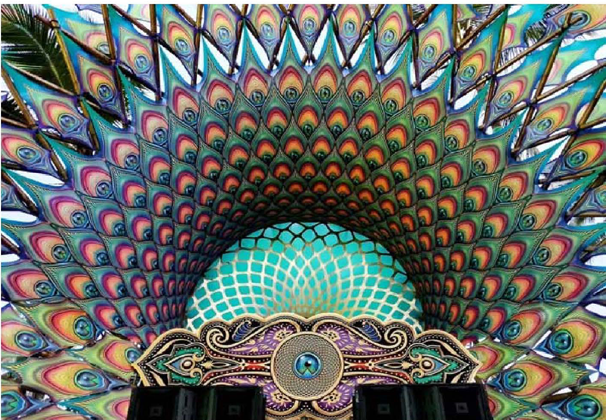
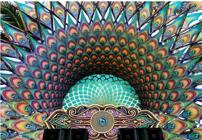
The selection of the spectacle’s theme was linked to the Festival’s theme, which used the peacock as the central symbol for the decoration of the main stage, where the performance took place. The structure was created by the renowned Artscape Deco company, from the Republic of South Africa (see Figure 1).
It can be said, in line with Silva and Torres Neto (2020) and Cavrell (2023), that the creation and presentation of O Pavão ended up becoming a site specific product, which falls within the field of Performing Arts. This is due not only to the fact that it is a spectacle created specifically to be presented in the spectacular area of the main floor of a large alternative culture festival, which imposes itself as an experience that is guided each year by a theme that guides the set of artistic elements, but also by the fact that it takes place on a specific day, determined by the presence of psydark and forest electronic music, which are characterized by sounds that refer to the dark and gloomy; the spectacle was planned to be a unique and unprecedented presentation and, to date, has not been replicated.
The spectacle’s narrative emerged from a creative process that considered a laboratory of improvisations, supported by the criteria and procedures outlined below.
In order to connect cohesively with the festival’s theme, the first criterion was to consolidate a character and establish elements that clearly refer to the peacock, throughout the entire the spectacle. To this end, action games and character creation were used as a procedure (Macedo; Gallo, 2022, p. 7).
The second criterion determined that the selection of the elements for the construction of the narrative should, somehow, absorb a social critique that refers to current environmental problems; the third and final criterion defined that elements qualified as dark and gloomy would be considered for the creation of conflicts in the scenes, which should dialog with the type of music played at that time on the dance floor. For both the second and third criteria, motivations for the actions were used as a procedure – using specific stimuli to direct the artists’ movements before and after each action and the moments of transition between each number, seeking to integrate the actions of each scene with the proposed theme, as Macedo and Gallo (2022) indicate.
The creative process followed an approach determined by a collaborative process which, in line with the words of Fischer (2010, p. 61), involves a “[...] group procedure that integrates direct action between actor, director, playwright and other artists, from a democratic perspective, by considering the collective as the main agent of creation and agglutination of its members”.
The work resulting from this approach was a sequence of fire juggling numbers and theatrical scenes, which followed a specific story, created from a dramaturgy formulated within the group itself, as a starting point.
The text highlighted the following story: ‘The bird freedom has been captured and along with it the idea a free humanity, which now lives in a dark time with no prospects. At the sight of the cage protected by the power of non-freedom, the warriors of the new dawn, who have the task of freeing it, don’t think twice: let’s get to work! Fighting with flaming sticks, swords, balls and clubs, our heroes engage in a battle in which, in the end, they release the bird of freedom. The bird, represented by the great peacock, then opens the door to the power of vision and shows universal love to all of humanity, thereby revealing the light in all of its splendor, in every corner of the universe’.
Based on the rereading of the above text, each scene was created separately and organized in a non-sequential way. The spectacle was, therefore, not based solely on a script or just a text, but, in line with Sarrazac’s (2002, p. 24) vision, a “monstrous text, a hybrid text, an ideal patchwork of written (and even unwritten) pieces”.
In short, the spectacle tells the fantastic story of two Hunters who wander through the forest with handmade traps in their quest to capture the Spirit of Nature, represented by the figure of the Peacock. After achieving the desired result, the Hunters are surprised by the Spirit of Freedom, who dreamily places the Peacock at the center of the scene, creating a situation of conflict with the Hunters. A fight ensues, interrupted by the Spirit of Freedom, who illuminates a path and places a drop of wisdom in the Hunter’ souls, transforming them into kind beings. The Peacock reappears still wrapped in the ropes and the Hunters, repentant, set him free. In the final scene, by recreating the image of a peacock, the Hunters reveal, together with the Spirit of Freedom and the Spirit of Nature, a happily better world.
The scenes were conceived to include fire juggling numbers based on routines and virtuoso tricks that were part of the groups’ repertoires, which were articulated or alternated with non-verbal theatrical scenes, with the narrative predominantly marked by the re- signification of fire instruments and the use of props. The creation focused on the construction of instruments and props, but also gave priority to the limit variable of the logic of the risk of the instrument, as a path for the creative process and the staging process.
The spectacle was, therefore, structured around circus acts and theatrical scenes that used three different groups of objects with fire: instruments, props and accessories.
Fire instruments are the actual fire juggling props: clubs, staffs, poi, dragon staff, hula hoop, diabolo, devil stick, among others, which require prolonged training in order to master the technique.
Fire props are flammable objects or costumes which, despite their possible complexity in design and construction, do not require long periods of practice before being used on stage. This group of objects includes: skirts, hats, wings, crowns, pants, trunks, necklaces and other types of prostheses or fire garments.
Accessories are a set of elements necessary for the act to happen in practice, but they are not always flammable objects. We are talking about fabrics for extinguishing instruments and props, suitably adapted containers for adding fuel to the objects, tarpaulins for positioning the instruments so that they don’t come into direct contact with the floor or stage, preventing the transfer of fuel and dirt to the surfaces. This list is complemented by blowtorches and lighters, which are necessary for igniting the fuel, as well as other types of lamps, such as oil lamps, torches, and scenic elements, which can remain lit throughout the entire act or spectacle.
The initial scene, described above, makes use of fire cages. Ordinary bird cages were selected, inside which a candle was placed, with a transparent protection against the wind. In this way, the cage could be moved around the stage without the candle inside going out. It was thought that having a candle in a cage, instead of a bird, would allow different readings by the audience; the cage also used as if it were a lamp, which illuminated the Hunters’ path, in order to broaden the possibilities of its meaning on stage.
To make the cage stand out as a stage object, a fluorescent dye was used so that its color would be accentuated in the presence of the black light and the blue LED, which would illuminate the stage and the performance area. In order to highlight a sense of inefficiency in the cage as an object with a specific function, the door was deliberately removed, meaning that the cage could in no way trap any animal. The choice to use ordinary paraffin candles with a small flame was also intentional, because, as it was an introductory scene, it was considered to start with small flames of a reduced size, which, over the course of the spectacle, would progressively increase, revealing a clear crescendo in the addition of fire, as well as numbers.
The choice to consider the increase in the amount of fire throughout the spectacle is recurrent in fire spectacles, and this is a form of assembly that contemplates the logic of the line of tension that comprises an increase in numbers that provoke tension and numbers that provoke relaxation of that tension. Bolognesi (2020) and Costa (2018) refer to the line of tension, but also Macedo and Gallo (2022), who, in addition to strengthening this position, when they say that fire juggling and risk create tension in the audience, draw attention to the fact that these performances distance themselves from representation, relating to the symbolic and the real.
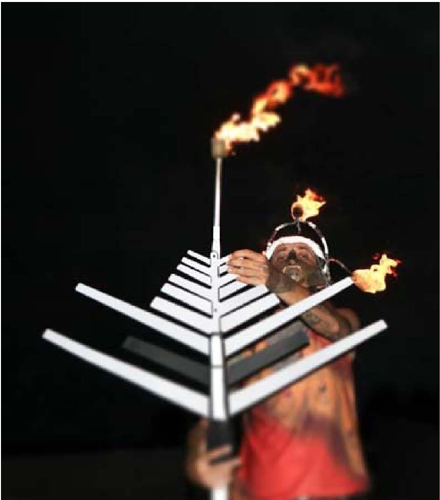
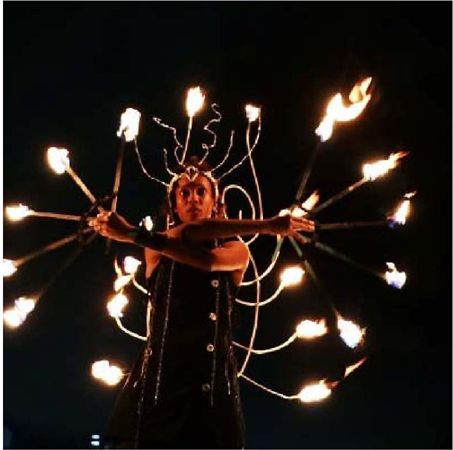
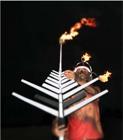
The Peacock had a scepter of fire (see Figure 2), which was designed to complement his character with an object that symbolized power and at the same time made it possible to manipulate, being intuitively associated with the instruments used in the sequence.
The choice of the scepter, as a symbol wisdom and power, fulfilled the proposed role because of its resemblance to the juggling stick, even with some manipulation limitations. In any case, this instrument could be manipulated with the basic movements of the staff, being placed at different entrances by the artist, who resumed and re-elaborated certain movements, in order to create an increasing complexity in the tricks and positions, until it was time to perform the numbers with one and two staffs.
To build the scepter, an old external television antenna were used, because of its geometry, reminded us of objects found in episodes of Star Trek, a science fiction television series from the 1960s.
The presence of fire crowns was also important in this scene; three fire crowns were built for this spectacle, all of them structured with galvanized baked wire, which was spiraled and covered, for the most part, with shiny white tubes. The choice of white tubes was a response to the need to increase the volume of the structure, to give the object greater visibility, since white stands out against the black light and blue LEDs on the pathway.
The fire of the instruments is supported by a high-temperature resistant material, an aramid strip approximately 15 centimeters long, which is attached to the central structure by means of wires and through-bolts.
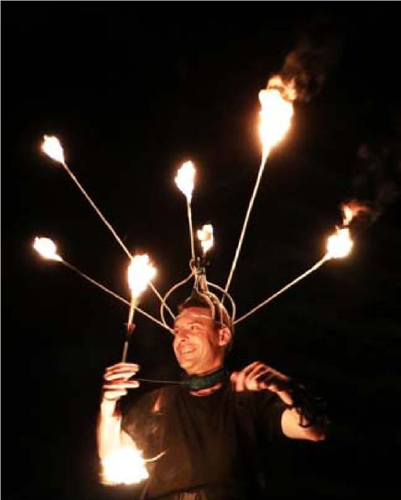
The crown had leather straps and a soft fabric to make it more comfortable for the artist. The crown worn by the Peacock (see Figure 4) was made up of three fire torches, one of which was positioned in the center and highest, with the two side torches directed slightly backwards; this figure is the result of a mixture elements that emerged from a brainstorming during the creative process, including: the crown of chess king, the horns of a faun, the hat of a jester and the small feathers on the peacock’s head, which look like antennae.
The rods that support the fire torches are approximately 30 centimeters long, a size that, in addition to providing an adequate distance from the performer’s head, has achieved greater stability and safety in the event of a sudden change in the wind, as well as making it possible to use them without the need for additional protection, reducing the time it takes to place and remove this object on stage.
A second crown, worn by the character Espírito do Liberdade (Lucas Góes), was produced using the same materials as the Peacock crown: galvanized boiled wire, shiny white tube and aramid ribbon. The design of this crown was also the result of a brainstorming, and, for its composition, priority was given to elements that relate to the feminine, including: the crown of the chess queen; the Indigenous headdress; the head of Medusa, a monster from Greek mythology; the feathers on the peacock’s head. In this case too, the crown’s barycenter was designed to be higher, so that the fire torches were far away from the artist’s head.
The third crown created was that of the Hunter, designed to be worn together with a necklace that could hold five torches; due to the amount of fire involved, it was decided that an overlapping fire would not be interesting, both for reasons of heating the prop and for the visual result, so a single torch of reduced size was added in the central position.
The crown was also made of spiral galvanized baked wire, but this time was covered with a transparent crystal tube, so that not only the volume but also the tangle and color of the aluminum rebar would show through and not be confused with the fire necklace.
To increase visibility, some details were built with colored epoxy paste and green, fluorescent paint, to stand out under the influence of the black light and blue LEDs present in the track lighting. The initial design of the crown was conceived to resemble the mohawk or punk hairstyle widely featured in the movie Mad Max, which is why the initial design involved more flaming torches, arranged in a line down the length of the head. As the number of flames was reduced to just one, it was decided to reverse the inclination of the rod, which was initially directed backwards and then turned upwards.
The group recognized that the result of the crown resembled the head of the character Gipsy, from the children’s cartoon Teletubbies, a fact that influenced the construction of the character, which involved gestures, posture, body and facial expression that ended up referring, at certain times, to the clown Augustus.
Scene 2: spirit of freedom
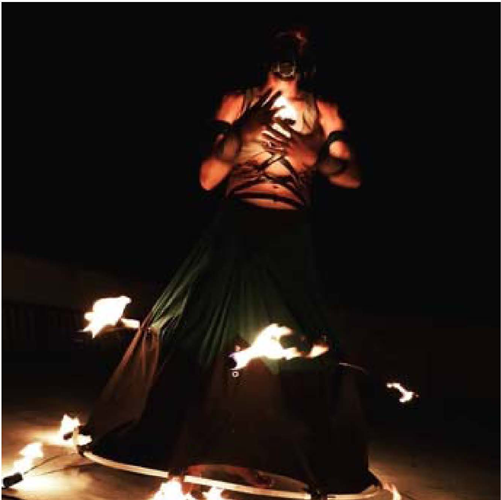
After the capture of Peacock, the Spirit of Freedom enters scene, wearing a skirt adorned with fire torches (see Figure 3), while holding another torch in his hands, he dances with undulating and circular movements, trying to express the environmental problems experienced today and the damage that nature could suffer from the capture of the peacock. He wears a gasmask to denounce the excessive pollution of the contemporary world, articulating robotic movements to represent the mechanization of everyday life. His dance is propitiatory, and calls the Spirit of Nature to the stage, who, in a dreamlike atmosphere, performs a one and two-stick routine, with an emphasis on contact and isolation tricks5.
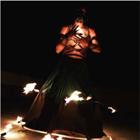
The fire skirt used in this scene was designed and built in 2017 by Cristina Macedo for the spectacle Wiking: uma Batalha Sonora (Wiking: a Sound Battle). This time, however, in order to modify the presence of this prop on stage, some adaptations were thought up. The Spirit of Freedom, who hadn’t been on stage until then, a fact that distances itself from the group’s recurring practice, which usually introduces all the artists and their characters at the beginning of the performance. Regarding this aspect, the considerations of Fo (1999) and Stratta (2000) are interesting, as they highlight that, in Commedia Dell’Arte, just as traveling performers and street artists did, it was common for artists to introduce themselves at the beginning of the performance.
The artists/characters were presented in a progression that considered the unfolding of the narrative itself, integrating a set of correlated choreographies that determined the entrances on stage: the Hunters, with their cages fire; the Peacock and his consequent capture; the Spirit of Freedom, to complete the cast’s presentation.
For this number, the fans and the crown of fire, usually worn along with the skirt in the spectacle Wiking: uma Batalha Sonora were removed, and the gasmask was added, giving her persona a dark and threatening image, which dialogued well not only with the narrative of the spectacle, but also with the psydark music played by the DJ during the performance.
The presence of the mask (we should remember that the performance took place just a few months before the start of the Covid-19 pandemic) was designed to denounce the increasing pollution and environmental problems contemporary times; placing this object on stage just after the capture of the Peacock made it possible to symbolize the consequences of human actions on wild flora and fauna. Furthermore, the use of the mask marked another reference in the scene, which is located in the movie Mad Max, whose theme is precisely the conflicts arising from the depletion of natural resources.
The fire skirt was constructed from fire-resistant nylon tubes and pure cotton fabric, which was properly fireproofed with a chemical treatment, which made this instrument, using the guidelines found in Bagai (2002), a safer material to use in the spectacle. The waist of the skirt was constructed with a quick-opening closure so that, if necessary, it could be removed immediately, allowing the artist to exit through the upper part of the garment.
The torches were attached to the nylon tube using threaded rivets, which were fixed by pressing them into the structure in a horizontal direction. These torches were built with a steel cable, which had an 8 mm threaded rod attached to one of its ends, secured with a terminal fixed using a hydraulic press. The other end of the cable received another stainless steel terminal, to which aramid tapes were screwed. This skirt has two levels, where the fire torches were positioned, seven of them on the plane closest to the ground and five in the center, making a total of 12 torches.
To ensure greater safety when using the skirt, the steel ropes that distance the flames from the fabric have been cut to more than 25 centimeters in size, so as to make it more difficult for the flames to get closer and reduce the possibility of the fabric’s temperature rising, especially in the presence of wind.
Scene 3: the fight for the peacock
After finishing the routine with the two staffs, the Hunters return to the stage to perform the fire fight, a number from the group’s repertoire, which is also present in other spectacles6. Suddenly, drops of water start to fall and quickly turn into rain. The stage becomes wet, making it difficult for the artists on stage to move, and at that moment each one is holding a fire sword and a devilstick.
The fight is interrupted by the entrance of the Spirit of Freedom, who performs a fire poi solo, with an emphasis on isolation movements. The Hunters lay down their swords and enter with a pair of poi each, and the three performers begin a partner poi routine, interacting with each other, while alternating three-beat wave movements with four-beat waves7. This interaction changes the behavior of the Hunters, who show regret for having captured the Peacock. Then the Peacock enters, wrapped in the rope and holding two small torches of fire. The Spirit of Freedom spits fire, making a large flame come out of his mouth, in tune with the moment when the rope falls to the ground, marking the Peacock’s release. The Hunters are now happy to see the Peacock free and pay tribute to him. Cristina Macedo enters with wings and fans of fire, performing movements based on the relationship between center and periphery, and Fabio Dal Gallo enters with a necklace of fire and a levistick in hand, performing a routine that prioritizes movements in the frontal plane and under the legs8.
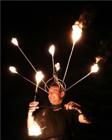
The fire necklace (see Figure 4) is a prop that develops vertically and allows it to be used in conjunction with other juggling instruments, such as a club, devilstick and others. It was built using seven-millimeter aluminum rebar, which was fitted into a structure to be supported on the back.
Aluminum is the metal most commonly used in fire instruments and props for a variety of reasons, being light, flexible, not oxidizing like iron and having a melting point high enough to manage the temperature of these types of devices.
The torches each had a 30-centimeter-long aramid ribbon attached to an eight- millimeter aluminum tube with forty-millimeter screws. The design of the necklace was intended to represent, in a stylized way, the peacock’s tail, one of the purposes of which was to increase the amount of fire for the artist who was going to perform a solo number with the levistick, which, without the presence of this prop, would only have two fire torches on stage. In this case, the use of the fire necklace highlighted the need to select movements and tricks that only used the plane middle and lower body, since circular movements, typical of the instrument’s fluctuations, could not be made above the head, as this would lead to collisions with the structure of the necklace.
To add even more fire to this scene, the crown called the Teletubbies, mentioned earlier in this article, was also added.
The fire wings emerged from a project partially conceived by the group in mid-2018, and were built specifically for this spectacle, being an unprecedented piece that was entirely conceived, designed and realized by the members of the group (see Figure 5).
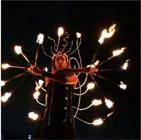
The structure was made of seven-millimeter aluminum rebar, which was manually bent with occasional assistance from a lever-type tube bender. To keep the wings suspended on the back, a PVC and faux leather structure with straps was built, to which the two actual wings were attached using 1.5 mm diameter screws, secured with nylon locknuts. Each wing is divided into three additional parts: one vertical section and two horizontal ones, all connected by screws and nylon locknuts that pass through precisely drilled holes in the aluminum rebar.
The nylon locknut was chosen to prevent the vibrations of the prop during the scene from accidentally opening the nut and causing the piece to come off. In order to increase the contact surface between the two points of the round tubes, which for this reason had the area around the hole was sanded, thus creating two flat surfaces for greater contact between them.
These wings make up a relatively large structure – more than a meter high and almost a meter and a half wide – but an interesting feature that can be highlighted is the fact that it has been designed so that it can be dismantled into seven different pieces, in order to reduce space when moving and ensure greater protection for the object itself. It is worth noting that even though the material used to build the wings (PVC and aluminum) allows for a restricted weight load, it is suitable because it is heat and fire resistant.
The fire was attached to the wings by means of aluminum tubes two hundred millimeters long and eight millimeters in diameter, which press fit into the main structure of the wings, which has a smaller diameter. The flammable fabric, which in this case was also aramid tape, was attached to one end of the tube using two 40 mm X 2.5 mm stainless steel screws, which passed through the fabric on one side, the entire length of the tube and a further 75% of the fabric on the other side.
This method ensured that the flammable fabric did not move from its fixed location at any point during the performance; this technical specificity is a redundancy that demonstrates how the props and instruments built by the group are always designed to ensure maximum safety during use.
One point to note is the design chosen for the wings. Despite being aware that the wings should represent a bird in the spectacle and refer to the peacock, symbol of the festival’s theme, it was decided that the prop should result from a mixture reminiscent of the wings and antennae of a butterfly, in order to be able to associate it with the group’s name, Taturna Circus. Taturna is an Indigenous name meaning fire caterpillar, but it also involves the meaning of metamorphosis and the transformation of the larva into a butterfly.
Scene 4: the release of the peacock
The Hunters position themselves on the stage. One positioned more to the front and the other closer to the center; the Peacock and the Spirit of Freedom stand on the sides, each holding a staff and performing a choreography of wavelike movements in the vertical plane, symbolizing the peacock’s wings in flight. The spectacle ends with a static image representing the great bird of fire, while the movement of the flames in the wind is the most evident on stage. One Hunter is crouched down in front, representing the Peacock’s head, the other Hunter with the Peacock and the Spirit of Freedom remain on the sides of the stage, this time extending the Peacock’s wings. At this point, the rain becomes torrential and, surprisingly, the amount of water on the stage increases rapidly, beginning to soak the instruments and props which, as the temperature cools, are extinguished. The artists are forced to end the spectacle a few minutes early. They thank the audience and leave through the back of the stage9.
In this last scene, the juggling instruments and props collaborated to create a single figure, which was important for the end of the spectacle, involving a progressive increase in fire on stage. In contrast to the initial scene, in which only two artists appeared with a few objects, now all the artists are on stage, each with a different object and prop, creating a single large image.
The presence of rain interfered with the spectacle, so that it had to be interrupted ahead of schedule. This was a factor that led to the immediate modification of the actions on stage, compared to those that had been planned. This point obviously amplifies the importance of considering other limit variables when dealing with fire juggling, as Gallo and Macedo (2023) rightly point out, such as the irregularities of the space and specific improvisation, but these are subjects to be analyzed in a future article.
Conclusion
The limit variable of the logic of the risk of the instrument is an essential and priority element that must be considered in the processes of creating and staging fire juggling spectacles and be understood within a process that involves the design, construction and handling of fire instruments and props, which therefore need to meet the logic of the risk of the instrument. It may seem like a redundancy, but this point is fundamental to determining and predicting risk factors and increasing the safety of the artists involved in a fire spectacle and the audience watching it.
In the spectacle O Pavão (The Peacock), the articulation of instruments and fire props, considering the logic of the risk of the instrument, promoted the creation of a narrative that dialogued with the theme of the event and the specific context of the performance.
The presence of fire on stage followed an increasing progression, delineating a line of tension constructed in such a way as to alternate numbers marked by the pursuit of virtuosity with scenes in which the focus shifted to the narrative and theatrical elements, placing the relationship between the tension and relaxation as a constituent part of the spectacle, revealing a construction typical of circus spectacles.
Notes
-
1
Juggling instruments that are part of the so-called Flowarts. The levistick consists of a staff that is supported by a wire that allows manipulation and creates the illusion of the instrument floating in the air. The dragonstaff is a staff with fire supports attached perpendicularly to its ends, which are driven by rotating movements on the main shaft.
-
2
Field journal, of a reflective ethnographic nature, written between January and February 2020, by Cristina Alves de Macedo and Fabio Dal Gallo, based on the dramaturgy of the spectacle.
-
3
Field journal (2020, p. 3).
-
4
Available at: https://www.artescape.co.za/stage-structures/universo-paralello-festival. Accessed on: Nov. 02nd 2023.
-
5
Field journal (2020, p. 3).
-
6
For more information on fire sword fighting, se: Gallo and Macedo (2023).
-
7
Typical movements of double poi, in which the artists interact with each other by exchanging the poi’s passing planes. For more information on these movements see: https://www.youtube.com/watch?v=1-NC8D8CThE&list=PLGRWu2f31dFXPgBQdiPmzpFNIP2kRAgGt&index=2 and https://www.youtube.com/watch?v=APS-8UIEkIQ&list=PLGRWu2f31dFXPgBQdiPmzpFNIP2kRAgGt&index=3. Acesso em: 22 nov. 2023.
-
8
Field journal (2020, p. 3).
-
9
Field journal (2020, p. 3).
-
This original paper, translated by Thuila Farias Ferreira, is also published in Portuguese in this issue of the journal.
Availability of research data:
the dataset supporting the results of this study is published in this article.
References
- BAGAI, Eric. Fire safety for jugglers. North Hollywood CA: Forework Publisher, 2002.
-
BOLOGNESI, Mario F. Do Teatro de Feira ao Circo Moderno. Revista Brasileira de Estudos da Presença, Porto Alegre, v. 10, n. 4, 2020. Available at: https://seer.ufrgs.br/index.php/presenca/article/view/93237. Accessed on: Mar. 29th, 2024.
» https://seer.ufrgs.br/index.php/presenca/article/view/93237. -
CAVRELL, Holly Elizabeth. O Corpo e o Espaço: real e imaginário - Reflexões sobre site-specific. Revista Brasileira de Estudos da Presença, Porto Alegre, v. 13, n. 2, 2023. Available at: https://seer.ufrgs.br/index.php/presenca/article/view/129232. Accessed on: Mar. 5th, 2024.
» https://seer.ufrgs.br/index.php/presenca/article/view/129232. - COSTA, Eliene Benício Amâncio. Saltimbancos Urbanos: O circo e renovação do teatro no Brasil 1980-2000. São Paulo: Perspectiva, 2018.
- FISCHER, Stela. Processo colaborativo e experiências de companhias teatrais brasileiras. São Paulo: Hucitec, 2010.
- FO, Dario. Manual Mínimo do Ator. São Paulo: SESC, 1999.
-
GALLO, Fabio Dal; MACEDO, Cristina Alves de. Malabarismo de fogo: uma etnografia entre imaginário e simbólico. Urdimento: Revista de Estudos em Artes Cênicas, Florianópolis, v. 1, n. 46, 2023. Available at: https://revistas.udesc.br/index.php/urdimento/article/view/23019. Accessed on: Mar. 5th, 2024.
» https://revistas.udesc.br/index.php/urdimento/article/view/23019. - GUERRA Matos Antônio; COELHO, José Augusto; LEITÃO, Ruben Elvas. Fenomenologia da combustão e extintores. Sintra: Escola Nacional de Bombeiros, 2006.
- JUNIOR, Abel Batista Camillo. Manual de prevenção e combate a incêndios. São Paulo: Senac, 2022.
-
MACEDO, Cristina Alves de; GALLO, Fabio Dal. Odisseia dos sentidos: um espetáculo de luz e fogo. Urdimento: Revista de Estudos em Artes Cênicas, Florianópolis, v. 1, n. 43, 2022. Available at: https://revistas.udesc.br/index.php/urdimento/article/view/20482. Accessed on: Mar. 5th, 2024.
» https://revistas.udesc.br/index.php/urdimento/article/view/20482. - NASCIMENTO, Maria Helena Cassago. Determinação do ponto de fulgor e pressão de vapor Reid em petróleo por HTGC e DHA associados à Quimiometria. 2018. 121 f. Dissertation (Master’s in Chemestry) – Chemestry Graduate Program, Universidade Federal do Espírito Santo, Vitória, 2018.
- NESS, Sally Ann. Dancing in the Field: notes from memory. In: FOSTER, Susan Leigh (Ed.). Corporealities: dancing, knowledge, culture and Power. London; New York: Routledge, 1996. p. 129-154.
- SARRAZAC, Jean-Pierre. O Futuro do Drama. Porto: Campo das Letras, 2002.
- SILVA, José Jackson; TORRES NETO, Walter Lima. Considerações sobre o conceito de site-specific no Teatro Brasileiro. Urdimento: Revista de Estudos em Artes Cênicas, Florianópolis, v. 2, n. 38, Aug./Sep. 2020.
- STRATTA, Paolo. Una piccola tribú corsara. Il teatro di strada in Italia. Torino: Ananke, 2000.
-
Editors in charge:
Eliene Benicio Amâncio Costa; Mario Fernando Bolognesi