
 From one audible past to another, the same listening protocol?
ABSTRACT
From one audible past to another, the same listening protocol?1 – To initiate scientific dialogue between the members of the project L'écoute du théâtre [ECHO] (UMR THALIM) and the team Arquivos Sonoros de Teatro (University of São Paulo and FAPESP-São Paulo Research Foundation), this article addresses a delicate question that the Franco-Brazilian partnership can illuminate: to what extent can the concepts and methods of Sound Studies and French work on sound facilitate understanding of other cultures, while enriching understanding of one's own? Taking into consideration Sterne’s own reflections in his book, The Audible Past, I shall call on our extensive experience to propose the beginning of a response and a work program.
Keywords:
Cultural (history); Listening; Scientific (method); Sound (archive); Theater (sound of)
RESUMO
De um ‘passado audível’ a outro, um mesmo protocolo de escuta?1 – Para estabelecer o diálogo científico que se inicia entre os membros do projeto francês L’écoute du théâtre [ECHO] (UMR THALIM – CNRS/ENS/Université Sorbonne Nouvelle) e a equipe da pesquisa Arquivos sonoros de teatro (FAPESP/Universidade de São Paulo), este artigo aborda uma questão delicada que poderá ser elucidada pela contribuição dessa parceria franco-brasileira: em que medida os conceitos e métodos dos Sound Studies norte-americanos e dos estudos sonoros franceses podem ajudar a tornar audíveis outras culturas e serem ao mesmo tempo enriquecidos por elas? Considerando as reflexões do próprio Sterne sobre a sua obra, The Audible Past (O passado audível), parto de nossa já longa experiência de pesquisa no tema para propor um início de resposta e de um plano de trabalho.
Palavras-chave:
História Cultural; Escuta; Método Científico; Arquivos Sonoros; Som (teatro)
RÉSUMÉ
D’un passé audible à un autre, un même protocole d’écoute?1 – Pour amorcer le dialogue scientifique qui doit s’instaurer entre les membres du projet L’écoute du théâtre [ECHO] (UMR THALIM) et l’équipe d’Arquivos Sonoros de Teatro (Université de São Paulo/FAPESP), l’article aborde une question délicate que le partenariat franco-brésilien pourrait contribuer à éclairer : dans quelle mesure les concepts et les méthodes des Sound Studies et des études sonores à la française peuvent-ils aider à rendre audibles d’autres cultures, et en être eux-mêmes enrichis ? Après m’être référée à la réflexion de Sterne lui-même sur son ouvrage The Audible Past, je solliciterai notre expérience déjà longue pour proposer un début de réponse et un programme de travail.
Mots-clés:
Culturelle (histoire); Ecoute; Scientifique (méthode); Sonores (archives); Théâtre (son du)
As Jonathan Sterne’s readers will have understood, the title of this article refers to that of The Audible Past (2003), which has asserted itself as a major text in the field of Sound Studies (in French, ‘le champ des études sonores’). This apparently simple expression, “the audible past”, plays on two possible readings of the adjective: physically perceptible by hearing, or able to be “heard” in the sense of being understood within what was its own reality. This semantic dichotomy introduces the reader to what constitutes one of the important propositions of the book, presented by the author in the introduction:
We can listen to sounds recorded in the past, but we cannot claim to know exactly what it was to hear them at a particular time or place in the past. In the era of technological reproduction, we can sometimes experience an audible past, but we can only presume the existence of an auditory past (Sterne, 2003, p. 19)2.
The disturbing effect of the sound document. What do we imagine of the past?
I have often quoted these two sentences, because they enlightened and accompanied our first listening experiences, when we undertook, more than fifteen years ago, in Montreal and Paris, pioneering research into theatrical recordings3. On hearing very old cylinders (such as those of Sarah Bernhardt, studied by Melissa Van Drie [2011, pp. 46-50]), but also less remote documents (such as audio recordings from the 1950s to the 1960s at the TNP [Théâtre national populaire], the lovely images of actors at work made us feel closer to them), we felt a sense of strangeness, triggering curiosity, embarrassment, smiles, laughter or boredom, often accompanied by questions about what the reactions of listeners of the time might have been. As if the sensation of the present moment, automatically triggered by the capture of a sound event, even if it was recorded – the sound is always “in the present”, to use the words of Daniel Deshays – prevents modern listeners from thinking of these events as belonging entirely, listening included, to a certain bygone moment, even though, due at least in part to the temporal switch, the historical specificity of the sound is obvious to the ear. Given the fantasmatic power of acousmatic sounds – which all audio documents are – these listeners also had trouble distinguishing between what was objectively heard and what was already part of their interpretation. The disappearance of old recording devices, such as the tape recorder and the electrophone, with their manipulable media, tapes or disks, in favor of computers and dematerialized files, has accentuated the more general tendency to abstract sound from any social temporality. “As if the sonic dimension of human life inhabited a space prior to or outside history” (Sterne, 2003, p. 19). A significant detail: in the rare cases where theater specialists resorted to audio documents, they did not give references, and paid little attention to proper dating.
These phenomena led us to reflect on the “past”, on what this word meant to us; on its significance for us, which was mainly visual and intellectual. It was not enough to know, in fact, that a sound was recorded in a certain period for us to situate in within what we imagine of that era. Finding a way to achieve this was not impossible, and we will come back to it, but we still need to understand the problem which presents itself... The historian Alain Corbin, whose work we discovered at the same time as that of Jonathan Sterne, pointed out in one of his works devoted to the nineteenth century, Village Bells: Sound and Meaning in the 19th-century French Countryside, our inability to conceive that the people of yesteryear could have had a completely different auditive relationship with what was not yet called their ‘environment’ than that which we have now, and more generally our narcissistic inability to ascribe to those who preceded us reasons very different from our own for their actions and their lives.
If the reading of sounds that I have here called an ‘auditory landscape’ has disappeared it is because we have failed to listen in all humility to the men of the past with a view to detecting, rather than dictating, the passions that stirred them (Corbin, 1999 [1994], p. XX).
Being aware of these obstacles, and benefiting from the presence in our team of several disciplines (film studies, media history) which had already dealt with them, we undertook to treat ‘the sound of the theater’ and in particular the stage voice, through an approach different from that currently dominant which, aside from a few exceptions such in studies of historical acoustics and in scattered work on a history of diction, was ‘atemporal’. Significantly, the Introduction of the book Le son du théâtre (Theater Sound), in which we brought together the work done during the study sessions and symposiums of the project, is headed: “Composing with sound: historicizing, listening, writing”. The order in which the three tasks were presented reflected the priority given to the historian approach as it had been organized, “between the history of techniques (including intermediality), cultural history (particularly the so-called ‘History of Sensibilities’) and the history of the performing arts (starting with that of cinema)” (Larrue; Mervant-Roux, 2016, p. 9). Once again, the chosen order made sense. Apart from a first “reduced” listening, to use Pierre Schaeffer’s term – that is to say carried out without any prior information – which we had chosen to recommend wherever possible, the hearing of the document, in reality a series of hearings of the document, had to be accompanied by a long process: establishing the precise circumstances of the recording, identification of the theater and its acoustics, the sound transformation devices on stage, etc. as well as of the performance itself, its casting, its own history. But that’s not all. Due to the social nature of the theater, it was also necessary to ascertain the general auditory and sociocultural context, which could include, for example, listening to other voices and sounds of the time. Finally, each listening episode had to be recorded immediately in writing, otherwise the sounds heard would be lost, because the next experience of hearing them would be different. The practice of these three techniques, applied to phonograms4 of very different formats, ages and contents, made it possible to develop a general proposal for a working protocol (Mervant-Roux, 2013, p. 165-182).
From the research carried out at this exploratory stage, I will mention three examples for the exemplary way in which they documented theatrical sound by inscribing them within a general framework of listening: that of Agnès Curel, who studied in her thesis the voices of fairground hucksters – voices essentially prior, let us emphasize, to the invention of the phonograph (Curel, 2016; to be published in 2025), and those of Jeanne Bovet and Bénédicte Boisson, who brought to light two famous plays, supposedly well known to specialists: The Flight across the Ocean (1929), and The Cenci (1935) (Bovet, 2016, p. 315-328; Boisson, 2016, p. 247-260).
The subsequent ECHO project focused on the so-called “spoken” voice in French and Francophone theater from the post-World War II period, from the 1950s to the 1990s. It exploited and refined these methodological principles. First, via a program in which four participants listened to about a hundred recordings (about 500 hours of listening), a corpus was progressively defined which included objective measures (the duration of the project, the number and nature of the phonograms kept at the BnF, the national library of France) and scientific criteria (some of the shows had to have been produced at the two theater halls chosen for the study, the Palais de Chaillot and the Théâtre de l’Athénée, all had to be representative of the period). Second, in the use of some of these archives by members of the group working on their own subjets (theater and cabaret, theater and radio...). Finally, the collective development of educational ressources for the general public, including real listening exercises, accompanied by relevant documentation. Since I cannot go into all the details of this undertaking here5, I will concentrate on what we have called the “writing” of the corpus listenings. It consisted of filling in several standardized index or note cards, the number and functions of which took time to be decided upon. There ended up being four cards for each item: a summary of the phonogram according to the rules of the BNF catalogue; a concise description of the sound document, supplemented by an inventory of the sources and references used for its evaluation; a survey, ideally exhaustive, of all the sounds (voices, noises and music) to be heard in the representation (stage and theater hall), carried out over a more or less long extract of the work; and finally, the personal comments of the listener.
The main aim of the ECHO project was the rediscovery of sound archives, in partnership with the BNF’s Performing Arts Department, where they were held. This was accompanied by two other tasks that explored, in different ways, how the sounds would have been heard originally. One of these tasks, carried out by a team of acousticians and computer scientists from the LIMSI-CNRS, another official partner of ECHO, in dialogue with an architect specialising in theatrical venues, Sandrine Dubouilh, consisted of reconstructing the architectural and acoustic history of the auditoria of the chosen theatres and developing, from this reconstruction, digital acoustic models in which one could hear objectively variations of the same sound sequence according to the period and the place occupied by the listener6. The other was conceived and directed by the anthropologist Hélène Bouvier, who had long worked on performing arts in Indonesia. It consisted of organizing and recording oral interviews with spectators from the time and the theaters studied, then deciphering and analyzing them. About twenty interviews were conducted7. This was an example of the living memory of those who had lived through the study period: the emotions they had experienced, “the passions that stirred them”. Finally, testimonies from several generations of managers and technicians were collected by Daniel Deshays, both practitioner and intellectual, and who has been with us since 2008. Through this we explored the technical and professional aspects of stage management, extending to the creation of the sounds of the productions, from those who had also been the first listeners of these sounds.
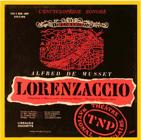
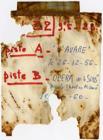
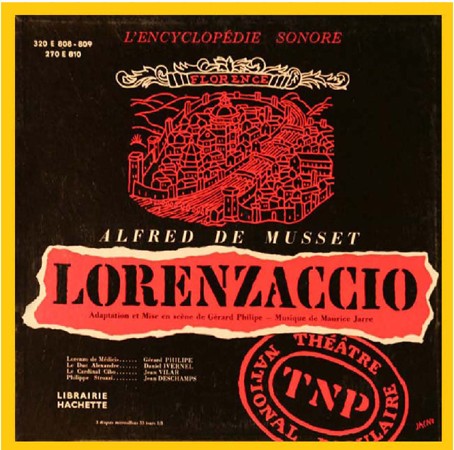
This interdisciplinary project has changed the perception of this period of theater art, but also, and what interests us here, the appreciation of sound documents and their original, even irreplaceable, contribution to research. I will mention two cases where the auditory examination of archives which, as was the case for all those we listened to, were up until then dormant, triggered investigations and discoveries that no one had foreseen: the listening by Noémie Fargier, then a doctoral student, of Musset’s Lorenzaccio directed by Gérard Philipe, recorded at the Palais de Chaillot on November 27, 1954 with an audience composed of employees and workers of the Renault factory8, and the listening by Pascale Caemerbeke, a recent PhD, of Molière’s The Miser staged by Vilar in the same hall, during its revival in 19569. In the first case, it was inconsistencies in the onstage sounds, in the second, noises coming from offstage, which attracted the attention of the listener. In order to understand what had happened, we had to make use of a wide variety of documents: administrative files and private writings used to follow the production of the disc (for Lorenzaccio) (Image 1) and the production of the recording (for The Miser) (Image 2), supplemented by technical documents on the theatrical scene and testimonies from spectators, to which was added, each time, a recording of the show made on a different date. Beyond the productions themselves, we were able to bring to light aspects of the social activity surrounding the theater, in a way different from the usual conventions of sociological studies. In 1956 the microphone did not capture The Miser as a work “staged by Jean Vilar” as an audiovisual recording would have done, but rather the theatrical event as a whole, including both stage and audience; as for Lorenzaccio, the recordings of several events (between 1953 and 1955) had been edited together to transmit the event of “the Renault night” more “faithfully” to the listeners of the box set.
“The plurality of audible pasts”: rereading Sterne’s book
The choice, in the present article, to speak of two “audible pasts” is consistent with the reasonable hypothesis that the archives of Tunica Teixeira (1949-2012), Sao Paolo’s great sonoplasta, around which the “Sound Archives of Theatre”10 project was organized, keep trace of a very different history to the one that the ECHO project allowed us to rediscover, even though the period is the same (the second half of the 20th century), and even if there were many cultural transfers between the two worlds. The story behind ECHO’s sounds was fundamentally French (and European) and more broadly, Francophone. Taking this difference into account we could question how the knowledge acquired in France could apply to the research group which will start it’s work in Brazil. In their introduction to the dossier History and Sound Culture: the Historicization of Listening and Sounds published last year in Revista de História, the authors distinguish three major trends in the contributions:
[…] the anglophone Sound Studies, the History of Sensibilities of French tradition and Latin American studies, which, although inspired by the previous two, strive not to confine themselves to classical discussions but to reflect on the specificities of sound production and modes of listening within their cultures (Bessa et al., 2023, p. 1; my emphasis).
I will make two brief comments on this, in order to indicate the complexity – greater than one probably imagines – of the Franco-Brazilian dialogue. The first comment is inspired by what happened as part of the “Theatre Sound/Le son du théâtre” project. When French and Quebecois researchers heard the proposals of Sound Studies in 2007, which originated in Anglo-Saxon and especially North American culture, they enthusiastically jumped into the fray, using the proposals as a basis to develop original questions and time divisions, in order to focus on relating to their national and auditory culture. The second comment arose from a question about the term “classic” used about Anglophone and Francophone debates. It would seem that this “classicism” doesn’t suit the particular case of South America. However, within the French-speaking field, and even just the French field, there is a diversity of oral cultures that has been a subject of research and that we have studied. This is immediately apparent in the theater, notably starting with the accent. The section of our pedagogical website dedicated to this question: “analyzes the relationship of the French scene to non-academic accents: popular, regional or foreign, in a context marked by hexagonal centralization, decolonization and globalization. It makes it possible to closely reinterpret a history in which the esthetic dimension permanently changes according to socio-political criteria, which can be observed on several levels”11. This conception of history applies to all of ECHO’s work.
Before I make a proposal for a joint enterprise, using examples from each of our projects in order to examine the idea that each past would require a suitable methodological and theoretical approach; let us first return to The Audible Past, a “classic” of Sound Studies that deals, in a brief but perspicacious way, with this question.
Pluralizing the title chosen by Jonathan Sterne, that is to say remembering that there are several different pasts, means focusing on the few pages of the book which mention those pasts which it doesn’t directly deal with; these several pasts are alluded to under the subtitle “Cultural origins of sound reproduction” which reminds us that it is the Western world (the United States and Europe) which, by inventing the first recording techniques, fixed and preserved those other pasts, for better or for worse.
It examines the social and cultural conditions that gave rise to sound reproduction and, in turn, how those technologies crystallized and combined larger cultural currents. […] Capitalism, rationalism, science, colonialism, and a host of other factors […] all affected constructs and practices of sound, hearing, and listening (Sterne, 2003, p. 2).
On the cover of the French edition, where the title is no longer The Audible Past, but Une histoire de la modernité sonore (A History of Modern Sound), a formulation in the spirit of the subtitle which has also disappeared, the original photograph – of employees at their desks in an office, equipped with headphones – has been replaced by that of an indigenous North American chief sitting in front of a phonograph’s horn, illustrating “the drive to build and fill phonographic archives with the sounds of ‘dying’ nations and cultures” evoked in the Introduction (Sterne, 2003, p. 27). The new cover and its image underline the ambiguous nature of a “modernity” that is both scientific and violently domineering. The discrepancy between the two presentations of the same text raises an interesting question: does the interest of the book lie primarily in pointing out how the West has stolen other pasts, as the French cover suggests, even though this question, admittedly recognized as important, occupies little space in the book? Or does it lie in the scholarly account of a chapter of technical history with multiple components and implications of apparently universal significance? The last paragraph of the Introduction argues for the second answer. First, says Sterne, the subject matter is of interest in itself:
While acknowledging the plurality of possible audible pasts, this book outlines some common bases for modern sound culture in the West—especially around practices of sound reproduction. It is doubtful that they are truly universals, but they are sufficiently general to be worth considering (Sterne, 2003, p. 29, my emphasis).
Second, he says that his work is part of a necessary undertaking that requires enrichment, especially by works that criticize and amend his own: “As always, there are other histories to be written. We will have to write them in order to know if they fundamentally challenge my conclusions here” (Sterne, 2003). Concerning the particular question of the differences between the pasts and the temporal model that could accommodate them – this would obviously not be the arrow of modernity – he indicates “that the history of sound contains multiple temporalities and a variety of intersecting chronologies” (Sterne, 2003, p. 341), which he himself wanted to present in his contribution. At the very end of the book, Sterne adds another argument in favor of the scientific interest, and therefore the universality (the term is not used), of his study:
Nobody can predict the future with any certainty, but this much is sure: changes in the form and consistency of sensory experience are bound up in much larger social and cultural transformations. This book has explored one such conjuncture between sensory transformation and social transformation. It happened before; it could happen again (Sterne, 2003, p. 351).
It is because the author has produced what he would like to find more often in Sound Studies: an effort to reach “a more general level of questioning” (Sterne, 2003, p. 4), that The Audible Past, in presenting an account only localized and featuring primarily elites, constitutes, if not a model, at least a reference for any other studies of sound which intend, like his own, to become seminal works on the state of the world. Whatever past could be described and analyzed, what is important for Sterne is primarily the scientific nature of the research, which must then be complemented by a philosophical examination of the findings. However, if we accept the hypothesis formulated in “History and Sound Culture” that the scientific approach suitable for each culture has a certain uniqueness, it would seem useful to record our own experiences of the location and nature of this specificity. One lesson we can already learn from our own is that this specificity is often introduced by the sound archives themselves.
A metatheoretical addition to the Franco-Brazilian partnership? The study of the origins of the projects and their real scientific momentums
Historians, as individuals and as a group, are not external to the society in which they live: the questions they ask, even when they consider them “purely historical”, are always colored by problems of their time. As a result, these questions are generally interesting to the society in which they are located (Prost, 1996, p. 90).
Following the heuristic perspective indicated by Jonathan Sterne, applied to the research process itself, one could imagine that between the French researchers who participated in the projects on the sound of the theater and the contributors of “Sound Archives of Theatre”, a sort of meta-theoretical annex to the already programmed exchanges could be organized. It would consist of examining how these projects were conceived at their origin, and how unforeseen factors played out (in the first case) or might play out (in the second case) their scientific trajectory. The key moment, I wish to stress, is when traces of the past, acknowledged yet mute, become significant “documents”, within a process of questioning which itself is under transformation. Our experience seems to show 1) that the role of cultural factors can be important at this stage and 2) that this role is revealed rather than being decided upon. Researchers experience it far more than they narrate it.
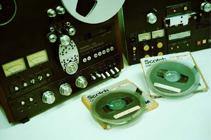
Before discussing in detail the beginning and the scientific redefinition of the French project, I will summarize for the reader to keep in mind the goals initially set for the project Sound Archives of Theatre, the general objective of which is the study, pioneered in Brazil, despite the existence of the notion of “sonoplastia” (Uhiara, 2011) of treating the sound dimension of theatric performance “as a whole”. In the presentation of the program as it appears in the application, only the first two lines of research directly concern the scientific research itself, but the other two contribute to the definition of a global perspective.
Given the extension of the work, our multidisciplinary and multinational team, with experienced and pioneer researchers in the area, is organized around 4 axes of work: a first dedicated to the vocabulary and concepts of the sound of theater; a second, to the study of the sound creation process, in order to understand which documents are generated, by which agents and how to interpret them; a third, to the study of the constitution of multimedia collections, which interrelate documents in different media, and, finally, a fourth and last axis is focused on the use of sound files on stage and in creative processes, a study that aims to bring the archives and the technical and artistic communities closer together (Uhiara, 2022).
Not knowing the content of the archive bequeathed by Tunica, and knowing almost nothing about the organization of the research, the archival institutions and the history of theater in Brazil, I cannot anticipate any questions and suggestions that my account might generate by comparison.
How did the ECHO project (2014-2018) come about? Since its emergence cannot be separated from the results of the previous project, it is with the birth of “Theatre Sound/Le son du théâtre” that we must begin.
Without the arrival in France of Melissa Van Drie, who had studied musicology in the United States, without the thesis project she had conceived and which I agreed to direct (Van Drie, 2010), without the decision to participate together, out of our sympathy with the group that had invited us, at the 2007 Montreal symposium (on the relationship of theater with new technologies), without the seemingly insignificant remark (made by whom?) concerning the small number of presentations dedicated to sound, without the eureka moment produced by this remark, nothing would have happened. Later we sometimes had fun humorously recounting these sudden developments – “Damn it, but of course!”12 –, In 2009 I undertook a more serious reconstruction of our beginnings, at the invitation of Pascale Goetschel, a cultural historian, intrigued by the interest which Theater Studies was taking in sound archives to which other human sciences, starting with hers, had paid little attention. Her first question was: had the sound archives which we were the first to listen to been hidden? At the BnF, the Department of Performing Arts held officially 9500 sound documents, duly inventoried13. The Audiovisual Department, which came out of the Phonothèque Nationale, presented in its catalogue a collection of about one million sound recordings, many of which concerned the theater. Among the oldest are records from the Archives de la parole (Spoken word archives) created in 1911, the historical and institutional foundation of the collection. At the Institut national de l’audiovisuel (INA), the guide entitled “Theatrical resources of the Inathèque of France” highlighted audiovisual recordings, but also mentioned radio broadcasts. Not to mention the funds of the Comédie-Française and those amassed by various private collectors. References to these many recordings were available. For practical reasons, they were not showcased: how to widely distribute for consultation tapes or discs for which there were no convenient reading devices and which were often unique and fragile? Could this relative discretion explain why researchers in Theater Studies (a discipline originating in the late 1950s) never, or almost never, consulted them? The answer is no. If we wanted to hear a document, especially from radio, it was possible to do so. I had personal experience of this. In addition, documents on paper concerning the sound dimension of the theater (sound management’s handbooks, radio editing diagrams, etc.), which did not pose the same problems of consultation, had not been taken advantage of either. These archives had been less hidden than forgotten (Mervant-Roux, 2014 [2009], p. 37-45). A phenomenon of a completely different nature.
In reality – and realizing this would help us give a more precise date for this forgetfulness – the first generation of theater theorists did attach importance to theater recordings. Jacques Scherer, founder in 1959 of the Institut d’études théâtrales de la Sorbonne (IET, Institute of Theater Studies at the Sorbonne), anticipated a pedagogical usefulness for the sound recordings that he contributed, alongside books and iconographic documents, to the library of the IET, material that he himself already used in his courses. Another important academic, André Veinstein, who was very interested in radio, was active in the same sense within the BnF. But this period was brief and was quickly forgotten. However, these sound archives have mostly been preserved, that is to say, kept physically intact. They were able to wait for someone to pose them a question.
There is no document without a question. It is the historian’s question that elevates the traces left by the past into sources and documents. Before a question is posed to them, the traces of the past are not even perceived as possible traces of anything (Prost, 1996, p. 81).
To sum up: There have long been audio recordings available in our field and they have on occasion been used, but these uses have not given them the status of “historical documents” in theater studies, because the questions asked of them were not adapted to their nature: either they did not take into account that phonograms are essentially a sonic medium (the recording of a play was for example used simply to check whether the text read by the actors accorded with the official “stage version” of the script), or because the depth of analysis was insufficient (for example, studying the radio version of a work, or an outstanding oeuvre of a sound-artist). Our question since that initial evening conversation in 2007 has been: “Why are we not more interested in the sound and auditory dimensions of the theater taken as a whole”? And the complementary question, formulated a little later, when we became aware of the complete neglect of audio archives in research, has been “Why is it taken for granted that these archives can say nothing about the reality of theater?” These questions have been powerful enough to make us rethink our judgement and consider, on the contrary, archival sound material to be precious remnants of theatrical reality, which allowed us to perceive in a way different from before not only classic performances, but all performances, from the most remote to the most recent. The cogency of these two questions, apparent first of all to us alone, triggered the rapid development of an international collaboration, the acceptance of the project by two major research institutions, one in France, the other in Quebec, followed by a meeting of about thirty researchers from several disciplines and eight different countries for several years of intense work. The real issues that we would grapple with turned out to be commensurate with the extent of the silence we had observed. They went beyond the field of theatrical aesthetics, and even, as we shall see, the area of theater studies: taking into account this material as legitimate archives of the theater not only mean having new resources for the analysis of stage productions, but enabled us to examine how contemporaries had recorded the history of recent European theater, and the way in which they had thought about it. As soon as we considered it, and even taking into account the overall difficulty, shared by all the human sciences, of dealing with the phenomenon of sound, it became evident to us that the erasure of the acoustic dimension and the neglect of the auditory records in the description of theatrical events, first seemed incomprehensible, this art having itself been based (in the West - only Western theater concerns us here) on the voices of the actors, the music of the choir, the capacity of the auditorium to allow them to be heard, and not only to be seen. This neglect of the audible traces of the theater, which can be dated to the 1970s, could only be explained by the preference now given to the visual, or to the nonverbal body. Audio archives of theatric productions, considered to be closely linked to the playscript itself, were erased under the effect of the dynamic movement of empowerment by which the second generation of Theater Studies severed its historical link to literary studies, adopting a scenographic and plastic conception of staging, and subjugating noises and music within a fundamentally visual paradigm.
The rest is history. Questions of vocality and orality have logically gained importance in our work (Bovet; Larrue; Mervant-Roux, 2011; Larrue; Mervant-Roux, 2016, p. 391-500). On this subject – as for others – there remained much to do at the end of the project. ECHO extended Theatre Sound/Le son du théâtre in this particular direction14, refocusing on France (and the French-speaking world) and on the second half of the 20th century.
The ECHO project approached theatre as a space organised by and for the spoken voice, thus returning to the commonly accepted definition by modern acousticians of the theatrical space (end of the 19th - beginning of the 20th), which seemed to be less suitable: technologies (from microphones to tape recorders) had transformed the sound of the theatre; significantly, the relation to the text, to the verbal, to the language (here, the French language) had experienced major transformations. Based on the hypothesis that, in the vital domain of language, transformation does not denote disappearance, the team explored how artists and technicians, from post-World War II to the end of the 1990s, have renewed the conditions and forms of the stage spoken word and its listening (Summary of the ECHO project in the final report for the ANR (Mervant-Roux, 2018).
Having put at the center of its program the acoustic specificity of the theatrical locus, a place constructed for an audience to listen to the voices of actors saying, or more precisely, “reciting” a text, the team incorporated acousticians (Katz; Mervant-Roux, 2019), which was often remarked on, but also literary scholars, which provided a less striking form of interdisciplinarity, which was to have important effects too: it contributed to the renewal of the dialogue, also interrupted in the 1970s, between theater specialists belonging to the field of the performing arts and theater specialists belonging to the field of literature. Under the ECHO project, the four years of joint research have led to a transformation in the artistic framework in which the theater is usually sited: ordinarily associated with cinema and the visual arts – many publications attest to this – it could be considered closer to the arts of oral production, that is to say, in the period studied, song, spoken poetry, and radiophonic creation. The way in which the history of technology is presented has also been affected: while intermediality, a concept developed at the end of the twentieth century to designate, in simplified form, the relations between the various media, was immediately thought of as organized around the image, we were able to show that the 1950s were marked – a hypothesis first formulated from studying theater records – by a completely different intermediality, organized around sound and more precisely the spoken voice, while music and sound effects also played a role. Our research confirmed that theater is not the art of the visual, of optical effect, but an art of the imagination, greatly activated by sound.
Our experience of the first project allowed us to situate the second from the outset in a much broader cultural question: “ECHO has allowed the reintegration of the theatre, an art which has contributed to structure Western society, within today’s crucial reflections on our relationship to the art of practicing (listening, reading, memorising, vocalising – singing) a written or elaborated language” (End of ECHO summary cited above (Mervant-Roux, 2018)). Listening to the recordings revealed different social and political facets of this issue, which are presented in a simplified way on the website Entendre le théâtre (Hearing the Theater). The idea, often heard, that nonverbal plays are more democratic, because more open and more popular, stems in part from the ignorance, among those who espouse it, of the hidden part of the modern history of theater, one that has made the theatrical locus a major site of learning of poetic listening, and for the development, among less cultured audience members, of “internal libraries” of sound15.
From standardized listening protocols to the particular questions posed by the archives: cultural variations in the scientific history of sound

While the Sound Archives of Theatre project affirms a methodological dimension without restriction as to working protocols, since in this research it is a question of studying the sound dimension of theater in general, by developing appropriate “conceptual tools”, related to a Center for Theatre Documentation, aimed at “understanding theater in all spheres (aesthetic, social, political, economic)”, the transfer of competence between the French team and the Brazilian team cannot be limited to a transmission of processes. First of all because simply copying processes (such as the writing of the index or notes cards) would inevitably lead to fundamental issues. How does one describe actors’ voices without referring to the vocabulary used at the time, without comparing them to the voices featured in cinema or radio? How to describe stage noises without wondering if they were, at the date of the performance, identifiable or not? Etc. Which raises the question of the extent of contextualization desirable: is the context the theatrical sphere? the aesthetic sphere? the social world? Then, because the questions that will be asked of researchers from the Tunica archive will probably be different from those that have been asked of us, despite the existence between our projects of at least one essential common point: the loss of interest by theater specialists in the sound archives of their art. Is it in fact, in both cases, the same loss of interest? Are the reasons, fundamental or circumstantial, the same? Conservation institutions seem to have played a less important role in Brazil than in France. The role of the theater in university studies there seems at first glance not to have undergone the same historical development. As for the social relevance of the project, the report of São Paulo Research Foundation (FAPESP) – unanimously favorable - demonstrates a greater acceptance for “Sound Archives of Theatre” than was initially received by ECHO. The report shows how previously unrealistic-seeming expectations were expressed when it was read by both the rapporteurs and those responsible for grant selection (FAPESP, 2023). Will the fact that the “esperança” – hope – of a serious preservation of the traces of the whole history of Brazilian theater has emerged from a program dedicated to sound, the most volatile and most neglected of the elements of theater, centered around an individual, personal collection16, a ‘space of memory’17, anchored in the broader São Paulo memory, have any consequences for the project itself? Does it already have any such consequences? On the choice of team members? On their scientific activity? On what it will contribute to international sound studies? The adventure begins.
Notes
-
1
This text should be read as a personal contribution (I often express myself in the first person) to the partnership that is starting between the researchers of the French laboratory THALIM, members of the project "L'écoute du théâtre [ECHO]", and the Brazilian team "Sound Archives of Theatre" (University of São Paulo and São Paulo Research Fondation).
-
2
In the French version of this article I chose to use the translation we had proposed in 2010 in our translation of key passages of the introduction (Sterne, 2010, p. 18), rather than the translation proposed in the French edition of the book (Sterne, 2015, p. 33-34), which does not attempt to transcribe the pun between “audible” and “auditory”. There is a translation of the introduction into Portuguese (Bessa; Lima; González, 2020).
-
3
“Sound technologies and theater (19th-21st century)”, usually called “The sound of theater”, PICS [international scientific cooperation project] that I co-directed with Jean-Marc Larrue. CNRS (Paris)-CRI (Université de Montréal) 2008-2012 (See: Larrue; Mervant-Roux, 2010; Guinebault-Slamowicz; Larrue; Mervant-Roux, 2011; Bovet; Larrue; Mervant-Roux, 2011; Larrue; Mervant-Roux, 2016).
-
4
The term "phonogram" refers to any medium that enables the recording and/or reproduction of sound. It also denotes the recording made on such a medium.
-
5
See the online review RSL. L’Echo du théâtre 1 et 2 (Bouvier; Chénetier-Alev, 2017; Bovet; Mervant-Roux, 2019). See also the educational site “Entendre le théâtre” (Hearing the theater) (Mervant-Roux; Huthwohl, n.d.) and the Hypothèses booklet “L’écoute du théâtre (“Listening to the theater)” (Chénetier-Alev; Mervant-Roux, n.d.).
-
6
Due to the lack of sufficient documentation about the hall of the Palais de Chaillot, only the auralization of the hall of the Athénée could be completed. (cf. Katz; Du-bouilh, n.d.). See this link: https://classes.bnf.fr/echo/acoustique/index.php#partie2.
-
7
You can listen to examples online (see Gros de Gasquet, 2022).
-
8
According to the presentation given in the box of three 33rpm records, The Hachette Sound Encyclopedia, 1956 (320 E 808-809, 270 E 810). For the criticism of this date (see Mervant-Roux, 2020).
-
9
A recording made on magnetic tape by the NPT management.
-
10
Archives recently acquired by the theater Documentation Centre of the University of São Paulo. According to the description given in the presentation text of the project “Sound Archives of Theatre”, the Tunica collection, which has made more than 300 sound creations for the stage in 48 years, includes a large number of recordings on various media: about 1,500 vinyl records, 200 magnetic tapes, 120 digital audio tapes, 4,000 compact discs, 10 minidiscs, and more than 1,800 minutes of recordings on 300 reel magnetic tapes.
-
11
See at this link: https://classes.bnf.fr/echo/accents/ (ECHO [collective of authors], n.d.)
-
12
“Bon sang, mais c’est bien sûr !” The expression by which, in the very popular French police series “The Last Five Minutes” (1958-1973), Commissioner Bourrel (Raymond Souplex), conveyed sudden enlightenment.
-
13
Here are the details: 810 Pyral engraved discs, 1300 78 rpm pressed discs, 1000 microgroove discs, 6150 tapes and cassettes (from magnetic wire [steel wire, for speech recording] to DAT cassette), a hundred CDs and CD-ROMs.
-
14
Jean-Marc Larrue, for his part, engaged with Giusy Pisano in a research project entitled The archives of staging. Theatrical hypermediality (Larrue; Pisano, 2014)
-
15
On this concept, see Brian Stock (2005). On the “diction” of the actors essential in this unusual orality (see Chénetier-Alev, 2017); on contemporary theater as a place for listening (see Fargier, 2024).
-
16
The fact that the post-doctorate of Ana Wegner, Transições Tecnológicas na Sonoplastia Teatral: Perspectivas Históricas e Transculturais (1970-2010), included aims to study two personal collections, that of Tunica Teixeira (1949-2019) and that of Daniel Deshays (born in 1950), far from being a handicap on the scientific level, guarantees that in the technical history of theatrical sound mentioned in the title, the cultural dimension, also mentioned, will not be underestimated: it will be expressed in a complex way in the archives of creators and in their practices of archiving.
-
17
A voluntary allusion to Ecléa Bosi’s (1995) “espaço de memória”.
-
Availability of research data: the dataset supporting the results of this study is published in this article.
-
This original paper, translated by Colette de Castro, is also published in French and Portuguese in this issue of the journal.
References
-
BESSA, Virgínia de Almeida et al. História e Cultura Sonora: a historicização das escutas e dos sons. Revista de História, São Paulo, n. 182, 2023. Disponível em: https://www.revistas.usp.br/revhistoria/article/view/213966 Acesso em: 14 out. 2024.
» https://www.revistas.usp.br/revhistoria/article/view/213966 - BOISSON, Bénédicte. Une “bande-son” trop peu écoutée : la musique de scène des Cenci d’Antonin Artaud. In : LARRUE, Jean-Marc; MERVANT-ROUX, MarieMadeleine (Dir.). Le son du théâtre - XIXe-XXIe siècle Histoire intermédiale d’un lieu d’écoute moderne. Paris: CNRS éditions, 2016. p. 247-260.
- BOSI, Ecléa. Memória e sociedade São Paulo: Companhia das Letras, 1995.
-
BOUVIER, Hélène; CHÉNETIER-ALEV, Marion. Dossiê temático : L'Écho du théâtre : Dynamiques et construction de la mémoire phonique, XXe-XXIe siècles. Revue Sciences/Lettres, v. 5, 02 de outubro de 2017. Disponível em: http://journals.openedition.org/rsl/1037 Acesso em: 20 de julho de 2024. DOI: https://doi.org/10.4000/rsl.1034
» https://doi.org/10.4000/rsl.1034» http://journals.openedition.org/rsl/1037 - BOVET, Jeanne. Faire voir l’écoute. Le dispositif de démonstration du Vol de Lindbergh de Brecht, Baden-Baden, 1929. In : LARRUE, Jean-Marc; MERVANT-ROUX, Marie-Madeleine (Dir.). Le son du théâtre - XIXe-XXIe siècle Histoire intermédiale d’un lieu d’écoute moderne. Paris: CNRS éditions, 2016. p. 315-328.
- BOVET, Jeanne; LARRUE, Jean-Marc; MERVANT-ROUX, Marie-Madeleine (Dir.). Dossiê temático "Le son du théâtre". 3. Voix Words Words Words". Théâtre/Public, n. 201, p. 1-137, setembro de 2011.
-
BOVET, Jeanne; MERVANT-ROUX, Marie-Madeleine (Dir.). Dossiê temático : "L'Écho du théâtre 2: La scène parle. Voix, acoustiques et auralités (seconde moitié du XXe siècle) ». Revue Sciences/Lettres, v. 6, 29 de maio de 2019. DOI: https://doi.org/10.4000/rsl.1294
» https://doi.org/10.4000/rsl.1294. -
CHÉNETIER-ALEV, Marion; MERVANT-ROUX, Marie-Madeleine. Carnet Hypothèses, "Lécoute du théâtre [lieux, spectacles et voix]". s. d. Disponível em: https: //edt.hypotheses.org/. Acesso em: 20 de julho de 2024.
» https: -
CHÉNETIER-ALEV, Marion. Esquisse d’une cartographie des dictions françaises, 1890-1965, ruptures manifestes et filiations souterraines. Revue Sciences/Lettres, v. 5, L'Écho du théâtre : Dynamiques et construction de la mémoire phonique, XXe-XXIe siècles, 2 de outubro de 2017. Disponível em: http://journals.openedition.org/rsl/1144 Acesso em: 20 de julho de 2024. DOI: https://doi.org/10.4000/rsl.1144
» https://doi.org/10.4000/rsl.1144» http://journals.openedition.org/rsl/1144 - CORBIN, Alain. Village Bells. Sound and Meaning in the Nineteenth-Century French Countryside (Les cloches de la terre. 1994). Translated by Martin Thom. London: Papermac, 1999.
- CORBIN, Alain. Les cloches de la terre Paysage et culture sensible dans les campagnes au XIXe siècle. (1994). Paris: Flammarion, 2006.
- CUREL, Agnès. La voix oubliée du bonimenteur. In : LARRUE, Jean-Marc; MERVANT-ROUX, Marie-Madeleine (Dir.). Le son du théâtre - XIXe-XXIe siècle Histoire intermédiale d’un lieu d’écoute moderne. Paris: CNRS éditions, 2016. p. 405-415.
- CUREL, Agnès. Le grand théâtre du bonimenteur Pratiques spectaculaires et imaginaires culturels (1845-1914) Lyon: PUL, a ser publicado no início de 2025.
-
ECHO (collectif d’auteurs). À propos des accents. In : MERVANT-ROUX, Marie-Madeleine; HUTHWOHL, Joël (Dir.). Site pedagógico « Entendre le théâtre: un voyage sonore dans le théâtre français au XXe siècle ». Classes BnF, s. d. Disponível em: https://classes.bnf.fr/echo/accents/ Acesso em: 19 jul. 2024.
» https://classes.bnf.fr/echo/accents/ - FAPESP. Fundação de Amparo à Pesquisa do Estado de São Paulo. Resultado da análise inicial Auxílio Jovem Pesquisador. Processo nº 2022/15032-4. Despacho emitido em 4 de setembro de 2023. (Resultado: Concedido. Situação: Divulgado. Documento não publicado).
- FARGIER, Noémie. Contours de l’attention sonore Paris: Classiques Garnier, a ser publicado em 2024.
-
GROS DE GASQUET, Julia. L’acteur Gérard Philipe : « une voix mythique et méconnue ». Carnet Hypothèses « L’écoute du théâtre », 9 de novembro de 2022. Disponível em: https://edt.hypotheses.org/2080 Acesso em: 19 de julho de 2024.
» https://edt.hypotheses.org/2080 - GUINEBAULT-SZLAMOWICZ, Chantal; LARRUE, Jean-Marc; MERVANT-ROUX, Marie-Madeleine (Dir.). Dossiê temático « Le son du théâtre. 2. Dire l'acoustique". Théâtre/Public, Gennevilliers, n. 199, abril-junho de 2010.
-
KATZ, Brian F. G.; MERVANT-ROUX, Marie-Madeleine. « Comment entendre le passé ? Quelques leçons d’une collaboration de recherche entre acousticiens et spécialistes d’études théâtrales ». Revue Sciences/Lettres, v. 6, 2019. Disponível em: http: //journals.openedition.org/rsl/1645. Acesso em: 17 de julho de 2024. DOI: https://doi.org/10.4000/rsl.1645 Acesso em 14 out. 2024.
» https://doi.org/10.4000/rsl.1645.» http://journals.openedition.org/rsl/1645 -
KATZ, Brian F. G.; DUBOUILH, Sandrine. Architecture et acoustique, site pédagogique. Entendre le théâtre, BnF classes, n.d. Disponível em: https://classes.bnf.fr/echo/acoustique/index.php#partie2 Acesso em: 19 de julho de 2024.
» https://classes.bnf.fr/echo/acoustique/index.php#partie2 - LARRUE, Jean-Marc; MERVANT-ROUX, Marie-Madeleine (Dir.). Théâtre/Public, n. 197, Gennevilliers, outubro de 2010. (Dossiê temático « Le son du théâtre. 1. Le passé audible »).
- LARRUE, Jean-Marc; MERVANT-ROUX, Marie-Madeleine (Dir.). Le son du théâtre - XIXe-XXIe siècle Histoire intermédiale d’un lieu d’écoute moderne. Paris: CNRS éditions, 2016.
- LARRUE, Jean-Marc; PISANO, Giusy. Les archives de la mise en scène Hypermédialité du théâtre. Lille: Septentrion, 2014.
-
MERVANT-ROUX, Marie-Madeleine; HUTHWOHL, Joël (Dir.). Site pedagógico « Entendre le théâtre : un voyage sonore dans le théâtre français au XXe siècle ». Classes BnF, s. d. Disponível em: http://classes.bnf.fr/echo/ Acesso em: 19 de julho de 2024. (Site pedagógico Entendre le théâtre : un voyage sonore dans le théâtre français au XXe siècle).
» http://classes.bnf.fr/echo/. - MERVANT-ROUX, Marie-Madeleine. Peut-on entendre Sarah Bernhardt ? Le piège des archives audio et le besoin de protocole. Sociétés & Représentations, Paris, n. 36, p. 165-182, 2013.
- MERVANT-ROUX, Marie-Madeleine. « Archives cachées, archives oubliées, archives sonores ». In : FILLOUX-VIGREUX, Marianne ; GOETSCHEL, Pascale ; HUTHWOHL, Joël ; ROSEMBERG, Julien (Dir.). Spectacles en France Archives et recherche (journée d’étude, BnF, Centre d’histoire sociale du XXe siècle, 23 déc. 2009). 2014. P. 37-45. (Publibook, col. Histoires contemporaines).
- MERVANT-ROUX, Marie-Madeleine. [ECrire l’Histoire de l’Oral] L’émergence d’une oralité et d’une auralité modernes Mouvements du phonique dans l’image scénique (1950-2000). Relatório final do projeto de pesquisa para a ANR (Agence Nationale de la Recherche) para financiamento de pesquisa, 2018. (Documento não publicado).
-
MERVANT-ROUX, Marie-Madeleine. Complémentarité des modes d’archivage modernes du spectacle théâtral : archives sonores / archives papier /archives audiovisuelles. In: GILL, Sandrine (Dir.). Chaillot, lieu de tous les arts, Pierrefittesur-Seine. Publications des Archives nationales, coll. Actes, 2020. Disponível em: https: //books-openedition.org/pan/2359. Acesso em: 17 de julho de 2024.
» https: - PROST, Antoine. Douze leçons sur l’histoire Paris: Seuil, 1996.
- PROST, Antoine. Doze lições sobre a história (Douze leçons sur l’histoire. 1996). Tradução de Guilherme João de Freitas Teixeira. Belo Horizonte: Editora Autêntica, 2008.
- STERNE, Jonathan. The Audible Past: Cultural Origins of Sound Reproduction. Durham: Duke University Press, 2003.
- STERNE, Jonathan. The Audible Past [Excerpts from the introduction to The Audible Past, 2003]. Trans. Françoise Ouellet. Théâtre/Public, Gennevilliers, n. 197, p. 15-20, October 2010.
- STERNE, Jonathan. Une histoire de la modernité sonore (The Audible Past 2003). Tradução de Maxime Boidy, Paris: La rue musicale/La découverte, 2015.
- STERNE, Jonathan. O passado audível: origens culturais da reprodução sonora. Tradução: V. de A. Bessa, G. de S. Lima e J. P. González. Música Popular em Revista, Campinas, v. 7, p. 1-45, 2020.
- STOCK, Brian. Bibliothèques intérieures Grenoble: Jérôme Million, 2005.
- UHIARA, Rafaella. “Sonoplastia”, un mot fantôme. Théâtre/Public, Gennevilliers, n. 199, p. 35-39, abril-junho de 2010.
- UHIARA, Rafaella. “Sonoplastia”: um termo em desuso ?. A[l]berto, São Paulo, nº 4, p. 47-54, Gennevilliers, n. 199, p. 35-39, outono de 2013.
-
UHIARA, Rafaella. Arquivos Sonoros de Teatro: implementação de uma base para a pesquisa da dimensão sonora em artes cênicas. Projeto de pesquisa submetido à FAPESP para financiamento de Jovem Pesquisador. São Paulo: FAPESP, 2022. (Documento não publicado). Disponível para consulta no link: DOI: 10.13140/RG.2.2.25154.18884. Acesso em 16/10/2024.
» https://doi.org/10.13140/RG.2.2.25154.18884 - VAN DRIE, Melissa. Théâtre et technologies sonores (1870-1910) Une réinvention de la scène, de l’écoute, de la vision. Orientação: Marie-Madeleine Mervant-Roux. 2010. Tese (Doctorat en Études Théâtrales) – Université Paris 3, Paris, 2010. (Manuscrito não publicado).
- VAN DRIE, Melissa. Des modèles phonographiques pour de nouvelles voix théâtrales. Théâtre/Public, Gennevilliers, nº 201, p. 46-50, julho-setembro de 2011.
- WEGNER, Ana. Transições Tecnológicas na Sonoplastia Teatral: Perspectivas Históricas e Transculturais (1970-2010). Projeto de pesquisa de pós-doutorado submetido à FAPESP. São Paulo: FAPESP, 2024. (Documento não publicado).
-
Editors in charge: Rafaella Uhiara; Ana Wegner

 Source: Cover of the box set of three 33 RPM records, L’Encyclopédie sonore-Hachette, 1956 (Reference 320 E 808-809, 270 E 810), graphic design by Marcel Jacno. Documented by Jacques Hiver. With the permission of Corinne Juresco and the support of the Association of Friends of Marcel Jacno.
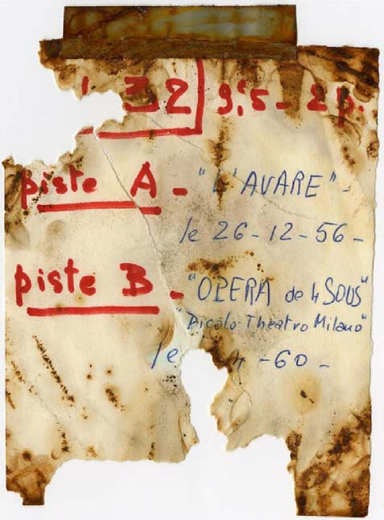 Source: a small piece of paper, partially rusted and torn, which ECHO researchers found attached to the flask containing the magnetic tape ASPBAN_000943 (located in the Department of Performing Arts at the BnF). Bearing precise handwritten notes (including the recording date: December 26), it was originally affixed to the metal box containing the original tape, both of which were destroyed during the archiving campaign.
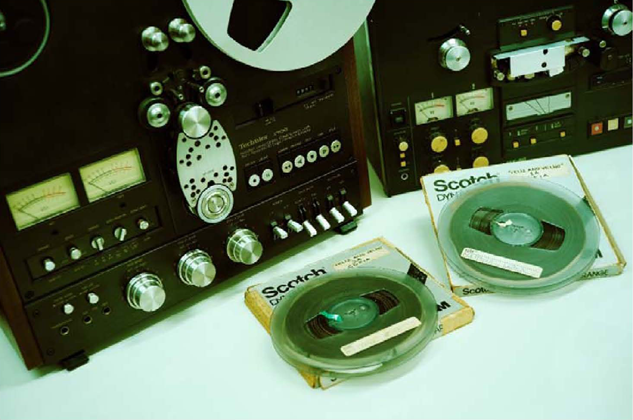 Source: an adaptation of the work by Marcelo Rubens Paiva, adapted by Alcides Nogueira. Directed by Paulo Betti. Tunica Teixeira Collection. CDT-Center for Theater Documentation, University of Sao Paulo. Photo: Paulo Assis.
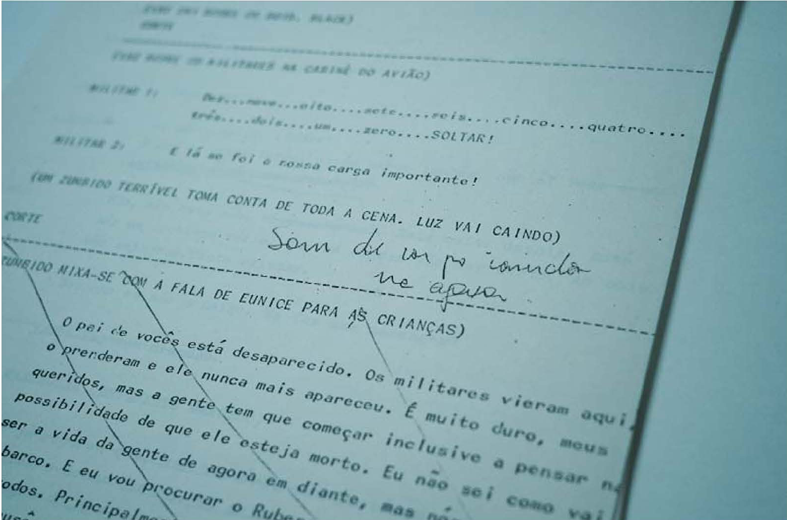 Source: Tunica Teixeira Collection. CDT-Center for Theater Documentation, Universidade de São Paulo. Photo: Paulo Assis.