
 Implementation science and epistemic justice in Brazilian medical education
ABSTRACT
Introduction: Medical education has historically been shaped by paradigms that favor Global North perspectives, contributing to the reproduction of practices and epistemologies disconnected from local realities. This theoretical essay presents implementation science as an alternative and transformative paradigm for Brazilian medical education, grounded in epistemic justice and the contextual adaptation of educational innovations.
Development: Drawing on a critical analysis of the positivist legacy that still underpins medical training, the text questions the uncritical appropriation of international models and highlights subtle contemporary forms of epistemic domination, such as Northern ventriloquism. In contrast, it argues that educational change should be driven by situated implementation processes, those that value local knowledge, actively engage stakeholders, and foster sustainable and context-sensitive practices. The article expands the scope of implementation science by connecting it to concepts such as situated epistemology, travelling concepts, and instrumental theoretical frameworks like the Consolidated Framework for Implementation Research (CFIR).
Conclusion: By adopting implementation science as both a theoretical and practical foundation, the essay advocates for a medical education aligned with Brazil’s Unified Health System, committed to local knowledge production, and oriented toward the dismantling of historical epistemic inequities.
Keywords:
Implementation Science; Medical Education; Cultural Diffusion
RESUMO
Introdução: A educação médica tem sido historicamente moldada por paradigmas que privilegiam perspectivas do Norte Global, o que tem contribuído para a reprodução de práticas e epistemologias descoladas das realidades locais. Este ensaio teórico propõe a ciência da implementação como um paradigma alternativo e promotor de transformação na educação médica brasileira, alicerçado na justiça epistêmica e na adaptação contextualizada de inovações educacionais.
Desenvolvimento: Com base em uma análise crítica das raízes positivistas que ainda permeiam a formação médica, o texto problematiza a apropriação acrítica de modelos internacionais e evidencia formas contemporâneas de dominação epistêmica, como o ventriloquismo do Norte. Em contraponto, argumenta-se que a mudança educacional requer processos de implementação situados, capazes de reconhecer saberes locais, engajar ativamente os sujeitos envolvidos e promover práticas contextualizadas e sustentáveis. O artigo propõe uma leitura ampliada da ciência da implementação, articulando-a a noções como epistemologia situada, conceitos viajantes e modelos teóricos instrumentais como o Consolidated Framework for Implementation Research (CFIR).
Conclusão: Ao adotar a ciência da implementação como referencial teórico e prático, defende-se uma educação médica comprometida com a produção local de conhecimento, com os princípios do Sistema Único de Saúde e com a superação das iniquidades epistêmicas que historicamente marcam o campo.
Palavras-chave:
Ciência da Implementação; Educação Médica; Transculturação
INTRODUCTION
Medical education, as we know it today, is a direct result of a paradigm established at the beginning of the twentieth century with the publication of the Flexner Report in 19101)-(2, which consolidated an alliance between biomedical science and medical training. By laying the foundations for an educational model anchored in scientific rationality, the experimental method and the standardisation of teaching, Flexner strengthened a conception of true knowledge as synonymous with scientific knowledge: objective, measurable, predictable. This epistemological foundation, derived from positivism (which exclusively values objectivity, measurement and predictability as criteria for truth) imposed a hierarchy of knowledge on medical education, in which other ways of knowing were systematically marginalized3)-(5. Traditional institutions, teaching hospitals and laboratories became the legitimate spaces for learning, consolidating a pedagogy of control, standardisation and homogenization6.
Over the course of the twentieth century, with a growing demand for greater social accountability in health professions, this model shifted accordingly. In 1978, the World Health Organization (WHO) proposed the adoption of competency-based education7, establishing a post-positivist paradigm8 which, although still committed to objectivity and measurement, recognises the limits of isolated scientific knowledge and emphasises the role of context, complexity and bias in professional training9. Although discourses such as learner-centred focus, lifelong learning and the understanding of competency as a dynamic and situated construct have strengthened, subtle forms of epistemological domination10)-(11still persist, less visible but effective mechanisms that continue to impose hegemonic perspectives on what counts as valid and relevant knowledge. The dynamic followed is: the Global North continues to dictate the parameters of quality, excellence and innovation in medical education, while the Global South is often reduced to representing those who observe, receive, apply and adapt.
In the current era of so-called “Evidence-Based Medical Education” (EBME), which advocates “finding, criticising and implementing the best evidence for educating students”, most of the published studies are still concentrated in a few countries in the Global North12. Meanwhile, scientific production in the South faces a lack of resources, language barriers and unequal access to literature, making it difficult for it to be fully included in the international medical education research agenda13. In what Kusurkar calls the “leaky pipeline” of knowledge14 (a process of systemic leakage that prevents diverse voices from gaining circulation and recognition), Naidu warns of “Northern ventriloquism”15, a practice through which foreign discourses are mimicked in search of external validation. This attitude reinforces the hegemony of external paradigms16 and, paradoxically, inhibits the recognition of truly contextualised proposals: by replicating other people’s models, we seek patterns that, due to their origin and logic, cannot be fully achieved in realities other than those that generated them.
Much of the evidence from the Global North seeps into curricula, languages, assessments and educational structures under the promise of reliability, quality and effectiveness. For example, it is common to naturalise the term “gold standard” to describe instruments or practices that are considered superior. Returning to the original meaning of the expression17 is enlightening: coming from economics, the gold standard referred to a system in which the value of the currency was backed by gold reserves, conferring stability but also rigid control and centralised power. Historically, this model has benefited the nations with the reserves, reproducing inequalities. Similarly, certain epistemologies today act as a symbolic ballast of validity, determining what can and cannot be recognised as legitimate knowledge and thus becoming hegemonic.
Hegemony18 operates as a form of power that is naturalised in the practices, discourses, norms and devices that shape everyday life, including in the field of education. Foucault deepens this idea by understanding power19 not as possession, but as exercise: a productive power that manufactures realities, subjectivities and “rituals of truth”. In medical education, this power not only regulates, but constitutes the subjects (students and educators) who start to act and perceive themselves according to these truths, as if they were natural, what is known as the microphysics of power: disciplinary devices that regulate bodies and ways of knowing and being.
In view of such a scenario, tackling epistemic injustice11 becomes unavoidable. It is a question of recognising and valuing voices, experiences and knowledge that have historically been marginalised because they fail to fit the universalising criteria of hegemonic science. Brazilian medical education, with its vast institutional ecosystem, high number of schools and commitment to the Unified Health System20)-(21, needs to critically examine its own structural and historical conditions, asserting that there is no single truth, nor a single, external path to guarantee development and quality.
Cultivating in every educator and researcher an epistemic curiosity22 that queries how knowledge is constructed, validated and applied - and under what power relations - is the first step towards breaking with hegemonic patterns and moving forward from a logic of importation to a practice of situated and transformative implementation23. It is through this movement that the potential of education as a practice of freedom24 can be retrieved and, thereby, a commitment to “untested feasibility” (25.
In this essay, we defend implementation science26)-(27 as a structuring paradigm for the future of Brazilian medical education, capable of recognising, applying and adapting consolidated evidence, operationalising practices and, above all, enabling the production, validation and sustainability of national contributions to global knowledge23.
DEVELOPMENT
The reason behind implementation science
The globalisation of medical education has intensified the circulation of practices, instruments and curricular models between countries and institutions, often under the premise of universalising quality and standardising training28. However, this circulation occurs predominantly in one direction: from the Global North to the Global South10),(13),(15),(29. Against this backdrop, Bal introduces the concept of “travelling concepts” (30 - apparently universal ideas that are transplanted from one context to another with little or no attention to the conditions that give them meaning. Veen et al deepen this criticism by demonstrating that many of these concepts do not “travel well” in the field of medical education31, given the historical baggage they carry, the linguistic contexts in which they were coined and the epistemological boundaries that delimit them.
Among these concepts, “competency” stands out as a paradigmatic example. Although it has a multifaceted trajectory in the field of education, its introduction in medical education was driven by the WHO in 1978, when it proposed a competency-based curriculum adjusted to local realities7. The document is categorical in stating that the definition of medical competency is linked to the political, social and economic circumstances of each context, the health needs of the population and the structure of the health system. So any attempt at a universal definition is, in principle, inadequate: “A good doctor in one context may be totally incompetent in another.”
Since the 2000s, with the consolidation of the competency-based model in various national and international guidelines32)-(37, there has been a proliferation of associated terms - such as domains, key competencies, results, professional roles, skills and capabilities - often used interchangeably, without clear conceptual articulation32),(38. In Brazil, from the National Curriculum Guidelines of 2001 to the current version of 2014, a general notion of competency has been widely incorporated, but with little conceptual definition, broad and varied specifications and limited instrumentalization. This variability may be attributed both to the heterogeneous influence of international literature and to the personal interpretations of educators39, which has led to the adoption of these terms without the mediation of systematic validation processes, national contextualisation and linguistic adaptation to the Brazilian reality.
The gap between the adoption of terminology and the effective understanding of concepts and practices highlights the urgent need for structured implementation processes23),(40. In addition to competency, other terms and approaches widely disseminated in international literature16 - such as “professionalism”, “feedback”, “OSCE” and “problem-based learning” - have been uncritically incorporated into the Brazilian context. Originating in specific scenarios, marked by particular educational cultures, their own health systems and distinct models of professional practice, these concepts, when travelling free of critical mediation30)-(31, often land in our reality without fully achieving the meanings and purposes they carried in their original setting.
Implementation science in medical education
Faced with the risks of uncritically importing educational concepts, models and practices, it is imperative to adopt approaches that systematically consider the processes of incorporating innovations into the specific contexts in which we wish to promote transformations. In this scenario, implementation science23),(40)-(42 is emerging as a promising field, capable of guiding practices and understandings in a contextualised, sustainable and equitable way.
Implementation science43)-(46 can be defined as the systematic study of methods that favour the integration of evidence, practices and interventions in real environments. It is distinct from the simple dissemination or linear adoption of innovations insofar as it conceives implementation as a dynamic and adaptive process that takes into account individual, organisational, cultural and systemic factors. Birken et al emphasise that implementation science seeks to answer not only what works, but also how, why, for whom and in which contexts a practice is effective26 - and, above all, what adaptations are necessary for it to have an impact in the local context.
For a long time, it was assumed that changes in education systems would take place in a linear fashion: from the production of evidence to the formulation of guidelines, and from these to practical adoption. This conception ignores the complexity of decision-making processes in education23. Implementation requires recognising multiple levels of decision-making, from everyday pedagogical choices to regulatory frameworks and institutional policies, each with its own actors, rationalities and limitations.
Recognising this complexity, implementation science proposes four fundamental principles43),(47)-(49: the identification of barriers and facilitators to the adoption of innovations; the active engagement of subjects in the adaptation and operationalisation processes; continuous and responsive monitoring; and the centrality of equity and contextual relevance as success criteria. It is therefore an approach that values situated construction and rejects prescriptive and universalising solutions.
To expand its analytical and operational capacity, implementation science can be articulated with the three levels of conceptual support proposed by Varpio et al: theory, theoretical framework and conceptual framework50. A theoretical approach problematises the direct application of concepts, requiring critical mediation with the context. The theoretical framework makes it possible to analyse the factors that influence the contextual effectiveness of interventions. The conceptual framework, in turn, supports the idea that implementation is an ongoing process that requires periodic review of practices in the light of social, institutional and pedagogical changes.
In the field of medical education, these principles are particularly important. The introduction of new teaching strategies, assessment methods or curricular structures requires situated analysis: how do these innovations interact with local values, available resources, the Unified Health System and students’ ways of being and learning? The value of external knowledge lies not in its direct application, but in its ability to be reinterpreted from the local reality: a process of critical translation, with culturally competent engagement.
An illustrative example is the Mini Clinical Evaluation Exercise (Mini-CEX), a formative assessment tool developed by the American Board of Internal Medicine, structured around direct observation of real clinical activities. Although often touted as a “best practice” in formative assessment, its application in the real world reveals considerable heterogeneity - variations in instruments, judgement criteria, feedback modes, assessor training and understanding of pedagogical objectives51. This diversity, far from representing a flaw, can be understood as a sign of the instrument’s ability to be re-signified in the different contexts in which it is implemented, characterising it as a “travelling concept”.
This is where the distinction between effectiveness and implementation52 becomes crucial. Effectiveness seeks to demonstrate whether an intervention works under ideal, controlled conditions; implementation science, on the other hand, shifts the focus to the actual conditions of use, asking: “Is it usable, sustainable and adaptable here?” By adopting an implementation perspective, the Mini-CEX is no longer a form to be mechanically replicated, but a potentially transformative instrument, provided it is contextualised, adapted and sustained locally. Table 1 summarises the main differences between effectiveness-focused and implementation-focused approaches, taking Mini-CEX as an example.
Although these approaches are not mutually exclusive, an exclusively effectiveness-orientated approach tends to produce dichotomous answers, “it worked” or “it didn’t work”, which can obscure contextual nuances. Implementation science, on the other hand, makes it possible to expand the production of applicable knowledge by identifying local factors, institutional gaps and opportunities for innovation.
This example therefore leads us to the need to mobilise analytical models capable of linking theory and practice. One of the most consolidated is the Consolidated Framework for Implementation Research (CFIR)53) which structures the analysis, as shown in Figure 1, into five domains: characteristics of “the thing” or the intervention; internal context; external context; characteristics of individuals; and the implementation process.
More than operational instruments, models like the CFIR should be used as tools for active theorization. In a field as complex and diverse as medical education, this means overcoming the simplified use of models and adopting a reflective, critical and adaptive stance. The science of robust implementation43),(47),(54),(55 rests on four interdependent pillars:
-
Understanding the determinants of the implementation;
-
Careful selection and application of theories, with openness to interdisciplinary approaches;
-
Development of innovative research methods, such as cartography, intervention mapping and comparative methods;
-
Formulation, testing and evaluation of implementation strategies, with a focus on the production of applicable and sustainable knowledge.
Assuming implementation science as a guiding paradigm in medical education means reaffirming the commitment to fairer, more rooted and transformative educational practices - not just by adopting external models, but by being able to produce, adapt and sustain knowledge based on local realities.
FINAL CONSIDERATIONS
Throughout this essay, we have argued that the critical adoption of implementation science is a promising way to strengthen medical education in Brazil. More than a set of operational tools, this approach proposes an educational practice rooted in context, underpinned by active listening and geared towards transformation.
In dialogue with Paulo Freire, for whom authentic education arises from the awareness of subjects and their capability to intervene in the world with freedom and responsibility56, this opens up space for the notion of the “untested feasible”: that which does not yet exist, but which can emerge from dialogical practice, collective imagination and transformative action.
Transposed to the field of medical education, this conception calls for the overcoming of technocratic models, based on the linear application of evidence or the uncritical importation of educational trends. Rather, we advocate the construction of solutions that are scientifically based, culturally and institutionally significant, sustainable and committed to epistemic justice11.
When anchored in local realities and epistemologies, implementation science becomes an instrument for the critical reconstruction of the educational field. This implies not only adapting practices to specific contexts, but also reconfiguring the very ways in which change is conceived: who decides, how it is decided, based on what knowledge and in favour of which subjects.
To implement, on this horizon, is to assume an institutional responsibility: to abandon the comfort of uncritical reproduction and invest in the shared construction of educational concepts and practices that are more coherent with the challenges and potential of Brazilian medical education.
Cultivating untested feasibility25 means committing to medical education that does not only work according to imported criteria of efficiency, but that makes sense and, in doing so, is truly transformative.
References
- 1 Ludmerer KM. Commentary: Understanding the Flexner report. Acad Med. 2010;85(2):193-6.
- 2 Norman G. Medical education: past, present and future. Perspect Med Educ. 2012;1(1):6-14.
- 3 Park YS, Konge L, Artino, AR Jr . The Positivism Paradigm of Research. Acad Med . 2020;95(5):690-4.
- 4 García JC, Teixeira CF, Santos L, Rocha MND. A educação médica na América Latina. Salvador: Edufba; 2022.
- 5 Kirch DG. Commentary: The Flexnerian Legacy in the 21st century. Acad Med . 2010;85(2):190-2.
- 6 Clark J, Hurley R, Ladher N, Jarvies D. What next for decolonising health and medicine? BMJ. 2023;383:2302.
- 7 McGaghie WC, Miller GE, Sajid AW, Telder TV. Competency-based curriculum development on medical education: an introduction. Public Health Pap. 1978(68):11-91.
- 8 Young ME, Ryan A. Postpositivism in Health Professions Education Scholarship. Acad Med . 2020;95(5):695-9.
- 9 Ryan MS, Lomis KD, Deiorio NM, Cutrer WB, Pusic MV, Caretta-Weyer HA. Competency-based medical education in a norm-referenced world: a root cause analysis of challenges to the competency-based paradigm in medical school. Acad Med . 2023;98(11):1251-60.
- 10 Sims DA. When I say ... global south and global north. Med Educ. 2024;58(3):286-7.
- 11 Percival CS, Martin PC, Maggio LA, Wyatt TR. When I say ... epistemic injustice. Med Educ . 2024;58(5):497-8.
- 12 Cecilio-Fernandes D, Sandars J. The frustrations of adopting evidence-based medical education and how they can be overcome! Med Teach. 2021;43(1):108-9.
- 13 The Lancet Global H. Global health 2021: who tells the story? Lancet Glob Health. 2021;9(2):e99.
- 14 Kusurkar RA. The leaky pipeline of publications and knowledge generation in medical education. Perspect Med Educ . 2022;11(2):70-2.
- 15 Naidu T. Says who? Northern ventriloquism, or epistemic disobedience in global health scholarship. Lancet Glob Health . 2021;9(9):e1332-e5.
- 16 Naidu T. Coloniality lives on through medical education. BMJ . 2023;383:2294.
- 17 Gontijo C. Os mecanismos de funcionamento do “padrão-ouro”: uma visão crítica. Economia e Sociedade. 2014;23(1):243-80.
- 18 Johnston JL. When I say ... hegemony. Med Educ . 2017;51(8):782-3.
- 19 Christensen G. Three concepts of power: Foucault, Bourdieu, and Habermas. Power and Education. 2023;16(2):182-95.
- 20 Castro MC, Massuda A, Almeida G, Menezes-Filho NA, Andrade MV, Souza Noronha KVM de, et al. Brazil’s unified health system: the first 30 years and prospects for the future. The Lancet. 2019;394(10195):345-56.
- 21 Scheffer M, Mosquera P, Cassenote A, McPake B, Russo G. Brazil’s experiment to expand its medical workforce through private and public schools: Impacts and consequences of the balance of regulatory and market forces in resource-scarce settings. Globalization and Health. 2025;21(1):14-26
- 22 Ellaway RH. When I say ... epistemic curiosity. Med Educ . 2014;48(2):113-4.
- 23 Thomas A, Ellaway RH. Rethinking implementation science for health professions education: a manifesto for change. Perspect Med Educ . 2021;10(6):362-8.
- 24 Freire P. Pedagogia da libertação em Paulo Freire. São Paulo: Paz e Terra; 2018.
- 25 Paro CA, Ventura M, Silva NEK e. Paulo Freire e o inédito viável: esperança, utopia e transformação na saúde. Trab educ saúde. 2020;18(1):e0022757
- 26 Birken SA, Nilsen P. Implementation science as an organizational process. Health Care Management Review. 2018;43(3):181.
- 27 Lockwood CS, Ivers NM. Implementation science: a primer. JBI Evid Implement. 2023;21(4):307-9.
- 28 Martin C. Reconstructing a lost tradition: the philosophy of medical education in an age of reform. Med Educ . 2013;47(1):33-9.
- 29 Rasheed MA. The case for a Global South centred model in global health. BMJ . 2023;383:2256.
- 30 Bal M, Marx-MacDonald S. Travelling concepts in the humanities: a rough guide. Toronto: University of Toronto Press; 2002.
- 31 Veen M, van der Tuin I. When I say... travelling concepts. Med Educ . 2021;55(2):146-7.
- 32 Carraccio C, Englander R, Van Melle E, Ten Cate O, Lockyer J, Chan MK, et al. Advancing competency-based medical education: a charter for clinician-educators. Acad Med . 2016;91(5):645-9.
- 33 Van Melle E, Frank JR, Holmboe ES, Dagnone D, Stockley D, Sherbino J, et al. A Core Components Framework for Evaluating Implementation of Competency-Based Medical Education Programs. Acad Med . 2019;94(7):1002-9.
- 34 Harden RM. AMEE Guide No. 14: Outcome-based education: Part 1 - An introduction to outcome-based education. Med Teach . 1999;21(1):7-14.
- 35 Smith SR. AMEE Guide No. 14: Outcome-based education: Part 2 - Planning, implementing and evaluating a competency-based curriculum. Medical Teacher. 2009;21(1):15-22.
- 36 Ben-David MF. AMEE Guide No. 14: Outcome-based education: Part 3 - Assessment in outcome-based education. Med Teach . 1999;21(1):23-5.
- 37 Frank JR, Snell L, Sherbino J. CanMEDS 2015 Physician Competency Framework. Ottawa: Royal College of Physicians of Canada; 2015.
- 38 Englander R, Frank JR, Carraccio C, Sherbino J, Ross S, Snell L, et al. Toward a shared language for competency-based medical education. Med Teach . 2017;39(6):582-7.
- 39 Chen AMH, Kleppinger EL, Churchwell MD, Rhoney DH. Examining Competency-Based Education Through the Lens of Implementation Science: A Scoping Review. Am J Pharm Educ. 2024;88(2):100633.
- 40 Ellaway RH, Kehoe A, Illing J. Critical Realism and Realist Inquiry in Medical Education. Acad Med . 2020;95(7):984-8.
- 41 MacLeod A, Ellaway RH, Paradis E, Park YS, Young M, Varpio L. Being Edgy in Health Professions Education: Concluding the Philosophy of Science Series. Acad Med . 2020;95(7):995-8.
- 42 Ellaway RH. Postmodernism and Medical Education. Acad Med . 2020;95(6):856-9.
- 43 Waltz TJ, Powell BJ, Fernandez ME, Abadie B, Damschroder LJ. Choosing implementation strategies to address contextual barriers: diversity in recommendations and future directions. Implement Sci. 2019;14(1):42.
- 44 Bartels SM, Haider S, Williams CR, Mazumder Y, Ibisomi L, Alonge O, et al. Diversifying implementation science: a global perspective. Glob Health Sci Pract. 2022;10(4):e2100757.
- 45 Zullig LL, Drake C, Check DK, Brunkert T, Deschodt M, Olson MS, et al. Embedding implementation science in the research pipeline. Transl Behav Med. 2024;14(2):73-9.
- 46 Williams LS, Vickrey BG. Implementation science. Stroke. 2021;52(12):4054-6.
- 47 Wang Y, Wong EL, Nilsen P, Chung VC, Tian Y, Yeoh EK. A scoping review of implementation science theories, models, and frameworks - an appraisal of purpose, characteristics, usability, applicability, and testability. Implement Sci . 2023;18(1):43.
- 48 Galaviz KI, Sanders M, Gil O. Editorial: Implementation science to address health disparities and improve the equitable implementation of proven interventions. Front Public Health. 2023;11:1356063.
- 49 Schwartz R, Moore JB. Implementation science in practice. J Public Health Manag Pract. 2021;27(2):100-1.
- 50 1Varpio L, Paradis E, Uijtdehaage S, Young M. The Distinctions Between Theory, Theoretical Framework, and Conceptual Framework. Acad Med . 2020;95(7):989-94.
- 51 Mortaz Hejri S, Jalili M, Masoomi R, Shirazi M, Nedjat S, Norcini J. The utility of mini-Clinical Evaluation Exercise in undergraduate and postgraduate medical education: A BEME review: BEME Guide No. 59. Med Teach . 2020;42(2):125-42.
- 52 Ridde V, Perez D, Robert E. Using implementation science theories and frameworks in global health. BMJ Glob Health. 2020;5(4):e002269.
- 53 Damschroder LJ, Reardon CM, Widerquist MAO, Lowery J. The updated Consolidated Framework for Implementation Research based on user feedback. Implement Sci . 2022;17(1):75.
- 54 Bhuiya AR, Sutherland J, Boateng R, Bain T, Skidmore B, Perrier L, et al. A scoping review reveals candidate quality indicators of knowledge translation and implementation science practice tools. J Clin Epidemiol. 2024;165:111205.
- 55 Kislov R, Pope C, Martin GP, Wilson PM. Harnessing the power of theorising in implementation science. Implement Sci . 2019;14(1):103.
- 56 Freire P. Educação como prática da liberdade. São Paulo: Paz e Terra ; 2014.
Research data is available in the body of the document

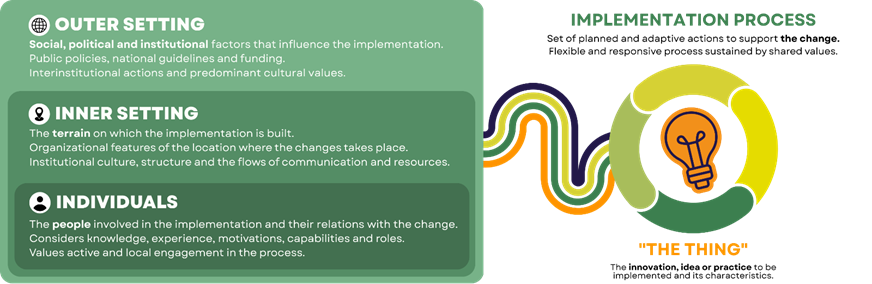 Source: Adapted from Damschoroder et al (2022) by the authors.