 Learning paths as a strategy for managing professional educational actions: a scoping review
ABSTRACT
Introduction: The training of health professionals in Brazil has been a subject of constant debate, with the need to systematize educational actions that are in line with the various contexts in which they work. However, the organization and management of educational actions for these professionals are still incipient and poorly aligned with daily practice.
Objective: To systematize evidence on the organization and management of educational offers using learning paths, in order to identify terminological and conceptual variations, and organizational strategies.
Method: This is a scoping review of scientific production on the organization and management of learning paths, aiming to generate a synthesis of knowledge that can contribute to correlations with training actions in the Unified Health System, especially with the professional training of participants in the More Doctors for Brazil Project.
Results: 76 studies were selected, published between 2018 and 2023, with significant variation in terms of the objects of study and the countries in which they were carried out and published. It was possible to identify 58 definitions associated with learning paths, whose meanings were similar or complemented each other. The concepts presented seem to be more in line with continuing education strategies centered on updating disciplinary knowledge, without necessarily considering the context as a producer of knowledge. As for pedagogical organization, different approaches were identified, such as conductivist, functionalist and, to a lesser extent, dialogical. The results of the review indicate the need for further research to assess the viability and sustainability of learning paths. It is also crucial to involve health professionals in the planning and implementation of these trails to ensure their relevance and suitability to the needs of the services.
Conclusion: Analysis of the trails as a tool for educational organization and management revealed that they are often treated as mere bureaucratic formality, with generic content, especially on digital platforms. The challenge lies in going beyond the offer, guaranteeing quality continuing education in line with the needs of the Unified Health System.
Keywords:
Health Education; Health Human Resource Training; Professional Practice; Primary Health Care; Medical Education
RESUMO
Introdução: A formação de profissionais de saúde no Brasil tem sido um tema de debate constante, com a necessidade de sistematizar ações educacionais que se coadunem com os diversos contextos de atuação. No entanto, a organização e gestão das ações educacionais para esses profissionais ainda são incipientes e pouco alinhadas com a prática cotidiana.
Objetivo: Este estudo teve como objetivo sistematizar evidências sobre a organização e gestão de ofertas educacionais utilizando as trilhas de aprendizagem, a fim de identificar variações terminológicas e conceituais, e estratégias organizativas.
Método: Trata-se de um estudo de revisão de escopo da produção científica sobre organização e gestão de trilhas de aprendizagem, visando gerar uma síntese de conhecimentos que possa contribuir para correlações com ações formativas no Sistema Único de Saúde, especialmente com a formação profissional de partícipes do Projeto Mais Médicos para o Brasil.
Resultado: Selecionaram-se 76 estudos, publicados entre 2018 e 2023, com variação significativa quanto aos objetos de estudo e aos países nos quais foram realizados e publicados. Foi possível identificar 58 definições associadas às trilhas de aprendizagem, cujos significados eram similares ou se complementavam. As concepções apresentadas parecem mais alinhadas a estratégias de educação continuada centradas na atualização de conhecimentos disciplinares, sem necessariamente considerar o contexto como um produtor de conhecimentos. Quanto à organização pedagógica, diferentes abordagens foram identificadas como condutivista e funcionalista, e, em menor número, dialógica. Os resultados da revisão indicam a necessidade de aprofundar pesquisas que avaliem a viabilidade e sustentabilidade das trilhas de aprendizagem. É crucial, também, o envolvimento dos profissionais de saúde no planejamento e na implementação dessas trilhas para garantir sua relevância e adequação às necessidades dos serviços.
Conclusão: A análise das trilhas como ferramenta de organização e gestão educacional revelou que são frequentemente tratadas como mera formalidade burocrática, com conteúdos genéricos, sobretudo em plataformas digitais. O desafio reside em ir além da oferta, garantindo uma educação permanente de qualidade e alinhada às necessidades do Sistema Único de Saúde.
Palavras-chave:
Educação em Saúde; Formação Profissional em Saúde; Prática Profissional; Atenção Primária à Saúde; Educação Médica
INTRODUCTION
The training of health professionals in Brazil has been the subject of analysis and reflection in recent years, sparking the construction of proposals to organise educational actions that are coherent with the different health care settings1. However, the models for organising, representing and managing knowledge and information in educational activities aimed at health workers are incipient in scientific production and remain largely disconnected from everyday professional practices2.
In fact, educational actions aimed at professionals, characterised in the context of continuing education, require a reordering of the teaching-learning process in order to overcome the technicist model, which demands innovations and changes in the constitution of these professionals at different levels of training, in health teaching, in the production of knowledge and in continuing education3.
In the health sector, the challenge is to promote in-service training that encourages reflective and contextualised practice, based on the principles of permanent health education (PHE), with the aim of training ethical, critical, reflective, collaborative and socially responsible individuals2, overcoming the merely technical and traditional training model offered by a continuing education. In line with this perspective, the Mais Médicos para o Brasil (More Doctors for Brazil) Project (PMMB) is building structuring measures to improve medical training on an ongoing basis, seeking to enable them to practise in a way that is more in line with the needs of the population3. Thus, the organisation and management of these offers need to suit the premises laid down for professional education in the Unified Health System (SUS).
With this in mind, some authors4)-(7 have discussed new, previously not discussed ways of organising and managing training strategies in view of the rapid technological, scientific, cultural and economic changes in the workplace4. These include, for example, web-based teaching and paths, navigations or Learning and/or Training Paths, which are considered more flexible in relation to the prevalent search for continuing professional development. Learning Paths (LP), as a systematic and multimodal set of learning units, are advocated by the aforementioned authors5)-(7 because they are capable of encompassing different navigation schemes in educational offers.
Some studies7),(8 reiterate that the personalised construction of virtual pathways can strengthen meaningful learning and the development of skills to implement practices that are consistent with each learner’s profile, learning styles and level of knowledge. This process presupposes an inference based on the actions of the subjects, who mobilise and combine resources, knowledge, know-how or skills and attitudes that are adjusted and relevant to the context, in order to achieve effective performance in view of the challenges faced in work contexts9.
In other words, the standardisation of knowledge, while useful for guaranteeing a minimum skills base, can neglect regional particularities and the need for adaptive critical thinking. In addition, inadequate supervision and an excessive workload often turn these paths into mere formalities, without effective integration between theory and practice. As an example, medical training in the PMMB, in challenging contexts such as remote areas with structural weaknesses, begs the question:
-
To what extent do the LPs meet the complexities of medical practice in real scenarios, where the lack of infrastructure in health units and the epidemiological diversity of the population require much more than a pre-defined curriculum?
Another critical point is the superficiality with which the LPs can address essential issues such as collective health, health management and community relations, which are central themes for doctors working in the SUS. The emphasis on generic modules and the disconnect from real local demands reveal a dissonance between the training project and the needs of the population.
Despite the growing interest in the application of LPs in healthcare, there remains a knowledge gap in relation to the effectiveness, viability and sustainability of these strategies in the context of the SUS. Furthermore, there is little evidence on how paths can be used to promote continuing health education and improve the quality of health services. Rather than promoting truly transformative training, there is a risk of the experience being reduced to a bureaucratic fulfilment of stages, lacking reflection on the social role of health professionals.
In view of the above, the aim of this scoping review is to systematise evidence on the organisation and management of educational offers using LPs, in order to identify terminological and conceptual variations, and organisational strategies, with a view to problematising their application in professional training, including in health, where there is a gap in the area of research demonstrated by the incipient scientific production.
The application of LPs in healthcare is especially relevant in Brazil, given the challenges faced by the SUS in training and qualifying its professionals. This review seeks to provide useful information for managers, educators and health professionals interested in the subject, and can demonstrate the viability and sustainability of these processes for improving training processes linked to continuing education in the SUS.
METHOD
This study reviews the scope of scientific production on the organisation and management of educational offers for professionals, focusing on the analysis of proposals for training paths, with the aim of generating a synthesis of knowledge that can contribute to training adjustments in the SUS. This arose from reflections raised by the overarching research project “Identification and validation of the training model for doctors in the More Doctors for Brazil Project”.
A scoping review presents various types of evidence and their methods of production. It is also important for tracking and/or anticipating potential in research with emerging evidence, in recent and/or incipient scientific production, and in investigations of how research is being conducted in already consolidated areas. By placing less emphasis on the critical appraisal of the evidence included, this type of review allows for the inclusion of more potentially relevant literature to capture the evidence on the subject in question10.
To this end, the questions that guided this research were adapted from the study by Lopes et al11, according to the WH Questions proposal:
-
What are the definitions and concepts of learning paths?
-
What are the terminological variations?
-
How are the strategies for organising and managing LPs structured?
-
In which contexts have the paths been applied?
-
In which countries is research on LPs concentrated?
The recommendations of the Preferred Reporting Items for Systematic Reviews and Meta-Analyses (PRISMA)12) were followed (supplementary material 1) and some stages were defined, namely: elaboration of the guiding question, literature search or sampling, data collection, critical analysis of the included studies; discussion of the results.
Initially, the descriptors were identified in MeSH/DeCS terms, and the original term and synonyms were selected, as well as in Spanish and English to cover possible terminological variations. The search strategies designed for each database were then created using Boolean operators for the search strings (supplementary material 2). The following search strategies were used in the Web of Science databases (“learning paths” OR “learning trails” - 795 publications); Education Resources Information Centre - ERIC (“learning tracks” OR “learning trails” - 121 publications); and Scientific Electronic Library Online - SciELO ((itinerarios de aprendizaje) OR (rutas de formación) OR (itinerários formativos) OR (trilhas de aprendizagem) AND (healthcare professionals) - 40 publications)).
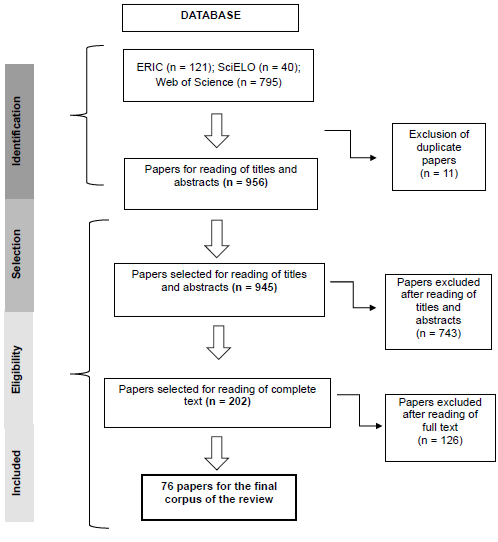
The searches were conducted from August to December 2023, with no time limits for a broad selection of publications in the scientific literature. A total of 956 documents were identified and exported to the Rayyan programme for the exclusion of duplicates, the classification of articles by relevance and the management of screening results. Following the exclusion of 11 duplicates, the titles and abstracts were read, which phase was conducted by two reviewers, whose conflicts were resolved by a third reviewer. A total of 743 articles that failed to meet the eligibility criteria were excluded, followed by a full reading of 202 articles, leaving 76 studies to make up the final corpus (Figure 1).
The inclusion criteria included articles in English, Portuguese and Spanish, with no publication date limit, which addressed LP in educational contexts (with an emphasis on vocational education), pedagogical models and different types of educational provision (face-to-face and online). The choice of these criteria aimed to make the research broader, to address and fill knowledge gaps related to the topics investigated. Studies were excluded if they were not related to educational aspects from the perspective of organising training offers, if they were not available in full or if access to them was not free of charge.
The eligible studies were systematised in an Excel® spreadsheet containing the variables used to identify and extract the relevant information for the study: title, authors, year of publication, objective, type of study, definitions of LPs, terminological variations, contexts of application, countries in which the studies were conducted, actors involved in modelling and management, strategies adopted for organising, representing and managing LPs. (supplementary material 3).
Subsequently, the methodological quality of the qualitative studies was assessed using the instrument proposed by the Critical Appraisal Skills Programme (CASP)13. This instrument has ten questions that lead the evaluator to systematically consider the rigour, credibility and relevance of the studies, allowing them to be classified with the greatest methodological rigour. This review included studies that achieved at least eight of the ten CASP items13 (80 points). It should be borne in mind that this stage was not intended to exclude articles, but essentially to analyse the quality and robustness of each publication.
The results are presented taking into account the characterisation of the studies (year of publication, language, location) and questions adapted from Lopes et al11, such as definitions, concepts and terminological variations, actors involved in LP modelling, motivations for its adoption, advantages and benefits, organisation of educational offers, with the modes of pedagogical organisation of education in the different contexts of LP and organisation of educational offers with the use of digital tools.
RESULTS
Characterisation of the selected studies
Consisting of 76 documents (supplementary material 4), the corpus of this scoping review covered qualitative studies, predominantly in English (86.8 per cent) and some publications in portuguese (6.6 per cent), spanish (5.2 per cent) and russian (1.3 per cent). Publications were concentrated between 2018 and 2023 (86.8 per cent). The methodological quality assessment through the application of CASP indicated that the studies maintained satisfactory quality, with a score of over 80 points (Chart 1).
As regards the types of study, various approaches were identified, the majority being experimental (34), for the development of software focused on LP organisation and management. Then, empirical works were identified (9), exploratory (21), reviews (9) and research using mixed methods, perspective and theoretical-reflective (one publication each).
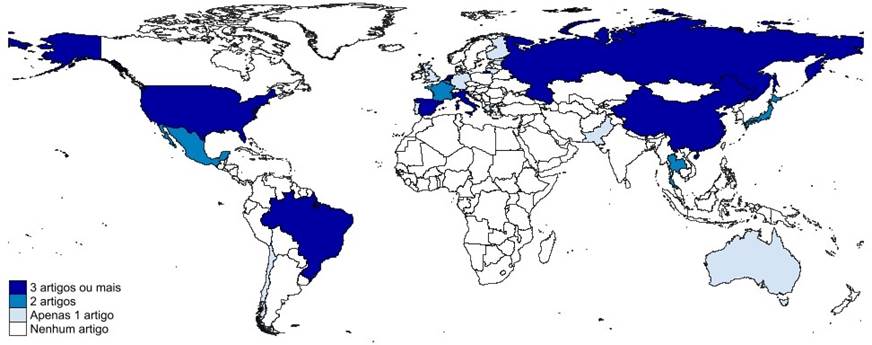
The studies originated from various continents such as Europe, Asia, South America, North America, Central America and Oceania. The top countries were China with nine publications, followed by Italy and Brazil with five each. Of particular note was the lack of information on the locus of the study in 21 productions, an aspect recognised as a methodological weakness (Figure 2).

Distribution of articles on learning paths and related topics by country - period: 2013 to 2023.
There was significant variation in the study scopes and the continents in which the studies were conducted and published. In South and Central America, there has been a significant emphasis on research into the application of LPs in competency-based management14)-(18. The studies aimed to investigate curricular policies, continuing education and analysis of the connection between LPs at the different levels of training.
In North America, represented mainly by the United States, the articles presented analyses focused on the use of personalised teaching models, with the use of artificial intelligence (AI)19)-(22. In European countries, strategies have focused on improving methods for personalisation using information and communication technology, AI and gamification23)-(29, to support the creation of e-learning systems and self-regulated learning30)-(32. Studies in the Asian region have predominantly focused on building online LP models33)-(45, using algorithms, graphics, cognitive models and curriculum sequencing to develop adaptive e-learning systems.
In general, there is a similarity between Asian and North American countries in the use of LPs in training offers via virtual platforms, including the use of logarithms to personalise students’ journeys based on their preferences. On the other hand, South American and Central American countries focused on the application of LPs in teaching plans with a view to integrating knowledge with the practices developed by students in the services.
In the context of the SUS, the use of LPs in the training of health professionals is exemplified by the study by Mello et al14. They highlight the paths as a strategic possibility for operationalising PHE by promoting competency development in nurses. Another context that was well explored was the technological setting, in which they aimed to build the learning path in a personalised manner, based on students’ online experiences39.
The limitations pointed out by Xu et al (2023) on the use of LPs are linked to the challenges of the online environment. The lack of instant communication and feedback between teachers and students, which is reduced or non-existent compared to a traditional classroom, makes self-discipline difficult and can compromise the learning experience.
Organisation and management of educational offers: definitions, concepts and terminological variations
With regard to terminological variations, 79 terms related to the terminology learning paths were found in the 76 articles evaluated. The english terms learning paths, learning track, learning process and learning trails were prominent. In portuguese, the term trilha de aprendizagem is similar to expressions such as trilha de navegação, roteiro de navegação and itinerários de formação. In spanish, equivalent terms include itinerarios formativos, itinerarios de aprendizaje and percurso formativo.
It was also possible to identify 58 definitions associated with LPs, whose meanings were similar or complement each other. In the works that studied the organisation of educational offers14),(16),(19),(30)-(32),(46)-(53, the authors tended to conceive of paths as an order, a sequence of learning objects, a chain of stages, a set or combination of activities.
In the studies that relied on the development of technologies for the use of LPs24),(33),(35),(37),(39),(54)-(57 the concepts related to paths as organisers, including lists of basic requirements, a set of activities and/or a roadmap with the purpose of developing competencies, as well as promoting professional and personal development. It should be noted, however, that although all of them addressed the paths, some studies did not highlight a specific concept (Table 2). It is assumed that these conceptions are closer to training strategies based on the principles of continuing education for the training of health professionals, in which there is a certain predominance of a continuity of the school model centred on updating knowledge and a disciplinary approach. In other words, where health work is not necessarily understood as a context for producing knowledge.
Pedagogical organisation in the different learning paths contexts
There were 20 articles14)-(17),(19),(23)-(25),(30)-(32),(46)-(53),(58) on pedagogical organisation in the different LP contexts. The didactic and pedagogical aspects were diverse and included different approaches, such as the conductivist approach, which values cognitive and behavioural attributes16),(38),(40),(59),(54; the functionalist approach, with an emphasis on performing tasks and achieving results, according to professional functions14),(23)-(24),(30)-(31),(51),(54),(40),(42),(43),(45),(56) and, to a lesser extent, studies that adopted the dialogical approach, which relates the constituent elements of the competency and favours competency-based management and education14),(30),(40),(60)-(61 (Chart 3).
The question should be raised that the studies15),(30),(40),(60),(61 which adopt conductivist-behaviourist and functionalist approaches present conceptions that are, to a certain extent, conflicting in terms of their notions of competencies. The conductivist-behaviourist model values the acquisition of predominantly cognitive attributes, directing professional training towards adapting to the demands of the labour market. On the other hand, the functionalist model focuses on performing tasks assigned to different professional roles, with a focus on achieving results both in the organisational context and outside it62.
The dialogical model is prominent since it seeks a re-reading of the approaches, establishing an articulation between their constituent elements, knowledge, skills and attitudes. The dialogical approach is considered to be the closest to the foundations of PHE, as it proposes the reorganisation of knowledge in order to value the complementarity between work and education, where work is the axis of the educational process and the very source of its transformation62.
Although the synthesis of didactic-pedagogical and organisational aspects expressed in table 3 shows that there is no dominant pedagogical current at a specific educational level, it can be seen that studies aimed at basic education students tend to adopt predominantly functionalist and conductivist approaches. Similarly, studies from higher vocational education and the context of technological development have only occasionally shown the adoption of a dialogical perspective.
The actors involved include primary18),(53, technical16 and higher education institutions15),(50),(63) as well as medical centres48, for their role in planning, organising and developing the modelling of educational processes. It is important that the pedagogical proposals of these institutions are aligned with more dialogical approaches, so that training actions can emerge from the work context itself. However, most of the time this identification is based on general and previously assumed needs, which limits the construction of more localised and participatory strategies.
As for the main results, the studies in the health area46),(32) sought to find out about and compare training itineraries with what is desired in the market, the use of LPs to develop competency-based management models and as an organisational strategy for developing the skills of nurses and doctors, as well as reflecting on PHE as a strategy for competency development14.
Most of the articles selected by this scoping review did not explain the institutions involved or interested in building the competency profile of a particular profession or occupation, revealing an important gap with regard to the articulation between the training process and the educational contexts that demand it.
With regard to operational aspects, the works18),(20)-(22),(26),(27),(33)-(45),(54)-(59),(64)-(84) were related to the development of technological resources for the use of LPs in education. Learning environments have been given different names, such as: collaborative learning environment23, learning platform, personal learning environments - PLE 54, collaborative knowledge-building environments, intelligent tutoring systems - ITS29, adaptive educational hypermedia systems - AEHS29, and even social networks such as Twitter63. These tools relied on the support of students and teachers to manage the content and organise the personalised learning process. From the teaching material, the learning path was travelled by the user to acquire a skill and/or fill a skill gap.
Other studies have reiterated the development of technology as an opportunity to conduct new learning strategies linked to learning and innovation competences, digital literacy competences and competences for personal and professional life28; the use of e-learning technology, in particular the mining of weak concepts85)-(89, e-learning models66, the construction of learning paths based on the knowledge graph40, personalised learning paths using graph theory57, and the modular object-oriented dynamic learning environment (MOODLE)65),(66),which is a free software to support learning, and virtual learning environments - VLE14),(15),(84.
It should be noted that no studies were found that discussed the applicability of LPs for use in medical training programmes.
DISCUSSION
The research revealed that the organisation and management of educational offers, from the perspective of LP development, show significant variations between countries, both in terms of the terminology adopted and the methodological approaches used. There has been a marked use of this perspective in countries in the Global North, especially with a view to institutionalising continuing education practices, with an emphasis on professional and managerial updating processes. These practices are strongly mediated by technology as a tool for developing automated and customisable learning systems90.
In this context, the conductivist approach was most prominent, valuing cognitive and behavioural attributes16),(38),(40),(59),(54; the functionalist approach, with an emphasis on performing tasks and achieving professional results14),(23)-(24),(30)-(31),(51),(54),(40),(42),(43),(45),(56) and, to a lesser extent, studies that adopted the dialogical approach that relates the constituent elements of the competency, which are in line with the proposal of PHE - a model that prioritises meaningful learning, anchored in everyday work and the real needs of the services.
The proposal for continuing education is predominant in the proposals for professional qualifications in North American and European countries, and is compulsory in many US states for the renewal of a licence to practise medicine. In the context of continuing training, it is worth highlighting the main advantages of using LPs: greater availability of educational offers, reduced cost, the possibility of inter-institutional collaboration, greater flexibility in the choice of topics by the course participants themselves, as well as greater applicability of web tools, with digital tools self-managed by the students.
As for the limitations described in the studies, difficulties of access were pointed out, as well as poor digital skills and literacy on the part of both students and teachers teachers, which can lead to lack of interest and dropping out of the training process. In addition, a set of generic modules making up the LPs reduces training, hindering dialogue and reflection with the reality experienced by professionals in territories marked by social inequalities, especially in health92)-(93.
Unlike traditional continuing education, which is often limited to one-off training sessions disconnected from practice, PHE proposes a ongoing process of reflection-action, in which knowledge is built collectively based on the challenges faced in the territory91)-(92. In this sense, LPs will only fulfil their role if they are flexible, contextualised and connected with local demands, avoiding the reproduction of content that contributes little to the transformation of health practices.
In general, it was found that educational activities structured through LPs must be in line with dialogical references - such as problematisation and meaningful learning - which are a possibility for innovation and reorganisation of the work process based on critical thinking and in-service education. These approaches aim to strengthen the development of competencies in health care professionals8),(90),(92)-(93, therefore, for the continuing education to be effective, it is essential that LPs are built in a participatory way, with the involvement of managers, workers and users of the health system, so that knowledge is produced and applied in a critical and contextualised way.
Furthermore, it is essential to overcome challenges such as the lack of time for professionals to train, the shortage of qualified preceptors and the fragile infrastructure in many territories. If well structured, the paths can be powerful tools for qualifying the SUS, but their success depends on a real commitment to PHE - education that not only transmits information, but also transforms realities91.
In this regard, LPs have emerged as a promising strategy for organising educational offers in the SUS, including for doctors linked to the PMMB. Analysing the training of doctors within the scope of the PMMB, which uses primary health care (PHC) services as a pedagogical resource for training, the paths represent an opportunity to offer and manage training courses, only in terms of the individual’s cognitive “knowledge”2),(92. But a learning path, in this sense, will be considered positive if it provides the individual with useful knowledge and encourages them to carry out their professional activity in the best possible way.
On the other hand, it can be added that one of the most widely used formats for developing LP is Massive Online Open Courses (MOOC), with the sole aim of updating themes and technical and operational guidelines, aimed at instrumentalising professionals8. In other words, the challenges perceived in the applicability of LPs are fundamentally about overcoming the disciplinary and compartmentalised production of knowledge, which is insufficient to generate professionals who recognise themselves as protagonists, critical, reflective and capable of problematising the challenges, actively participating in the construction of new alternatives for health practice94.
The study by Neris Filho95 highlights that work overload and the lack of qualified preceptors jeopardise the effectiveness of these paths, turning them into mere bureaucratic formalities. Thus, the results of this review offer valuable directions for improving professional health training in the SUS, guiding public policies and directing future research to promote a curriculum structure that manages to integrate theory and practice in a meaningful way, especially in regions with structural shortcomings96.
In order to fulfil their role, the paths need to be flexible, participatory and linked to local realities, in line with the critical pedagogy advocated by Paulo Freire97. Without this approach, programmes to supply doctors run the risk of training technically competent professionals who are ill-prepared to face the political and social challenges of the SUS.
Another aspect worth highlighting is the application of LPs without due consideration of the professionals’ previous training experiences, as well as their possible difficulties in recognising the essential competences to be developed. This mismatch can compromise worker autonomy in their selection of training content. Therefore, it is necessary to analyse the capacity of each professional to make their training more flexible, to avoid inequalities in access to qualifications and possible negative impacts on the results of the actions developed in the services.
The additional results of this study show that dialogical approaches have hardly been used, although it is the approach that comes closest to the constitutive elements for advancing the connection of professional capacities to the action required in a given context, integrating work and training in processes of mutual transformation11. Even though in scenarios of increasing complexity, the training of health professionals needs to take into account a broad and integrated approach, from the choice of pedagogical and curricular approaches, in order to leverage disruptive possibilities of the anachronistic division between theory and practice in the services98)-(100.
In the light of the above-mentioned aspects, it is important to emphasise the need for training choices to converge with the expectations of comprehensive training for individuals in public health services. The mere provision of paths is insufficient to guarantee the effectiveness of the process of developing the competences, skills and attitudes needed for effective, democratic professional practice that is experienced in the reality of the teams94. It is therefore essential to invest in more rigorous studies to assess the viability of LPs.
Finally, it is worth reiterating that this review has some important limitations. Firstly, due to the scarcity of the subject matter in the health area, the search strategy used may not have been specific and therefore sensitive enough to capture fundamental studies to subsidise the intended analysis. In addition, the search strategy may have favoured publications in the areas of education and technology, neglecting the area of health, which may not have covered the same specificity in describing the results.
FINAL CONSIDERATIONS
By mapping scientific production on the organisation and management of educational offers, with a focus on the analysis of training path proposals, this study has broadened the debate on the complexity of training health professionals. The strong technological mediation in automated and customisable systems and the predominance of conductivist (cognitive and behavioural emphasis) and functionalist (focus on tasks and results) approaches are important characteristics pointed out in this study that need to be considered when recommending the application of LPs to managers and educators to improve professional health training in the SUS.
Thus, merely offering flexible paths, without contextualisation or qualified and stable supervision, will not promote the necessary qualification for this professional to work in the face of the complexity of health actions that require permanent education in and for work, based on competencies and the real needs of services and territories. These issues reinforce the importance of studies with more rigorous methodologies, such as evaluative studies that can assess the results of using the organisational approach of the paths in the process of learning and applying content in health services.
Professional trainingin health, especially in the SUS, cannot be just rhetoric. LPs have immense potential, but their success depends on a real commitment to PHE, which transcends the transmission of information and materialises in the transformation of realities. In order to encourage the implementation of paths in the training process, it is imperative to guarantee a process of qualification and inclusion of these proposals in the educational plans of the training offers made available by the educational systems prioritised in the SUS.
References
- 1 Frenk J, Chen L, Bhutta ZA, Cohen J, Crisp N, Evans T, et al. Health professionals for a new century: transforming education to strengthen health systems in an interdependent world. Lancet. 2010;376(9756):1923-58.
- 2 Separavich MA, Couto MT. Programa Mais Médicos: revisão crítica da implementação sob a perspectiva do acesso e universalização da atenção à saúde. Cien Saude Colet. 2021;26(supl 2): 3435-46.
- 3 Rocha JSY. Uso de tecnologias da informação e comunicação na educação em saúde. Problematização e desenvolvimento. Medicina (Ribeirão Preto). 2015;48(3):214-23.
- 4 Kanan LA, Arruda MPD. A organização do trabalho na era digital. Estud Psicol (Campinas). 2013;30:583-91.
- 5 Tonhom SFDR, Costa MCGD, Hamamoto CG, Francisco AM, Moreira HM, Gomes R. Competency-based training in nursing: limits and possibilities. Rev Esc Enferm USP. 2014;48:213-20.
- 6 Amaral ARW, Sá FP. Diretrizes para construção de trilhas de aprendizagem para desenvolvimento de profissionais do setor industrial da sociedade em transformação digital. Rev Gest Anál. 2021;10(2): 80-99.
- 7 Vanitha V, Krishnan P, Elakkiya R. Collaborative optimization algorithm for learning path construction in e-learning. Comput Electr Eng. 2019;77:325-38.
- 8 Freitas IA, Brandão HP. Trilhas de aprendizagem como estratégia de TD&E. In: Borges-Andrade JE, Abbad G, Mourão L, organizadores. Treinamento, desenvolvimento e educação em organizações e trabalho: fundamentos para a gestão de pessoas. Porto Alegre: Artmed; 2006. 97-113.
- 9 Lima VV, Ribeiro ECDO. Abordagem dialógica de competência: pressupostos e percurso metodológico para a construção de perfis na área da saúde. Interface (Botucatu). 2022;26: e210737.
- 10 Cordeiro L, Soares CB. Revisão de escopo: potencialidades para a síntese de metodologias utilizadas em pesquisa primária qualitativa. Bol Inst Saúde. 2019;20(2):37-43.
- 11 Lopes P, Lima GA. Estratégias de organização, representação e gestão de trilhas de aprendizagem: uma revisão sistemática de literatura. Perspect Cienc Inf. 2019;24:165-95.
-
12 Tricco AC, Lillie E, Zarin W, O’Brien KK, Colquhoun H, Levac D, et al. PRISMA extension for scoping reviews (PRISMA-ScR): checklist and explanation. Ann Intern Med. 2018;169(7):467-73. doi: https://doi.org/10.7326/M18-0850.
» https://doi.org/https://doi.org/10.7326/M18-0850 - 13 Critical Appraisal Skills Programme. CASP Systematic Review Checklist. Oxford: CASP; 2018.
- 14 Mello ADL, Brito LJDS, Terra MG, Camelo SH. Estratégia organizacional para o desenvolvimento de competências de enfermeiros: possibilidades de educação permanente em saúde. Esc Anna Nery. 2018;22:e20170192.
- 15 Junqueira ES. Conteúdos hipermodais para fins de aprendizagem: usos em contexto pelos alunos. Educ Rev. 2010;26(03):371-86.
- 16 Arias KL, Cáceres IO, Lobos GF. Articulación de itinerarios formativos en la educación superior técnico profesional. Estudio de un caso en una universidad chilena. Perfiles Educ. 2018; 40(160):174-90.
- 17 Aguirre-Aguilar G, Veytia-Bucheli MG, Barrios-Pérez EG, Amaya-Melgar S. Docencia y REA para la formación investigativa. Hacia la definición de nuevos itinerarios de aprendizaje. Rev Latinoame Tecnol Educ. 2023;22(1):241-59.
- 18 Reinfeld B, Lountain K, Mellowship D. New voices-maths monsters, learning trails, games and interventions: some of the teaching and learning resources developed by teachers in the mathematics for learning inclusion program. Austr Prim Math Class. 2008;13(4):28-32.
- 19 Wu X, Wu R, Zhang Y, Arthur D, Chang HH. Research on construction method of learning paths and learning progressions based on cognitive diagnosis assessment. Assess Educ. 2021; 28(5-6):657-75.
- 20 Shemshack A, Kinshuk, Spector JM. A comprehensive analysis of personalized learning components. J Comput Educ. 2021;8(4):485-503.
-
21 Yu H, Miao C, Leung C, White TJ. Towards AI-powered personalization in MOOC learning. NPJ Sci Learn. 2017;2(1):1-5. doi: https://doi.org/10.1038/s41539-017-0016-3.
» https://doi.org/https://doi.org/10.1038/s41539-017-0016-3 - 22 Xie H, Zou D, Wang FL, Wong TL, Rao Y, Wang SH. Discover learning path for group users: a profile-based approach. Neurocomputing. 2017;254:59-70.
- 23 De Smet C, Schellens T, De Wever B, Brandt-Pomares P, Valcke M. The design and implementation of learning paths in a learning management system. Interact Learn Environ. 2016;24(6):1076-96.
- 24 De Smet C, De Wever B, Schellens T, Valcke M. Differential impact of learning path based versus conventional instruction in science education. Comp Educ. 2016;99:53-67.
- 25 Shpolianskaya I, Seredkina T. Intelligent support system for personalized online learning. Broad Res Artif Intell Neurosci. 2020;11(3):29-35.
- 26 Garro A, Palopoli L, Ricca F. Exploiting agents in e-learning and skills management context. AI Commun. 2006;19(2):137-54.
- 27 Leleu-Merviel S, Labour M, Verclytte L, Vieville N. Script creation for the design of lesson plans. J Technol Teacher Educ. 2002;10(1):5-16
- 28 Xiao Y, Xiao R, Huang N, Hu Y, Li H, Sun B. Knowledge tracing based on multi-feature fusion. Neural Comput Appl. 2023;35(2):1819-33.
- 29 Abyaa, A Idrissi, MK, Bennani S. Learner modelling: systematic review of the literature from the last 5 years. Educ Technol Res Dev. 2019;67:1105-43.
- 30 Franken B, Yates J, Russell C, Marsick V. Dominant actor and reflection within learning paths. J Workplace Learn. 2018;30(5):364-376.
- 31 De-la-Calle-Durán MC, Rodríguez-Sánchez JL, González-Torres T. Las competencias del talento en la Industria 4.0, demanda vs oferta: caso de estudio de la Universidad Rey Juan Carlos, España. Form Univ. 2022;15(1):19-32.
- 32 Bartolomé JL, Martínez IP, Martín AL, Castro FL, Vizcaíno VM. Análisis de la variabilidad en la formación sanitaria especializada en medicina familiar y comunitaria en España. Rev Clín Med Fam. 2022;15(1):28-34.
-
33 Xu X, Hong WCH, Zhang Y, Jiang H, Liu J. Learning paths design in personal learning environments: the impact on postgraduates’ cognitive achievements and satisfaction. Innov Educ Teach Int. 2023;61(4):1-16. doi: https://doi.org/10.1080/14703297.2023.2189603.
» https://doi.org/https://doi.org/10.1080/14703297.2023.2189603 - 34 Chen YH, Huang NF, Tzeng JW, Lee CA, Huang YX, Huang HH. A personalized learning path recommender system with line bot in MOOCS based on LSTM. Proceedings of the 2022 11th International Conference on Educational and Information Technology; 2022.40-45.
- 35 Chen CM. Intelligent web-based learning system with personalized learning path guidance. Comput Educ. 2008;51(2):787-814.
- 36 Jeng YL, Huang YM. Dynamic learning paths framework based on collective intelligence from learners. Comput Human Behav. 2019;100:242-251.
- 37 Liu Z, Dong L, Wu C. Research on personalized recommendations for students’ learning paths based on big data. Int J Emerg Technol Learn. 2020;15(8):40-56.
- 38 Zhu H, Tian F, Wu K, Shah N, Chen Y, Ni Y, et al. A multi-constraint learning path recommendation algorithm based on knowledge map. Knowl Based Syst. 2018;143:102-114.
- 39 Hwang GJ, Kuo FR, Yin PY, Chuang KH. A heuristic algorithm for planning personalized learning paths for context-aware ubiquitous learning. Comput Educ . 2010;54(2):404-415.
- 40 Shi D, Wang T, Xing H, Xu H. A learning path recommendation model based on a multidimensional knowledge graph framework for e-learning. Knowl Based Syst . 2020;195: e105618.
- 41 Kong SC, Kwok WY, Poon CW. Evaluating a learning trail for academic integrity development in higher education using bilingual text mining. Technol Pedag Educ. 2021;30(2):305-22.
- 42 Huang MJ, Huang HS, Chen MY. Constructing a personalized e-learning system based on genetic algorithm and case-based reasoning approach. Expert Syst Appl. 2007;33(3):551-564.
- 43 Nitchot A, Gilbert L, Wettayaprasit W. Competence representation and the use of educational technology support for Thai learners. Educ Inf Technol. 2021;26(5):5697-716.
- 44 Intayoad W, Becker T, Temdee P. Social context-aware recommendation for personalized online learning. Wirel Pers Commun. 2017;97:163-179.
- 44 Perveen A. Facilitating multiple intelligences through multimodal learning analytics. Turk Online J Distance Educ. 2018;19(1):18-30.
- 46 Albini A, Peres AM, Almeida MDLD. Contributions of the simplified competency management model to a municipal health secretariat. Rev Lat Am Enfermagem. 2021;29:e3429.
- 47 Silva RRDD. A individualização dos percursos formativos como princípio organizador das políticas curriculares para o ensino médio no Brasil. Ensaio Aval Polít Públ Educ. 2019;27:426-47.
- 48 Poell RF, Van der Krogt FJ. An empirical typology of hospital nurses’ individual learning paths. Nurse Educ Today. 2014;34(3):428-33.
- 49 Nabizadeh AH, Leal JP, Rafsanjani HN, Shah RR. Learning path personalization and recommendation methods: a survey of the state-of-the-art. Expert Syst Appl . 2020;159:e113596.
- 50 Lindín C, Steffens K, Bartolomé A. Experiencing edublocks: a project to help students in higher education to select their own learning paths. J Interact Media Educ. 2022;2022(1):1-16.
- 51 González-Salamanca JC, Agudelo OL, Salinas J. Key competences, education for sustainable development and strategies for the development of 21st century skills. A systematic literature review. Sustainability. 2020;12(24):e10366.
- 52 Van der Rijst R, Baggen Y, Sjoer E. University teachers’ learning paths during technological innovation in education. Int J Acad Dev. 2019;24(1):7-20.
- 53 Kuno H, Ikura G. Investigating society “close-up”: a case-study of an individual student, Yumiko, and the Construction of a Footbridge on Route 419. J Soc Sci Educ. 2014;13(2):87-103.
- 54 Normak P, Pata K, Kaipainen M. An ecological approach to learning dynamics. J Educ Technol Soc. 2012;15(3):262-74.
- 55 Wang D, Xu Q, Li J, Zhu Y. Skill hierarchy structure based skill assessment and learning paths. Int J Gen Syst. 2023;53(1):97-125.
- 56 Raj NS, Renumol VG. An improved adaptive learning path recommendation model driven by retime learning analytics. J Comput Educ . 2022;11(1):1-28.
- 57 Durand G, Belacel N, LaPlante F. Graph theory based model for learning path recommendation. Inf Sci. 2013;251:10-21
- 58 Ritella G, Loperfido FF. Students’ self-organization of the learning environment during a blended knowledge creation course. Educ Sci. 2021;11(10):e580.
- 59 Serth S, Staubitz T, Elten MV, Meinel C. Measuring the effects of course modularizations in online courses for life-long learners. Front Educ. 2022;7:e1008545.
- 60 Ma Y, Wang L, Zhang J, Liu F, Jiang Q. A personalized learning path recommendation method incorporating multi-algorithm. Appl Sci. 2023;13(10):1-18.
- 61 Halimi K, Seridi-Bouchelaghem H, Faron-Zucker C. An enhanced personal learning environment using social semantic web technologies. Interact Learn Environ . 2014;22(2):165-87.
- 62 Valle R. O conhecimento em ação: novas competências para o trabalho no contexto da reestruturação produtiva. Rio de Janeiro: Relume Dumará; 2003.
- 63 Amry A. The effect of Twitter activities in a blended learning classroom guided by activity theory on students’ achievement and attitudes. Turk Online J Educ Technol. 2018;17(2):143-57.
- 64 Ramos DB, Ramos IMM, Gasparini I, Oliveira EHT. A new learning path model for e-learning systems. Int J Distance Educ Technol. 2021;19(2):34-54.
- 65 Janssen J, Van den Berg B, Tattersall C, Hummel H, Koper R. Navigational support in lifelong learning: enhancing effectiveness through indirect social navigation. Interact Learn Environ . 2007;15(2):127-36.
- 66 Caputi V, Garrido A. Student-oriented planning of e-learning contents for Moodle. J Network Comput Appl. 2015;53:115-27.
- 67 Gasparetti F. Discovering prerequisite relations from educational documents through word embeddings. Future Gener Comput Syst. 2022;127:31-41.
- 68 Notaris D, Canazza S, Mariconda C, Paulon C. How to play a MOOC: practices and simulation. Entertain Comput. 2021;37:e100395.
- 69 Sabeima M, Lamolle M, Nanne MF. Towards personalized adaptive learning in e-learning recommender systems. Int J Adv Comput Sci Appl. 2022;13(8):14-20.
- 70 Krechetov I, Romanenko V. Implementing the adaptive learning techniques. Vopr Obraz. 2020;2:252-77.
- 71 Alekseeva GI, Mikhaleva OI, Barakhsanov VP, Abramova DG, Pavlov NM. Digital transformation of additional professional education: features of the LK-14 educational platform. J Educ Psychol-Propositos Represent. 2020;8:e699.
- 72 Chen S. A cognitive model for non-linear learning in hypermedia programmes. Br J Educ Technol. 2002;33(4):449-60.
- 73 Chytas K, Tsolakidis A, Triperina E, Skourlas C. Educational data mining in the academic setting: employing the data produced by blended learning to ameliorate the learning process. Data Technol Appl. 2023;57(3):366-84.
- 74 Dobish M, Griffiths J, Meyer R. Improving teaching and learning using the keeping learning on track professional development program and strategies. J Leadersh Instr. 2017;16(1):22-6.
- 75 Lin CF, Yeh YC, Hung YH, Chang RI. Data mining for providing a personalized learning path in creativity: an application of decision trees. Comput Educ . 2013;68:199-210.
- 76 Mustapha R, Soukaina G, Mohammed Q, Es-Sâadia A. Towards an adaptive e-learning system based on deep learner profile, machine learning approach, and reinforcement learning. Int J Adv Comput Sci Appl . 2023;14(5):265-274.
-
77 Skalka J, Drlik M, Benko L, Kapusta J, Pino JCR, Smyrnova-Trybulska E, et al. Conceptual framework for programming skills development based on microlearning and automated source code evaluation in virtual learning environment. Sustainability. 2021;13:e3293. https://doi.org/10.3390/su13063293.
» https://doi.org/https://doi.org/10.3390/su13063293 - 78 Kurilovas E, Zilinskiene I, Dagiene V. Recommending suitable learning paths according to learners’ preferences: experimental research results. Comput Human Behav . 2015;51:945-51.
- 79 Huang SL, Shiu JH. A user-centric adaptive learning system for e-learning 2.0. J Educ Technol Soc . 2012;15(3):214-25.
- 80 Teixeira AM, Mota J, Pinto MDCT, Morgado L. Can iMOOCs close the opportunity gaps?: the contribution of social inclusive pedagogical design. Rev Fuentes. 2019;21(2):239-52.
- 81 Alshammari MT. Design and evaluation of an adaptive framework for virtual learning environments. Int J Adv Appl Sci. 2020;7(5):39-51.
- 82 Shmelev V, Karpova M, Dukhanov A. An approach of learning path sequencing based on revised Bloom’s taxonomy and domain ontologies with the use of genetic algorithms. Procedia Computer Sci. 2015;66:711-9.
- 83 Gaeta M, Orciuoli F, Ritrovato P. Advanced ontology management system for personalised e-learning. Knowl-Based Syst. 2009;22(4):292-301.
- 84 Krouska A, Troussas C, Sgouropoulou C. A cognitive diagnostic module based on the repair theory for a personalized user experience in e-learning software. Computers.2021;10(11):1-12.
- 85 Romero L, Saucedo C, Caliusco ML, Gutiérrez M. Supporting self-regulated learning and personalization using ePortfolios: a semantic approach based on learning paths. Int J Educ Technol Higher Educ. 2019;16:1-16.
- 86 Fonte FAM, Burguillo JC, Nistal ML. An intelligent tutoring module controlled by BDI agents for an e-learning platform. Expert Syst Appl . 2012;39(8): 7546-54.
- 87 Ortiz-Vilchis P, Ramirez-Arellano A. Learning pathways and students’ performance: a dynamic complex system. Entropy. 2023; 25(2):1-14.
- 88 Pirolli P, Kairam S. A knowledge-tracing model of learning from a social tagging system. User Model User-Adap Interact. 2013;23:139-68.
- 89 Diao X, Zeng Q, Li L, Duan H, Zhao H, Song Z. Personalized learning path recommendation based on weak concept mining. Mob Inf Syst. 2022;2022(17):1-14.
- 90 Batista KBC, Gonçalves OSJ. Formação dos profissionais de saúde para o SUS: significado e cuidado. Saúde Soc. 2011;20(4):884-99.
-
91 Ferreira L, Barbosa JSA, Esposti CDD, Cruz MM. Educação permanente em saúde na atenção primária: uma revisão integrativa da literatura. Saúde Debate. 2019;43(120):223-39. doi: https://doi.org/10.1590/0103-1104201912017.
» https://doi.org/https://doi.org/10.1590/0103-1104201912017 -
92 Ministério da Saúde. Portaria Interministerial nº 604, de 16 de maio de 2023. Dispõe sobre a execução do Projeto Mais Médicos para o Brasil - PMMB. Brasília: Ministério da Saúde; 2023 [acesso em 15 set 2024]. Disponível em: Disponível em: https://bvsms.saude.gov.br/bvs/saudelegis/gm/2023/pri0604_18_05_2023.html
» https://bvsms.saude.gov.br/bvs/saudelegis/gm/2023/pri0604_18_05_2023.html -
93 Ministério da Saúde. Política Nacional de Educação Permanente em Saúde [Internet]. Brasília: Ministério da Saúde ; 2009 [acesso em 20 nov 2024]. Disponível em: Disponível em: http://bvsms.saude.gov.br/bvs/publicacoes/politica_nacional_ educacao_permanente_saude.pdf
» http://bvsms.saude.gov.br/bvs/publicacoes/politica_nacional_ educacao_permanente_saude.pdf -
94 Silva JAD, Moura THMD, Navarrete VEDLS, Cavalcante PS. Percepções dos médicos do programa mais médicos sobre os massive online open courses do programa de educação permanente em saúde da família. Inf J Dev Res. 2022;12(02):53864-8. doi: https://doi.org/10.37118/ijdr.23945.02.2022.
» https://doi.org/https://doi.org/10.37118/ijdr.23945.02.2022 - 95 Neris Filho J. Projeto Mais Médicos para o Brasil: percepção da tutoria e supervisão acadêmica sobre a qualificação dos médicos no Maranhão [dissertação]. São Luís: Universidade Federal do Maranhão; 2024.
-
96 Freitas RB, Ferreira DS, Nunes LC, Gomes AN, Lins TS, Soares RS, et al. Potencialidades e desafios sobre o programa de provimento de médicos em um estado do Nordeste brasileiro. Rev Atenção Prim Saúde. 2022;(25):e4 [acesso em 24 mar 2025]. Disponível em: Disponível em: https://periodicos.ufjf.br/index.php/aps/article/view/37023/26425
» https://periodicos.ufjf.br/index.php/aps/article/view/37023/26425 - 97 Freire P. Pedagogia da autonomia: saberes necessários à prática educativa. 25a ed. São Paulo: Paz e Terra; 1996.
-
98 Cyrino EG, Pinto HA, Oliveira FP de, Figueiredo AM de. O Programa Mais Médicos e a formação no e para o SUS: por que a mudança? Esc Anna Nery . 2015;19(1):5-6. doi: https://doi.org/10.5935/1414-8145.20150001.
» https://doi.org/https://doi.org/10.5935/1414-8145.20150001 - 99 Ceccim RB, Feuerwerker L. O quadrilátero da formação para a área da saúde: ensino, gestão, atenção e controle social. Physis. 2004;14:41-65.
- 100 Lampert JB. Formação médica e os desafios do SUS. Rev Bras Educ Med. 2019;43(1):5-15.
-
9
Evaluated by double blind review process.
-
FUNDING
Project financed with technical cooperation resources through Letter of agreement SCON 2023/216 signed with the Pan American Health Organisation (PAHO) through secretariat of work management and health education (SGTES).
-
DECLARATION OF DATA AVAILABILITY
Research data is only available upon request
Research data is only available upon request

 Source: Prepared by the authors, based on PRISMA-ScR 2018.
 Source: Prepared by the authors.