| Mentors |
Integration between students of different courses and years
|
“The project showed me a new way of integrating with nursing students that I had not seen with the Teaching-Services-Community Interaction (TSCI) axis, for example”. |
| “This project came to fulfill a freshman’s desire, as I felt this lack of sharing experiences/practices with classmates in nursing and other years of the medical course”. |
| “In addition to being able to better understand how the other course works, I was able to learn about the challenges that nursing suffers and about the difference in treatment that the two groups receive at the hospital”. |
| “I really enjoyed the contact with the people from other years and especially the contact with the nursing students. It was inspiring to live with the reality and experience of each one”. |
|
Being a mentor
|
“I was able to see all the problems I faced during the course through the speech of the people in my group, both other mentors and mentees. They made me think about how I’ve grown as a person, as a student, as a professional, as a friend, and other ways over time, and how proud I am of who I’ve become. The mentoring was honestly a moment to ‘look in the mirror’ and see that, in the end, our dedication does have value”. |
| “I believe that the mentoring project allowed me to make a comparison of the difficulties I faced in my freshman year with those faced by current freshmen, identifying similarities and differences”. |
| “At first it was scary to know that I was there as a role model, or a source of wisdom, when I often doubt myself. However, throughout the meetings, it became a very comfortable environment to show my weaknesses and strengths, as well as a good opportunity to learn about experiences so different from mine.” |
| “Being a mentor is listening to the other’s demands, offering support, welcoming and showing the perspective of the future with one’s own experiences. However, in addition, I realized that being a mentor is also being heard and welcomed by one’s own anxieties, it is taking care of oneself and reflecting. I really enjoyed the experience of being a mentor this year and I feel more prepared and have more perspectives of what is to come in the next school years and in the profession I chose to follow.” |
|
Welfare
and
Mental health
|
“Mentoring worked as a moment of ‘group therapy’, as everyone spoke and was heard. [...] a moment of distraction and stress relief, important breaks that made this year’s routine lighter”. |
| “I felt very well when someone vented about a subject and I could say ‘it happened to me and everything worked out’. It wasn’t much, but it was pointed out by mentees as something that brought relief to them, and that’s a very good feeling.” |
|
Development of
Skill
Communication
|
“It contributed to my communication skills and intrapersonal intelligence, as I had to communicate clearly and guide students who had very different demands from what I was used to.” |
| “I was able to improve my ability to listen to others and to offer, based on my experience, a new point of view on a certain subject, something that ends up being very useful in medical practice.” |
| “I will certainly carry the learning of listening to other areas of my life and I would have liked to have had help like the one we were able to make available to them.” |
|
Frustrations
|
“The class generated a certain frustration in me, because they did not like to participate and, at various times, the behavior was almost like that of someone who did not like to be there, even after trying to make several agreements during the year (which were never fulfilled)”. |
| “At times it was a burden, as the curricular activities were demanding more attention, and I felt that I was prioritizing mentoring over my studies.” |
| “I didn’t enjoy the experience as much as I could have if the organization had been between a mentor and a mentee. That way it would be easier to find times that were adequate for both people than trying to find times that were adequate for both mentors and for all mentees simultaneously” |
| “Delegating the group (defining schedules, deadlines, topics) fell a lot into the hands of the mentors, and I felt a little worn out due to this issue, mainly because we did not define a single general ‘coordinator’ of the group”. |
| “In larger groups it is difficult to reconcile schedules. This, together with the fact that few absences are allowed throughout the year, makes the participation of mentors and mentees unfeasible”. |
|
Mentees
|
College adaptation tools
|
“The project was very useful at the beginning of the course, as I was able to adapt and feel that I belonged to ESCS”. |
| “It gave me a lot of strength to be able to close the year with the experiences shared by the mentors and the moments when I exposed my weaknesses and got support from the group.” |
| “Mentoring helped me more in relation to frustrations and the change in the routine, which became much more intense and demanding.” |
| “I was in direct contact with people from both courses, from the first to the last year. We were together exchanging knowledges and advice, and I feel that this made my first year even lighter.” |
| “The project helped me a lot, as the tips for studying, reviewing and planning gave me greater orientation in my studies, making me apply many of the tips shared and improving my performance and adaptation”. |
| “What helped me the most was really the exchange of experiences with the mentors. The tips, the tricks, are simple things that helped us to take the year more lightly”. |
| “The project helped my performance, specifically when the mentors and some mentees gave study tips and advice on how not to get lost or overloaded in the teaching routine”. |
| “The group meetings were moments of great learning with the mentors. The project helped us share the insecurities in relation to this new stage.” |
|
Lack of Mentors From nursing
|
“At first I really missed a nursing mentor, but still the medical mentors were very receptive. [...] I think the project should be extended and have at least more than one nursing mentor next time.” |
| “We could have a nursing mentor and not just a medical mentor in our group, as it would help more in the orientation and experience of nursing”. |
| “My group consisted of a majority of medical mentors while we only had one medical mentee, and this ended up being a little uncomfortable and hindering our connection a little. I believe it should be more balanced.” |
| “I loved my mentors, because, even though they were both from the medical course, they gave enormous support to me and to the other mentees of the nursing course. I thought that very often they even gave priority to our doubts and our agendas, as we were in the majority in most of the group’s meetings”. |

 Peer-mentoring between Medical and Nursing students: a pilot project
 Thumbnail
 Thumbnail
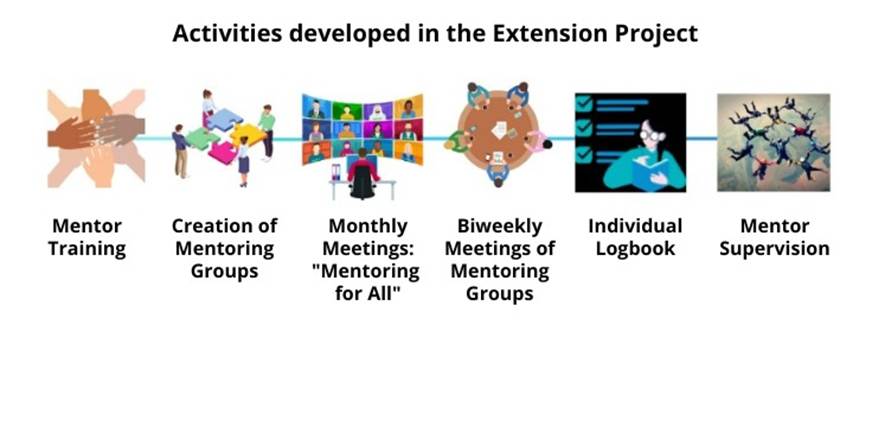 Source: prepared by the authors, 2023.
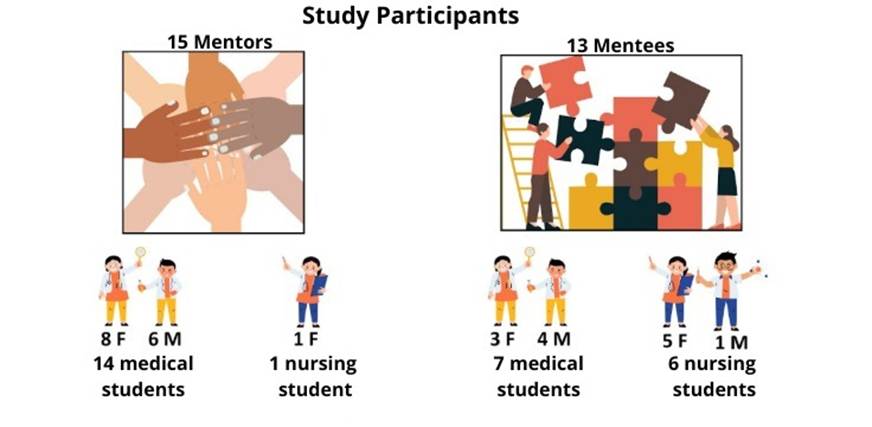 Source: prepared by the authors, 2023.