
 Peer-mentoring between Medical and Nursing students: a pilot project
ABSTRACT
Peer-mentoring promotes, through a horizontal bond among students, the development of skills related to autonomy, self-assurance, and personal management in studies and daily life. A pilot project of interprofessional peer-mentoring was developed at Escola Superior de Ciências da Saúde (ESCS) aiming to facilitate the academic transition for medical and nursing students. This exploratory and descriptive study, with a qualitative approach, describes how the ESCS Mentoring Project was implemented in 2022 and investigates the sociodemographic profile of the participants, in addition to analyzing their perceptions about the experience. Undergraduate students from the medicine and nursing courses who participated in the 2022 edition as mentors (seniors) and mentees (freshmen) constitute the study sample. In total, there were 14 medical mentors and 1 nursing mentor, along with 7 medical and 6 nursing mentees. The predominant profile corresponds to female students, with a mean age of 23 years, from the Federal District and living with family members. Biweekly meetings were held in small mixed groups, besides monthly meetings involving all participants to discuss topics of collective interest. Mentors and mentees stated that mentoring provided a mutually supportive environment and offered valuable insights for their education. Additionally, mentoring facilitated integration between the courses and allowed an exchange of experiences that anticipates future teamwork, promoting the understanding of different professional roles and reinforcing the importance of interprofessional collaboration. The main challenges reported were the difficulty in scheduling biweekly meetings and the small participation of senior nursing students. The extension project was successful and confirms that peer-mentoring is an important tool in welcoming incoming students and adapting them to the higher education context. The remaining challenge is to find a mentoring format (virtual, in-person, hybrid) at ESCS aiming to reinforce participation and proximity between students whose courses operate on different campuses, with demanding and distinct curriculum schedules.
Keywords:
Mentoring; Nursing Students; Medical Students; Interprofessional Education; Mental Health
RESUMO
A mentoria entre pares promove, por meio de um vínculo horizontal entre estudantes, o desenvolvimento de habilidades relacionadas à autonomia e à gestão pessoal dos estudos e da vida cotidiana. Um projeto-piloto de mentoria interprofissional entre pares foi desenvolvido na Escola Superior de Ciências da Saúde (ESCS), com o intuito de facilitar a transição acadêmica de discentes de Medicina e Enfermagem. Este estudo exploratório e descritivo, com abordagem qualitativa, descreve como se deu a implementação do Projeto Mentoria da ESCS em 2022 e investiga o perfil sociodemográfico dos participantes, além de analisar a percepção deles sobre a experiência. Estudantes de graduação em Medicina e Enfermagem que participaram desta edição do projeto como mentores (veteranos) e mentorandos (calouros) compõem a amostra do estudo. Foram ao todo 14 mentores de Medicina e uma mentora de Enfermagem, bem como sete mentorandos de Medicina e seis de Enfermagem. O perfil predominante corresponde a estudantes do gênero feminino, com idade média de 23 anos, oriundas do Distrito Federal e que vivem com os familiares. Ocorreram encontros quinzenais em pequenos grupos mistos e encontros mensais com todos os participantes para discussão de temas de interesse coletivo. Os mentores e mentorandos afirmaram que a mentoria forneceu um ambiente de apoio mútuo e lhes proporcionou conhecimentos úteis para sua formação. A experiência oportunizou ainda a integração entre os cursos e permitiu uma troca de vivências que antecipa o futuro trabalho em equipe, promovendo o entendimento dos diferentes papéis profissionais e reforçando a importância da colaboração interprofissional. Os principais desafios relatados foram a dificuldade de agendar os encontros quinzenais e a limitação da participação de veteranos de Enfermagem. O projeto de extensão obteve êxito e confirma que a mentoria entre pares é uma ferramenta importante no acolhimento dos estudantes ingressantes e na sua adaptação ao contexto do ensino superior. O desafio que permanece é encontrar um formato (virtual, presencial, híbrido) de mentoria para a ESCS, com vistas a aumentar a participação e a aproximação de estudantes cujos cursos funcionam em campi diferentes, com agendas curriculares exigentes e distintas.
Palavras-chave:
Mentores; Educação Médica; Educação em Enfermagem; Educação Interprofissional; Saúde Mental
INTRODUCTION
The first mentoring programs were implemented in North American and European contexts in the 1970s and, since then, they have also been established in Brazil. Mentoring can be characterized as a relationship of guidance and support between a more experienced person and a beginner, and its dynamics of welcoming and sharing experiences are especially important in the academic and professional environments1. This is a strategy with potential support for students in a moment of transition marked by intense changes2.
Leaving High School is associated with the incorporation of new responsibilities inherent both to the academic environment and its obligations and to the arrival of adulthood. It is a period of adaptation that is usually marked by uncertainty, anxiety, and feelings of frustration, with great impact on the physical and mental health of students3. A program aimed at generating interpersonal bonds, as well as promoting knowledge, skills, and ethical posture4),(5, can make entry into higher education less difficult. Additionally, this strategy has the potential to favor the exploration of aspects that are not contemplated in the traditional curriculum, such as the promotion of equity relations by encouraging greater integration among non-white, non-heterosexual students and those who are the recipients of university scholarships6.
With regard specifically to undergraduate medical courses, the extensive workload, the teachers’ demands and the competitiveness among students bring challenges from the moment they enter the course. Moreover, medical students are subject to suffering and feelings of unpreparedness during graduation, due, for example, to contact with critically-ill patients and with the possibility of a negative outcome. Such elements are associated not only with a reduction in the quality of life, but also with losses in academic performance and impairment of the students’ personal sphere7),(8.
Similarly, the practice of nursing in educational institutions can be associated with constant emotional stressors, as students dedicate themselves to the development of care skills but neglect their own mental and physical health. This phenomenon can also be explained by the educational system itself, which does not usually offer strategies to strengthen the psychological sphere during the academic path9. Thus, it is essential that students have equipment that identifies learning difficulties and promotes a support network for their education10),( 11).
In this context, peer mentoring based on the student-student relationship is especially useful for students, because it allows a symmetrical bond with reciprocal understanding. Mentors, as veteran learners, are in a unique position to assist in managing daily problems faced by students due to their shared experiences and the non-hierarchical nature of the relationship they foster12. Moreover, they are understood as more accessible to certain conversations13), (14, creating a safe environment for addressing sensitive issues. Mentoring relationships are considered more functional when they involve shared values, mutual commitment, clarity of expectations, and personal connection5),(15.
The inclusion of interprofessional experiences during undergraduate school has been currently a challenge for health education. Although simple in concept, its implementation may encounter barriers such as the large number of students, scarcity of resources, and lack of availability or preparedness by the faculty16),(17. Regardless of this, considering that comprehensive patient care involves the participation of different complementary professional entities, it is important that the courses include opportunities for teamwork, as part of continuous learning16. An educational strategy that promotes dialogue between students from different health areas also allows them to learn about the role of others and collaborate towards a common agenda18, which is crucial in an increasingly complex and interdependent health environment.
A pilot project of interprofessional peer mentoring was developed at Escola Superior de Ciências da Saúde (ESCS), taking into account the particularities of the medicine and nursing courses and aiming at the solidary experience in higher education, as well as the early identification and initial management of situations of psychological distress among students. This study describes and analyzes the implementation experience of the extension project “ESCS Mentoring”, developed between March and December 2022.
METHODS
This exploratory and descriptive study with a qualitative approach presents how the ESCS Mentoring Extension Project was developed throughout 2022, in addition to describing the sociodemographic profile of the students who participated in the project and analyzing their perceptions of the experience.
The research is based on the analysis of documents from the extension project, including registration and evaluation forms filled out by students via Google Forms at the beginning and end of the project, respectively. Data collection was carried out by the coordinators of the extension project after the end of the project, ensuring the participants’ confidentiality through the use of aggregated data. The study was approved by the Research Ethics Committee CEP/FEPECS/SES/DF (Opinion number 5,556,704/2022).
Data from students over 18 years of age who agreed to participate in the research by signing the Free and Informed Consent Form (FICF) were included. Forms with incomplete information regarding the studied variables were excluded. The variables of interest were the profile of the study participants (age, gender, course, stage of graduation, region of origin and residence); the perceptions of mentors and mentees about the mentoring experience, as well as suggestions for future editions.
RESULTS
ESCS Mentoring Extension Project
The extension project had the following structure: biweekly meetings in small mixed groups with students (freshmen and seniors) of medicine and nursing, as well as monthly meetings with all participants to discuss topics of collective interest. The activities also included mentors’ training and supervision, carried out by two psychologists from the Higher Education Institution (HEI), coordinators of the project.
The program was publicized through the college’s social networks, in meetings with student leaders and in lectures during the freshman welcome week. Registration took place electronically via Google Forms. All meetings took place in an online format. To obtain the certification of the extension project, the participants had to achieve 75% attendance in the planned activities, as well as present the “logbook” - an instrument that aimed to assess the students’ perception of each meeting throughout the project, in small and large groups.
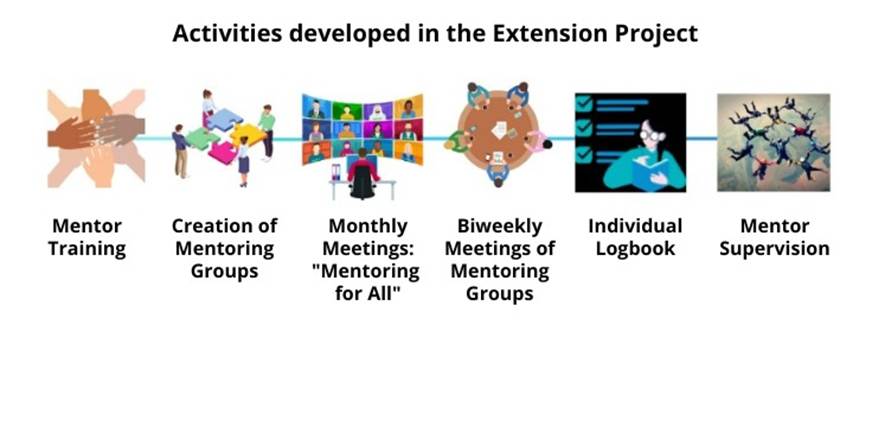
Figure 1 illustrates the developed activities. Initially, two training meetings for mentors took place, with the aim of providing tools, information and guidance before the beginning of mentoring practices. After the arrival of the mentees, five mentoring groups comprising up to eight students were created, each with two to four mentors from different courses. The biweekly meetings in small group covered a total of 13 sessions (26 hours). The discussion topics were proposed by the members themselves, who chose the most relevant subject for the moment. This format aimed to promote proximity between students and strengthen the bonds of mutual support.
The monthly meetings with all participants, in turn, took place in eight sessions, totaling 16 hours, with the intention of promoting integration and the exchange of experiences between mentors and mentees collectively. Each meeting had a medical professional or nurse invited to discuss topics relevant to the academic moment or to the professional future. The topics of the meetings were: Welcome meeting; What is Mentoring; Time management and study organization; Professional Trajectory in medicine and nursing from the perspective of ESCS Graduates; Veterans’ Experience with the ESCS Undergraduate Research Program; Mental Health and Suicide Prevention; Mental Health of Medical and Nursing Students; Closing meeting: evaluation of the Extension Project.
As for the mentors’ monitoring, three supervision meetings were held with the project coordinators throughout the year, totaling four hours. The supervision aimed to provide support to the mentoring process by building a space for reflection, discussion of challenges and exchange of experiences among mentors. The individual “logbook” activity allowed the continuous evaluation of the project, since the records of the perceptions of all participants in all mentoring meetings could be monitored by the coordinators throughout the year.
The participants’ total workload varied according to their roles, with the mentors adding up to 71 hours, and the mentees, 63 hours of participation. Among the students who were certified, there was a greater number of nursing mentees (12 from the nursing and 7 from the medicine course), with a predominance of women (9 from nursing and 4 from medicine). Among the mentors, 14 medical veterans (8 female and 6 male) were certified, while only 1 nursing veteran met the certification criteria.
Profile of the study participants
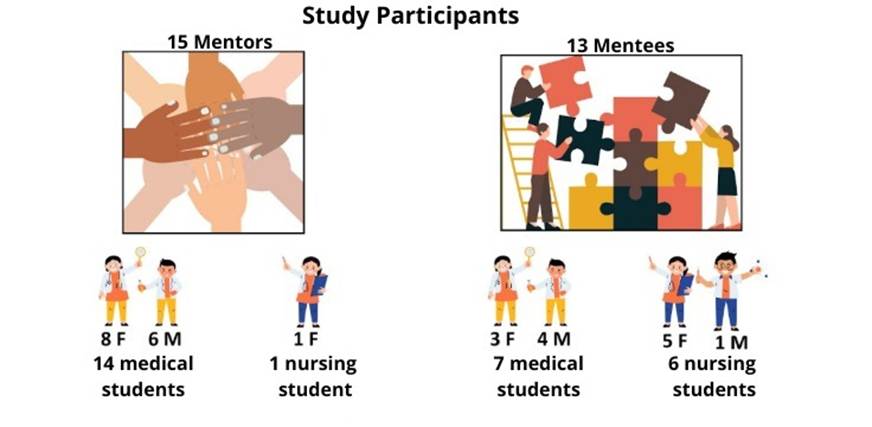
All participants who met the certification criteria were invited to participate in this study by signing the Free and Informed Consent Form (FICF), so that, of the 19 certified mentees, 13 (68.42%) agreed to participate in this research. As for the mentors, the 15 certified mentors (100%) agreed to participate. We emphasize that this was the sample used in this study for qualitative analysis of the data collected from the extension project. Figure 2 illustrates the distribution of participants according to courses and roles played in the project.

Table 1 shows details about the participants’ profile. The predominant trend was: female gender (53.57%), with a mean age of 23 years, with 14 medical mentors and 1 nursing mentor, 7 medical mentees and 6 nursing mentees. Most of them come from the Federal District (50%) and live with family members (67.8%).
Participants’ perception of the mentoring experience
At the end of the program, mentors and mentees answered an online project evaluation form. The mentors reported their perceptions about how the Extension Project contributed to their professional training and performance in that school year, in addition to telling how the experience of being a Mentor was. The mentees, on the other hand, reported their perceptions about how mentoring contributed to their adaptation to the ESCS and to their performance in that school year, in addition to evaluating the mentors’ performance. Chart 1 shows the categories of answers and examples of some of the students’ statements.
Mentors’ perception
Table 1 presents the categories of answers and examples of some of the veterans’ statements. The mentors evaluated the presence of medical and nursing students in the same group as positive and commented that the project allowed an interaction that does not usually happen between the two courses on other occasions. Moreover, they reported identifying in the freshmen’s demands issues they also faced in the past, and this is an opportunity to reassure newcomers from the perspective of someone who has already gone through similar events.
The perception of having had a positive impact on the mentees was seen as another important point. Some mentors reported that the experience with mentoring provided the opportunity to “look at oneself”, as well as a reflection on personal growth and professional development. The ability to listen was also mentioned by the veterans as a positive experience gain, representing a fundamental acquisition for professional practice.
However, negative experiences were also reported by the mentors as they struggled to maintain the group’s interest in the activities. The feeling of frustration was cited for not being able to mobilize the participants to engage in the proposals collectively. Additionally, some mentors mentioned that they felt overwhelmed when organizing the meetings at times that were convenient for everyone in the small group, leaving as a suggestion for future projects the organization of smaller groups.
As for the possibility of returning to the project as mentors again in future editions, the majority (7) stated they were interested. Those who do not intend to return (6) mentioned as a reason the desire to participate in other academic experiences provided by the course or the existence of other priorities required by the end of the course, in the case of those close to graduation. A smaller number (3) is unsure of the answer due to uncertainties regarding the management of time for study and the associated task overloads.
Mentees’ perception
Study and time management tips, as well as elucidations about the operation of the institution, were considered important tools in adapting to college. The aspects of sharing insecurities due to changes in routine and intense curricular demands were also understood as positive points of mentoring.
Particularly with regard to the demand of nursing mentees, the absence of mentors from their own course had negative impacts on the discussions in some groups. On the other hand, in other groups, the creation of bonds was strong enough that this discrepancy was less noticeable.
The main suggestions for changes involved holding meetings in smaller groups and some in-person meetings; the more balanced participation of mentors from the two courses; and the prior planning of the activities of each meeting by the project management, with pre-established topics.
As for the possibility of returning to the project in the next editions, this time in the role of mentors, 7 students said they were interested. The unequal participation of mentors from both courses was even mentioned by some nursing mentees as a motivating condition to participate again in the future and overcome this need. The greatest resistance to volunteering involved the lack of time and availability to commit to this responsibility, manifested by 6 students. One mentee wasn’t sure of the answer.
DISCUSSION
Peer-mentoring was pointed out in other experiences as an instrument that provided opportunities for horizontal relationships among students, facilitating the construction of a safe space for the exposure of fears, anxieties and suffering to their peers11),(19)-(23. According to the students, this reality was replicated in our pilot project, as both seniors and freshmen experienced situations in mentoring that helped them deal with emotional stress. The willingness of mentors to contribute again to the project, as well as of mentees to become mentors in future editions, is another positive indicator of the success of mentoring.
In addition to support for well-being and mental health issues, the improvement of skills such as communication was noticed by our mentors. In this sense, the project carried out in 2020 with medical students from Unisinos24 had objectives and results close to those of this study, such as the development of useful skills for personal and academic development, including the ability to listen altruistically. This is a competency that can also be extended to clinical practice scenarios, as it is associated, for example, with the transmission of a diagnosis in a comprehensive way and the recognition of the patients’ emotional suffering, allowing the professional to respond appropriately25. Hence, it is clear that, in addition to being an essential aspect of mentoring, effective communication is a fundamental quality of a good health caregiver.
On the other hand, the “weight” of the commitment to the mentoring project at times of high demand for the courses emerged as an important topic in the mentors’ statements, which was also identified in other experiences26),(27. In published reports, the mentors pointed out difficulties in reconciling their own primary academic responsibilities with the activities of support to the freshmen, which may have resulted in an increase in psychological stress with consequent impairment in the positive impact of the mentoring. Moreover, the lack of compatibility of schedules among all the students in the group and the perception of the mentees’ low engagement were complaints brought by the mentors in this and other studies26),(28, which may have reduced interest in the program over time. This finding underscores the importance of recognizing and mitigating the impact of weight on mentors in peer-mentoring programs, ensuring that the support offered is sustainable and beneficial for all parties involved.
The integration between medical and nursing students was another characteristic perceived as very positive by the participants, with reports even of a desire for integration that was prior to the project. This reveals that, despite the numerous challenges related to the promotion of interprofessionality during undergraduate studies, there is an appreciation of this formative aspect by the students themselves. The exchange of knowledge regarding the different roles and modes of patient care, for instance, encourages undergraduate students to value a cohesive, collaborative, and efficient work environment throughout their careers5),(16),(17. Thus, the proposal of inclusive mentoring for these two groups can also find fertile environments for implementation in other educational institutions.
Also regarding this aspect, it was mentioned that the interprofessionality of the program contributed to the understanding of the challenges that each course offers to its students, such as the difference in the treatment that doctors and nurses receive in the hospital. Possible previously established negative perceptions about each person’s work fit into what is recognized as “hidden curriculum”, the set of educational and professional experiences taught unintentionally29),(30. These are practices with the potential to guide actions and values that can perpetuate unequal power relations, evidencing a flaw in the formal curriculum by not addressing them adequately. It is important that the undergraduate course ensure the exposure of these aspects to minimize their deleterious effects, making the implicit explicit. The mentoring experience, in this case, reveals itself as a strategy for educational change, by confronting old prejudices, addressing aspects of professionalism and promoting empathy and sensitivity in the presence of the difficulties and potentials of each profession.
Another concept implied during health education is the constant separation between clinical skills and humanistic qualities, the latter often implicitly understood as less important than the former31. This can corroborate to scenarios in which students do not seek help in situations of vulnerability, as they live in a culture of false self-sufficiency in hospitals and other services. Mentoring, on the other hand, provides the opportunity to identify and welcome emotional suffering, in addition to providing a safe environment for its management, allowing the student to identify their own “weaknesses and strengths”, as described by a mentor, and thus being able to ask for appropriate help whenever necessary. These activities centered on the relationship among students break with the notion of hierarchical relationships, value teamwork and stimulate qualities of professionalism30.
The fact that most participants were female is compatible with what was observed in similar projects1),(21),(24),(32. This adherence profile may be a reflection of the trend towards the feminization of medicine, with a consistent increase in the number of women in the profession33, as well as the maintenance of a female profile in nursing courses. Although gender issues involving the inclusion of these women in the academic context or in health services have not been addressed in discussions of collective interest, the strong female representation in the program opens the door to the inclusion of this topic in future editions.
The absence of undergraduate nursing mentors, cited by mentees as a negative aspect of the experience, was also a frustration for the project coordination. Although there were an equal number of veterans from both courses during registration, there was a dispersion of nursing mentors during the training and after the beginning of the activities, which can be attributed to a better understanding of the commitment to be assumed in the mentoring. Another justification may involve the clash of schedules with other extracurricular activities. The coordination decided, nevertheless, to keep the nursing freshmen in the project, trying to meet the common demands of these freshmen in the “Mentoring for All” meetings.
Our mentoring experience developed in the online modality was inspired by similar projects from other institutions1),(24), (34. This study participants did not mention the online format as a challenge or barrier, but some suggested adding in-person meetings. This perception of the students suggests that a hybrid model would be interesting for the ESCS, because, although the online modality facilitates the meeting of agendas between students from different courses and grades, the face-to-face format could strengthen the personal bonds between freshmen and seniors.
This study reflects on the experience of a pilot project in a school that offers only nursing and medical courses, and its results cannot be generalized. Comparisons with similar projects are limited to studies with students from only one course, either medicine or nursing, since no reports of experiences with groups of students from both courses in the same mentoring program were found in the literature.
A strong differential of this proposal among peers corresponds, therefore, to the integration between the two health courses, an aspect considered as one of the great gains of mentoring by the students themselves. Considering that there is almost no contact between groups that study on two campuses that are very distant from each other, the interprofessional proposal favored an academic approach that would not occur spontaneously - despite being undergraduate students from the same institution. In this sense, interprofessional mentoring can anticipate team collaboration based on the dialogue with other disciplines and ways of working, with a possible impact even on health environments.
FINAL CONSIDERATIONS
Mentors and mentees stated that the Mentoring Project at ESCS provided them with relevant learning for their training, in addition to representing an environment that fosters academic support and mental well-being through mutual support. The interest of both groups in participating in future editions reflects the appreciation of the experience and the desire to contribute to other students’ development. Moreover, the mentoring provided the opportunity for integration between two courses in the health area, enabling the sharing of experiences that prepare for future collaborative work.
The success of the extension program proves the relevance of peer mentoring as an important tool to welcome new students and facilitate their transition to the university environment. The challenge that remains is to find a format (virtual, in-person, hybrid) of mentoring program for ESCS that facilitates the proximity of students from courses that operate on different campuses, with demanding and distinct curricular agendas.
To improve adherence to the program and maximize its impact, strategies such as the formation of pairs or smaller groups of mentees can be implemented, which facilitates the personalization of follow-up and the building of stronger bonds between participants. It is also important to make meeting times and formats more flexible, offering alternatives that consider the students’ different academic demands. In this way, the program could more effectively meet the students’ needs, promoting an even richer and more inclusive mentoring experience.
References
- 1 Souza MG, Reato LF, Bellodi, PL. Ressignificando a relação entre calouros e veteranos: mentoria de pares na visão de alunos mentores. Rev Bras Educ Med. 2020;44(4): e174.
- 2 Akinla O, Hagan P, Atiomo W. A systematic review of the literature describing the outcomes of near-peer mentoring programs for first year medical students. BMC Med Educ. 2018;18(1): 1-10.
- 3 Morosanu L, Handley K, O’Donovan B. Seeking support: researching first‐year students’ experiences of coping with academic life. Higher Education Research & Development. 2010;29(6): 665-678.
- 4 Bellodi PL. O Programa Tutores e a integração dos calouros na FMUSP. Rev Bras Educ Med . 2020;28(3): 204-214.
- 5 Seshabela H, Havenga Y, de Swardt HC. Nursing student peer mentorship: the importance of professional relationships. Afr J Nurs Midwifery. 2020;22(1): 17.
- 6 Acherman ND, Ribeiro AP, Lima LM, Cavalcanti AC, Miranda TK, Oliveira GL. Mentoria entre pares: percepções de suporte social e ambiente educacional de estudantes de medicina. Rev Bras Educ Med . 2021;45: e100.
- 7 Conceição LS, Batista CB, Dâmaso JG, Pereira BS, Carniele RC, Pereira GD. Saúde mental dos estudantes de medicina brasileiros: uma revisão sistemática da literatura. Avaliação (Campinas). 2019;24(3): 785-802.
- 8 Feodrippe AL, Brandão MC, Valente TC. Qualidade de vida de estudantes de Medicina: uma revisão. Rev Bras Educ Med . 2013;37(3): 418-428.
- 9 Esperidão E, Barbosa JA, Silva NS, Munari DB. The mental health of nursing students: an integrative review of literature. SMAD, Rev. Eletrônica Saúde Mental Álcool Drog. 2013;9(3): 144-153.
- 10 Silveira LM, Bellodi PL, Diniz RV, Afonso DH. Mentoria em contexto. Rev Bras Educ Med . 2021; 45(1): e129.
- 11 Menezes DP, Cunha AT, Oliveira LC, Souza LF. Peer mentoring como estratégia de acolhimento ao estudante e adaptação ao método PBL. Rev Bras Educ Med . 2021;45(01): e103.
- 12 Colvin JW, Ashman M. Roles, risks, and benefits of peer mentoring relationships in higher education. Mentoring & Tutoring: Partnership in Learning. 2010;18(2): 121-134.
- 13 Andre C, Deerin J, Leykum Li. Students helping students: vertical peer mentoring to enhance the medical school experience. BMC Res Notes. 2017;10: 1-7.
- 14 Seery C, Andres A, Moore-Cherry N, O’Sullivan S. Students as partners in peer mentoring: expectations, experiences and emotions. Innov High Educ. 2021;46: 663-681.
- 15 van der Vleuten CP, Driessen EW. What would happen to education if we take education evidence seriously? Perspect Med Educ. 2014;3(3): 222-232.
- 16 Frenk J, Chen L, Bhutta ZA, Cohen J, Crisp N, Evans, T et al. Health professionals for a new century: transforming education to strengthen health systems in an interdependent world. The Lancet. 2010;376(9756): 1923-1958.
- 17 Sunguya BF, Hinthong W, Jimba M, Yasuoka J. Interprofessional education for whom? - challenges and lessons learned from its implementation in developed countries and their application to developing countries: a systematic review. PloS One. 2014;9: e96724.
- 18 Thistlethwaite J, Moran M. Learning outcomes for interprofessional education (IPE): literature review and synthesis. J Interprof Care. 2010;24(5): 503-513.
- 19 Kaji AK, Gazzi BC, Schimitd B, Silva MD, Zollner, MS. Desenvolvimento de um programa de mentoria por pares estudantis: um relato de experiência. Rev Bras Educ Med . 2021;45: e107.
- 20 Yuksel A, Bahadir-Yilmaz E. The effect of mentoring program on adjustment to university and ways of coping with stress in nursing students: a quasi-experimental study. Nurse Educ Today. 2019;80: 52-58.
- 21 Vandal N, Leung K, Sanzone L, Filion F, Tsimicalis A, Lang A. Exploring the student peer mentor’s experience in a nursing peer mentorship program. J. Nurs Educ. 2018;57 (7): 422-425.
- 22 McKellar L, Kempster C. We’re all in this together: Midwifery student peer mentoring. Nurse education in practice. 2017; 24: 112-117.
- 23 Franzoi MA, Martins G. Experiência de mentoring entre estudantes de graduação em enfermagem: reflexões e ressonâncias dialógicas. Interface Comun Saúde Educ. 2020;24: e190772.
- 24 Martins PM, Bosak VX, Oliveski DL, Hoff BB, Salvador RF, Massena JR. Mentoria entre pares na escola médica: uma estratégia colaborativa durante a pandemia da Covid-19. Rev Bras Educ Med . 2021;45: e118.
- 25 Zoraya SI, Florettira MT, Syakurah RA, Azhar AA, Okparasta A, Irfani TH. The impact of peer assisted learning on mentors’ academic life and communication skill in medical faculty: a systematic review. Int J Public Health. 2021;10: 401-10.
- 26 Won MR, Choi YJ. Undergraduate nursing student mentors’ experiences of peer mentoring in Korea: A qualitative analysis. Nurse Educ Today . 2017;51: 8-14.
- 27 Cross M, Lee S, Bridgman H, Thapa DK, Cleary M, Kornhaber R. Benefits, barriers and enablers of mentoring female health academics: an integrative review. PLoS One. 2019;14(4): e0215319.
- 28 Heirdsfield AM, Walker S, Walsh K, Wilss L. Peer mentoring for first‐year teacher education students: the mentors’ experience. Mentoring & Tutoring: Partnership in Learning . 2018;16(2): 109-124.
- 29 Gupta M, Forlini C, Lenton K, Duchen R, Lohfeld L. The hidden ethics curriculum in two Canadian psychiatry residency programs: a qualitative study. Acad Psychiatry. 2016;40(4): 592-599.
- 30 Silva JM e. Educação médica e profissionalismo. Acta Med Port. 2013;26(4): 420-427.
- 31 Craig SR, Scott R, Blackwood K. Orienting to medicine: scripting professionalism, hierarchy, and social difference at the start of medical school. Cult Med Psychiatry. 2018;42(3): 654-683.
- 32 Joung J, Kang KI, Yoon H, Lee J, Lim H, Cho D, et al. Peer mentoring experiences of nursing students based on the caring perspective: a qualitative study. Nurse Educ Today . 2020;94: 104586.
- 33 Guilloux AG, Miotto BA, Almeida CD, Guerra A, Cassenote A, Matijasevich A, et al. Demografia médica no Brasil. São Paulo: FMUSP, AMB; 2023.
- 34 Soares MV, Junqueira PD, Young PD, Feliciano DG, Mendonça VS, Gois AF. Mentoria virtual durante a pandemia de Covid-19: percepções de mentorandos e mentores. Rev Bras Educ Med . 2021;45: e109.

 Source: prepared by the authors, 2023.
 Source: prepared by the authors, 2023.