 Research as a formative tool: experience with endocrinologists on adrenal insufficiency management
ABSTRACT
Introduction: Continuing medical education represents a growing challenge given the rapid expansion of scientific knowledge. Knowledge assessment surveys are valuable tools for identifying educational gaps and, when combined with immediate feedback to participants, add a formative dimension to the investigative process. This report describes and analyzes the formative potential and participant satisfaction in a survey on the knowledge and practices of Brazilian endocrinologists regarding adrenal insufficiency management in stress situations.
Experience report: A cross-sectional observational study conducted through an online form with 280 endocrinologists from 24 Brazilian states. The instrument included two general questions and eight clinical vignettes on glucocorticoid dose adjustments in patients with adrenal insufficiency. Upon completion, participants automatically received an email with feedback including answer justifications and bibliographic references. Subsequently, a satisfaction survey comprising four dichotomous questions about the participation experience was sent to participants.
Discussion: Participation in the main survey was substantial, exceeding the calculated sample size and achieving national representativeness, despite potential embarrassment from email collection. The average correct answer rate was 63.3%, revealing gaps in technical knowledge and educator competence. The satisfaction survey response rate was 16.4%, with expected non-response bias. Among respondents, nearly all reported having accessed the feedback, found it useful, and anticipated a positive impact on their clinical practice. All expressed interest in participating in future studies with a similar format.
Conclusion: Research with immediate formative feedback proved to be a viable and well-received strategy to promote continuing medical education among specialists, integrating knowledge gap diagnosis and professional updating in a single instrument. The model proved to be feasible and well accepted, and may contribute to bridging the gap between the generation of scientific evidence and its application in clinical practice.
Keywords:
Continuing medical education; adrenal insufficiency; Health knowledge, attitudes, practice
RESUMO
Introdução: A educação médica continuada representa um desafio crescente diante da rápida expansão do conhecimento científico. Pesquisas diagnósticas de conhecimento constituem ferramentas valiosas para a identificação de lacunas formativas e, quando associadas a devolutivas imediatas aos participantes, agregam a dimensão formativa ao processo investigativo. Este relato descreve e analisa o potencial formativo e a satisfação dos participantes em uma pesquisa sobre conhecimento e práticas de endocrinologistas brasileiros no manejo da insuficiência adrenal em situações de estresse.
Relato de experiência: Trata-se de um estudo transversal observacional realizado por meio de formulário online com 280 endocrinologistas de 24 estados brasileiros. O instrumento continha duas questões gerais e oito vinhetas clínicas sobre ajustes de dose de glicocorticoides em pacientes com insuficiência adrenal. Ao concluírem o preenchimento, os participantes receberam automaticamente, por e-mail, devolutiva com justificativa das respostas e referência bibliográfica. Posteriormente, foi enviada aos participantes uma pesquisa de satisfação com quatro questões dicotômicas sobre a experiência de participação.
Discussão: A adesão à pesquisa principal foi expressiva, superando o tamanho amostral calculado e alcançando representatividade nacional, apesar do possível constrangimento decorrente da coleta de endereços eletrônicos. O índice médio de acertos foi de 63,3%, revelando lacunas no conhecimento técnico e na competência educadora dos participantes. A taxa de resposta à pesquisa de satisfação foi de 16,4%, com viés de não resposta esperado. Entre os respondentes, a quase totalidade relatou ter acessado a devolutiva, considerou-a útil e prevê impacto positivo em sua prática clínica. Todos manifestaram interesse em participar de estudos futuros com formato similar.
Conclusão: A pesquisa com devolutiva formativa imediata mostrou-se uma estratégia viável e bem recebida para promover educação médica continuada entre especialistas, integrando diagnóstico de lacunas de conhecimento e atualização profissional em um único instrumento. O modelo demonstrou ser viável e bem-aceito, podendo contribuir para aproximar a geração de evidências científicas de sua aplicação na prática clínica.
Palavras-chave:
Educação Médica Continuada; Insuficiência Adrenal; Conhecimentos, Atitudes e Prática em Saúde
INTRODUCTION
Continuing education is one of the core competencies set out in the National Curriculum Guidelines for Undergraduate Medical Studies (DCN)1. However, given their multiple professional responsibilities, heavy workload and need to work in a variety of clinical settings, combined with personal and family commitments, maintaining their capabilities sharp and up-to-date represents a challenge for doctors. This challenge is becoming increasingly acute, given that the time it takes for medical knowledge to double has fallen from 50 years in 1950 to 3.5 years in 2010, and is projected to be just 73 days by 20202. Scientific knowledge is expanding at a faster rate than healthcare professionals’ ability to assimilate and apply it in practice, creating gaps that could potentially compromise the quality of care and patient safety2),(3.
Continuing education for qualified doctors presents its own set of challenges: the lack of a structured curriculum, no clearly defined educational objectives, and disputes regarding the ideal teaching and learning methodologies. Against this backdrop, studies that assess knowledge gaps and innovative proposals in medical education are particularly relevant4)-(6.
Diagnostic assessments are valuable tools for identifying these gaps and subsequently developing tailored educational strategies, thereby improving the outcomes6)-(8. When such surveys provide immediate feedback to participants, they add an educational dimension to the research process. Accordingly, in addition to identifying knowledge gaps for future educational interventions, the research itself can serve as a tool for medical continuing education, representing an interesting strategy for active and collaborative learning8.
This case report examines a study into the practices adopted by Brazilian endocrinologists regarding the education of patients with adrenal insufficiency for glucocorticoid dose adjustments in stressful situations9. Given that any maladjustment of the dose poses a potentially fatal risk, this issue is of particular importance in this field. The study examined not only gaps in the technical knowledge of the specialists, but also possible shortcomings in the way they fulfil their role as educators - another competency established by the DCNs1. The aim of this report is to analyse the educational potential of a study on specialist medical knowledge and to assess participants’ satisfaction with their involvement in the study. It should be noted that this paper focuses on the methodological aspects of the research, rather than its specific results, which have been published in a specialist journal9.
EXPERIENCE REPORT
Participants and methods
An observational cross-sectional study based on data collected via an online questionnaire. All participants provided informed consent, and the protocol was approved by the local Ethics Committee in June 2024 (CAAE 74855523.4.3001.5257).
Participants
Brazilian endocrinologists from all regions of the country were invited to take part in the study. The sample calculation used confidence intervals for population proportions. Given an estimated population of 5,000 endocrinologists in Brazil, according to data from the Brazilian Society of Endocrinology and Metabology, a margin of error of 5% and a confidence level of 90% were adopted, resulting in a required sample size of 257 respondents.
Methods
An online survey platform developed using Google Forms was used; this collected sociodemographic data (age, time since qualification and in the specialty) and presented two general questions followed by eight clinical case studies. The hypothetical cases covered common scenarios requiring glucocorticoid (GC) dose adjustments in patients with adrenal insufficiency, as previously described9. The tool assessed the specialists’ technical knowledge, clinical practices and teaching skills.
The dissemination was done via cross-platform messaging app groups (WhatsApp) comprised of endocrinologists from across the country. The researchers, who are also members of these groups, requested further dissemination of the invitation to the study among other relevant communities within the field. The invitation included a description of the study’s objective and a link to the informed consent form, followed by the questionnaire. To maximise participation, the invitation was sent out every two weeks over an eight-week period.
Once they had completed the form, participants automatically received an email via Google Forms containing feedback on their answers, including a concise explanation of the correct answers and the corresponding bibliographical references. All recommendations regarding GC dose adjustment for the prevention of adrenal crisis were based on the current Endocrine Society guidelines10.
A few weeks after the initial participation, a satisfaction survey created using Google Forms was sent to the registered email addresses. The survey consisted of four dichotomous questions (Yes/No), as shown in Table 1.
The responses from both surveys were exported to Excel for further analysis.
Statistical analysis
In the descriptive analysis, categorical variables were expressed as frequencies and percentages, whilst numerical variables were expressed as mean ± standard deviation.
Results
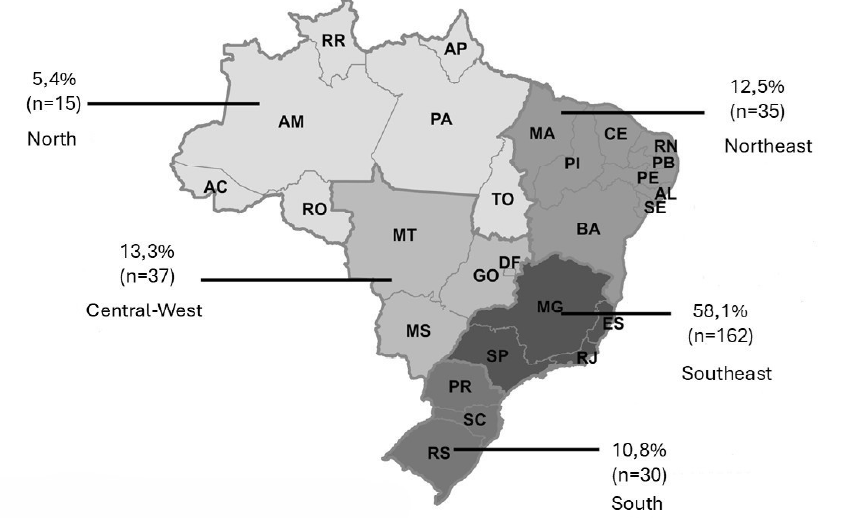
A total of 280 physicians completed the online questionnaire in full. The participants represented 24 of Brazil’s 27 states (Figure 1), with the following regional distribution [n (%)]: North, 15 (5.4%); North-East, 35 (12.5%); Central-West, 37 (13.3%); South-East, 162 (58.1%); and South, 30 (10.8%).
The mean age of the participants was 43.9 ± 10.6 years, with a mean time since specialisation of 14.5 ± 11.4 years. The majority of respondents (n = 212; 75.7%) had been practising the specialty for more than five years. The average percentage of correct answers across the set of questions was 63.3%. Detailed results for each question are available in the original research article9. The survey tool, which includes the categorisation of the options and the classification of the difficulty level of each question based on participants’ correct answer rates, is presented in Table 2.
Question #1, which assessed the specialists’ role as educators, had a 70.4% correct response rate. Question #2, which concerned the doctor’s role as an educator in promoting patient autonomy, received the highest percentage of responses relating to potential harm to the patient or the risk of an adrenal crisis (41.1%).
As for the satisfaction survey, 46 doctors (16.4% of the original sample) completed the questionnaire. Of these, only three reported that they had not read the feedback email. Of the 43 participants who accessed the feedback, they all found it useful and 42 said they expected it to have a positive impact on their clinical practice. All respondents (n=46) expressed an interest in participating in future studies with a similar research/medical education format that provides feedback. The satisfaction survey was conducted anonymously, without collecting any identifying information or sociodemographic data, in order to encourage more spontaneous and honest responses from participants; consequently, profiling of this subgroup was not possible.
DISCUSSION
The aim of this case report was to explore the educational potential and participant satisfaction in a study examining the knowledge of medical specialists (endocrinologists) regarding a topic of high clinical relevance: patient guidance practices and the management of adrenal insufficiency in stressful situations. The development of knowledge assessment surveys aimed at doctors is a valuable tool for identifying training gaps, thereby facilitating the development of tailored training strategies6)-(8. This dialogue between the target public (doctors in need of continuing medical education) and providers of continuing medical education services (educational institutions and medical societies) is essential for aligning the identified gaps with the educational content offered6)-(8.
In addition to its diagnostic purpose, the study included an immediate educational component by providing feedback to the participants. The design of this methodological study was based on the authors’ previous experience in a study on screening practices for primary hyperaldosteronism among specialists and general practitioners, in which several participants, having received no feedback, contacted the researchers requesting the answer key for the clinical vignettes11.
Despite the inherent challenges in recruiting for studies of this nature, we obtained a sample of 280 participants, exceeding the calculated sample size (257) and ensuring national representativeness (24 of Brazil’s 27 states), with a distribution proportional to the concentration of endocrinologists according to SBEM census data. A significant barrier to participation in knowledge assessment studies lies in the potential discomfort felt by participants, who may feel exposed or as though they are being tested. In this study, the methodological design - which involved immediate feedback followed by a satisfaction survey - required the collection of participants’ email addresses, which could have exacerbated this sense of embarrassment. However, this did not prevent a significant number of experts from all regions of the country from taking part.
For the data processing, we followed strict ethical procedures, removing participants’ email addresses from the Excel spreadsheet generated by Google Forms before commencing the analysis, thereby ensuring anonymisation of the data and safeguarding the respondents’ privacy. Despite the risk of exposure, the survey attracted a significant number of respondents, which may be explained by the specialists’ interest in self-assessing their knowledge and performance. It is worth noting that participation in studies of this nature (assessment of knowledge and clinical practice with feedback) can encourage self-reflection on gaps in training that the individual was not even aware existed (so-called ‘unperceived needs’ or ‘what I didn’t even know I didn’t know’, in contrast to ‘perceived needs’ or ‘what I know I don’t know’, according to Cohen8 et al.) and motivate a desire for a deeper understanding. The automated feedback sent to participants included a concise discussion of the answer key for each question/scenario, accompanied by an open-access bibliographic reference10. The self-identification of unsuspected gaps in knowledge regarding adrenal insufficiency was also observed in a study conducted with primary care doctors6, in which participants, who were initially confident in their knowledge (“above average”), reassessed their proficiency as “average” or “below average” following the intervention. In addition, some participants in this study told the researchers that they recognised gaps in their knowledge regarding the diagnosis and management of adrenal insufficiency6. Although the study by Makin6 and colleagues employed a methodology and objectives similar to ours, it differed in that it did not incorporate the formative dimension, an aspect of particular interest in the experience described in this article.
The ultimate aim of any continuing medical education strategy goes beyond the acquisition of technical knowledge, focusing primarily on improving patient care8. Despite the methodological complexity involved in measuring the impact of educational interventions on care provision, evidence suggests that learning is more likely to bring about changes in practice when preceded by a needs assessment and underpinned by intrinsic motivation12. In this regard, we believe that the format adopted, combining knowledge assessment and clinical practice with feedback-prompted self-reflection, enhances the effectiveness of the study’s formative dimension.
From a theoretical perspective, the feedback provided to participants aligns with the feedback model proposed by Hattie and Timperley13, which defines it as information provided to an individual with the aim of reducing the gap between current performance and desired performance. According to this model, effective feedback answers three key questions: Where am I going? (feed-up), how am I going? (feedback) and where do I go next? (feed-forward). In this study, the research instrument indicated to participants the expected learning objectives (feed-up), the immediate feedback provided information on their performance in relation to the answer key (feed-back), and the bibliographic references provided indicated avenues for further study and addressing knowledge gaps (feed-forward). Although the feedback was standardised, that is, not tailored to individual responses, its immediate and context-specific delivery represents a strategy in line with the principles of adult learning, which emphasises the practical relevance and immediate applicability of the content learned. Furthermore, by presenting the participant with their own performance and offering guidance on how to address gaps, feedback can stimulate self-regulated learning processes, encouraging reflection on one’s own knowledge and motivation to actively seek further training3.
It is important to distinguish the strategy adopted in this study from other digital tools for medical education based on questions with feedback, such as the question banks used to prepare for medical residency exams and diploma revalidation. Although the format appears similar at first glance - answers to questions followed by explanatory comments - there are significant conceptual differences. On these platforms, the primary aim is to prepare for a summative assessment, with standardised content and an audience consisting mainly of trainee doctors or recent graduates. This study, in turn, focused on specialists with extensive clinical experience - most of the participants had been practising in their speciality for more than five years - for whom access to such platforms is uncommon and engagement with formal evaluation processes is limited. Furthermore, the tool was designed primarily for research purposes, whilst simultaneously generating scientific data on knowledge gaps within the field and providing participants with an opportunity to update their knowledge. This dual diagnostic and educational function sets this approach apart from traditional educational modules and affords the model a collaborative nature, in which researchers and participants share in the benefits of the process.
The authors believe that the implementation of this research model and its potential implications (dissemination of anonymised data, delivery of training workshops, incorporation of the topics into scientific events) may, over time, contribute to the development of a culture of collaboration, countering the culture of judgement, broadening uptake and facilitating the dissemination of knowledge. This environment, albeit virtual, which fosters safe learning and mutual support, is recognised as being important for maximising the effectiveness of educational strategies, and can make a significant contribution to continuing medical education14.
The overall correct answer rate in the questionnaire (63.3%) indicated that participants were moderately compliant with current guidelines, highlighting specific areas where further training is needed. A detailed analysis of the results has been published9, but it is worth highlighting the performance on questions #1 and #2, which relate to the doctor’s role as an educator. In question #1, the correct answer rate (70.4%) was reasonably satisfactory. However, the performance on question #2 raises cause for concern, given that 41.1% of participants selected an answer which, in clinical practice, would expose the patient to a significant risk of an adrenal crisis.
In addition to gaps in specific knowledge, these findings may reflect shortcomings in medical training with regard to the development of teaching skills. This finding highlights the importance of incorporating outreach activities into the curriculum of undergraduate medical programmes, a measure already recommended in the 2014 National Curriculum Guidelines (DCN) and formalised by CNE/CES Resolution No. 7/201815. Outreach activities, which often involve direct contact with the community through health promotion initiatives, guidance on care, or educational programmes in a variety of settings, provide students with valuable experience in taking on the role of an educator.
Whereas participation in the main survey was significant, the response rate for the satisfaction survey was comparatively low (16.4%). No specific sample size calculation was established for this stage, given the absence of a minimum response rate for this type of assessment16. Despite the low response rate, comparable studies have involved a similar limitation, with rates of around 30%7. A recent systematic review of medical graduates in Brazil, covering eight national studies17, identified response rates ranging from 15.8% to 44.9%, with an overall average of 25%, with the best results obtained in studies involving active recruitment via social media and multiple invitation mailings. These findings highlight the low response rate typically seen in satisfaction surveys, which naturally limits the interpretation of the results due to non-response bias. Additionally, the lack of an objective post-intervention assessment constitutes an inherent limitation of the study design: conducting a knowledge test after the feedback would require re-contacting the participants via the email addresses provided, which was not provided for in the protocol approved by the Research Ethics Committee.
Although the design of this study does not allow for the precise identification of the underlying factors in the low participation rate for the satisfaction survey, a number of hypotheses can be considered. The widespread use of satisfaction surveys across various service sectors may lead to respondent fatigue, even though the brevity of the questionnaire has been emphasised. Time constraints resulting from busy work schedules and a possible underestimation of the importance of this type of assessment may also have had a negative impact18. Furthermore, the specialist literature suggests that dissatisfied individuals are more likely to participate, as they are motivated to express their discontent19. It is therefore plausible that, having no significant objections, many participants did not feel motivated to complete the satisfaction questionnaire.
In this context, the findings from the satisfaction survey - particularly regarding interest in participating in future studies and the perceived positive impact on clinical practice - should be interpreted with caution, as they predominantly reflect the views of participants who were engaged and potentially more satisfied with the intervention. It should be noted, however, that the main aim of the satisfaction survey was not to measure the educational impact of the feedback, but rather to gauge the response to the format adopted, which combines research and continuing medical education. For a more robust assessment of the educational impact, post-intervention assessment tools would be required; however, this was not feasible in the present study due to the limitations of the approved ethics protocol, which did not allow for any further contact with participants beyond that already established.
Among the respondents to this evaluation stage, almost all reported having accessed the feedback provided and believed it made a positive contribution to clinical practice. All expressed an interest in participating in future studies with a similar methodological design, combining knowledge assessment with a formative dimension. This result represents significant recognition of the initiative, validating its value beyond the generation of knowledge and strengthening the prospect of collaboration between researchers and participants.
From a methodological point of view, the satisfaction survey has limitations that warrant consideration. The questionnaire was deliberately limited to four dichotomous questions (Yes/No), with no open-ended questions or rating scales included. This choice reflected a conscious decision by the researchers to minimise the burden placed on participants who had already generously devoted their time to the main study. This strategy is consistent with the literature, which highlights the brevity of the questionnaire as a positive factor for participation in satisfaction surveys. Conversely, the closed-ended format limits the depth of the information obtained: open-ended responses might have revealed richer qualitative insights, including suggestions for improving the format, the identification of priority topics for future research, or criticism of the feedback provided. This tension between brevity and depth is inherent to the design of satisfaction surveys and must be taken into account when interpreting the results.
FINAL CONSIDERATIONS
This case report demonstrates the educational potential of research into medical knowledge and practices when combined with a mechanism for providing immediate feedback to participants. The high level of participation and the positive response to the format demonstrate the viability of a model that combines, in a single tool, the identification of knowledge gaps and professional development. The model implemented goes beyond traditional one-way data collection, establishing a collaborative environment in which the process the simultaneously investigative and educational. This represents a significant contribution to the field of continuing medical education, particularly in contexts where structured training programmes for practising specialists remain scarce.
ACKNOWLEDGMENTS
Our thanks to our fellow endocrinologists who contributed by responding to the original survey.
References
- 1 Brasil. Resolução CNE/CES nº 3, de 20 de junho de 2014. Institui Diretrizes Curriculares Nacionais do curso de graduação em Medicina. Diário Oficial da União; 23 jun 2014. Seção 1, p. 8-11.
- 2 Densen P. Challenges and opportunities facing medical education. Trans Am Clin Climatol Assoc. 2011;122:48-58 [acesso em]. Disponível em: https://pmc.ncbi.nlm.nih.gov/articles/PMC3116346/.
-
3 Wang J, Zhou G, Guo J, Sun X, Sun L. The influence of perceived formative assessment on the learning autonomy of medical students: the chain mediating role of psychological empowerment and positive academic emotions. Front Public Health. 2024 Oct 2;12:1435432. doi: https://doi.org/10.3389/fpubh.2024.1435432.
» https://doi.org/https://doi.org/10.3389/fpubh.2024.1435432 -
4 Harvey EJ, Ball CG. Why are doctors so hard to educate? Can J Surg. 2023 Aug 29;66(4):E448. doi: https://doi.org/10.1503/cjs.009923.
» https://doi.org/https://doi.org/10.1503/cjs.009923 -
5 Cheng C, Papadakos J, Umakanthan B, Fazelzad R, Martimianakis MAT, Ugas M, et al. On the advantages and disadvantages of virtual continuing medical education: a scoping review. Can Med Educ J. 2023;14(3):41-74. doi: https://doi.org/10.36834/cmej.75681.
» https://doi.org/https://doi.org/10.36834/cmej.75681 -
6 Makin V, Nowacki AS, Colbert CY. A pilot assessment of primary care providers’ knowledge of adrenal insufficiency diagnosis and management. J Prim Care Community Health. 2019;10:2150132719862163. doi: https://doi.org/10.1177/2150132719862163.
» https://doi.org/https://doi.org/10.1177/2150132719862163 - 7 Rosner F, Cohen S, Boehme AJ. Surveys as a tool for needs assessment of continuing medical education. J Natl Med Assoc. 1992;84(11):915-20.
-
8 Cohen BA, Courtney MJ, Moist LM, Barton J. Needs assessment: towards a more responsive Canadian Society of Nephrology Annual General Meeting (CSN AGM) program. Can J Kidney Health Dis. 2016;3:30. doi: https://doi.org/10.1186/s40697-016-0121-x.
» https://doi.org/https://doi.org/10.1186/s40697-016-0121-x -
9 Vieira Neto L, Moraes AB, Taboada GF. A national survey of Brazilian endocrinologists’ practices in educating patients with adrenal insufficiency on stress-induced glucocorticoid adjustments. Arch Endocrinol Metab. 2025;69(4):1-11. doi: https://doi.org/10.20945/2359-4292-2025-0098.
» https://doi.org/https://doi.org/10.20945/2359-4292-2025-0098 -
10 Bornstein SR, Allolio B, Arlt W, Barthel A, Don-Wauchope A, Hammer GD, et al. Diagnosis and treatment of primary adrenal insufficiency: an Endocrine Society clinical practice guideline. J Clin Endocrinol Metab. 2016;101(2):364-89. doi: https://doi.org/10.1210/jc.2015-1710.
» https://doi.org/https://doi.org/10.1210/jc.2015-1710 -
11 Taboada GF, Moraes AB, Vieira Neto L. Evaluation of screening practices for primary hyperaldosteronism by specialists and general practitioners: an observational, cross-sectional study. Arch Endocrinol Metab . 2024;68:e230211. doi: https://doi.org/10.20945/2359-4292-2023-0211.
» https://doi.org/https://doi.org/10.20945/2359-4292-2023-0211 -
12 Grant J. Learning needs assessment: assessing the need. BMJ. 2002;324(7330):156-9. doi: https://doi.org/10.1136/bmj.324.7330.156.
» https://doi.org/https://doi.org/10.1136/bmj.324.7330.156 -
13 Hattie J, Timperley H. The power of feedback. Rev Educ Res. 2007;77(1):81-112. doi: https://doi.org/10.3102/003465430298487.
» https://doi.org/https://doi.org/10.3102/003465430298487 - 14 Costa Junior JF, Moraes LS, Souza MMN, Lopes LCL, Meneses AR, Pinto ARAP, et al. The importance of a positive and effective learning environment for students. Rev Bras Ensino Aprendizagem. 2023;6:324-41.
-
15 Brasil. Resolução CNE/CES nº 7, de 18 de dezembro de 2018. Estabelece as diretrizes para a extensão na educação superior brasileira. Diário Oficial da União ; 19 dez 2018. Seção 1, p. 49 [acesso em]. Disponível em: https://www.gov.br/mec/pt-br/cne/pdf/resolucoes-do-cne/ces/2018/rces007_18.pdf
» https://www.gov.br/mec/pt-br/cne/pdf/resolucoes-do-cne/ces/2018/rces007_18.pdf - 16 Compton J, Glass N, Fowler T. Evidence of selection bias and non-response bias in patient satisfaction surveys. Iowa Orthop J. 2019;39(1):195-201.
- 17 Magalhães RE, Melo IP, Magalhães MHM, Vasconcelos LSMC, Silva ABR, Peixoto RAC, et al. Medical graduate in Brazil: integrative review. Res Soc Dev. 2022;11(11):e163111133589.
-
18 Yan T, Tourangeau R. Fast times and easy questions: the effects of age, experience and question complexity on web survey response times. Appl Cogn Psychol. 2008;22(1):51-68. doi: https://doi.org/10.1002/acp.1331.
» https://doi.org/https://doi.org/10.1002/acp.1331 -
19 Curtin R, Presser S, Singer E. Changes in telephone survey nonresponse over the past quarter century. Public Opin Q. 2005;69(1):87-98. doi: https://doi.org/10.1093/poq/nfi002.
» https://doi.org/https://doi.org/10.1093/poq/nfi002
Research data is only available upon request.

 SOURCE: Developed by the authors