 Development and validation of an inter-professional quiz on breastfeeding designed for students in health-related fields
ABSTRACT
Background: The prevalence rates of exclusive and non-exclusive breastfeeding worldwide remain well below levels recommended as desirable by the World Health Organization (WHO) and the United Nations Children’s Fund (UNICEF). Unquestionably, this scenario results in negative consequences for women, children and communities. Since inadequate training of healthcare professionals to manage the difficulties faced by breastfeeding mothers has been highlighted as one of the factors linked to this issue, training strategies that include innovative inter-professional tools may help tackle this problem. Such tools should appeal to the current generation of undergraduate students in healthcare-related courses, a population group well adept in the use of digital technology.
Objective: The primary aim of this study was to create and validate an inter-professional, educational quiz on breastfeeding designed for students in healthcare-related fields, with a view towards improving breastfeeding rates in northeastern Brazil.
Methods: A self-study quiz intended to increase knowledge on breastfeeding was created within a remote education module using the Analysis, Design, Development, Implementation and Evaluation (ADDIE) model. The quiz was developed by a group of specialists in information technology (IT), while a panel of experts from the Pan American Health Organization and the Faculdade Pernambucana de Saúde validated its content and the distance learning techniques. The internal review board of the Faculdade Pernambucana de Saúde approved the study protocol (CAAE: 62652122.8.0000.5569).
Results: An inter-professional educational quiz on breastfeeding for students in health-related fields was constructed to stimulate their acquisition of basic knowledge on breastfeeding and as a means of providing information to the public.
Conclusion: The rules of the validated quiz, baptized “The Milky Way”, are easily understood and its implementation will contribute significantly to the training of future healthcare professionals with respect to breastfeeding.
Keywords:
Breastfeeding; Education, Distance; Health Education; Games Experimental; Interprofessional Education
RESUMO
Introdução: A prevalência do aleitamento materno exclusivo e do aleitamento materno no mundo está bastante aquém do desejado e preconizado pela Organização Mundial da Saúde (OMS) e pelo Fundo das Nações Unidas para a Infância (Unicef), gerando consequências negativas para as mulheres, as crianças e a comunidade. A falta de capacitação dos profissionais de saúde para manejar as dificuldades enfrentadas pelas mães durante o processo de aleitamento é um dos fatores para o insucesso das taxas atuais. Evidencia-se, portanto, a necessidade do desenvolvimento de estratégias para aperfeiçoar a formação dos profissionais de saúde no que se refere ao tema “amamentação”. Precisam ser elaborados e implementados instrumentos inovadores, interprofissionais e fundamentados nas necessidades da atual geração de graduandos da área de saúde, que utilizam constantemente as tecnologias digitais.
Objetivo: Assim, objetivou-se elaborar e validar um quiz de cunho interprofissional sobre aleitamento materno para estudantes da área de saúde, buscando melhorar as taxas de aleitamento materno na Região Nordeste do Brasil.
Método: Elaboração e validação de um quiz de cunho interprofissional para a construção de conhecimentos sobre aleitamento materno na modalidade de educação a distância (EaD), utilizando o desenho instrucional baseado no ADDIE. A amostra responsável pela elaboração do quiz foi composta por grupo de especialistas em tecnologia da informação (TI), e um grupo de especialistas da Organização Pan-Americana da Saúde e da Faculdade Pernambucana de Saúde realizou a validação do conteúdo teórico e das técnicas de EaD. O projeto foi aprovado pelo Comitê de Ética em Pesquisa da Faculdade Pernambucana de Saúde (CAAE n° 62652122.8.0000.5569).
Resultado: Elaborou-se um quiz de cunho interprofissional com suporte de animações sobre aleitamento materno que propiciará a aquisição de conhecimentos fundamentais sobre essa temática para uso profissional e aconselhamento populacional.
Conclusão: O quiz “Via Láctea - O caminho do aleitamento materno” apresenta regras de fácil compreensão, e sua aplicação contribuirá significativamente para a capacitação dos futuros profissionais de saúde no que se refere ao manejo do aleitamento materno.
Palavras-chave:
Aleitamento Materno; Capacitação Profissional; Educação Interprofissional; Educação em Saúde; Jogos Experimentais
-
LIST OF ABBREVIATIONS
- PBL Problem-Based Learning
- ADDIE Acronym for Instructional Design Template integrated by 5 stages: Analysis, Design, Development, Implementation and Evaluation
- BF Breastfeeding
- EBF Exclusive breastfeeding
- CNS National Health Council
- EAD Distance Education
- FPS Faculdade Pernambucana de Saúde
- GBC Global Breastfeeding Collective
- GENERATION Y Group of people who were born between 1980 and mid-1990
- GENERATION Z Group of people who were born between the mid-1990s and 2010s
- WHO World Health Organization
- PAHO Pan American Health Organization
- IT Information Technology
- UNICEF United Nations Children’s Fund
INTRODUCTION
Currently, the World Health Organization (WHO) and the United Nations Children’s Fund (UNICEF) recommend the adoption of exclusive breastfeeding (EBF) during the first six months of life and the maintenance of breastfeeding (BF) for two years or more1. This recommendation is based on the notorious benefits of breastfeeding, immediate and long-term, for women’s and children’s health2),(3.
Among the advantages of lactation for nursing mothers, there is a lower risk of developing cancer (breast, ovarian or endometrial), faster return of the uterus to normal size, reduced risk of postpartum hemorrhage, lower stress levels, decreased chances of developing osteoporosis, among others1),(4. Regarding the benefits associated with children’s health, there are lower chances of developing arterial hypertension, better oral motor development, reduced risk of acute malnutrition, otitis, necrotizing enterocolitis, and other pathologies5.
Due to the recognition of the importance of BF, the Global Breastfeeding Collective (GBC) has defined global rate targets to be achieved by the year 20306. Among them, it is intended that 70% of newborns start breastfeeding within the first hour of life, 70% of children under six months of age are under EBF, 80% of women continue to breastfeed their children for at least one year, and 60% of nursing mothers breastfeed for two years or more6.
However, despite the recent increase in global rates and efforts to encourage breastfeeding, there is still insufficient adoption of this practice, which can be observed by the prevalence of less than 20% of breastfeeding at 12 months in most high-income countries7. Middle- and low-income countries, despite having better indicators, also have unsatisfactory rates of EBF and early initiation of breastfeeding7.
The Brazilian scenario, in turn, has undergone an evident and positive transformation in recent years. In 2020, 62.4% of the children were breastfed within the first hour of life and the country reached a prevalence of 45.8% of EBF among children under six months of age8. However, BF rates in the country are still below those recommended by the WHO8.
When analyzing the Brazilian regions separately, it is observed that the North and Northeast were the regions with the lowest prevalence of EBF among children under six months8. Moreover, the Northeast was the region with the highest use of baby bottles or rubber nipples by children under two years of age8. On the other hand, it was the region that showed the highest rates of continued breastfeeding9. Regarding the city of Recife, a study carried out in primary care showed that the median EBF was about two months and that of BF was approximately six months, values much lower than the desired ones10.
When perceiving that the support provided by health professionals can influence the mother’s decision to start and/or maintain breastfeeding, it is concluded that the current inadequate BF rates are partially due to the lack of preparedness of these professionals11)-(13. After all, many of them have a low level of confidence, competence and knowledge about breastfeeding, which makes it impossible to offer adequate support to mothers who face difficulties throughout the breastfeeding process14),(12. Additionally, isolated professional practice, with the absence of a common approach, contributes to the reduction of BF duration12.
Thus, the imminent need for future health professionals to be more adequately trained to handle situations related to BF has been perceived. For this purpose, the topic “breastfeeding” should be included in a specific and multidisciplinary manner in the technical and higher education of all health professionals12.
In view of the current prevalence of undergraduate students belonging to generations Y and Z, which are characterized by the constant use of digital technologies, it is important to integrate education and technology to favor learning15)-(17. This is because the minimal use of electronic instruments as a teaching resource generates a distance between the learning environment and the social reality of these groups18.
Digital games stimulate interest, creativity, memory, arouse curiosity and have a motivating characteristic, facilitating the acquisition of information19),(20. Thus, the use of interactive technologies allows the creation of new spaces for the construction of knowledge and new teaching and learning strategies that better suit the needs of generations Y and Z17.
Realizing the changes related to the preferences, motivations and expectations of current generations concerning education, as well as the benefits arising from teaching through digital technologies, a group consisting of teachers and students from Faculdade Pernambucana de Saúde (FPS) decided to build an interprofessional quiz on breastfeeding for students in the health area17. The decision seeks to promote contact with technology in the education of undergraduate students belonging to the health area, so that students can more effectively face future professional challenges in breastfeeding management17.
METHOD
An interprofessional quiz was developed and validated in the Distance Education (EAD) modality, to build knowledge about breastfeeding, using the instructional design based on ADDIE. The ADDIE model is widely applied in the classical instructional archetype and comprises five steps: Analysis, Design, Development, Implementation and Evaluation21.
The study was started in August 2021 and was developed until May 2023.
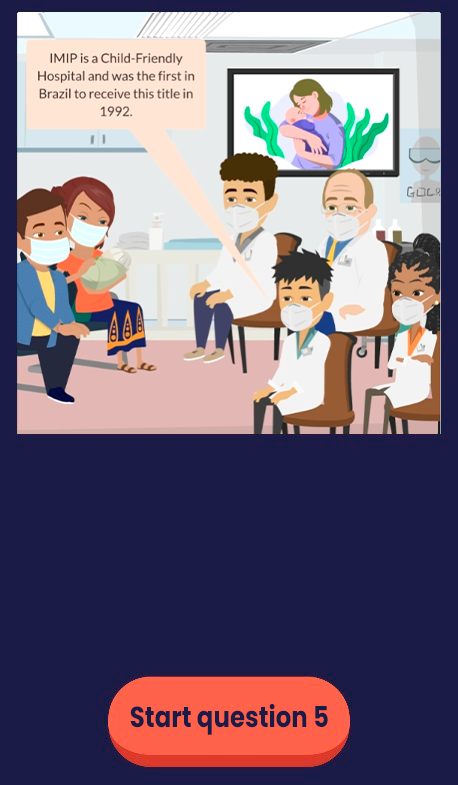
The study was carried out at Faculdade Pernambucana de Saúde - FPS, in the city of Recife, state of Pernambuco, Brazil. This institution was chosen because it specializes in undergraduate health courses (Nursing, Nutrition, Physical therapy, Dentistry, Physical Education, Psychology, Pharmacy and Medicine) and Master’s Degree courses (Professional Master’s Degree in Health Psychology and Professional Master’s Degree in Education for Teaching in the Health Area). In addition to having as a Teaching Hospital the Professor Fernando Figueira Institute of Integral Medicine - IMIP, the first Brazilian hospital to receive the title of Baby-Friendly Hospital and which has an interprofessional team of excellence in the promotion, protection and support of breastfeeding.
The methodological path consisted of two moments. At first, the creation of the content plan of the quiz was carried out, through an integrative review of the literature and the use of the stages of analysis, design and development of the ADDIE instructional design model. In the second moment, this content was validated by a panel of experts.
First, the analysis stage was carried out, in which there was an investigation of the literature with years of publication between 2015 and 2021, with the exception of the evaluation of one study published in 2001, one in 2010 and another in 2012. The search was carried out through the Scielo, Pubmed and Cochrane databases, using the keywords “breastfeeding, experimental games and interprofessional education”. Based on this integrative review, the educational needs of the target audience regarding the topic of breastfeeding were listed. In the design phase, learning objectives were defined to be achieved during the quiz, following Bloom’s revised taxonomy22.
During the development, the quiz questions were created, based on the information collected during the design phase, as well as all the content of the quiz, its activities and evaluations, following the assumptions of dialogic language for self-instructional materials.
In the second moment, the content of the quiz was validated by a panel of experts consisting of members of the Pan American Health Organization (PAHO) and tutors from the faculty of the Higher Education Institution, Faculdade Pernambucana de Saúde (FPS). The group of experts met remotely through the Cisco Webex Meetings platform. The discussion was recorded and only started after the consent of all participants was obtained, following the rules of Resolution 510/2016 of the National Health Council (CNS, Conselho Nacional de Saúde).
The project was carried out in accordance with the Guidelines and Regulatory Standards for Research involving Human Beings of the National Health Council (CNS), proposed by Resolution 510/16. The project was approved by the Research Ethics Committee of Faculdade Pernambucana de Saúde (CAAE N. 62652122.8.0000.5569).
RESULTS
An interprofessional quiz was created that will allow the acquisition of knowledge about breastfeeding by future health professionals.
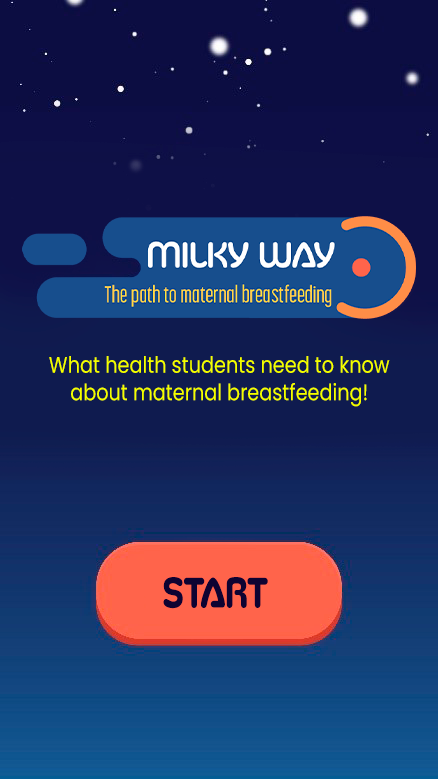
The quiz, called “Milky Way - The path to Breastfeeding” was created based on learning objectives, which were contextualized and included in a fictitious scenario to simulate situations the health professional will experience in their future practical activities.
Thus, the fundamentals of BF management can be better applied by professionals and population counseling will occur more effectively.
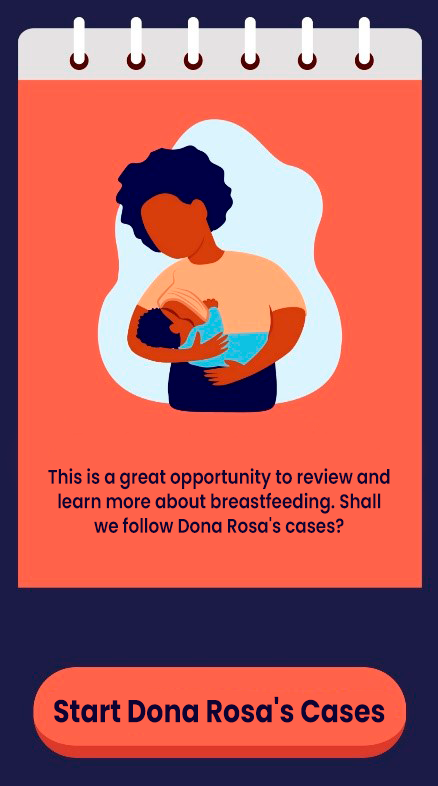
Figure 1 demonstrates the initial screen that the student will encounter when starting the quiz. After that, two videos will be exhibited. The first video explains why the name “Milky Way - The path to breastfeeding” was chosen for the quiz. The second video, in turn, highlights the role of FPS in encouraging breastfeeding and highlights the relevance of creating the quiz as a way to train future health professionals regarding breastfeeding management.

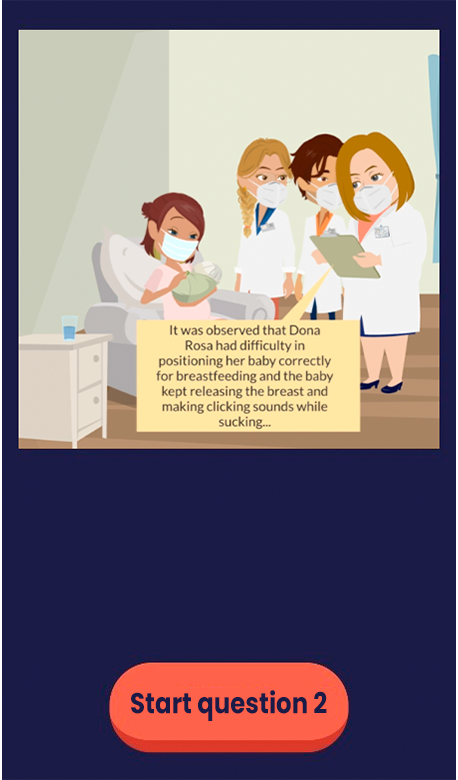
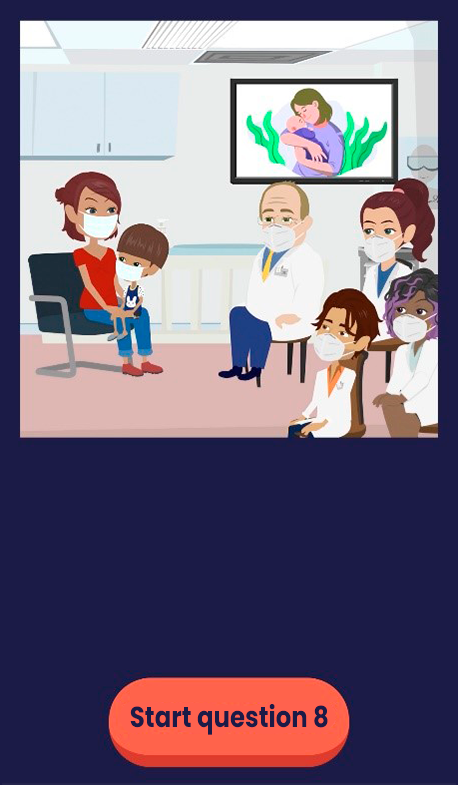
After the initial presentation, the students are directed to the questions, which were divided into two parts. Initially, Dona Rosa’s cases are presented (Figure 2), and consist of questions that address the follow-up of her child from the delivery room to the preschool phase. The second part of the quiz corresponds to the extra questions, necessary to achieve the learning objectives that were not developed in Dona Rosa’s cases. Before each statement, a narrated animation is shown presenting a fictitious scenario (Figures 3, 4, 5, 6, 7, 8 and 9) that resembles a situation experienced in practice by health professionals, which allows the introduction of the topic and the specific objectives of this question.





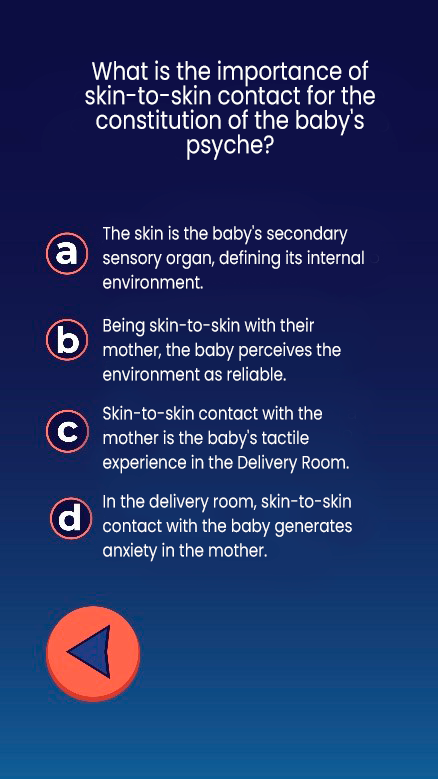
All the questions in the game (Figure 10) follow the same formatting pattern, consisting of an introductory animation, a question and four alternatives. Among the alternatives, there are three incorrect and only one correct answer, which adequately responds to the statement.

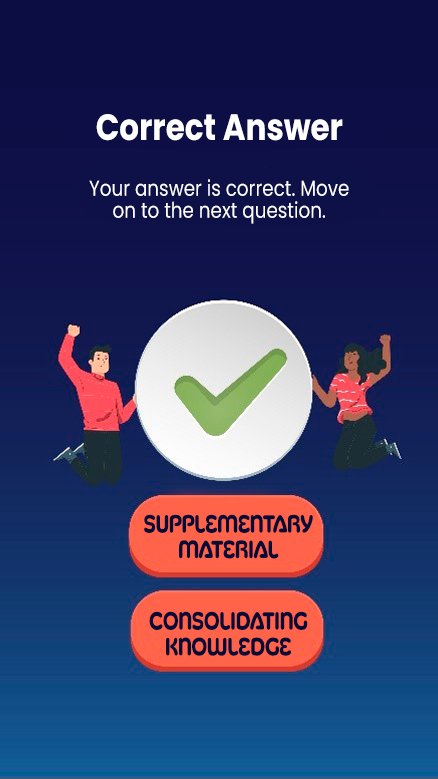
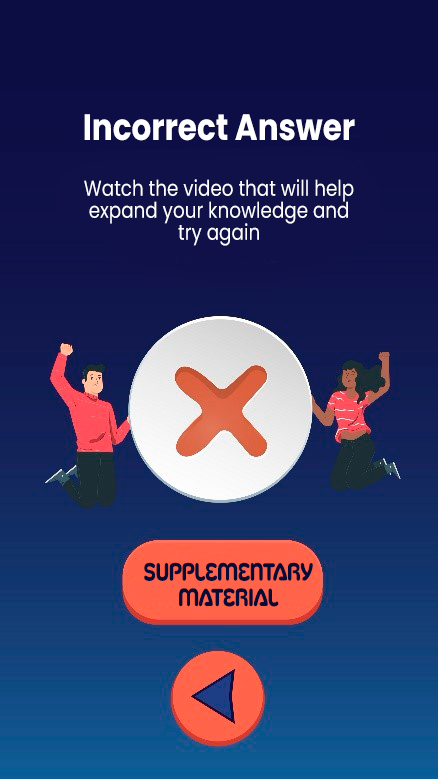
After the answer, the student will be directed to a page showing the enquiry of the question and the chosen alternative, in addition to the confirmation of the correct answer (Figure 11) or error (Figure 12).


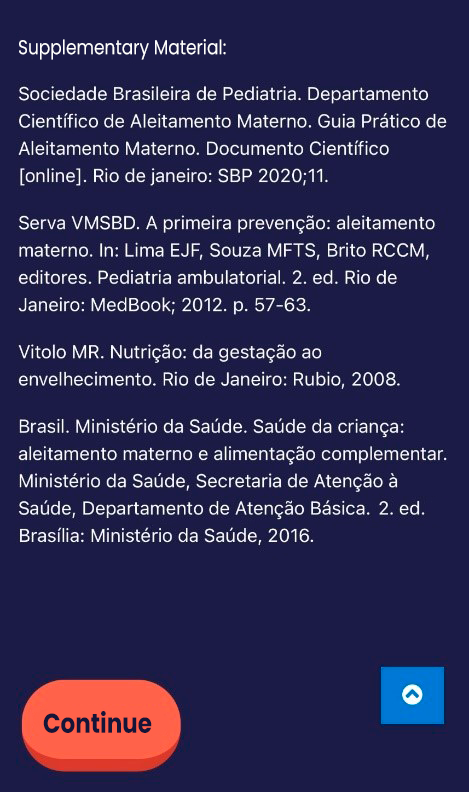
If the student provides a correct answer to the question, they can choose between accessing the references associated with the addressed topic (Figure 13) and then continuing the game, or just immediately moving on to the next step. Following the course of the game, after correctly answering the question, the student will find the section “Consolidating knowledge”, in which a brief video is presented bringing complementary information about the learning objectives of the answered question.

In the case of an incorrect answer, the student receives the information that they made a mistake and will be able to acquire the necessary knowledge to answer the question correctly through the list of references provided (Figure 13). Thus, the student remains the protagonist of the learning process. After the individual study, the video that contextualizes the question is presented again, as well as the statement and the alternatives, so that the user can only move on to the next question after choosing the correct answer.
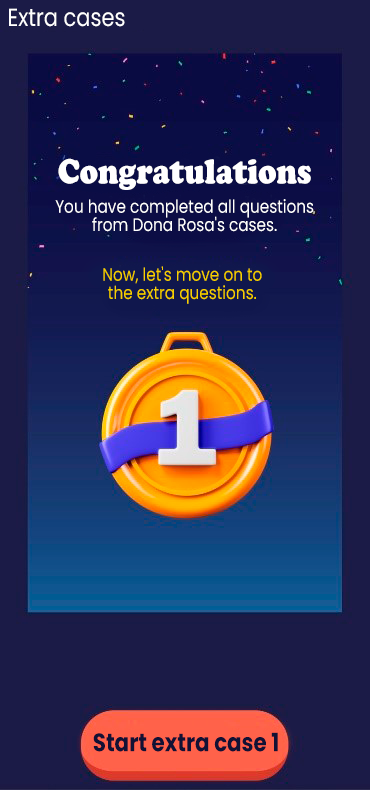
After correctly answering all the questions in Dona Rosa’s cases, the conclusion screen of the first phase of the quiz is presented (Figure 14). Only when the student completes Dona Rosa’s cases and the extra cases, it becomes possible to view the quiz completion screen (Figure 15).


DISCUSSION
Currently, the minimal use of electronic instruments as a teaching resource has caused a distance between the learning environment and the students’ social reality18. Thus, it becomes necessary to increase the use of digital technologies in the educational process to allow the construction of a new reality of communication in education, in individual and group learning23.
Therefore, aiming to encompass the use of information technology in the teaching environment, this study aimed to develop and validate an interprofessional quiz on breastfeeding for students in the health area.
The English language dictionary “Cambridge” defines the word “quiz” as a game consisting of questions and answers that can be used as an informal test24. Therefore, the quiz can be used as an effective educational tool, consisting of a unique and interactive teaching and learning method25)-(26. Due to their innovative, dynamic and flexible format from the students’ point of view, quizzes increase the active participation and healthy competition25)-(26.
As an example, we can mention the results found by Silva et al, 2010, who observed a high rate of student satisfaction when applying an electronic quiz on Molecular Biology. In their study, 85.53% of the students reported that their interest in the subject increased after the quiz, and 99.3% of the students agreed with the maintenance of the quiz in the class program25.
Moreover, the positive impact of using quizzes on learning and content retention was demonstrated by a review conducted by Dengri et al, 2021, which identified 11 relevant articles regarding quiz assessment as a teaching and learning tool in medical education26.
Therefore, we resorted to the creation of a quiz due to its ability to optimize learning and improve professional training, since games stimulate interest, creativity, memory, arouse curiosity and have a motivating characteristic, facilitating the acquisition of information19),(20.
The quiz “Milky Way - the path to breastfeeding” seeks to promote the qualification of health professionals and standardize knowledge about breastfeeding among the various health areas. Thus, it becomes relevant to create an interprofessional quiz, aiming at the integration between eight courses of Faculdade Pernambucana de Saúde (Nursing, Nutrition, Physical therapy, Dentistry, Physical Education, Psychology, Pharmacy and Medicine). This connection between the different areas of health is essential for the management of maternal breastfeeding, since an integrative review of the literature by Almeida, 2015, demonstrates that the absence of a common approach, coordination and cooperation among health professionals hinders women’s confidence in relation to breastfeeding, reducing BF rates12.
CONCLUSION
We created and validated an interprofessional quiz on breastfeeding for health students. After being developed, the theoretical content of the quiz and the distance learning techniques were validated by a group of experts from the Pan American Health Organization and Faculdade Pernambucana de Saúde. Therefore, it was possible to achieve the learning objectives stipulated at the beginning of the quiz production.
ACKNOWLEDGEMENTS
The authors would like to sincerely thank all the members of the FPS who participated in the design of the game: Amanda Souza Calixto da Silva; Charles Arthur Nazário Guedes da Silva; Douglas Adelino de Lima; Raissa Saldanha Lima Pinto; Roberta Cardoso da Silva and Bruno Hipólito da Silva. We also thank the members of the Pan American Health Organization for their willingness to validate the theoretical content of the game: Gabriel Listovsky, Edgardo De Gracia, Carlos León, Johel Díaz, Maria Isabel Duré.
References
- 1 World Health Organization. Global strategy on infant and young child feeding. Geneva: WHO; 2001.
-
2 Abdallah VOS, Oliveira AM de M, Ferreira DMLM, Faria PV de, Franco GM. Construindo práticas de promoção ao aleitamento materno: a experiência extensionista do projeto “Disque Amamentação” do Hospital de Clínicas da Universidade Federal de Uberlândia. Revista em Extensão. 2012;11(1):110-8 [acesso em: 12 maio 2023]. Disponível em: Disponível em: https://seer.ufu.br/index.php/revextensao/article/view/20740
» https://seer.ufu.br/index.php/revextensao/article/view/20740 -
3 Jesus PC de, Oliveira MIC de, Moraes JR de. Capacitação de profissionais de saúde em aleitamento materno e sua associação com conhecimentos, habilidades e práticas. Ciênc Saúde Colet. 2017;22(1):311-20 [acesso em: 12 maio 2023]. Disponível em: Disponível em: http://www.scielo.br/scielo.php?script=sci_arttext&pid=S1413-81232017000100311&lng=pt&tlng=pt
» http://www.scielo.br/scielo.php?script=sci_arttext&pid=S1413-81232017000100311&lng=pt&tlng=pt -
4 Del Ciampo L, Del Ciampo I. Breastfeeding and the benefits of lactation for women’s health. Rev Bras Ginecol Obs. 2018;40(06):354-9 [acesso em: 14 maio 2023]. Disponível em: Disponível em: http://www.thieme-connect.de/DOI/DOI?10.1055/s-0038-1657766
» http://www.thieme-connect.de/DOI/DOI?10.1055/s-0038-1657766 - 5 Brasil. Saúde da criança: aleitamento materno e alimentação complementar. 2a ed. Brasília: Ministério da Saúde; 2016.
- 6 World Health Organization, United Nations Children’s Fund. Global breastfeeding scorecard 2021: protecting breastfeeding through bold national actions during the Covid-19 pandemic and beyond. Geneva: WHO ; 2021.
-
7 Victora CG, Bahl R, Barros AJD, França GVA, Horton S, Krasevec J, et al. Breastfeeding in the 21st century: epidemiology, mechanisms, and lifelong effect. Lancet. 2016 Jan;387(10017):475-90 [acesso em: 14 maio 2023]. Disponível em: Disponível em: https://linkinghub.elsevier.com/retrieve/pii/S0140673615010247
» https://linkinghub.elsevier.com/retrieve/pii/S0140673615010247 -
8 Universidade Federal do Rio De Janeiro. Aleitamento materno: prevalência e práticas de aleitamento materno em crianças brasileiras menores de 2 anos - ENANI 2019. Rio de Janeiro: UFRJ; 2021 [acesso em: 14 maio 2023]. Disponível em: Disponível em: https://enani.nutricao.ufrj.br/index.php/relatorios
» https://enani.nutricao.ufrj.br/index.php/relatorios -
9 Universidade Federal do Rio de Janeiro. Estudo Nacional de Alimentação e Nutrição Infantil - ENANI-2019: resultados preliminares - indicadores de aleitamento materno no Brasil. Rio de Janeiro: UFRJ ; 2020 [acesso em: 15 maio 2023]. Disponível em: Disponível em: https://enani.nutricao.ufrj.br/index.php/relatorios/
» https://enani.nutricao.ufrj.br/index.php/relatorios/ -
10 Santos EM dos, Silva LS da, Rodrigues BF de S, Amorim TMAX de, Silva CS da, Borba JMC, et al. Avaliação do aleitamento materno em crianças até dois anos assistidas na atenção básica do Recife, Pernambuco, Brasil. Ciênc Saúde Colet . 2019;24(3):1211-22 [acesso em: 15 maio 2023]. Disponível em: Disponível em: http://www.scielo.br/scielo.php?script=sci_arttext&pid=S1413-81232019000301211&tlng=pt
» http://www.scielo.br/scielo.php?script=sci_arttext&pid=S1413-81232019000301211&tlng=pt -
11 Yang S-F, Salamonson Y, Burns E, Schmied V. Breastfeeding knowledge and attitudes of health professional students: a systematic review. Int Breastfeed J. 2018 Dec 20;13(1):8-19 [acesso em: 28 maio 2023]. Disponível em: Disponível em: https://internationalbreastfeedingjournal.biomedcentral.com/articles/10.1186/s13006-018-0153-1
» https://internationalbreastfeedingjournal.biomedcentral.com/articles/10.1186/s13006-018-0153-1 -
12 Almeida JM de, Luz S de AB, Ued F da V. Apoio ao aleitamento materno pelos profissionais de saúde: revisão integrativa da literatura. Rev Paul Pediatr. 2015;33(3):355-62 [acesso em: 28 maio 2023]. Disponível em: Disponível em: http://linkinghub.elsevier.com/retrieve/pii/S0103058215000702
» http://linkinghub.elsevier.com/retrieve/pii/S0103058215000702 -
13 Vasquez J, Dumith SC, Sus LRO. Aleitamento materno: estudo comparativo sobre o conhecimento e o manejo dos profissionais da Estratégia Saúde da Família e do Modelo Tradicional. Rev Bras Saúde Matern Infant. 2015;15(2):181-92 [acesso em: 30 maio 2023]. Disponível em: Disponível em: http://www.scielo.br/scielo.php?script=sci_arttext&pid=S1519-38292015000200181&lng=pt&tlng=pt
» http://www.scielo.br/scielo.php?script=sci_arttext&pid=S1519-38292015000200181&lng=pt&tlng=pt -
14 Oliveira MC de P, Lacerda ACT de, Lima JR de, Moura AK de, Lima KMO, Pontes TL. Atuação de profissionais de saúde para amamentação na primeira hora: Revisão integrativa. Res Soc Dev. 2021;10(3):e14110313128 [acesso em: 10 maio 2023]. Disponível em: Disponível em: https://rsdjournal.org/index.php/rsd/article/view/13128
» https://rsdjournal.org/index.php/rsd/article/view/13128 -
15 Verzoni A, Lisboa C. Formas de subjetivação contemporâneas e as especificidades da geração Y. Rev Subj. 2015;15:457-66 [acesso em: 05 junho 2023]. Disponível em: Disponível em: http://pepsic.bvsalud.org/scielo.php?script=sci_arttext&pid=S2359-07692015000300014&nrm=iso
» http://pepsic.bvsalud.org/scielo.php?script=sci_arttext&pid=S2359-07692015000300014&nrm=iso -
16 Rech IM, Viêra MM, Anschau CT. Geração Z, os nativos digitais: como as empresas estão se preparando para reter esses profissionais. Revista Tecnológica. 2017;6(1):152-66 [acesso em: 05 junho 2023]. Disponível em: Disponível em: https://uceff.edu.br/revista/index.php/revista/article/view/223
» https://uceff.edu.br/revista/index.php/revista/article/view/223 -
17 Tamoto P, Gati R dos S, Rondina JM, Brienze SLA, Lima AR de A, André JC. Aprendizagem da geração millennial na graduação médica. Rev Bioét. 2020;28(4):683-92 [acesso em: 10 junho 2023]. Disponível em: Disponível em: http://www.scielo.br/scielo.php?script=sci_arttext&pid=S1983-80422020000400683&tlng=pt
» http://www.scielo.br/scielo.php?script=sci_arttext&pid=S1983-80422020000400683&tlng=pt -
18 Rocha Sobreira ES, Aparecida Viveiro A, Viegas d’Abreu JV. Aprendizagem criativa na construção de jogos digitais: uma proposta educativa no ensino de ciências para crianças. Tecné. Episteme. Didaxis: TED [Internet]. 1º de julho de 2018;(44):71-88 [acesso em: 10 junho 2023]. Disponível em: Disponível em: https://revistas.upn.edu.co/index.php/TED/article/view/8990
» https://revistas.upn.edu.co/index.php/TED/article/view/8990 -
19 Panosso MG, Souza SR de, Haydu VB. Características atribuídas a jogos educativos: uma interpretação analítico-comportamental. Psicol Esc Educ. 2015;19(2):233-42 [acesso em: 10 junho 2023]. Disponível em: Disponível em: http://www.scielo.br/scielo.php?script=sci_arttext&pid=S1413-85572015000200233&lng=pt&tlng=pt
» http://www.scielo.br/scielo.php?script=sci_arttext&pid=S1413-85572015000200233&lng=pt&tlng=pt - 20 Carvalho GR de. A importância dos jogos digitais na educação [trabalho de conclusão de curso]. Niterói: Universidade Federal Fluminense; 2018.
- 21 Barreiro RM. Um breve panorama sobre o design instrucional. Revista Científica em Educação a Distância. 2016;6(2):61-75.
-
22 Ferraz AP do CM, Belhot RV. Taxonomia de Bloom: revisão teórica e apresentação das adequações do instrumento para definição de objetivos instrucionais. Gestão & Produção. 2010; 17(2): 421-31. doi: http://dx.doi.org/10.1590/S0104-530X2010000200015.
» https://doi.org/http://dx.doi.org/10.1590/S0104-530X2010000200015 - 23 Cunha NB, Cunha NC, Cunha TNB. Geração digital: transformação pedagógica. Cadernos da Fucamp. 2015;14(20):74-83.
-
24 Cambridge Dictionaries Online. Quiz [acesso em: 05 janeiro 2024]. Disponível em: Disponível em: https://dictionary.cambridge.org/dictionary/english-portuguese/
» https://dictionary.cambridge.org/dictionary/english-portuguese/ -
25 Silva JM de A, Canedo RV, Abrantes TA de S, Santos RT dos, Souza RA, Utagawa CY. Quiz: um questionário eletrônico para autoavaliação e aprendizagem em genética e biologia molecular. Rev Bras Educ Med. 2010;34(4):607-14. doi: https://doi.org/10.1590/S0100-55022010000400017.
» https://doi.org/https://doi.org/10.1590/S0100-55022010000400017 -
26 Dengri C, Gill A, Chopra J, Dengri C, Koritala T, Khedr A, et al. A review of the quiz, as a new dimension in medical education. Cureus. 2021;13(10):e18854 [acesso em: 10 maio 2023]. Disponível em: Disponível em: https://www.ncbi.nlm.nih.gov/pmc/articles/PMC8597672/
» https://www.ncbi.nlm.nih.gov/pmc/articles/PMC8597672/

 Source: Figure created by the authors.
 Source: Figure created by the authors.
 Source: Figure created by the authors.
 Source: Figure created by the authors.
 Source: Figure created by the authors.
 Source: Figure created by the authors.
 Source: Figure created by the authors.
 Source: Figure produced by the authors.
 Source: Figure created by the authors.
 Source: Figure produced by the authors.
 Source: Figure created by the authors.
 Source: Figure created by the authors.
 Source: Figure created by the authors.
 Source: Figure created by the authors.
 Source: Figure created by the authors.